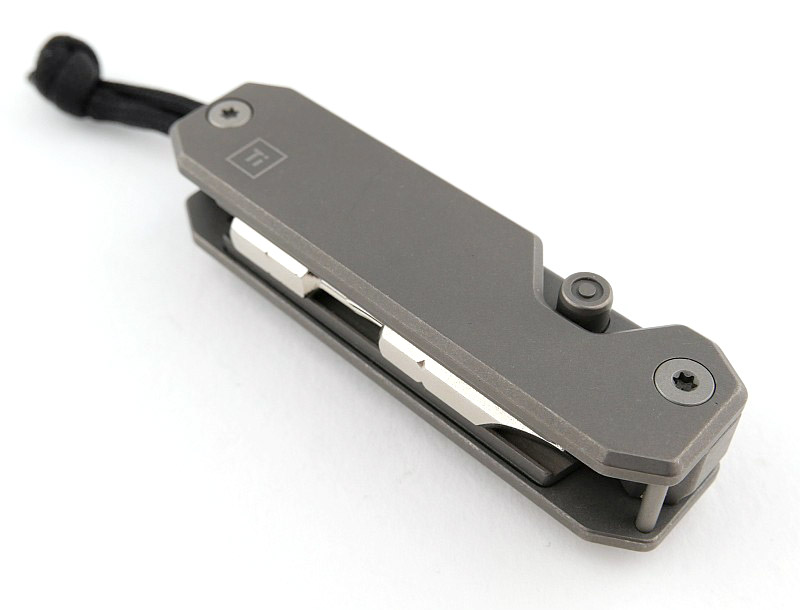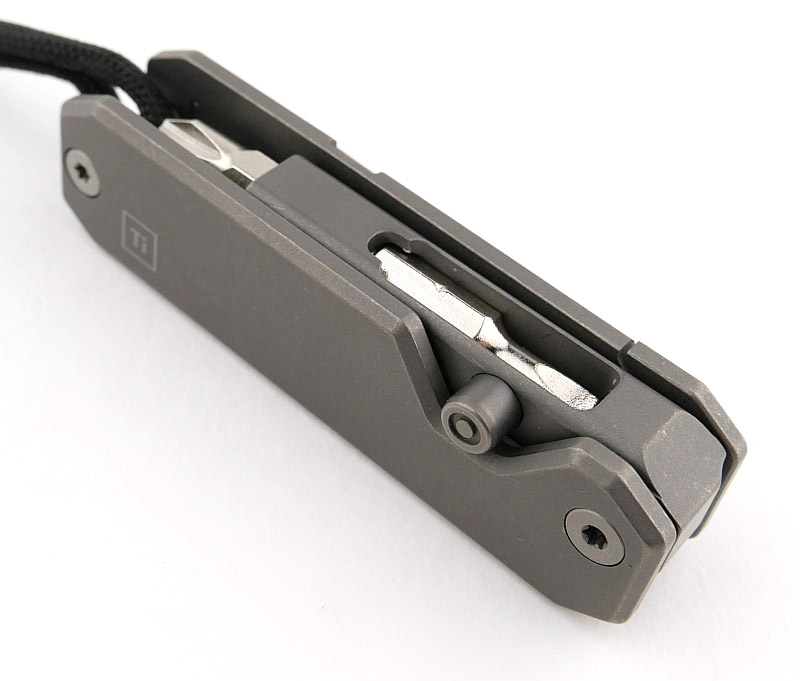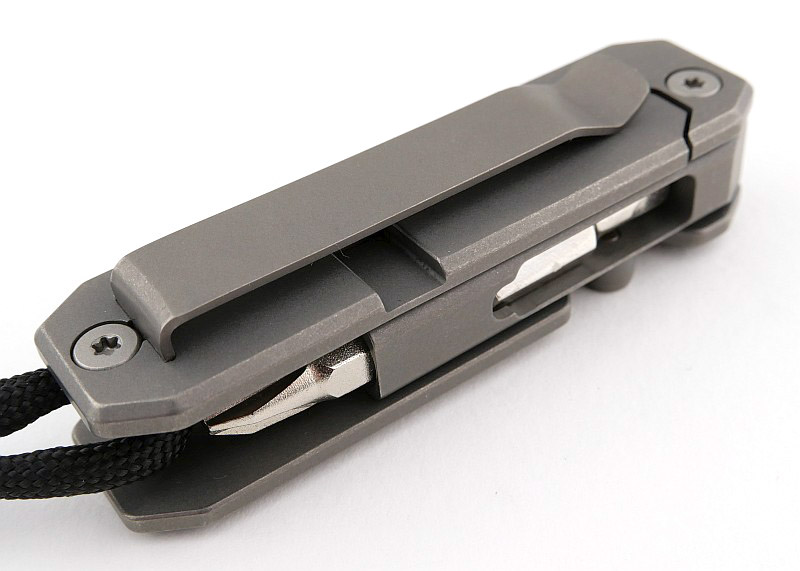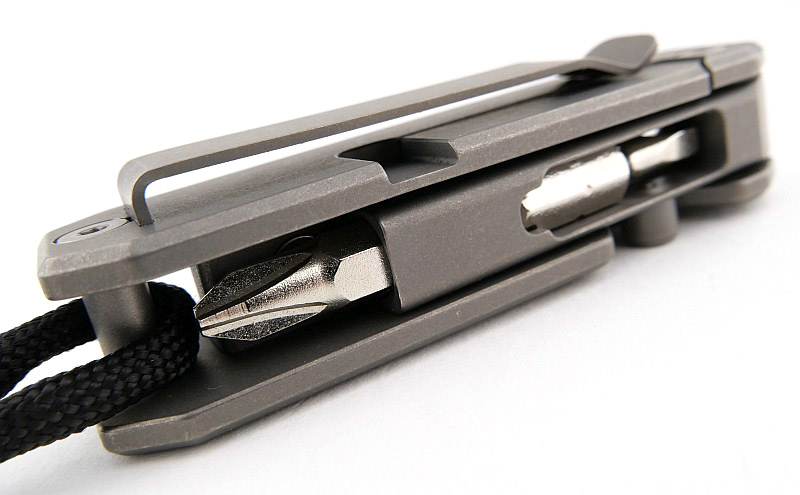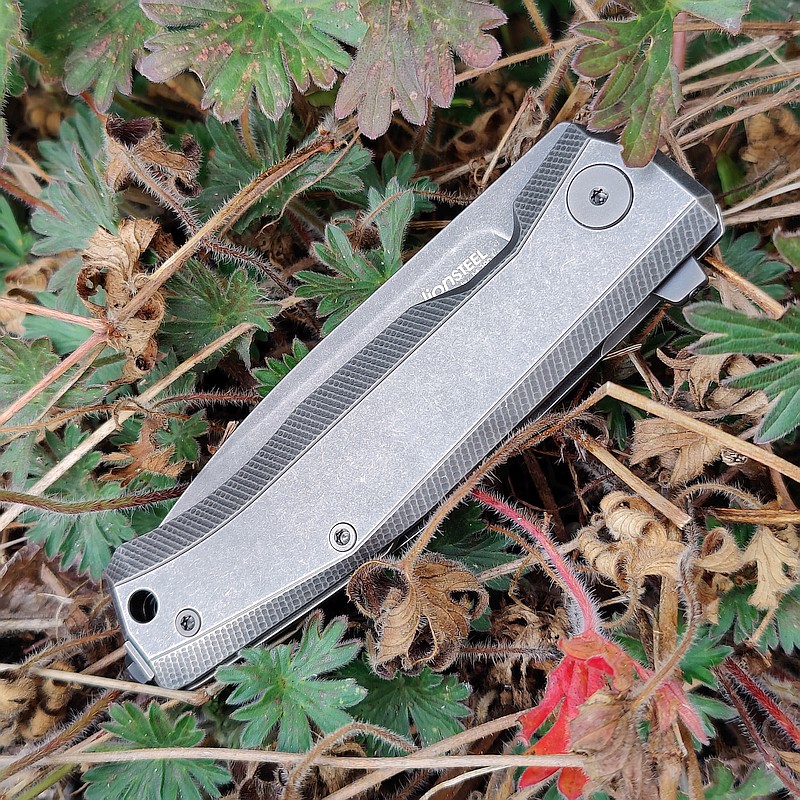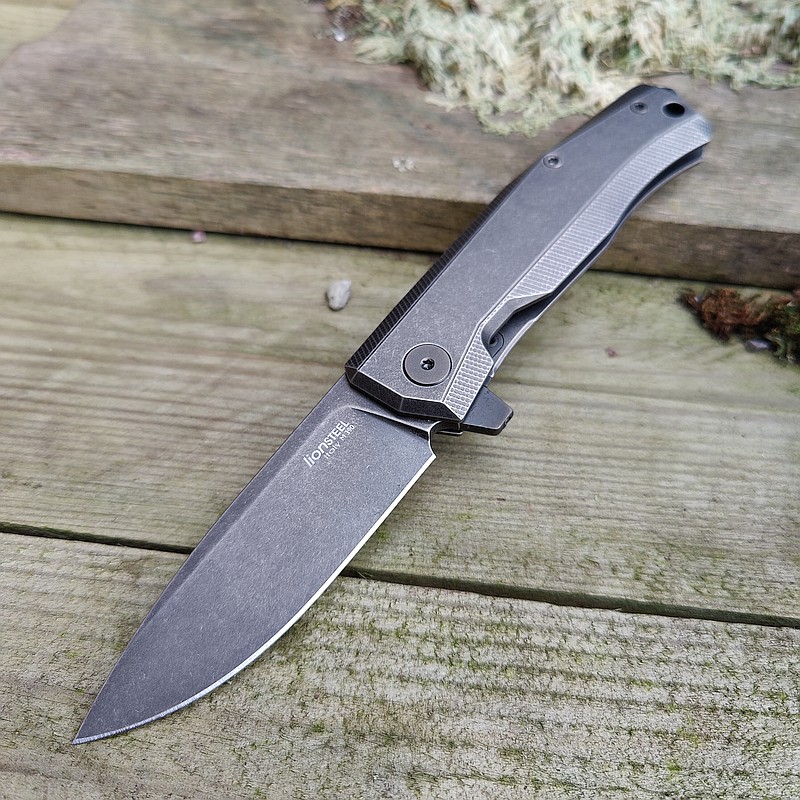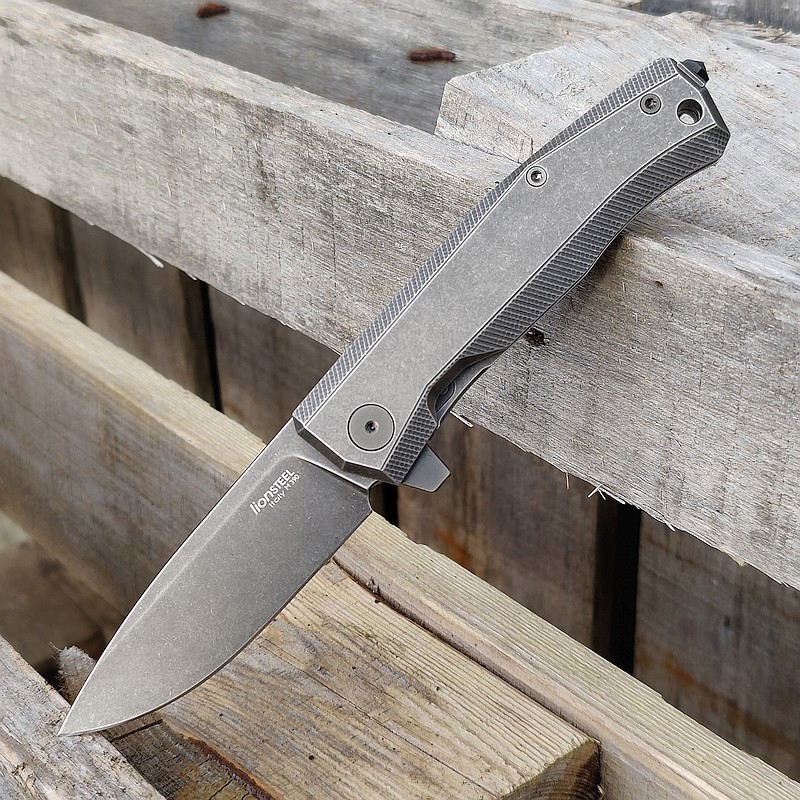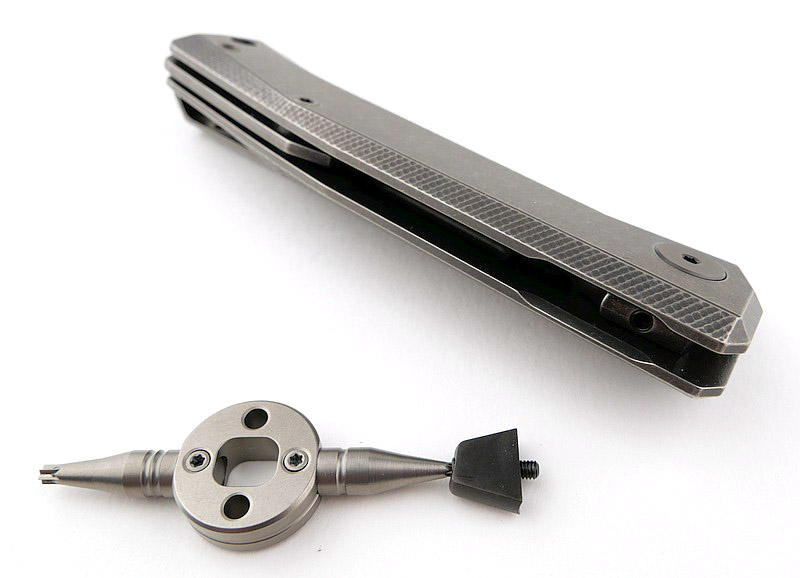
Gear Review: EDS II Screwdriver and EDC Wrench from BIGiDESIGN

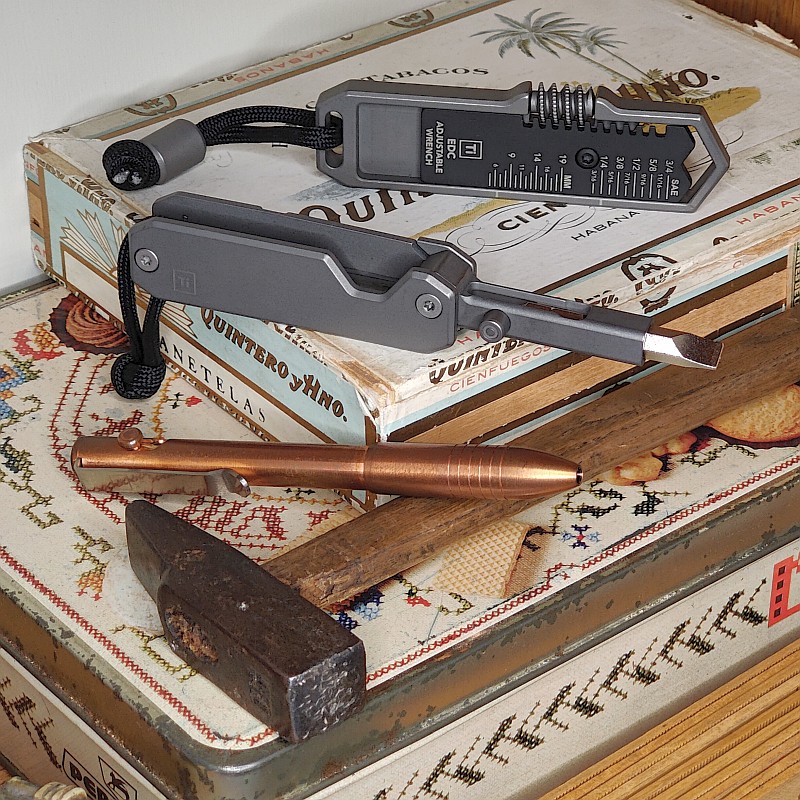
BIGiDESIGN is producing so many awesome EDC tools, and in this review we are taking a detailed look at the BIGiDESIGN EDS II, the second, updated version of their unique Everyday Screwdriver, along with the BIGiDESIGN EDC Wrench a reimagining of an antique Swedish adjustable wrench.

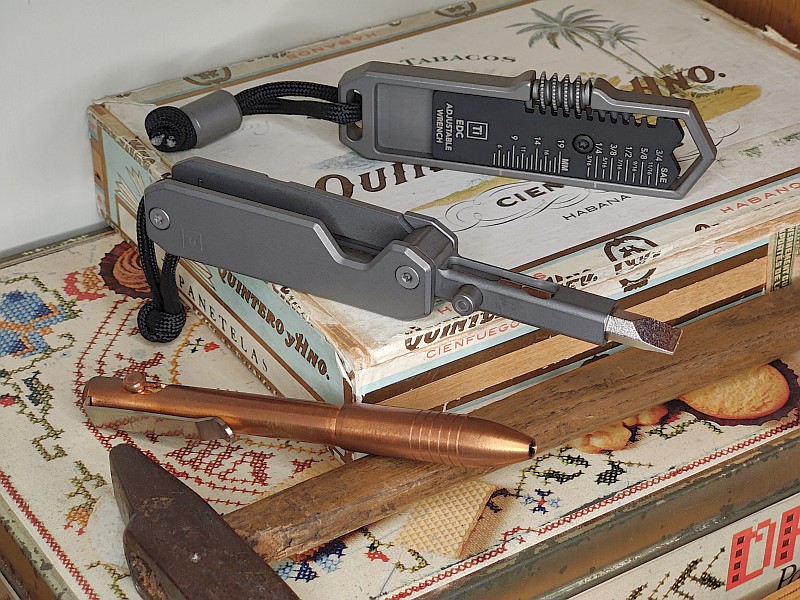
Their original EDS, Everyday Screwdriver, was probably the first BIGiDESIGN product that I saw, and since then I bought their bolt action pen, a design that ingeniously adjusts to take most ballpoint refills on the market. Now I’ve been able to partner up the Bolt Action pen with the EDS II and EDC wrench making for an incredible EDC setup.
Video Overview

In this video we take a good look at a couple of lovely EDC gear designs from BIGiDESIGN. The EDS II, the second, updated version of their unique Everyday Screwdriver, along with the EDC Wrench, a small unique pocket friendly adjustable wrench.


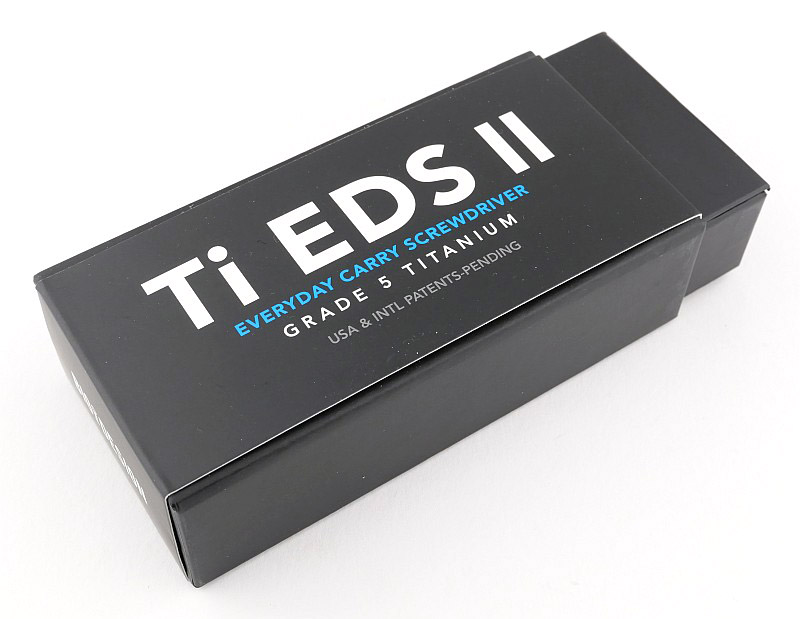
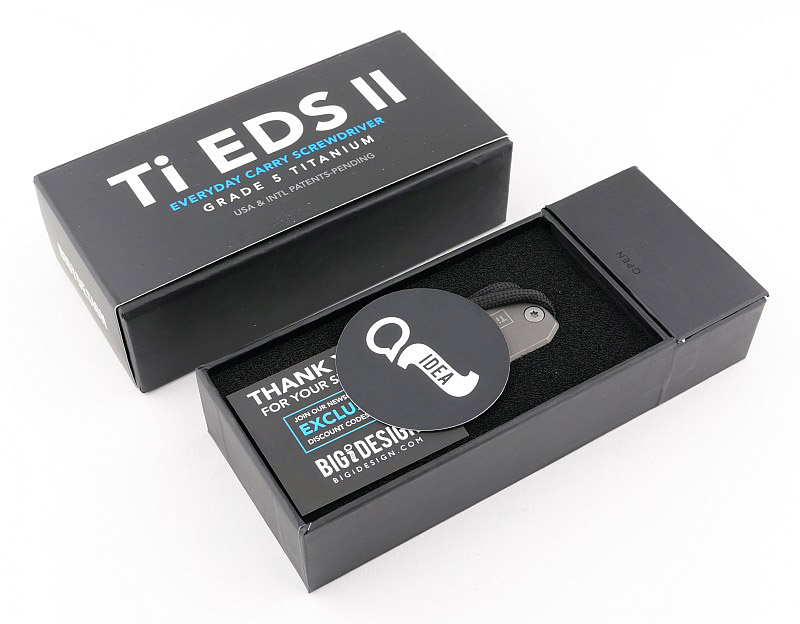
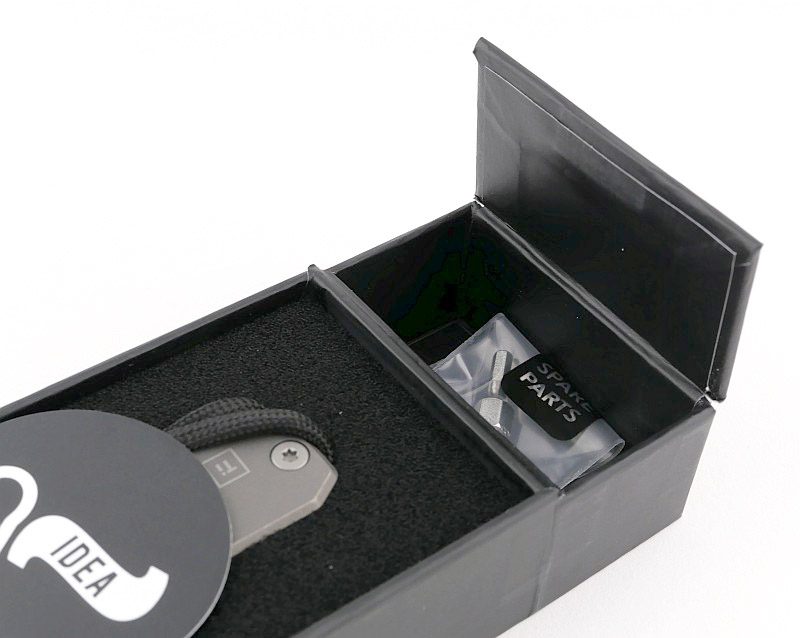
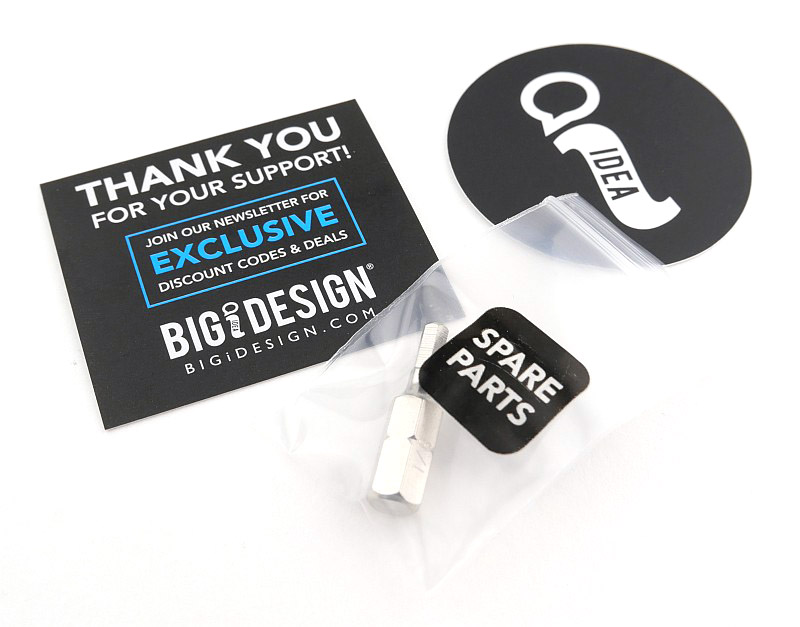
What’s in the box; Part 1 the EDS II?:
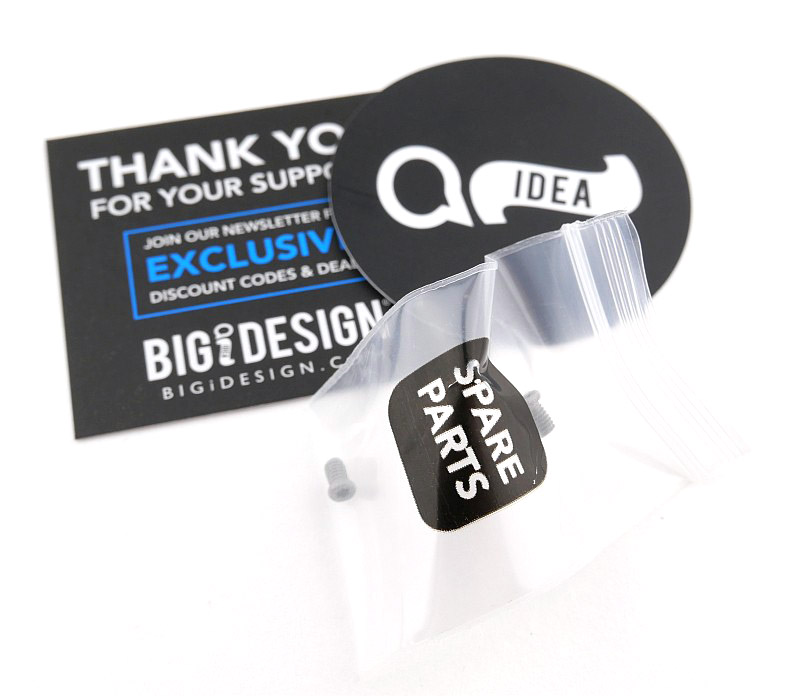
For the three BIGiDESIGN products I have, the packaging follows the same layout. A slide out tray which has a compartment at one end that contains spares.
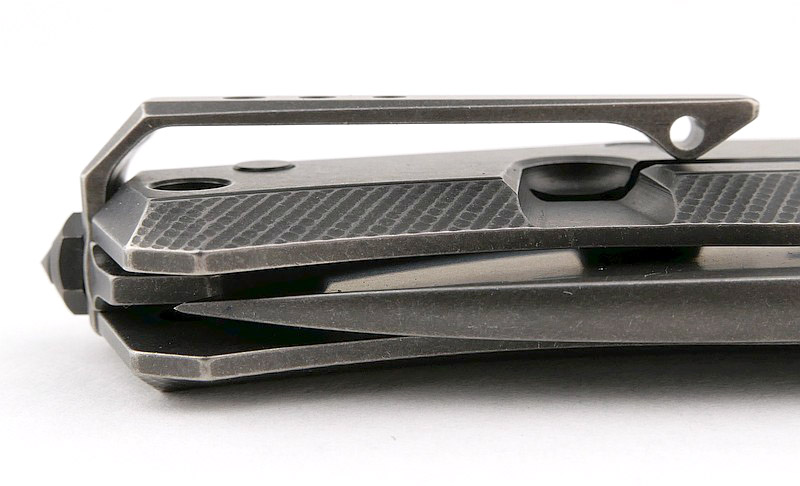
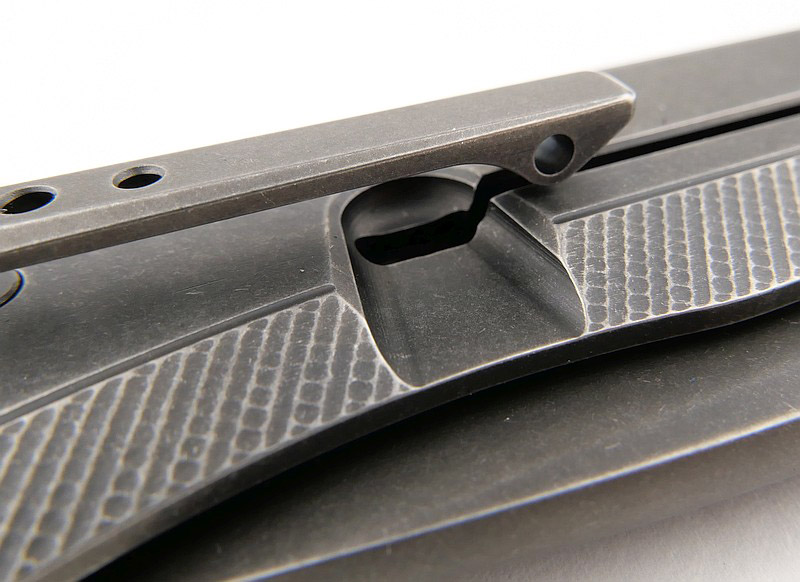
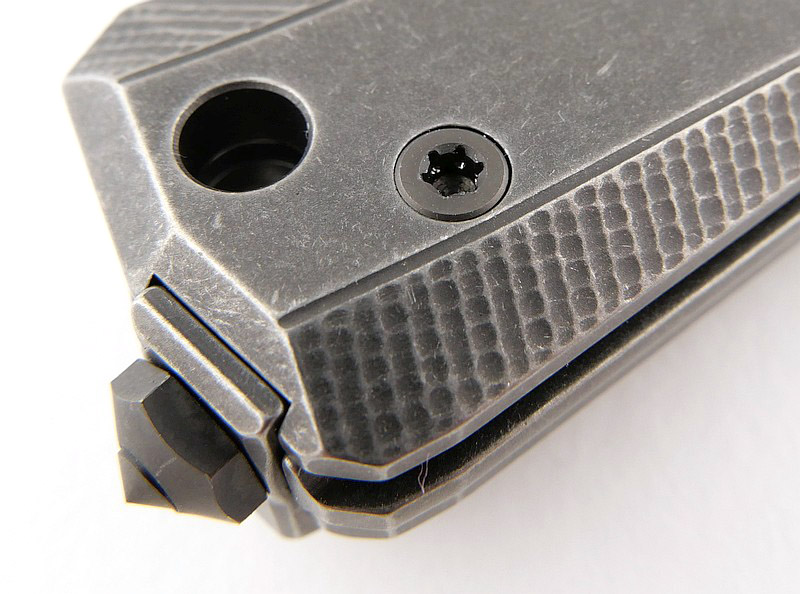
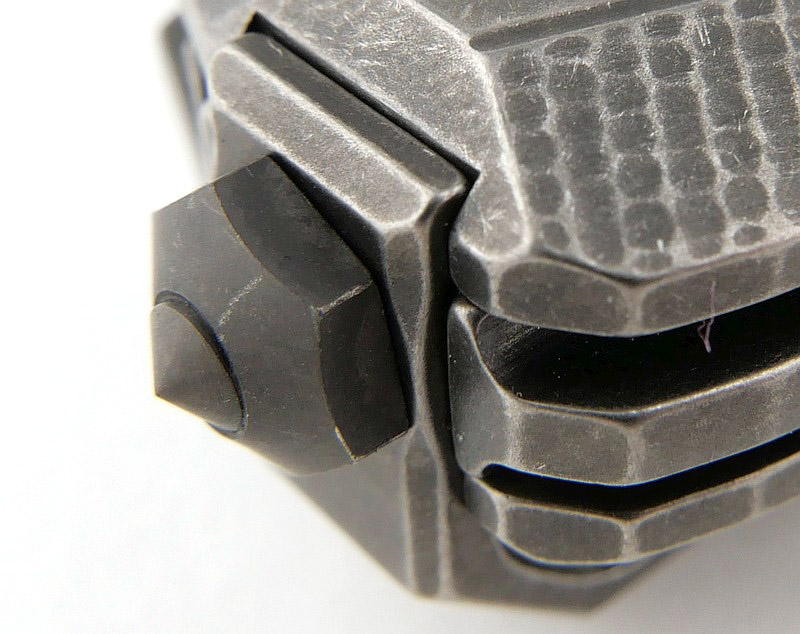
A good look round the EDS II – Things to look out for here are:
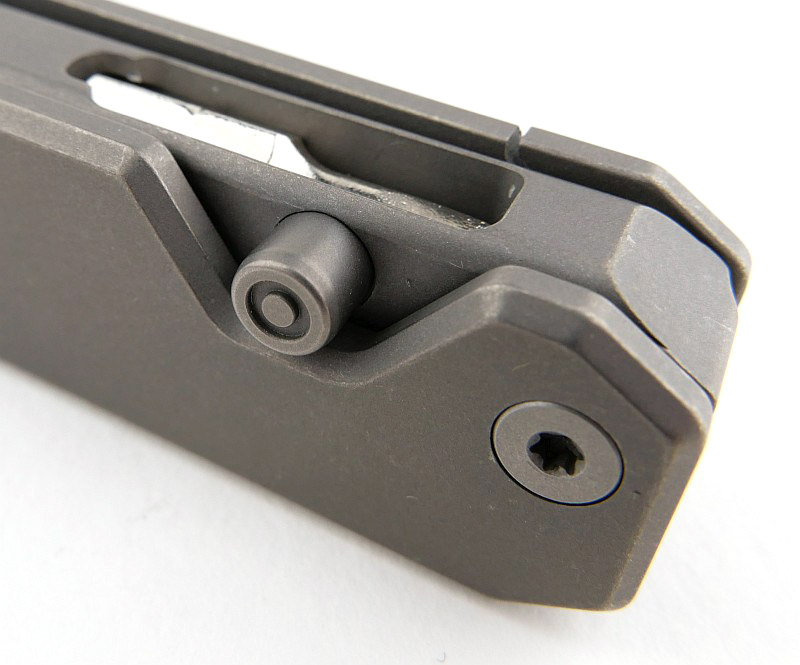
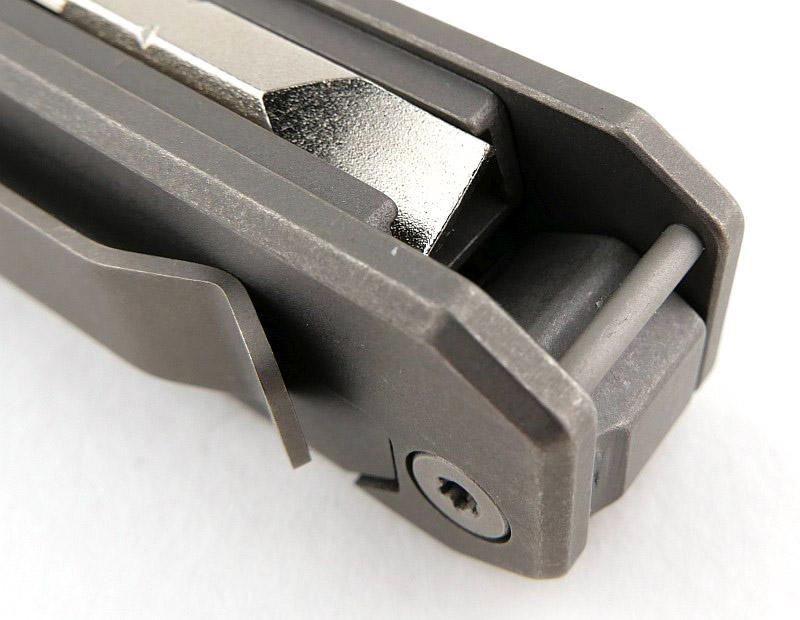
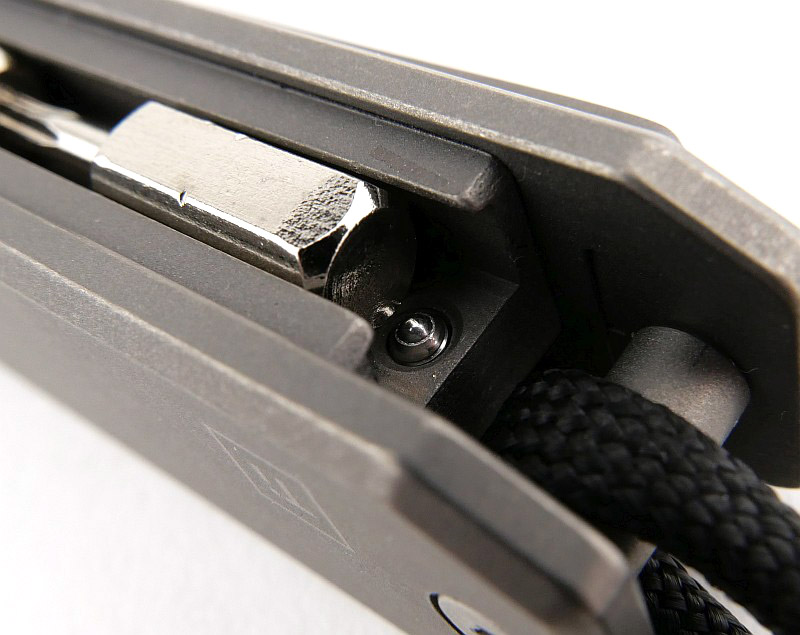
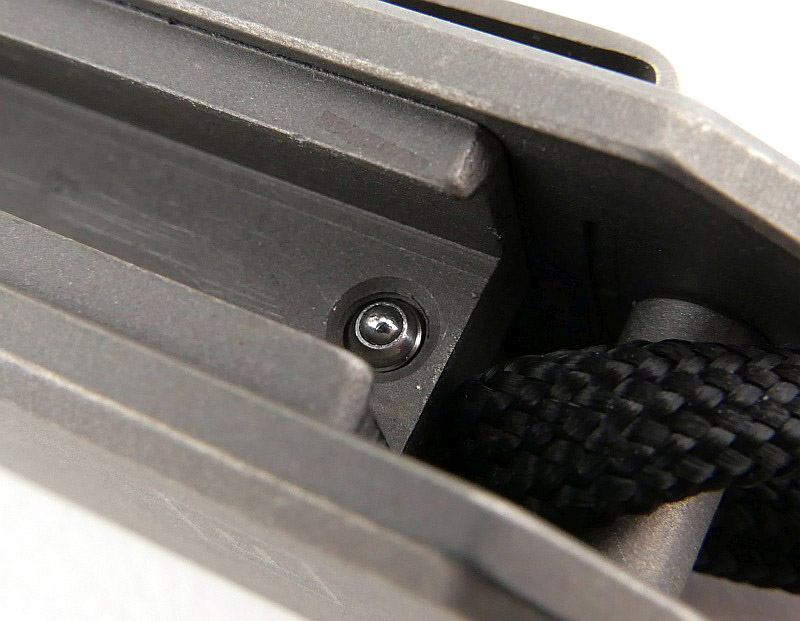
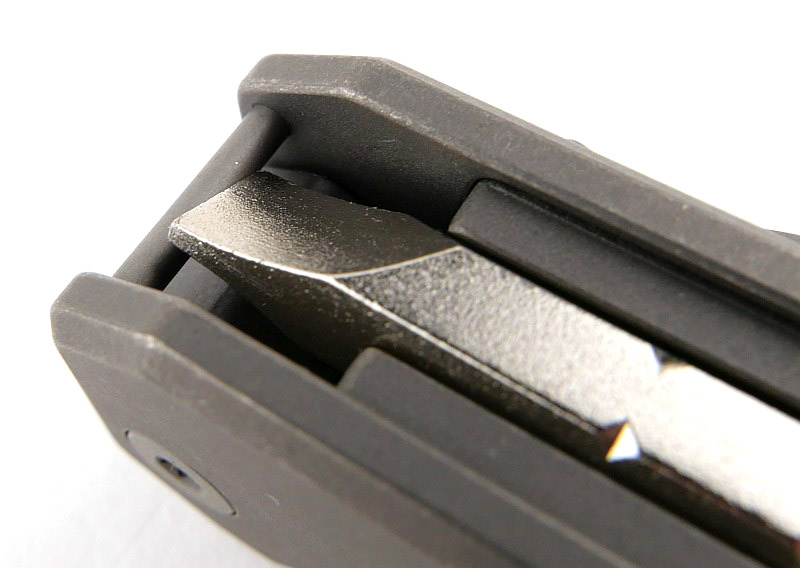
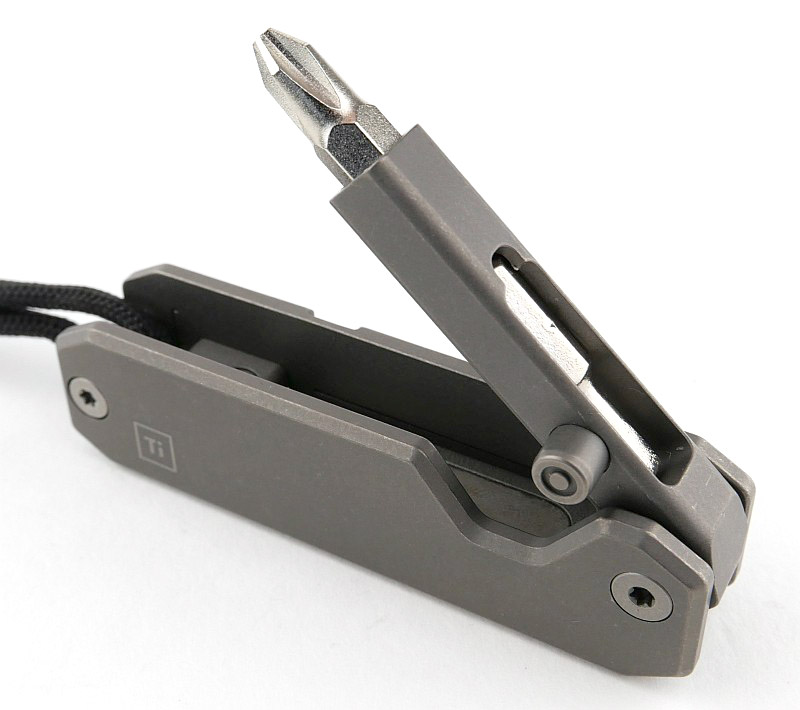
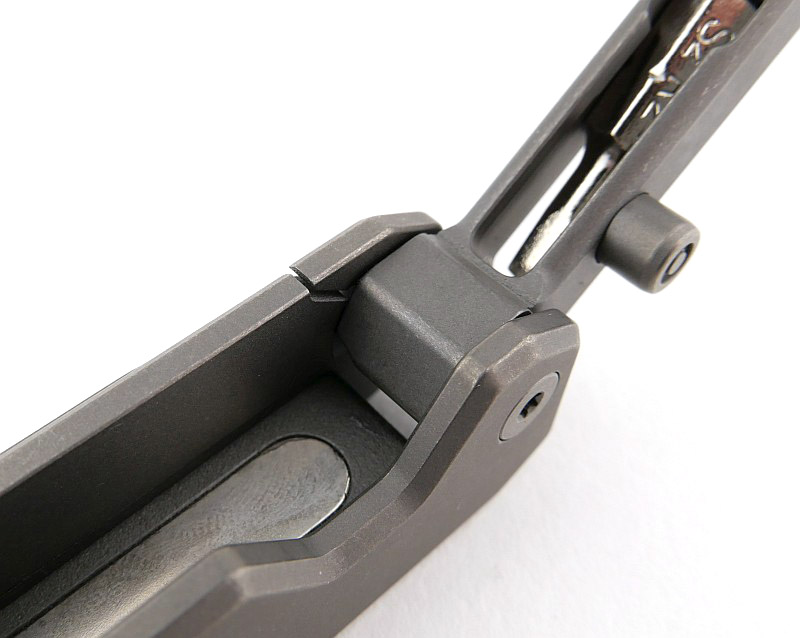
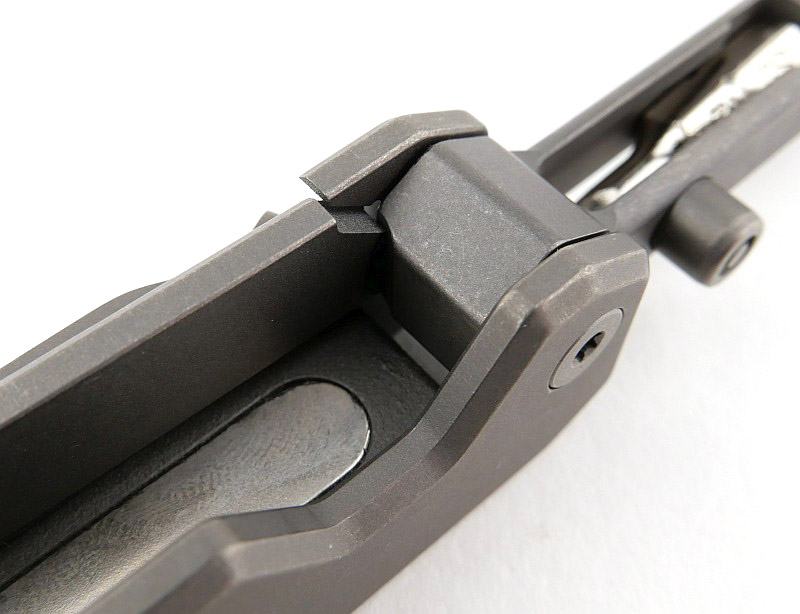
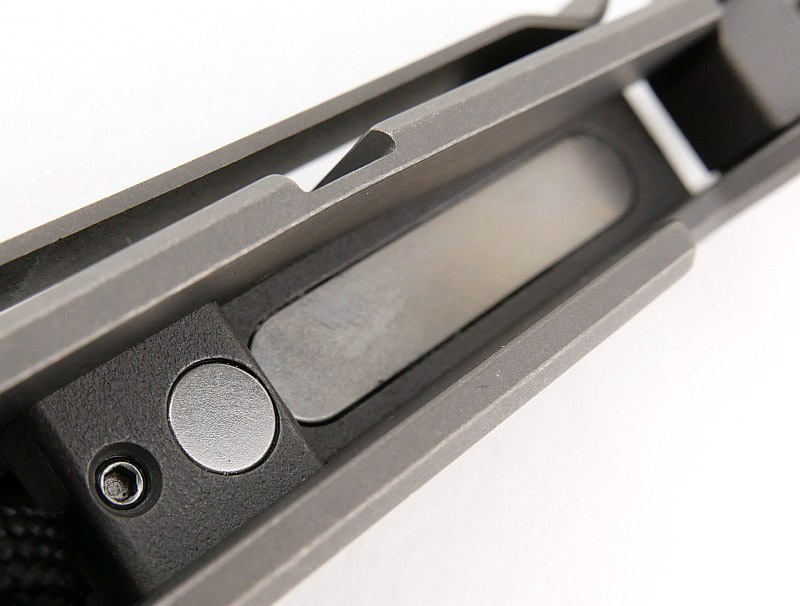
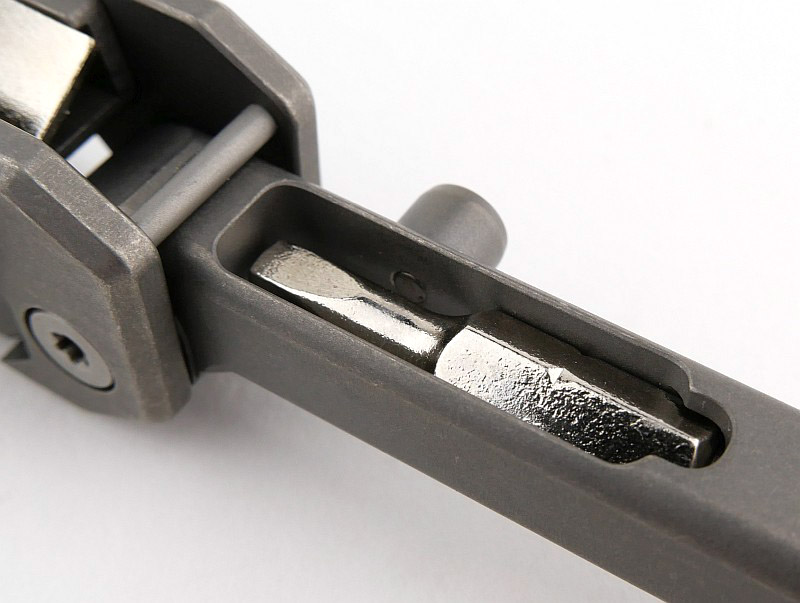
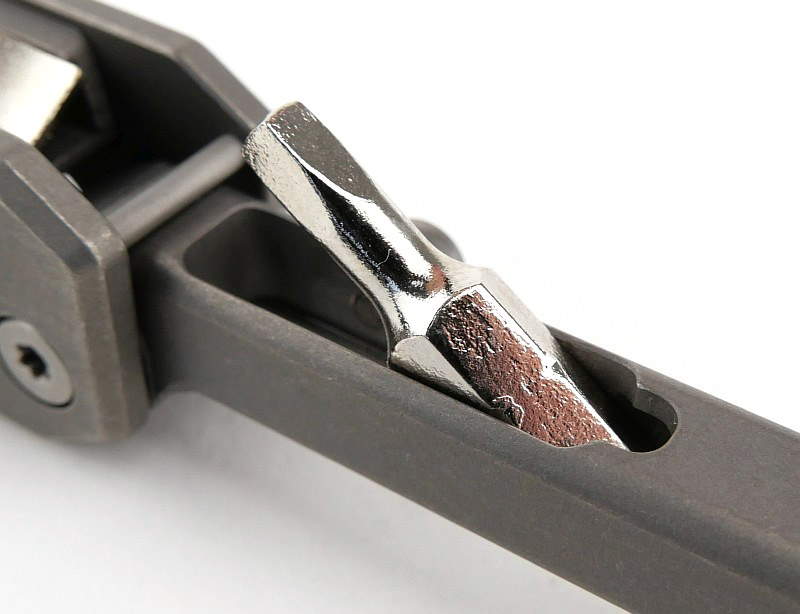
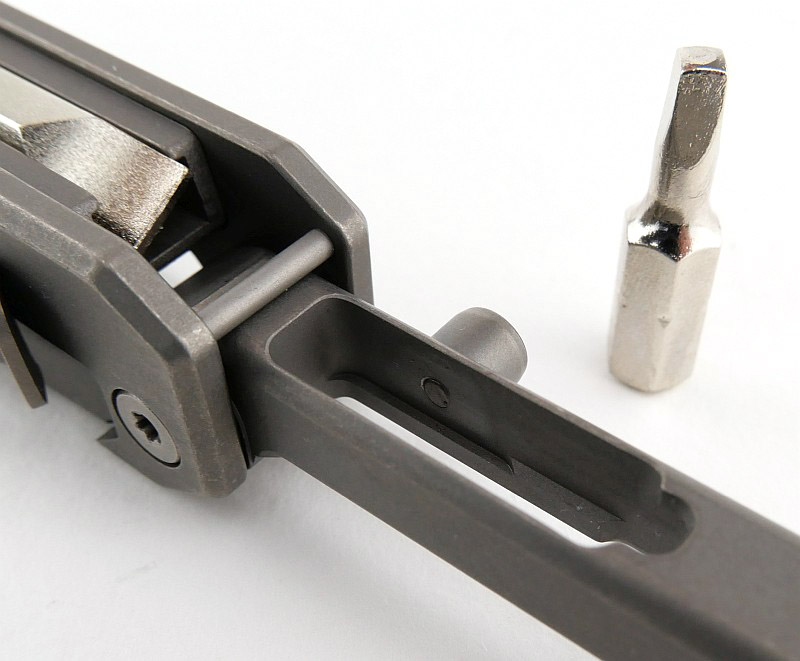
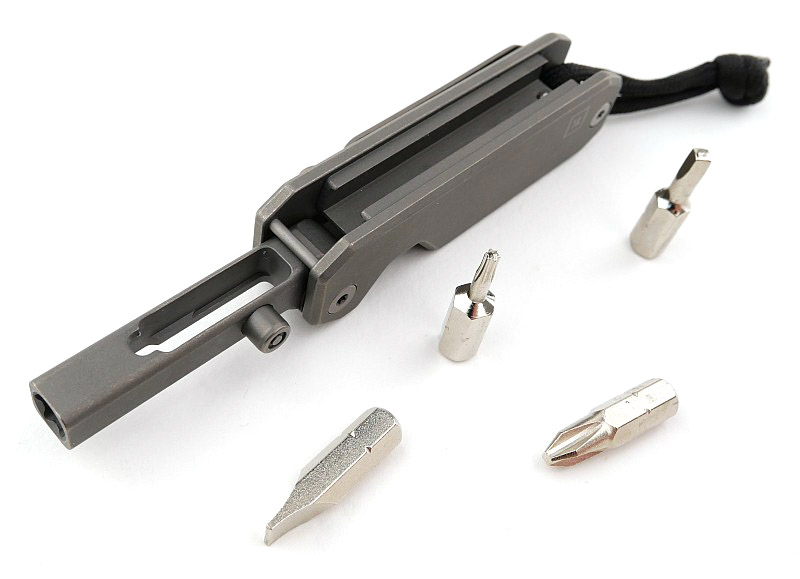
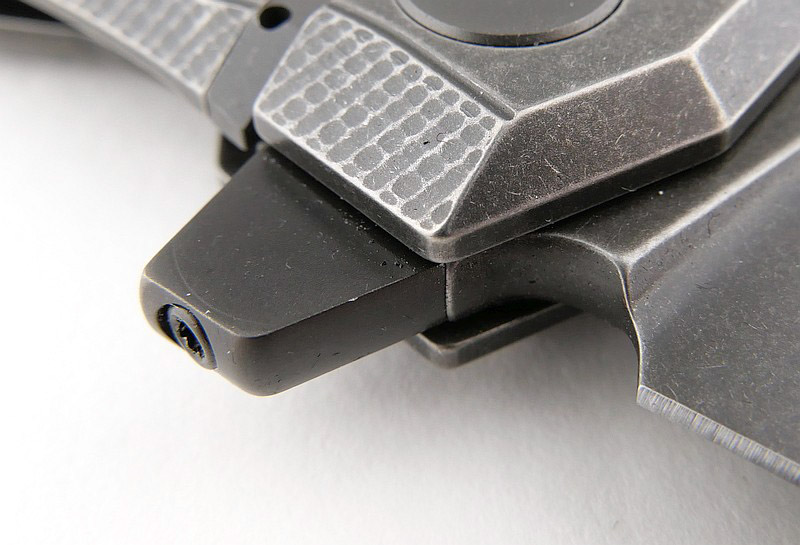
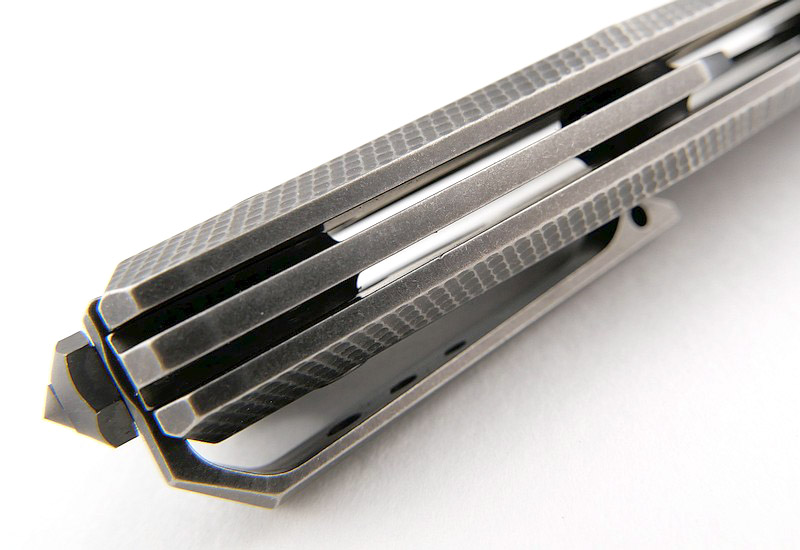
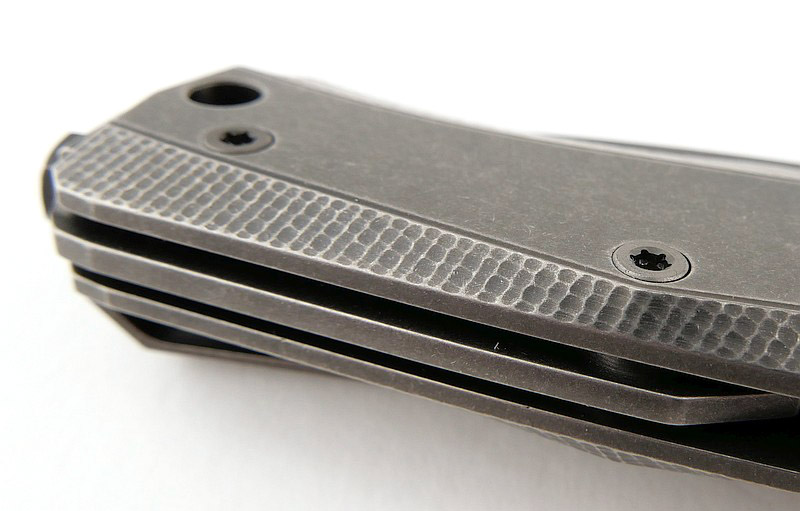
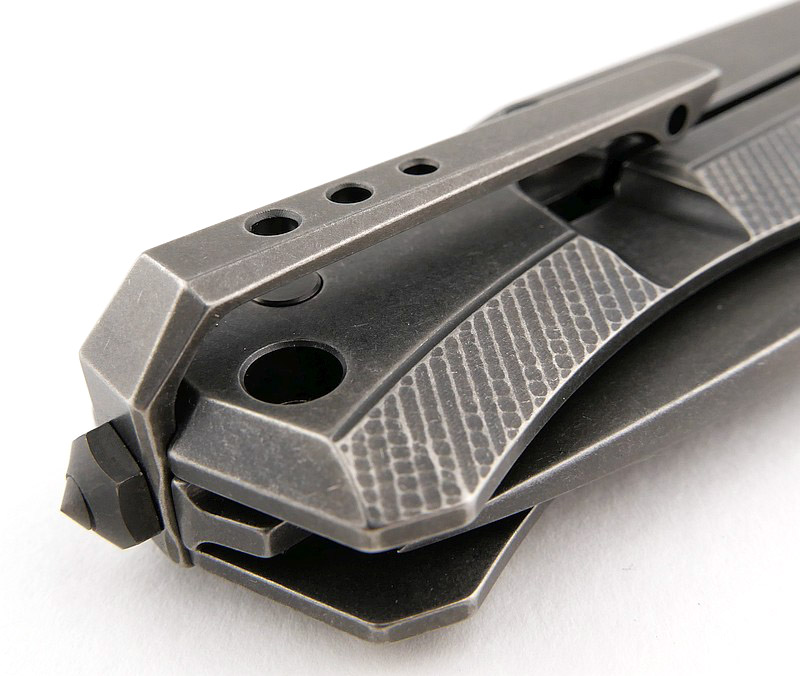
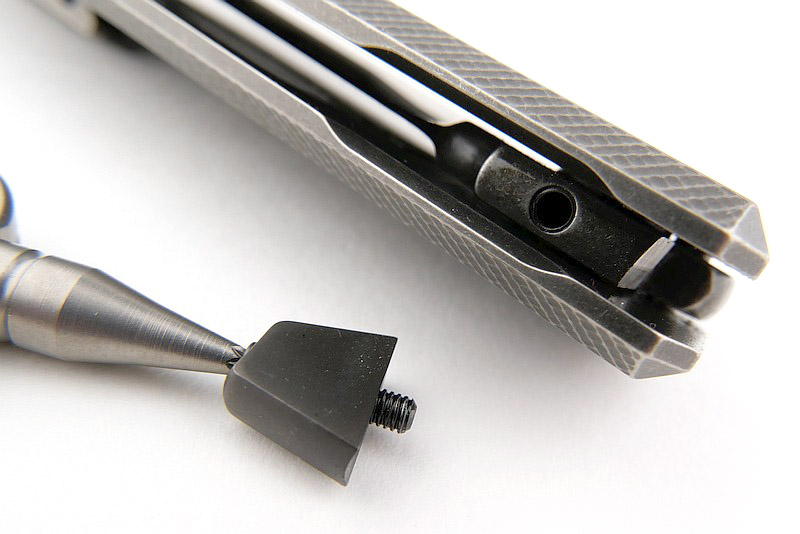
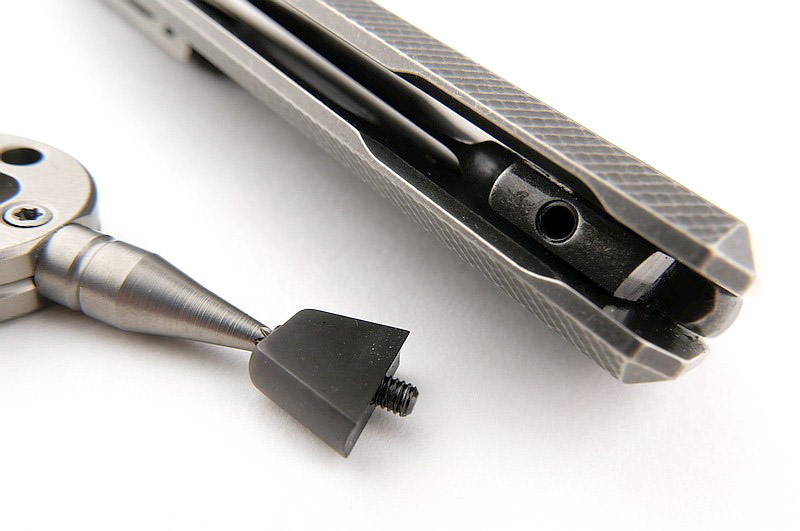
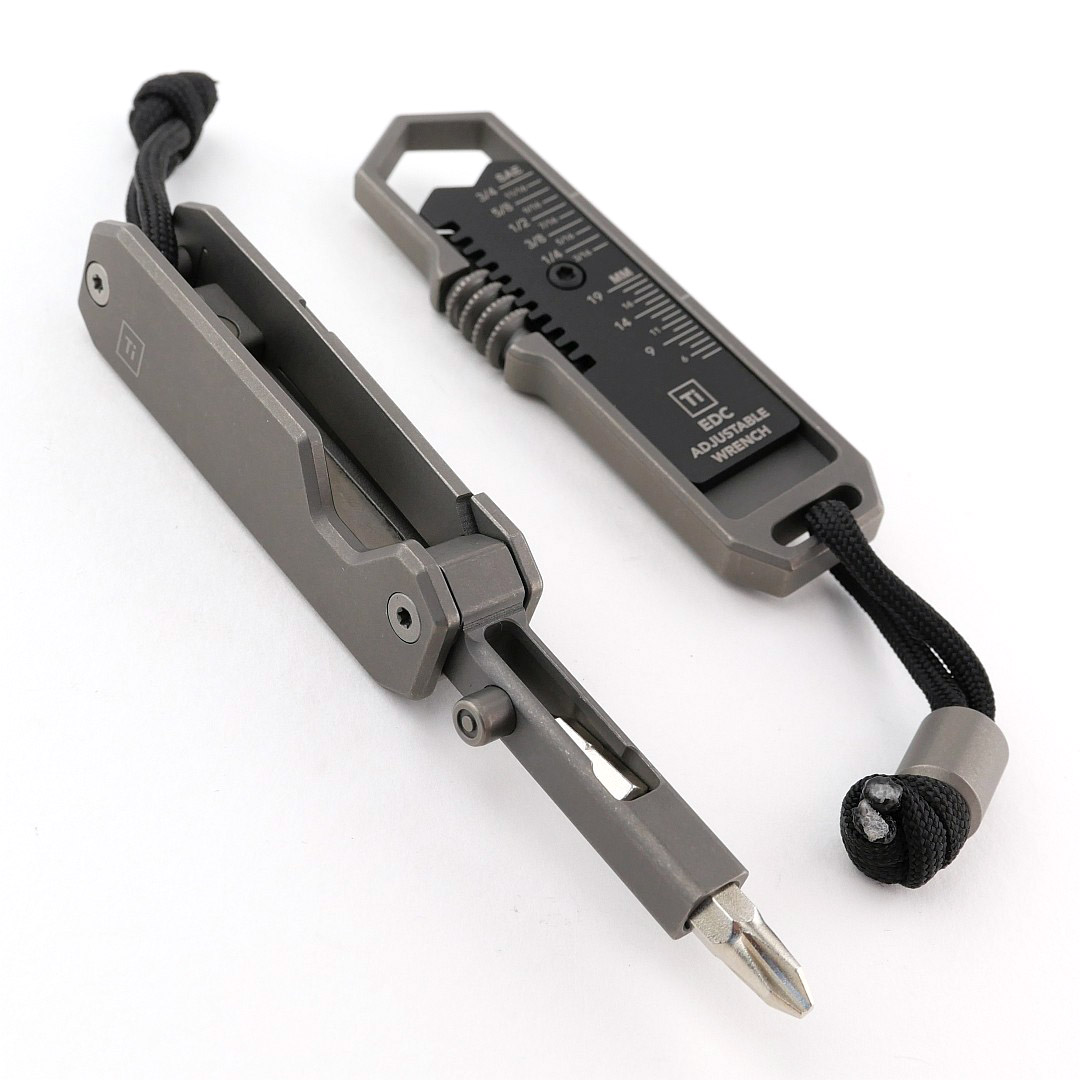
Overall layout of the EDS II is of an integral lock folding knife, but with a bit holder instead of a blade. A single thumb stud means this easier for a right-handed user. Explained in more detail in the video, there is a stop pin that both stops the bit holder arm in the right position when open, and also stops the spare bits sliding out of the front of the storage slot. The other end of the spare bit storage slot has a sprung ball to keep the bits in place. The integral lock action is easy to see as the bit holder is unfolded. Several magnets are used for keeping the spare bits in place and the main bit holder folded. In the EDS II an additional spare bit holder has been integrated into the lower section of bit holder arm. A total of four bits can be carried within the EDS II.


What’s in the box; Part 2 the EDC Wrench?:
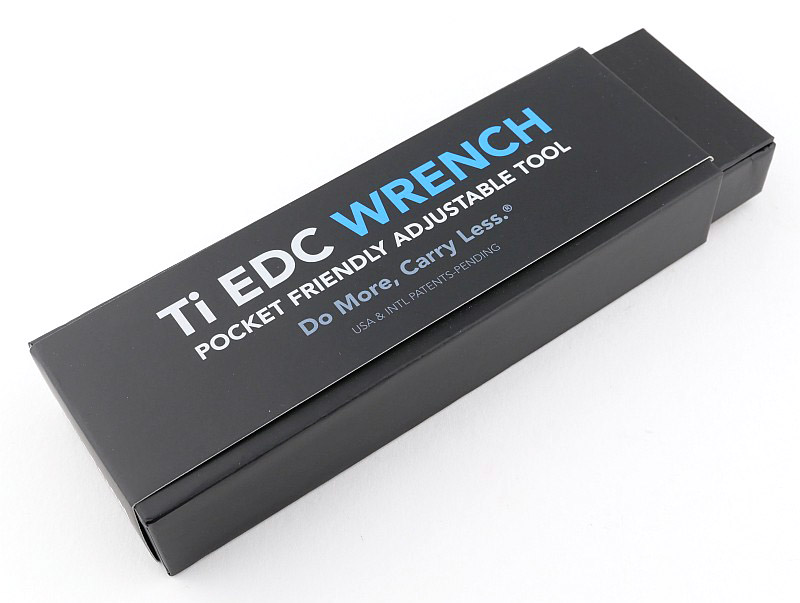
Again, following the format of the other BIGiDESIGN products I have, the box has a slide out tray which includes a compartment at one end that contains spares.
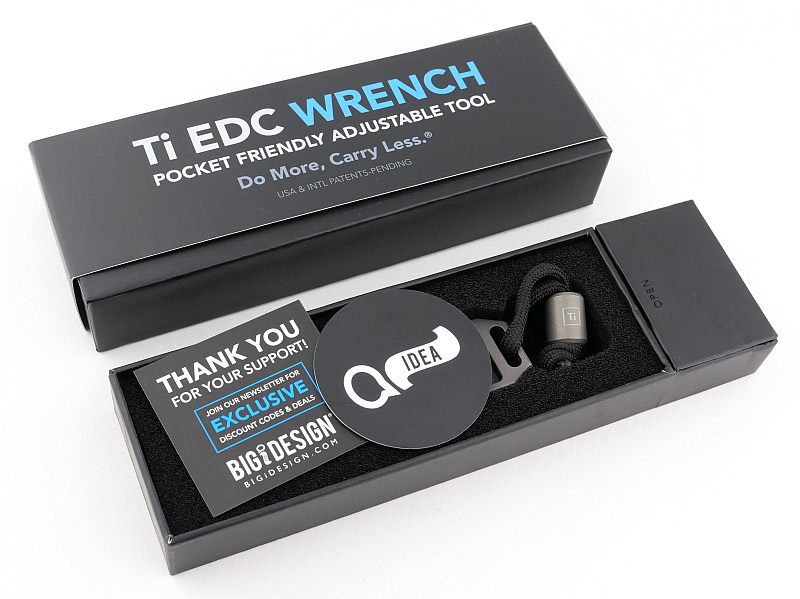
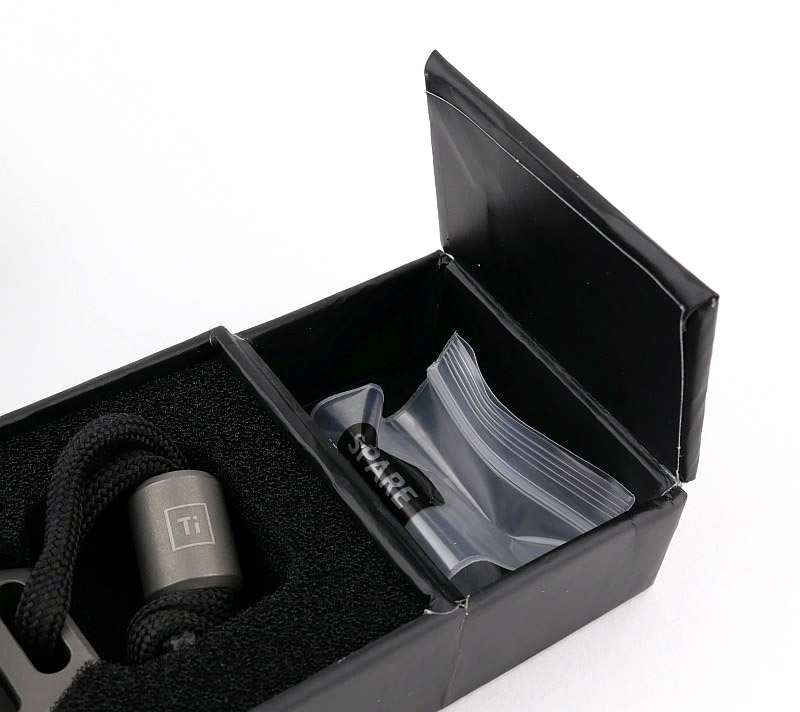
A good look round the EDC Wrench – Things to look out for here are:
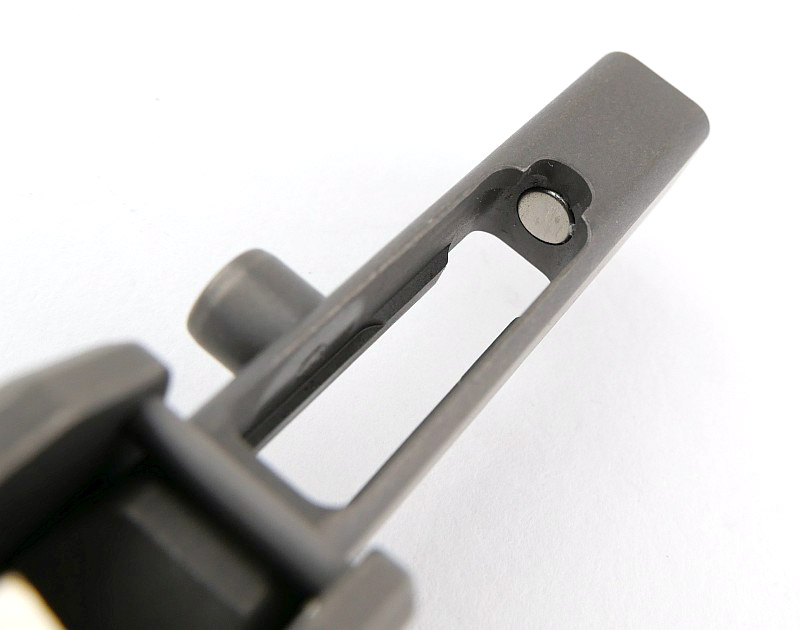
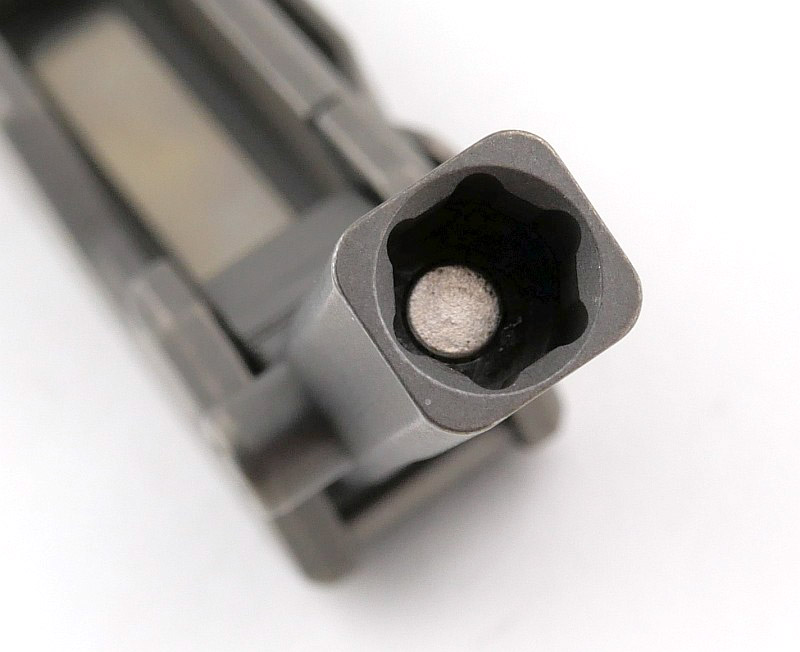
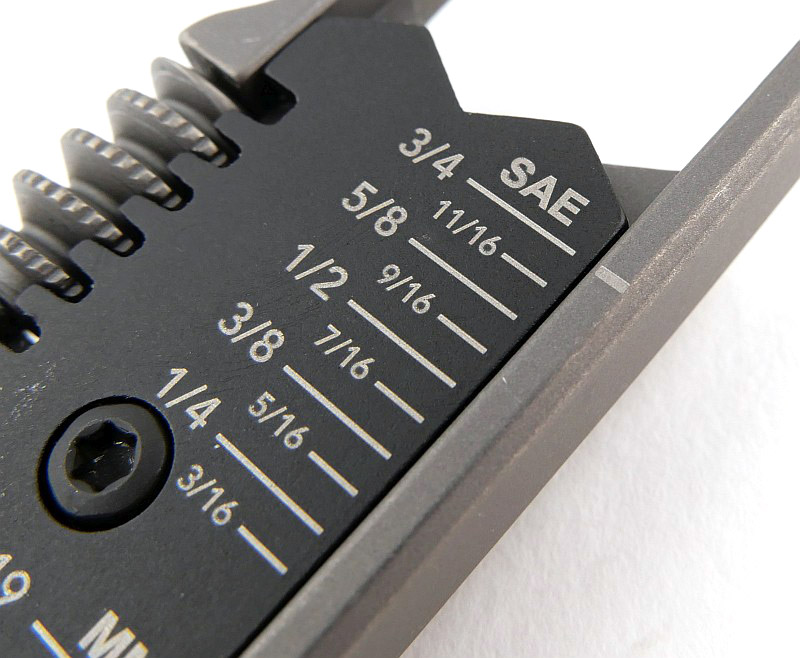
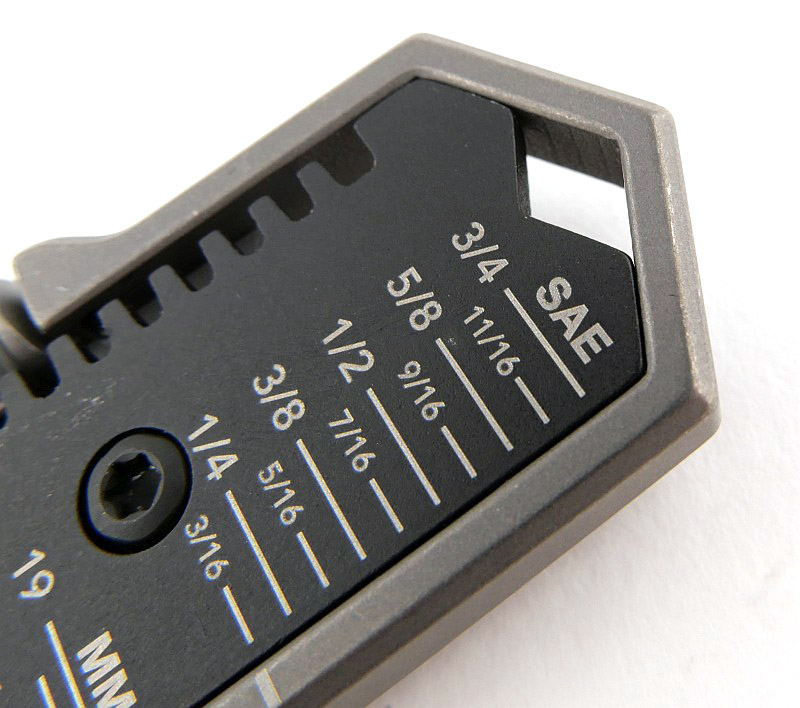
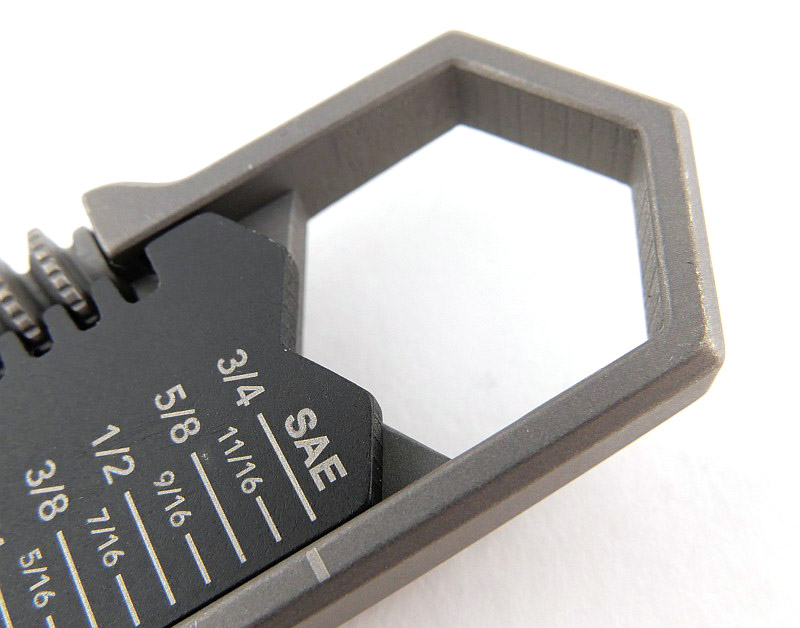
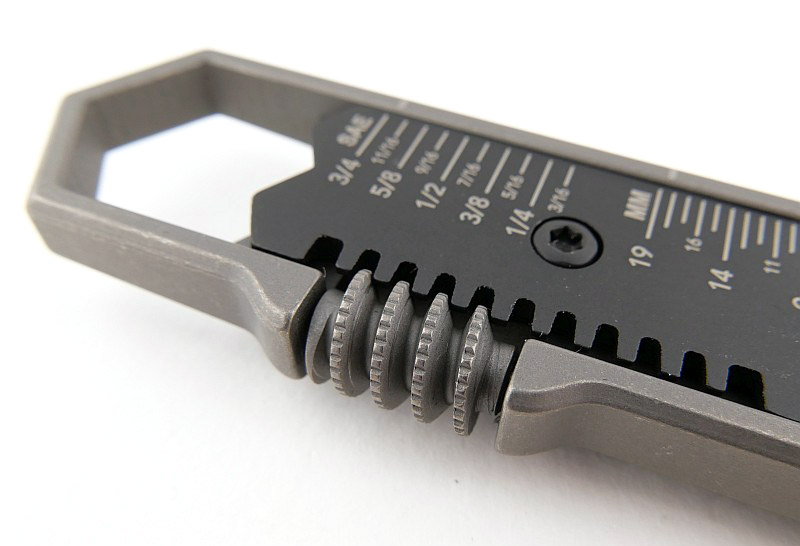
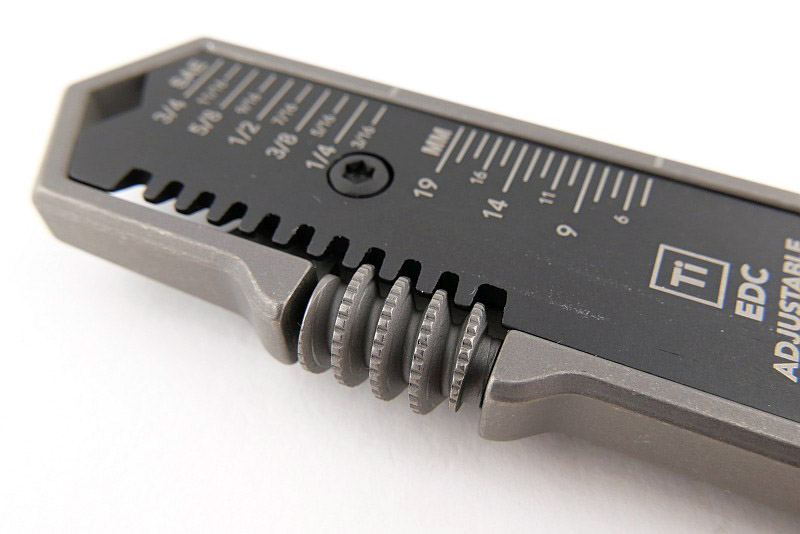
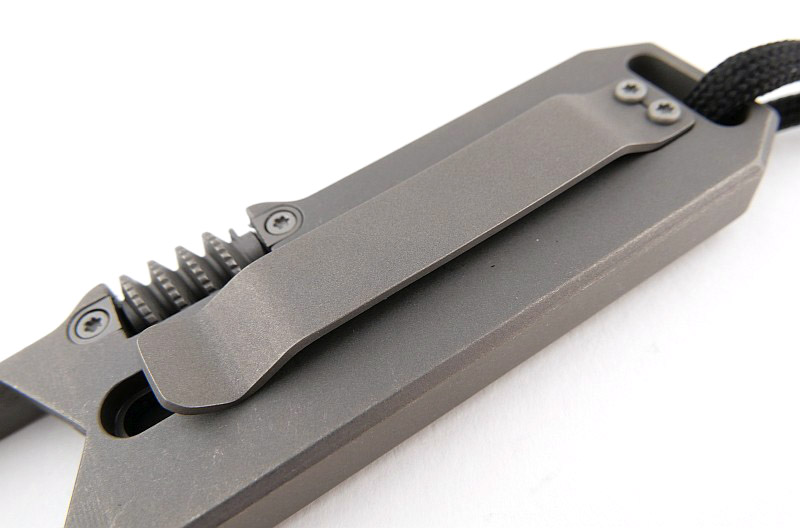
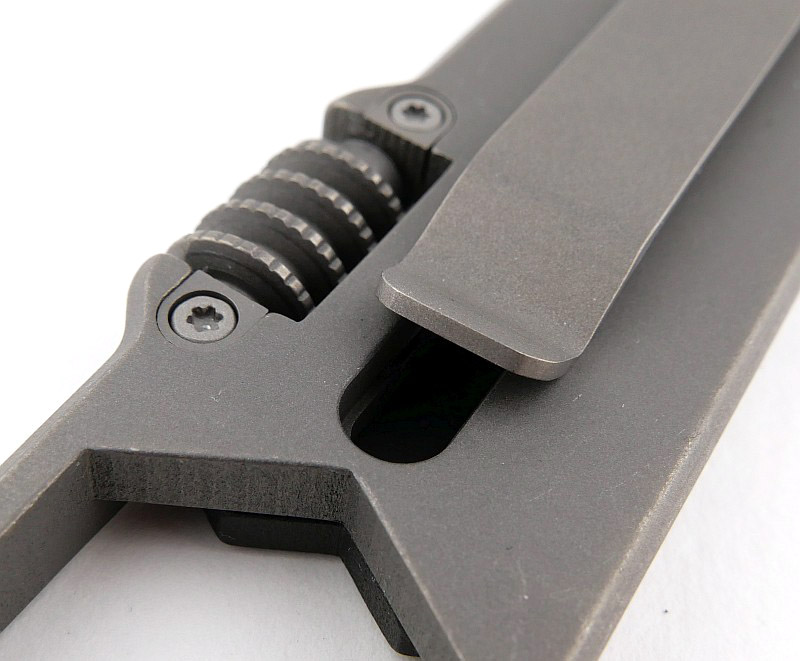
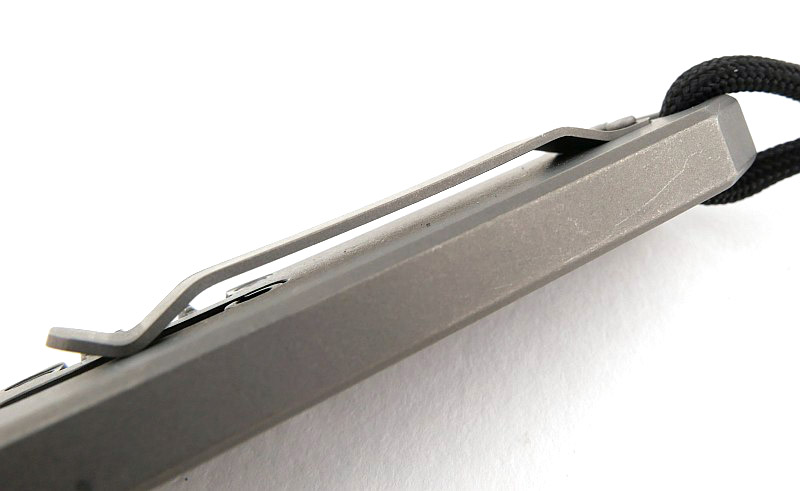
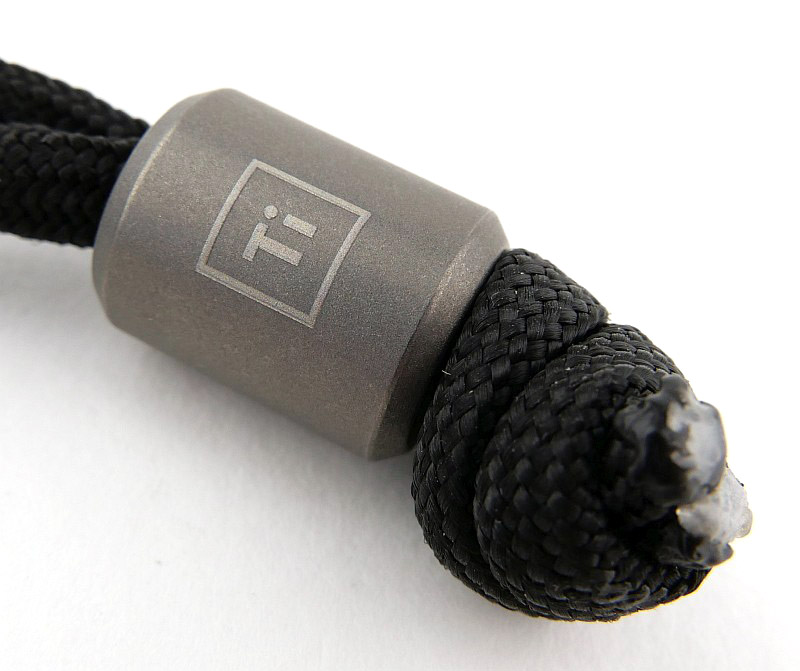
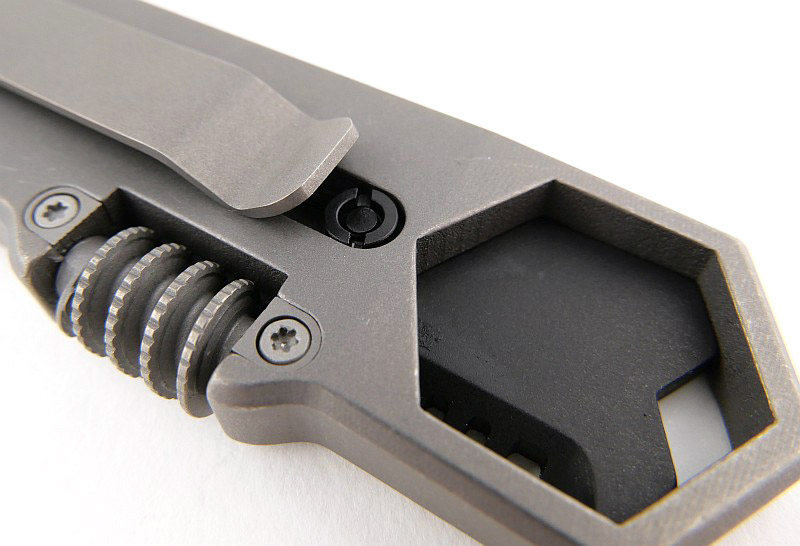
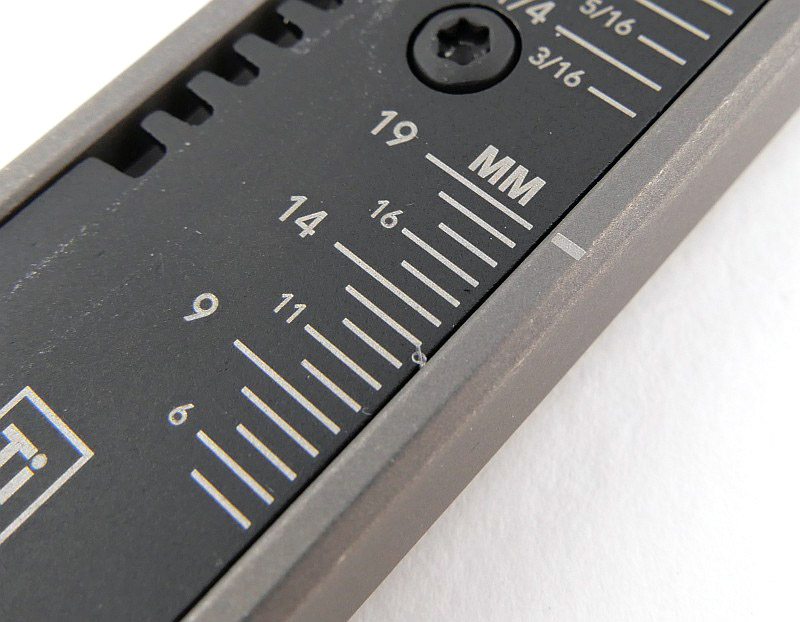
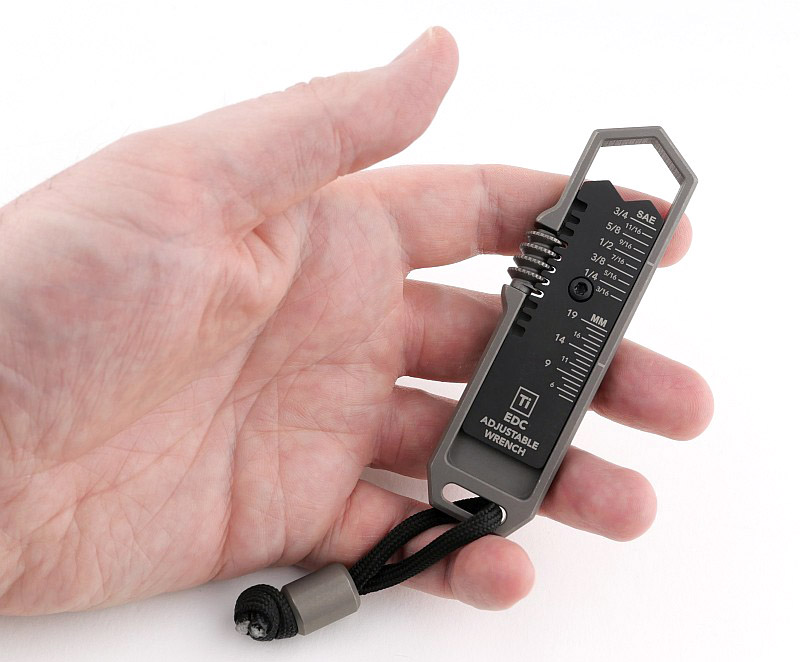
A reimagining of an old Swedish design, there is a sliding adjuster moved by a worm screw. BIGiDESIGN have added both a metric and imperial scale for setting the wrench ready to use. A low profile clip is fitted to the back and the EDC Wrench also includes a Ti bead on the lanyard. You can just see the slider retainer under the clip.
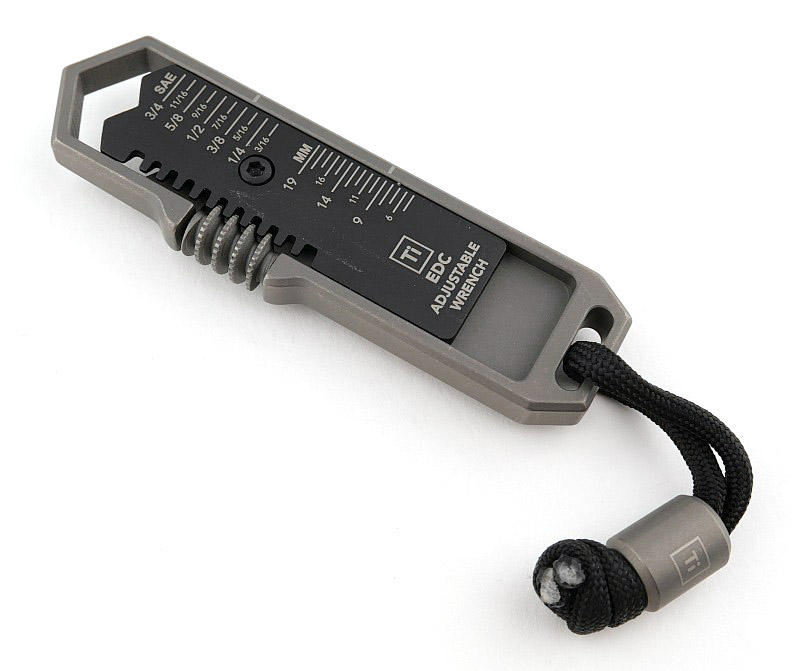
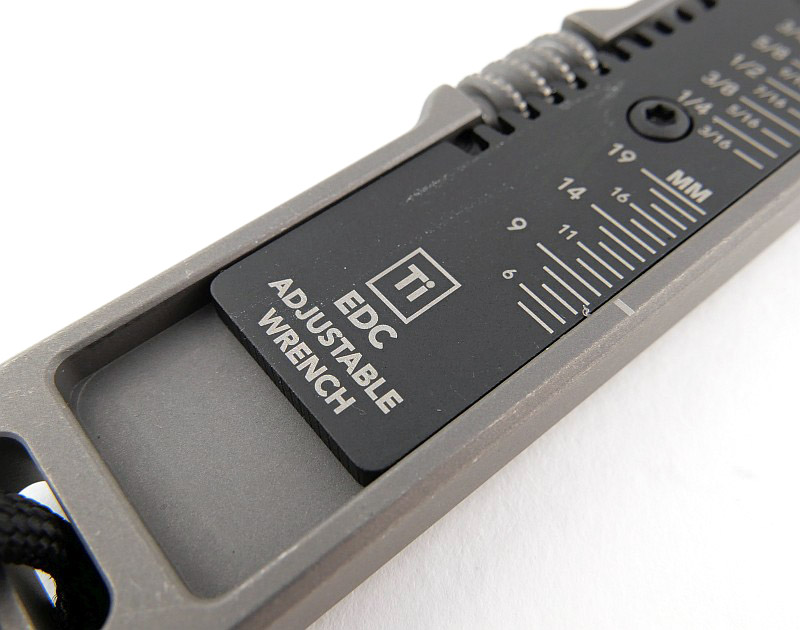
What it is like to use?

BIGiDESIGN have done something really special with the EDS, and now this updated EDS II, and given you not only a new experience of using and carrying a screwdriver, but one that is very practical as well.
It is not the smallest EDC bit holder available, nor does it include a ratchet, but instead it gives you a highly usable screwdriver with integrated bit storage for a total of four bits without needing anything else.
Having a swing-out bit holder extension arm, the EDS unfolds to a very practical conventional structure of handle, shank, and bit, so compared to many other small EDC screwdrivers it gives you a more usable tool.
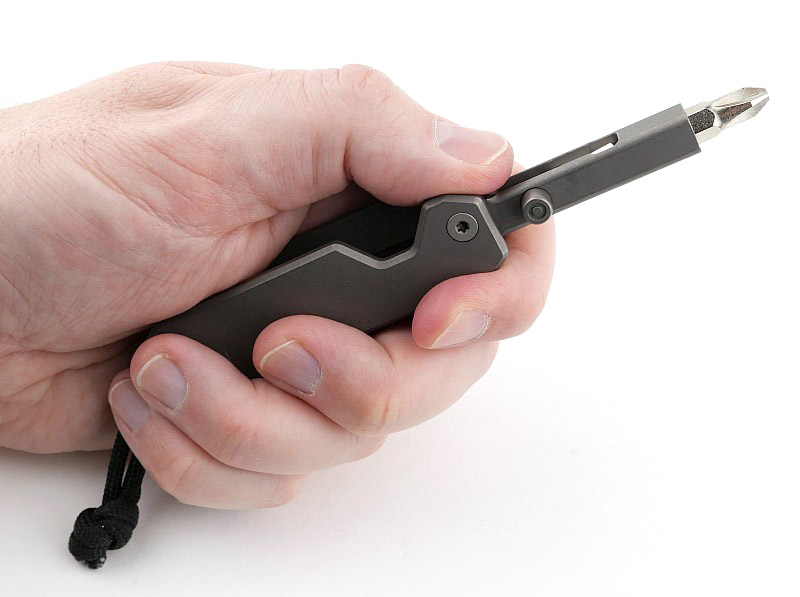
That genius part of the design is mimicking an integral lock folding knife, having a thumb stud to swing the bit holder arm out of the folded position for one-handed operation. So satisfying to use!

However there is a little observation to note about how easy or difficult it is to open the EDS II. The arm’s retention in the folded position is due to a magnet in the body grabbing the bit that is in the bit holder. As you use the EDS II and swap bits around, you will find that a bigger bit, like the full size flat bit, is held by the magnet more firmly, so firmly it becomes very difficult to open using the thumb stud. Put a smaller bit into the holder and it becomes much easier to open again. So the bit you leave in the main bit holder arm changes the ease of opening the EDS II. I would have preferred that the arm retention was a detent (like a knife would use) or that the thumb stud had a bigger cut-out round it allowing more contact and an easier open.


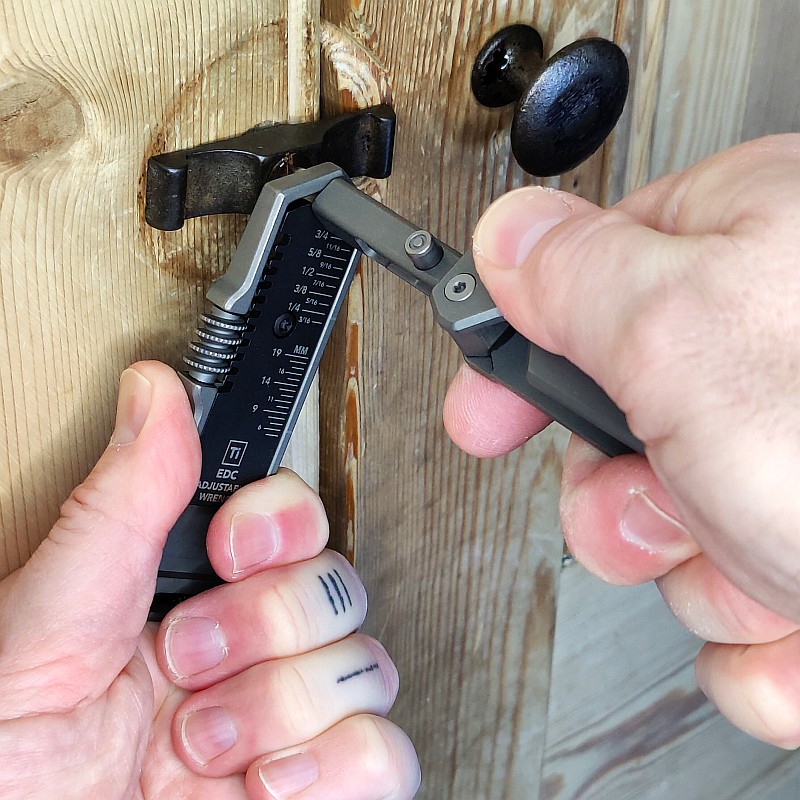
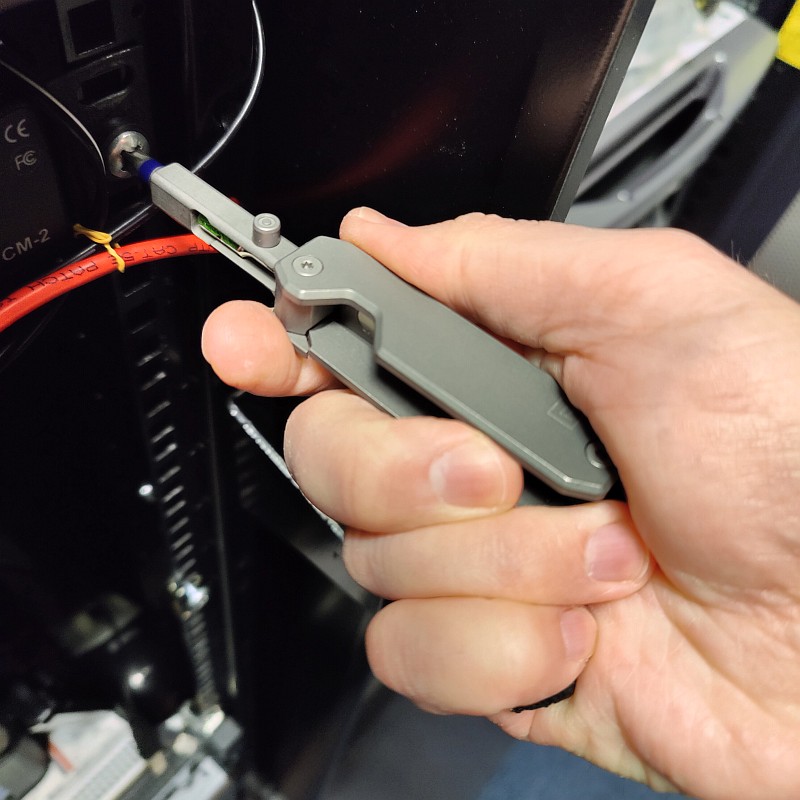
Onto the partner tool here and the EDC Wrench, an infinitely more pocket friendly design than a standard adjustable wrench, there was one big flip for me, literally, in how I envisaged using it before actually getting my hands on one. That is the fact that with the adjustable slider being very much on one side of the tool, to use it and make contact with the nut, you have to flip it over so the ‘front’ of the tool is away from you (pocket clip towards you). Like this you can’t see the scale, and initially it just felt a bit odd, but is just how it works. Even with larger nuts, all except the very largest, you need to use it this way round.
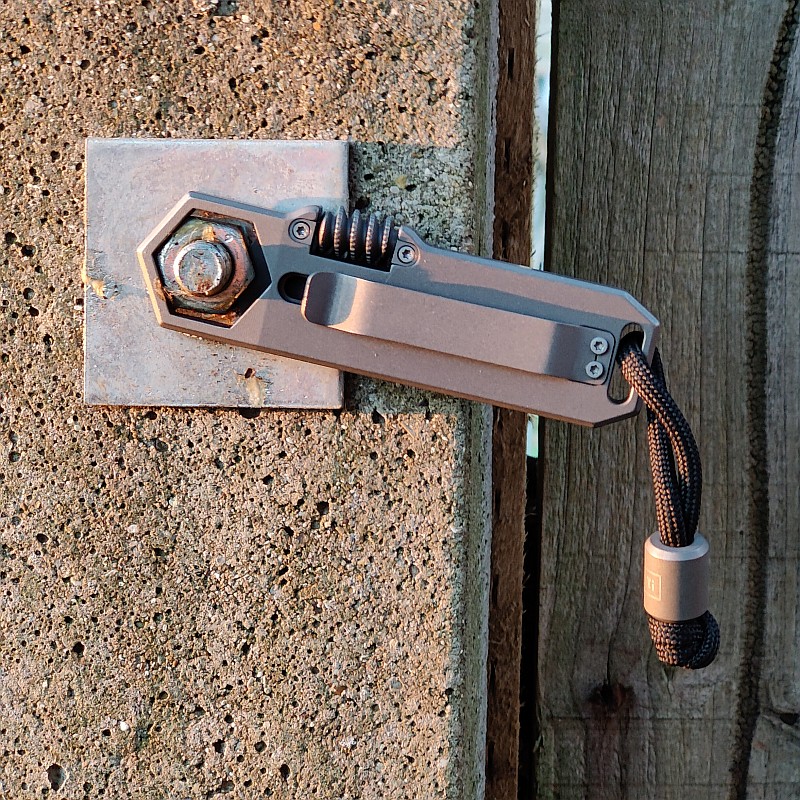
Being a ring spanner, you do have to be able to pass the ring over the end of the job onto the nut, so can’t be used for certain jobs. If you hit those limits though, it is less likely an EDC type of job, so then you bring out the full size tools. Know the limits of your tools and don’t abuse them and you’ll get along just fine.
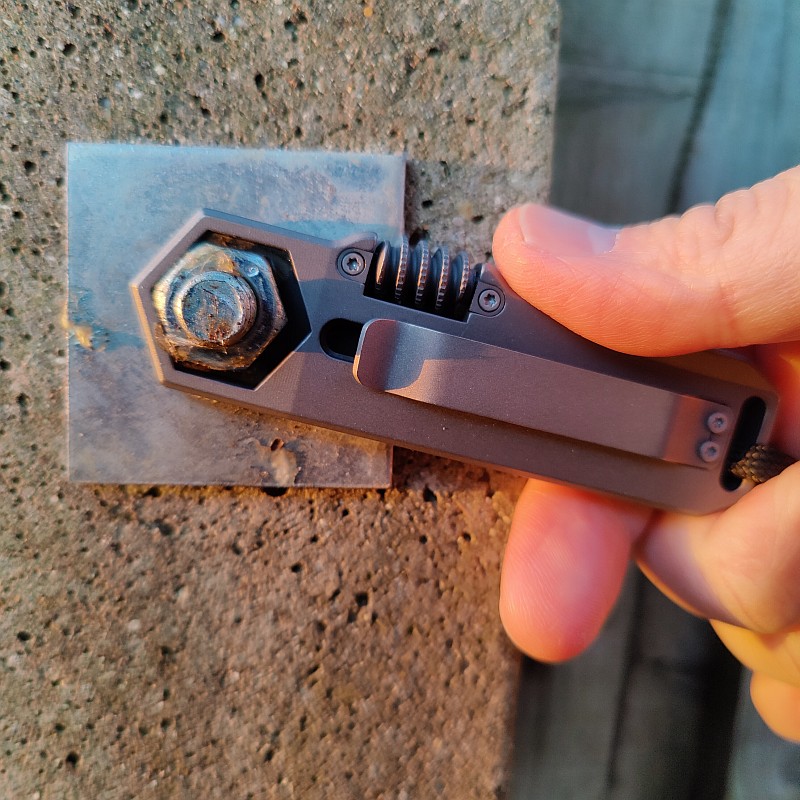
Talking of limits, and pushing them, the EDS II and EDC Wrench can nicely partner up for a bit more screw driving torque. There is just enough of the 1/4″ hexagonal bit showing to use the EDC Wrench to grip this and boost the turning force for stubborn screws. Not always possible, but if you have the space, this can save you having to go for bigger tools. In this case the EDC Wrench is used with the slider facing you as it needs to be this way round to grip that small section of the hex bit.

Both of these beautiful EDC tools are made from grade 5 titanium alloy and punch well above their weight, even more so together.


Review Summary

The views expressed in this summary table are from the point of view of the reviewer’s personal use. I am not a member of the armed forces and cannot comment on its use beyond that covered in the review.

Something that might be a ‘pro’ for one user can be a ‘con’ for another, so the comments are categorised based on my requirements. You should consider all points and if they could be beneficial to you.

_______________________________________________
What doesn’t work so well for me
_______________________________________________

EDS II – Difficult to open with larger bits installed.
EDS II – Thumb stud a bit too recessed.
EDC Wrench – Ring spanner design slightly restrictive.
EDC Wrench – Need to use with the slider away from you.

_______________________________________________
Things I like
_______________________________________________

EDS II – One-Handed Operation.
EDS II – Integral Frame-Lock Mechanism.
EDS II – Deep carry Pocket Clip.
EDS II – Uses any 1/4″ hex bit.
EDS II – Integral storage for four bits.
EDS II – 100% metal construction.
EDC Wrench – Infinitely adjustable.
EDC Wrench – SAE 3/16 – 3/4 in.
EDC Wrench – Metric 5 – 19 mm.
EDC Wrench – Solid Titanium Construction.
EDC Wrench – Removable Pocket Clip.

 
Discussing the Review:
The ideal place to discuss this review is on the Tactical Reviews Facebook Page
Please visit there and start/join the conversation.
Knife Review: lionSTEEL H1

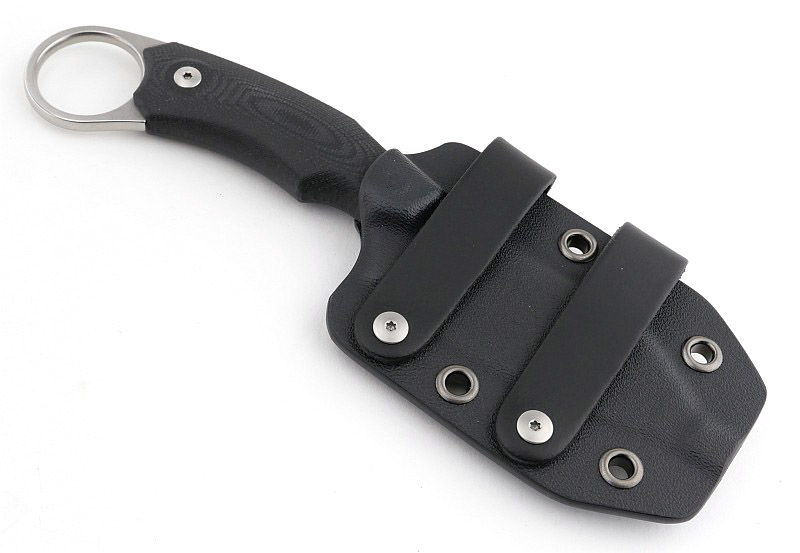
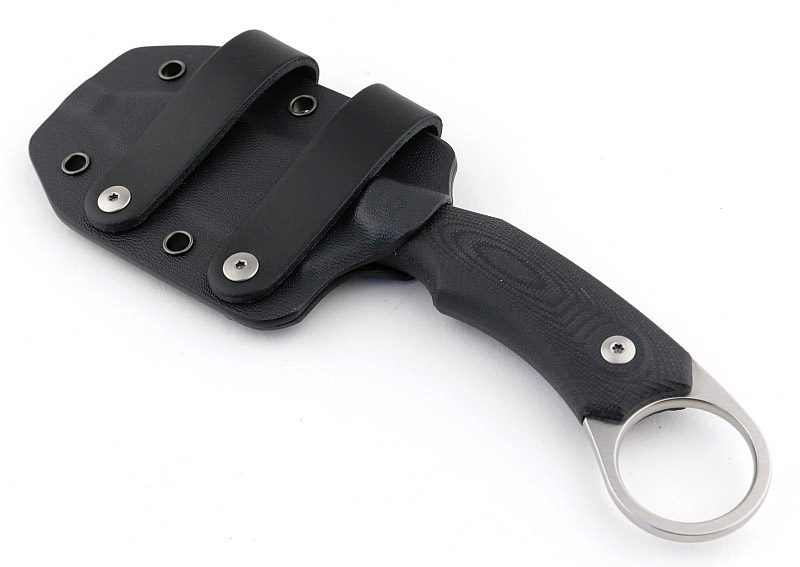
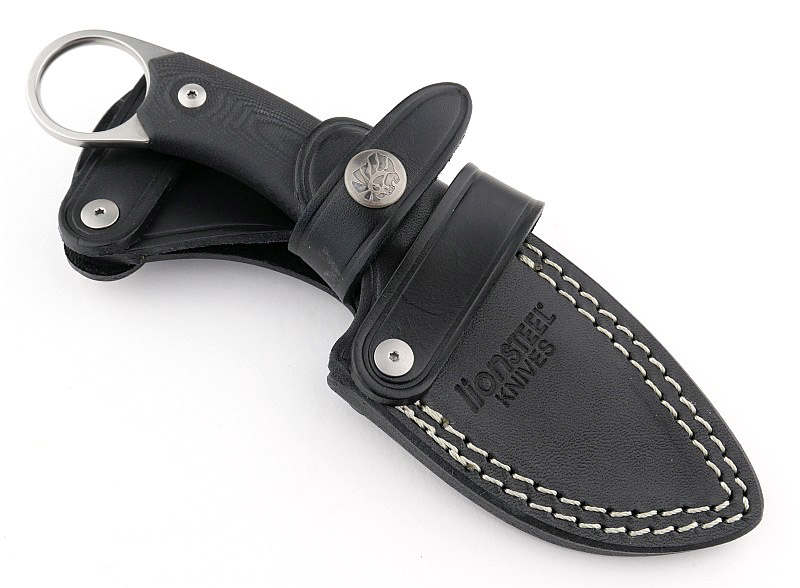
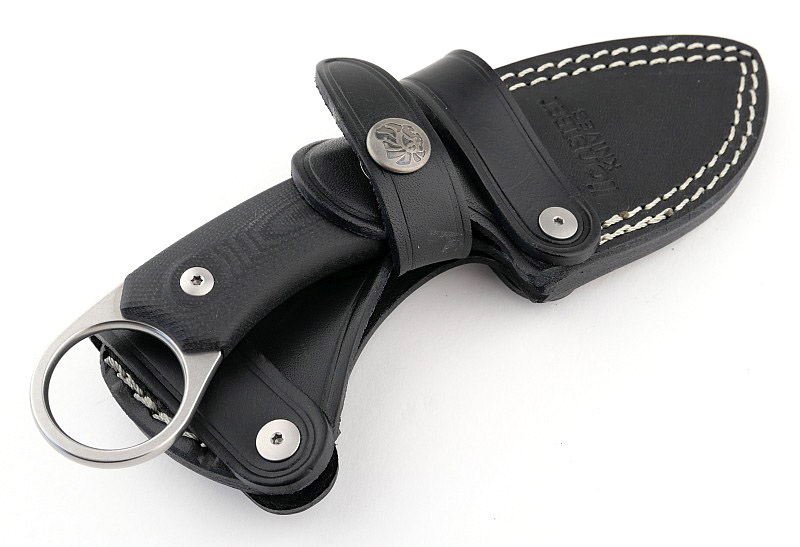
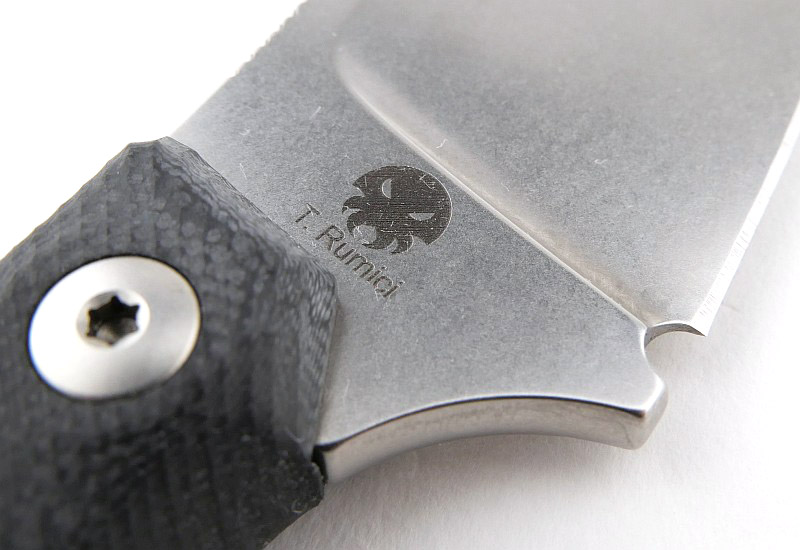
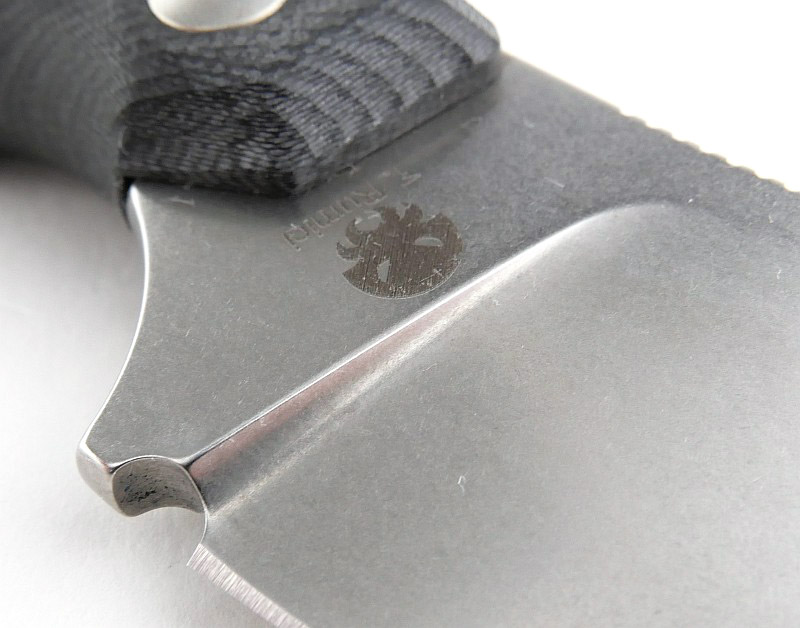
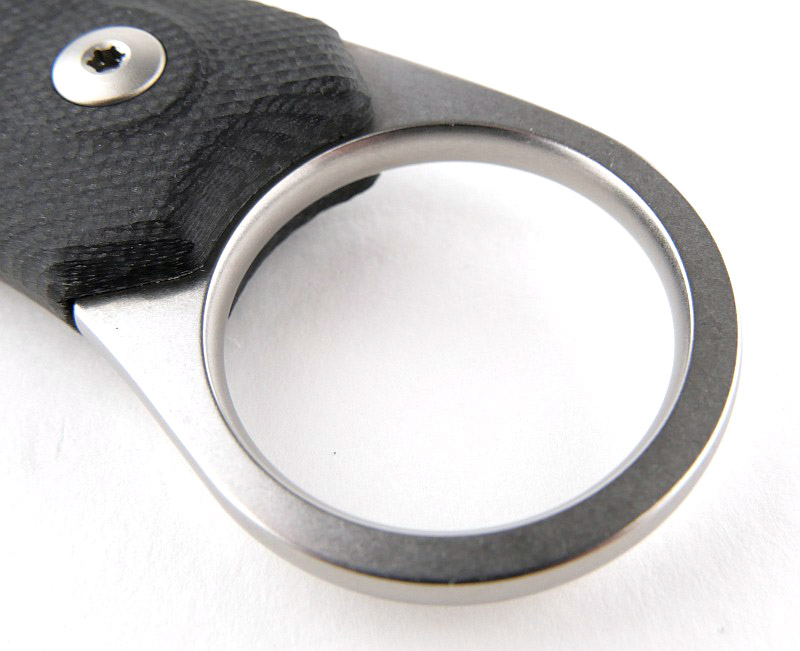
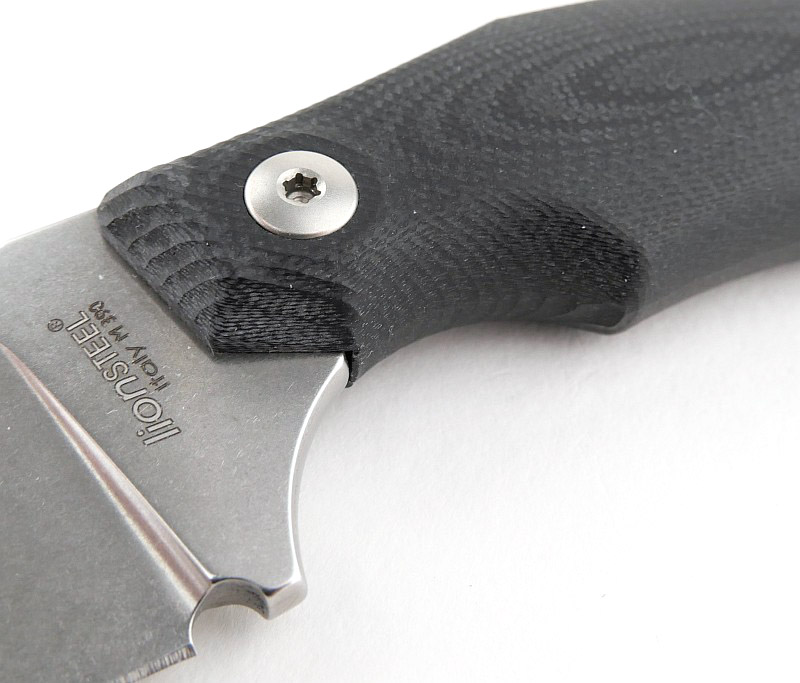
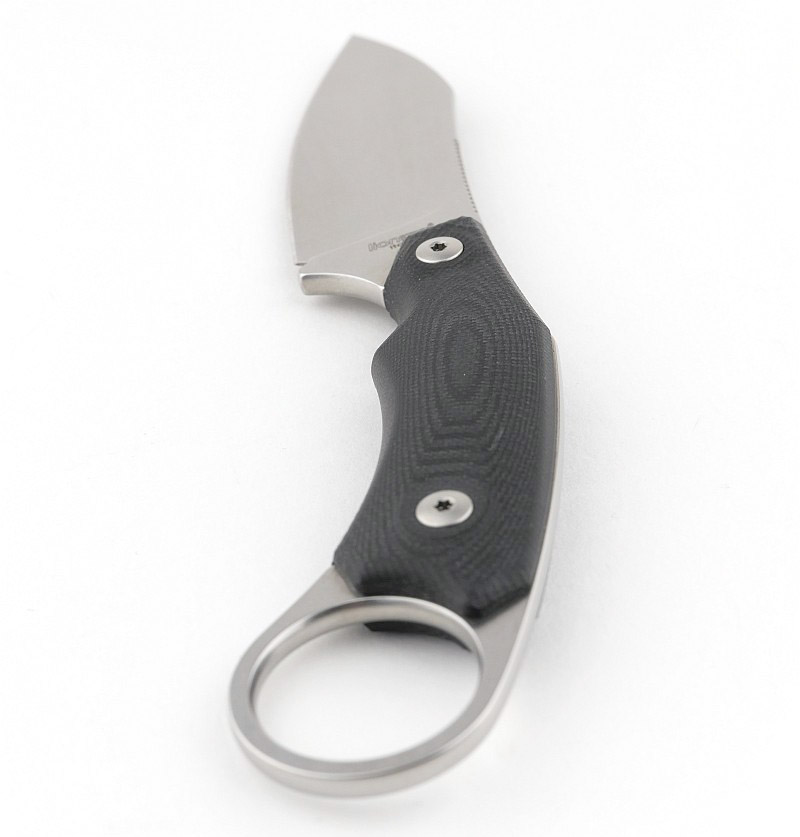
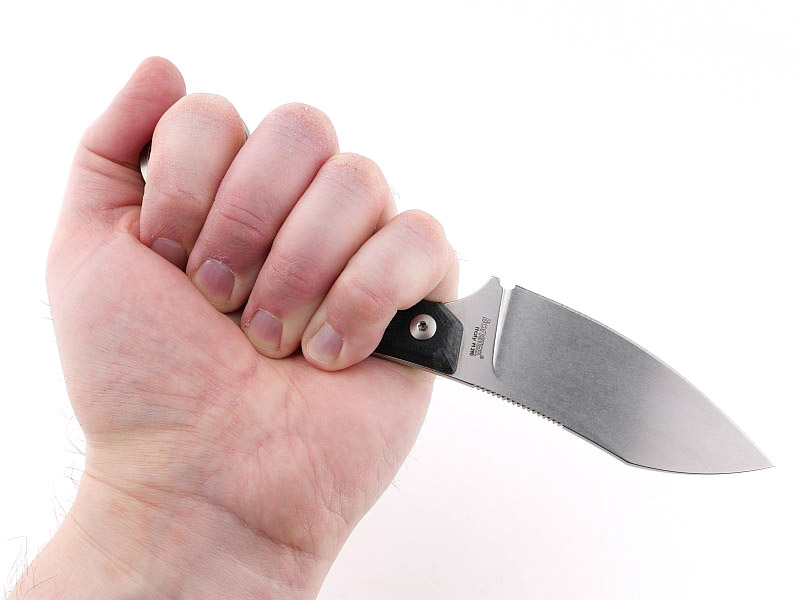
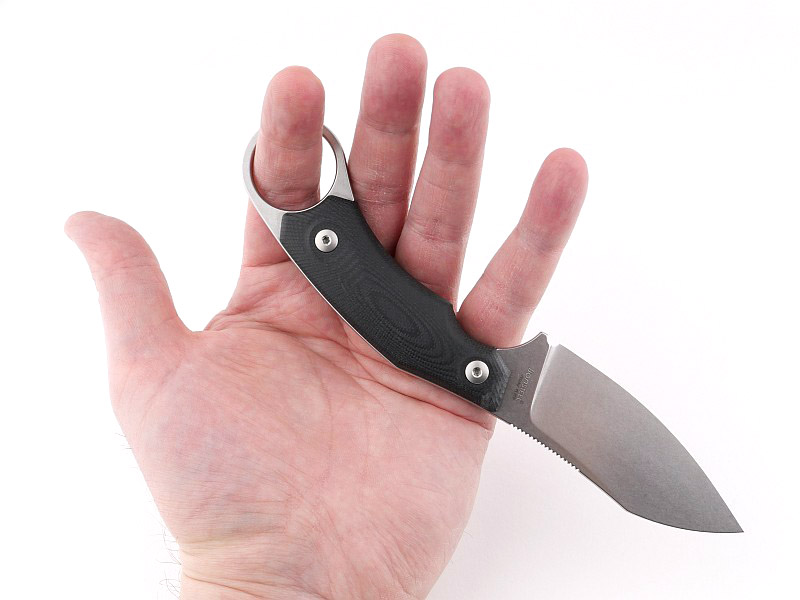
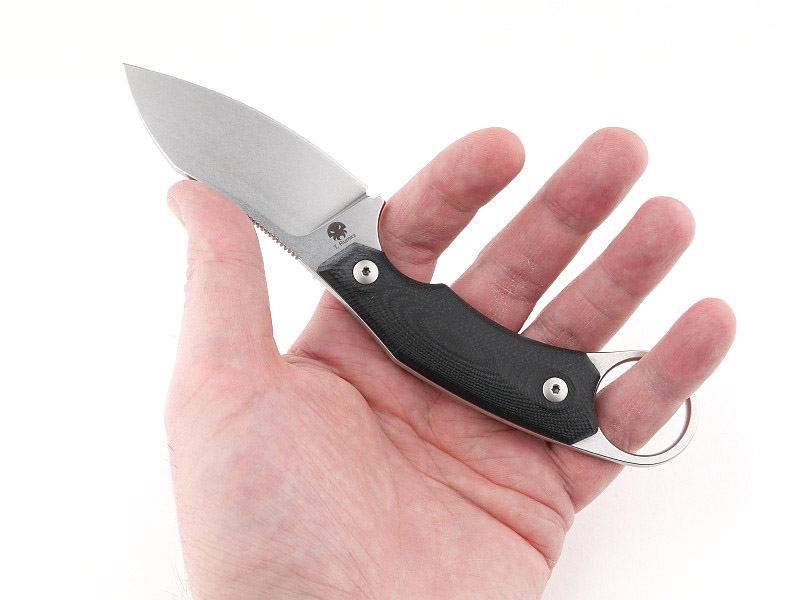
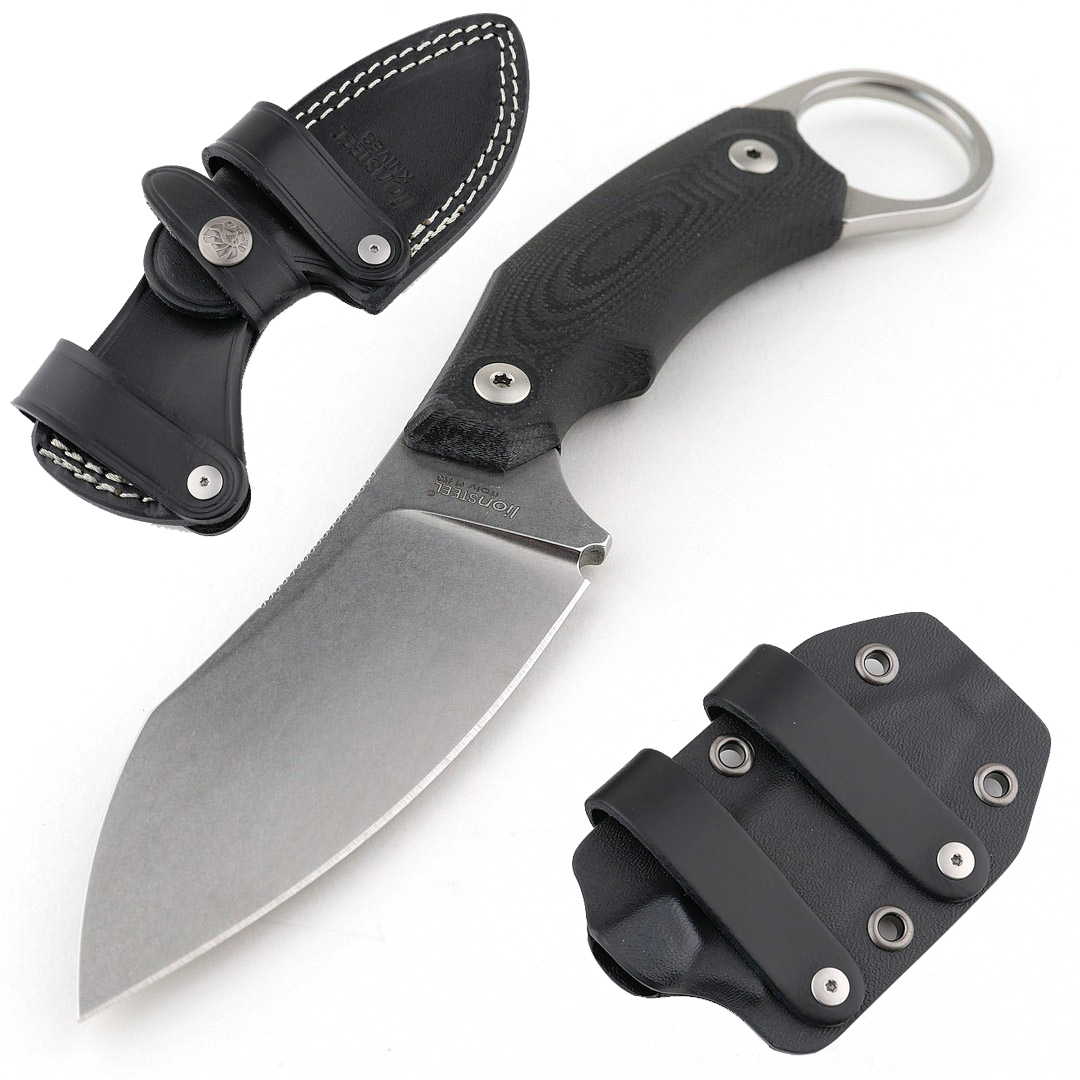
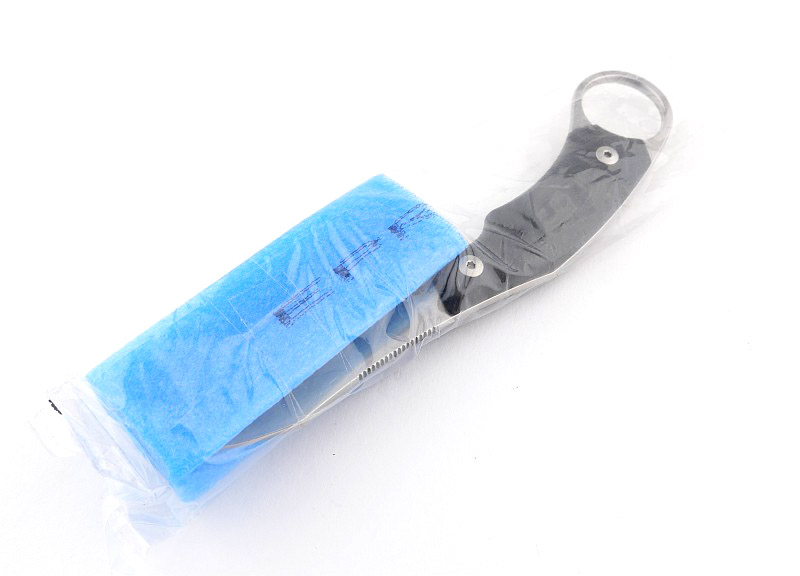
Join me in this review of the lionSTEEL H1, to take in all the details of this superb EDC fixed blade knife designed by Tommaso Rumici. This specific knife is a display model from IWA 2022 so might show a few imperfections. The H1 has a M390 blade, black G10 handle with grip ring, standard leather sheath plus also shown in this review with the optional Kydex sheath.

Video Overview

This video includes a close look round the H1, and then onto the measurements and specifications.


What’s in the box?:
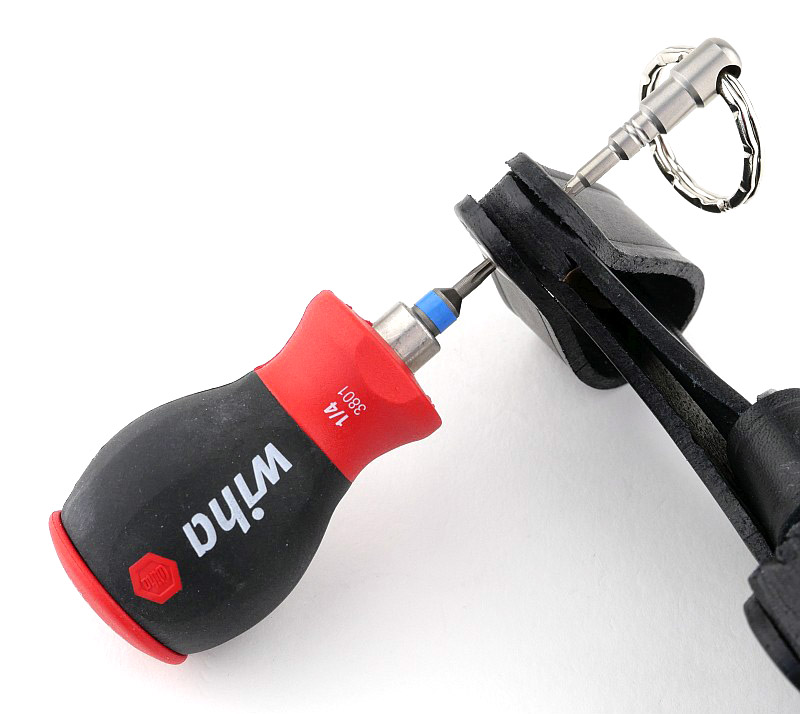
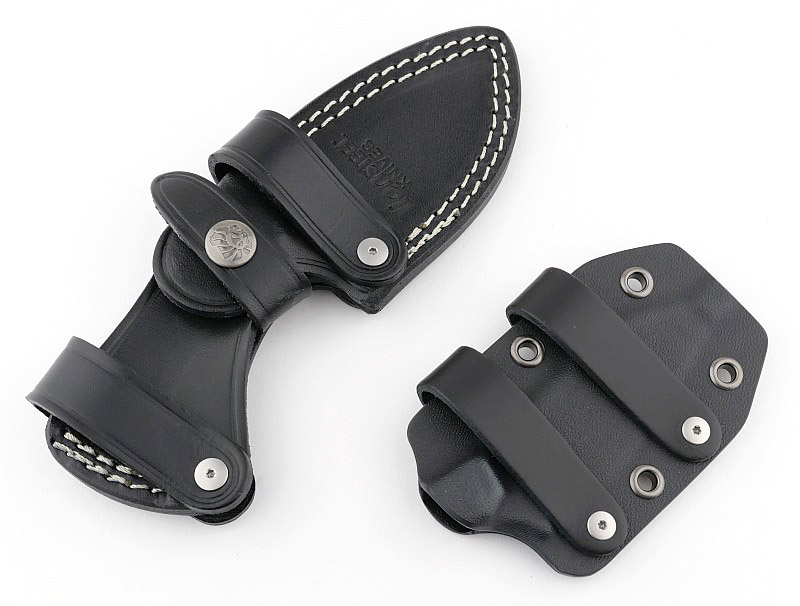
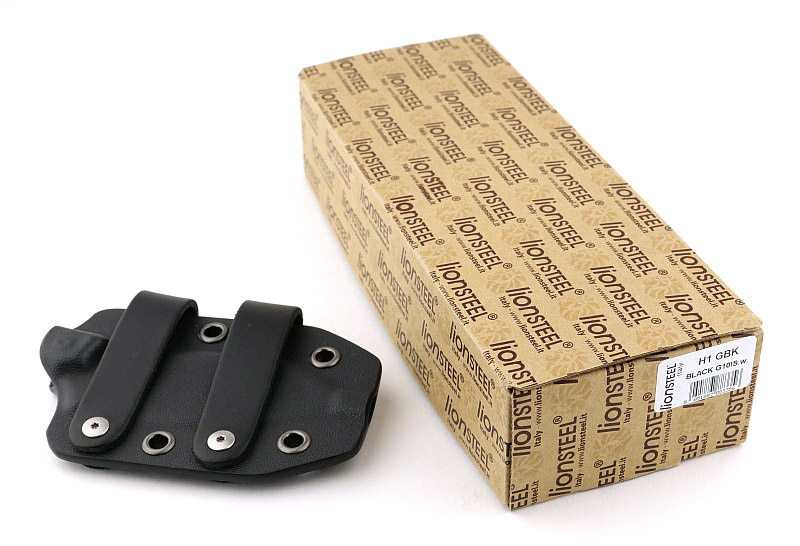
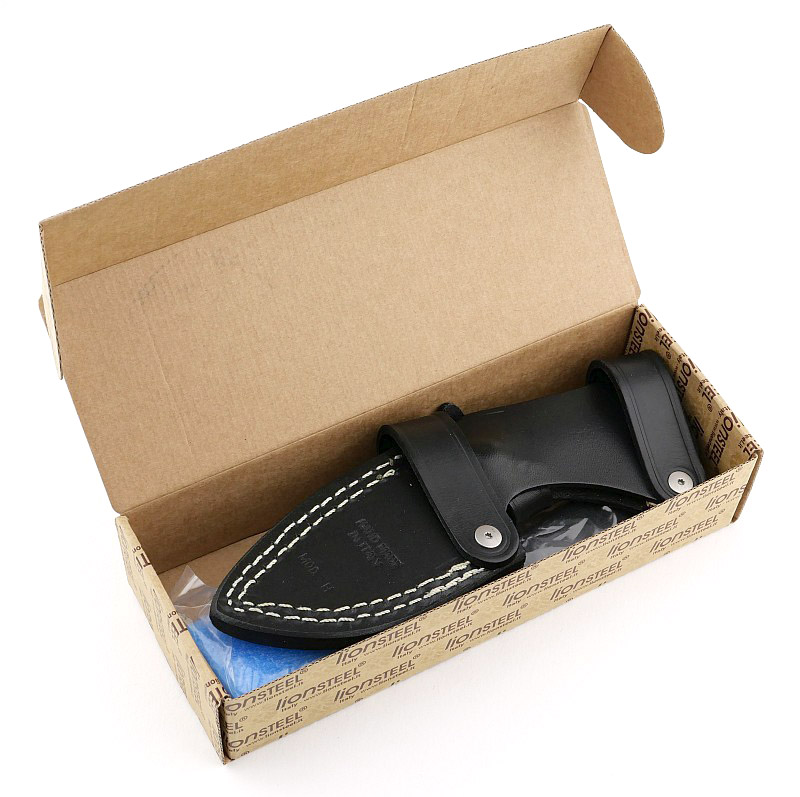
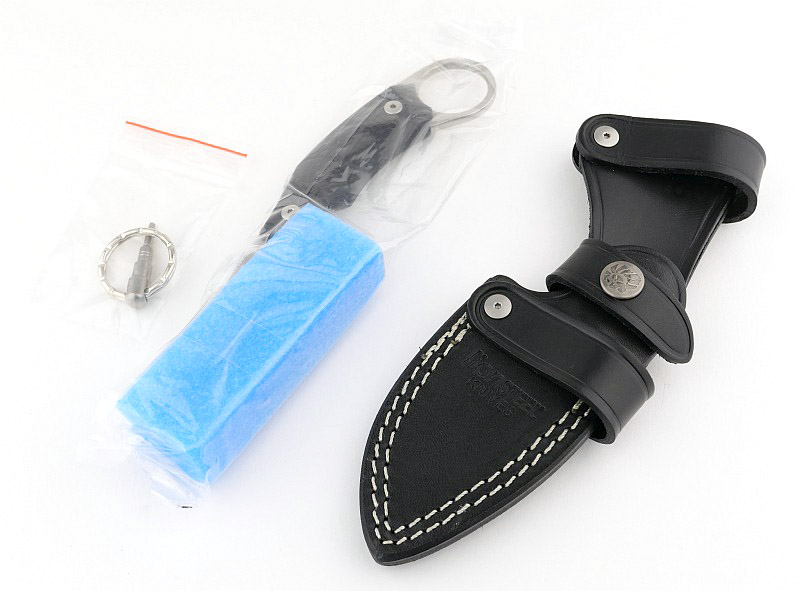
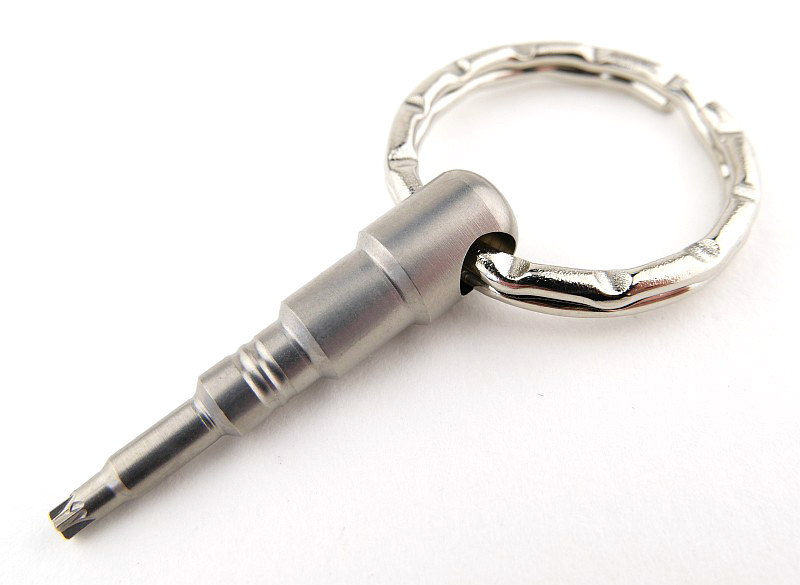
As well as the standard H1 package, this review shows the optional Kydex sheath which is pictured next to the closed box. As standard, the H1 comes with the leather sheath and a lionSTEEL made keyring torx wrench.


A good look round the standard Leather Sheath – Things to look out for here are:
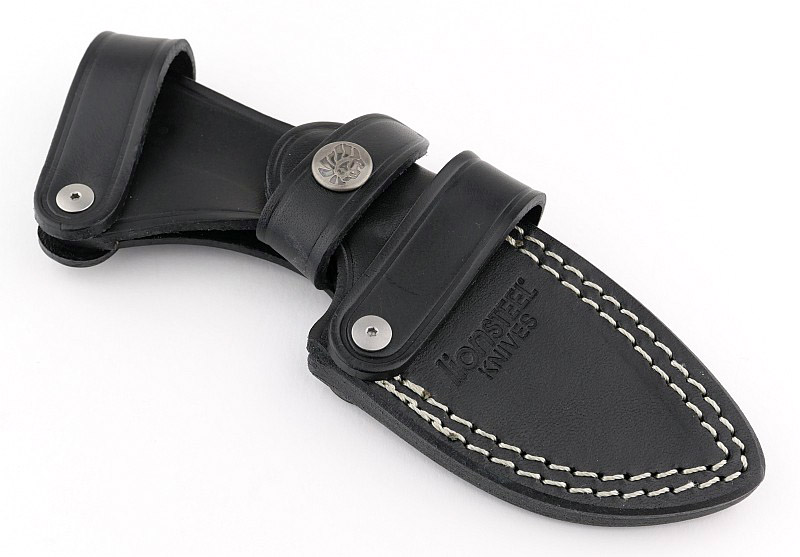
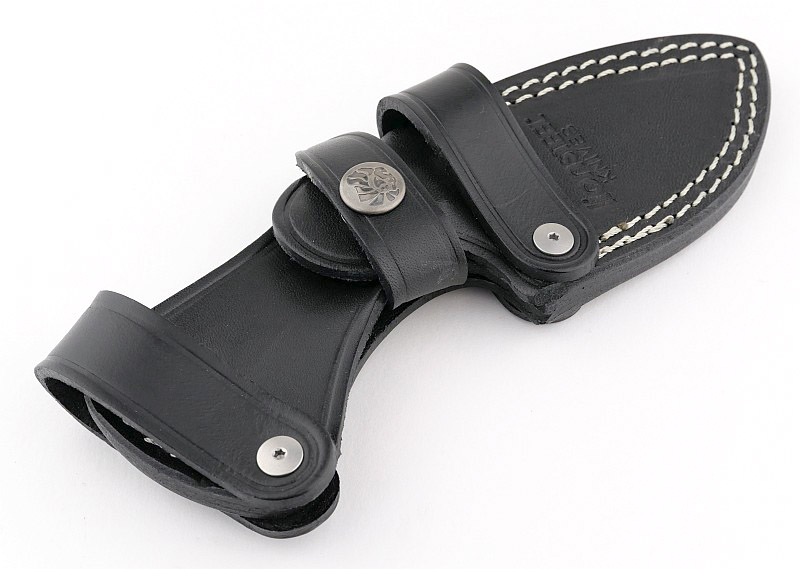
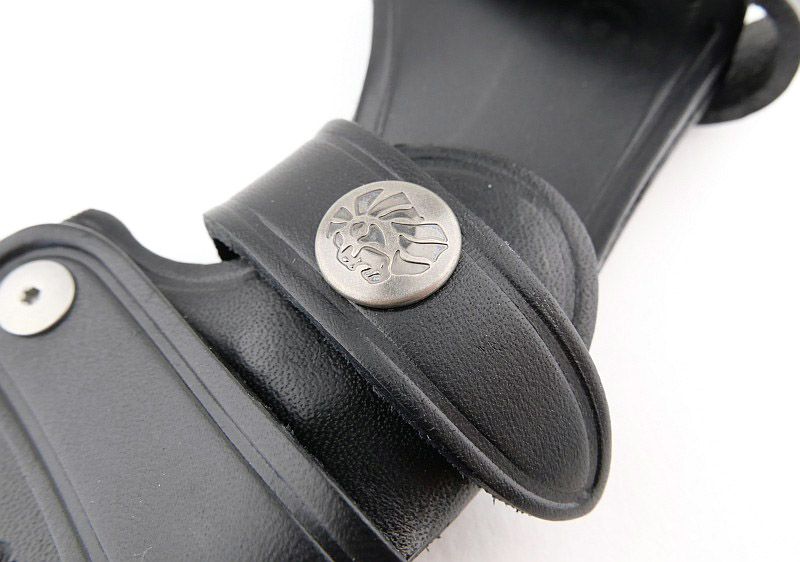
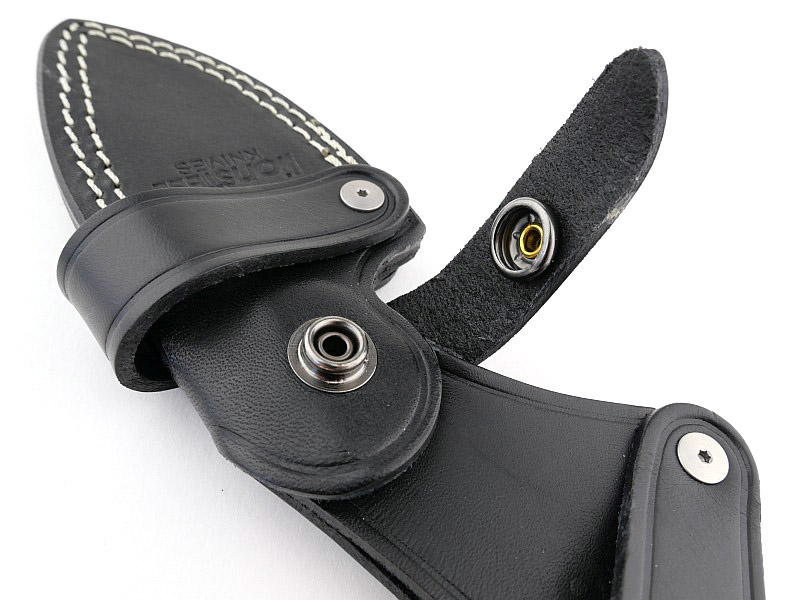
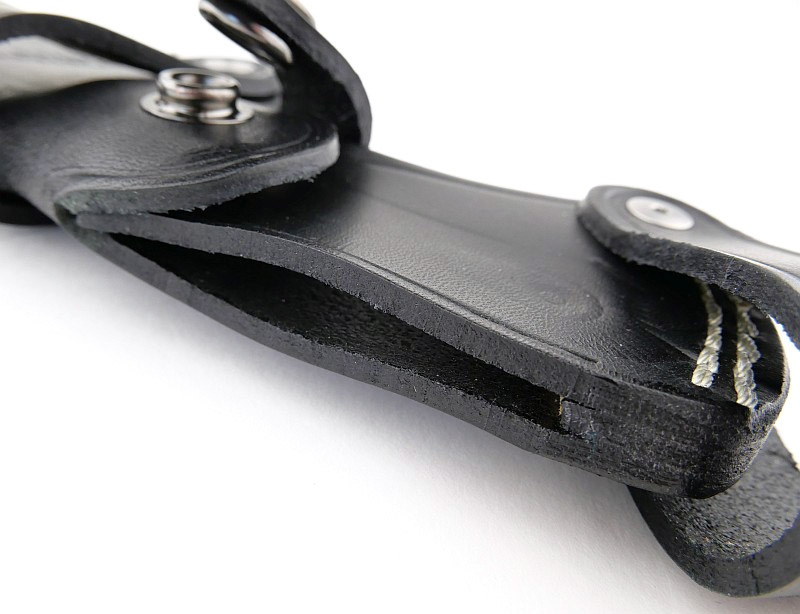
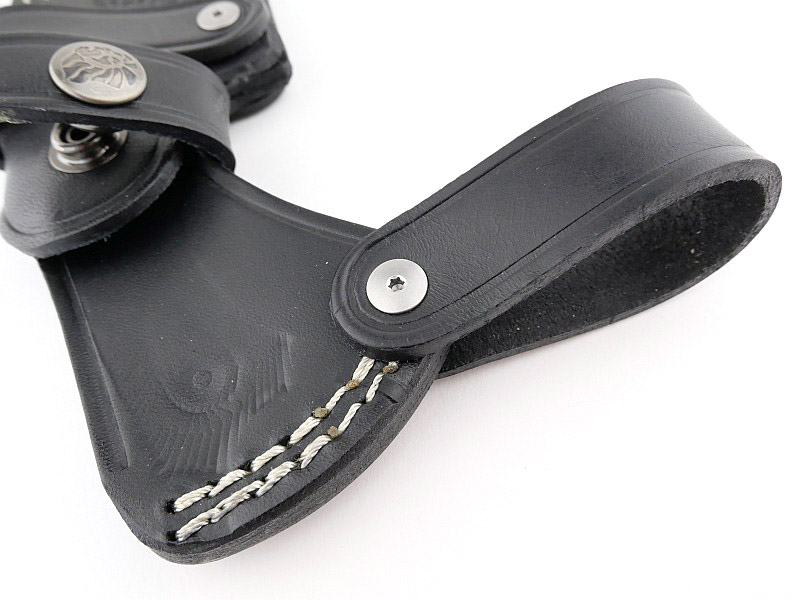
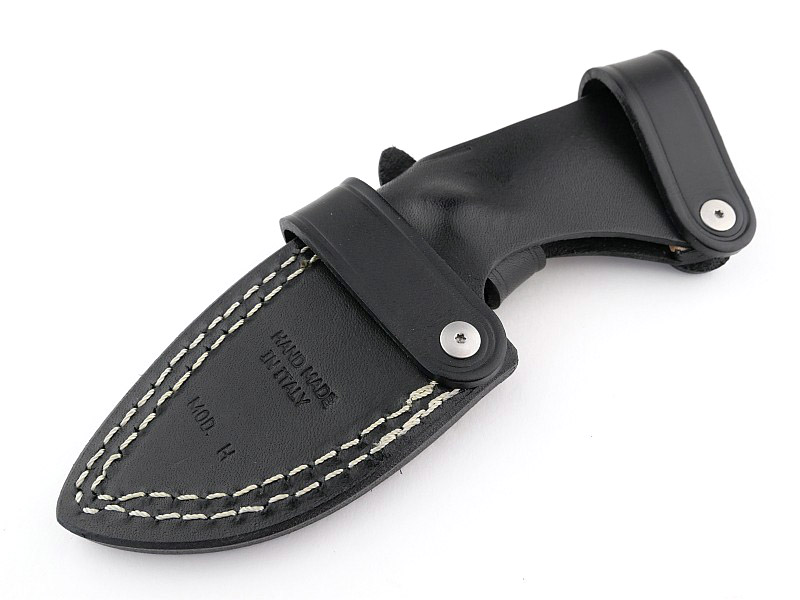
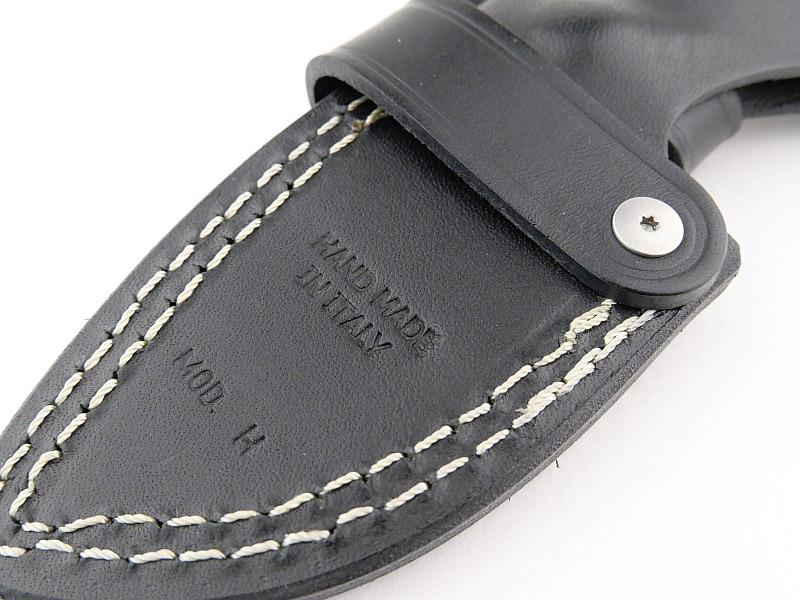
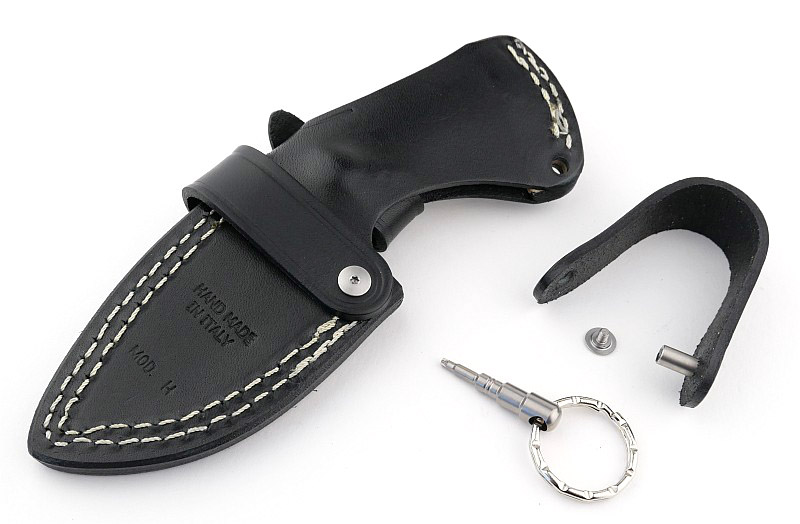
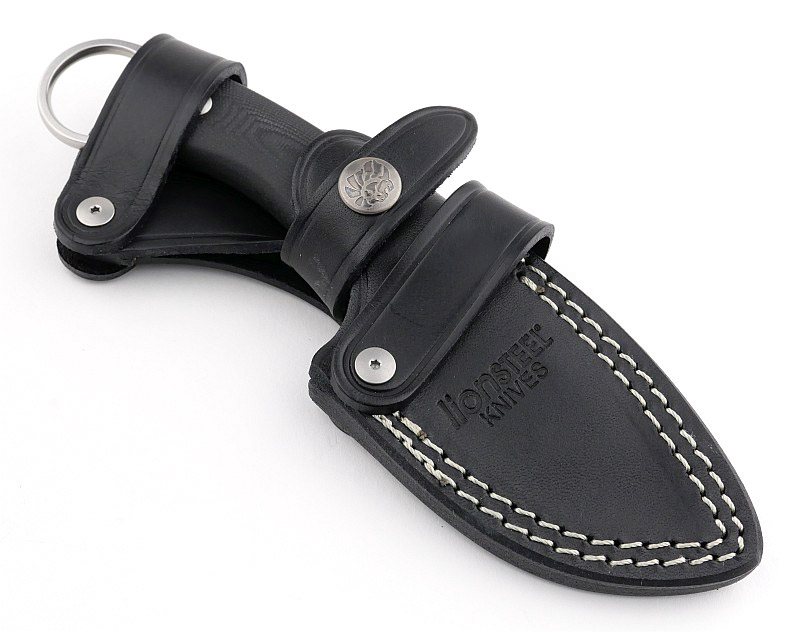
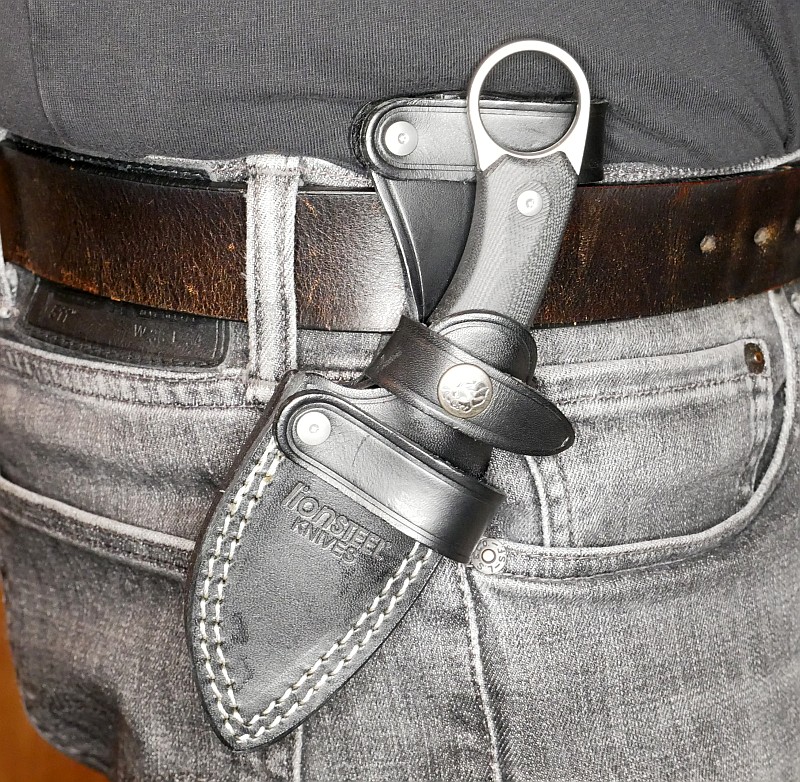
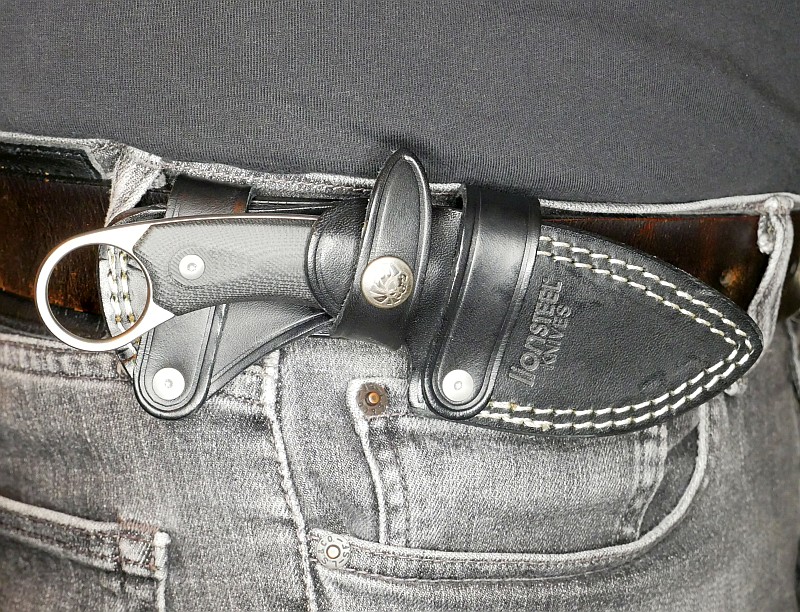
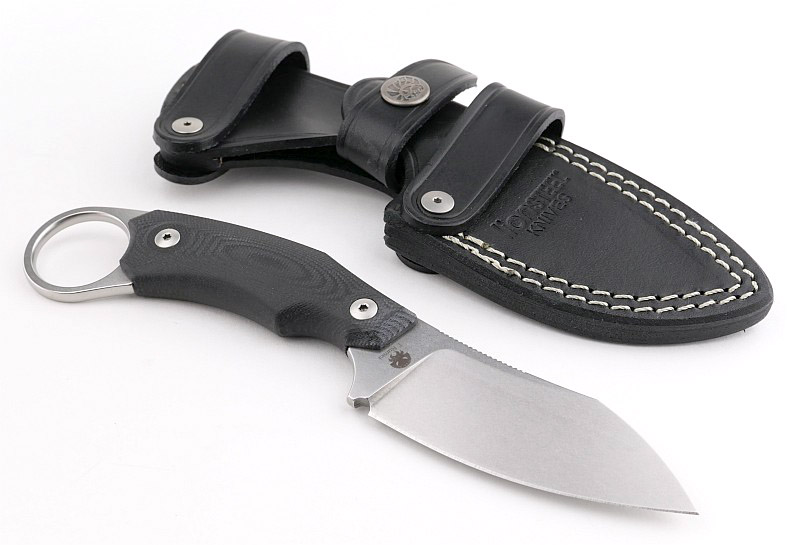
The H1’s standard leather sheath is packed full of features. Within the curved and flowing shaping of this sheath, it has a retaining strap secured with a press-stud, a ‘standard’ belt loop, along with two special loops that can be rotated and opened out to allow various belt or MOLLE carry configurations.


A good look round the optional Kydex Sheath – Things to look out for here are:
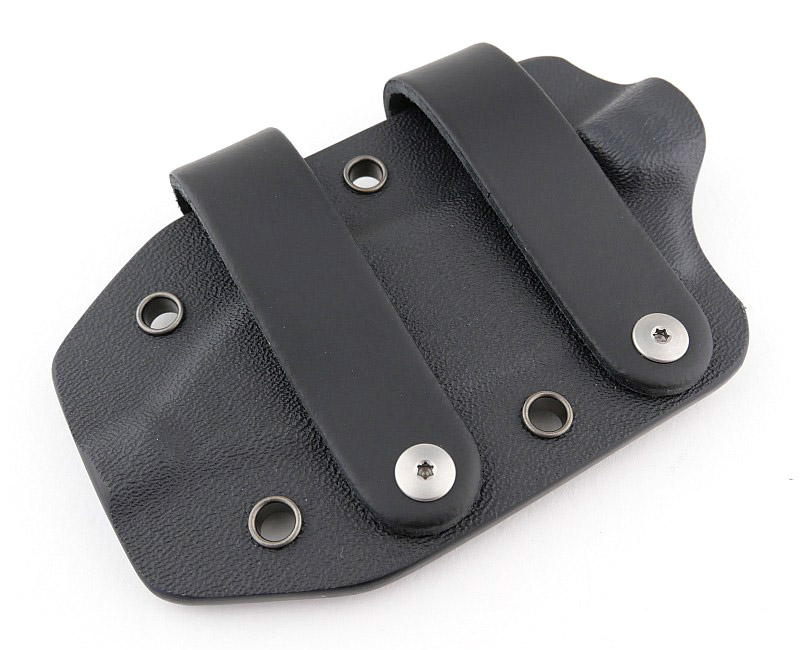
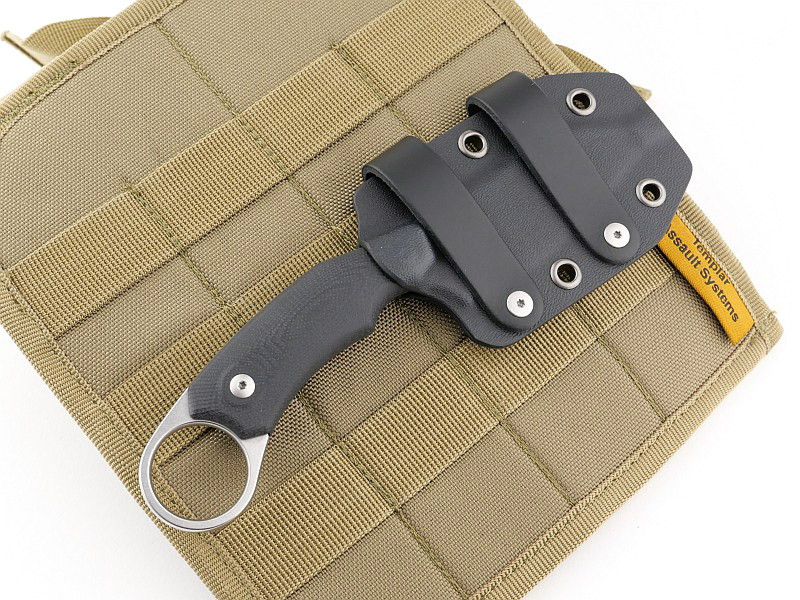
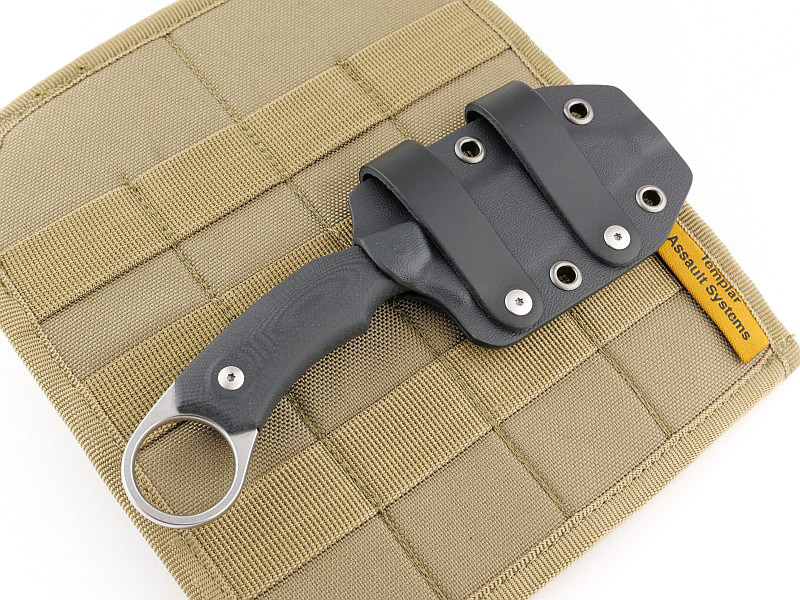
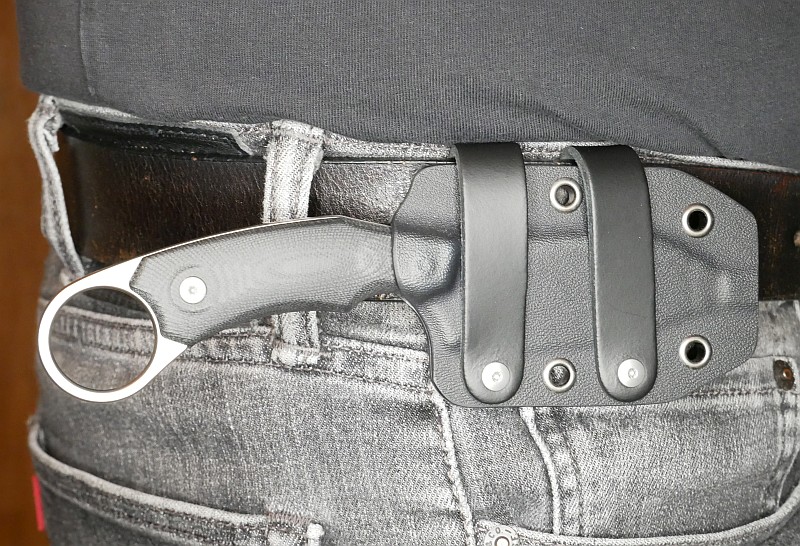
Giving you a more compact carry, the optional Kydex sheath has two special loops, like the leather sheath, that allow for various belt or MOLLE carry configurations, but without the fixed belt loop and retaining strap. The retaining strap is not needed due to the Kydex ‘clip in’ retention, so allowing for a much more streamlined sheath.


The details of the H1:
Starting off with the H1 sheathed in the leather sheath. A curvy knife in a curved and flowing sheath. Demonstrated in the last of the photos of the sheathed knife, if you are using the fixed belt loop, and if you wanted to tie-in the end of the handle tightly so it can’t catch on anything, you can swing the top loop over the end of the grip ring; not something you would do all the time, but an option.
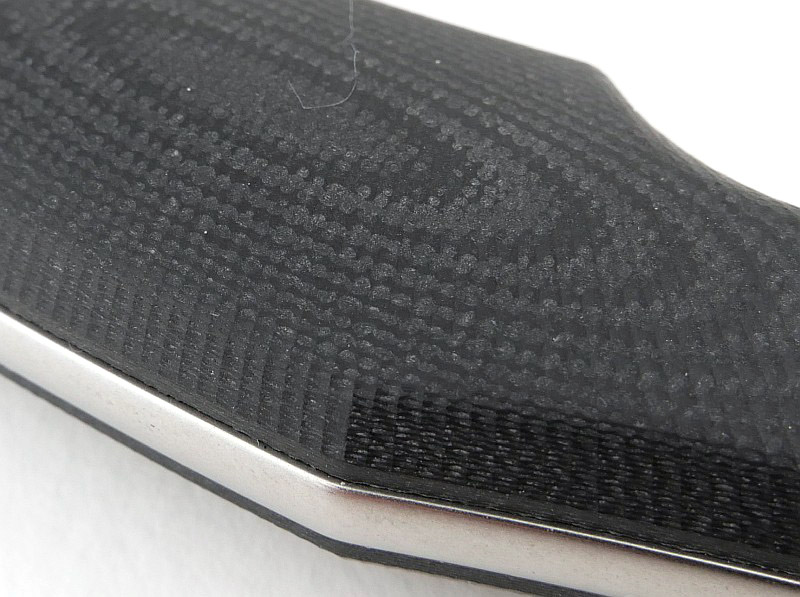
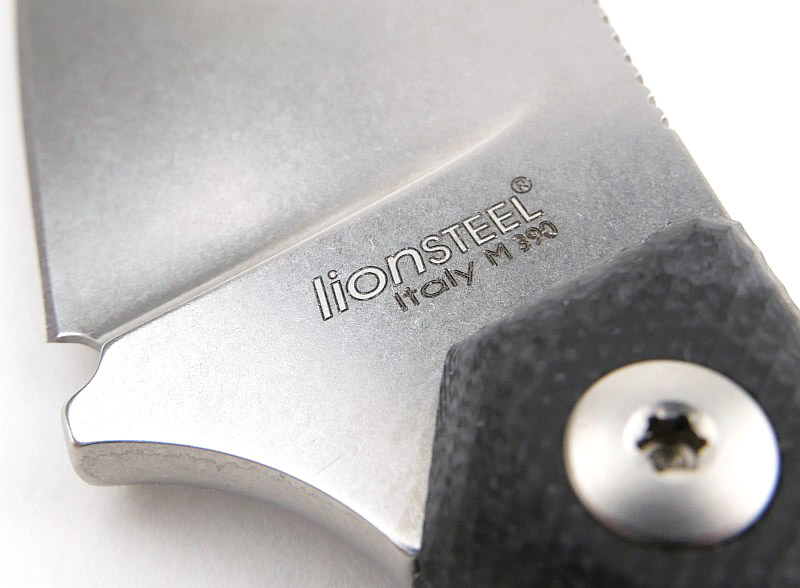
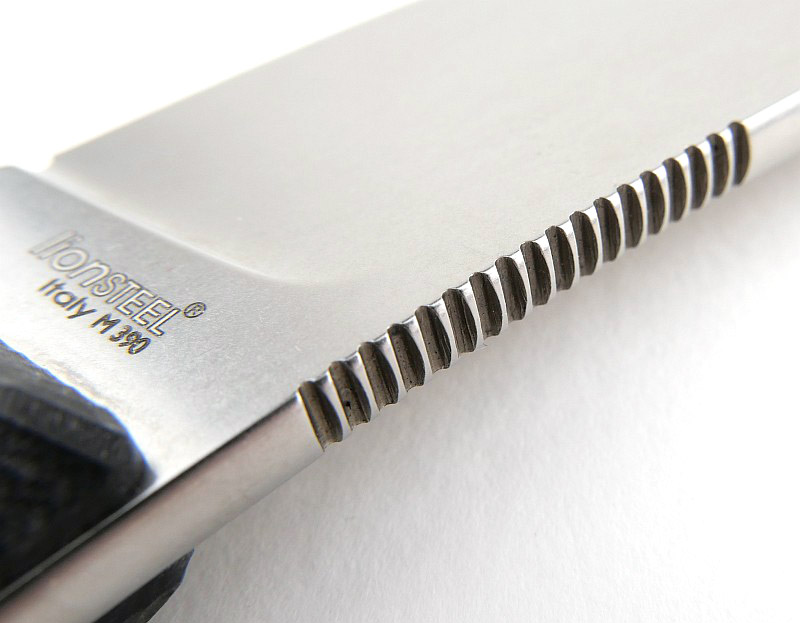
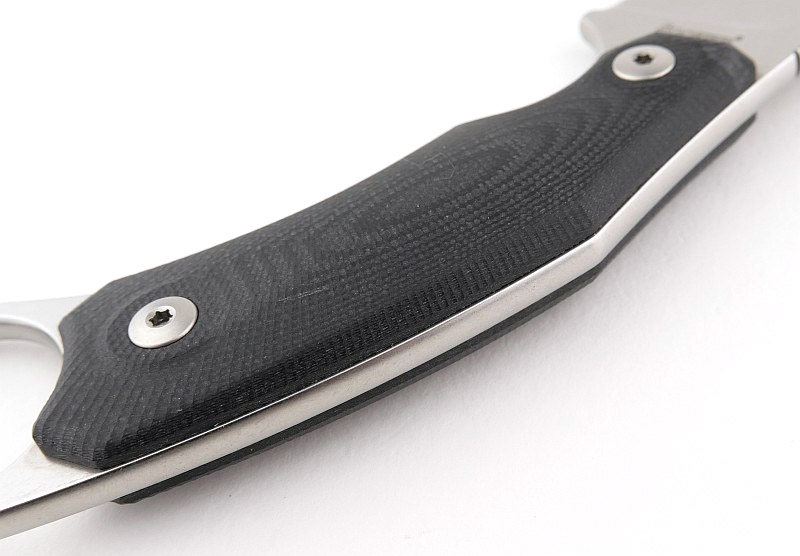
The remaining photos take in details like the engravings, plunge line, jimping, grip ring finish, handle shaping/milling/texture, plus the overall lines of this knife.


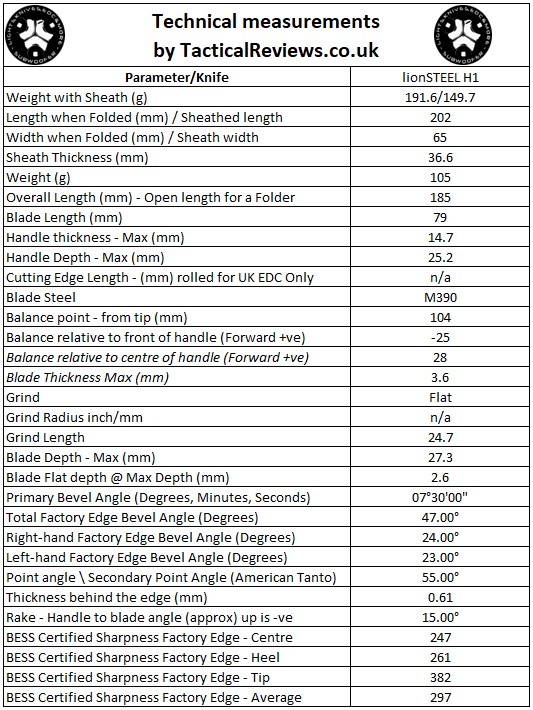
The Blade and Handle – Detailed Measurements:
For full details of the tests and measurements carried out and an explanation of the results, see the page – Knife Technical Testing – How It’s Done.


What is it like to use?
Designed to combine the secure handling of the karambit’s grip ring with a knife blade much better suited to daily EDC tasks, this make the H1 an unusual shape that you might not immediately be drawn to.
Although I started with the two galleries in this section the other way round, I decided to look at the personal carry aspect first. Shown earlier in the review, the H1 can be MOLLE carried, so this is about carry directly on your person using the belt and additional loops on both the leather and Kydex sheathes.
For me the least successful carry is the standard drop belt loop. With the angles set into the sheath, the presentation is very awkward for me, and with the leather wrapping round the handle, re-sheathing the knife tends to result in cutting into the sheath each and every time. It is quick to deploy, but not to re-sheath.
Moving swiftly to horizontal carry and suddenly everything works much better. For the leather sheath you can mount it on your hip facing backwards. The leather sheath doesn’t really work for back carry, due to the retaining strap (this is where the kydex sheath really shines).
(Just to mention these photos are all for right-handed drawing.)
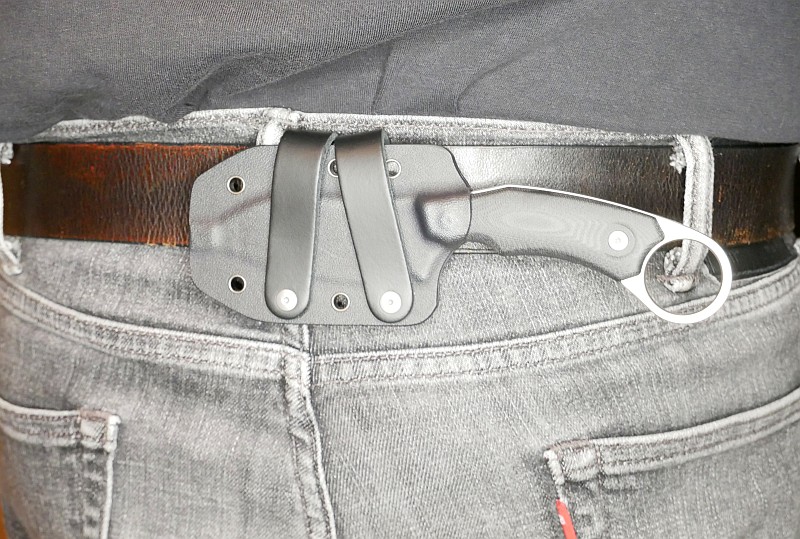
Last up is the kydex sheath on hip and back carry positions. Actually for the back carry I would have set the loops so that one was each side of the trouser belt loop to provide stability for drawing and re-sheathing. The lower profile kydex sheath is excellent, and shines in the back carry position.


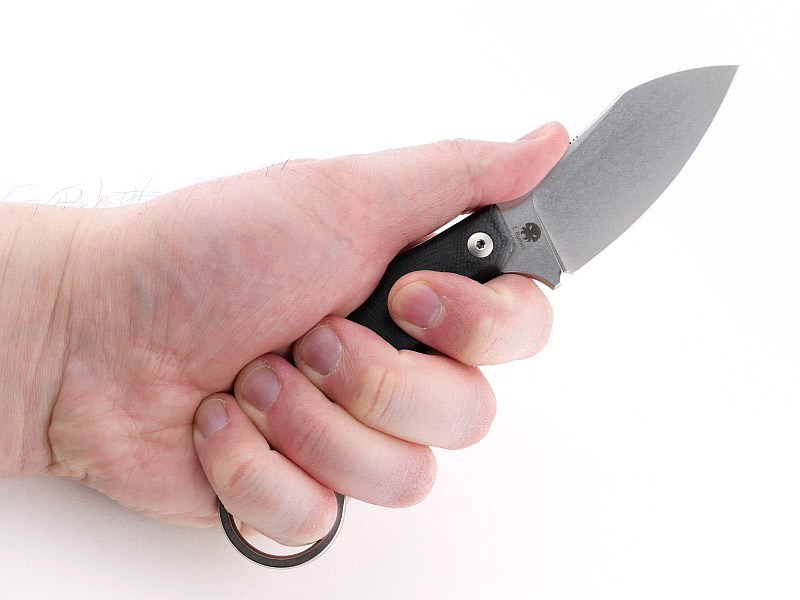
So we’ve looked at carry, and now onto handling of the H1. Yes the H1 has a grip ring, but you don’t have to put a finger through it, you can also hold it like a standard grip and use the width of the ring to control the angle the blade presents. Worth remembering and not always putting a finger through the ring.
As you can see, though I take XL size gloves, the H1 is quite a compact knife. With the curve of the blade and the jimping on the spine, the H1 sits so well in the hand making it feel a simple extension of you.
Reverse grips are as natural as forward grip, and the ring is a size and finish that makes it super comfortable however you take hold of it.


I’ve always loved lionSTEEL’s leather sheaths, and the H1’s is a very good sheath. For me though, the optional Kydex sheath takes the H1 into a different league. I would recommend getting it. (If lionSTEEL could offer a sheath choice when buying so you could get the H1 without the leather sheath and just the Kydex one, all the better.) The slim H1 definitely benefits from the much slimmer Kydex sheath. This sheath also allows for ‘in pocket’ carry which the bulkier leather sheath does not.
Handling is where the H1 really excels with the versatile grip ring and curving handle and blade shape that fits into the hand beautifully. Between the H1 and H2 (the H2 which has a drop point blade), the sheep’s foot style blade shape presets the tip of the knife very well for point work, and the curved cutting edge slices easily.

Review Summary

The views expressed in this summary table are from the point of view of the reviewer’s personal use. I am not a member of the armed forces and cannot comment on its use beyond a cutting tool or field/hunting knife.

Something that might be a ‘pro’ for one user can be a ‘con’ for another, so the comments are categorised based on my requirements. You should consider all points and if they could be beneficial to you.

_______________________________________________
What doesn’t work so well for me
_______________________________________________

Relatively bulky leather sheath.
Awkward angle of standard belt loop.

_______________________________________________
Things I like
_______________________________________________

Highly ergonomic.
Grip ring provides security.
Optional Kydex sheath (recommended).
M390 blade steel.
Slim and easy to carry.
Horizontal belt mounting.
MOLLE compatible.
Adaptable sheath mounting loops.

 
Discussing the Review:
The ideal place to discuss this review is on the Tactical Reviews Facebook Page
Please visit there and start/join the conversation.
As well as the Tactical Reviews Facebook Page, please consider visiting one of the following to start/join in any discussion.

BladeForums – Knife Reviews (US based Forum for Knife Discussion)

CandlePowerForums – Knife Reviews Section (Largest and Friendliest Flashlight Community Forum)

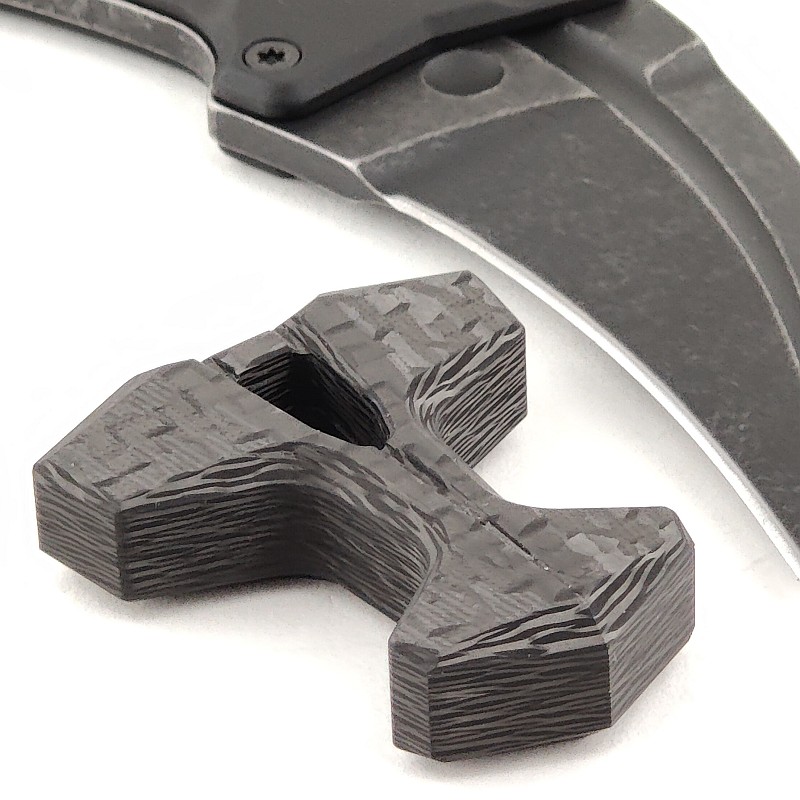
Gear Review: Mjolnir III by Ostap Hel Knives

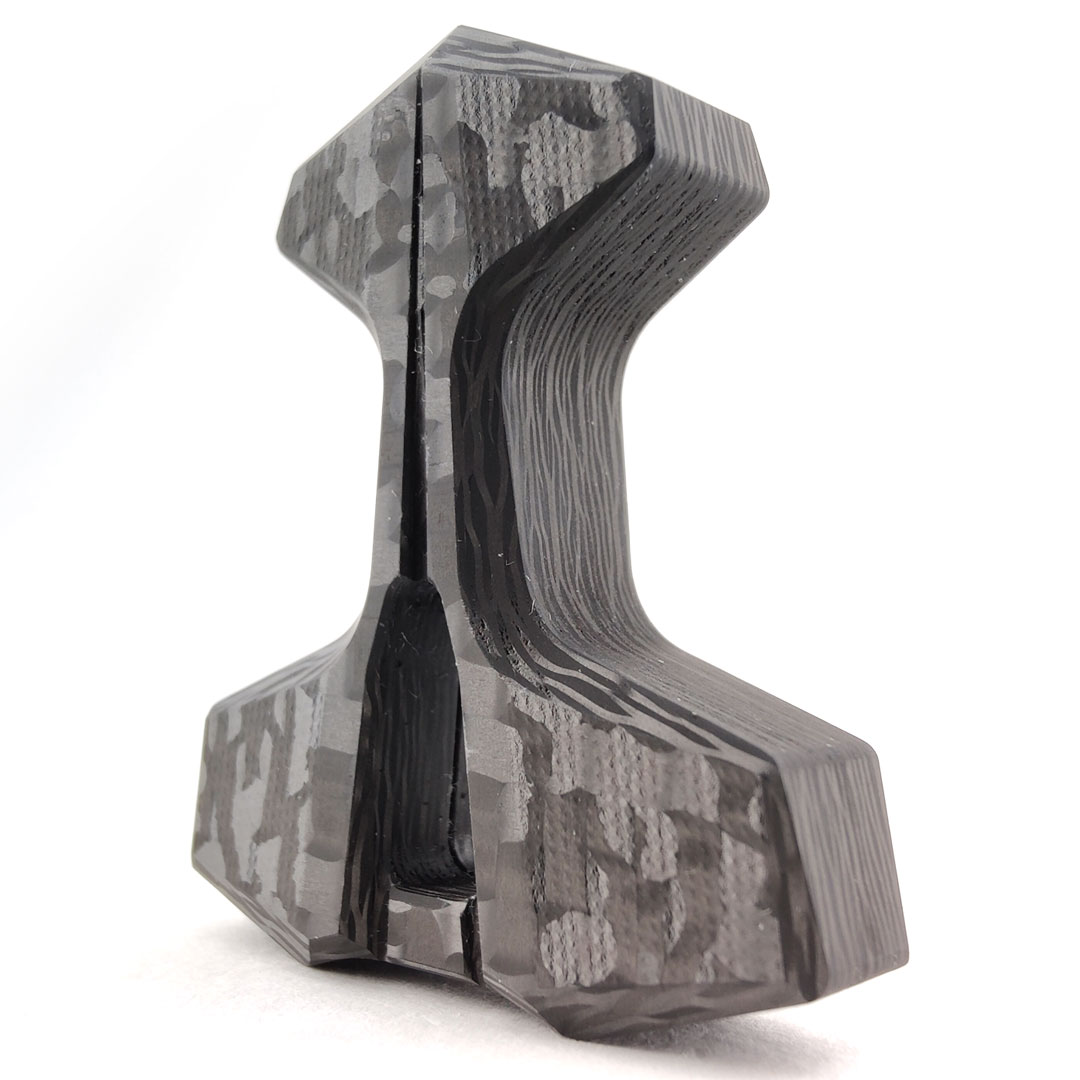
When it comes to EDC pocket jewellery, nothing beats a hand-made custom piece, and I’ve had my eye on the Mjolnir from Ostap Hel Knives for some time. Yes, Mjolnir is Thor’s hammer, and being capable of a knockout blow is very appropriate association, but of course the shape of Ostap’s Mjolnir is also like the old Norse symbols.
Join me in this review of the Mjolnir III from Ostap Hel Knives, the featured version is in carbon fibre.

Video Overview

This video is a detailed look at the Mjolnir III, and hopefully you can get a good feel for the quality of finish.


What it is like to use?
Without saying exactly how you might use the Mjolnir III (due to some more negative connotations), it is both EDC pocket jewellery and a self-defence aid.

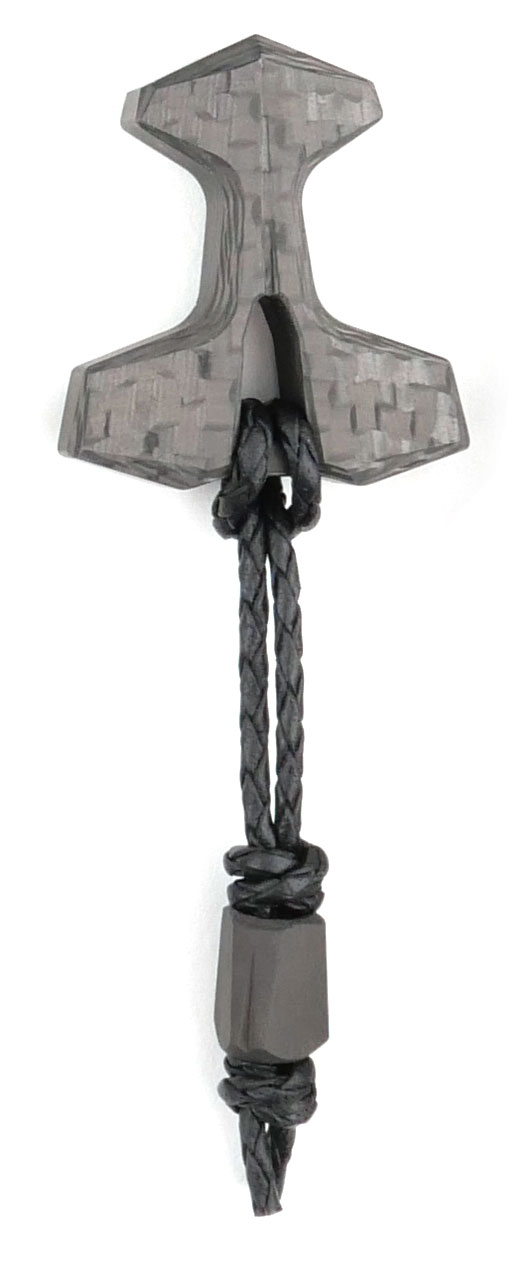
The intended configuration for carrying the Mjolnir III is on its own with a lanyard, added for ease of getting it into your hand when needed. Shown here, it has the matching lanyard from Ostap Hel Knives which has a CF bead on the cord. With the CF version being so light, it has minimal pocket presence so can also feel a little difficult to home in on. So…

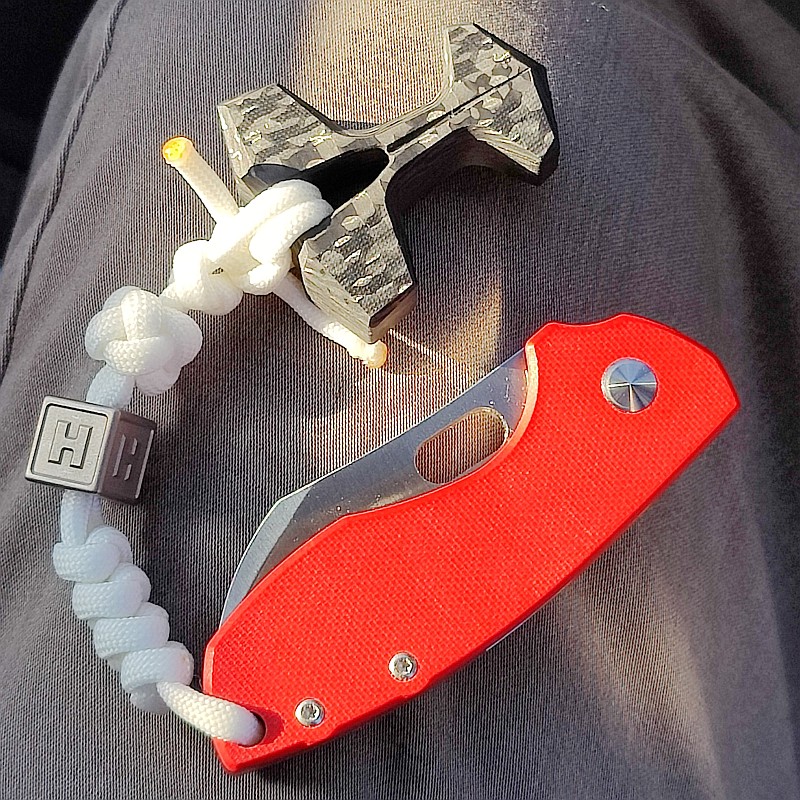
…picking up on the fact it has felt a little ‘detached’ from easily finding the CF Mjolnir III in my pocket, I wanted to try something a bit different and out there, and fit it as a lanyard stopper on another EDC item. In this case a slip-joint knife which already had a longish lanyard on it.
In this way, the knife provides the weight for easily finding it, and the Mjolnir III makes a fantastic ‘puller’ for getting the knife to hand, but also for then ease of getting the Mjolnir III into your hand.
Reversing the sense that the Mjolnir III is the lanyard stopper round to the knife being the lanyard stopper, and you can either allow the knife to hang out to the side, or take it into you palm while gripping the Mjolnir III between your fingers.
You can experiment with the lanyard length to see how it might work for you if you try this approach. Here the loose ends of the paracord are not yet woven into the lanyard to more easily allow adjustments before making the final configuration.
It has worked for me, it might work for you; try it before completely dismissing the idea.

Regardless of how you choose to carry it, the Mjolnir III is a pleasure to handle and carry. Despite there being no moving parts, it can be a worry-stone or fidget toy, as well as having an actual serious purpose – definitely worth the investment in a quality piece.


Review Summary

The views expressed in this summary table are from the point of view of the reviewer’s personal use. I am not a member of the armed forces and cannot comment on its use beyond that covered in the review.

Something that might be a ‘pro’ for one user can be a ‘con’ for another, so the comments are categorised based on my requirements. You should consider all points and if they could be beneficial to you.

I’m trying something slightly different and starting with what doesn’t work so well, so I can finish on a more positive note.

_______________________________________________
What doesn’t work so well for me
_______________________________________________

What is not to like?

_______________________________________________
Things I like
_______________________________________________

Beautifully crafted.
Choice of materials.
Easy to carry.
Might make all the difference in a tight situation.
Low profile.
Thor’s hammer in your pocket.

 
Discussing the Review:
The ideal place to discuss this review is on the Tactical Reviews Facebook Page
Please visit there and start/join the conversation.
Light Review: Nitecore TM20K – 20,000 Lumens!

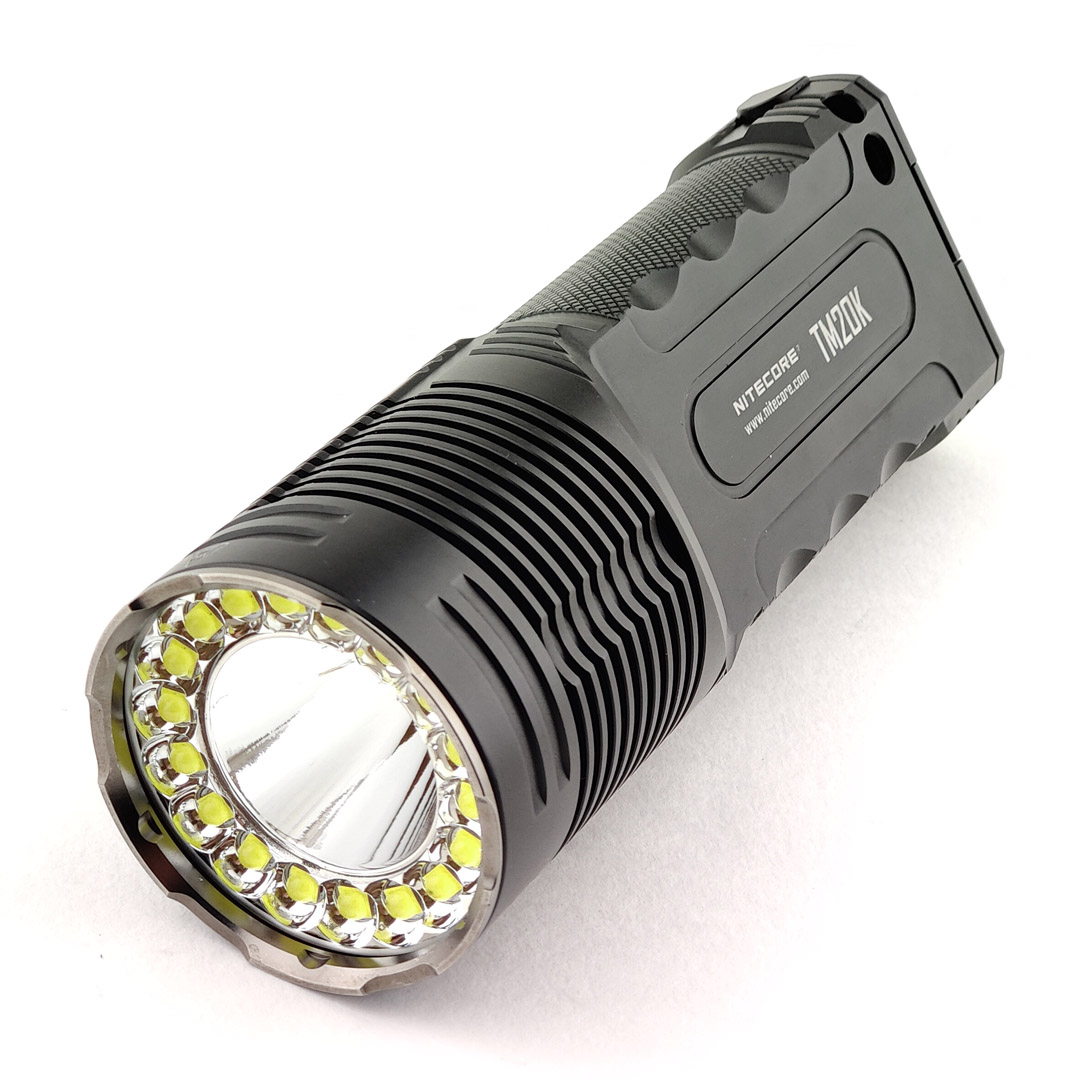
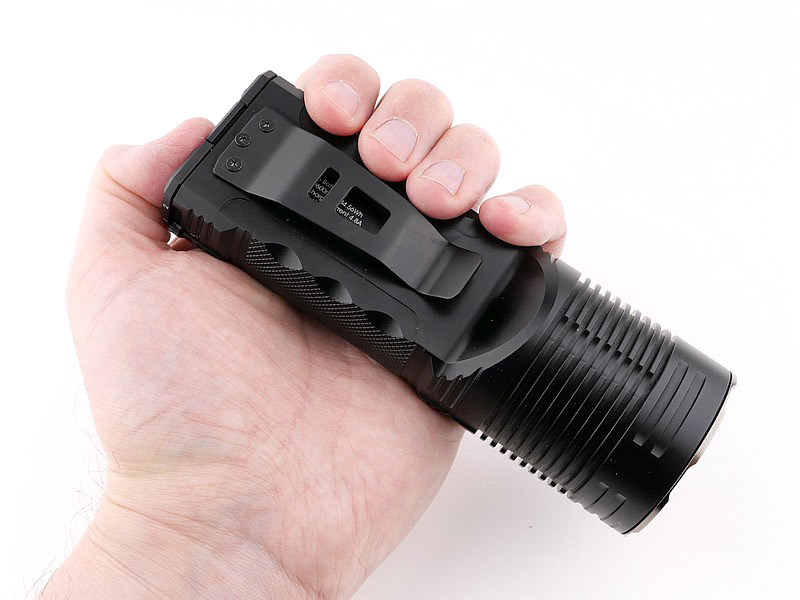
Nitecore’s Tiny Monsters have always been punchy performers, from the first one I tested, (the TM11) all the way through to another Monster light that is Tiny compared to its output. Join me in this Nitecore TM20K review, 20K being the 20,000 Lumens, yes, 20,000 Lumens output from a palm sized light. As well as a look round the TM20K, this review includes output measurements, runtime graphs, and beamshots to give you the true story of its performance. It really is a Monster!

Video Overview

This video is an overview of the TM20K with a first look over the light before we get onto more details and the measurements.


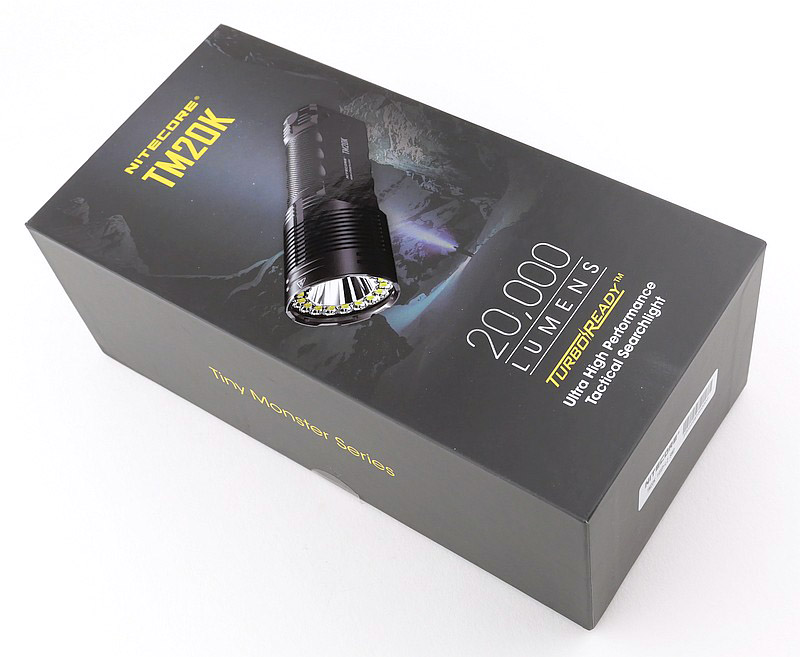
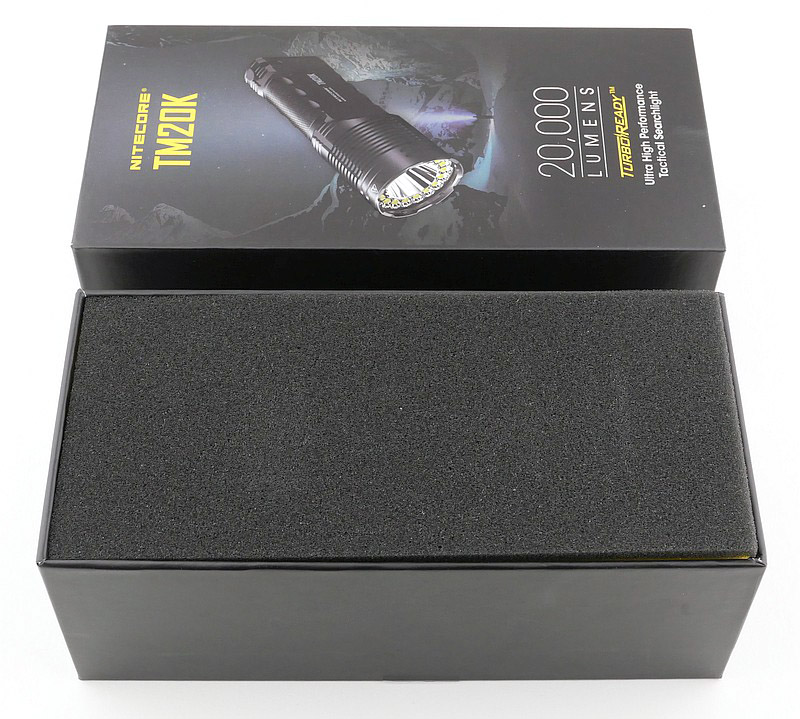
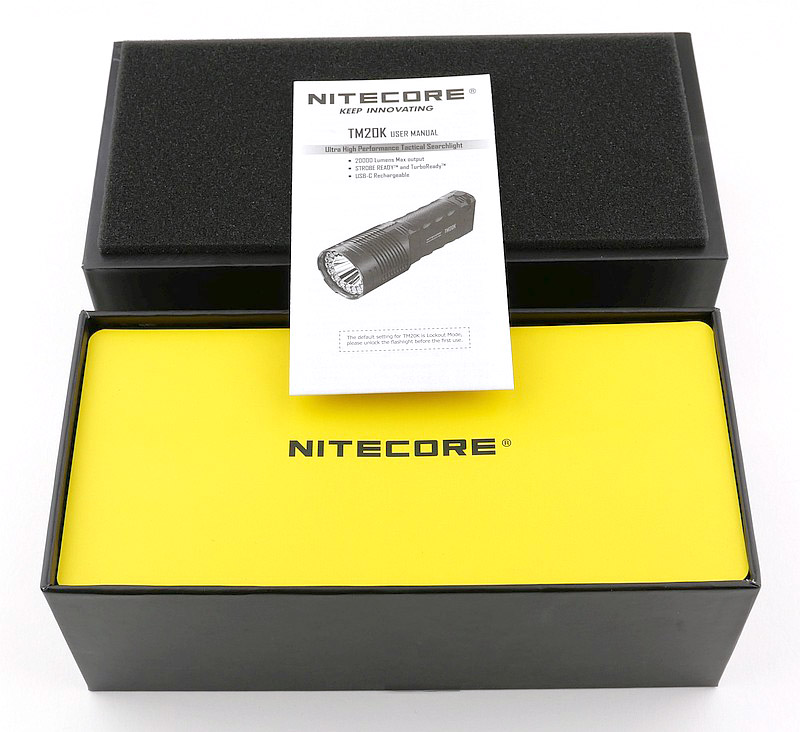
What is in the box?:
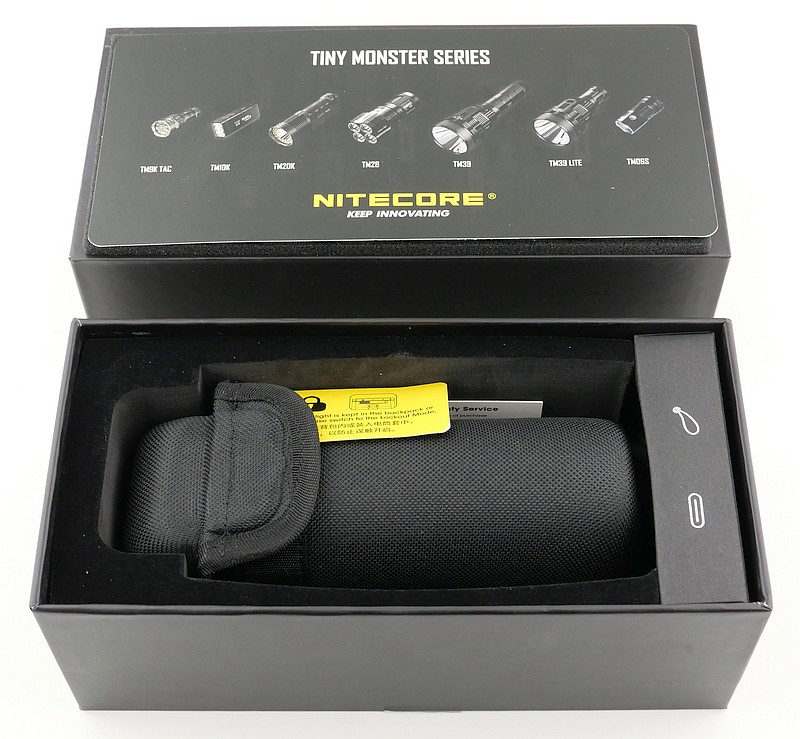
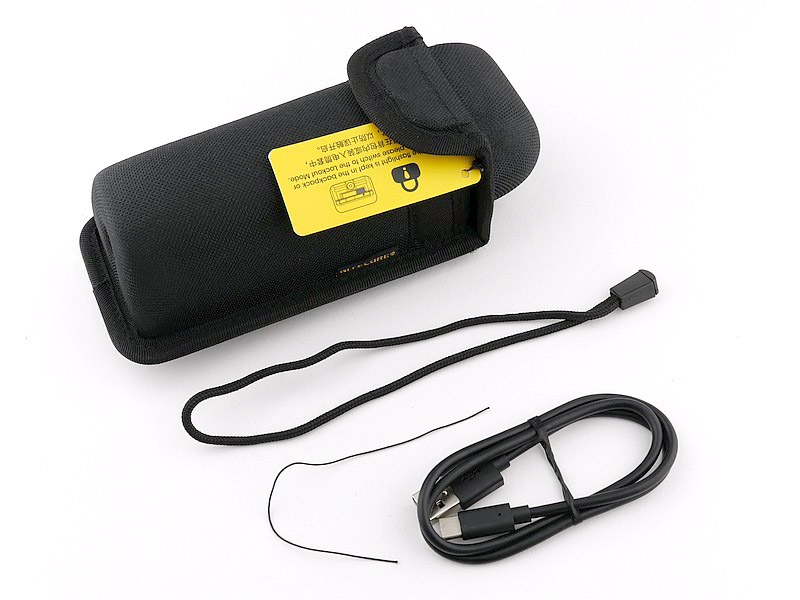
This gallery shows the TM20K’s packaging and what is included. The holstered TM20K, a USB-C charging cable, a lanyard, and a thin cord for threading the lanyard.
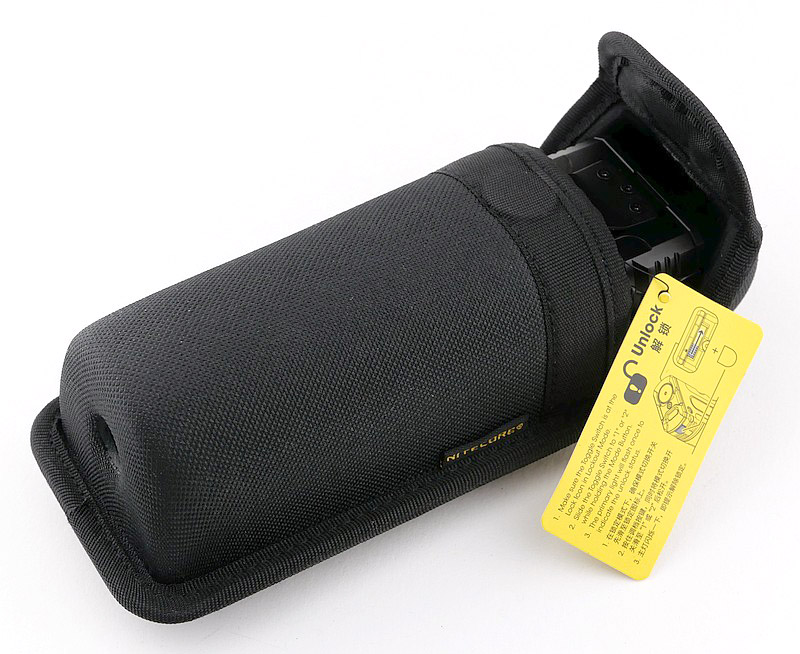
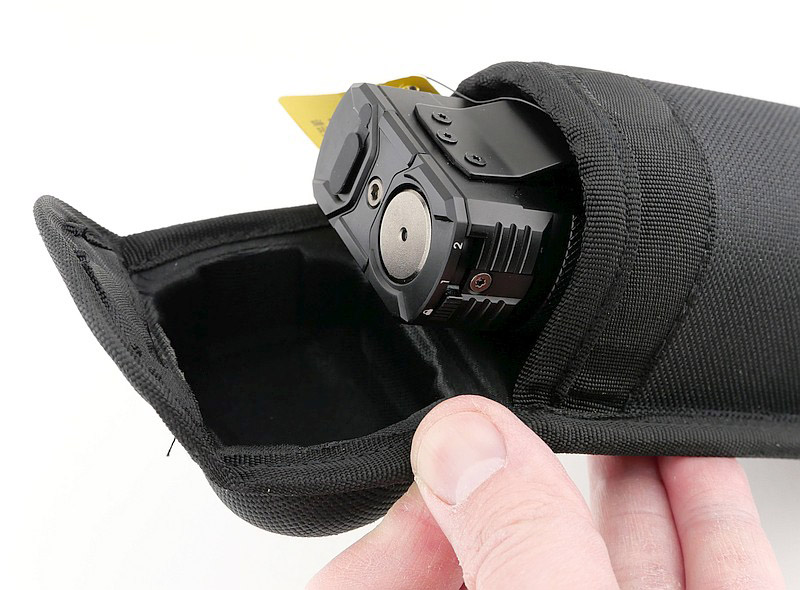
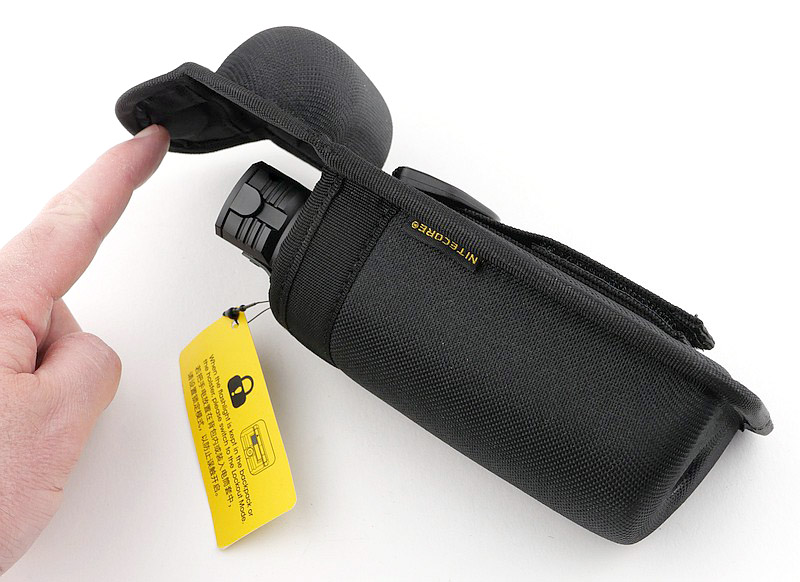
There is also a look over the belt holster and how the top flap opens.


A good look round the TM20K – Things to look out for here are:
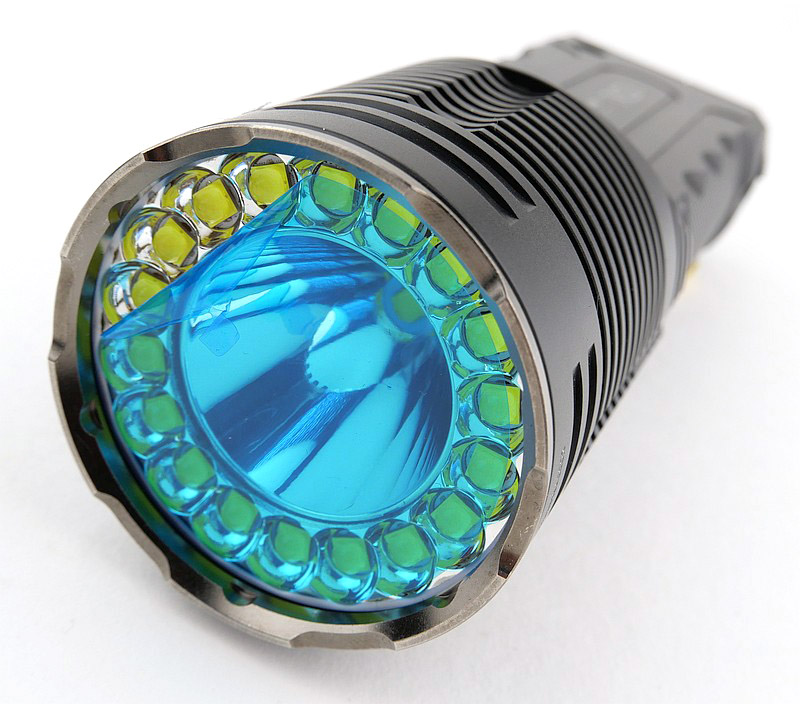
First, do not turn the TM20K straight on out of the box! There is a blue protective plastic film over the lens that will melt and make a mess of the front of the light, so make sure to take this off.
The body of the TM20K is a single piece, and this is not broken by any battery doors, as the TM20K has a built-in battery and is USB-C rechargeable.
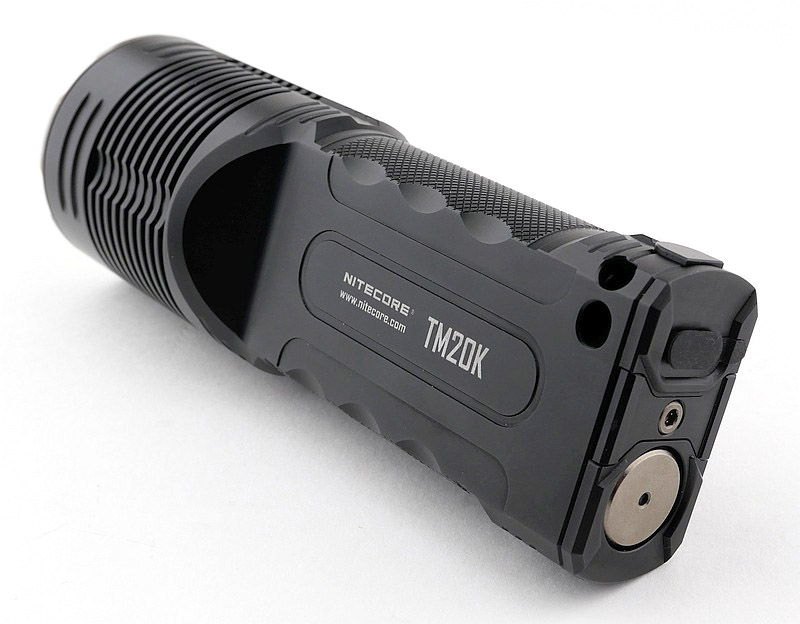
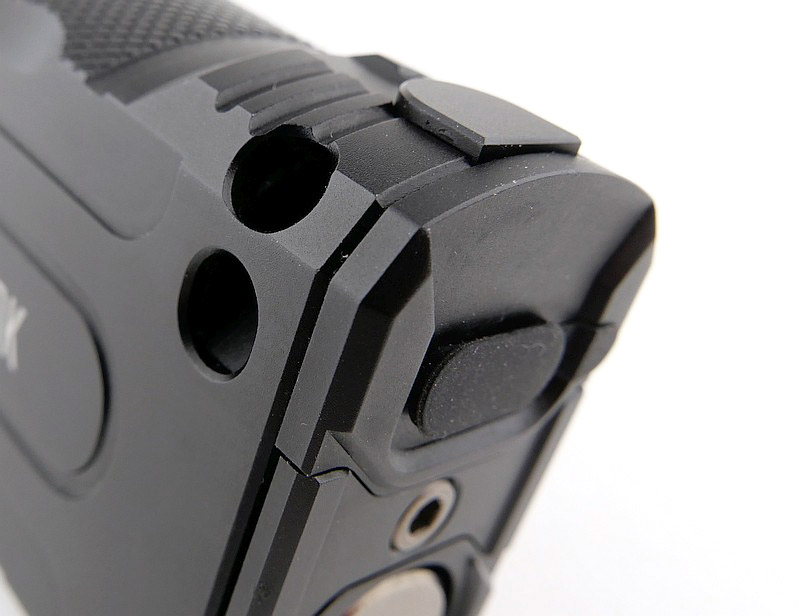
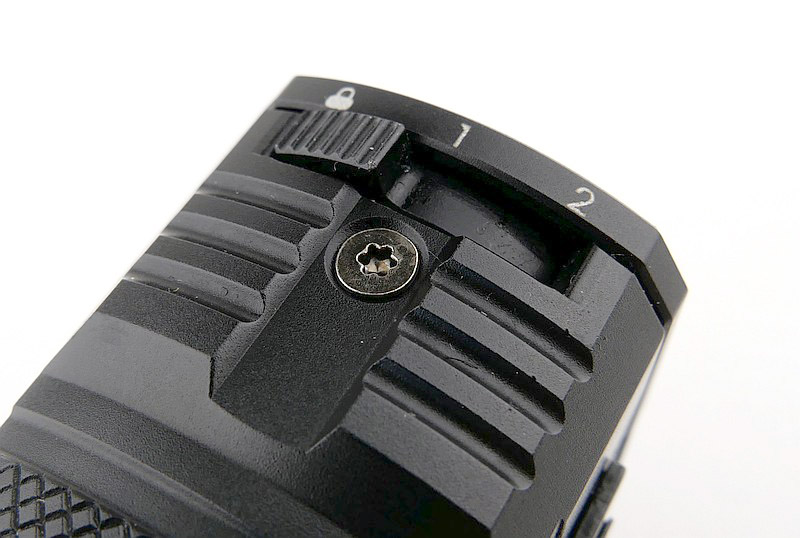
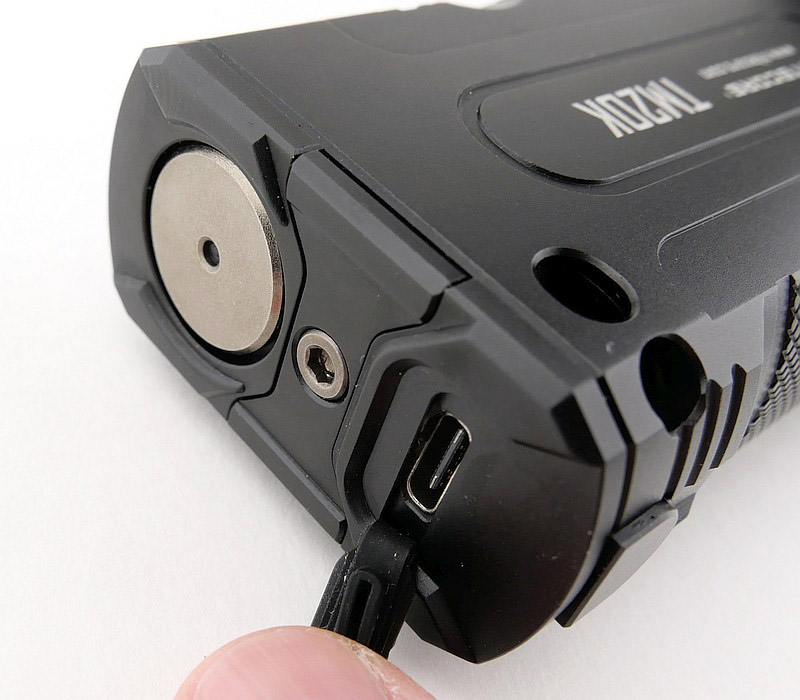
The lanyard hole is next to the charging port and mode switch. On the opposite side to the mode switch is the selector toggle switch with lockout setting.
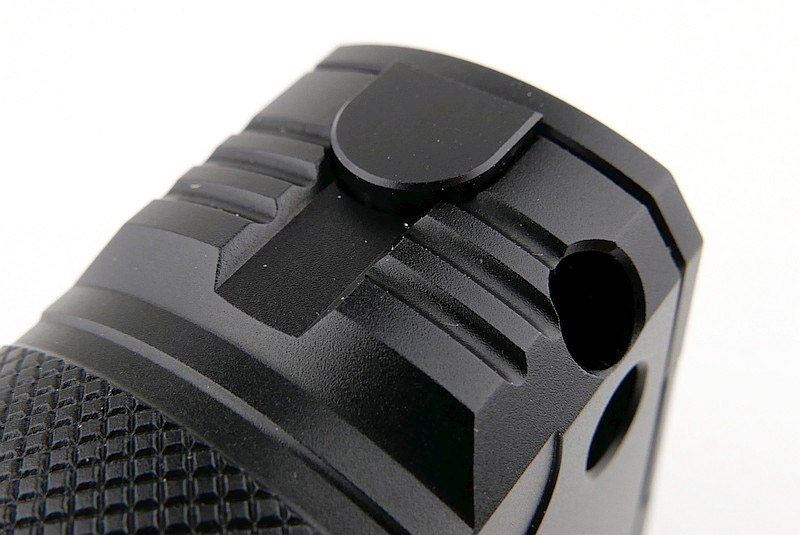
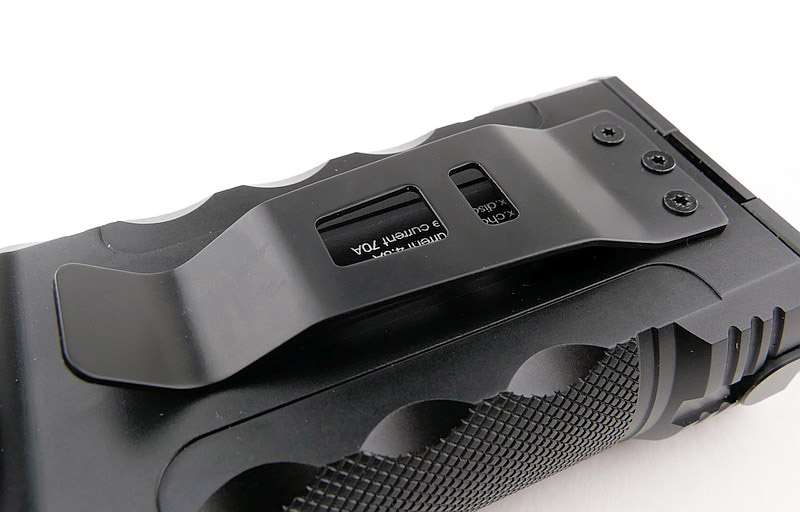
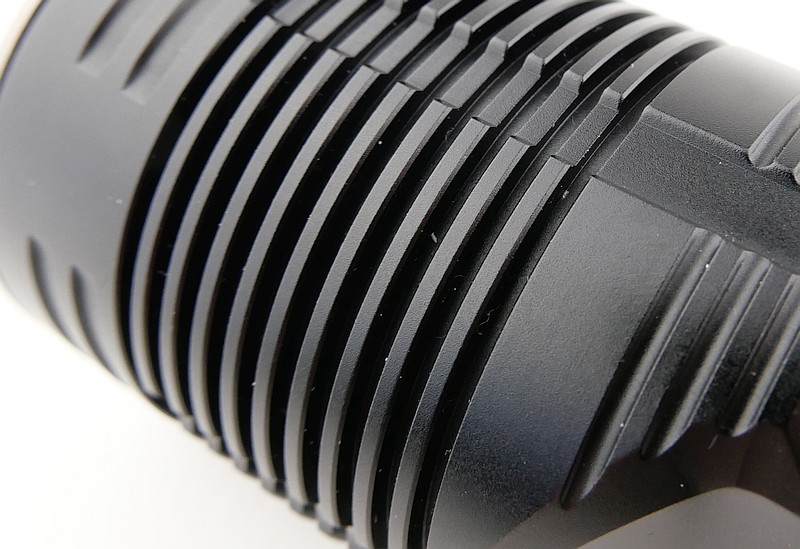
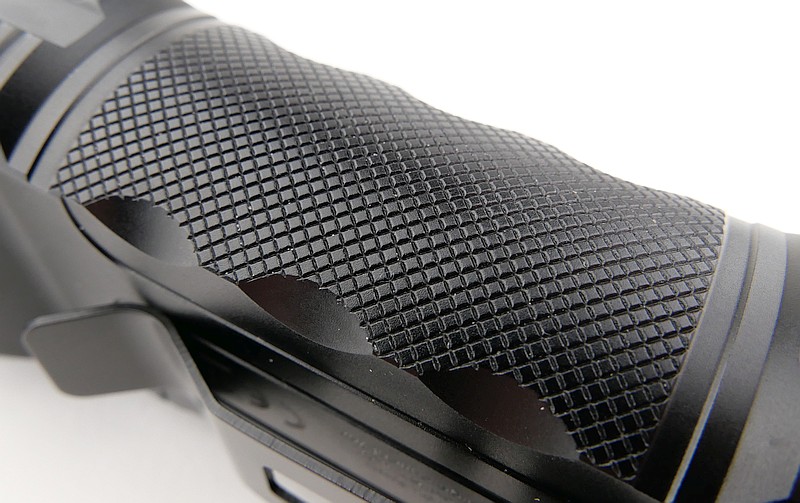
One of the flat sides has a wide steel belt clip. Also shown are the small heat sink fins and grip knurling.
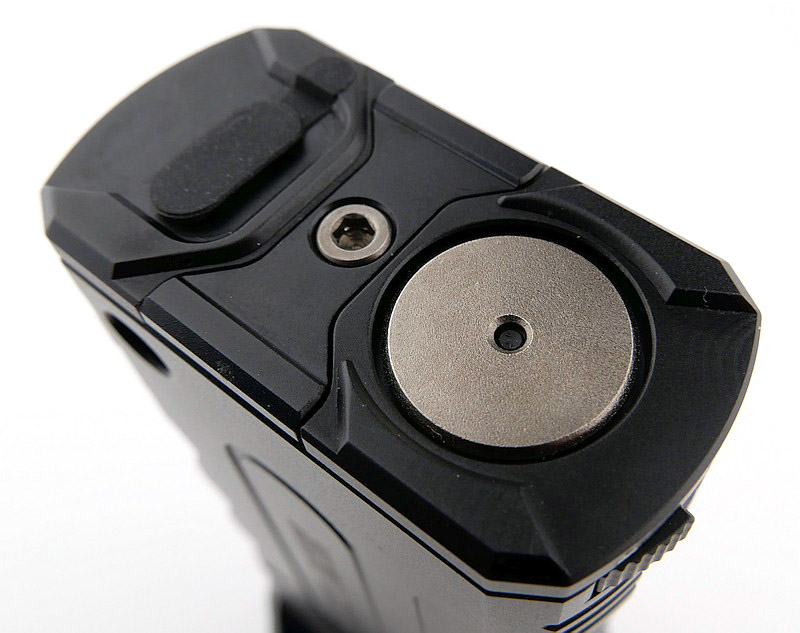
On the tail of the TM20K you find the power button, tactical switches and the charging port.


The beam

Please be careful not to judge tint based on images you see on a computer screen. Unless properly calibrated, the screen itself will change the perceived tint.

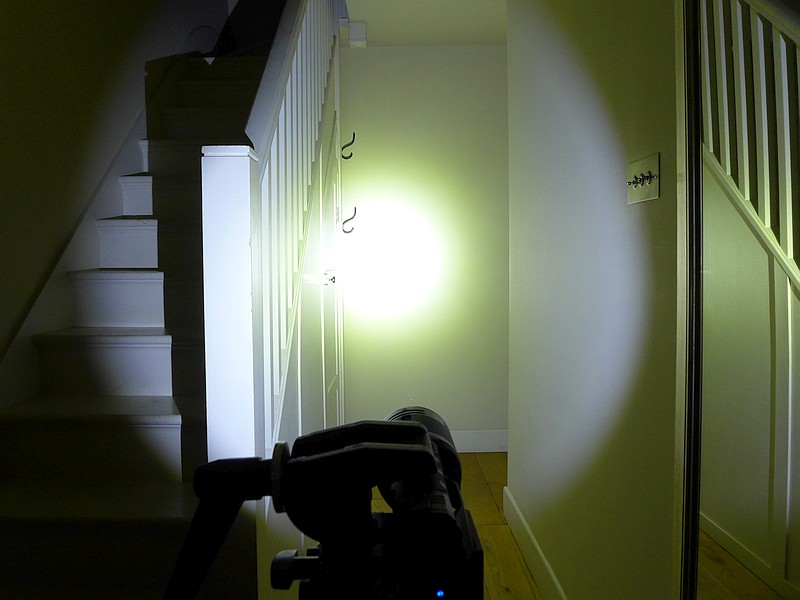
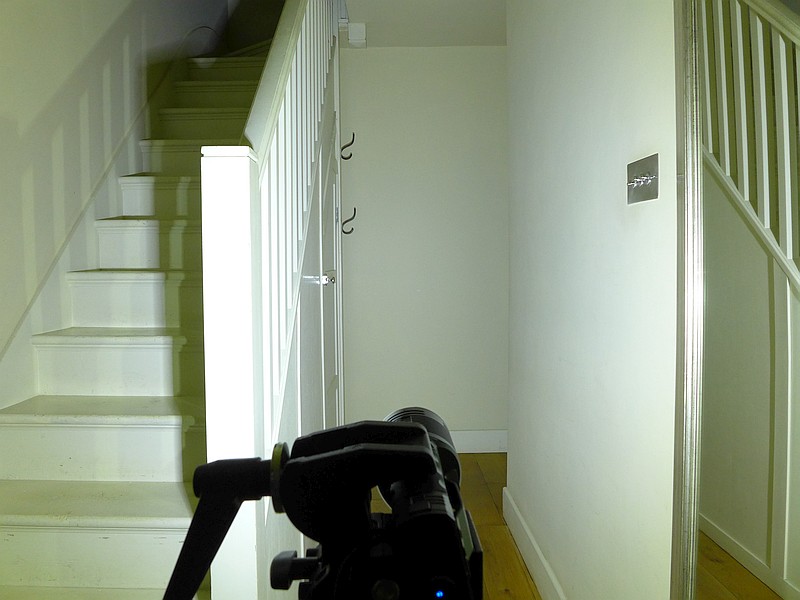
The indoor beamshot is intended to give an idea of the beam shape/quality rather than tint. All beamshots are taken using daylight white balance. The woodwork (stairs and skirting) are painted Farrow & Ball “Off-White”, and the walls are a light sandy colour called ‘String’ again by Farrow & Ball. I don’t actually have a ‘white wall’ in the house to use for this, and my wife won’t have one!

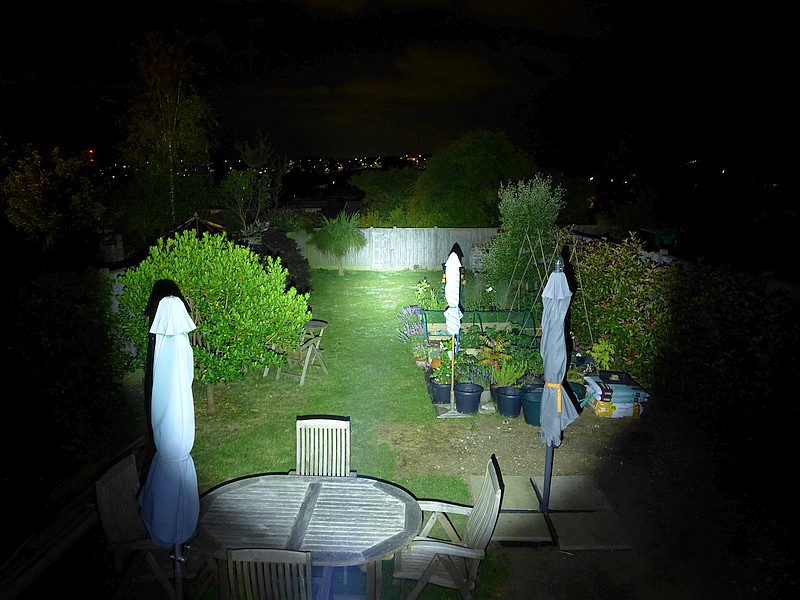
For the beamshot comparison I used three output modes. The Daily mode ‘Floodlight’ and ‘Spotlight’ special output levels plus the ‘Turbo’ 20,000 Lumen mode.

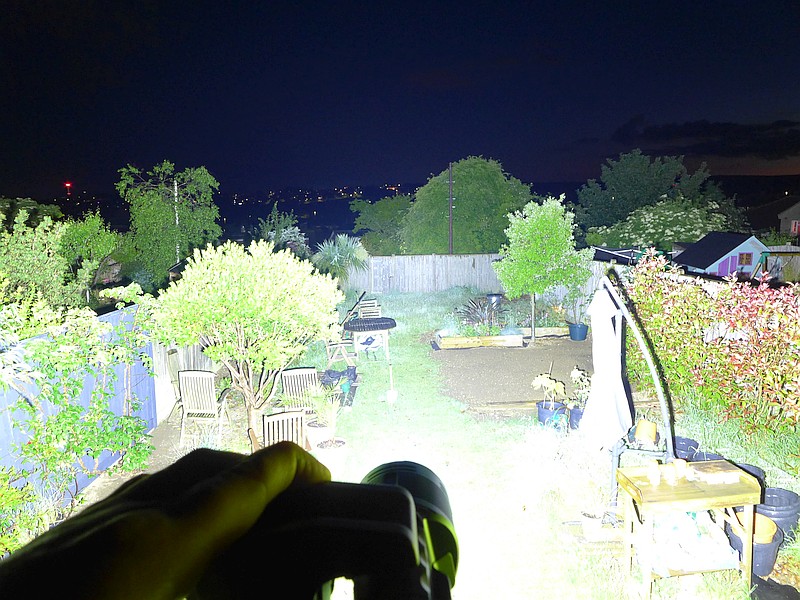
Indoors are only the ‘Floodlight’ and ‘Spotlight’ modes as Turbo is too bright. Then moving outdoors with the same modes (around the 2,000 Lumen level), and then with the same exposure, the Turbo output. 20,000 lumens really lights things up!!


Batteries and output:

The TM20K runs on a built in battery made of 2 x 21700 4800mAh cells.

Please note, all quoted lumen figures are from a DIY integrating sphere, and according to ANSI standards. Although every effort is made to give as accurate a result as possible, they should be taken as an estimate only. The results can be used to compare outputs in this review and others I have published.

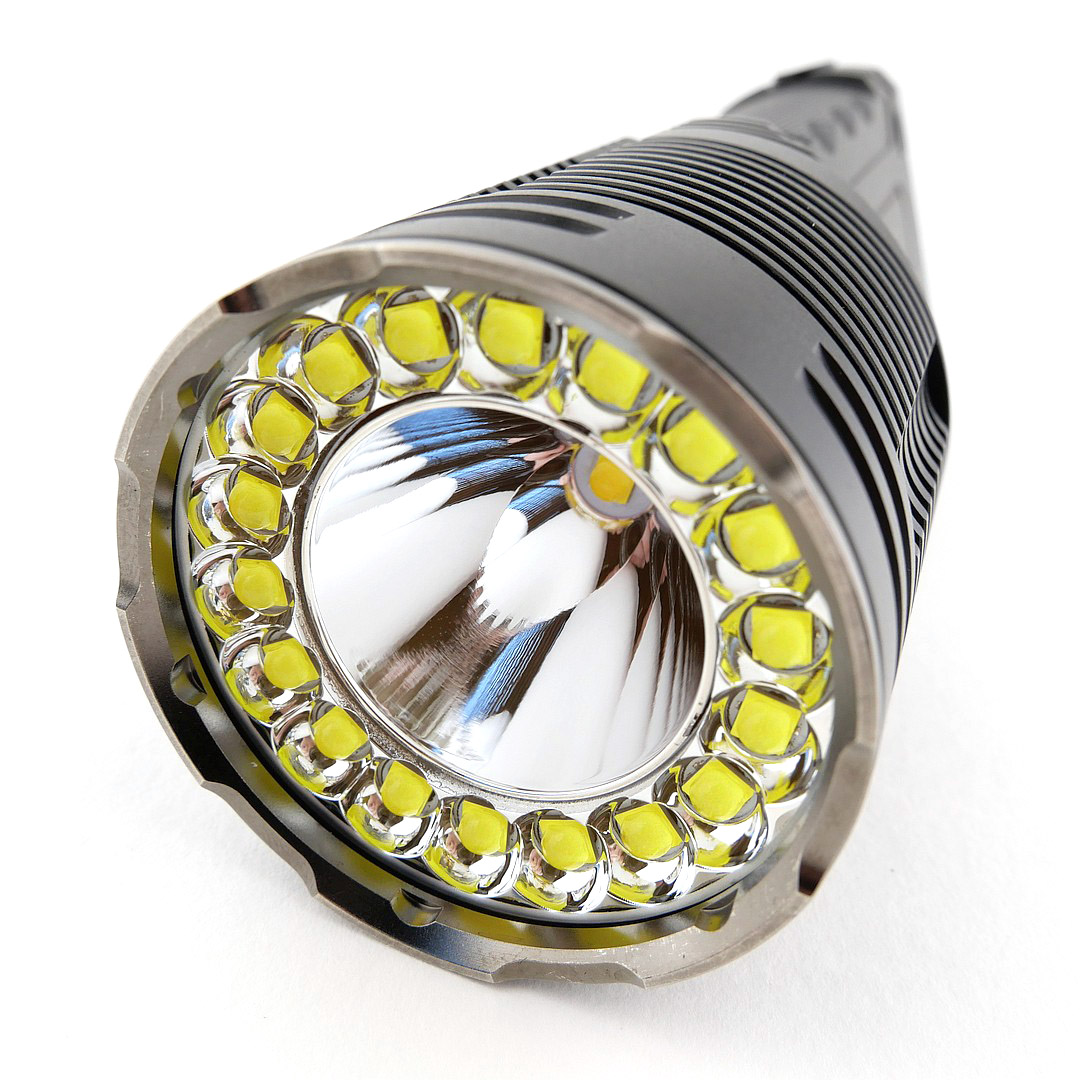
19 XP-L2 LEDs to blast out 20,000 lumens.

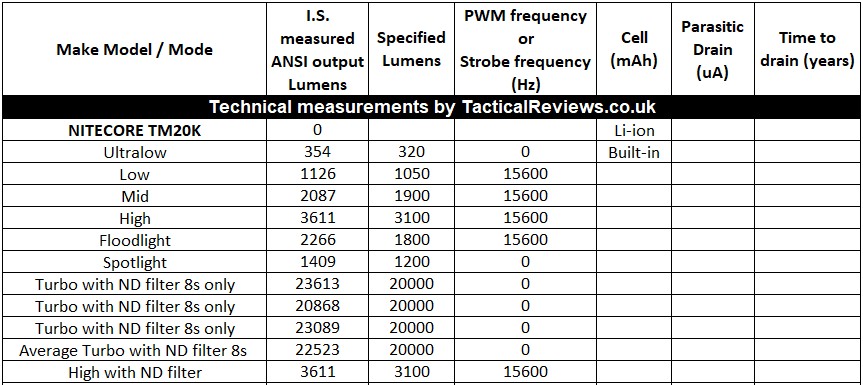
When working with any lights with an output over 5,000 lumens, I need to make modifications to the integrating sphere. For the TM20K, due to the extreme output and small size, it is limited to short bursts of the 20,000 lumen Turbo output. So the output table is a little different to most of the reviews I carry out.

Half the table is normal, then where it starts to list an ND filter, this is a ‘neutral density’ filter that simply cuts the light reaching the sensor by approximately 90%. Reference readings are taken to ensure the filter factor is correct, and a set of measurements were taken. With the short 8s burst of Turbo, several readings were taken and averaged. All of this is included in the table.

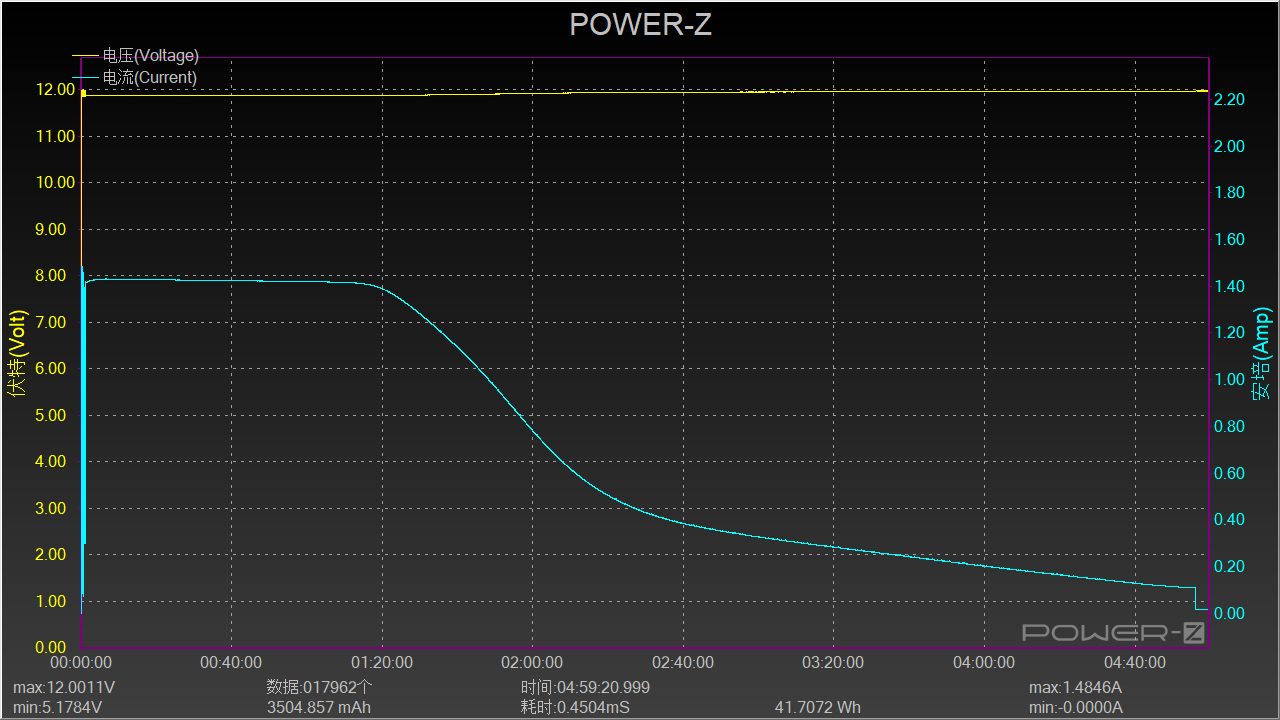
The graphs in this gallery show a few different things. First is a trace of the charging current consumed when charging the TM20K.
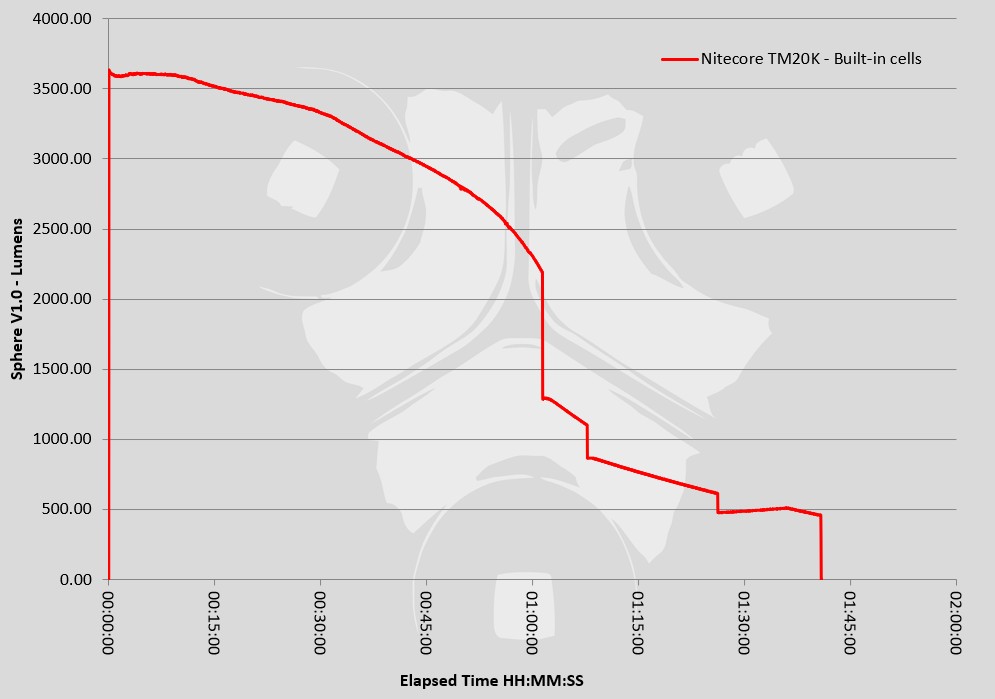
Next up is the runtime trace for High output. Due to the Turbo output being a burst mode only, for the full runtime, the graph shows the output for the high output level.
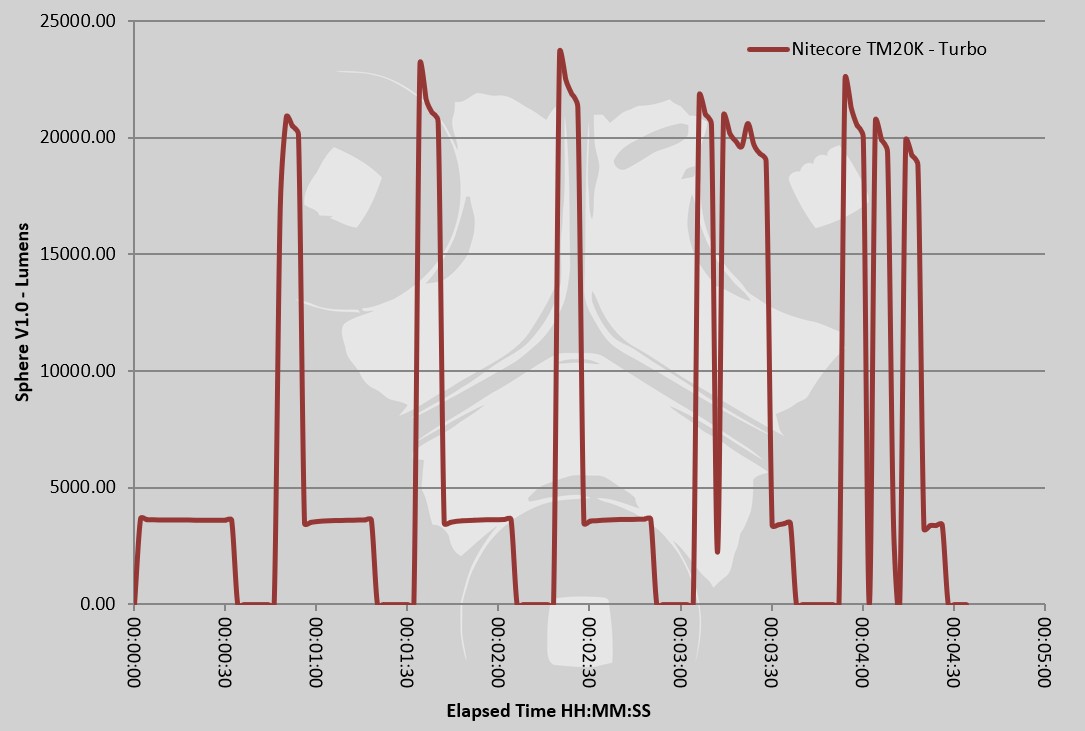
Now we have two copies of the same graph, the first shows all the traces taken to check the behaviour during the ANSI 30 second measurement time.

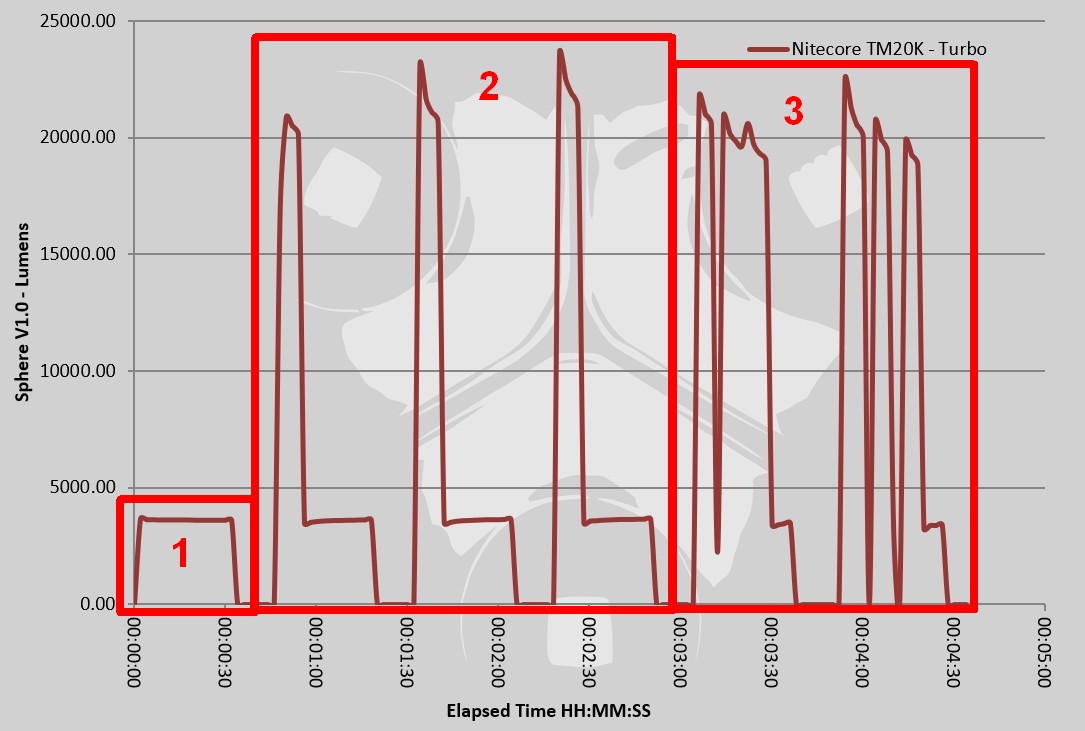
Shown first is an initial ‘High’ ANSI output trace (Section 1), then the Turbo button held for 30s (Section 2) where the output drops to High after 8s. Section 3 shows what happens when you intentionally use Burst, Burst, Burst until the TM20K won’t output Turbo any more.

As the ANSI output should be measured at 30s, the 8s Turbo output would mean ‘ANSI Turbo’ measurement was 3611 lm, so this means we can’t actually state an ANSI Turbo output and instead I have gone for ‘max at switch on’ for the value of Turbo, and this is what was used in the output table.


The TM20K in use

20,000 lumens in the palm of your hand, here it is:

And as a starting point I have to say the TM20K is scary bright! As well as that it heats up so quickly on Turbo you really know this is pumping out the power.

Being about the size of a 2x 18650 light used to be, the TM20K is noticeably heavier and more dense than this older class of light, a sign it is packed with performance.

The supplied holster is very nicely made and is a rigid style with flip-top lid style opening. When belt mounted you need to pull the holster body away from you to allow the lid to hinge open far enough to get the TM20K out. This might have worked better flipping open away from you. The magnetic closure is a nice touch and allows for silent opening (without the ‘tearing’ sound of Velcro).

One of the most important features for a light like this is the lockout; yes the ‘not outputting any light’ feature. Absolutely critical as the output is so high, if contained it will be dangerous.

Lockout should always be easier to activate than to deactivate, and Nitecore have made it very easy. Slide the toggle switch to the padlock and once it has been there for 2s the TM20K is locked.

While locked, if you slide the toggle to 1 or 2, the power button flashes five times to let you know it is locked. Unlocking requires two switches to be used at the same time. Holding the mode switch down as you slide the toggle switch from lockout to position 1 or 2 with the beam turning on briefly to let you know unlocking was successful.

All of that to talk about the TM20K not outputting anything, well, you will be very happy about this feature.

In terms of handling and the interface, although the TM20K lists ‘tactical’ modes, the layout of buttons and ease of access to them would not be my choice for use in a pressured situation. General use, and even search and rescue use, but not reaction or time critical scenarios where you might miss buttons or press ones you didn’t mean to.

Onto those 20,000 lumens. You get a burst of 8s at this level. If you immediately reactivate Turbo, you can do this two further times (three times before a cooling off period) where the thermal protection prevents the TM20K from going above High mode even using the Turbo button. So from cold, 24 consecutive seconds of 20,000 lumen output. Measured and confirmed as shown in the output table and graphs, all from a palm sized light. This is seriously impressive.

Going to the other extreme, I would have preferred a mode lower than 350lm. This is the ‘ultra-low’ mode on the TM20K. Even if you are breaking out the Tiny Monster, there is still a practical lower level for every day use and 350lm is too high, so this is a light to bring out when you want a lot of light.

Considering the size, that performance on High giving a hour of solid output, 45 minutes of which is over 3000lm, does make this a workhorse, even if you ignore the Turbo output.

Not forgetting my previous comments about the tactical mode, the momentary output in this mode is great for searching especially when other people are around and you don’t want to blind them.

My preference is always for removable/replaceable batteries, but the other side to this is the guaranteed performance of the cells chosen by Nitecore to power this Tiny Monster, and the simplification of the design as it doesn’t need a battery door. Being a super high performance light, the cell characteristics are critical, so we can take the built-in cells as a positive point.

20,000 lumens is shocking and astounding from a pocket sized light, well done Nitecore.


Review Summary
The views expressed in this summary table are from the point of view of the reviewer’s personal use. I am not a member of the armed forces and cannot comment on its use beyond that covered in the review.

Something that might be a ‘pro’ for one user can be a ‘con’ for another, so the comments are categorised based on my requirements. You should consider all points and if they could be beneficial to you.

_______________________________________________
What doesn’t work so well for me
_______________________________________________

‘Ultra-low’ mode is still 350 lumens.
Holster lid opening into your body is a bit awkward.

_______________________________________________
Things I like
_______________________________________________

20,000 Lumen burst output.
Excellent Lockout implementation.
Momentary and latching operation.
Fixed Flood and Spot special modes.
Instant access twin Turbo switches.
Very compact for the output performance.
Quality holster included.
19 XP-L2 LEDs.

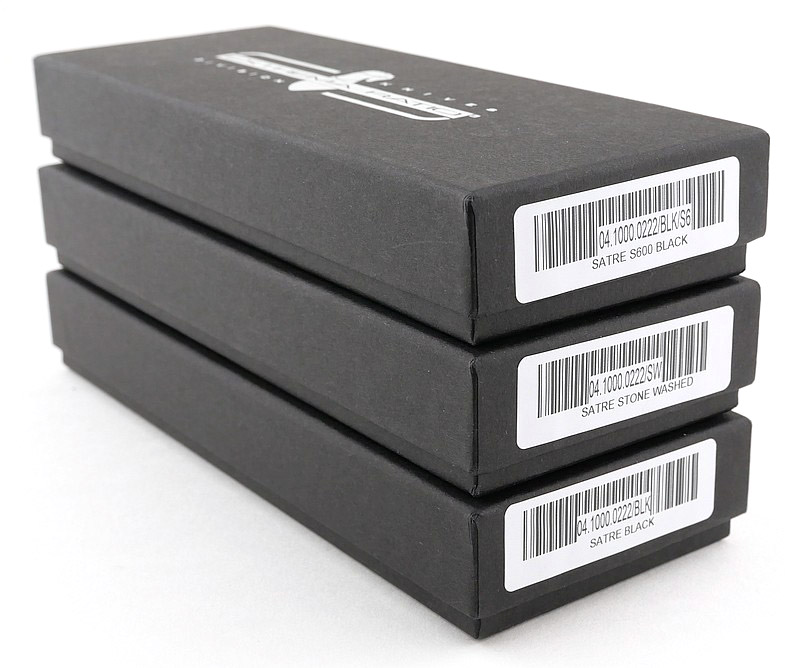
Knife Review: Extrema Ratio SATRE – Special Report

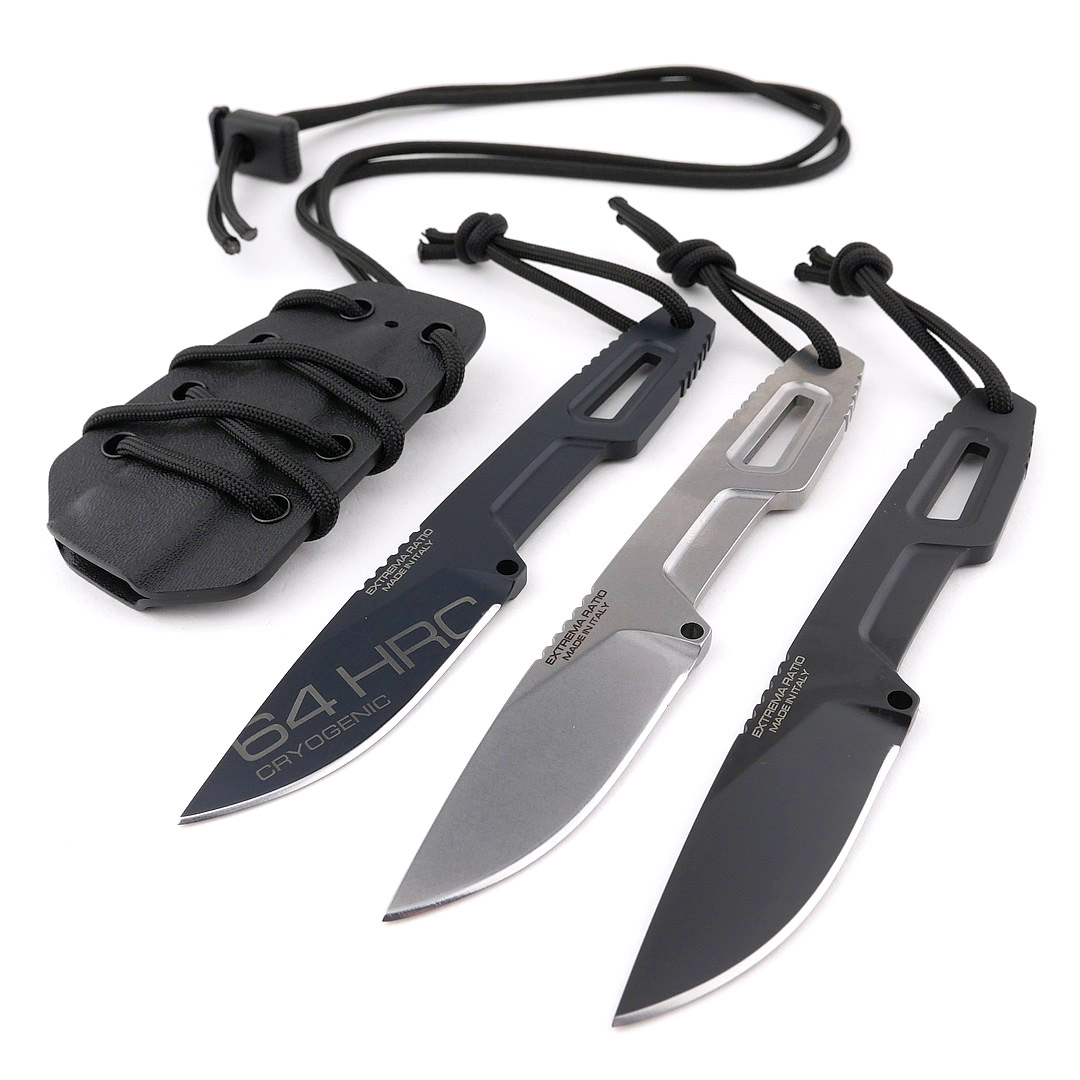
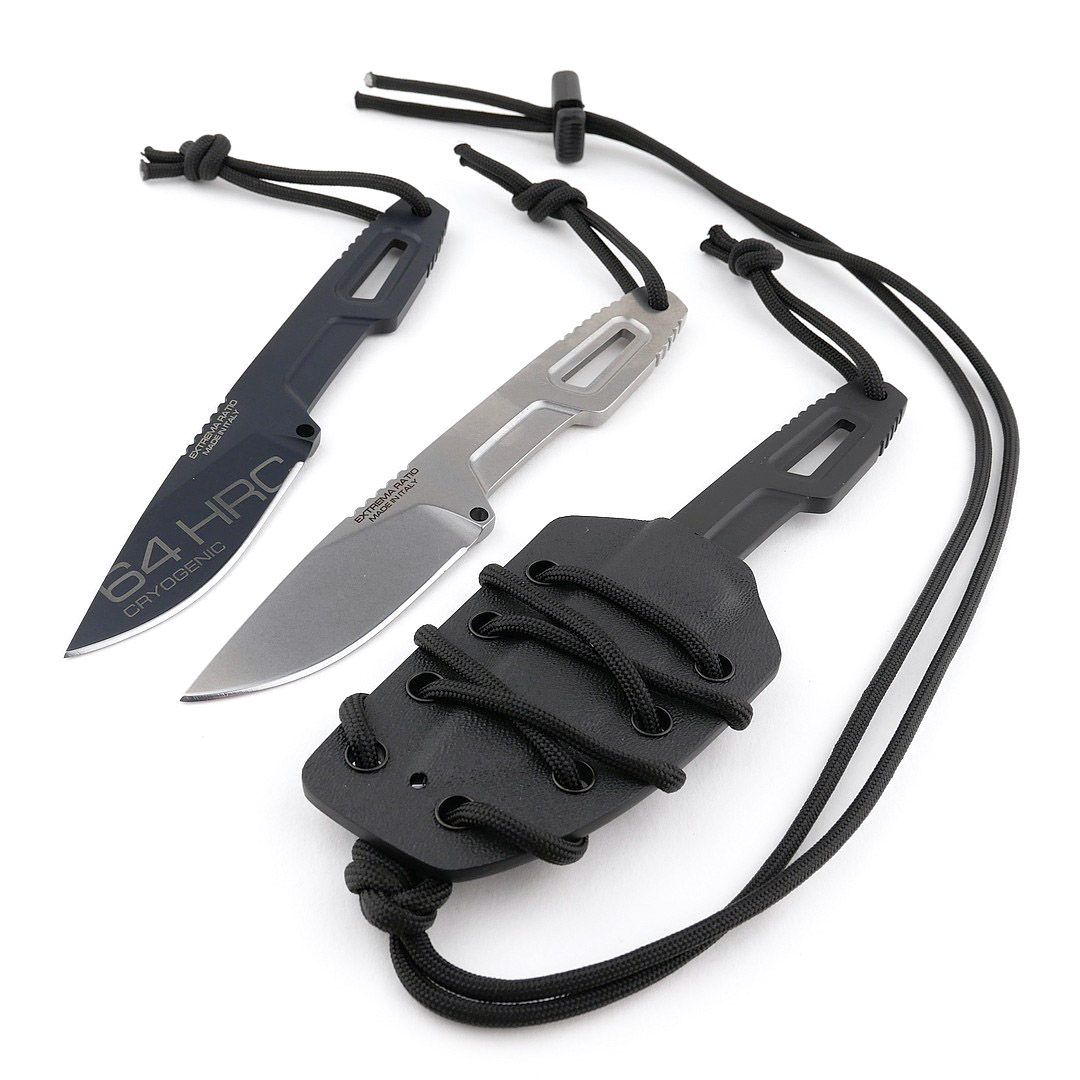
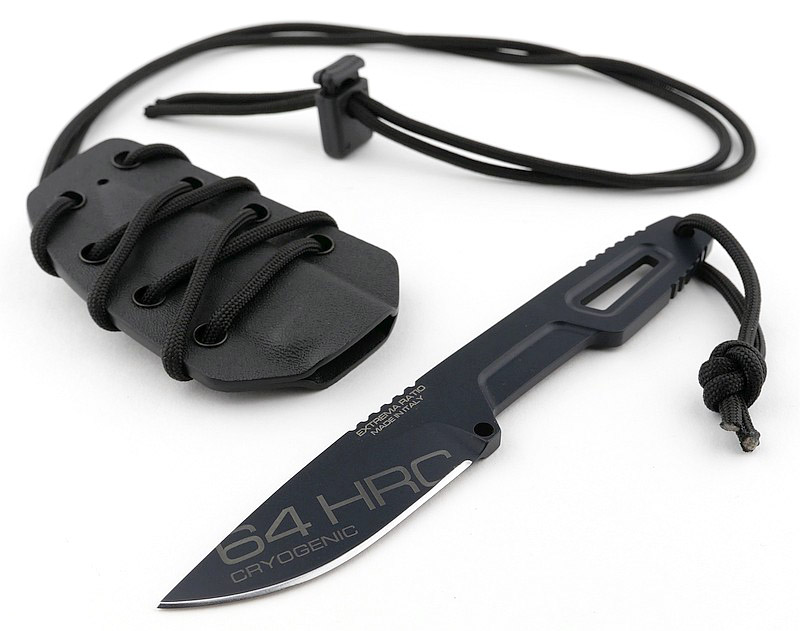
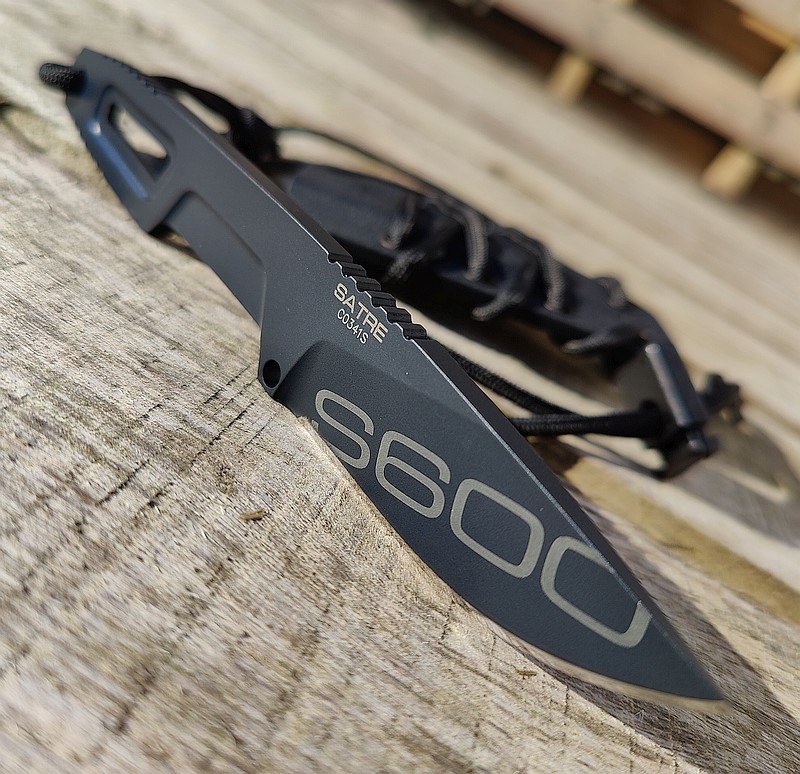
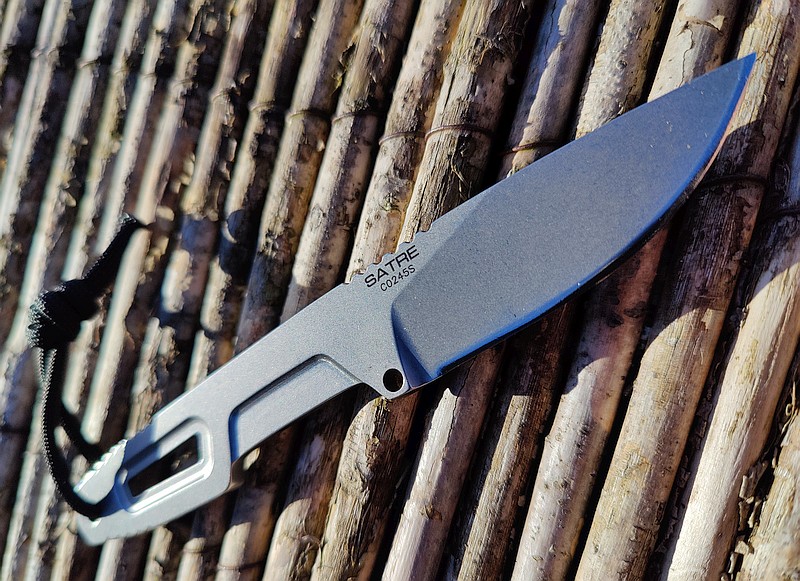
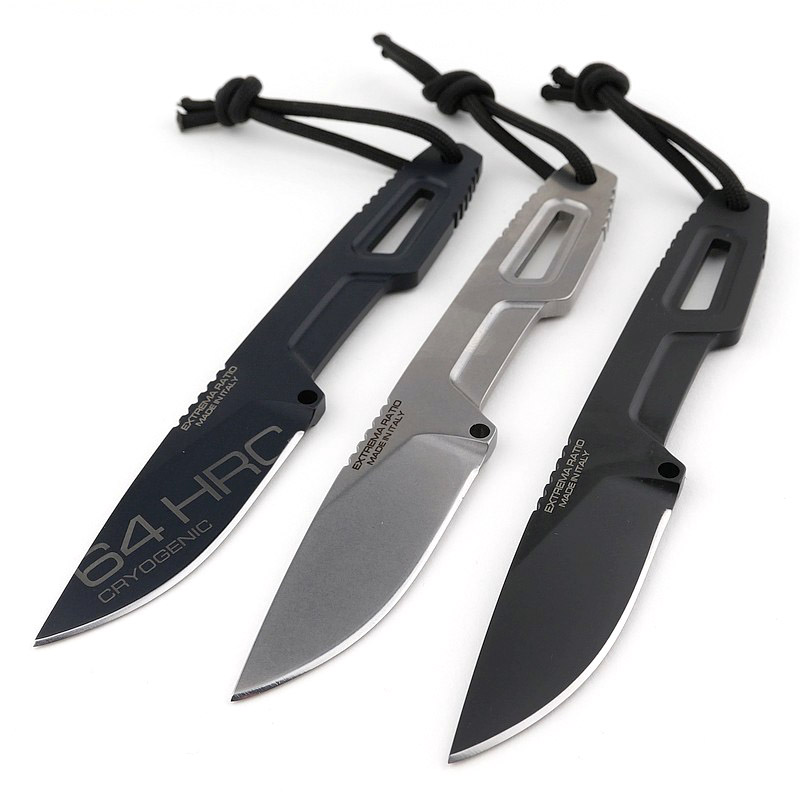
The Extrema Ratio Satre is a pocket-sized, light and extremely tough fixed blade knife, designed in collaboration with Daniele Dal Canto, a Master Advanced F.I.S.S.S. instructor. In this special report review of the Extrema Ratio Satre, I am able to carry out a special set of tests to quantify the edge apex stability (resistance to rolling) in a direct comparison of the two steels the Satre is available in, N690 and S600, as I have all three versions of the Satre available to test, the standard Black and Satin (N690) and the S600 version at an super hard 64 HRC. This special report also include two videos, an overview and detailed measurement, plus one showing the steps of the edge stability testing (SET – Structural Edge Testing).

Video Overview

This video is a detailed look at the three SATRE Models, from handling to technical measurements, hopefully something for everyone.


A few more details:

The videos show all three versions, but as the dimensions, shape and function are all identical, the galleries here show the standard Black Satre.

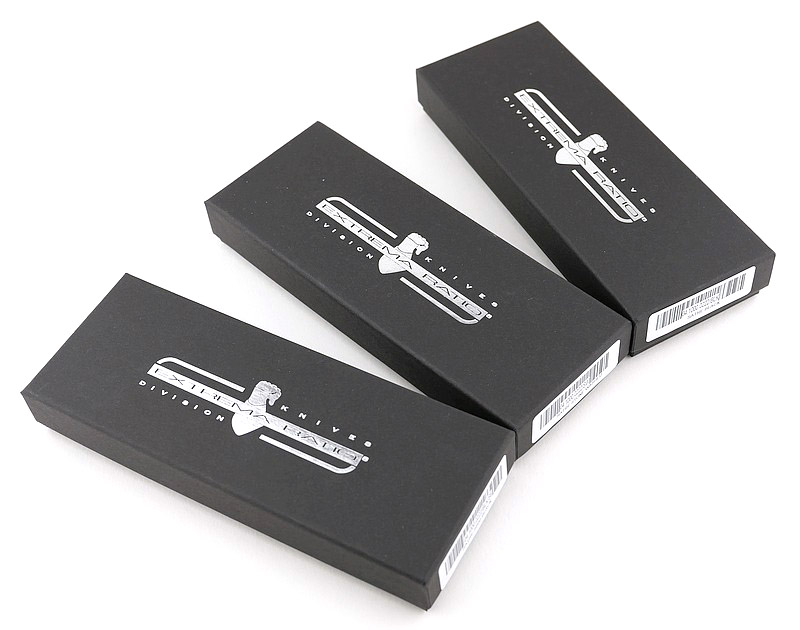
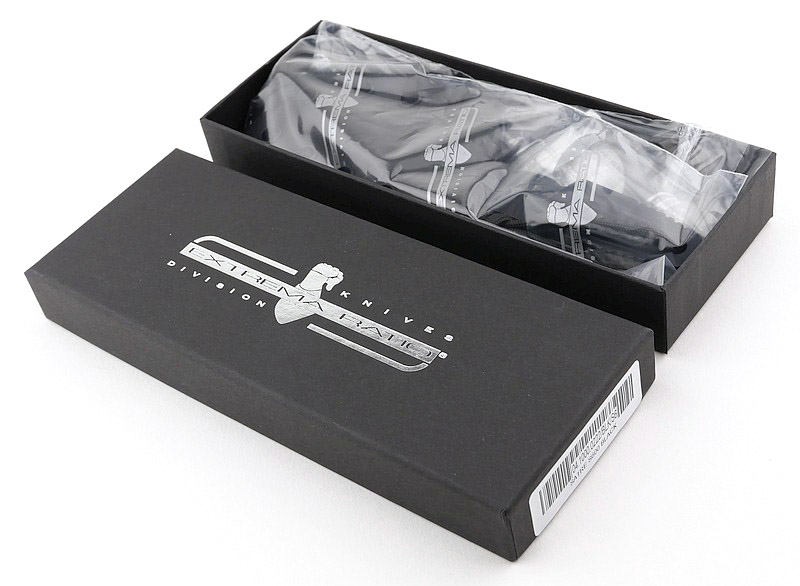
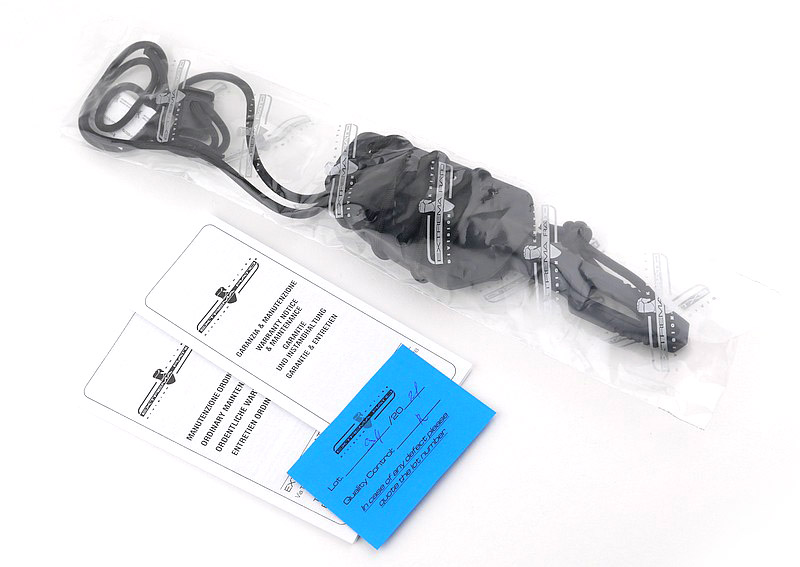
What’s in the box?:

As well as the knife in a bag with desiccant, there is a QC certificate, care instructions and warranty information.


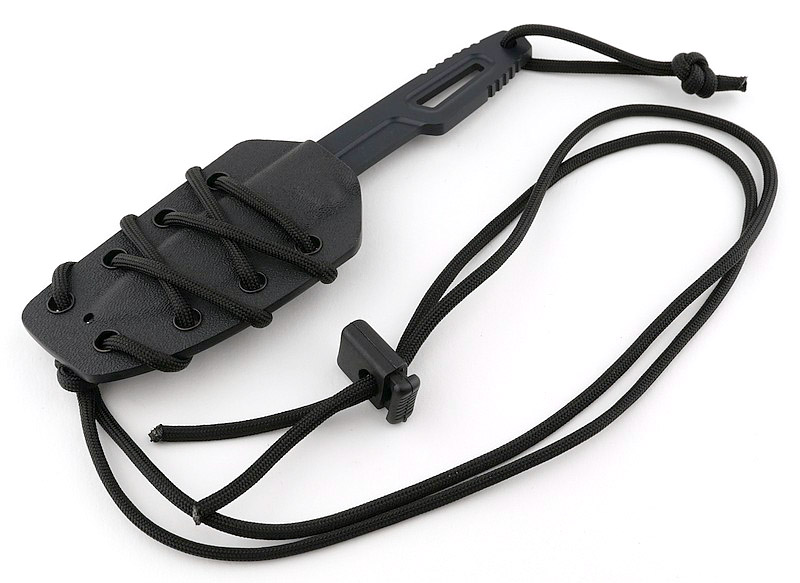
A good look round the Sheath – Things to look out for here are:

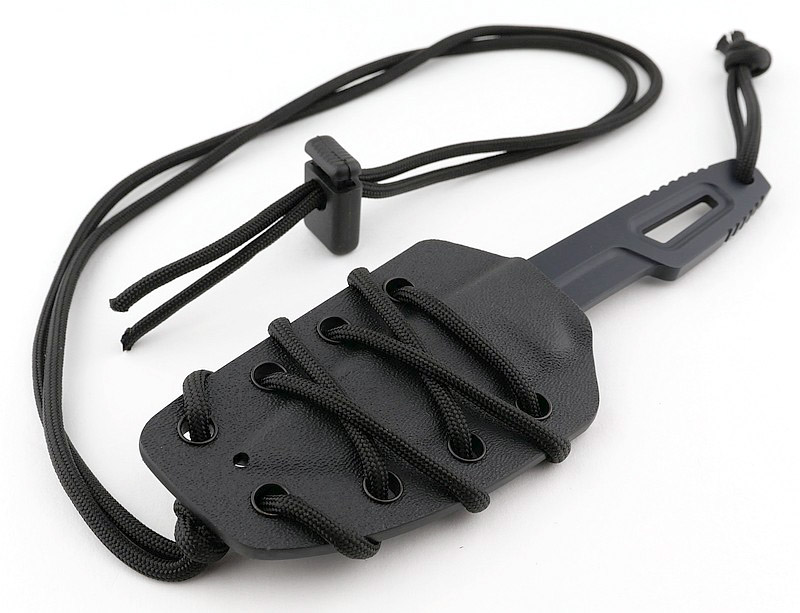
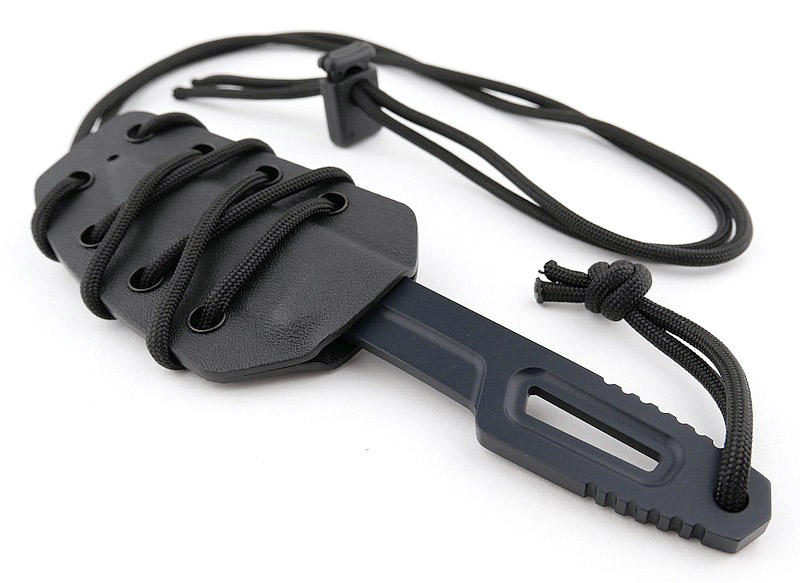
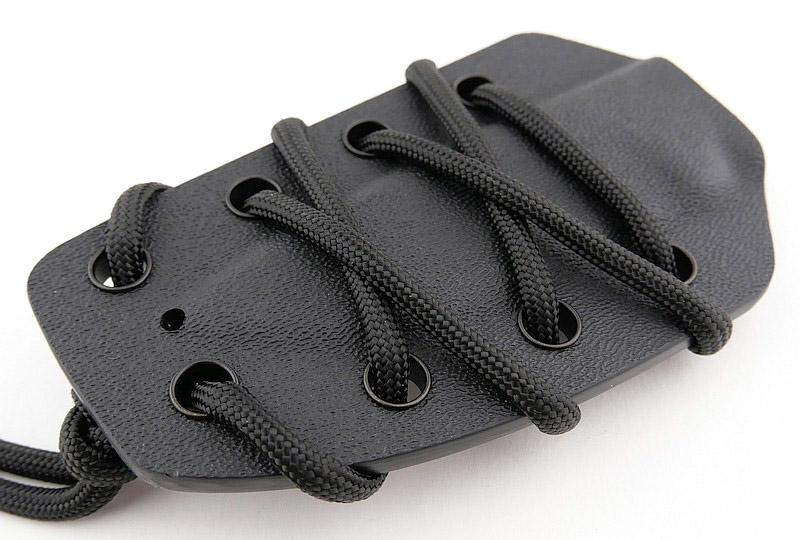
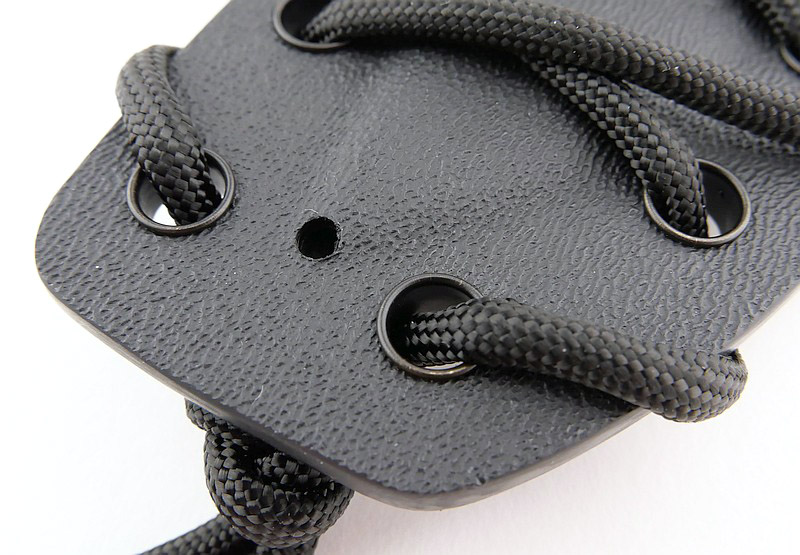
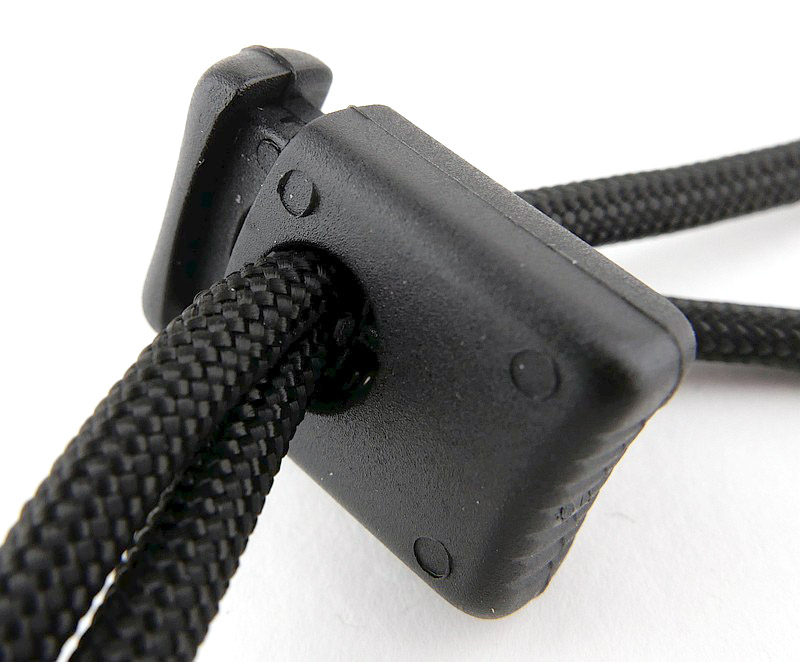
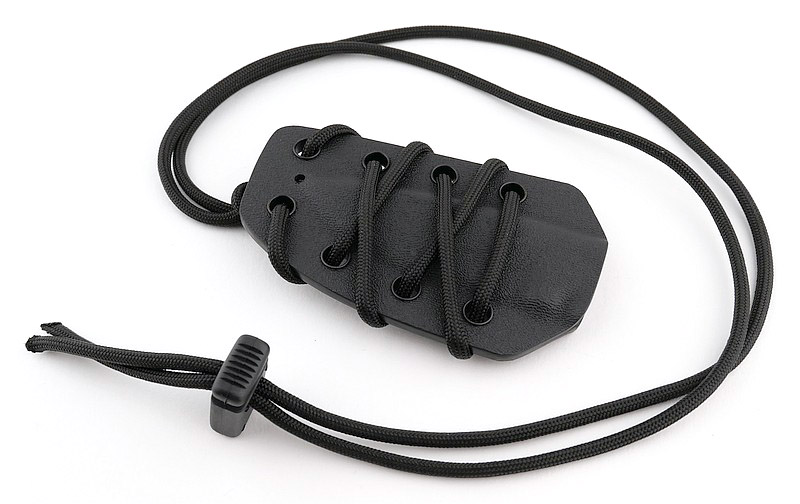
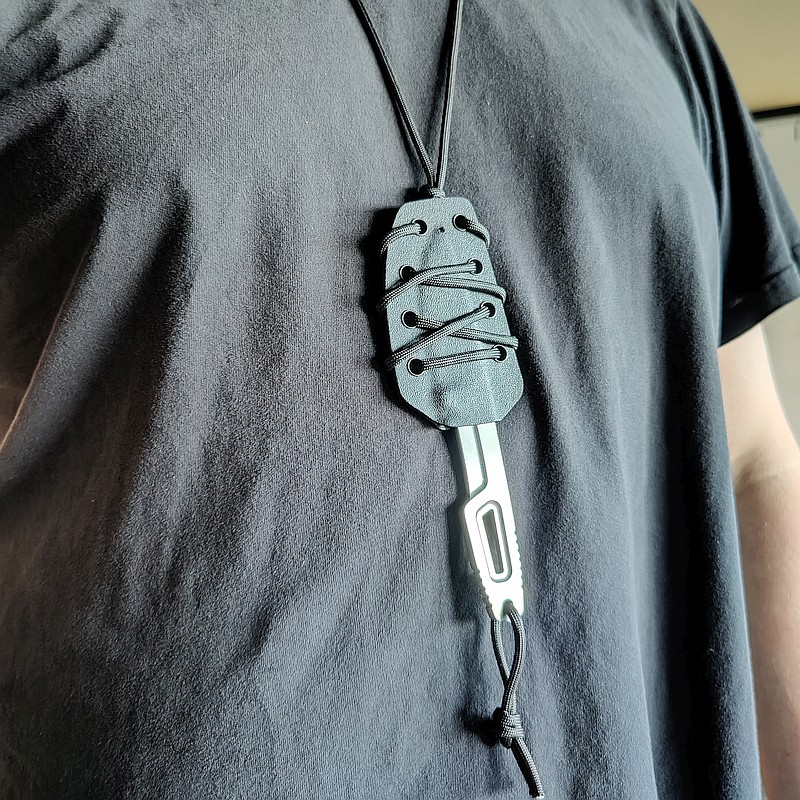
The small and neat Kydex sheath arrives with a neck lanyard, nicely laced through the eye rivets that hold the Kydex halves together. These eye rivets allow for other mounts to be fitted such as the ULTICLIP. The sliding adjustment toggle also serves as a safety break-away. There is a drainage hole at the blade tip on one side.


A good look round the Knife – Things to look out for here are:

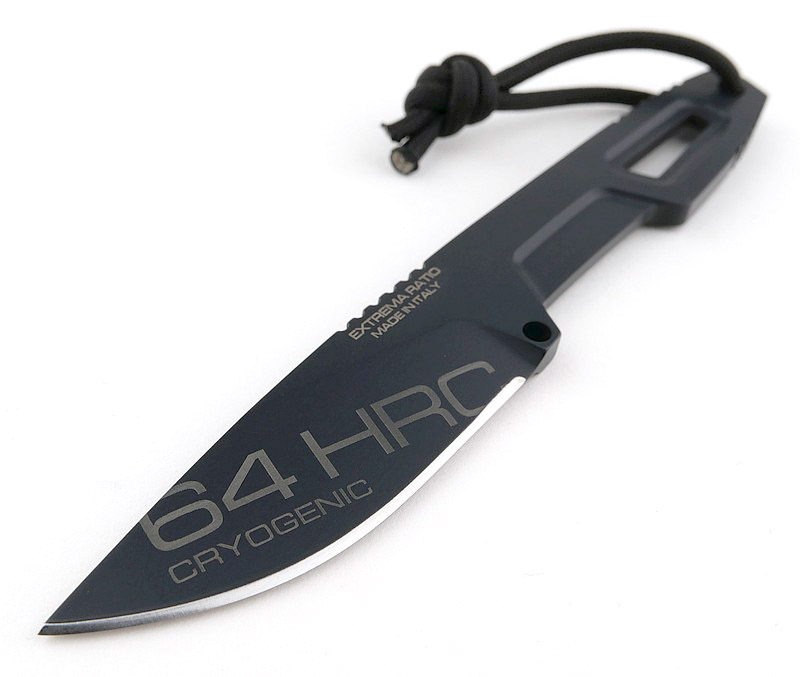
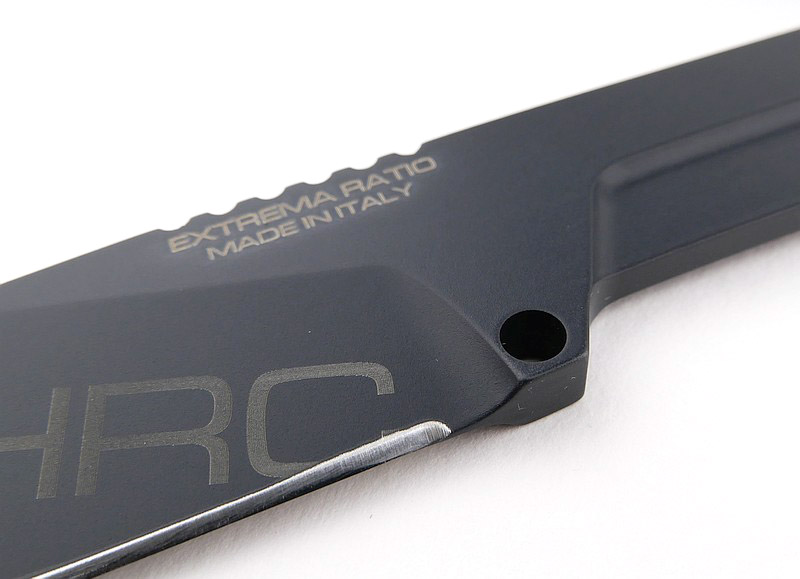
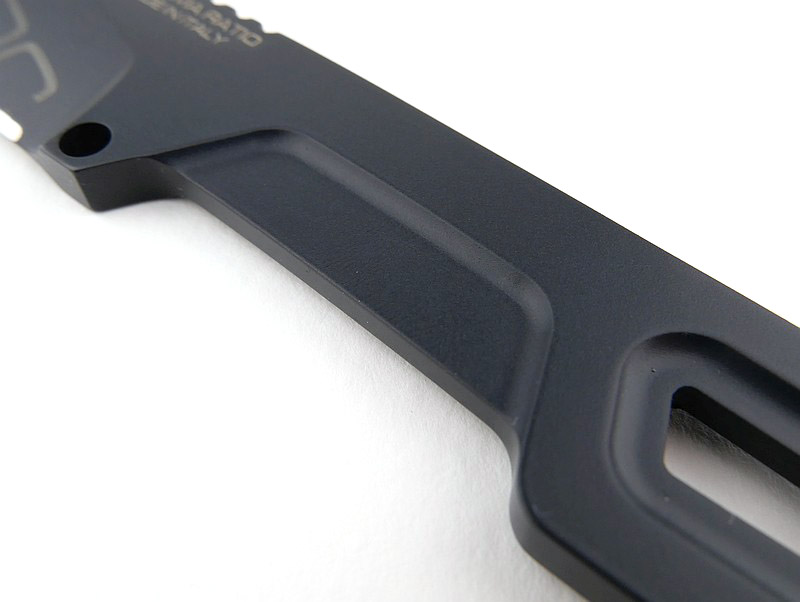
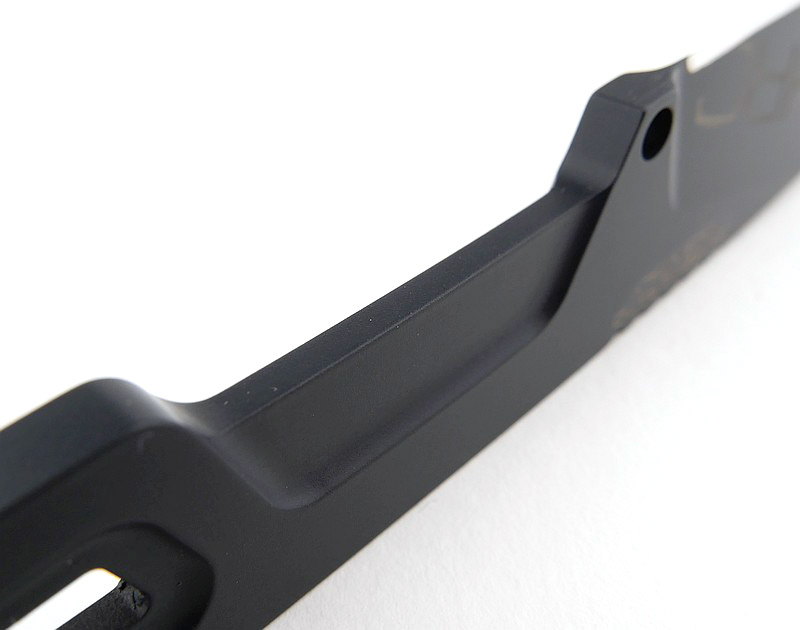
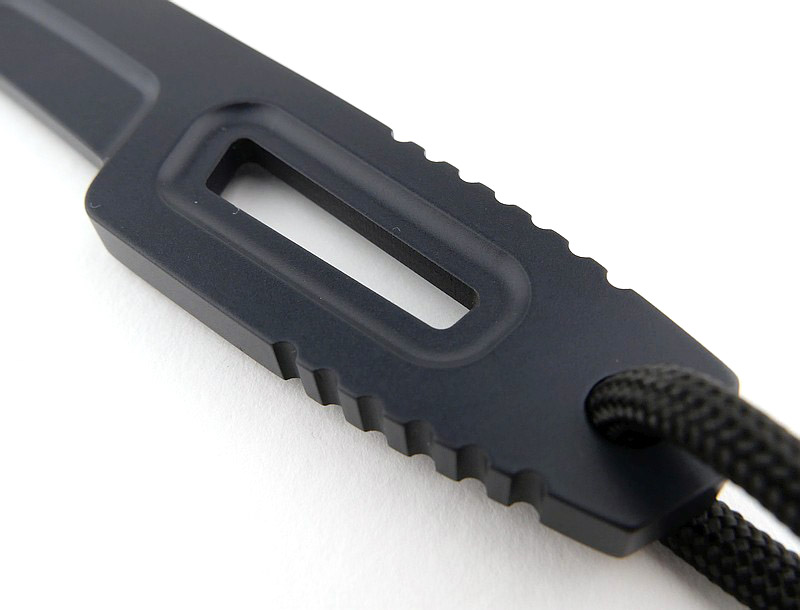
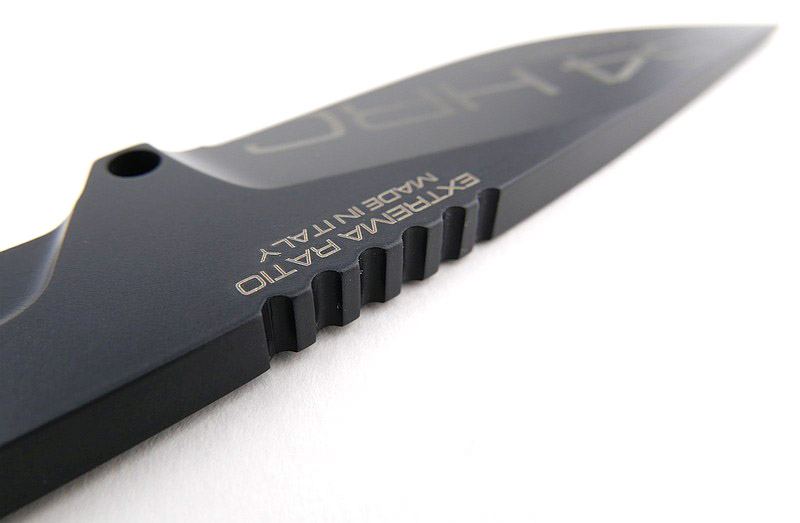
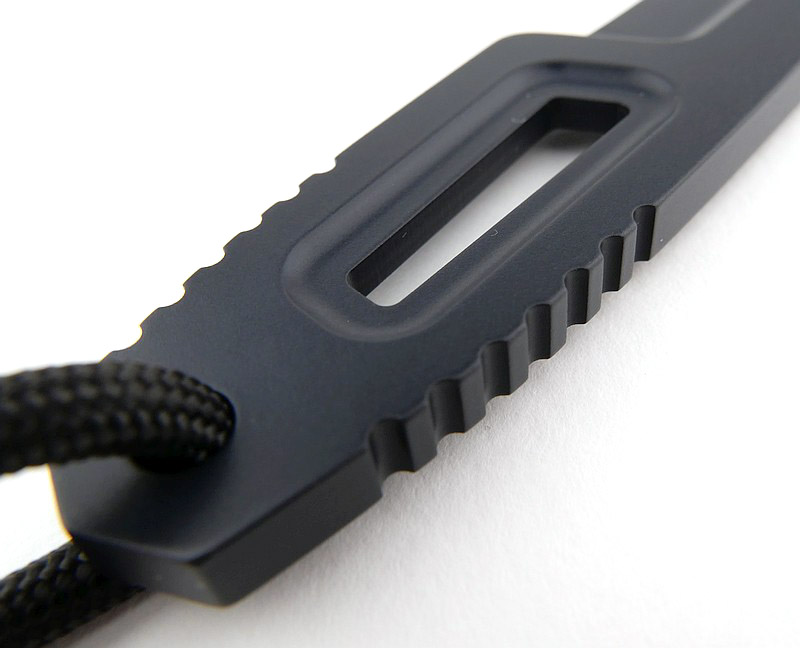
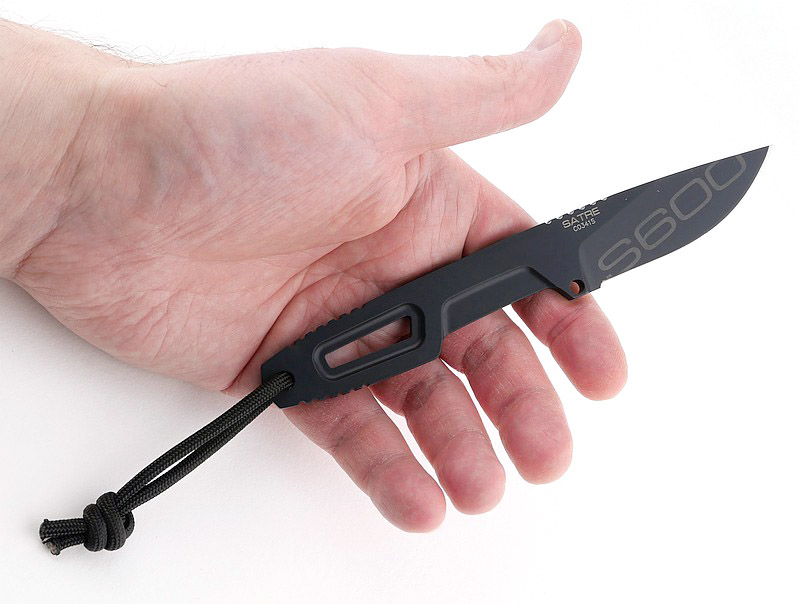
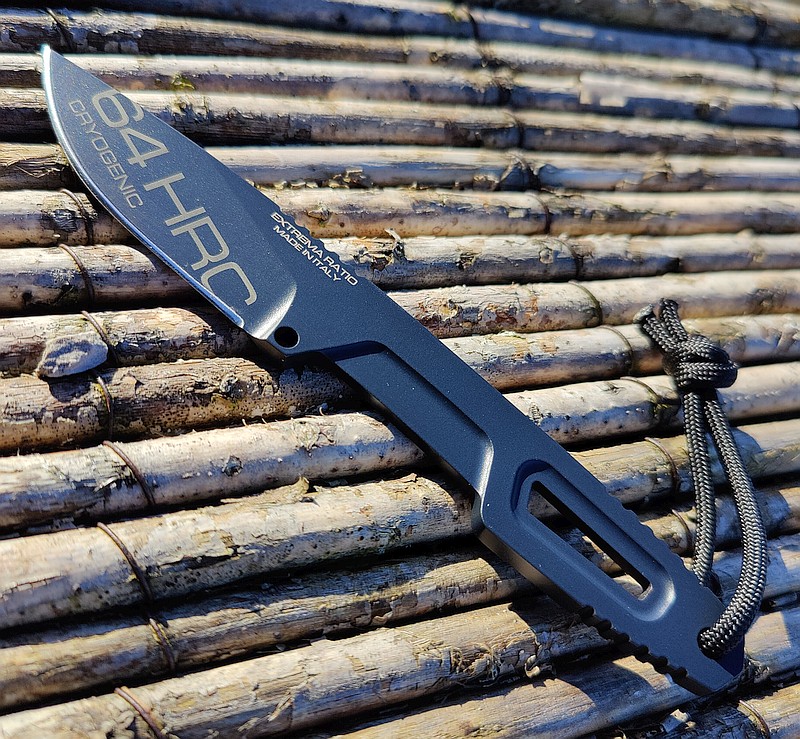
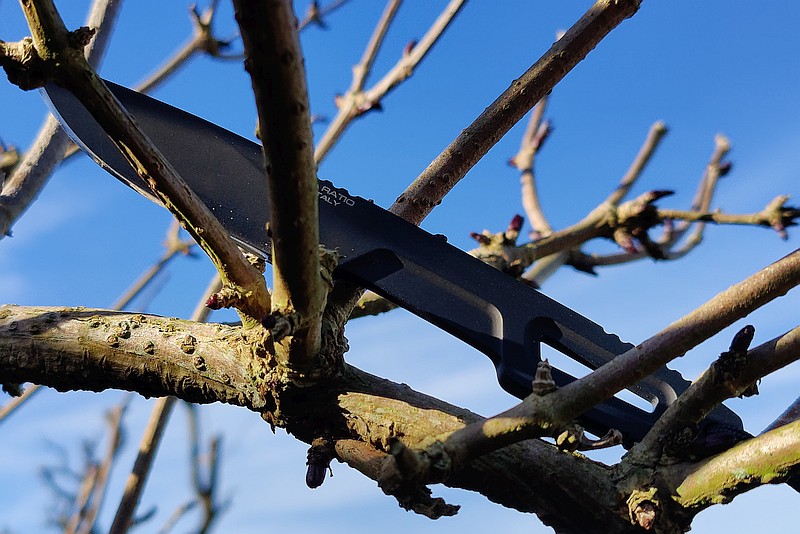
The Satre knife consists of a single piece of steel with no other material attached to it (ignoring the small cord lanyard). Despite that simple construction, Extrema Ratio have managed to pack it full of character and clearly identify it as one of their designs. The distinctive first finger grip is shaped into the tang along with the small cut out for weight reduction. Plenty of jimping is provided for various grips.


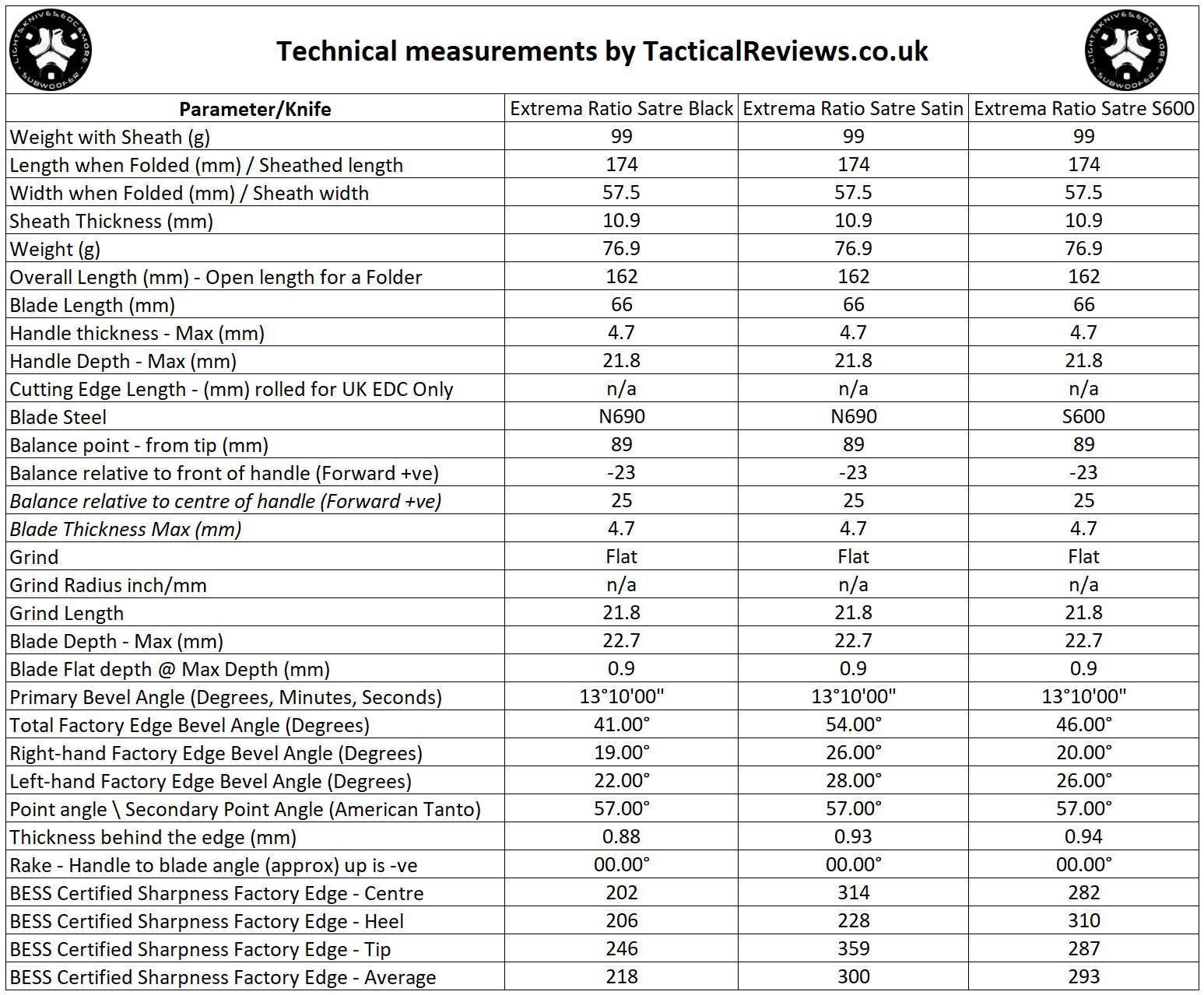
The Blade and Handle – Detailed Measurements:
For full details of the tests and measurements carried out and an explanation of the results, see the page – Knife Technical Testing – How It’s Done.


Structural Edge Testing:

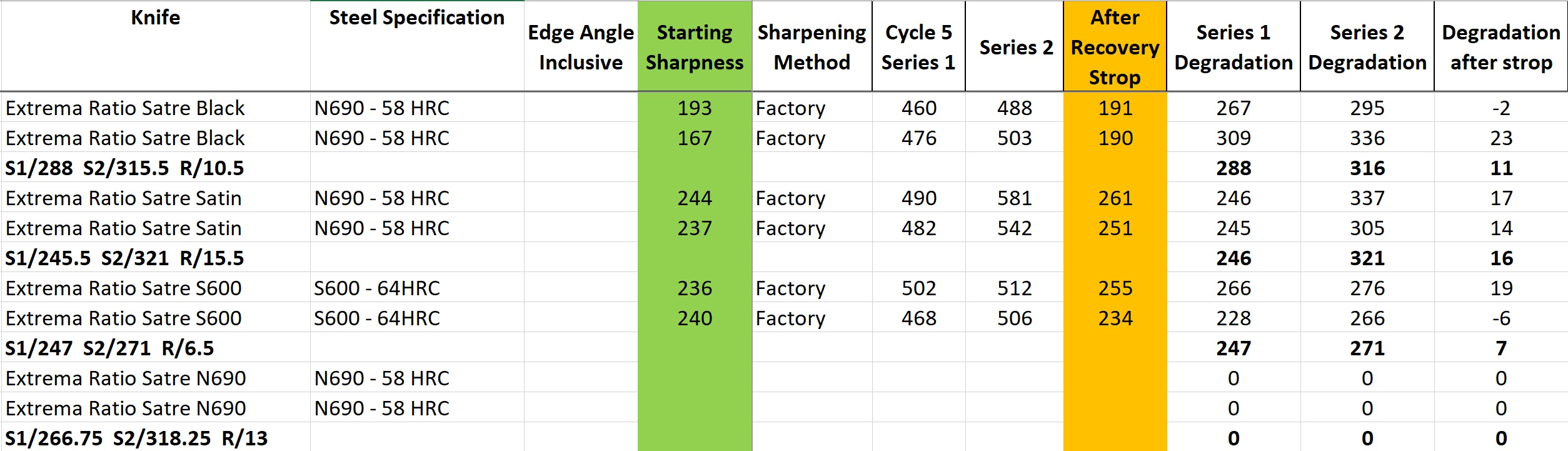
Added in 2019 are results from the Edge On Up Structural Edge Tester (SET) to measure the resistance of a knife’s edge to rolling.

The key factors for the SET results are:
Series 1 Degradation – how much damage the edge suffers from one edge rolling cycle. The damage is represented by an increase in the BESS ‘C’ score. (Averages also shown for A and B)
Series 2 Degradation – how much damage the edge suffers from one further edge rolling cycle. (Averages also shown for A and B)
Degradation after strop – has the edge been permanently damaged/chipped or can it be recovered with stropping? A negative number means it actually improved from the starting figure, suggesting there may have already been some rolling of the edge before testing. (Averages also shown for A and B)

First a video of the testing process, then the table of results.


The following results do show a clear increased resistance to edge rolling for the S600 steel. In fact after two ‘series’ the edge has rolled only a similar amount to the N690 blades have after one ‘series’. This is a clearly stronger and more stable edge apex.
Often this extra resistance to edge rolling can be coupled with a more brittle edge, yet the S600 recovered better than the N690 after stropping. (If it was brittle the edge can chip when stropping and give a high BESS measurement.)
In this table, are the individual results for all three, plus a combined N690 set of totals at the bottom.
The figures in bold in the first column are averages for the single measurements.


The Factory edge up close – NEW FOR 2022!:

Followers of Tactical Reviews will know my views on factory edges, but to recap:

Anyone using a knife will need to sharpen it. That first factory edge is just like the first tank of fuel that a new car comes with (or first charge of the battery).
A good factory edge is a ‘nice to have’ but not a ‘make or break’ for a good knife, as you will be putting your own edge onto it soon enough.
The factory edge does however indicate the care a knife maker has put into the final finish.
It is for this reason Tactical Reviews measures factory edge sharpness and specifications, and includes this information in the detailed technical testing.

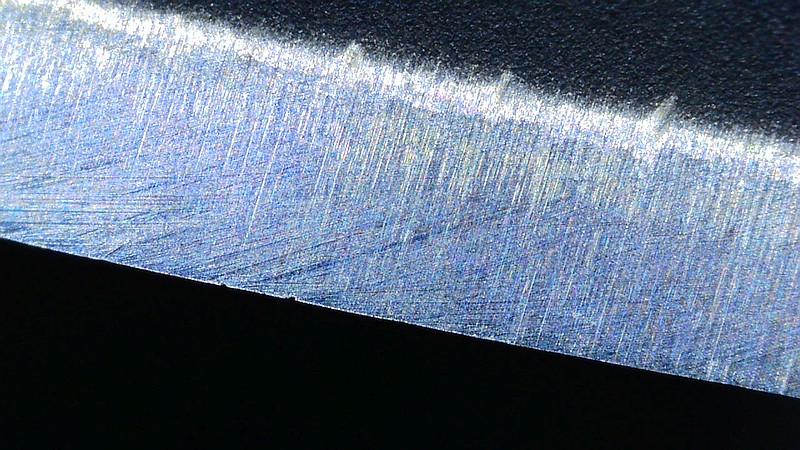
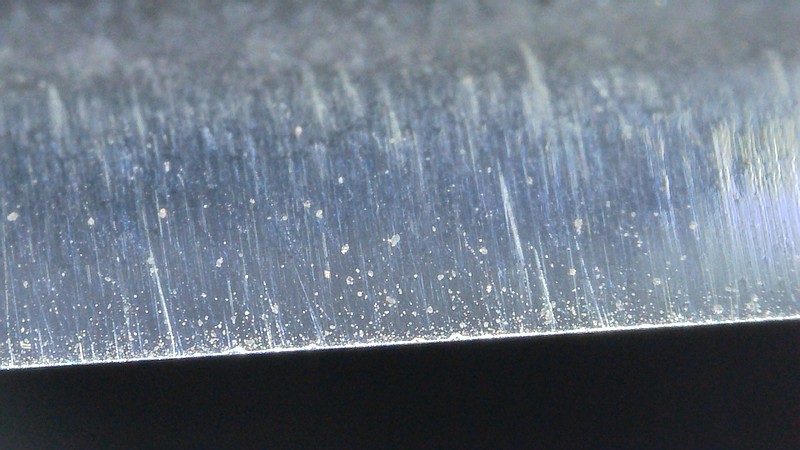
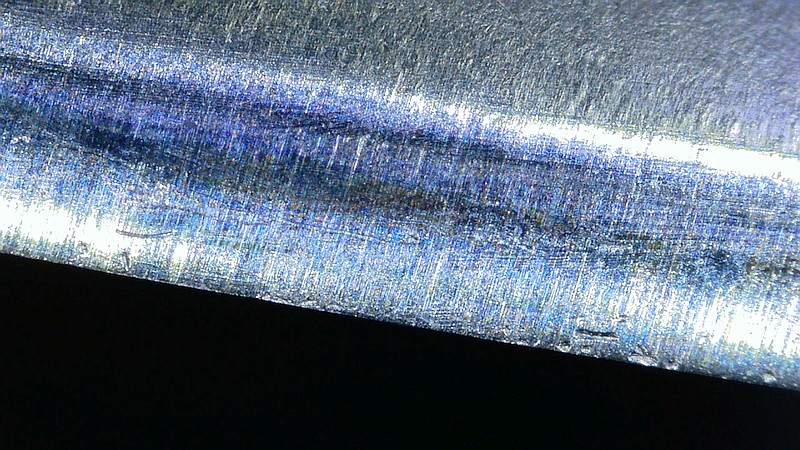
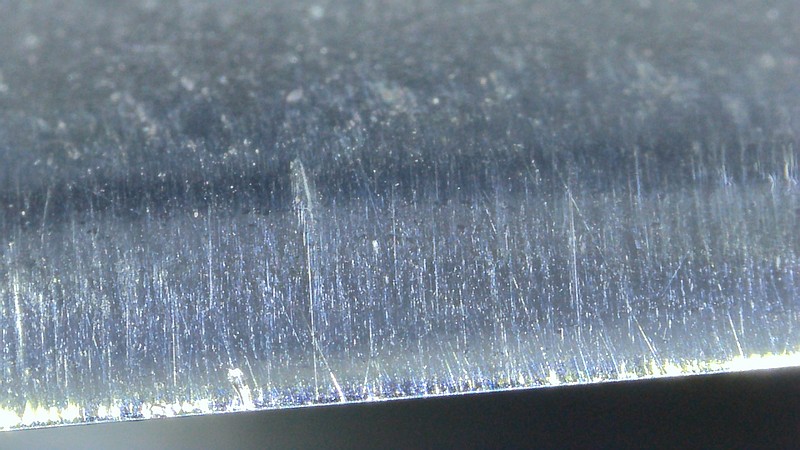
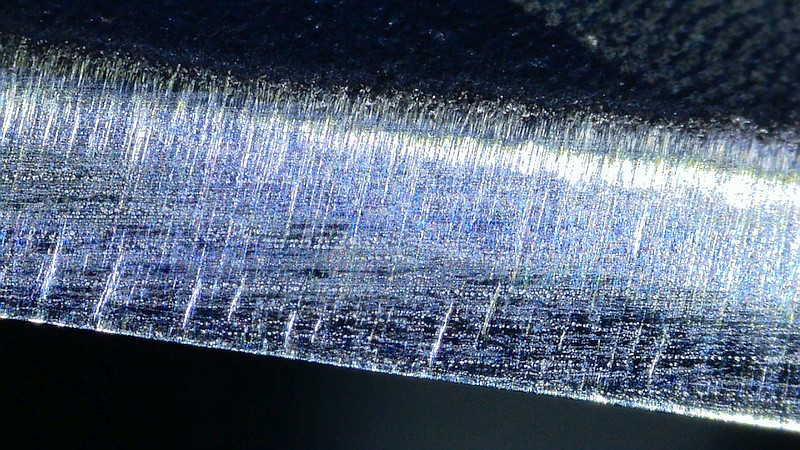
As a further look at the factory edge, this section has been added to include some high magnification photos of the factory edges.

In these galleries are each of the three versions with a before and after SET testing image. The edge rolling is just visible, but not easy to see.

Black N690


Satin N690


S600


What is it like to use?

It’s just one of those superbly useful knives. An easy size to carry and use, or keep as a backup. The size of the knife is similar to a medium sized folder, but being a fixed blade makes it super tough and a real working blade.
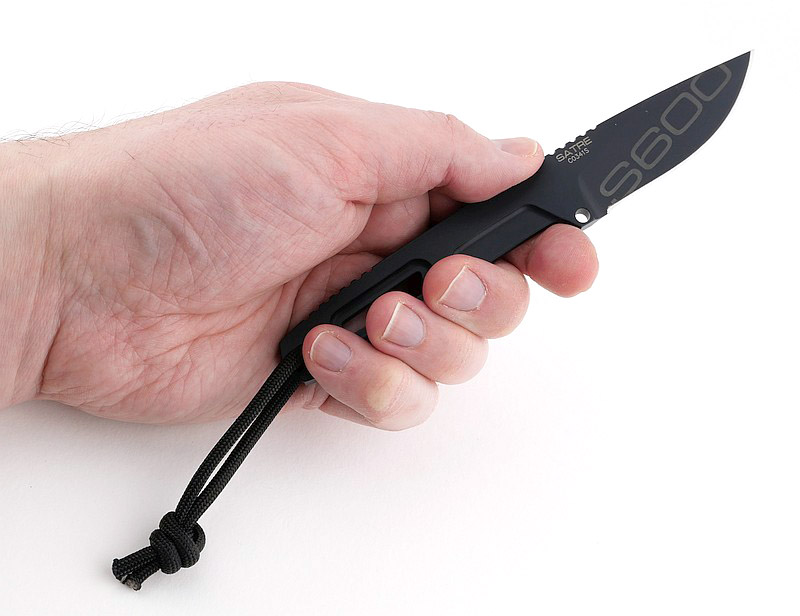
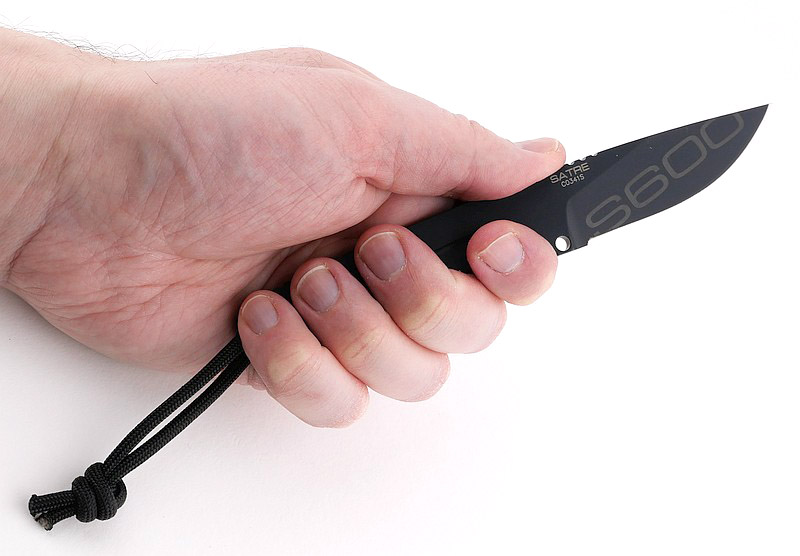
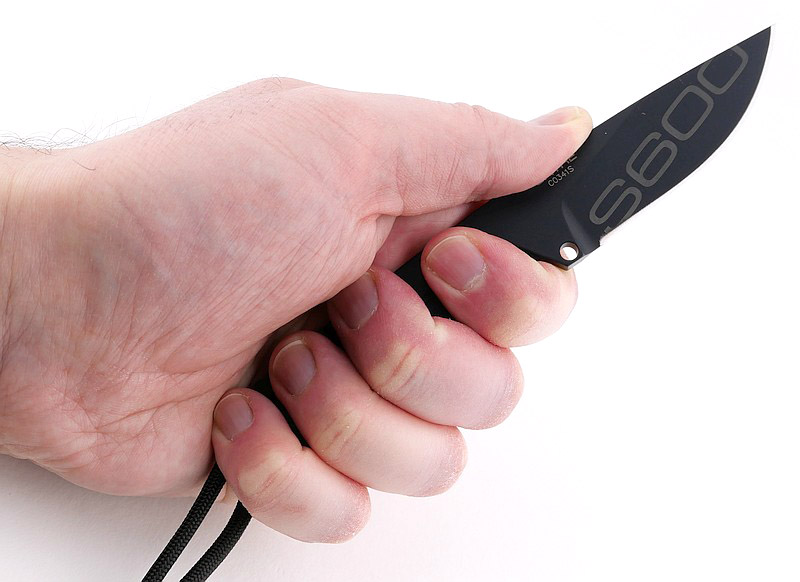
Here I’m showing it in an un-gloved hand (a hand which takes XL size gloves). It is compact, and doesn’t fill my hand, but the finger groove provides a really secure grip with the jimping (especially the thumb jimping) giving confidence.


With it being a compact blade and one without handle scales, the knife is capable of much harder work than you can comfortably manage with the bare blade tang in your hand. This design keeps it very low profile and really does make carrying and storing as a backup so much easier than a knife with wider handle.

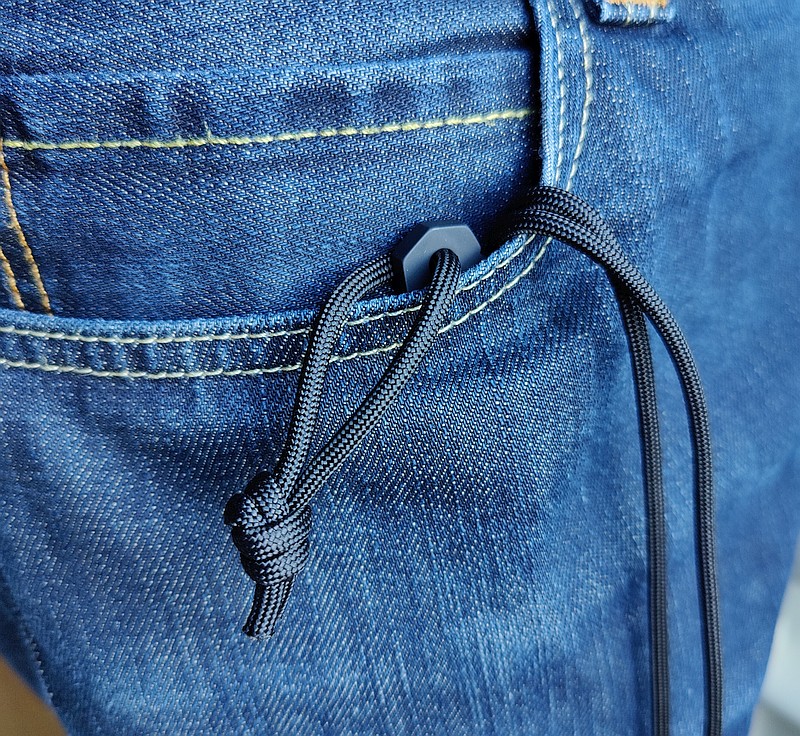
Either in the pocket, or hanging around your neck the Satre is slim and unobtrusive. I can make this comment, not just based on one example but on all three – the Kydex action is spot on. The sloped shoulders of the sheath are just right to push on to release the knife, and the blade clicks out without a fight. This action is almost identical across all three and holds the blade securely without struggling to sheath or unsheathe it.

As seen in the SET testing section and video, the S600 steel is noticeably tougher. As with any higher hardness and higher wear resistance steel, you will notice the S600 is much more difficult to sharpen, and will need a suitable sharpener. This always makes for a dilemma for field use for me. As much as I love a longer lasting edge, if I might need to rely on one knife and might need to sharpen it in the field I would want to be able to sharpen it more easily and if required with natural stones rather than specialist sharpening equipment. This is just a consideration, as for many the longevity of the edge it already has may be more important than being able to sharpen in the field.

With a blade this thick (compared to its length) it doesn’t slice as well as a finer pocket knife blade would, but this blade is one you know won’t let you down if you need to work it hard. If you put one aside as an emergency backup blade, you know it is going to serve you well.


Review Summary

The views expressed in this summary table are from the point of view of the reviewer’s personal use. I am not a member of the armed forces and cannot comment on its use beyond a cutting tool or field/hunting knife.

Something that might be a ‘pro’ for one user can be a ‘con’ for another, so the comments are categorised based on my requirements. You should consider all points and if they could be beneficial to you.

_______________________________________________
What doesn’t work so well for me
_______________________________________________

Pocket clip not supplied as standard.
Blade is relatively thick which affects slicing ability.
S600 steel much harder to sharpen (the cost of its higher hardness and wear resistance).

_______________________________________________
Things I like
_______________________________________________

Choice of blade steels.
S600 steel edge is measurably more stable.
Kydex sheath ‘action’ excellent.
Slim and low profile making carry easy.
Pocket or lanyard carry options.
Very secure grip.
Super strong design.

 
Discussing the Review:
The ideal place to discuss this review is on the Tactical Reviews Facebook Page
Please visit there and start/join the conversation.
As well as the Tactical Reviews Facebook Page, please consider visiting one of the following to start/join in any discussion.

BladeForums – Knife Reviews (US based Forum for Knife Discussion)

CandlePowerForums – Knife Reviews Section (Largest and Friendliest Flashlight Community Forum)

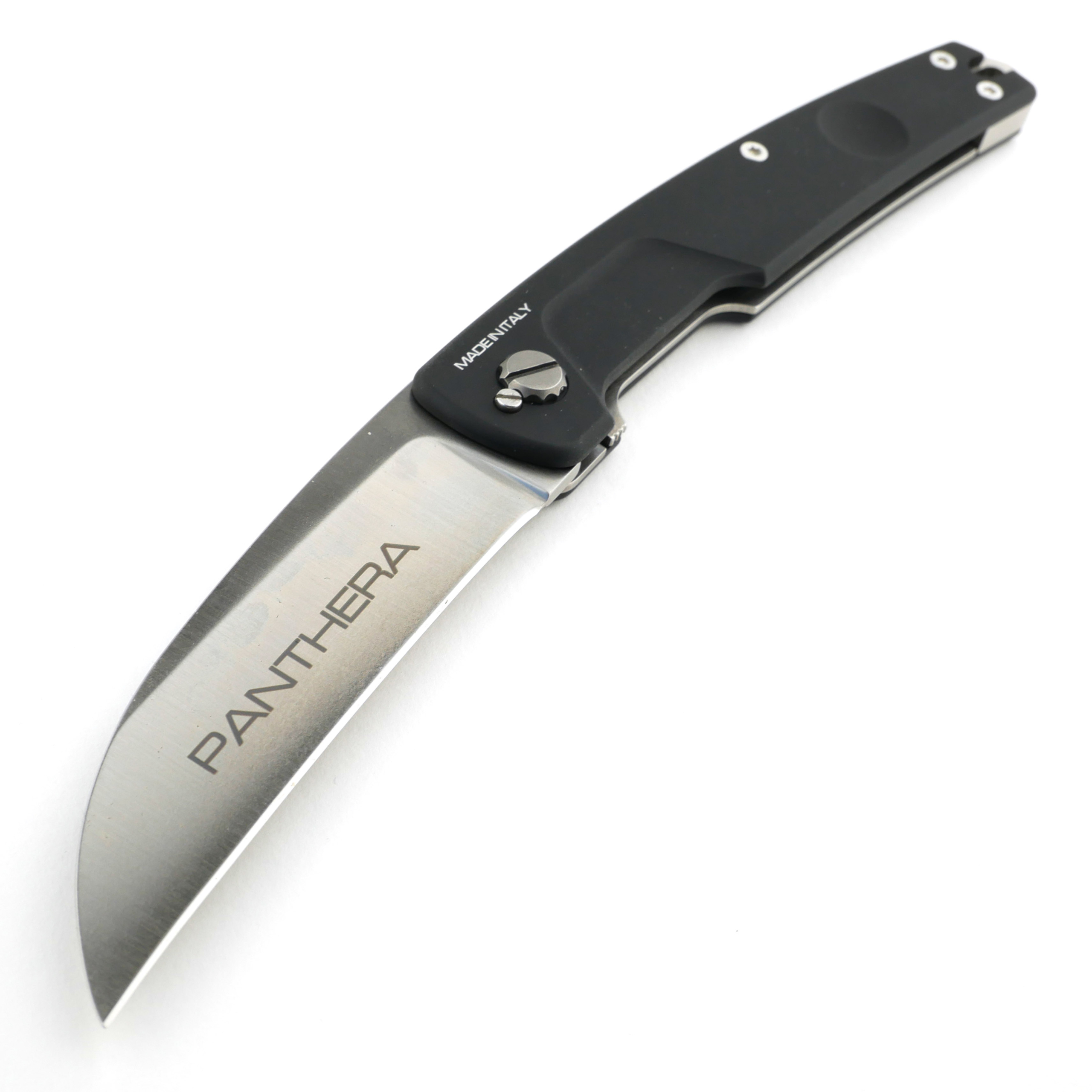
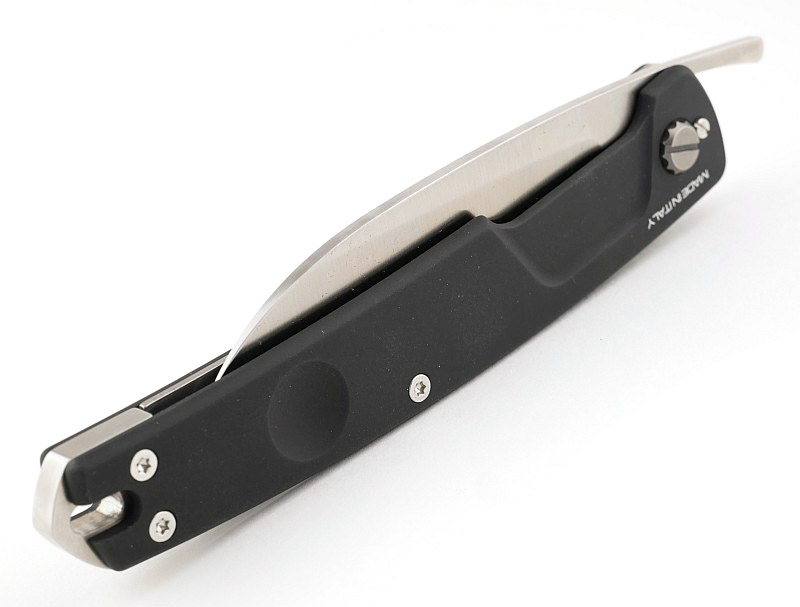
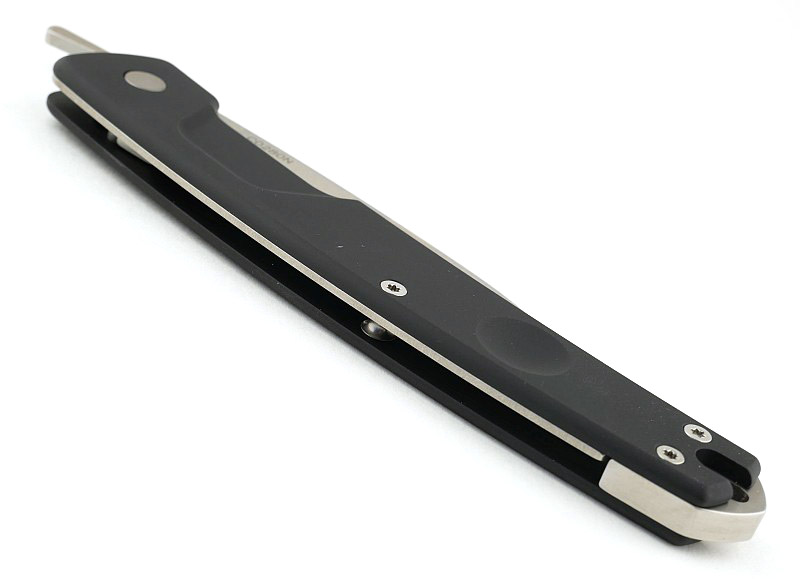
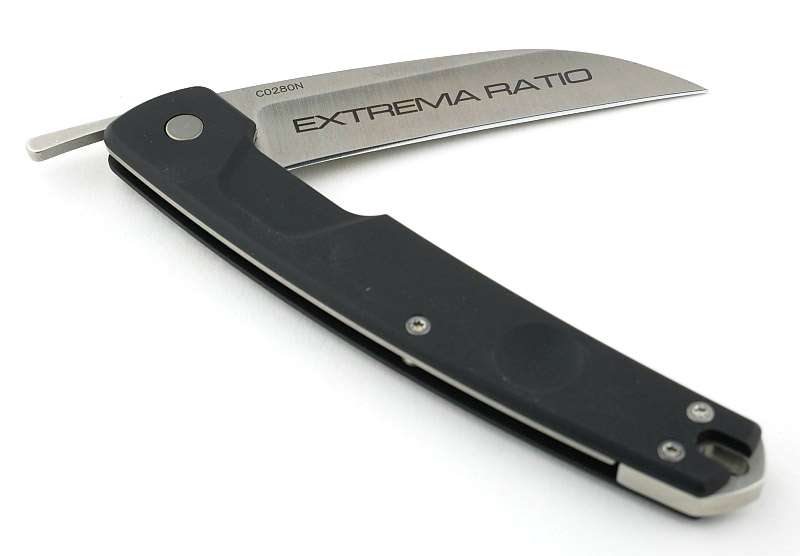
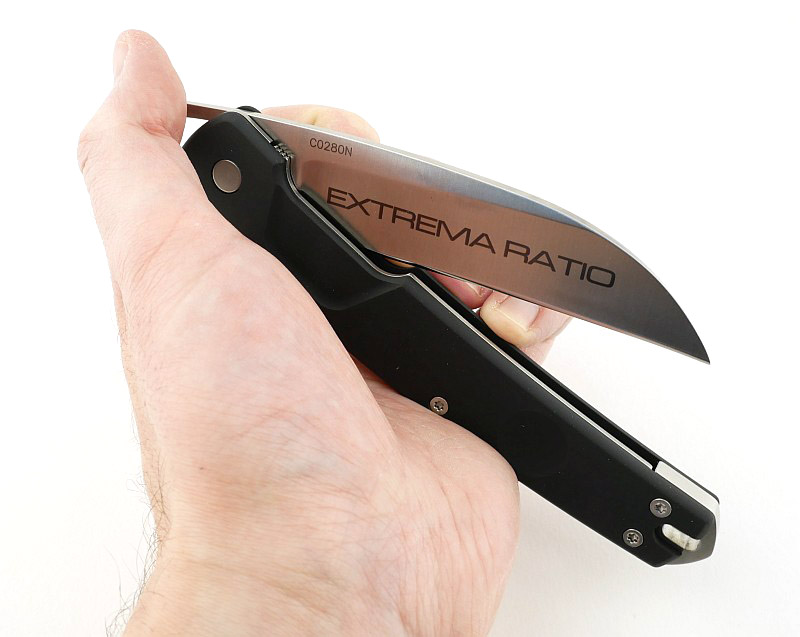
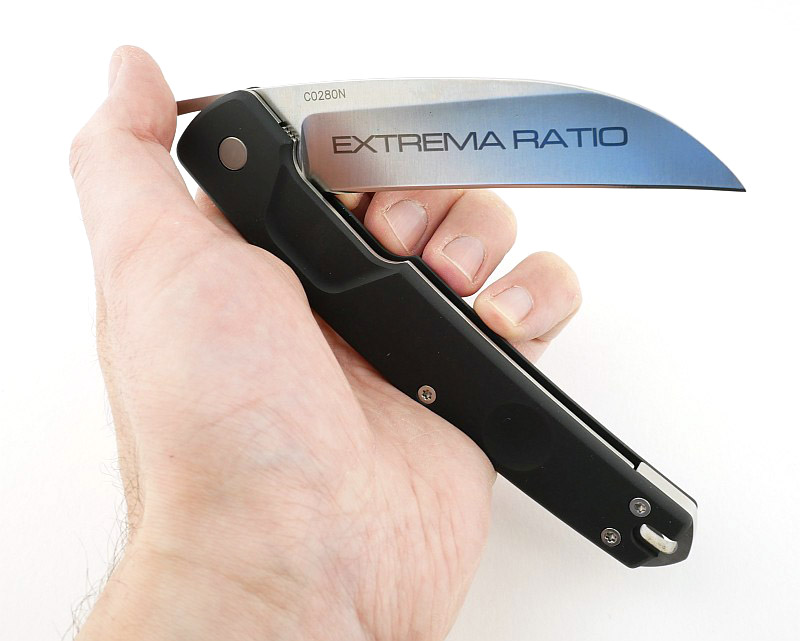
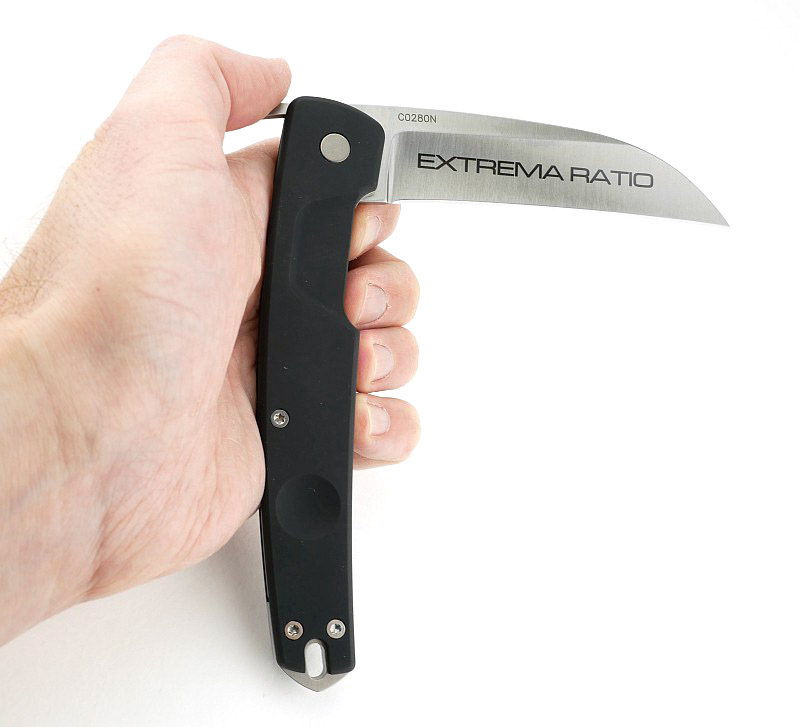
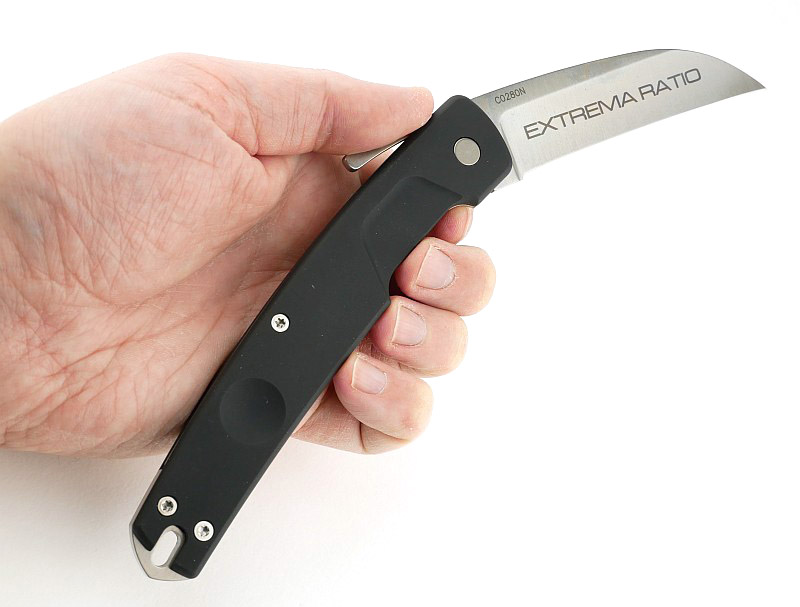
Knife Review: Extrema Ratio Panthera

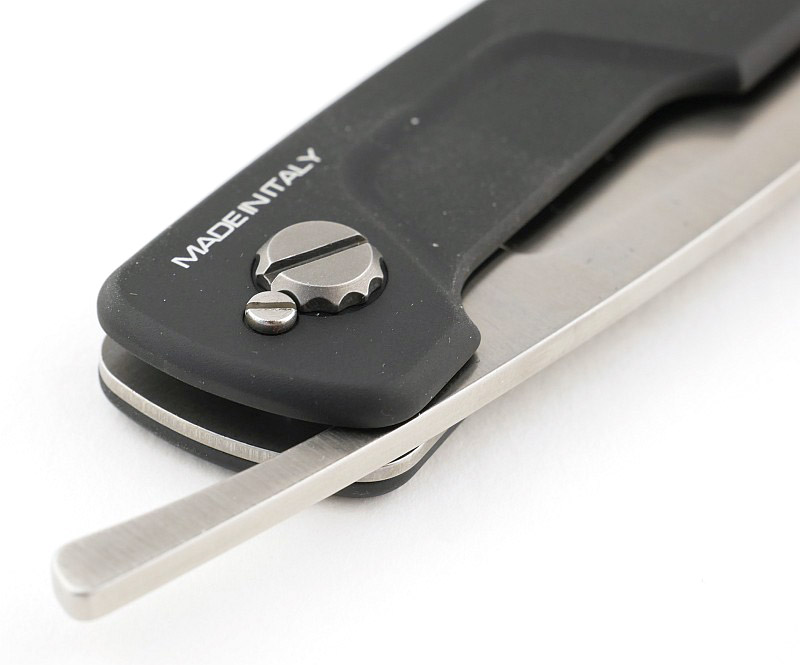
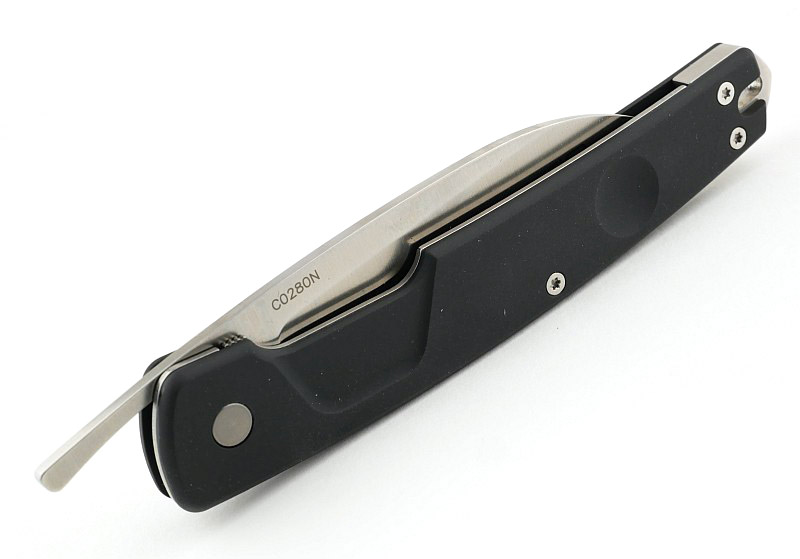
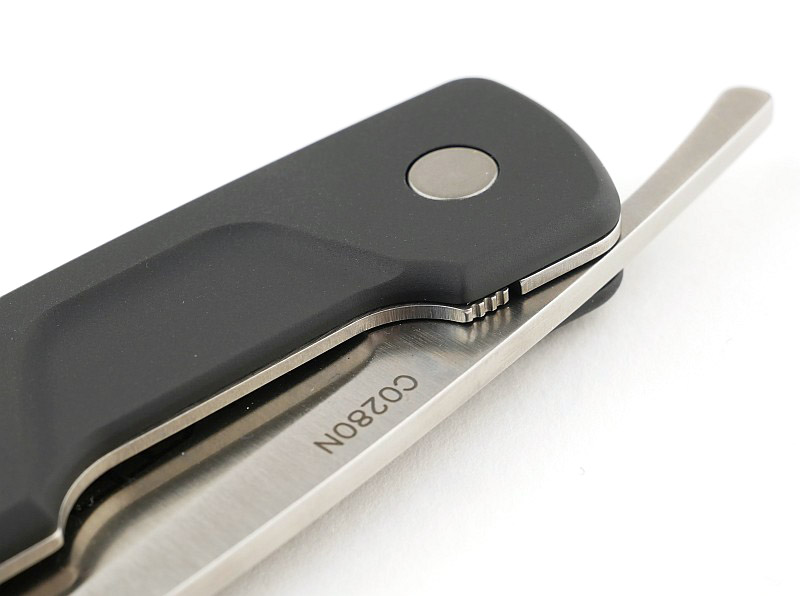
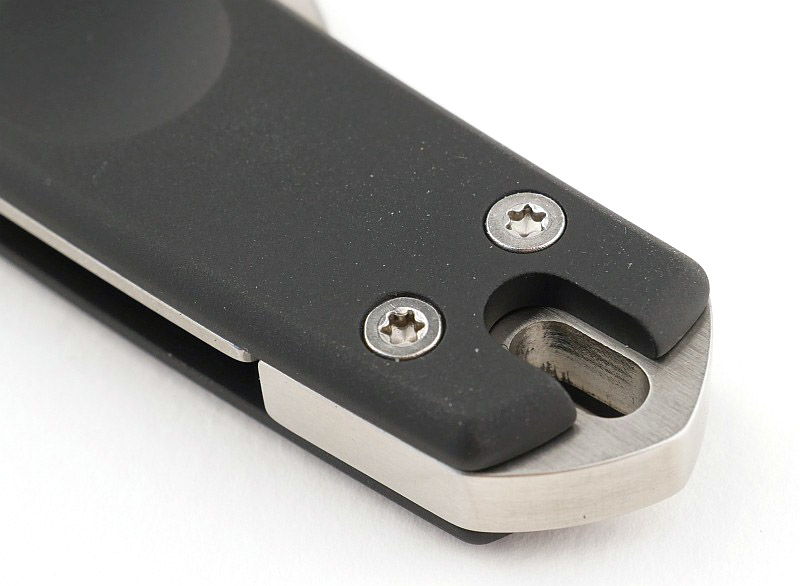
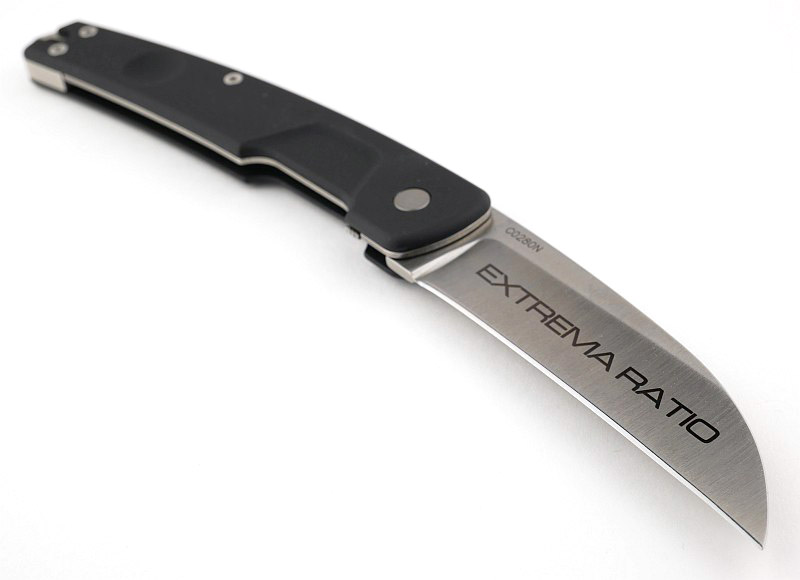
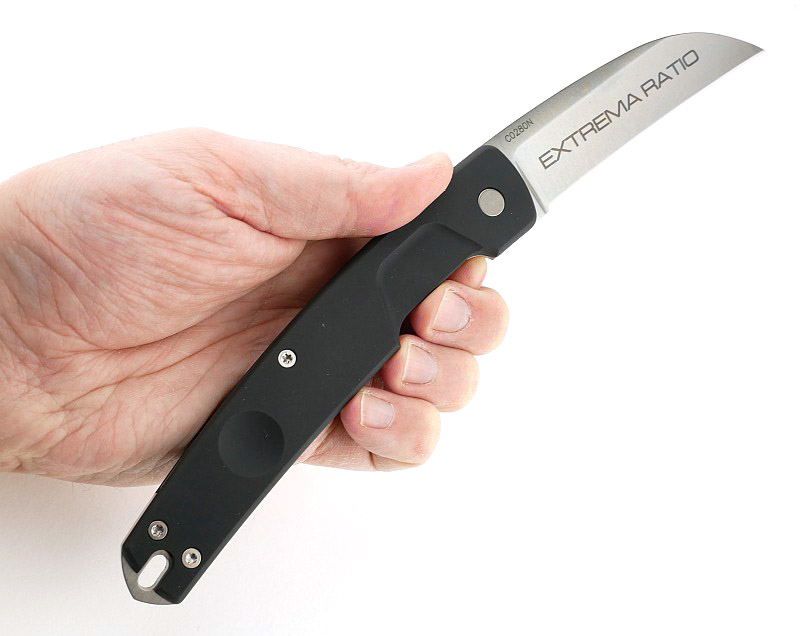
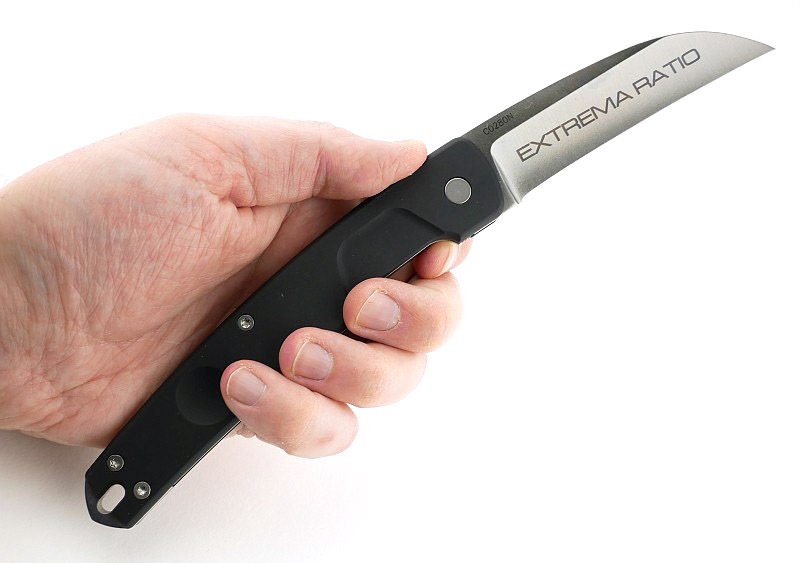
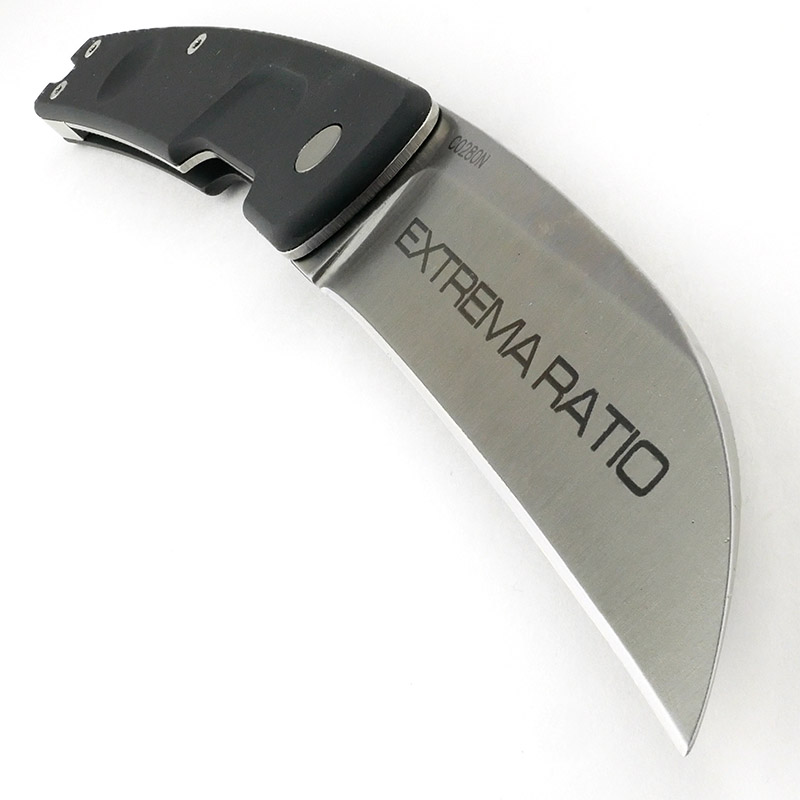
The Extrema Ratio Panthera is a further development of their T-Razor (that was based on the traditional straight razor) and maintains all the characteristics of the T-Razor, but with a new wharncliffe blade shape and curving claw-like appearance. In this Extrema Ratio Panthera review, I cover all the technical specifications, detailed galleries to show you all the details, a video overview and demonstration of the opening method.

Video Overview

This video is a detailed look at the Extrema Ratio Panthera, from handling to technical measurements. Hopefully something for everyone and you should have a better idea if you should also pick one up.


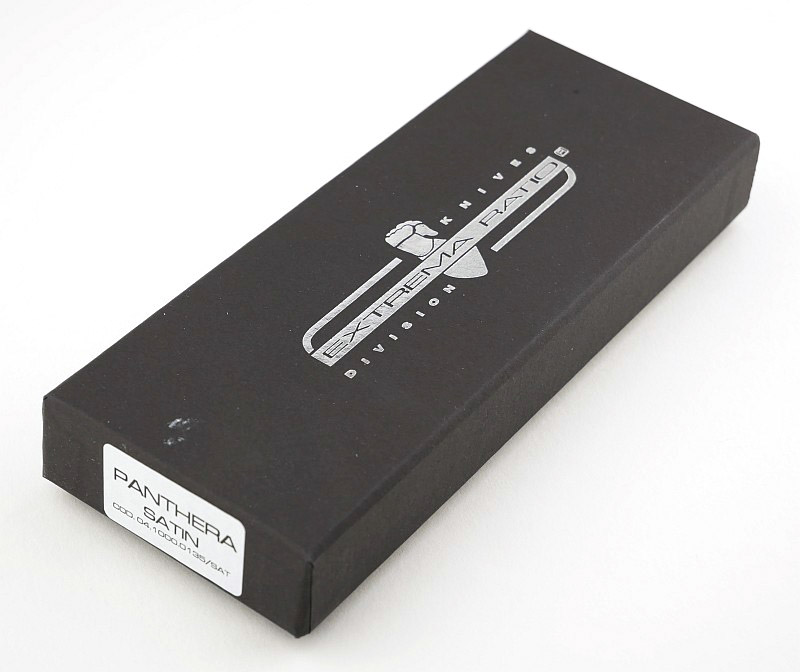
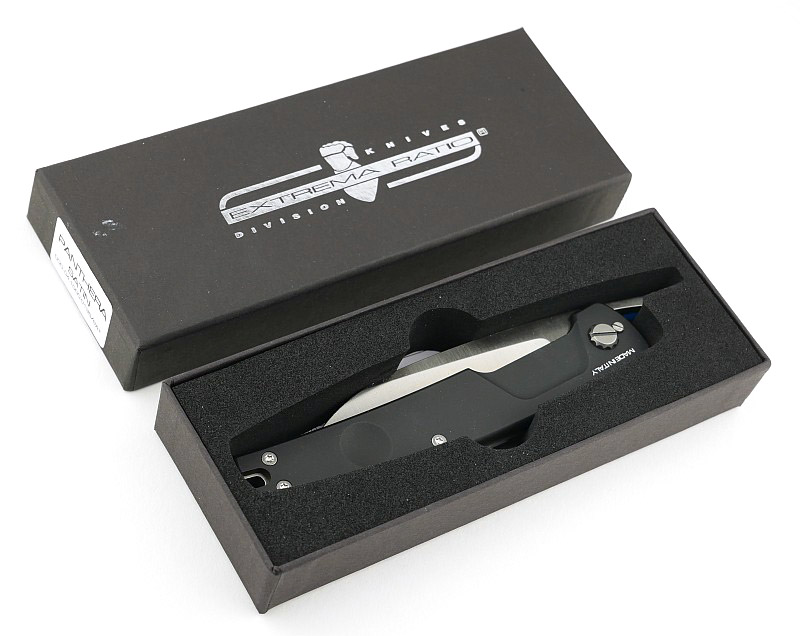
The packaging:


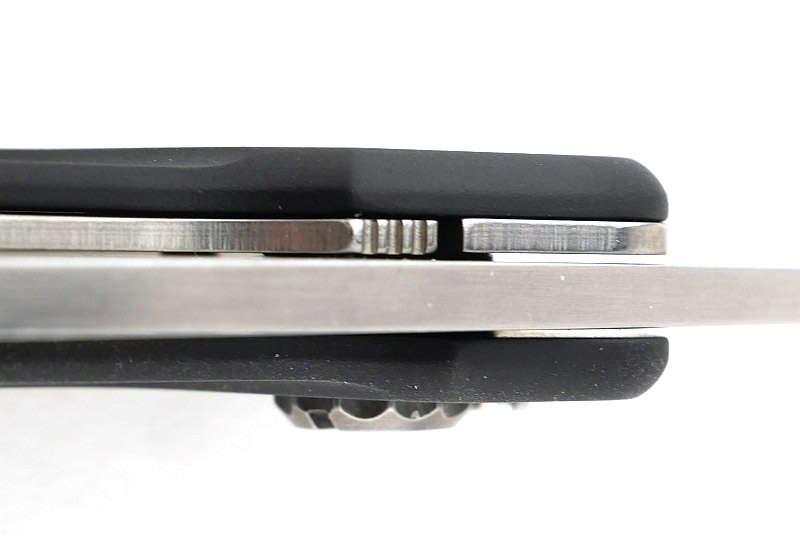
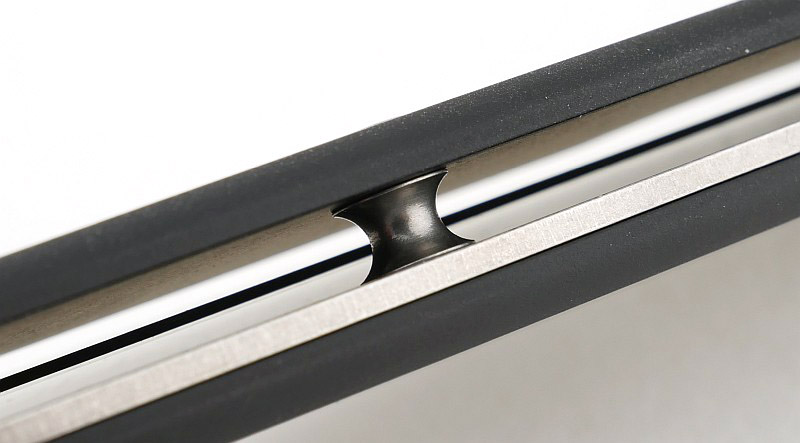
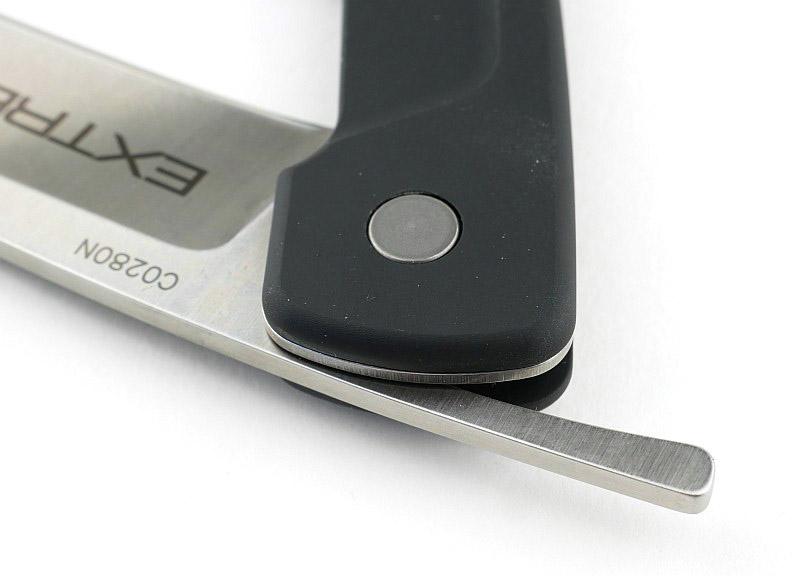
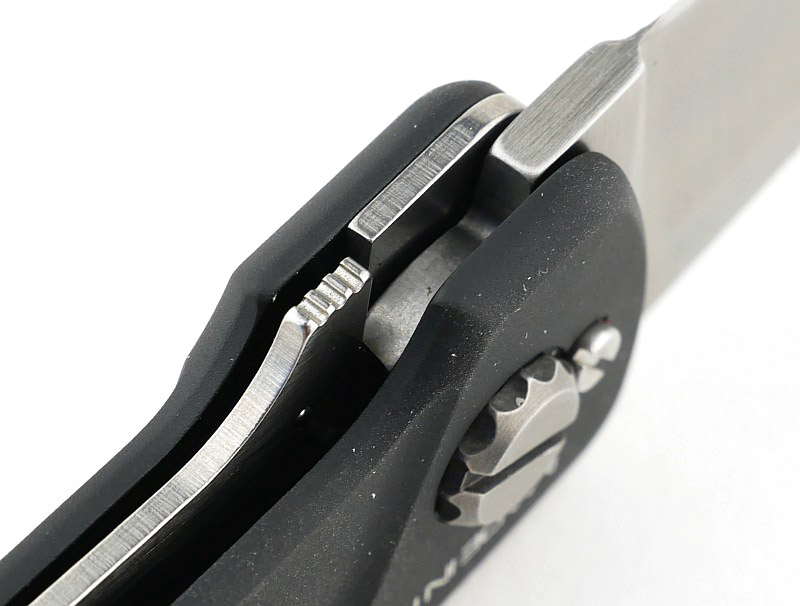
A good look round the Panthera – Enjoy all the details:


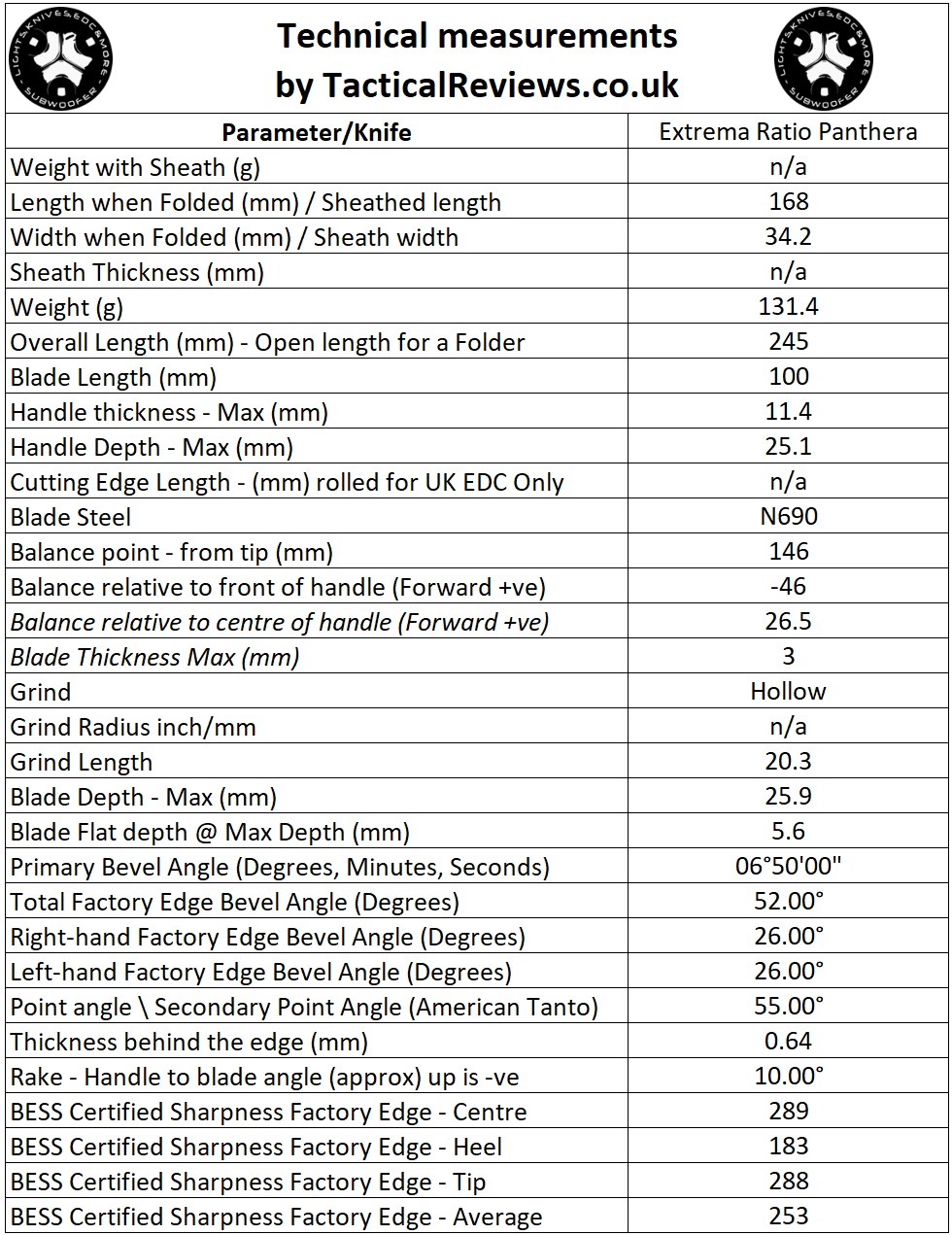
The Blade and Handle – Detailed Measurements:
For full details of the tests and measurements carried out and an explanation of the results, see the page – Knife Technical Testing – How It’s Done.

The blade is made from N690 steel.


The Factory edge up close – NEW FOR 2022!:

Followers of Tactical Reviews will know my views on factory edges, but to recap:

Anyone using a knife will need to sharpen it. That first factory edge is just like the first tank of fuel that a new car comes with (or first charge of the battery).
A good factory edge is a ‘nice to have’ but not a ‘make or break’ for a good knife, as you will be putting your own edge onto it soon enough.
The factory edge does however indicate the care a knife maker has put into the final finish.
It is for this reason Tactical Reviews measures factory edge sharpness and specifications, and includes this information in the detailed technical testing.

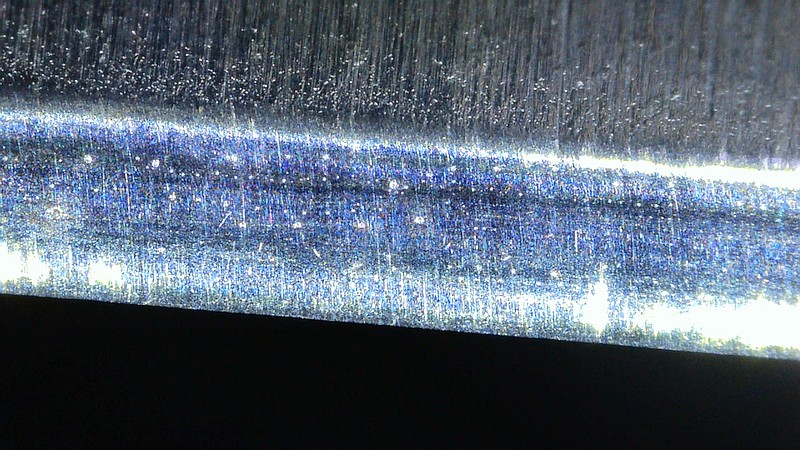
As a further look at the factory edge, this section has been added to include some high magnification photos of the factory edges.


What is it like to use?

One of the distinctive features of the Panthera (and its sibling the T-Razor) is the extended tang used as the blade opening lever. This is the same style as with a friction folder (which being of Roman design actually predates the straight razor by around 1600 years), and allows both opening of the blade, and holding it in the open position. The Panthera also has a liner lock, so the tang is not used to keep the blade open, only to open it in the first place.

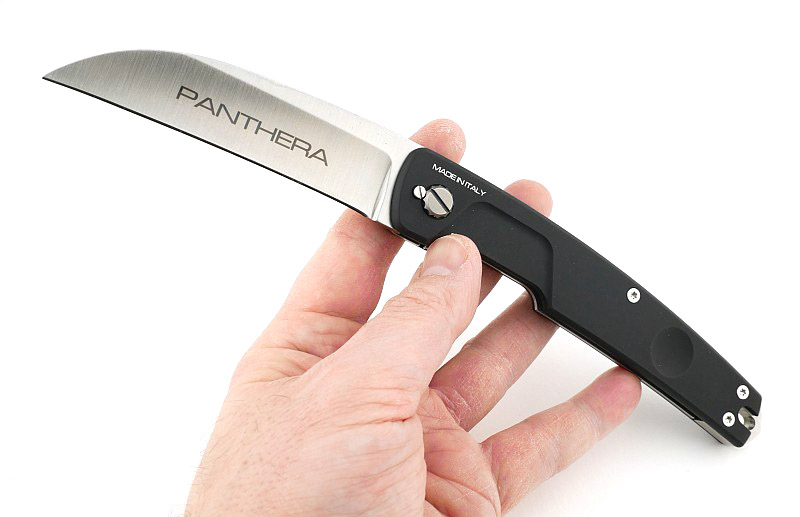
Of course the other striking design feature is the curved claw-like blade used in the Panthera, which makes it stand out.

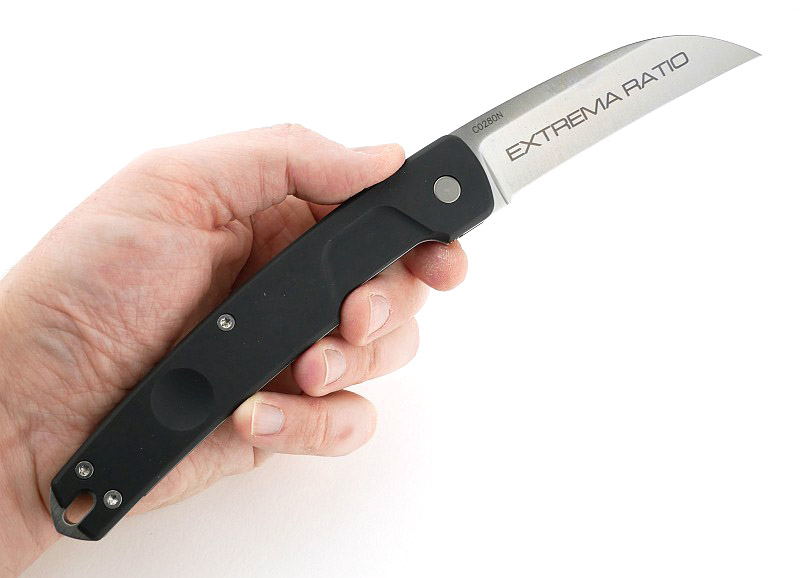
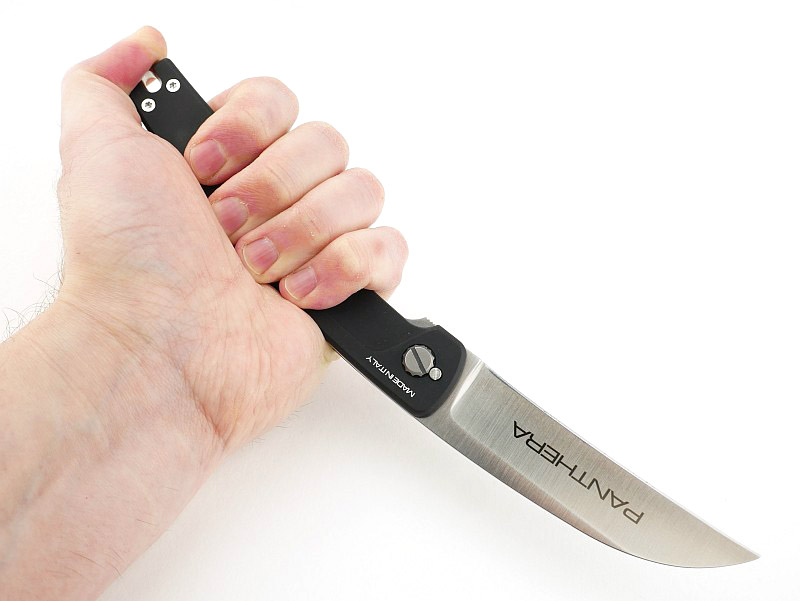
It’s a big knife. I take XL size gloves and the Panthera is a real handful, just take a look at this set of photos.


The opening method is shown a few times in the video at the start of this review, but here are a set of photos to step through opening the Panthera using the T-Razor speed style of opening.


Review Summary

The views expressed in this summary table are from the point of view of the reviewer’s personal use. I am not a member of the armed forces and cannot comment on its use beyond a cutting tool or field/hunting knife.

Something that might be a ‘pro’ for one user can be a ‘con’ for another, so the comments are categorised based on my requirements. You should consider all points and if they could be beneficial to you.

_______________________________________________
What doesn’t work so well for me
_______________________________________________

No pocket clip.
No case or holster (in lieu of a clip).
Tang opening doesn’t suit everyone.
Lock release is a bit sharp to push on.

_______________________________________________
Things I like
_______________________________________________

Striking and impressive knife.
Curved blade can increase cutting power for many tasks.
Very comfortable grip.
Blade opens quickly (once you are practiced).
Long handle allows for multiple grip positions.
Matte anodised handle finish feels great.

 
Discussing the Review:
The ideal place to discuss this review is on the Tactical Reviews Facebook Page
Please visit there and start/join the conversation.
As well as the Tactical Reviews Facebook Page, please consider visiting one of the following to start/join in any discussion.

BladeForums – Knife Reviews (US based Forum for Knife Discussion)

CandlePowerForums – Knife Reviews Section (Largest and Friendliest Flashlight Community Forum)

Knife Review: lionSTEEL Myto

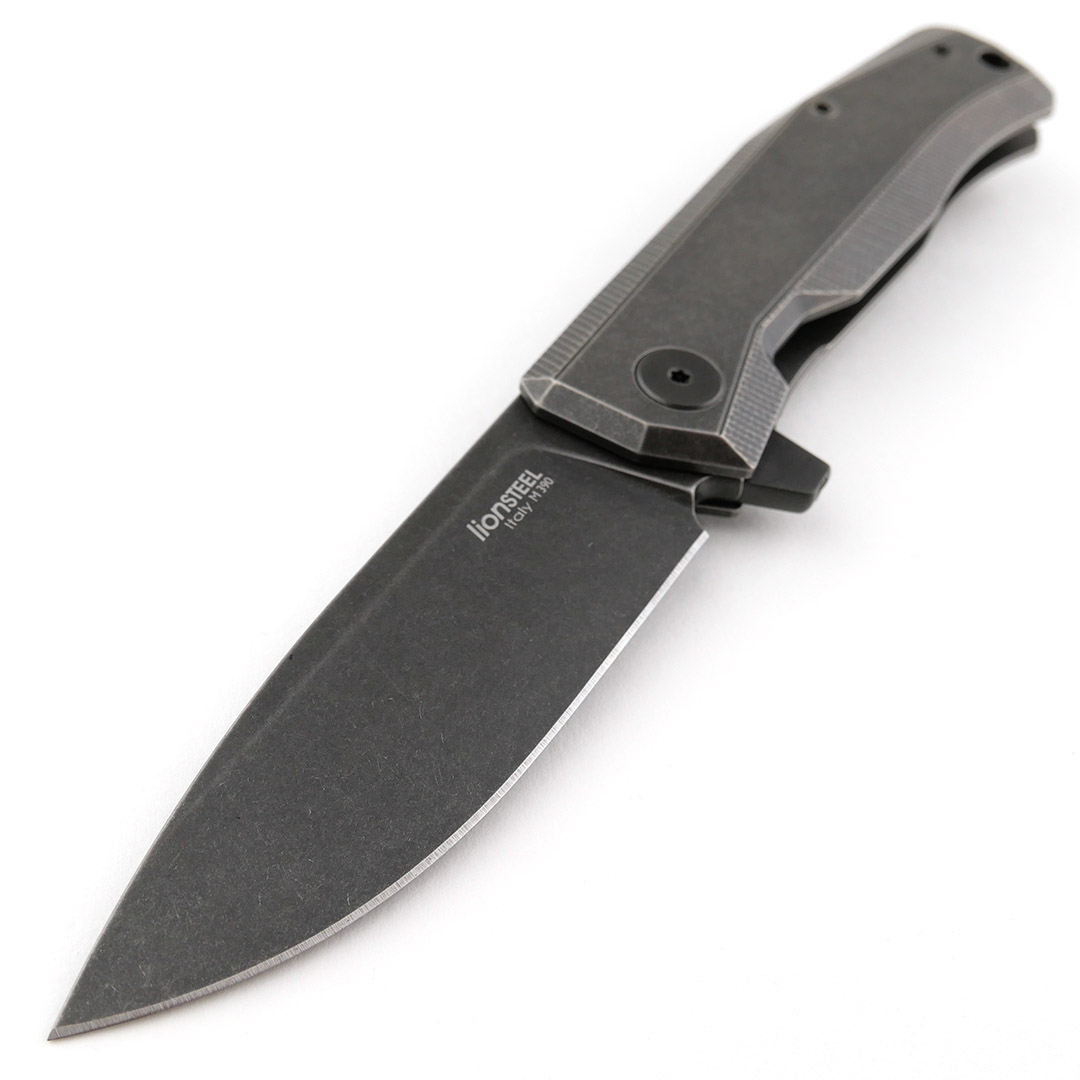
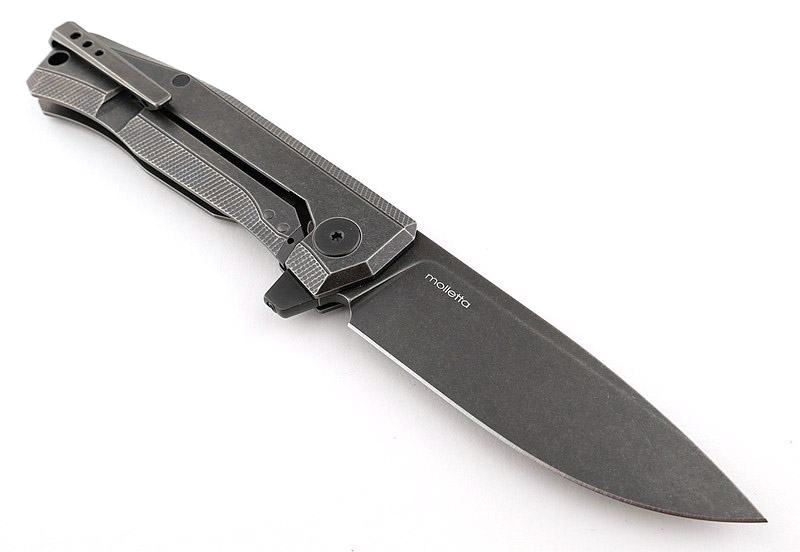
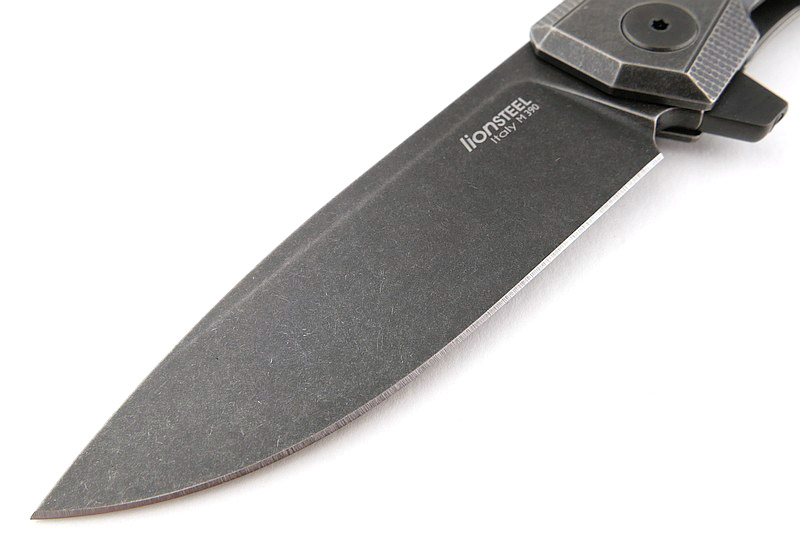
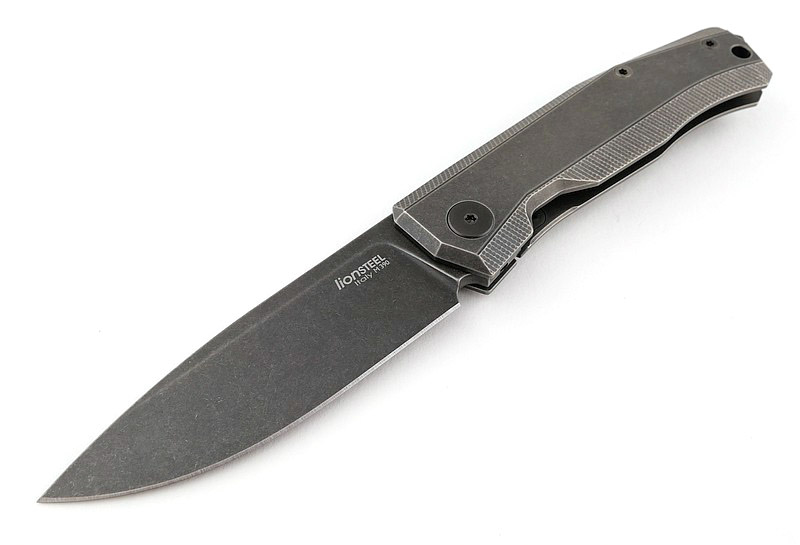
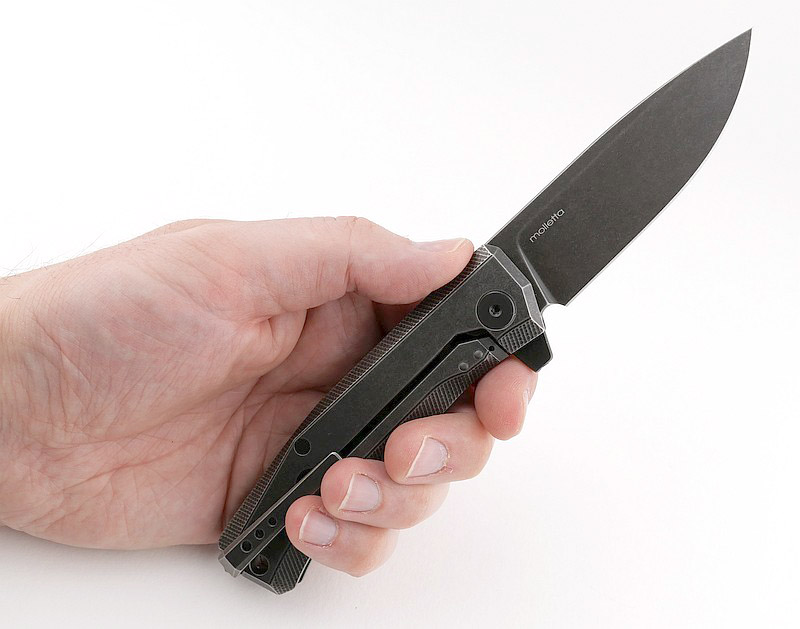
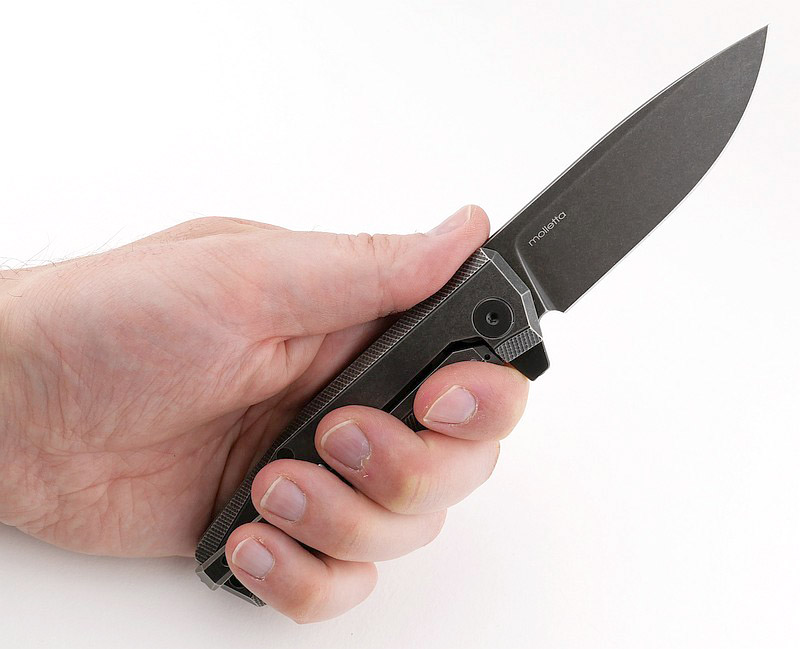
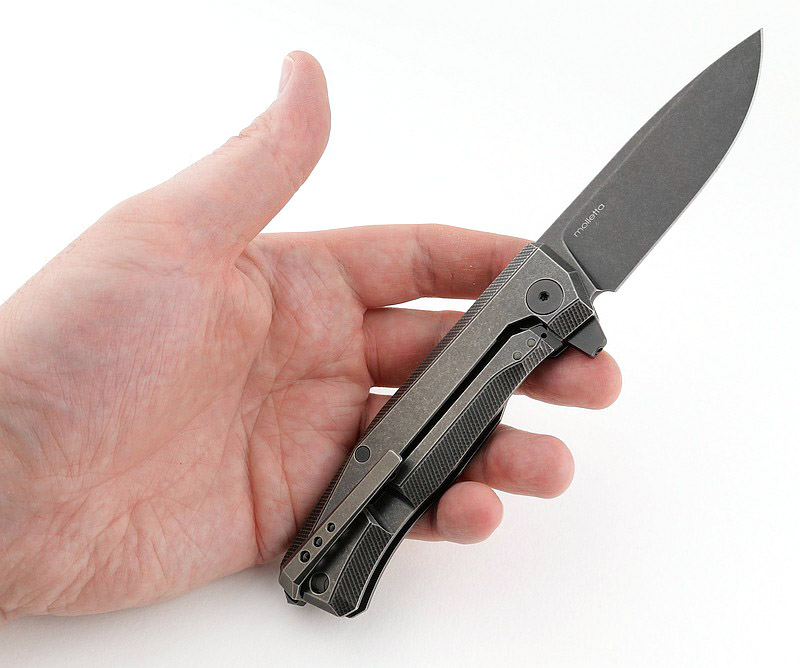
The lionSTEEL Myto is a superb EDC knife designed by Mik Molletta, with Titanium handles, M390 blade and a removable flipper tab. The version on test has a black stonewashed finish on the handles and blade. Join me in this review of the lionSTEEL Myto for a really detailed look over the design and technical specifications of this excellent EDC knife.

Video Overview

This video is a detailed look at the Myto, from handling to technical measurements. Hopefully something for everyone and you should have a better idea how the knife handles.


A few more details:

What’s in the box?:
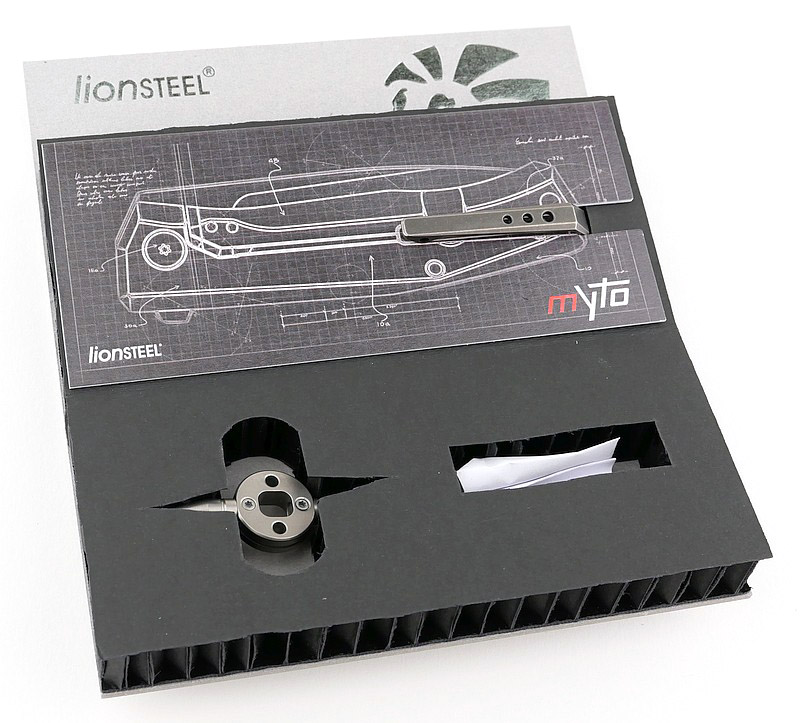
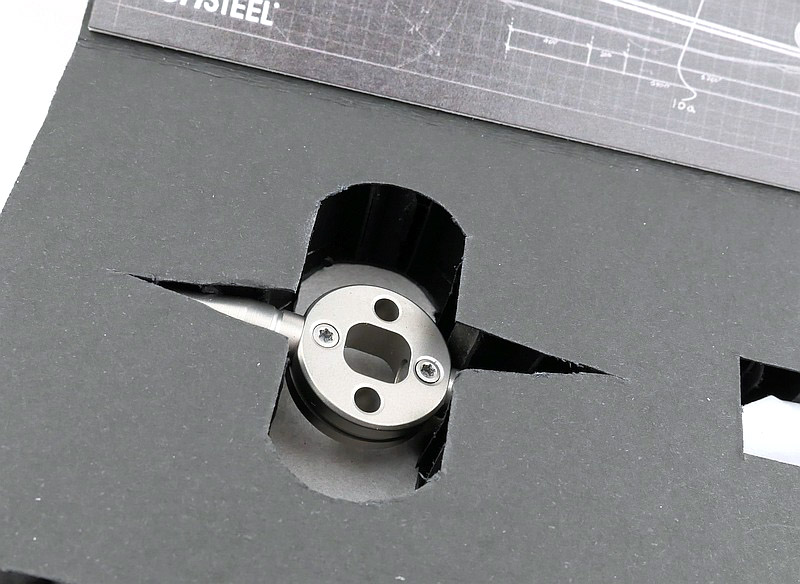
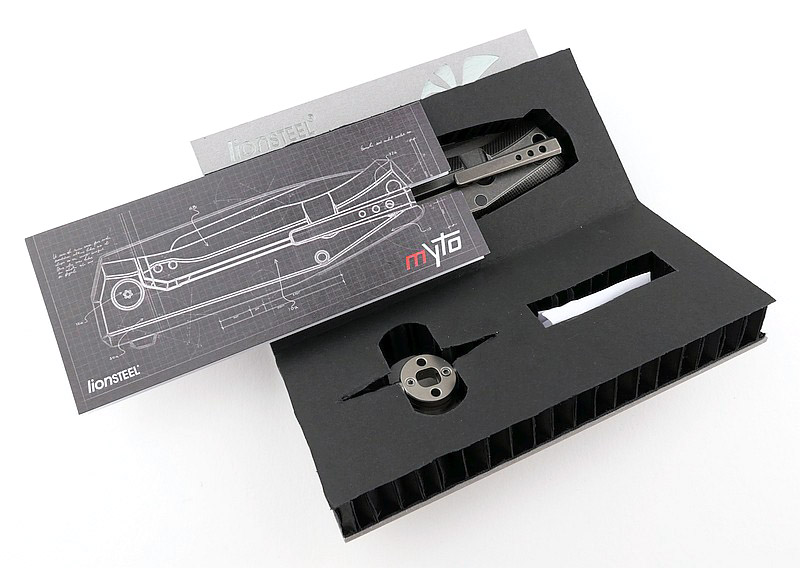
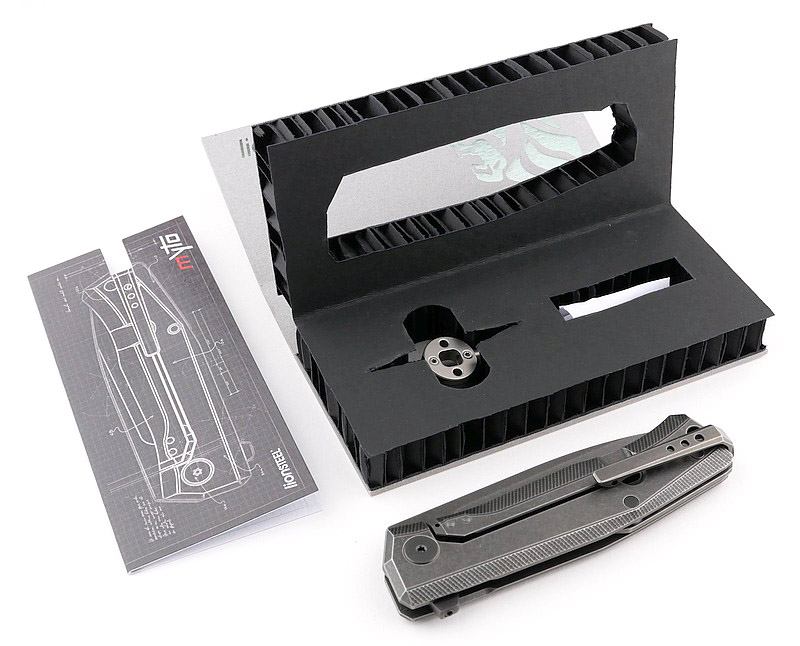
Arriving on lionSTEEL’s ‘recyclable’ packaging, this is how it arrives.


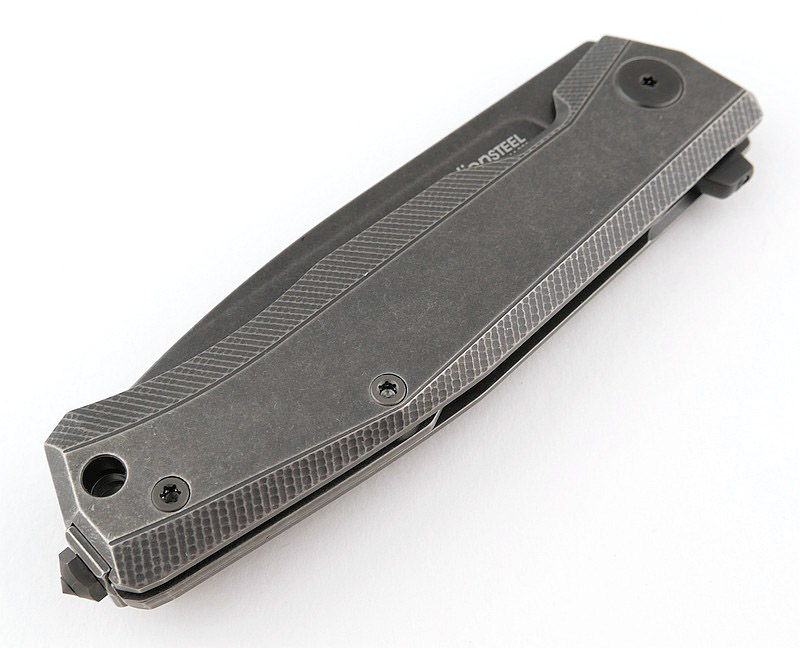
A good look round the Myto – Things to look out for here are:
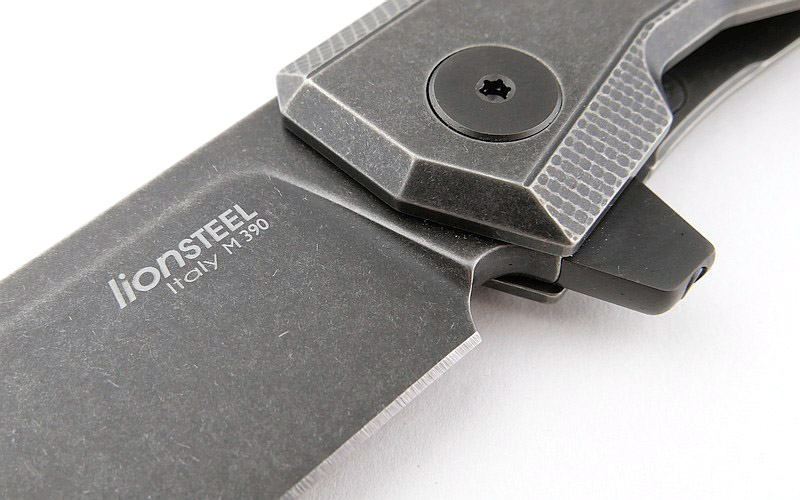
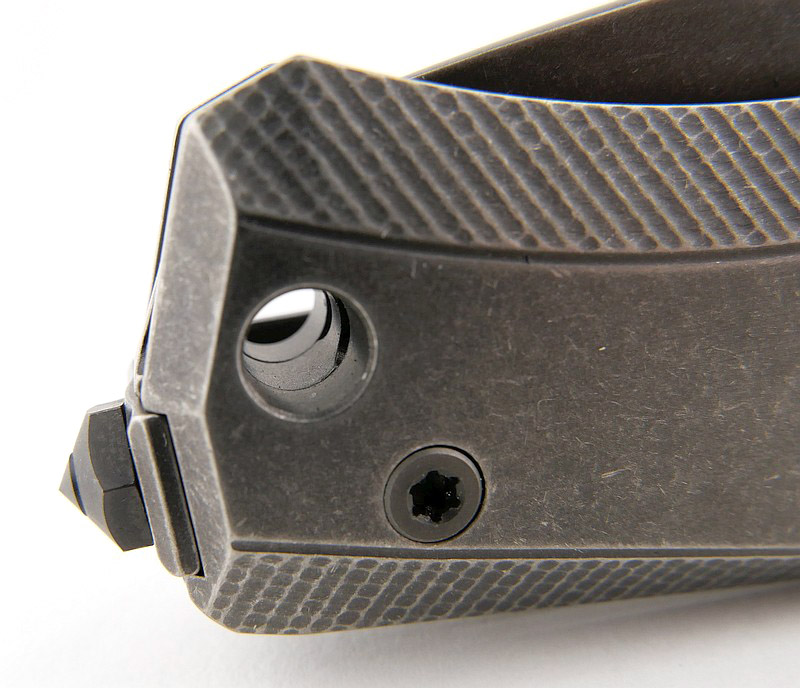
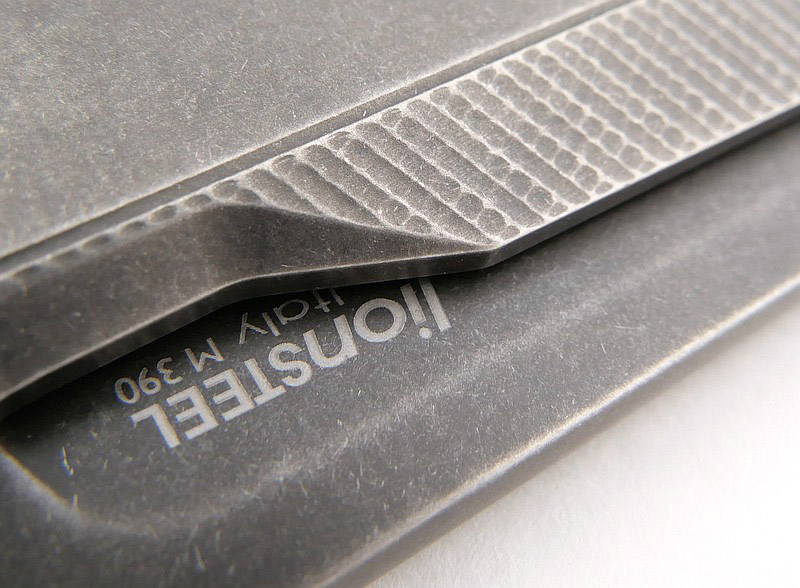
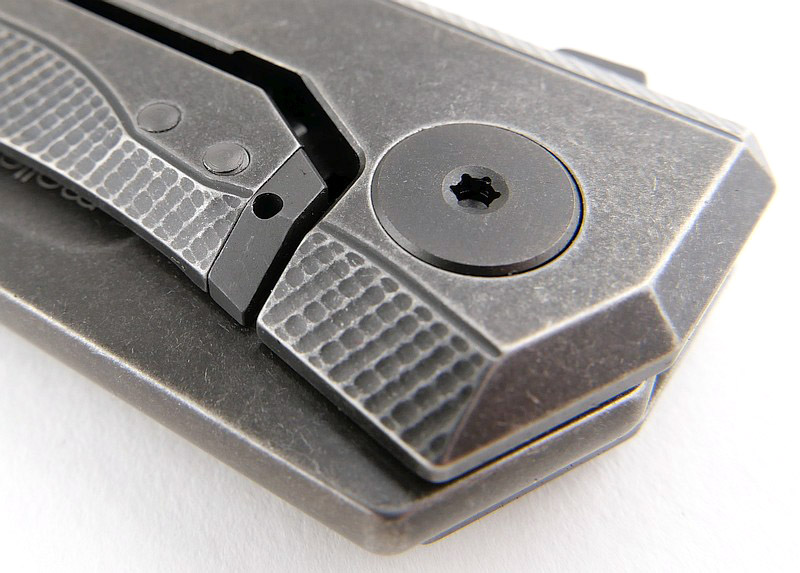
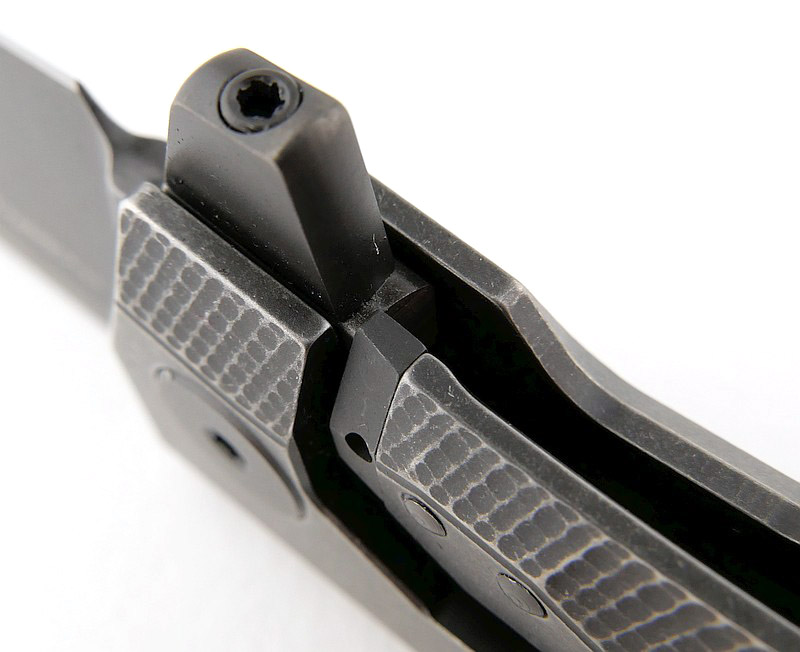
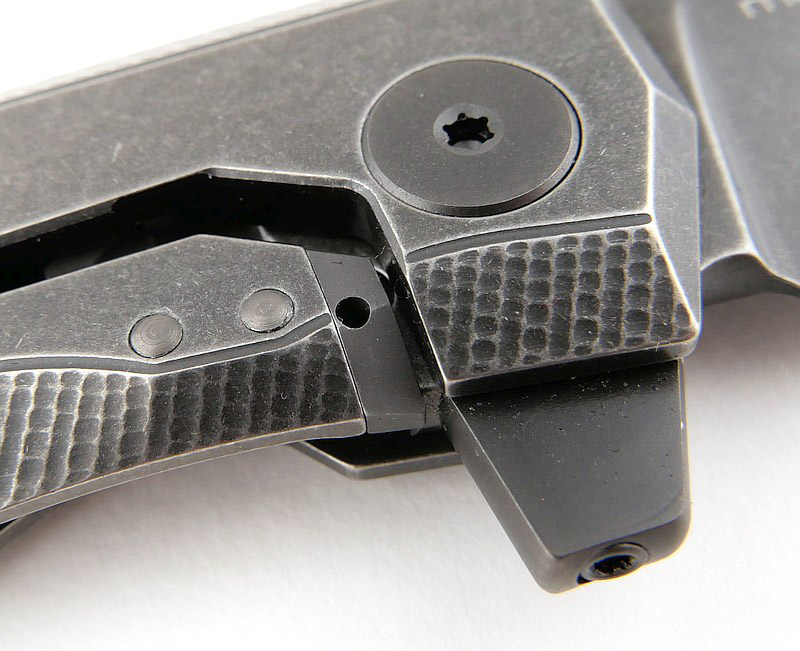
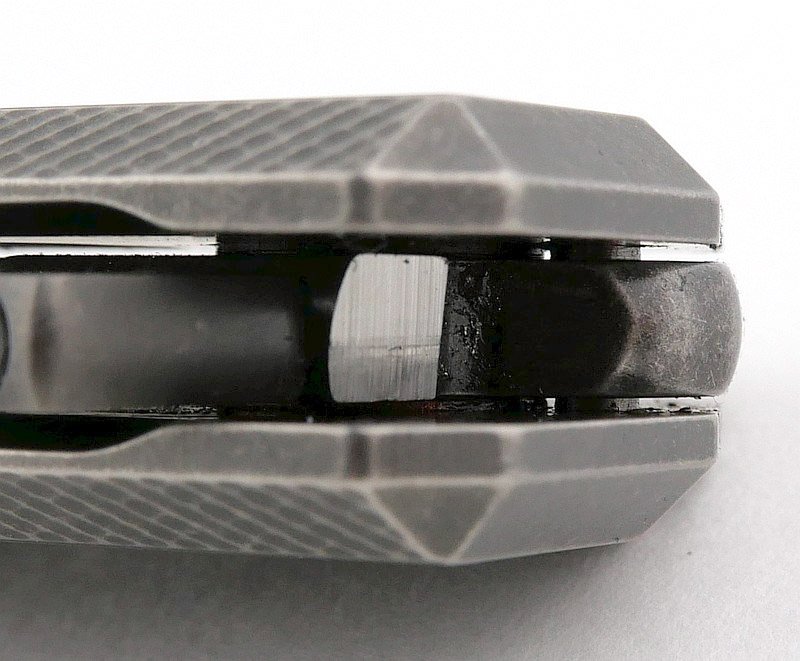
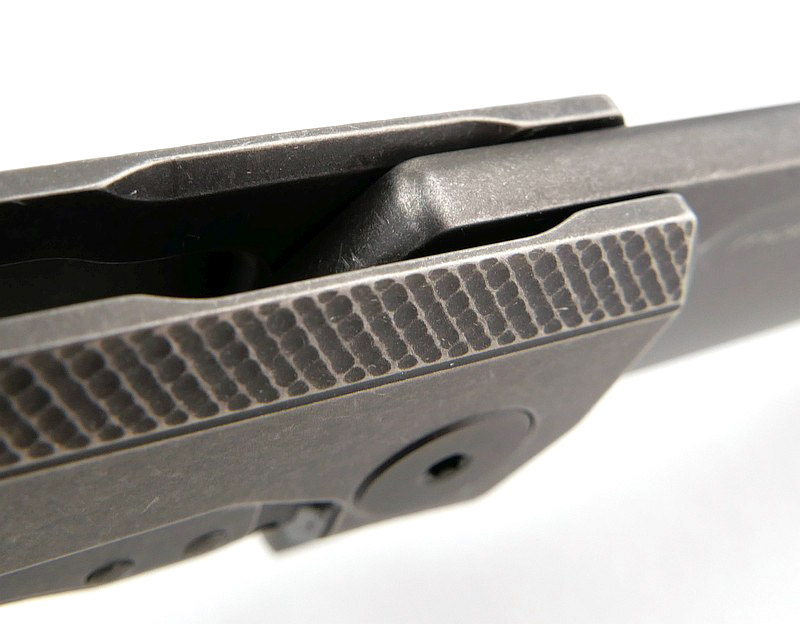
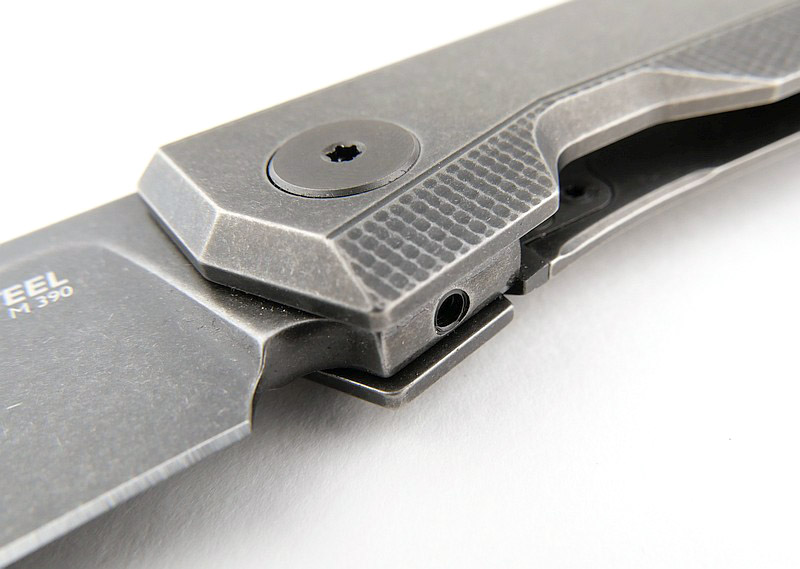
Overall fit and finish is flawless, even with the unforgiving close up photos. As you go through the gallery you will see the details of form (such as round the lock bar spring, or pocket clip, or lanyard hole, or flipper tab etc.) One detail you have to look closely for is the hidden stop pin which is just visible in one of the images. This version in the stonewash finish gives it a nice soft look, ready to be put to use.


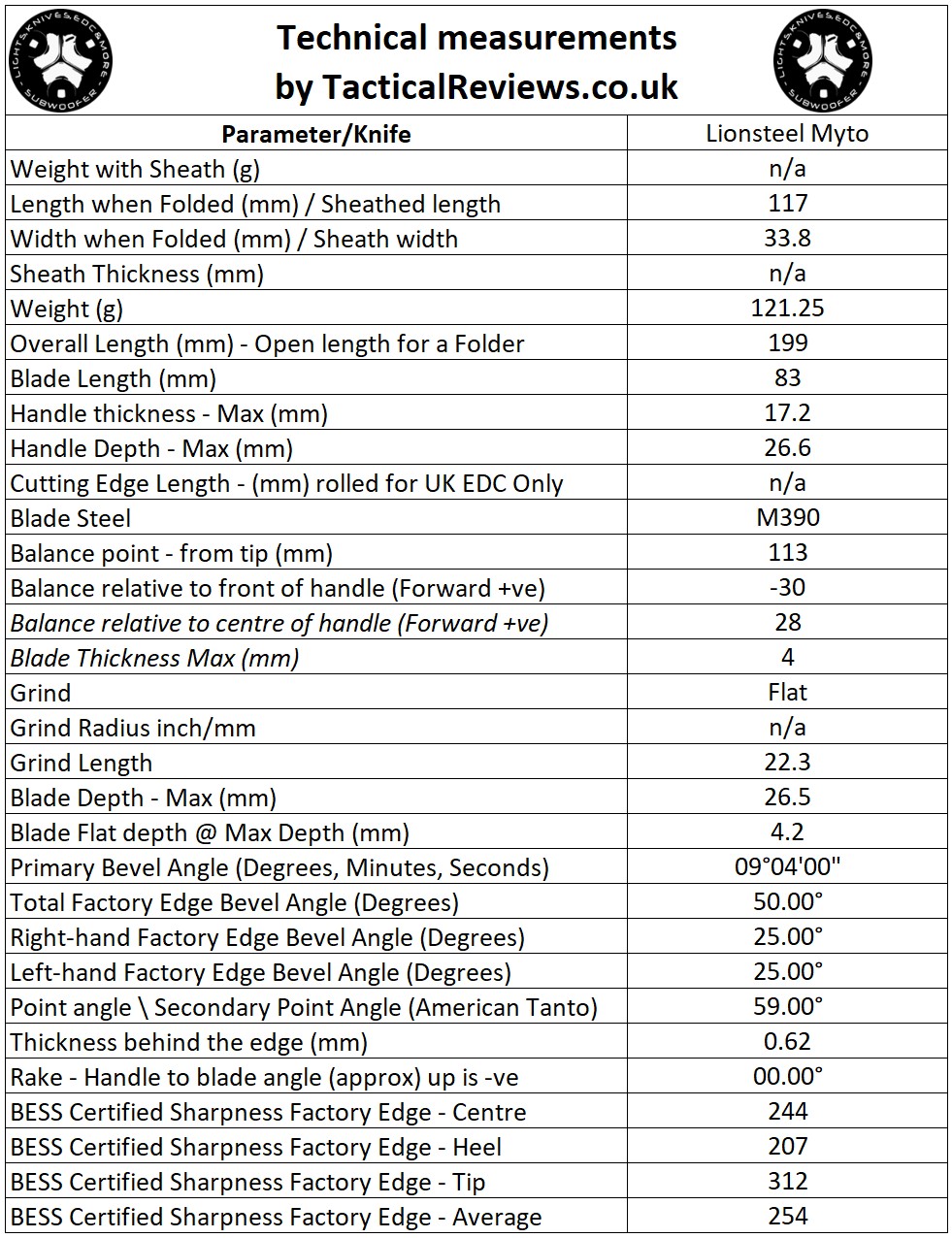
The Blade and Handle – Detailed Measurements:
For full details of the tests and measurements carried out and an explanation of the results, see the page – Knife Technical Testing – How It’s Done.

The blade is made from M390 steel.


The Factory edge up close – NEW FOR 2022!:

Followers of Tactical Reviews will know my views on factory edges, but to recap:

Anyone using a knife will need to sharpen it. That first factory edge is just like the first tank of fuel that a new car comes with (or first charge of the battery).
A good factory edge is a ‘nice to have’ but not a ‘make or break’ for a good knife, as you will be putting your own edge onto it soon enough.
The factory edge does however indicate the care a knife maker has put into the final finish.
It is for this reason Tactical Reviews measures factory edge sharpness and specifications, and includes this information in the detailed technical testing.

As a further look at the factory edge, this section has been added to include some high magnification photos of the factory edges.

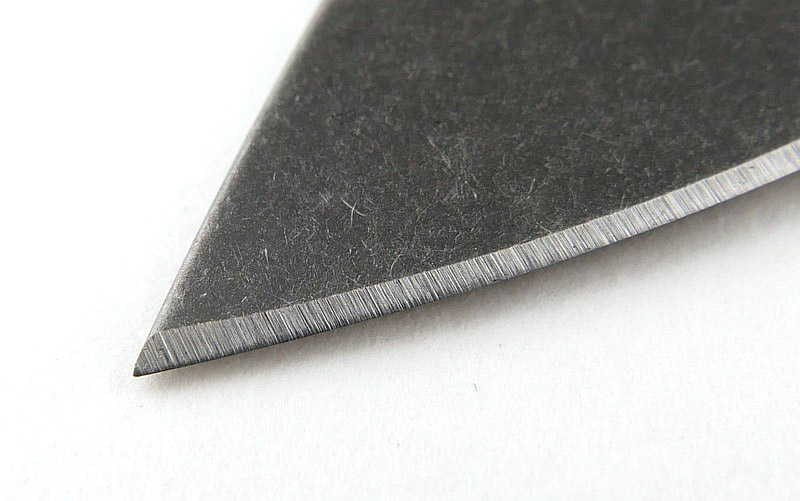
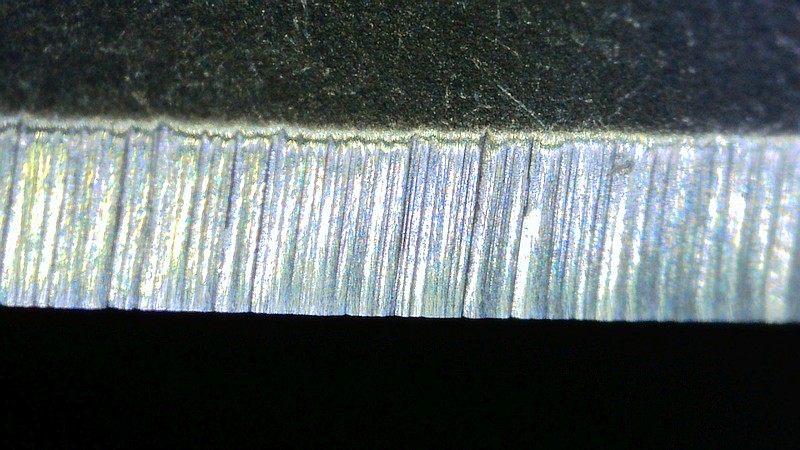
Though not the best BESS sharpness measurements, this close up of the edge shows the texturing in the edge that makes it really cut well.


What is it like to use?

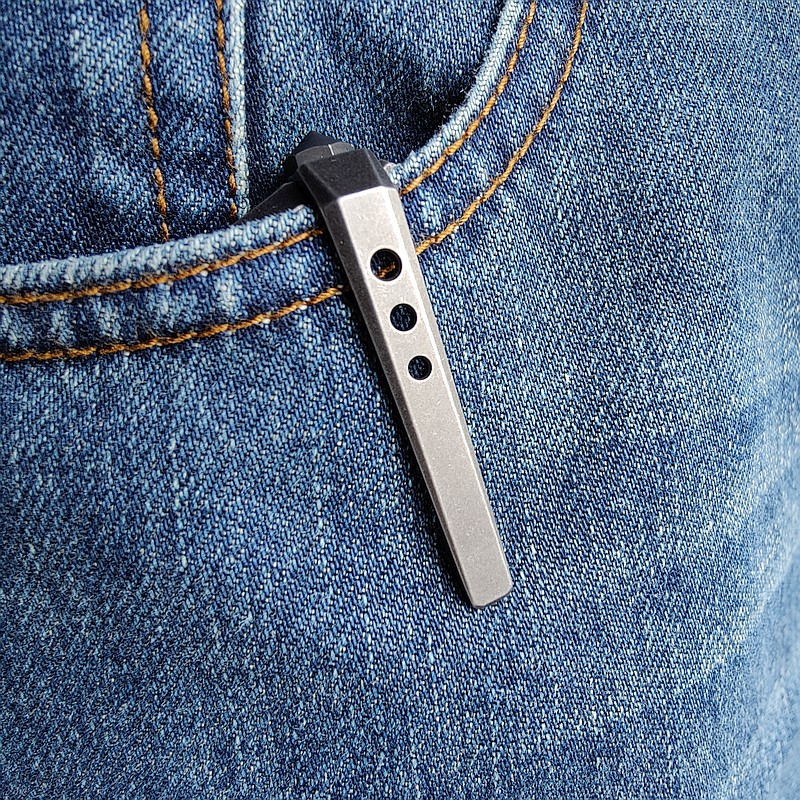
Inobtrusive and easy to carry are a couple of first impressions which make a great EDC knife. One thing I wasn’t so sure about when I first picked up the Myto was the solid pocket clip; it seemed too stiff and like it would be difficult to use. I’ve been proven completely wrong on that as actually the clip eases over the edge of a pocket without a struggle, but then is a bit harder to take off, so making it secure.


With the blade on bearings, the flip open is super slick, as you can see in the video. It really doesn’t take any effort at all to flip to the locked position and you can develop a nice slow lazy flip with the blade reliably locking, or really snap it out. The detent if firm without being harsh so you never have to fight with it.

It’s not the first lionSTEEL with removable flipper tab, and you might question the benefits of such a feature. Consider the pros and cons for a flipper. As pros, you might have fast deployment, and built-in finger guard. As cons, one of the most frequent complaints it the messy tab sticking out and the action appearing like a flick knife and in many places or situations causing distress to non-knife people.
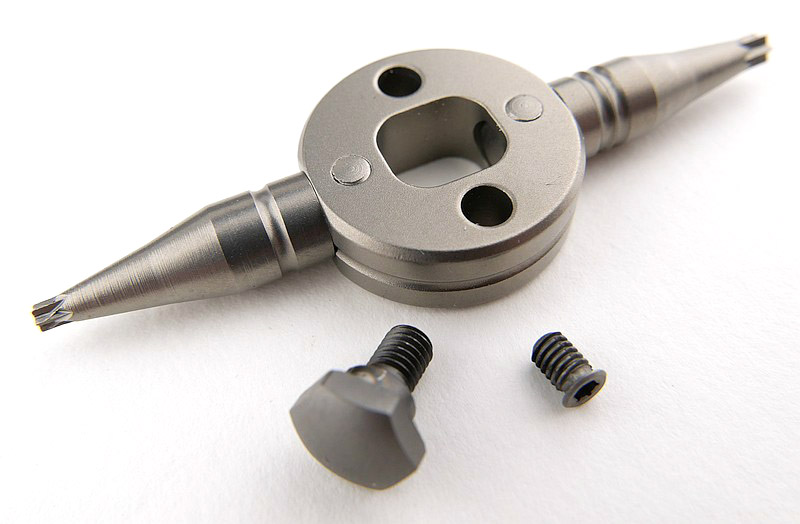
So if you want a sleeker looking knife, and one which requires a steady and inoffensive two-handed opening, you undo one screw and off comes the flipper tab. You can then change your mind, just want to mix it up again, or go fidget flipping and on goes the tab.
I did find the tab itself was not perfectly in line due to the removable system, and in trying to get it lined up better I over torqued the supplied tool and started to twist off the end of the torque driver, so beware of this when refitting the tab.
If you have the facility you will likely use it, giving you two slightly different knives in one. I have several folders I wish had the same feature.


In terms of size, the Myto fits in very well in the 3/3.5″ blade length category ideal for general purpose every day tasks. The strong lock and flipper tab/finger guard allow you to work hard with this knife.

I take an XL size glove, and in my hand I can take a full grip and the handle is large enough so that my hand doesn’t have the corners of the butt digging in, instead just extending slightly out of my hand. At the front, the flipper tab acting as a finger guard, keeps the position of the knife safely under control. Just right.


lionSTEEL’s superb engineering stands out the moment you pick up the Myto with absolutely nothing seeming out of place or ‘could be better’, instead everything just being right. Refined, easy to carry and strong blade with great slicing power.

Review Summary

The views expressed in this summary table are from the point of view of the reviewer’s personal use. I am not a member of the armed forces and cannot comment on its use beyond a cutting tool or field/hunting knife.

Something that might be a ‘pro’ for one user can be a ‘con’ for another, so the comments are categorised based on my requirements. You should consider all points and if they could be beneficial to you.

_______________________________________________
What doesn’t work so well for me
_______________________________________________

Flipper tab is slightly wonky due to removable system.
Easy to over-torque the supplied tool.
Solid clip feels very stiff.
Glass breaker is scratchy.

_______________________________________________
Things I like
_______________________________________________

Quality engineering.
M390 blade steel performance.
Excellent EDC size of knife.
‘ReF’ Removable Flipper tab system.
Elegant and refined design.
Blade geometry makes for a great slicer.
Solid and slick blade action.
Clip can be fitted for left or right handed use.

 
Discussing the Review:
The ideal place to discuss this review is on the Tactical Reviews Facebook Page
Please visit there and start/join the conversation.
As well as the Tactical Reviews Facebook Page, please consider visiting one of the following to start/join in any discussion.

BladeForums – Knife Reviews (US based Forum for Knife Discussion)

CandlePowerForums – Knife Reviews Section (Largest and Friendliest Flashlight Community Forum)

Light Review: Fenix PD36 TAC

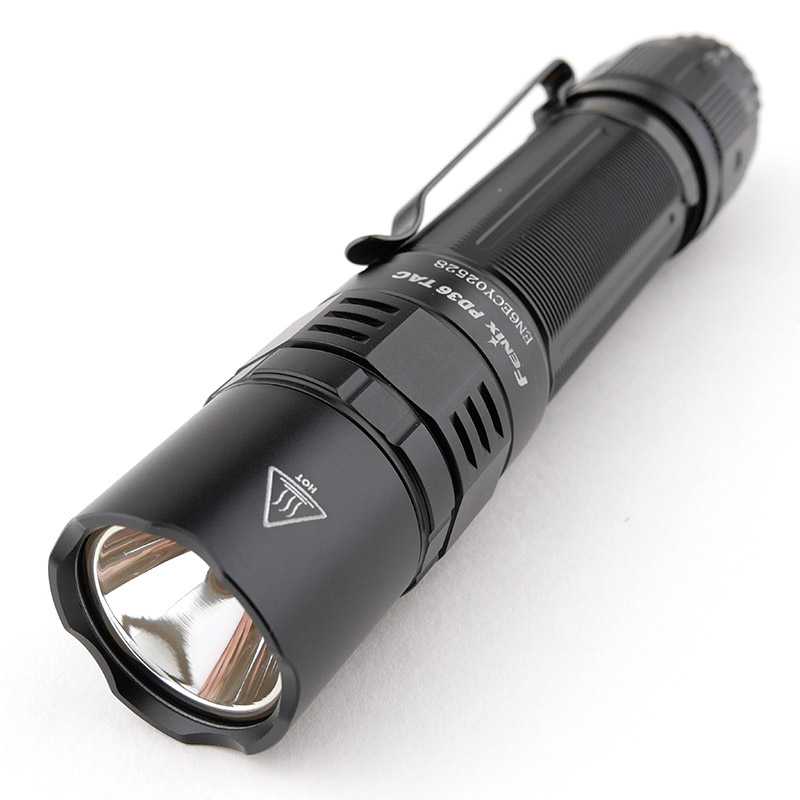
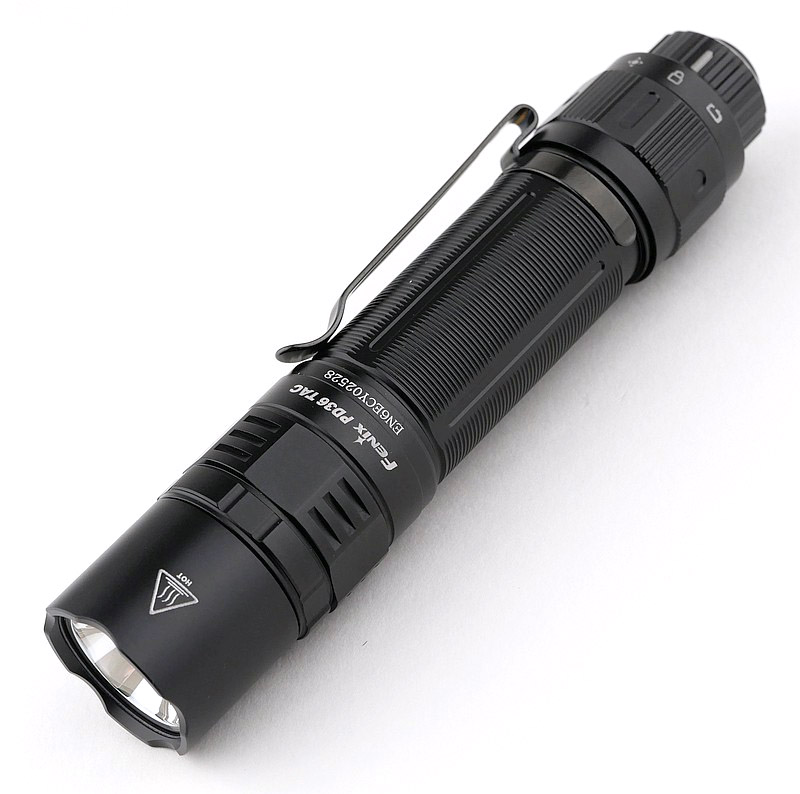
In this review of the Fenix PD36 TAC, I’m going to be taking a detailed look at the details, comparing its performance to the specifications, checking out the beam and how usable it is. The review includes video content as well as photo galleries and technical testing results.
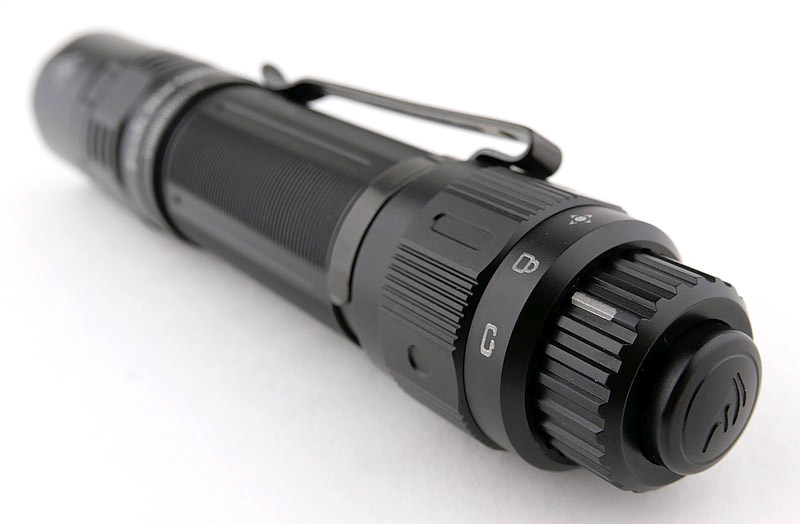
Join me in this look over the Fenix PD36 TAC Flashlight / Torch, a light built around the increasingly common larger 21700 cell (compared to the typical 18650 previously used). This has a specialised tail-cap with physical lockout, dedicated ‘Tactical’ setting, and a normal ‘duty’ multi-mode setting.
Let’s get to really know the Fenix PD36 TAC!

Video Overview

Starting out with the video overview of the PD36 TAC.


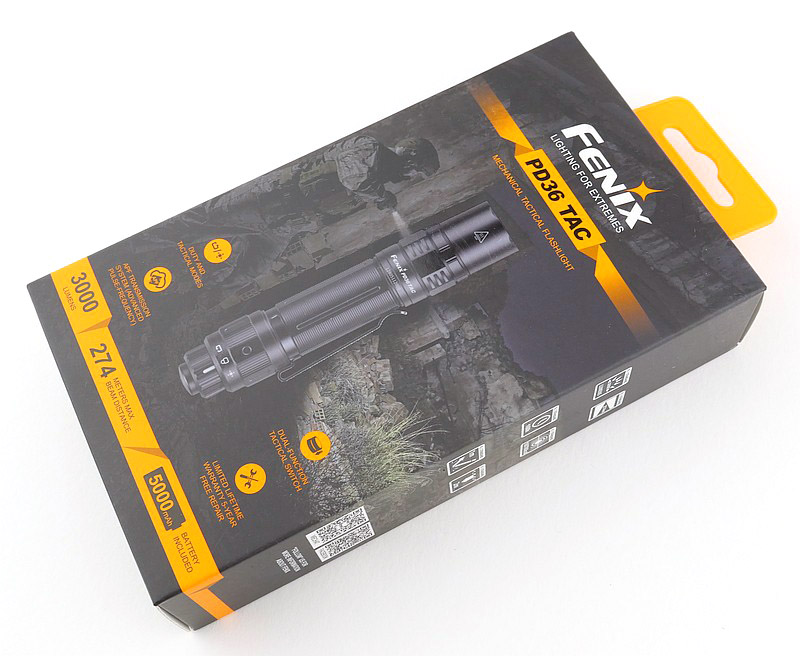
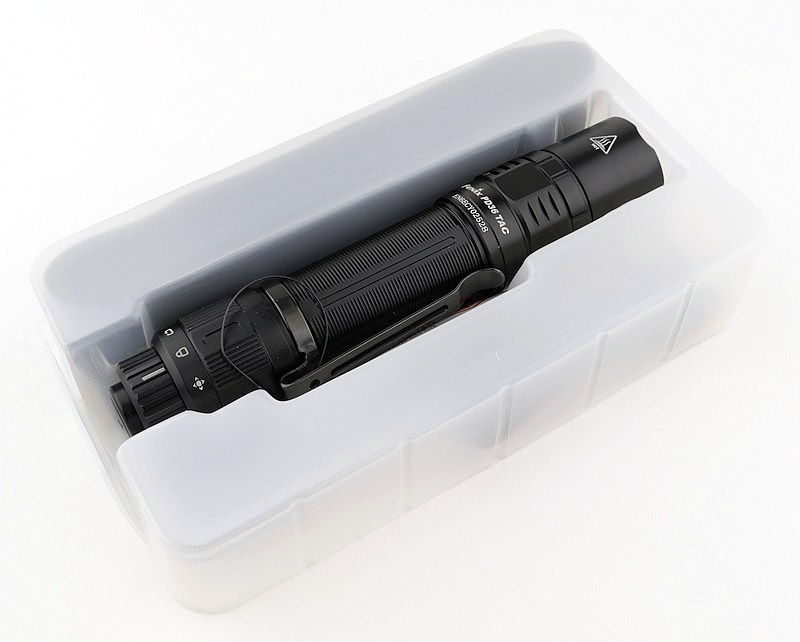
What is in the box?:

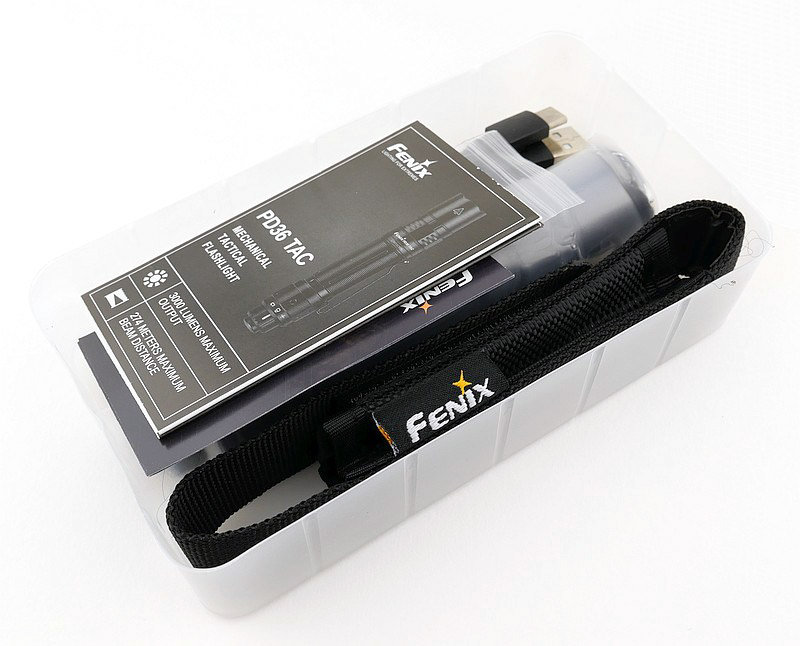
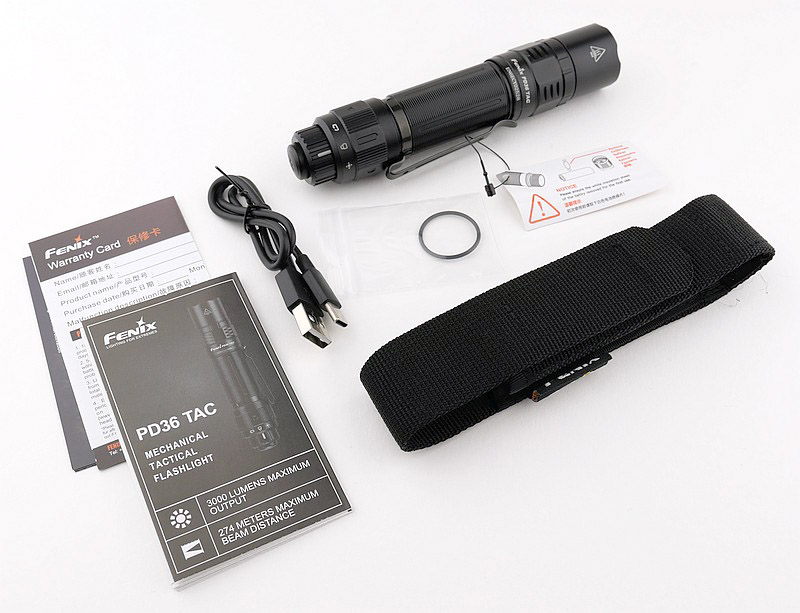
Unpacking the PD36 TAC and its accessories.


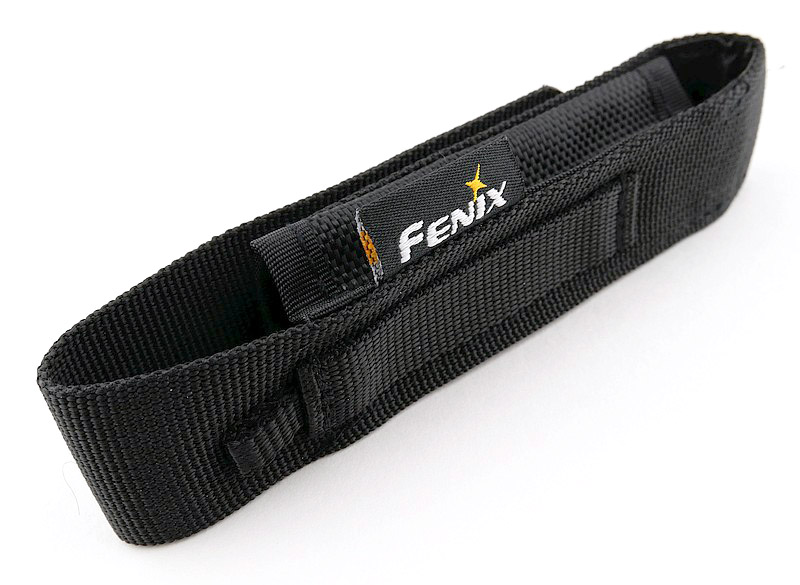
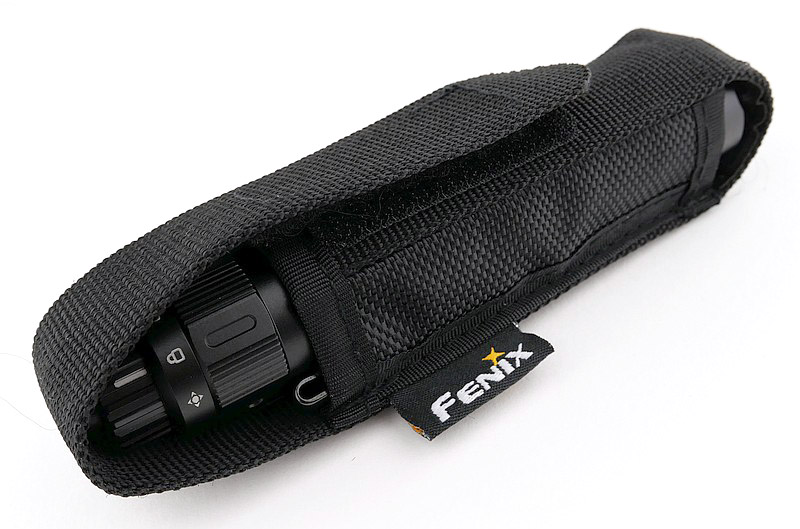
Taking a more detailed look at the holster:

Before moving onto the PD36 TAC itself, this is a run round the supplied belt holster.


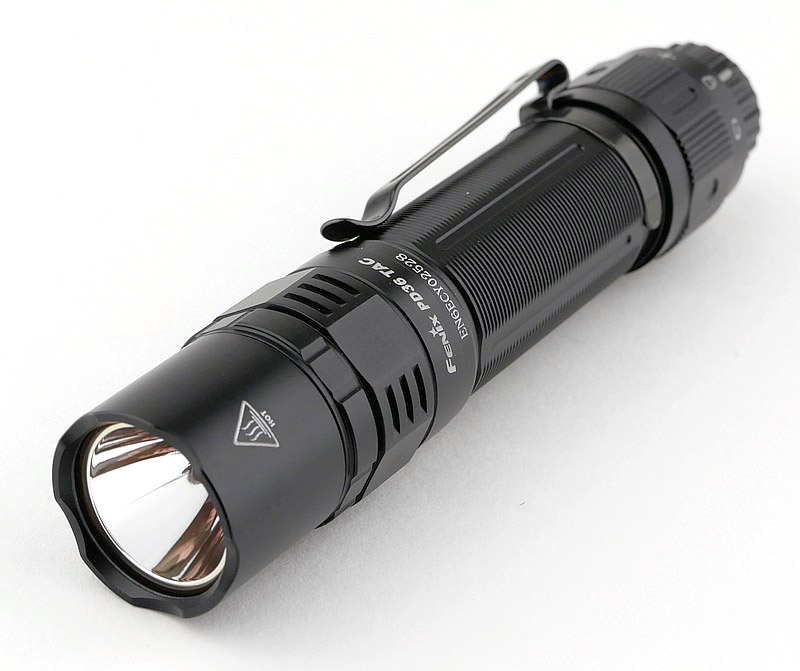
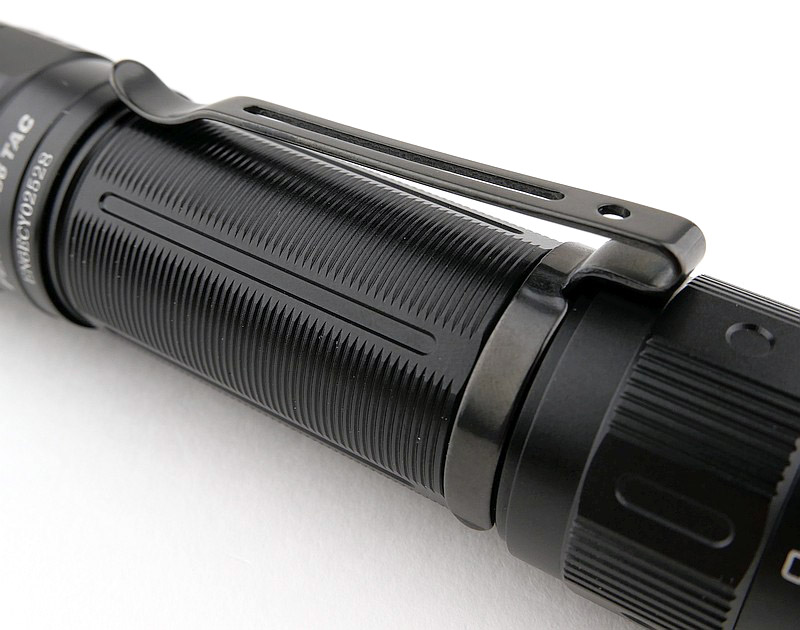
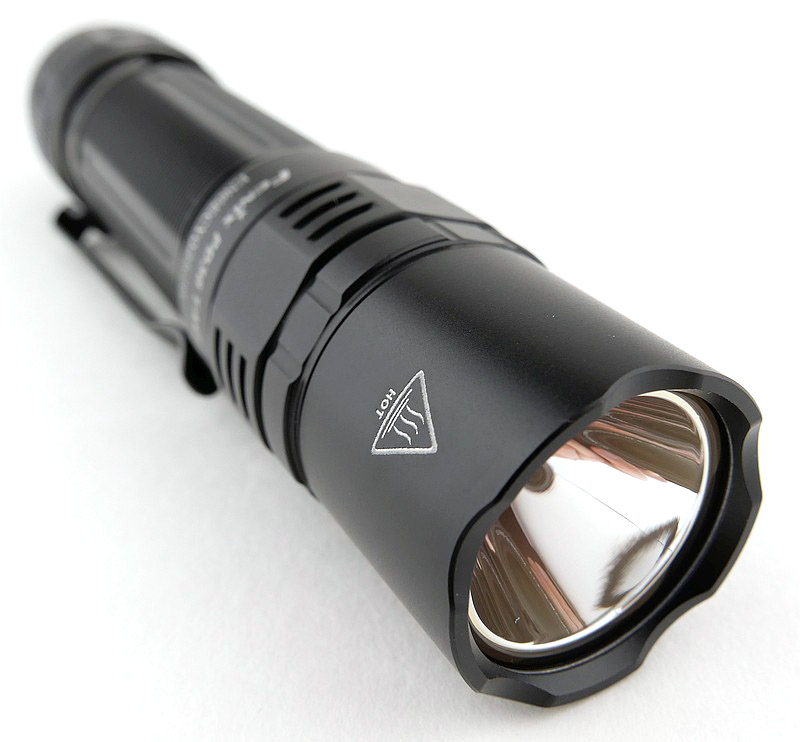
A good look round the PD36 TAC – Things to look out for here are:
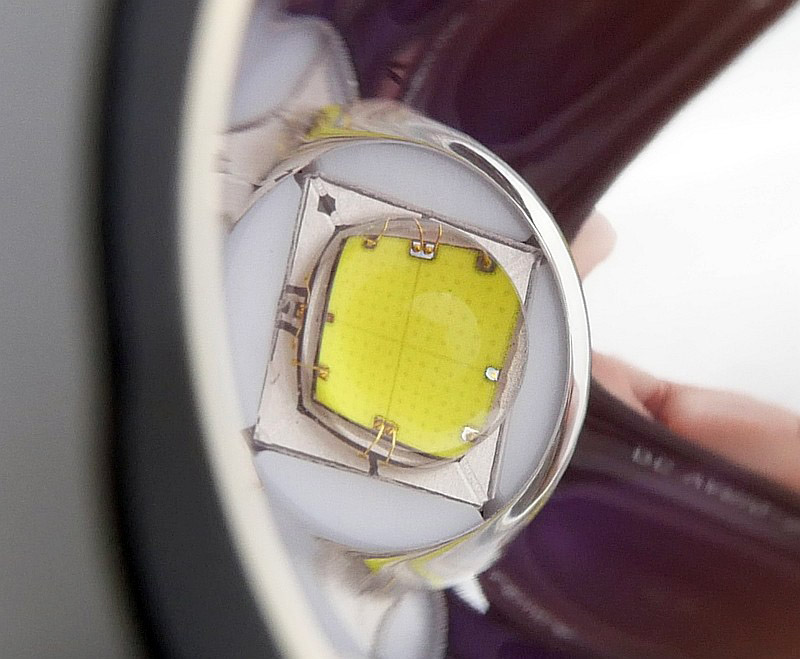
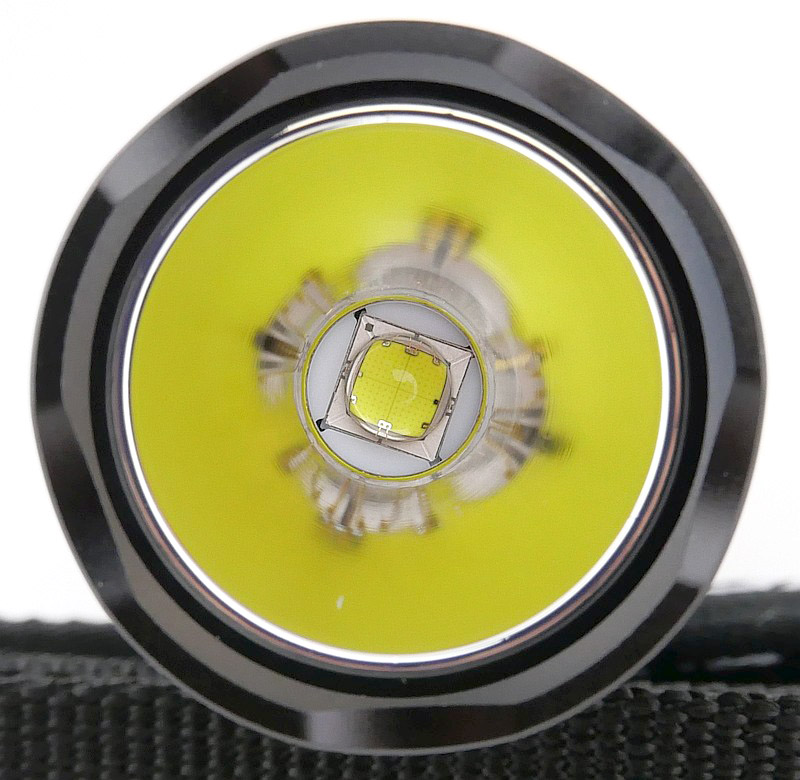
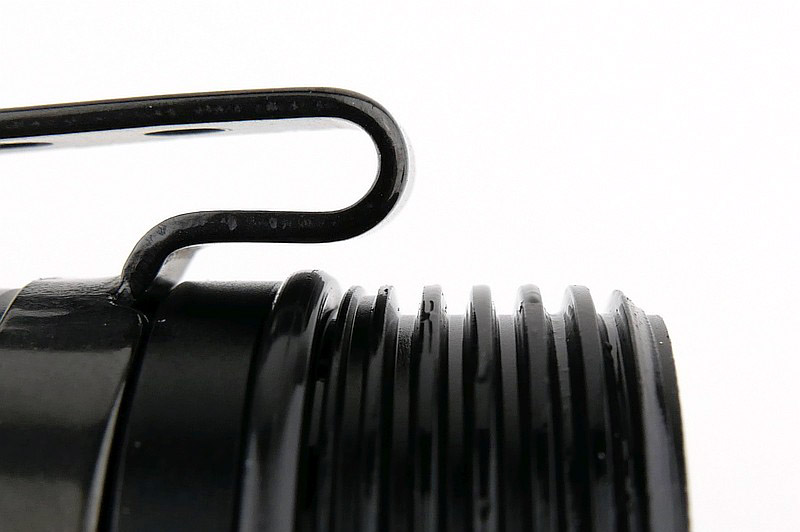
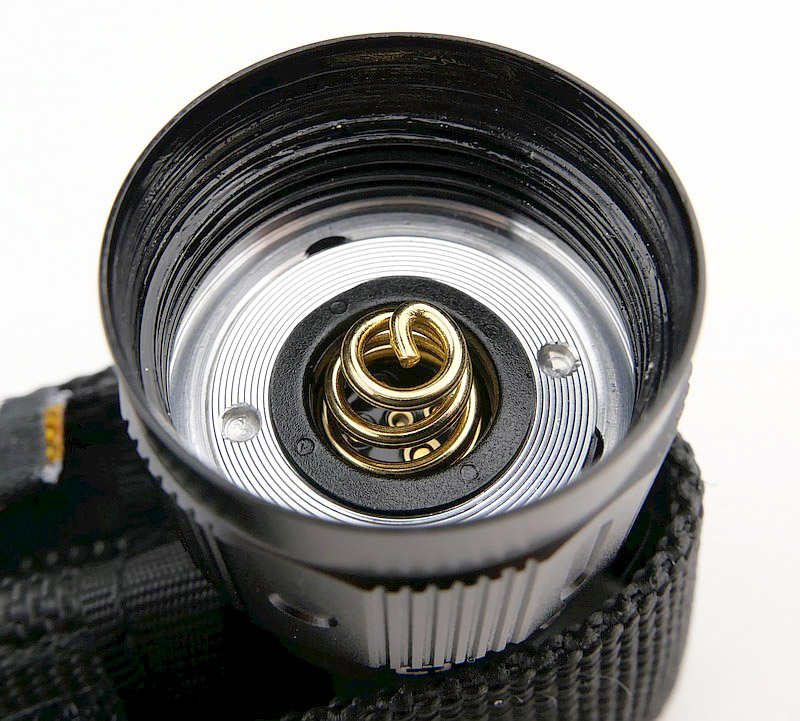
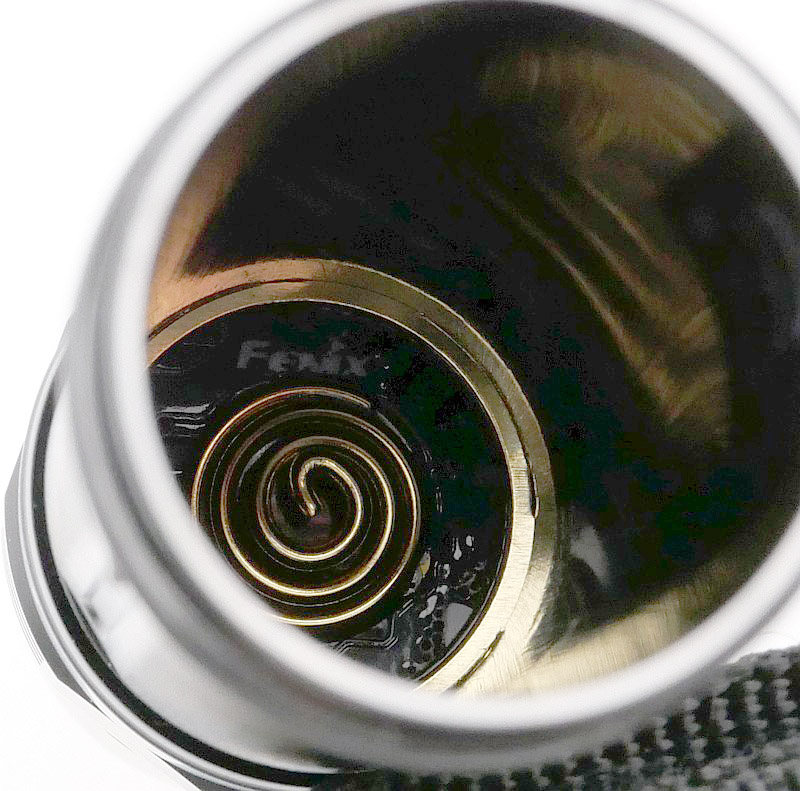
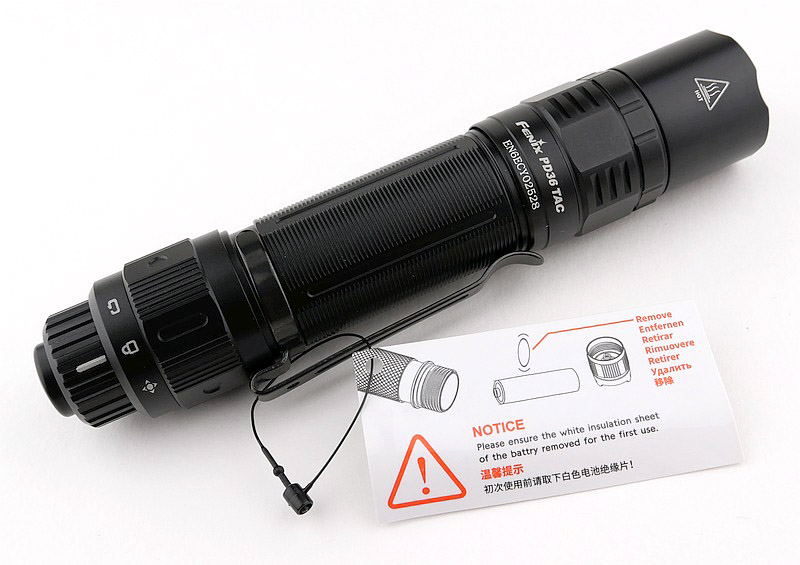
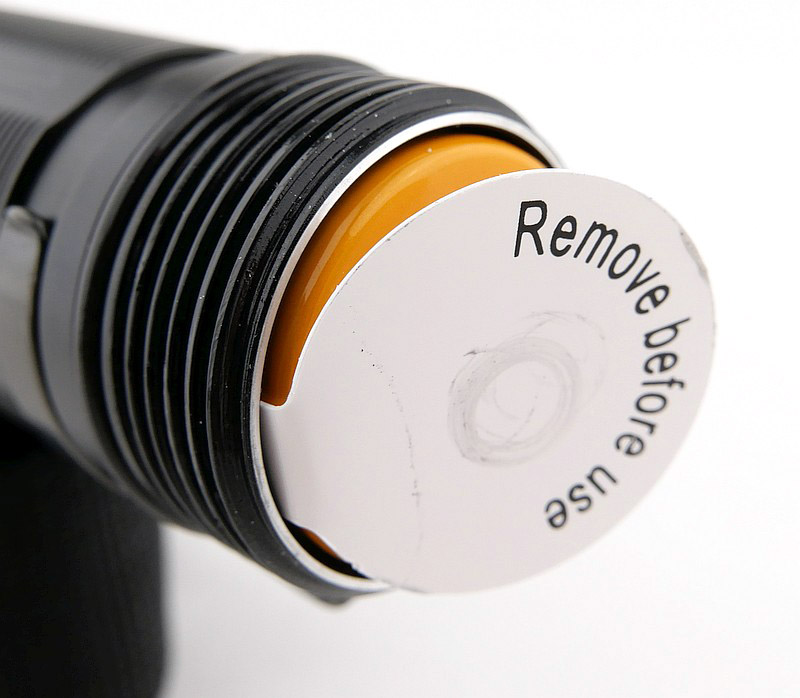
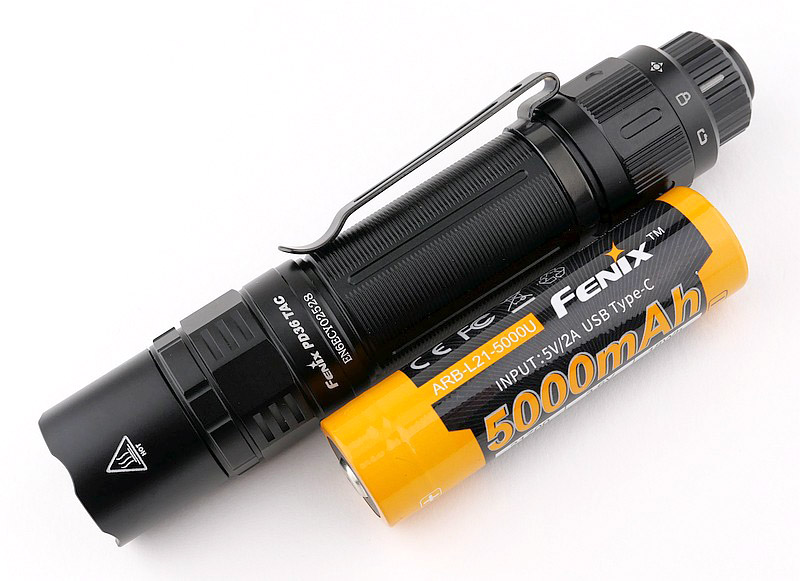
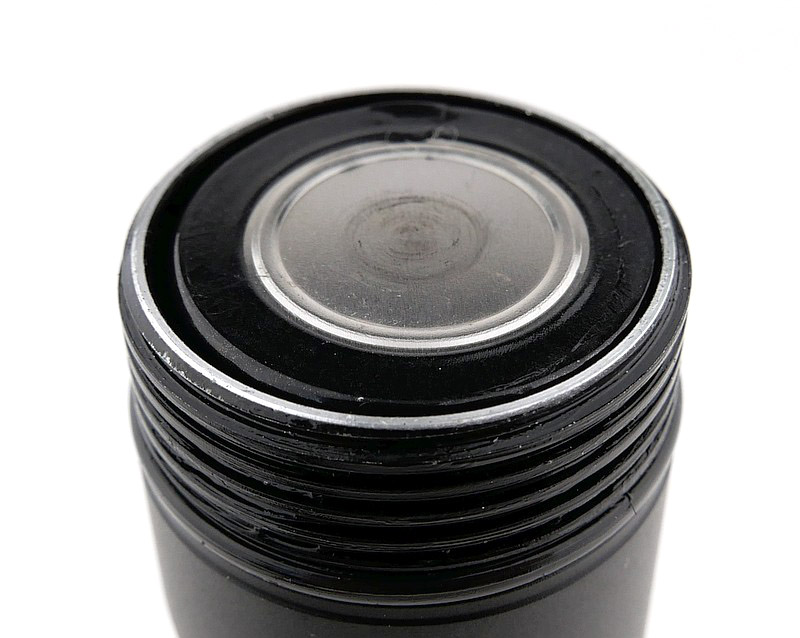
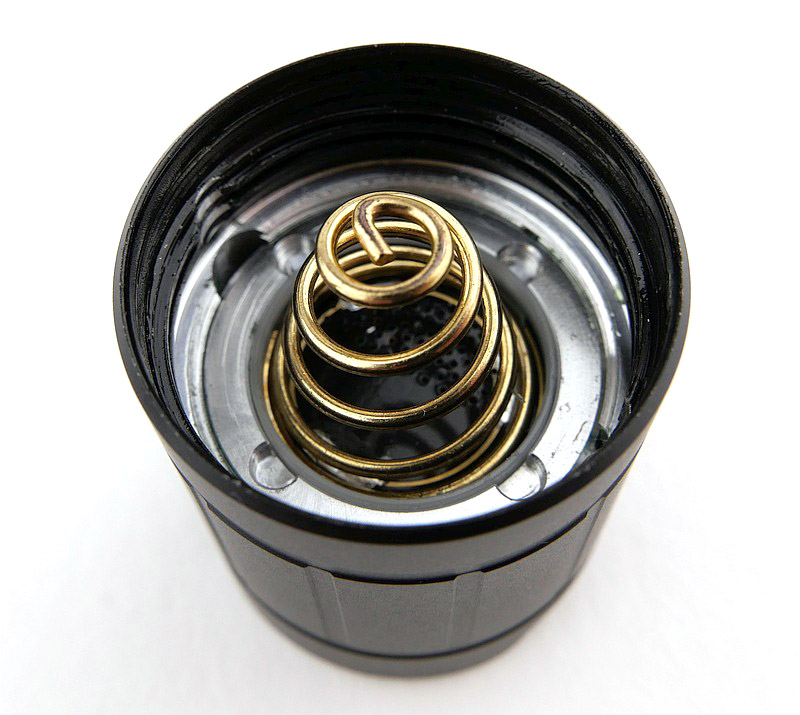
In the gallery are details of the design, the clip, bezel, contacts, threads, battery, and more…


The beam

Please be careful not to judge tint based on images you see on a computer screen. Unless properly calibrated, the screen itself will change the perceived tint.

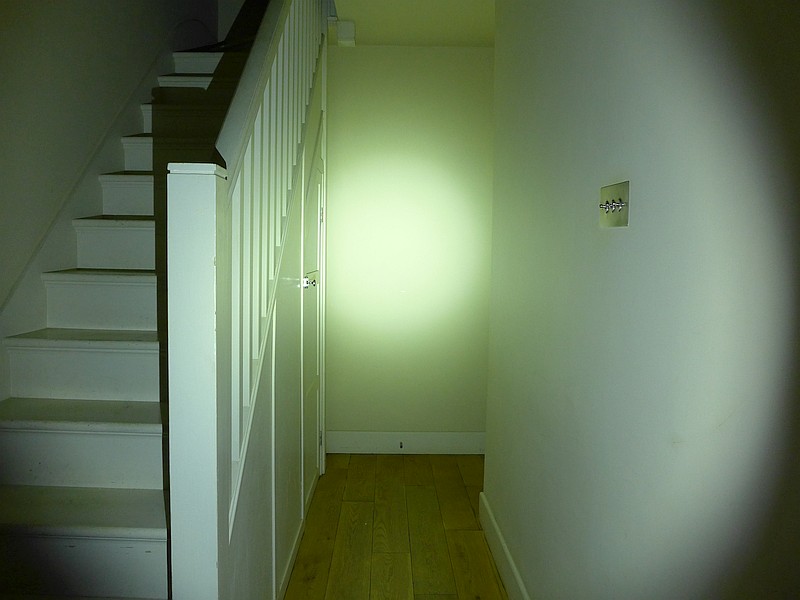
The indoor beamshot is intended to give an idea of the beam shape/quality rather than tint. All beamshots are taken using daylight white balance. The woodwork (stairs and skirting) are painted Farrow & Ball “Off-White”, and the walls are a light sandy colour called ‘String’ again by Farrow & Ball. I don’t actually have a ‘white wall’ in the house to use for this, and my wife won’t have one!

Below are the indoor and outdoor beamshots giving you an idea of throw and spill. The PD36 TAC has a great balanced beam with great area lighting.


Batteries and output:

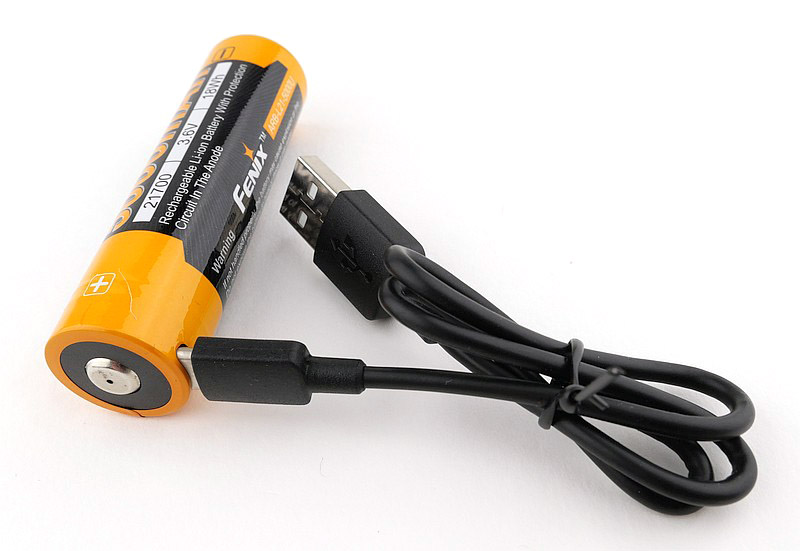
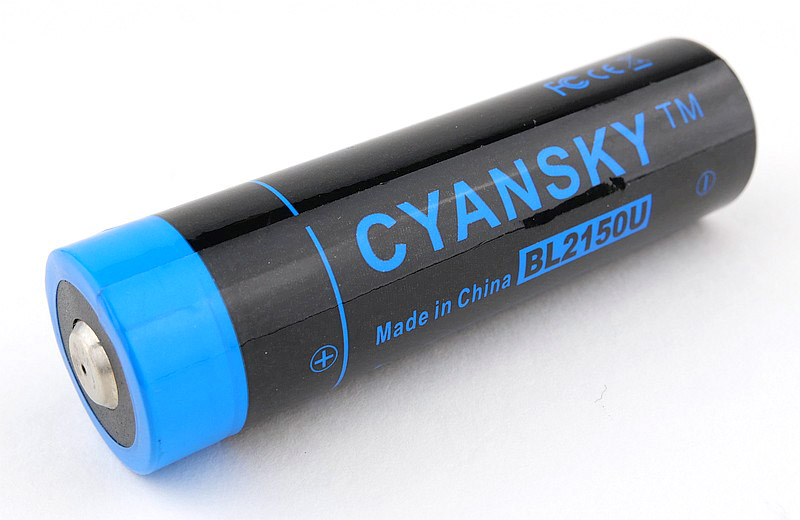
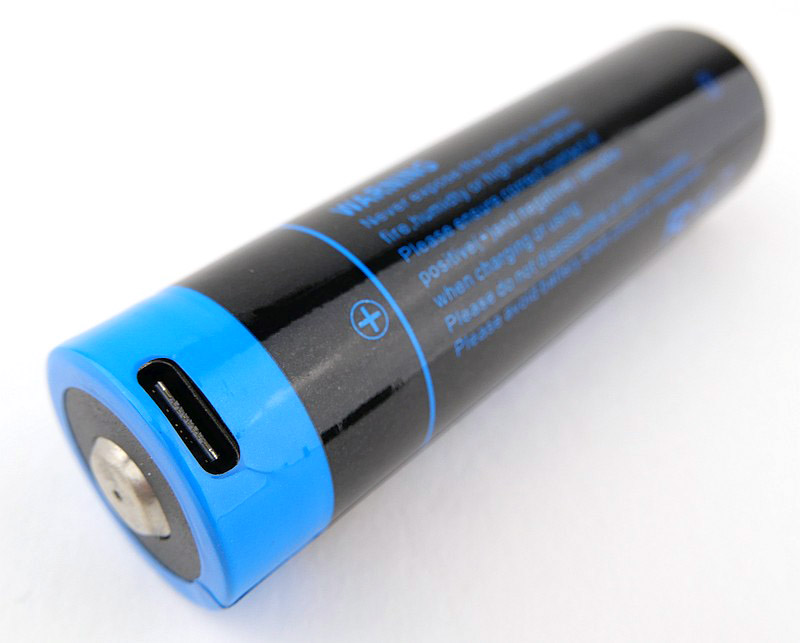
The PD36 TAC runs on the supplied 21700 USB-C rechargeable cell.

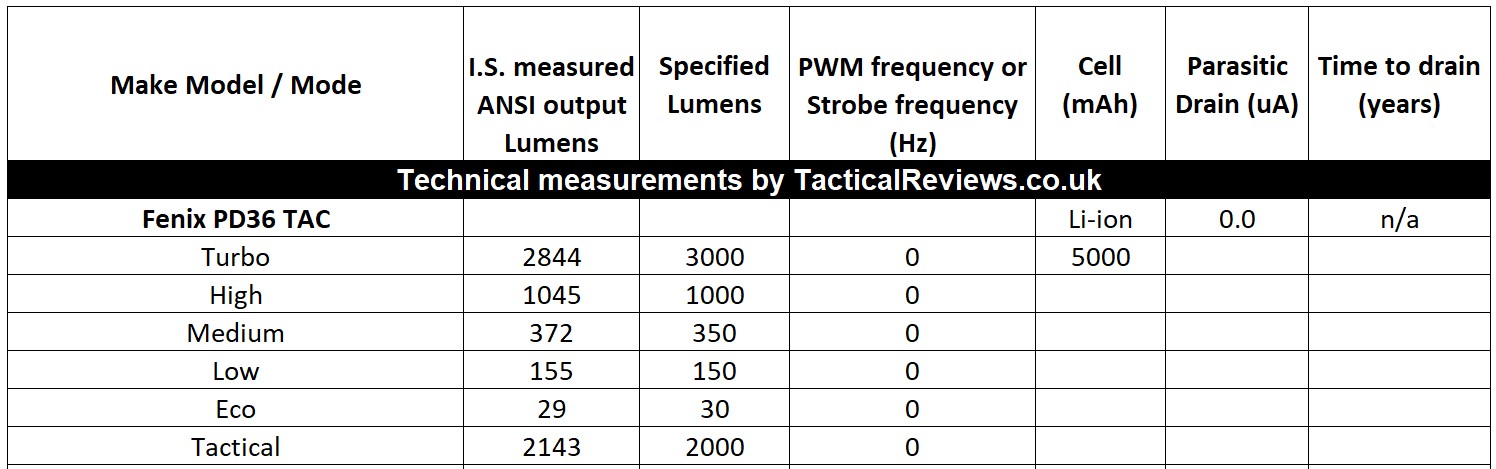
Please note, all quoted lumen figures are from a DIY integrating sphere, and according to ANSI standards. Although every effort is made to give as accurate a result as possible, they should be taken as an estimate only. The results can be used to compare outputs in this review and others I have published.

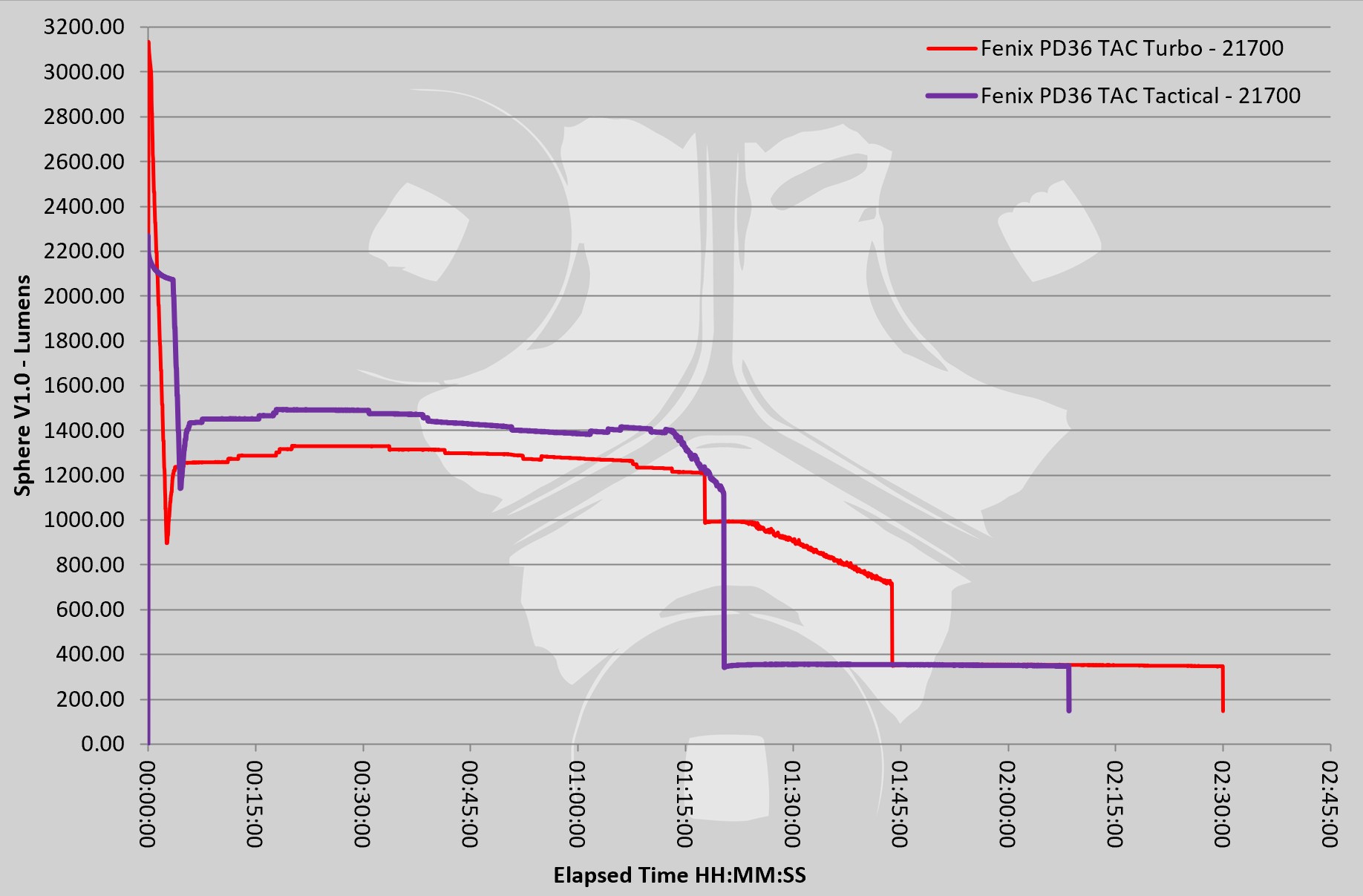
Measured output is a great match for the specifications.

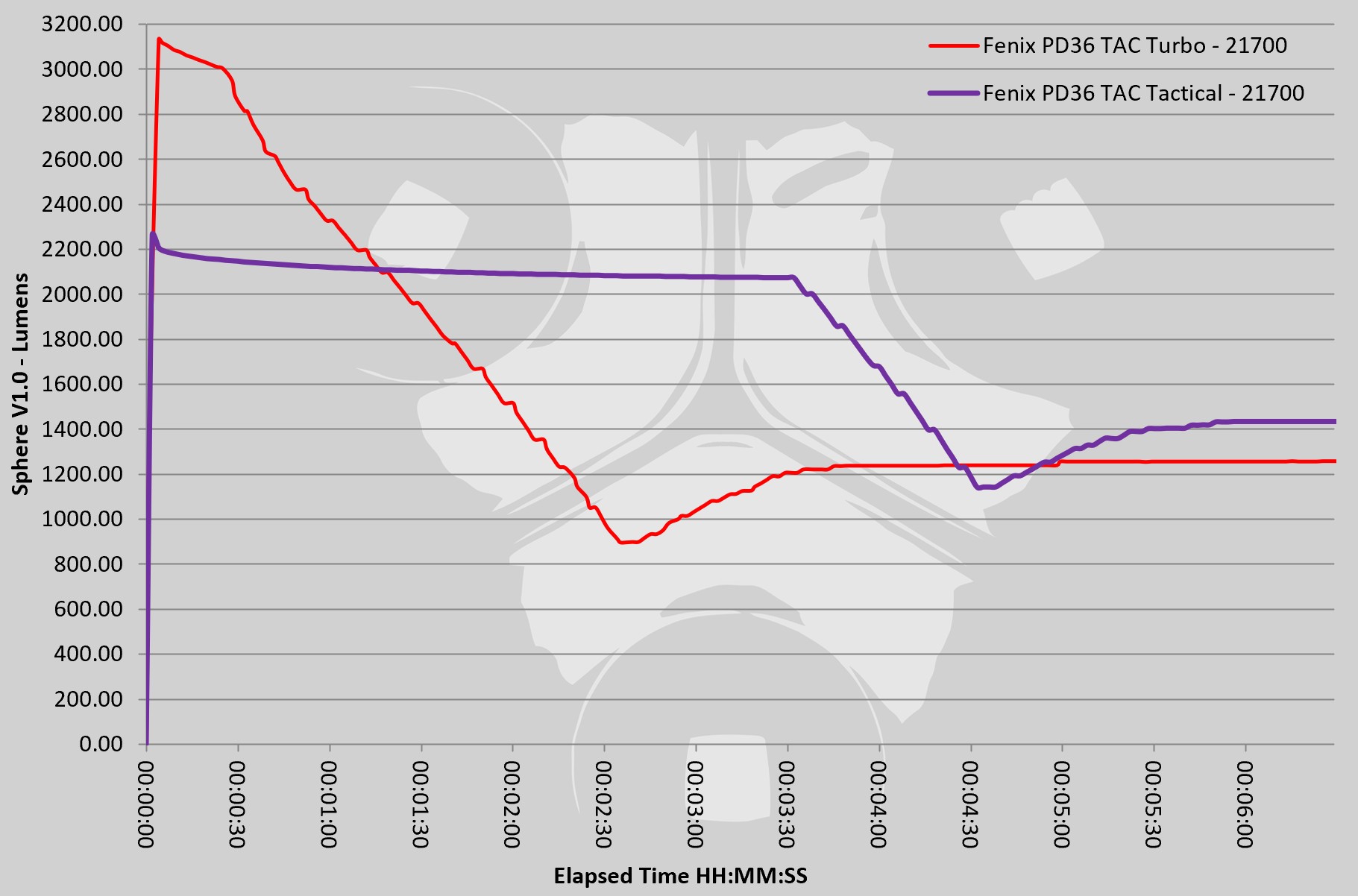
For the runtime graphs, I have included runs for Turbo and Tactical, which have different starting outputs. Also included is a graph of the first six minutes to better show the difference between Turbo and Tactical modes.


The PD36 TAC in use
The general change towards using 21700 cells is great for two reasons; better runtime/output and a comfortable size to hold. If you were completely unaware of the reason the battery tube was larger than previous generations that run on 18650, you would just be thinking the PD36 TAC is nice and comfortable to hold. The fact that it now houses a 21700 cell with that 5000mAh capacity is a further bonus to the comfort in the hand. Win win at this point.

With that greater capacity of the 21700 cell, this compact tactical light can pump out a huge 3000lm. Go back and look at the runtime graphs to see how impressively the PD36 TAC keeps its output going. The output limitation is more down to thermal capacity for longer runs.

This is the first of this style of Fenix tactical tail-cap I have been able to try. It has three functional modes. One is a simple and solid physical lockout. Line the selector ring up with the padlock, and the button does not move.

The selector ring certainly feels secure enough in its positioning that you won’t be accidentally going between locked and unlocked by accident. You pre-select the type of use you want and leave it there. Bear in mind, you can also use this to lock the PD36 TAC on. If you first turn it on to a mode you want and then rotate the selector ring to the padlock, you can’t turn it off again.

Being designed as a ‘Tactical’ light, most users will likely keep it in ‘Tactical’ mode – instant 2000lm output with momentary or latched action. Half press the tail-switch for momentary output, complete the press to latch it on (or just go for the full press to start with). Holding the switch fully in for about 1s and you enter strobe mode.

Move the selector round to the ‘Duty’ mode and you have access to five different output levels. Starting on ‘eco’ the first time you use it, but after that the last used level is remembered. Changing modes requires a half press – this can either be a half press from off and then cycle through modes before latching on, or a half press after turning the PD36 TAC on with a full press, the half presses then cycling through modes. Personally I would have preferred an automatic reset to eco after a few seconds being off as after not using it for a period of time, you won’t know if you had eco or turbo set, and this could be quite a shock.

The Fenix PD36 TAC is a purposeful lighting tool, and can instantly be reconfigured as either a dedicated ‘Tactical’ light or into a multi-mode ‘Duty’ light to fit with your needs.


Review Summary
The views expressed in this summary table are from the point of view of the reviewer’s personal use. I am not a member of the armed forces and cannot comment on its use beyond that covered in the review.

Something that might be a ‘pro’ for one user can be a ‘con’ for another, so the comments are categorised based on my requirements. You should consider all points and if they could be beneficial to you.

_______________________________________________
What doesn’t work so well for me
_______________________________________________

‘Duty’ mode last used level remembered (so could be on eco or turbo).
Tail-switch has a relatively stiff action.
No grip ring provided.

_______________________________________________
Things I like
_______________________________________________

Great area lighting beam profile.
Nearly 3000lm from a compact light.
Three function tail-cap selector ring.
Dedicated ‘Tactical’ mode.
Proper physical lockout.
Uses a large capacity 21700 cell.
Supplied cell has built-in USB-C charging.
Very usable holster supplied.

Classic Knife Review: Spyderco Police and Military Models

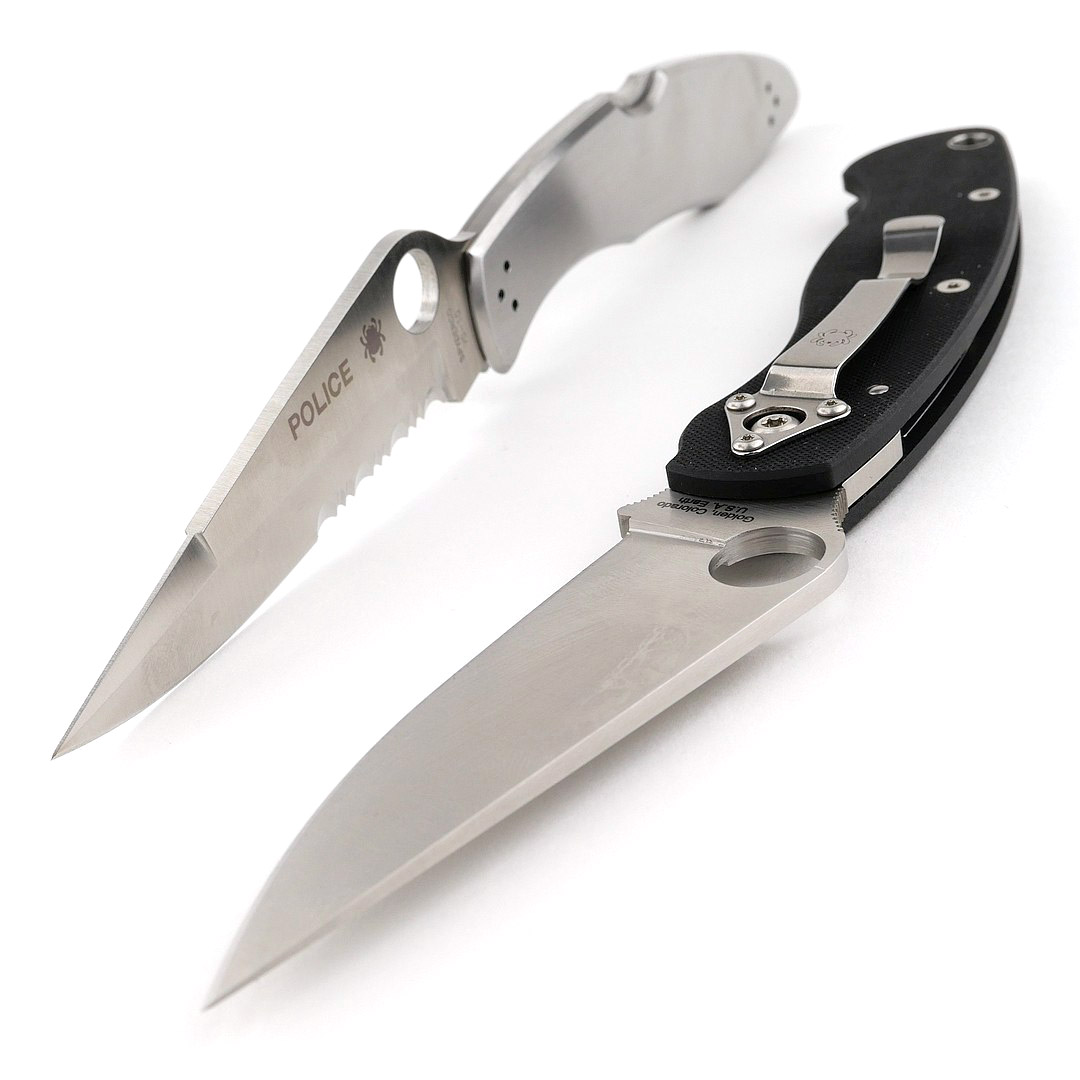
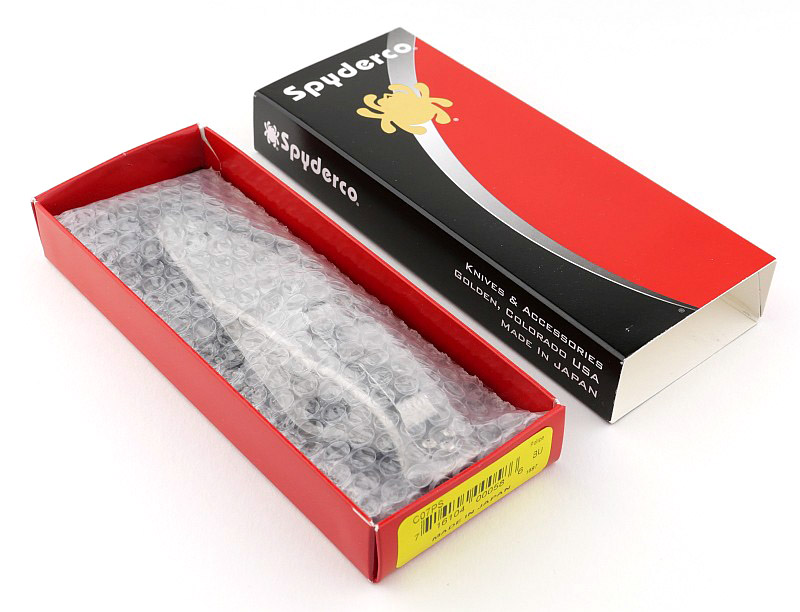
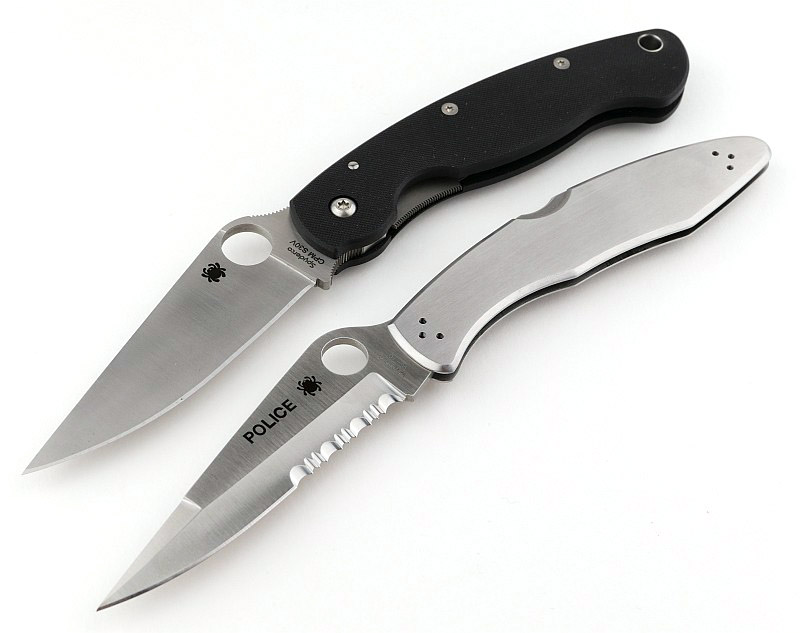
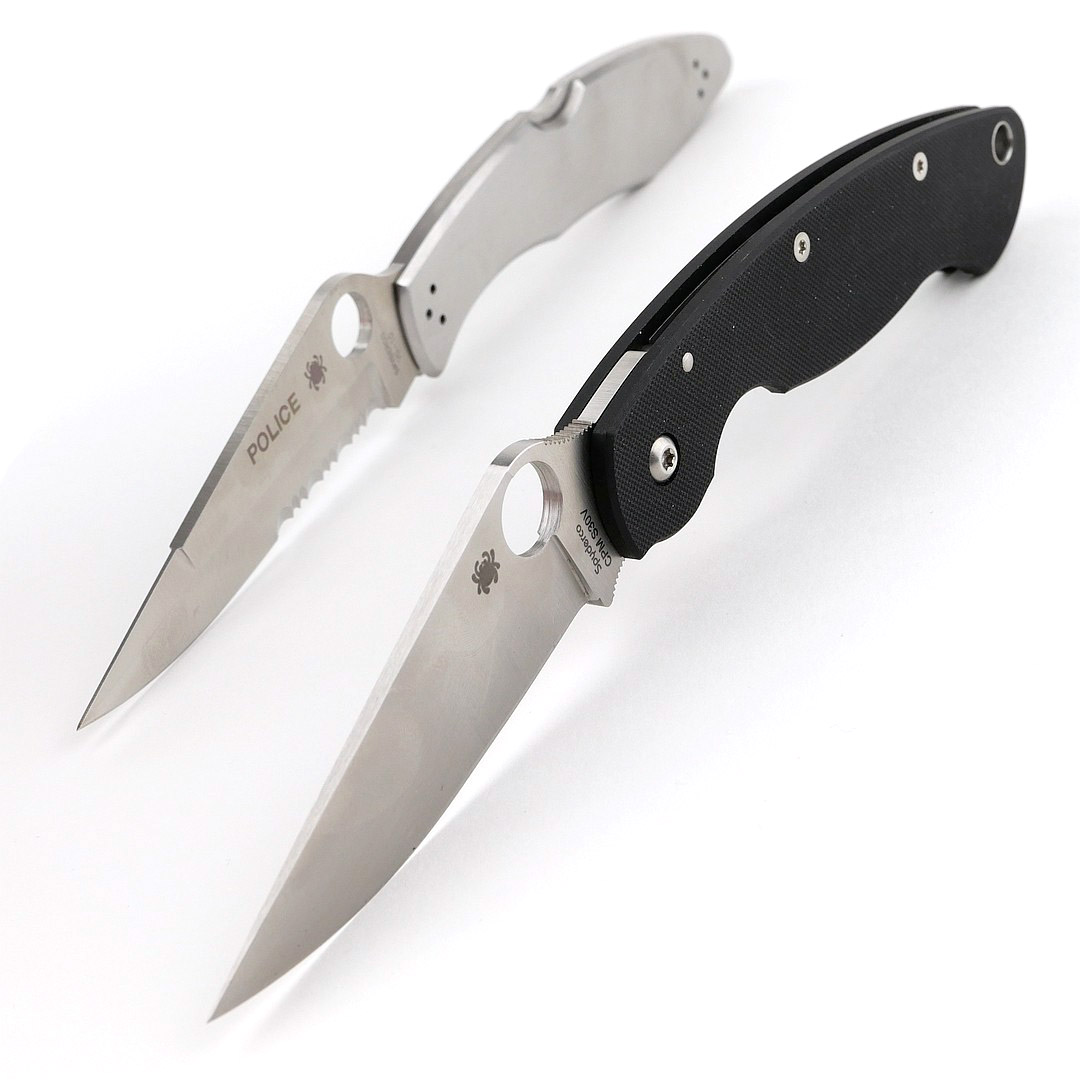
We all know them, we might not all have them. These two Spyderco classics (Police and Military) have stood the test of time and use, and are still current models – for good reason.
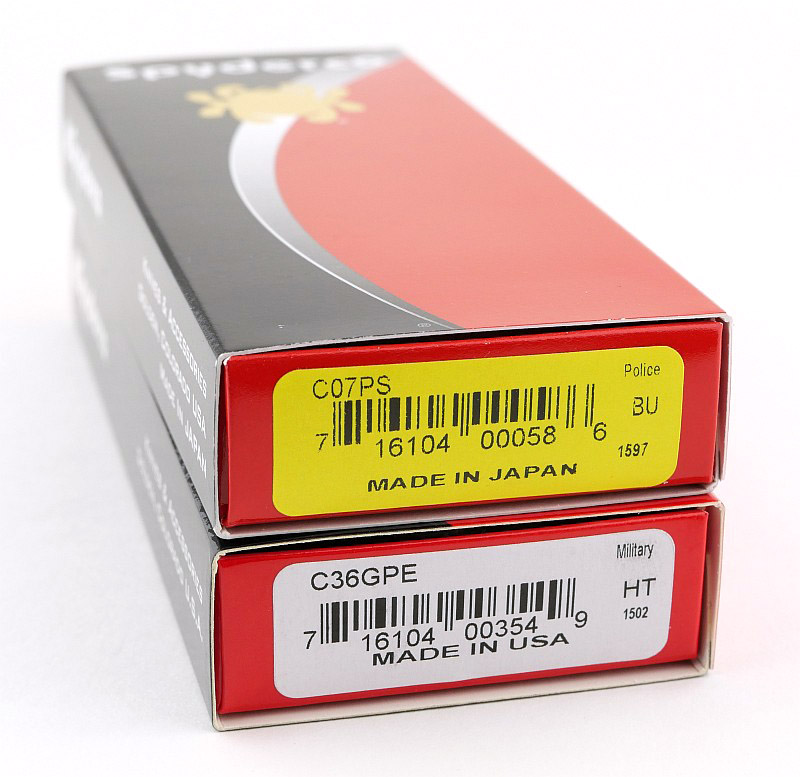
I refer to them as ‘Classics’ and Spyderco calls the Police model a ‘Signature’ model and the Military a ‘USA Made’ and/or ‘Save and Serve’ model. Both really qualify as a classic in my opinion and are worthy of being in your pocket.

Video Overview

This video is a detailed look at the Police and Military Models, from handling to technical measurements. Hopefully something for everyone and you should have a better idea if you should also pick up one or both.


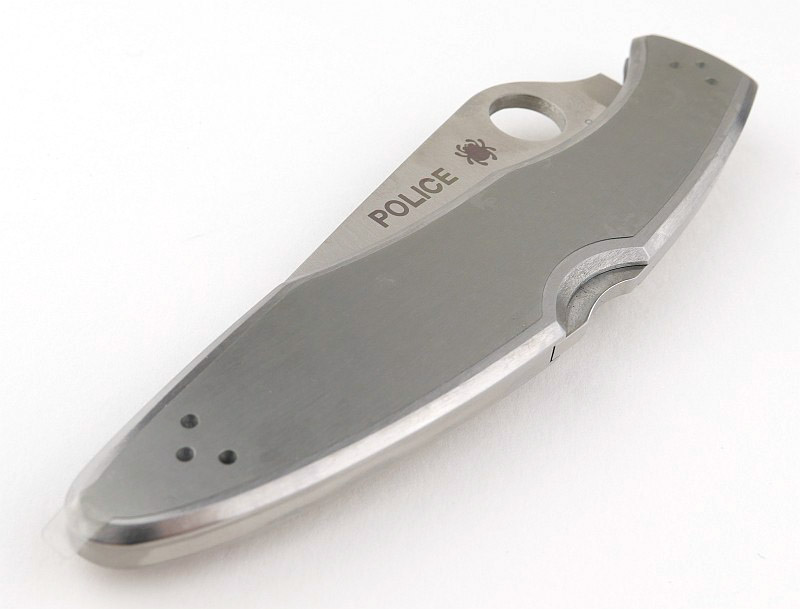
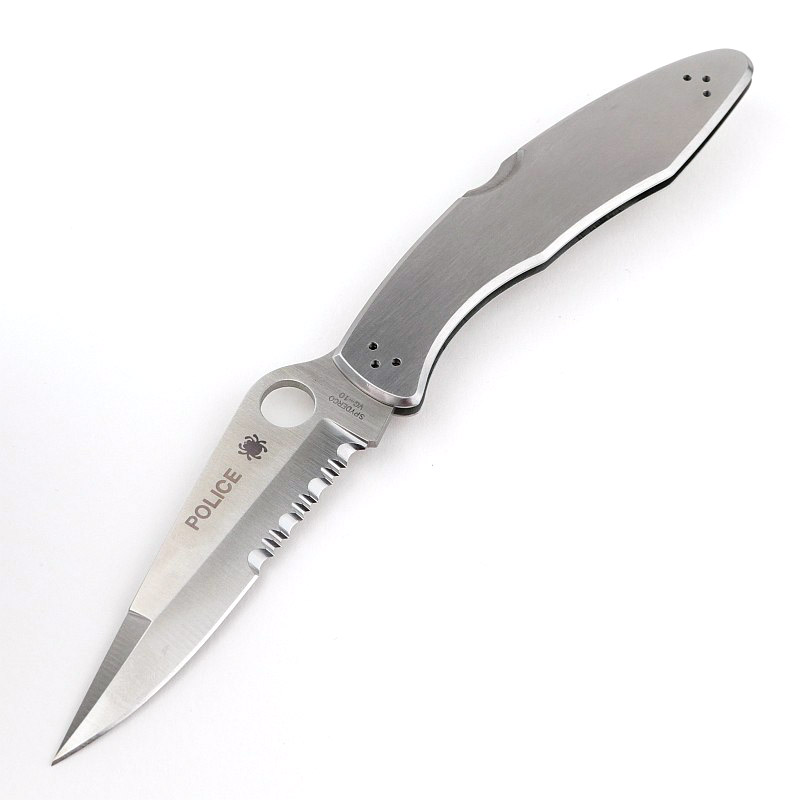
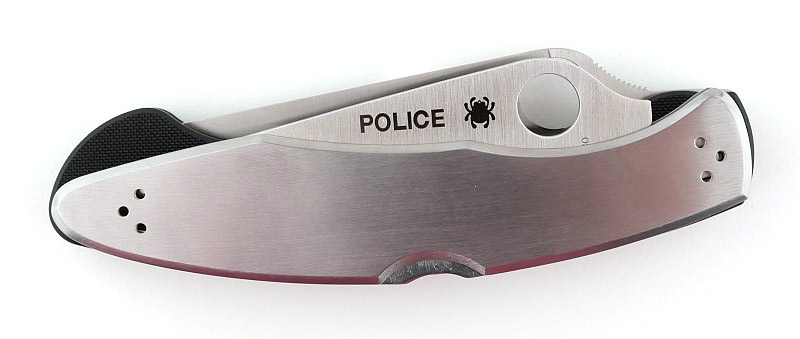
A good look round the Police Model – Things to look out for here are:
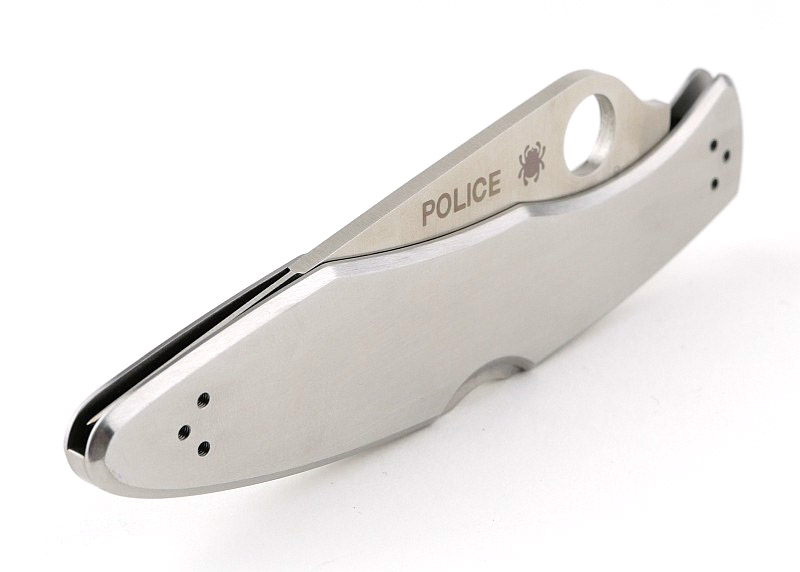
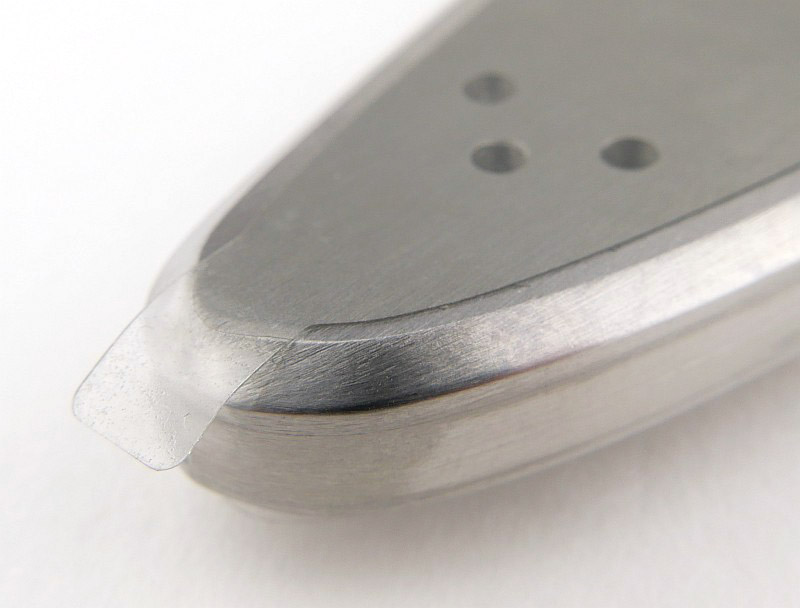
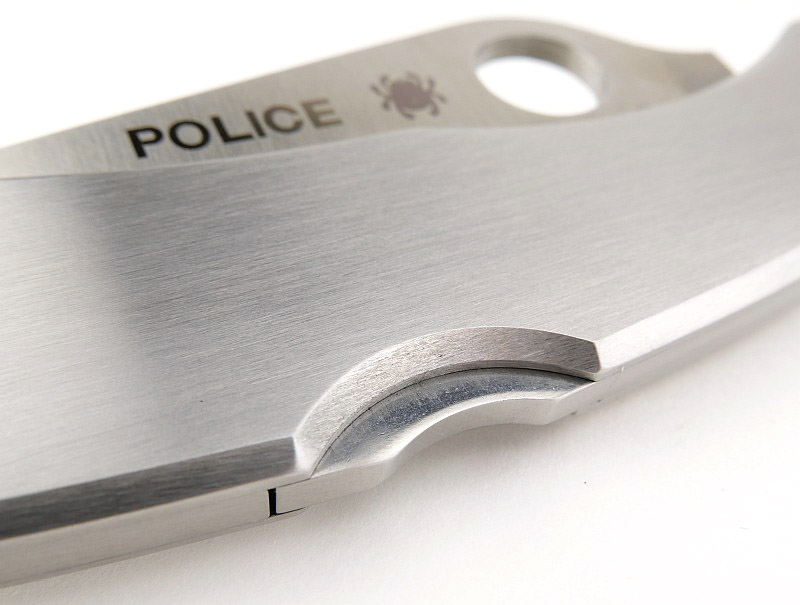
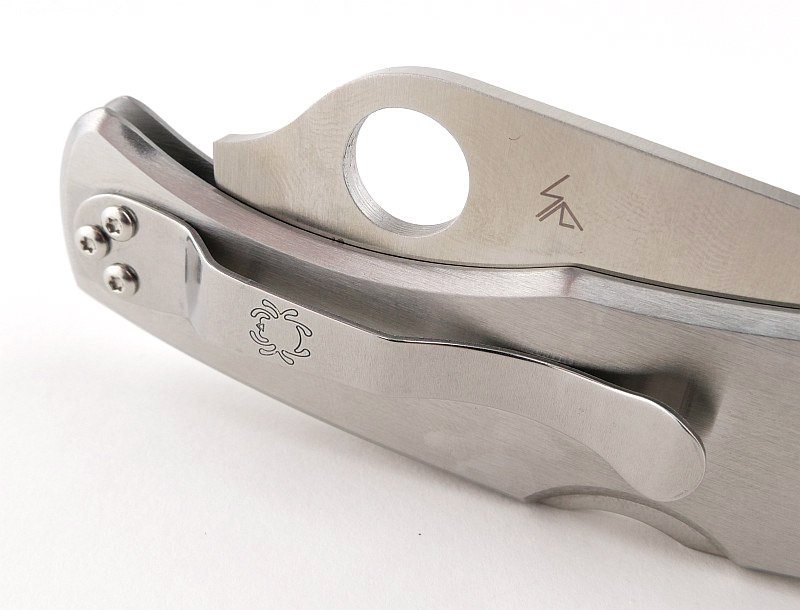
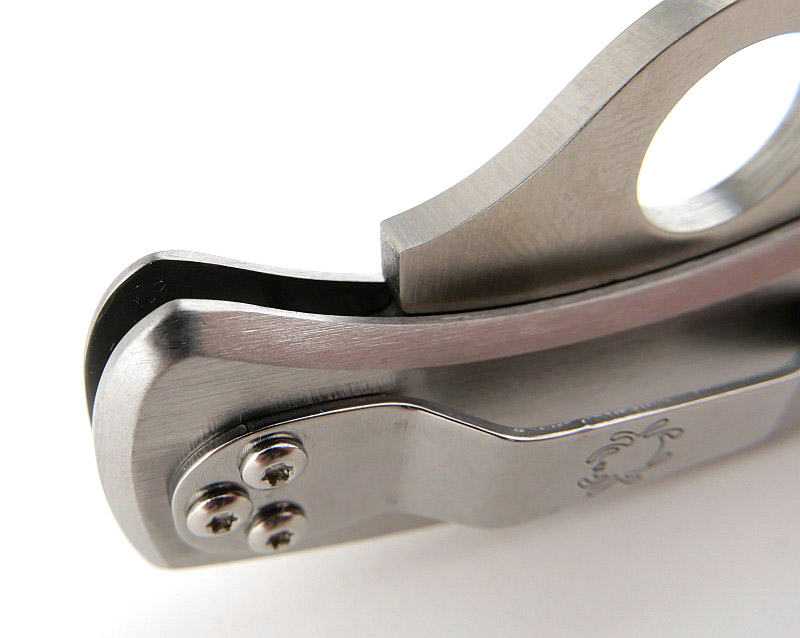
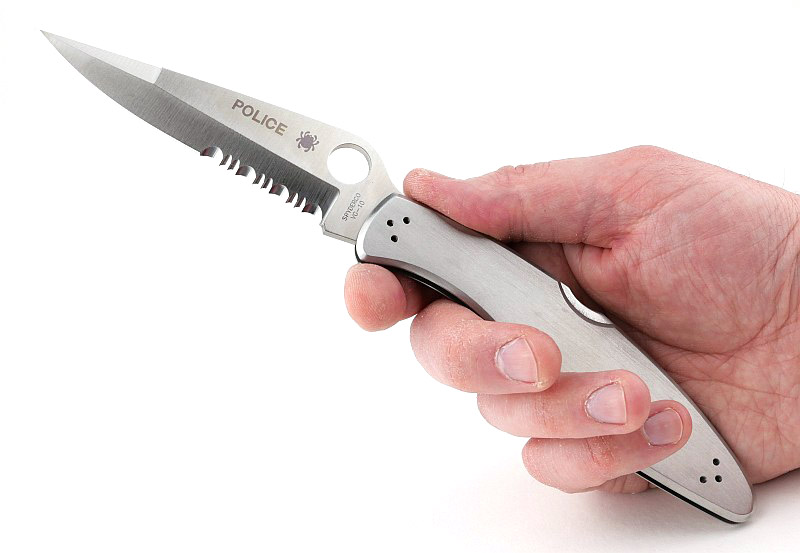
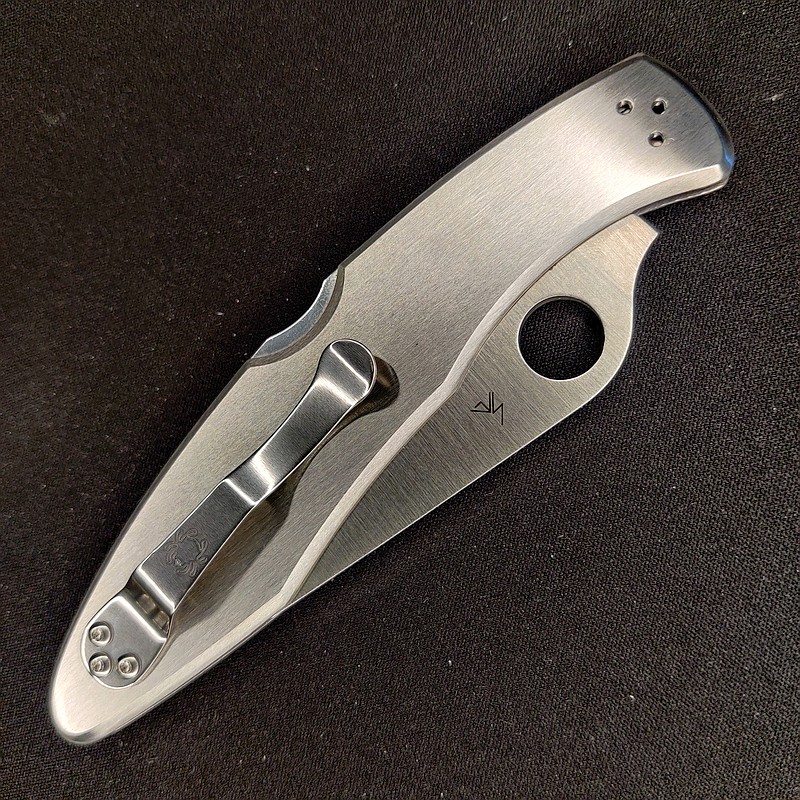
Being of full stainless steel construction, and having brushed steel handles, to ensure you get it in new condition, the handle scales come with protectors fitted that you need to peel off.
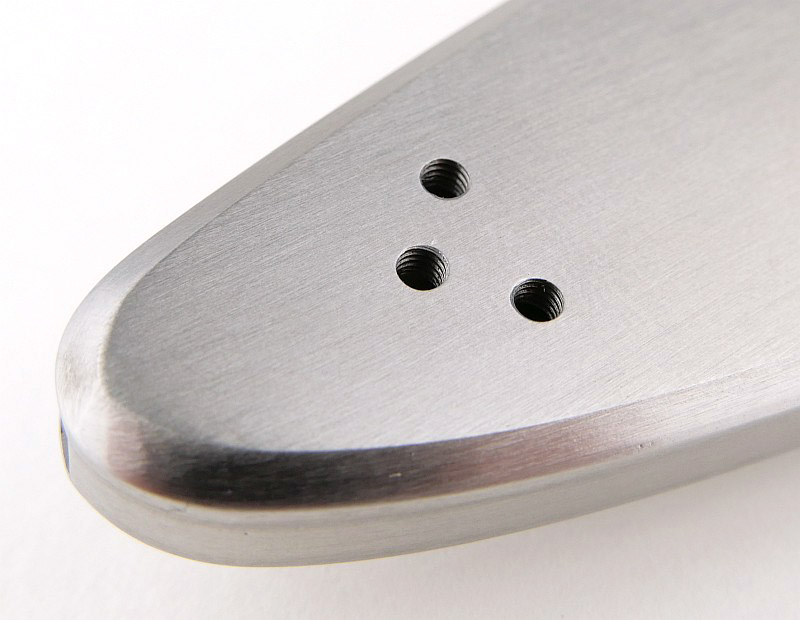
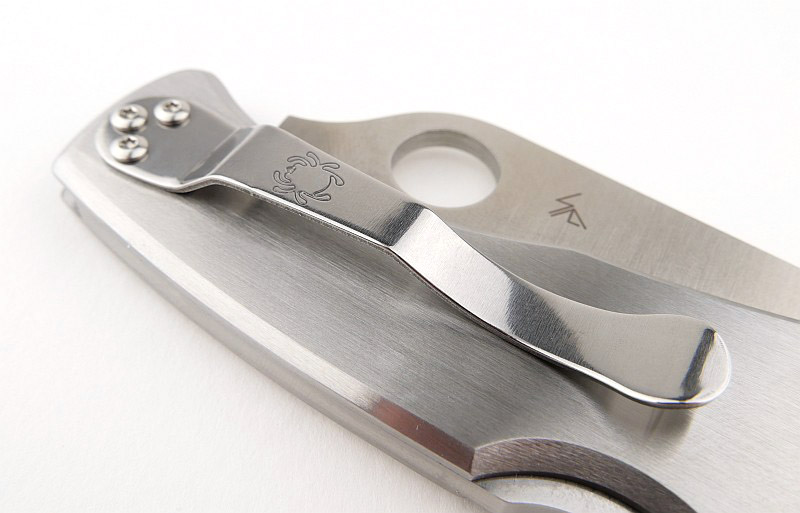
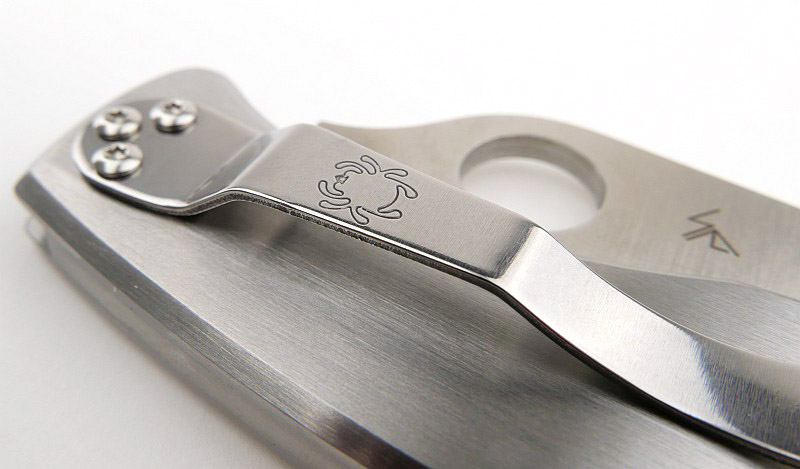
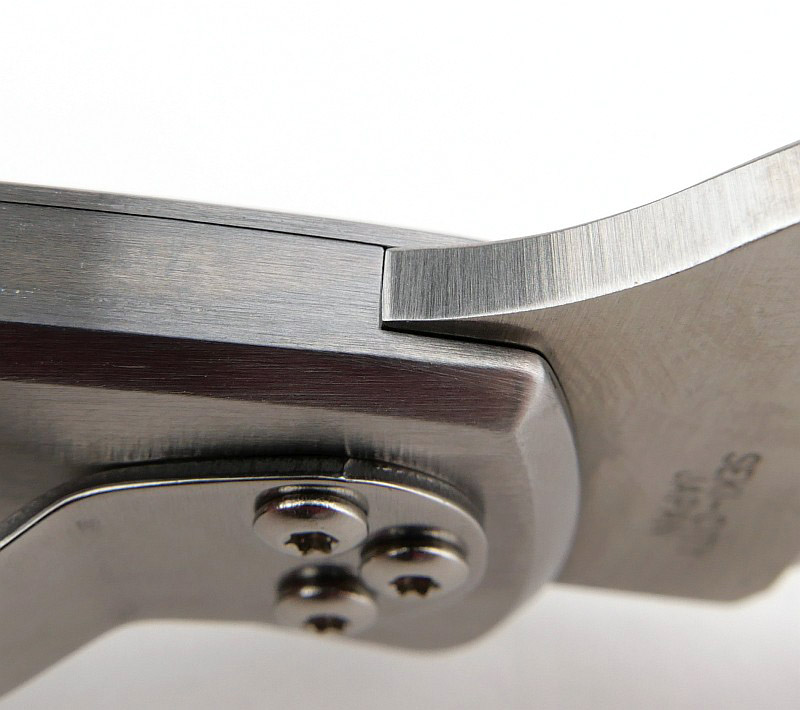
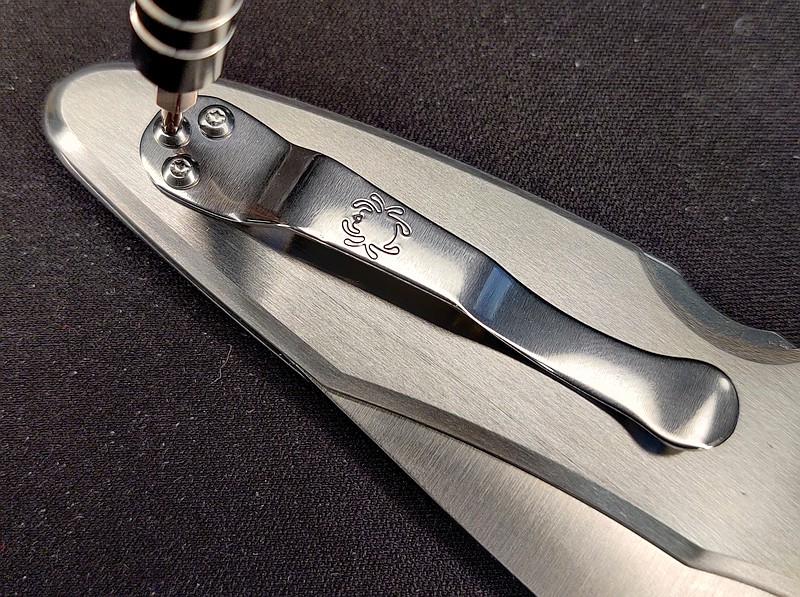
The Police model has drilled and tapped holes in all four possible clip positions, so you can decide the very best clip position for your needs (personally I changed this to tip-up and right handed).
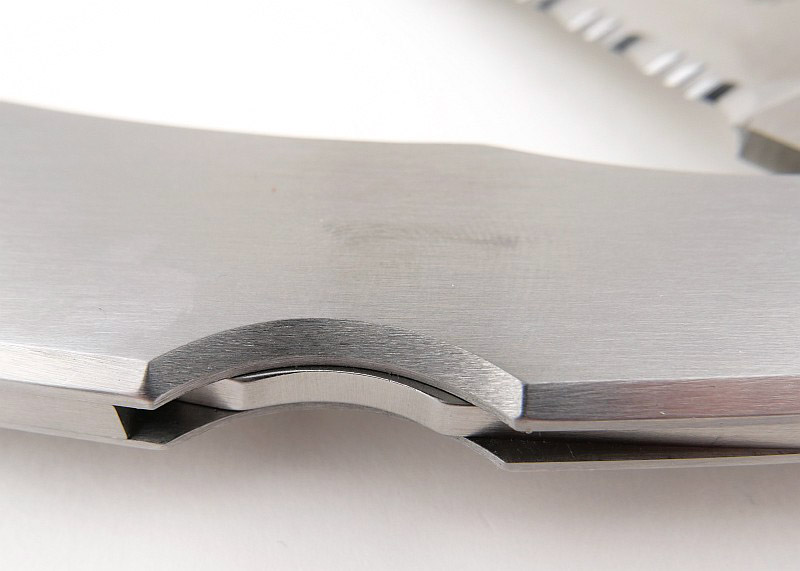
Being a long standing model it unsurprisingly uses a back lock.
With a rivet type of blade pivot, there is no adjustment or user servicing possible. The pivot rivet finishing is excellent and completely invisible.
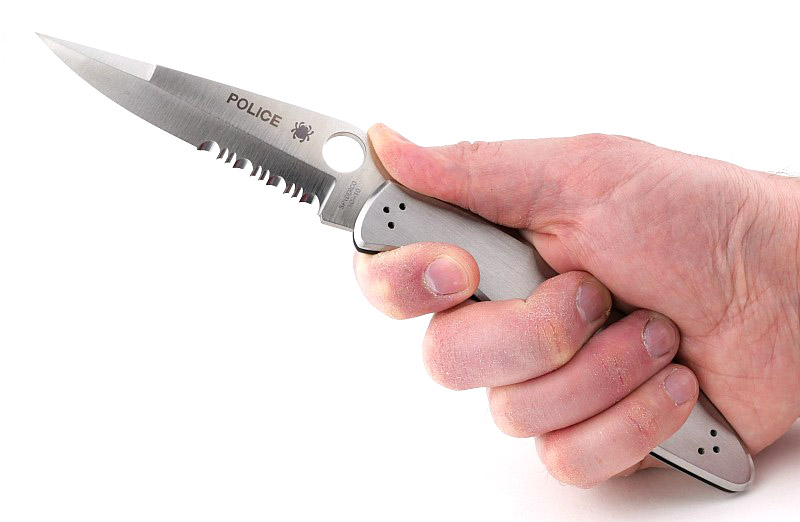
This example is the part serrated version, but it also comes in a fully serrated or full plain edge blade.


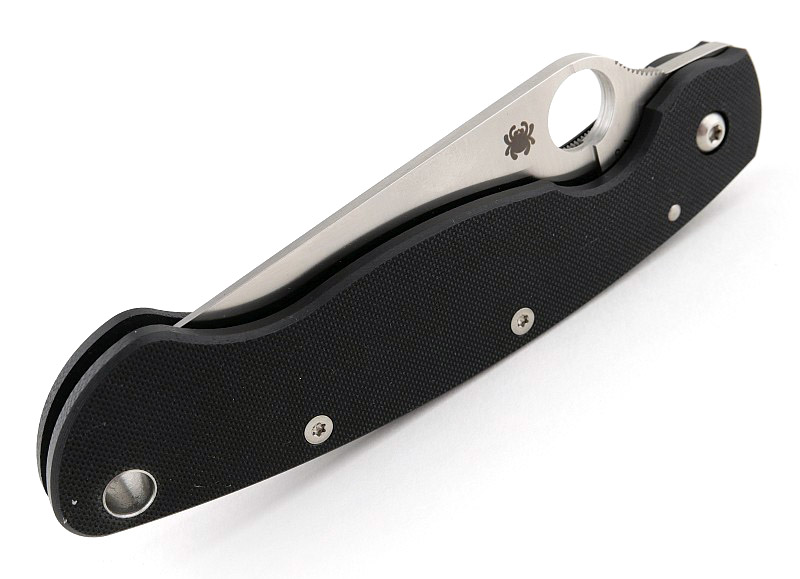
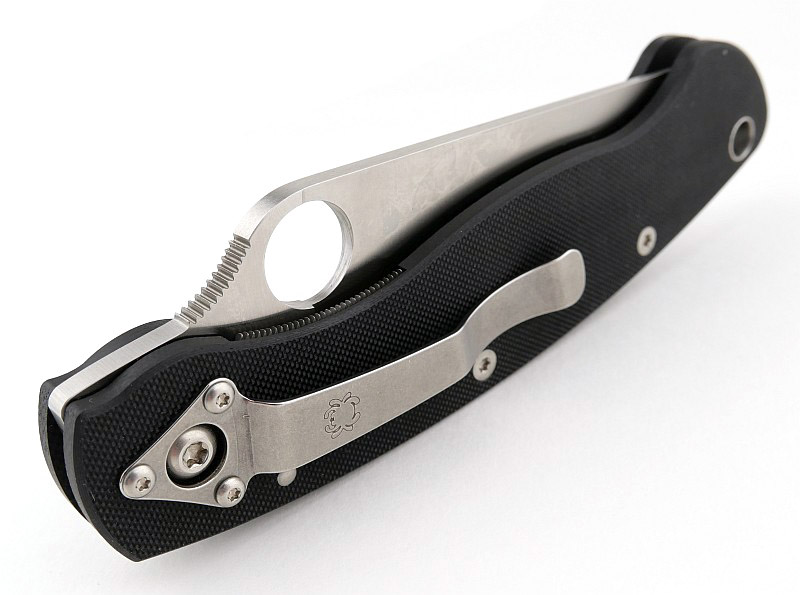
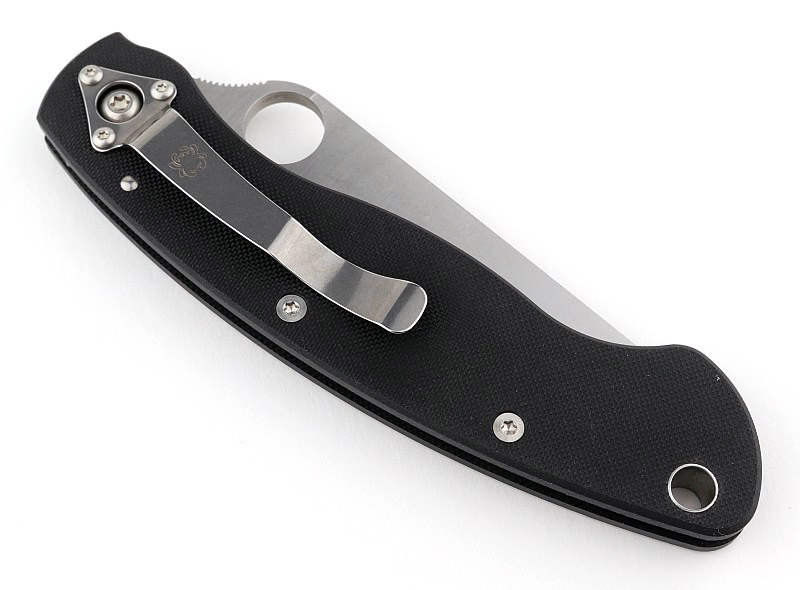
A good look round the Military Model – Things to look out for here are:
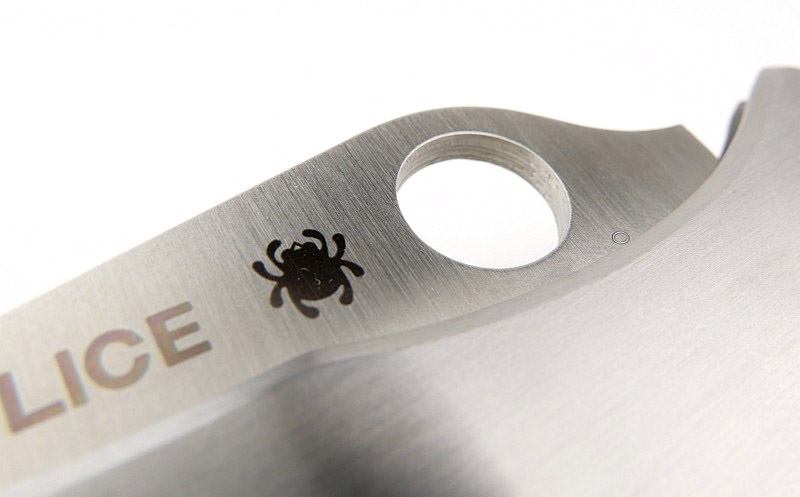
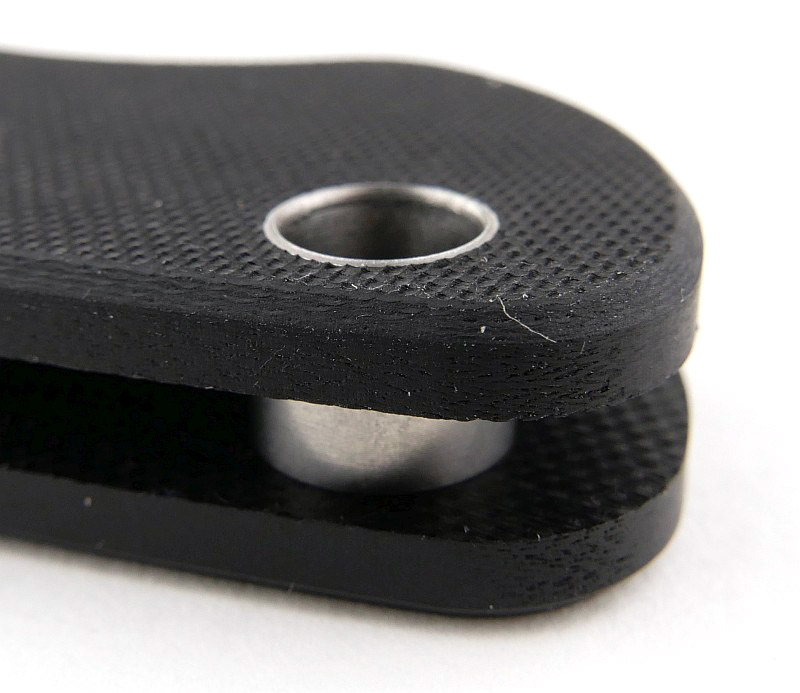
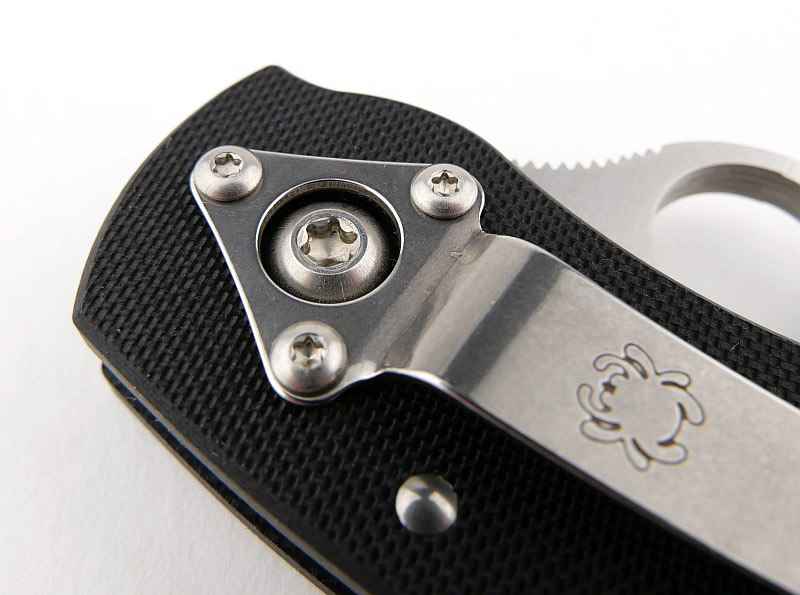
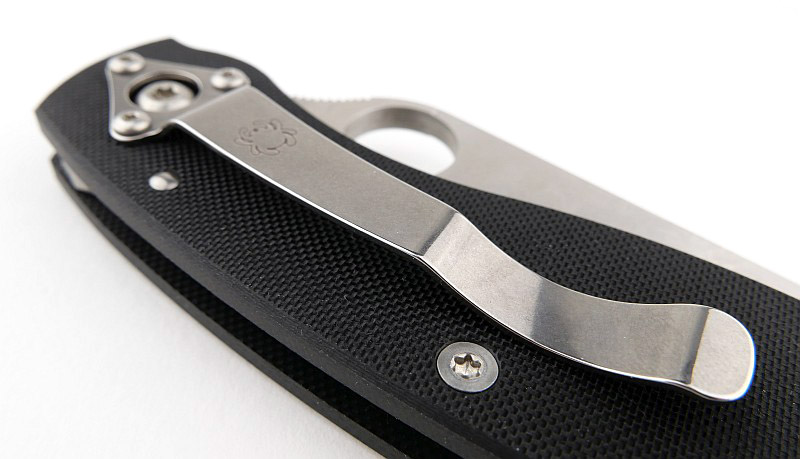
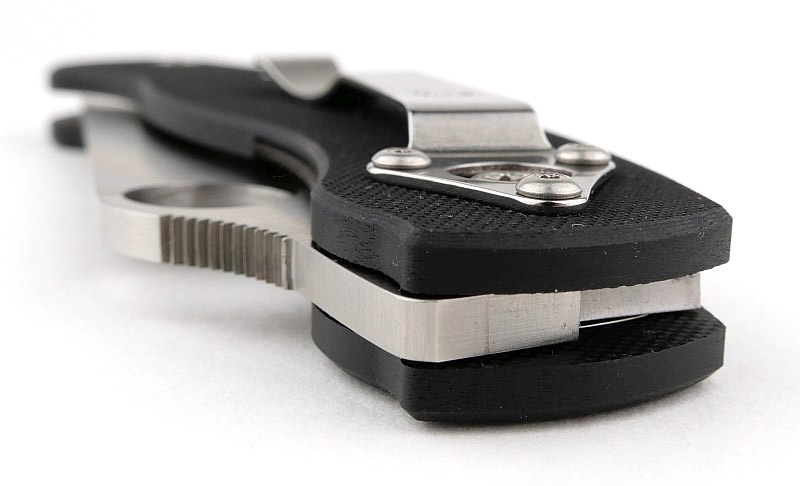
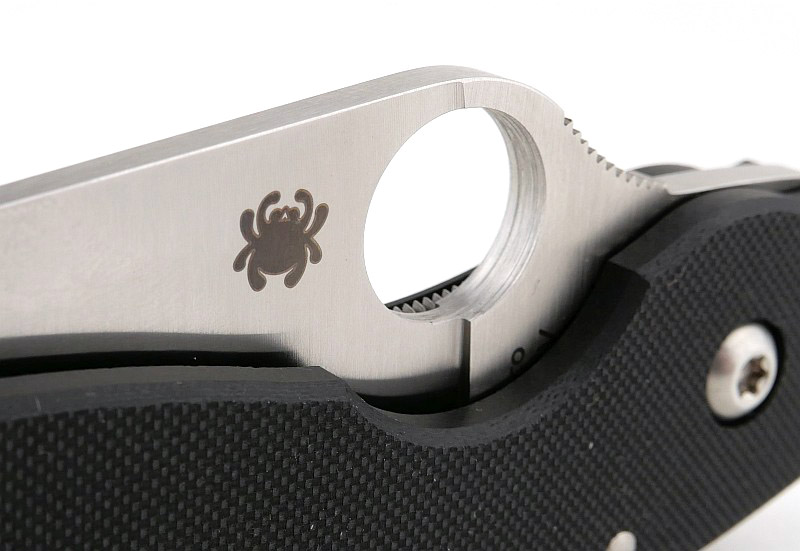
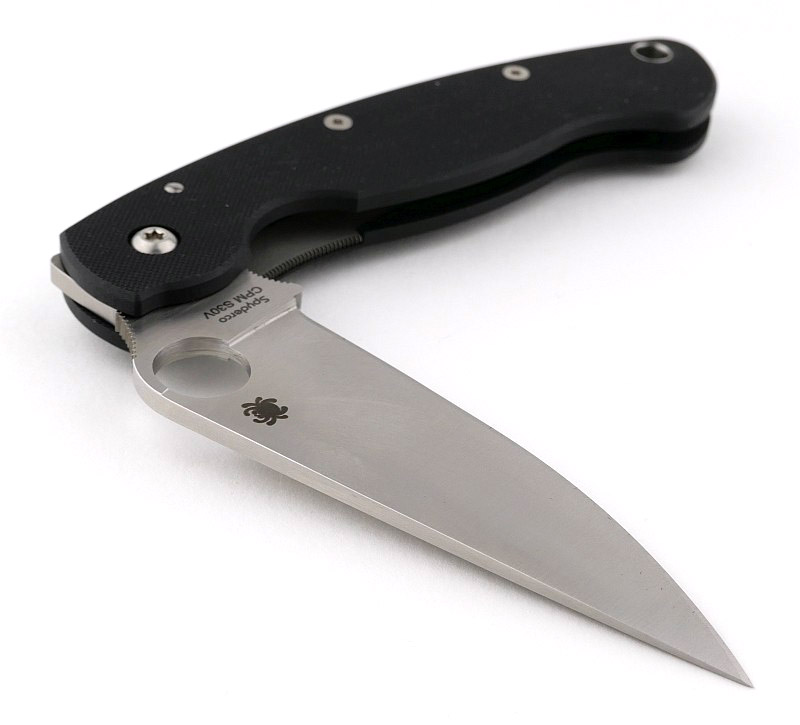
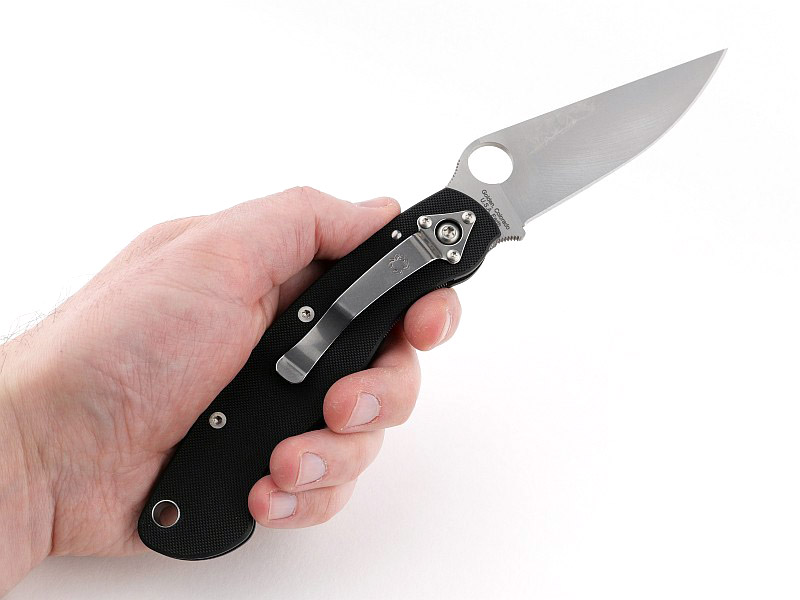
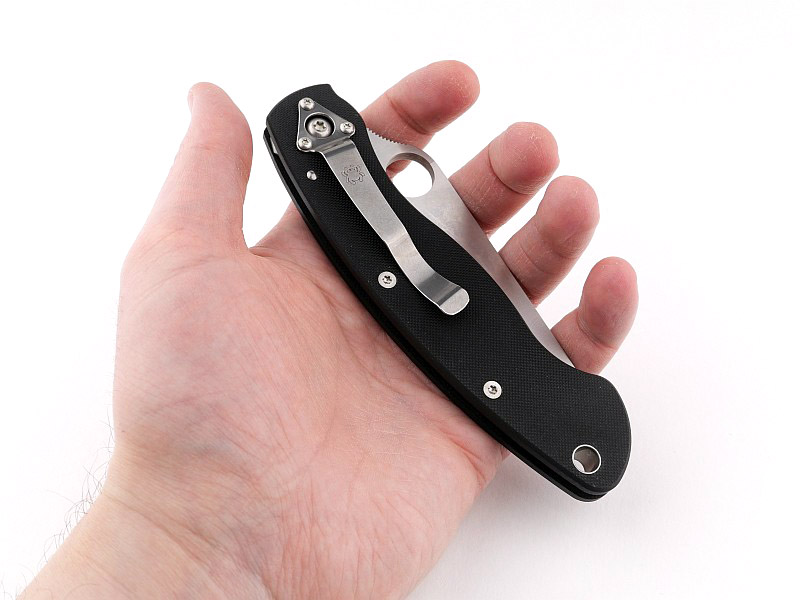
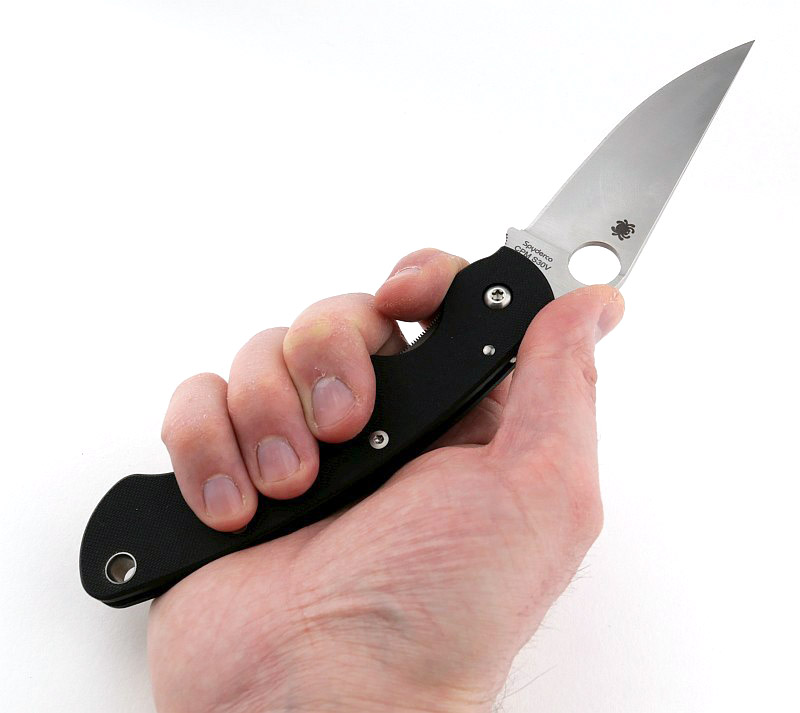
Immediately unmistakably Spyderco, with the G10 handle scales, pocket clip and opening hole, the Military is a good sized folder.
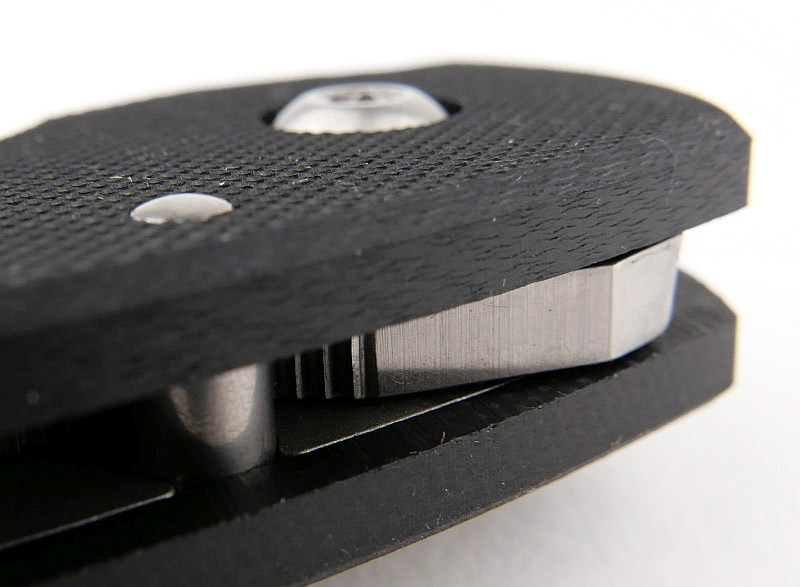
Unlike the Police model, the Military can be taken apart, with the G10 handle scales bolted together and a pivot bolt. Also unlike the Police model, the Military has only the one clip position (tip-down right handed).
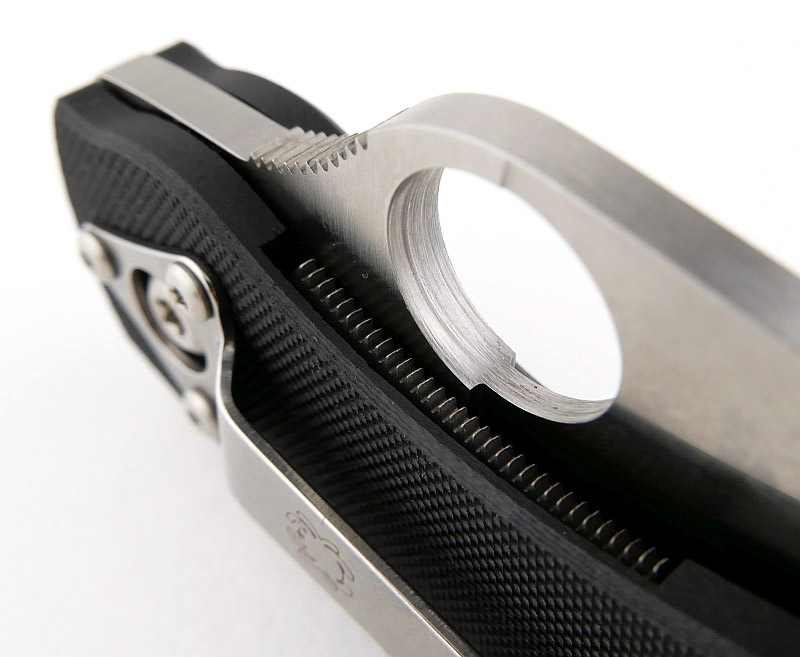
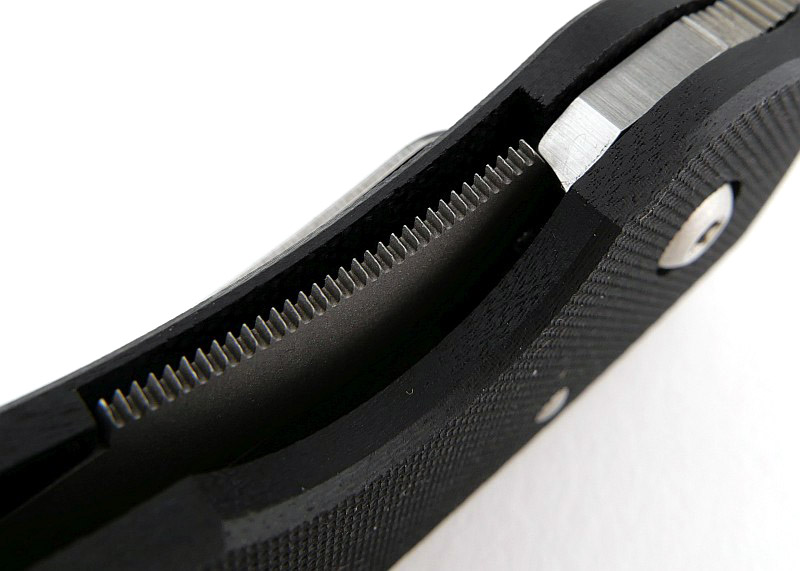
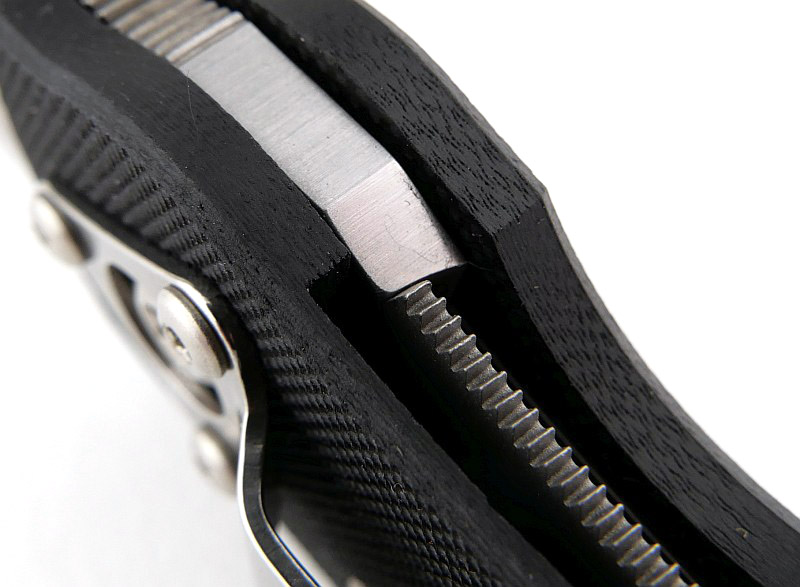
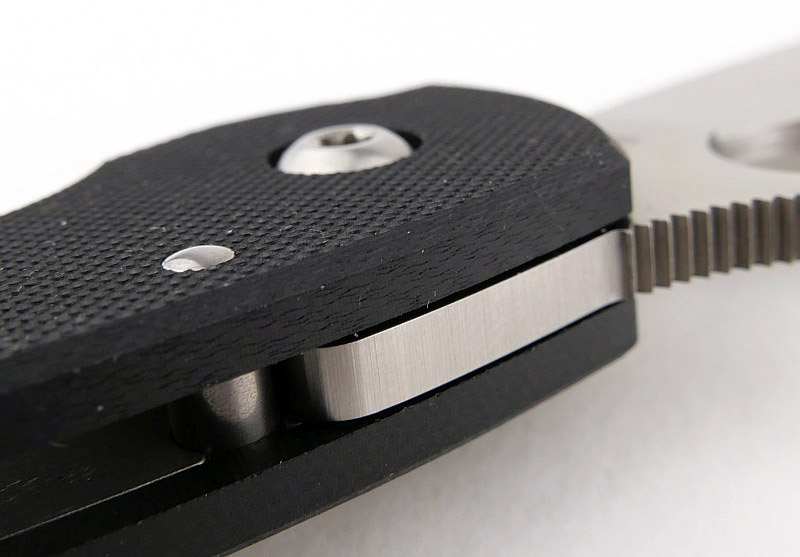
Recessed into the G10 handles are minimal steel liners and the Military uses a liner lock. Just to drive home that point about ‘minimal’ steel liners, this is what allows for the light weight yet still strong construction. The liner on the non-lock side just goes from handle bolt to handle bolt to the pivot (supporting the stop pin as well). The other partial liner is larger as it includes the lock bar.


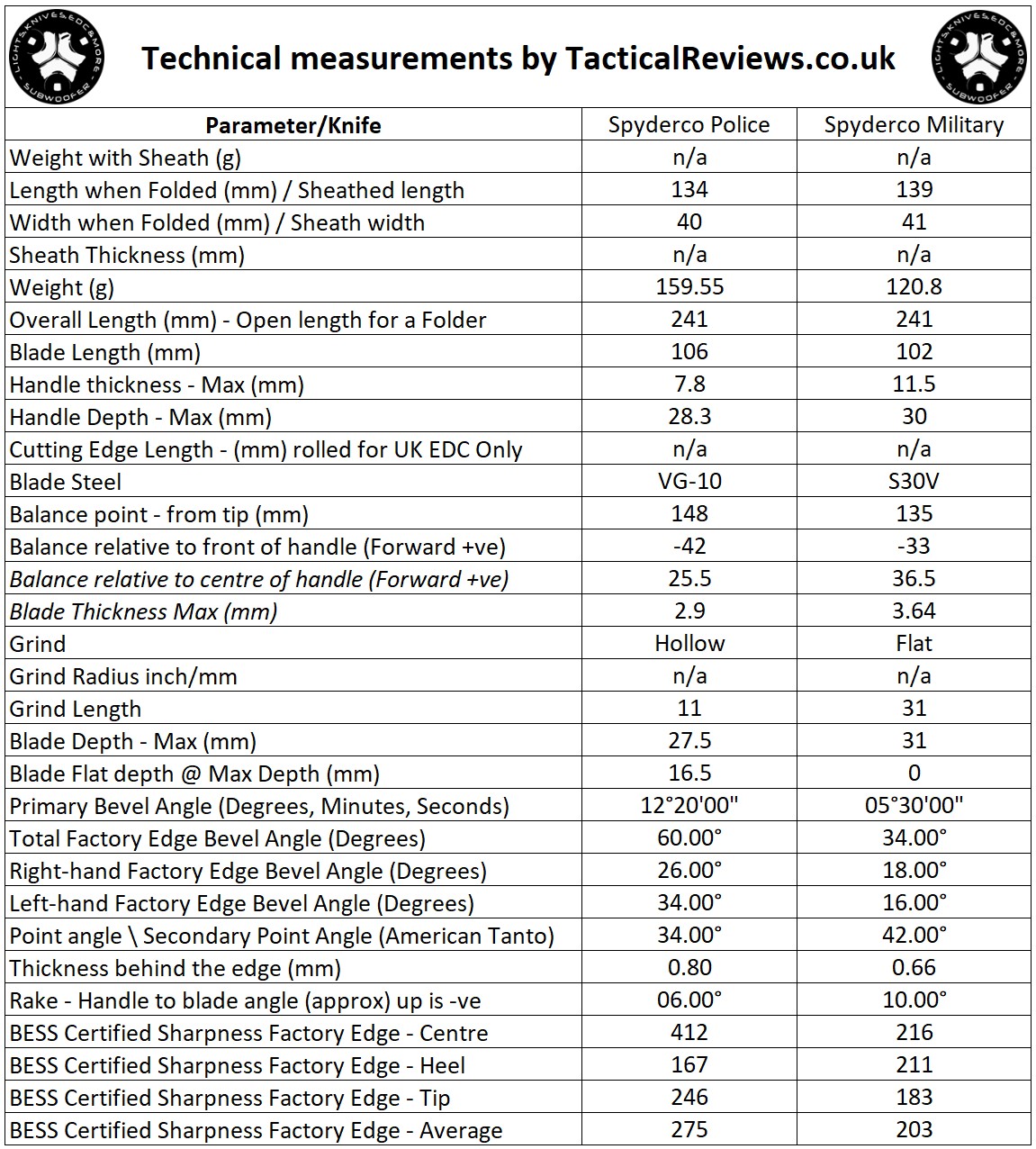
The Blade and Handle – Detailed Measurements:
For full details of the tests and measurements carried out and an explanation of the results, see the page – Knife Technical Testing – How It’s Done.

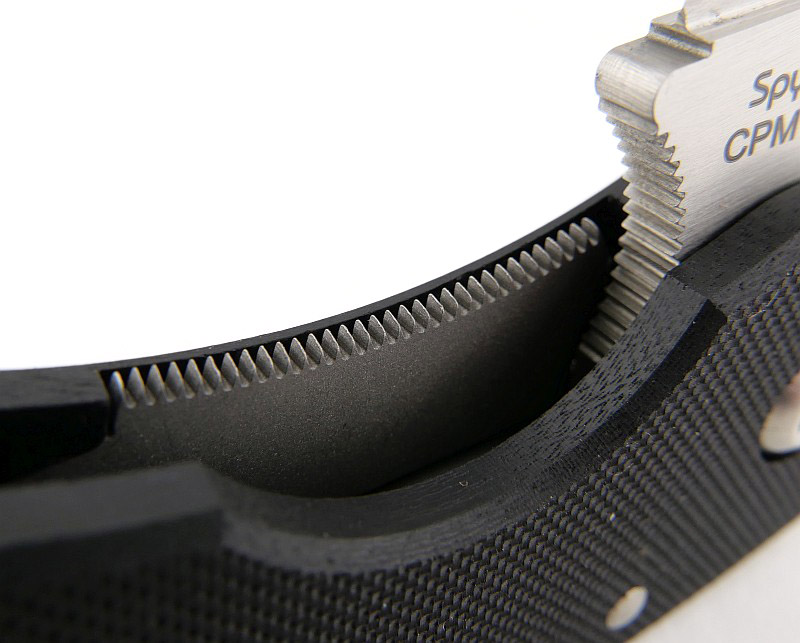
An extra detail not in this table is the edge angle of the serration on the Police Model. One of the reasons the Spyderco serrations cut so well is that they are chisel grind (so only one side is sharpened) making the edge angle very fine – in this case just 17 degrees total inclusive edge angle (0 degrees one side and 17 the other).


The Factory edge up close – NEW FOR 2022!:

Followers of Tactical Reviews will know my views on factory edges, but to recap:

Anyone using a knife will need to sharpen it. That first factory edge is just like the first tank of fuel that a new car comes with (or first charge of the battery).
A good factory edge is a ‘nice to have’ but not a ‘make or break’ for a good knife, as you will be putting your own edge onto it soon enough.
The factory edge does however indicate the care a knife maker has put into the final finish.
It is for this reason Tactical Reviews measures factory edge sharpness and specifications, and includes this information in the detailed technical testing.

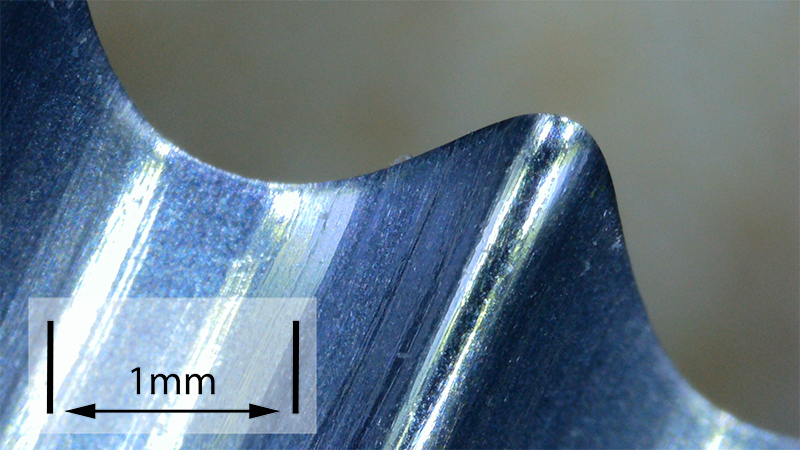
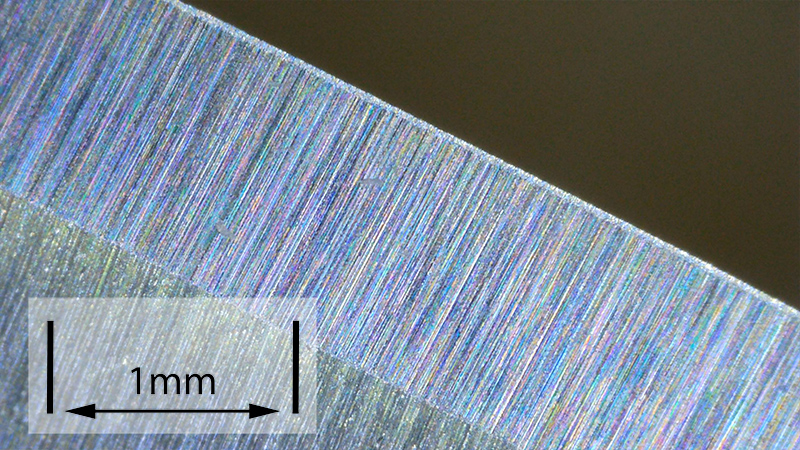
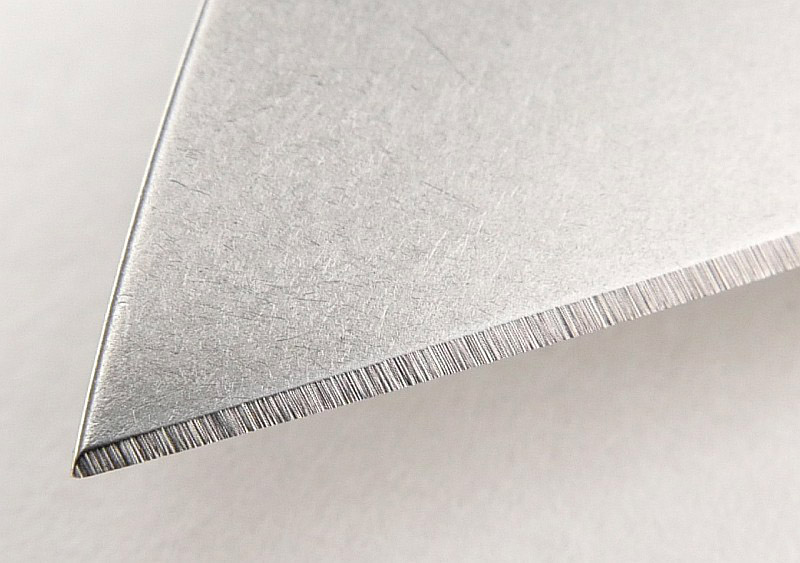
As a further look at the factory edge, this section has been added to include some high magnification photos of the factory edges.

In this case the serrated part of the Police model (the plain edge part was sharpened before the imaging device was ready) and the edge of the Military model.

These two edges are outstanding and will the standard by which others are judged!


What is it like to use?

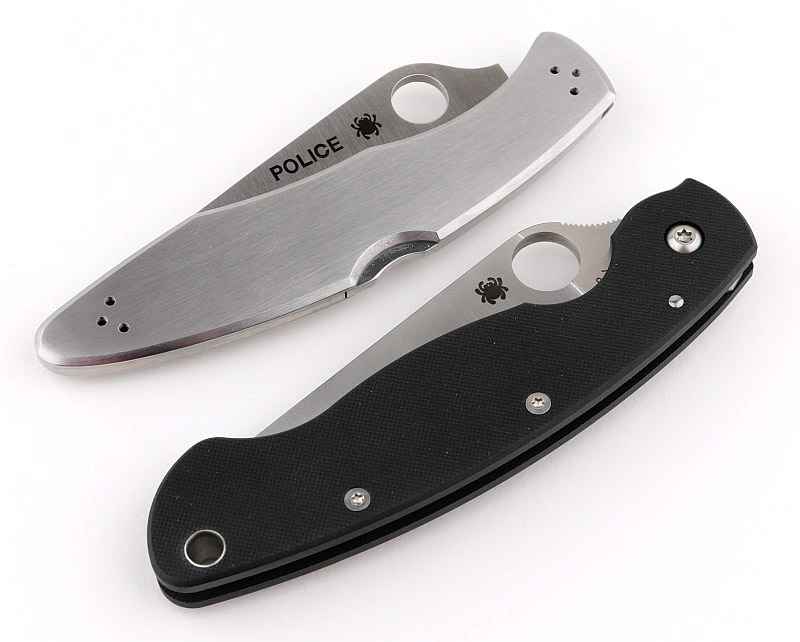
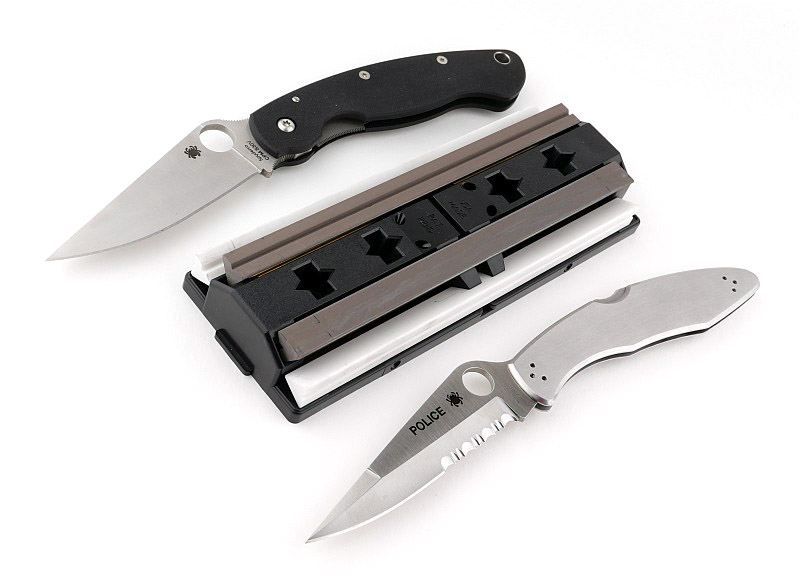
Before going further with using them, a quick side by side (and one on top of the other) size and form-factor comparison.


Moving onto the two knives in the hand, and despite being very similar in size, they do feel very different when you hold them. The G10 handles of the Military make for a different weight distribution plus fill the hand more. Of the two, the Military is definitely the more comfortable and easy to have a very secure grip of. Conversely though this makes it harder to carry, taking up more pocket space. The Police model is very slim and even at the size it is, slips into your pocket so easily.


In terms of carry, the Police model also gives you all four possible clip positions (or five if you count – ‘no clip’) so there isn’t any limitation of the clip position. Although that said, this current version is missing a lanyard hole if you wanted one of these.
For my own purposes, I have moved the clip from the factory position to tip-up and right handed.

Of course for edge maintenance, especially considering the serrated edge on the Police model, the Spyderco Tri-Angle Sharp Maker (also pictured above) is ideal and easy to use.

Both the Police and Military models do have a very pointy blade tip, the Police being the slightly pointier of the two. It makes them very aggressive at penetrating, and for anyone more used to a drop point or other less eager blade tip might find them unwieldy or difficult to control. You certainly need to use great care where depth of cut matters, and the long blade can make this control all the more difficult. You will get used to it, but it does need care and consideration when wielding these super capable blades.

Review Summary

The views expressed in this summary table are from the point of view of the reviewer’s personal use. I am not a member of the armed forces and cannot comment on its use beyond a cutting tool or field/hunting knife.

Something that might be a ‘pro’ for one user can be a ‘con’ for another, so the comments are categorised based on my requirements. You should consider all points and if they could be beneficial to you.

_______________________________________________
What doesn’t work so well for me
_______________________________________________

Military –
single clip position.
clip/G10 abrasive on pocket edge.

Police –
no lanyard hole.
slippery when wet.

_______________________________________________
Things I like
_______________________________________________

Military –
Very light for its size.
Very ‘eager’ blade (full flat grind and sharp point).
Liner lock makes for very smooth opening.
G10 handles have excellent grip.
Spyderco high quality fit and finish
One of the best factory edges I have ever seen!

Police –
Slim design makes it easy to carry.
Pocket clip has four possible positions.
Spyderco serrations incredibly sharp.
Three options for blade (plain, serrated, part-serrated).

Hope to see you at IWA 2022 soon!

 
Discussing the Review:
The ideal place to discuss this review is on the Tactical Reviews Facebook Page
Please visit there and start/join the conversation.
As well as the Tactical Reviews Facebook Page, please consider visiting one of the following to start/join in any discussion.

BladeForums – Knife Reviews (US based Forum for Knife Discussion)

CandlePowerForums – Knife Reviews Section (Largest and Friendliest Flashlight Community Forum)

Light Review: Cyansky H3 and H5 (built-in Red/Green Filter)

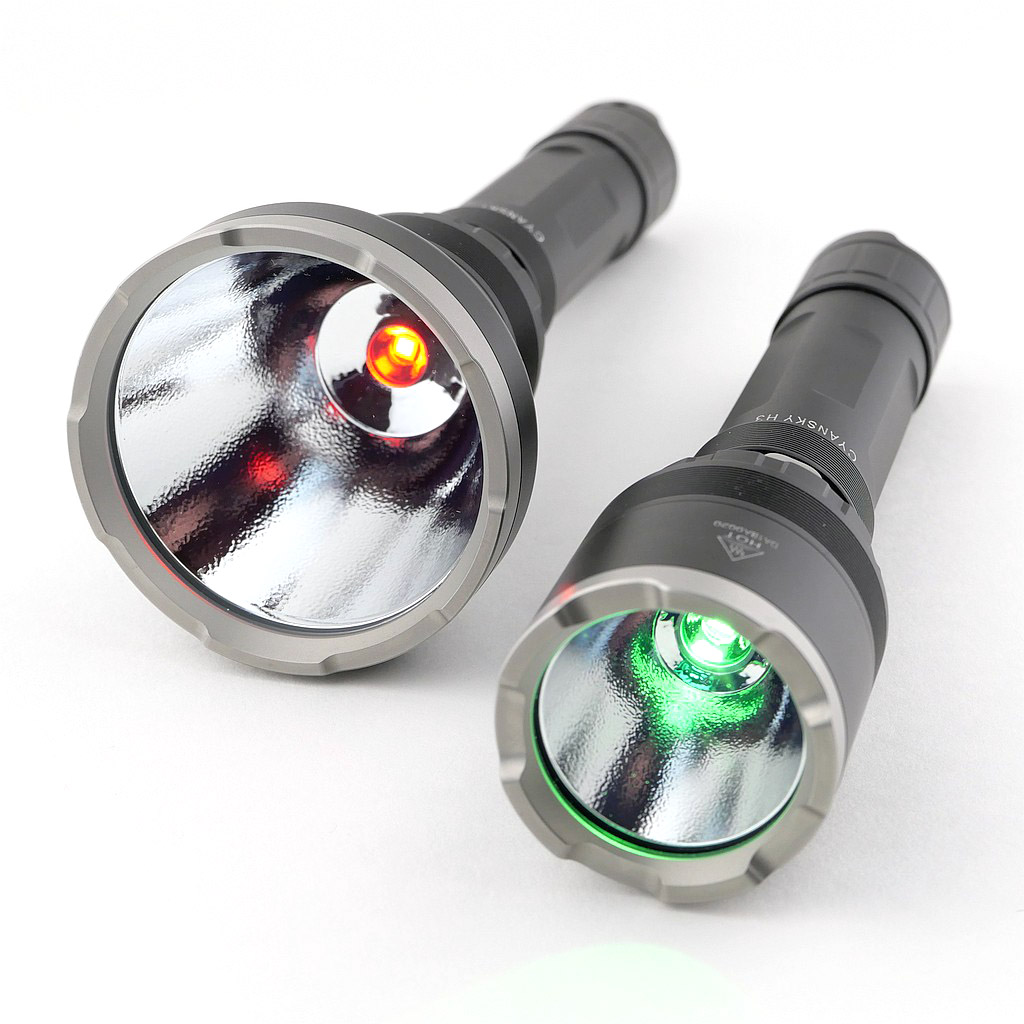
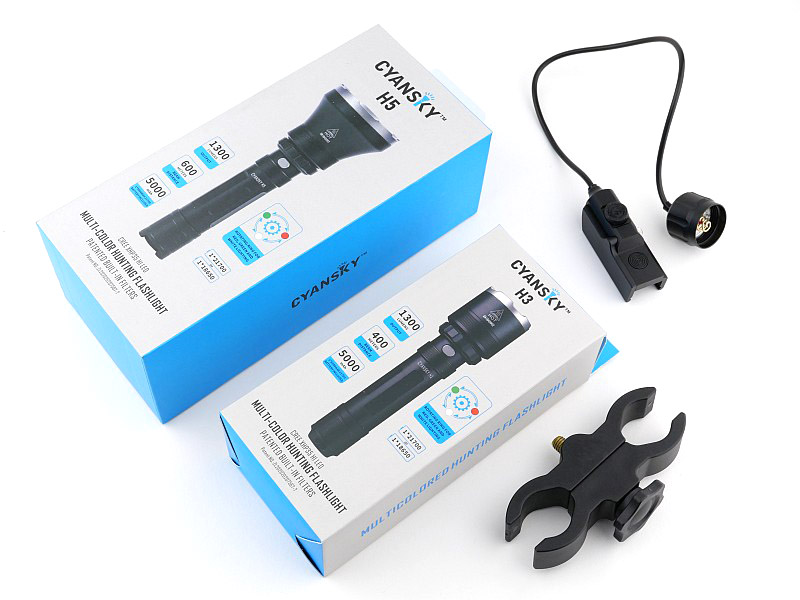
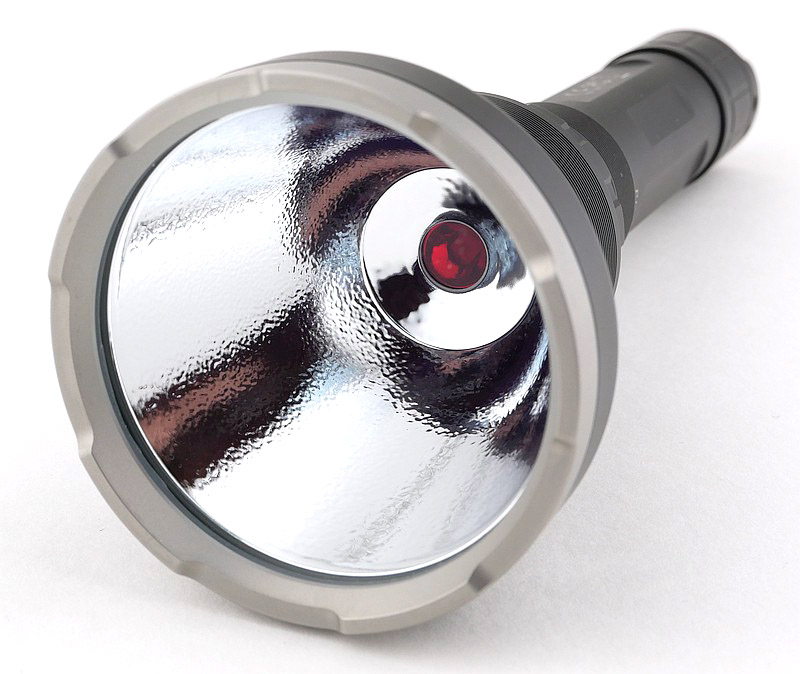
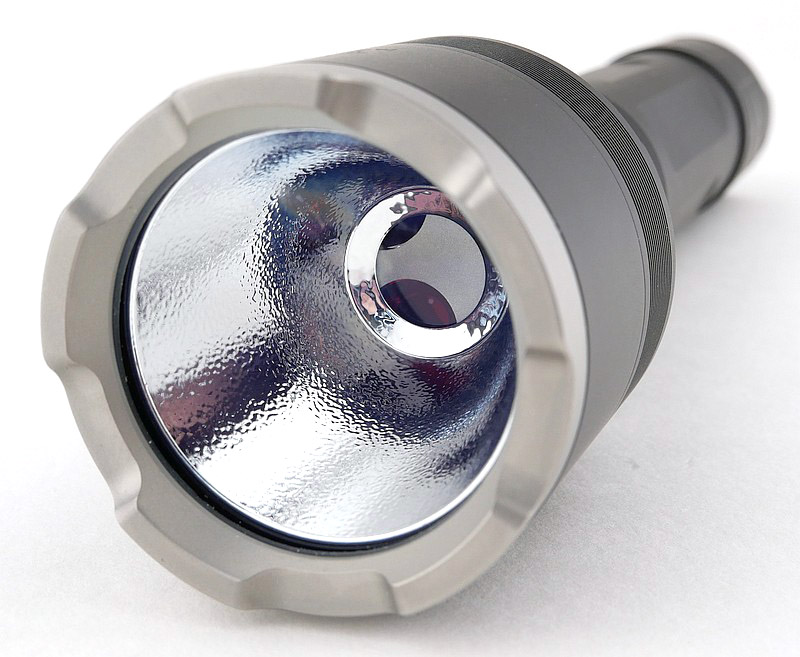
Cyansky have come up with a novel way to solve the problem of having multiple colours of light in a single device without many of the compromises multi-LED or LED swapping lights might have. Most people will have come across, or used, colour filters to change the output of a white beam, but these are easily forgotten or lost. In the Cyansky H3 and H5 hunting models, glass filters are completely contained within the head of the light and the patented mechanism lets you drop a red or green filter in front of the XHP35 HI LED with a simple twist of the control ring – nothing else needed. The H3 and H5 use the increasingly popular 21700 cell to provide more power and runtime, but can run on an 18650 or 2 CR123s for added versatility.
Join me in the detailed examination of these two hunting lights and see how they perform.

Video Overview

Starting with a look over these light in a short video.

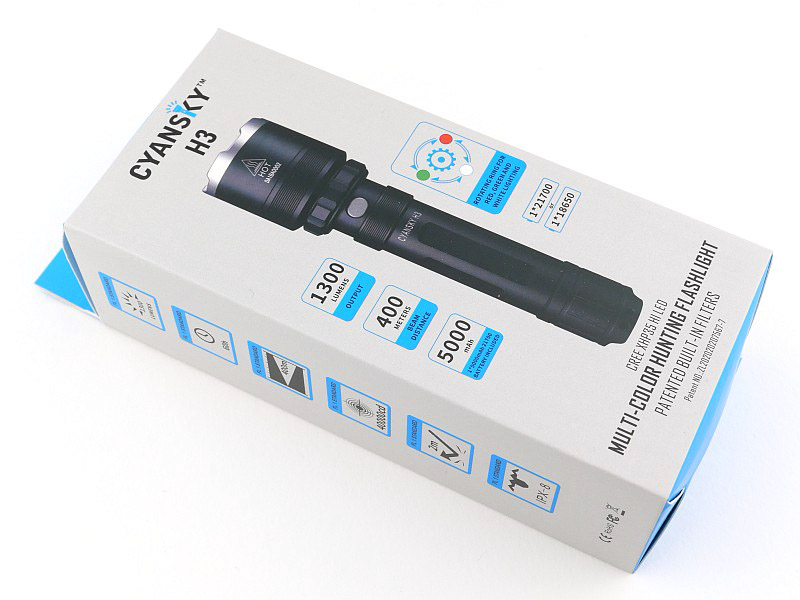
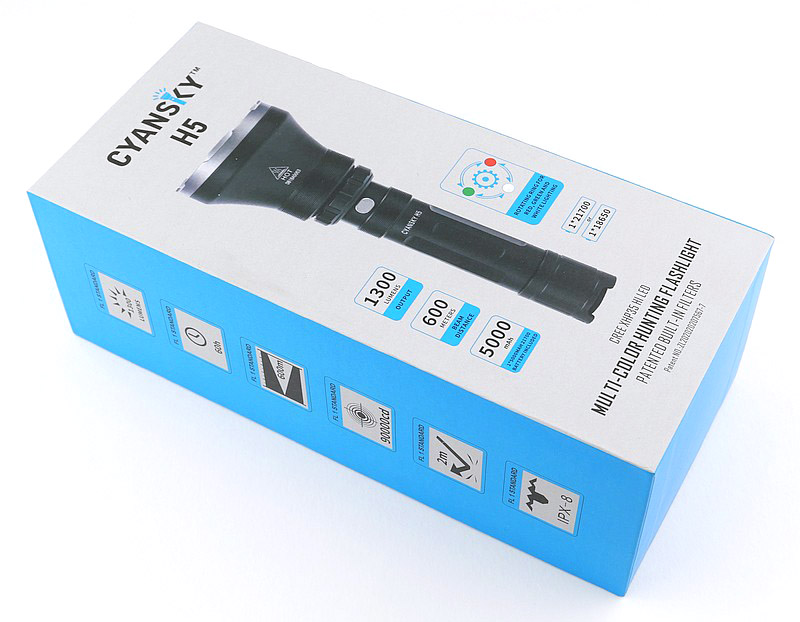
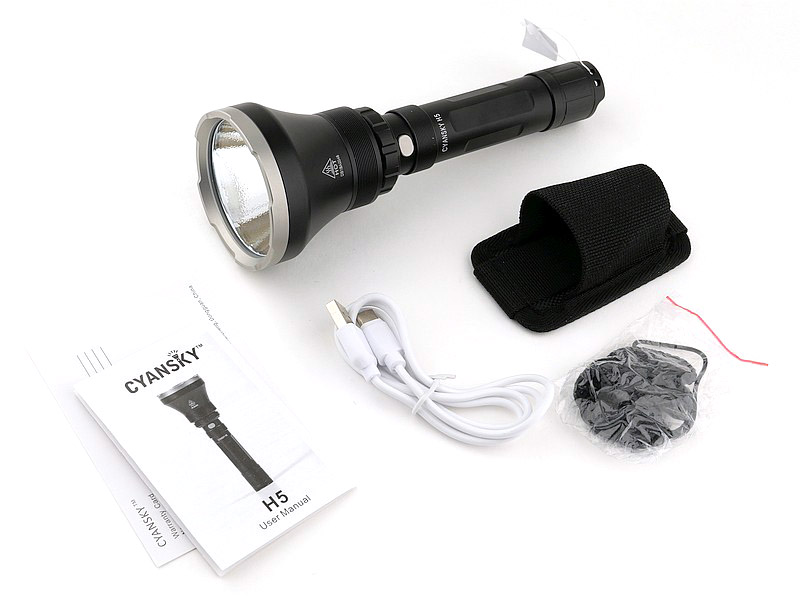
This is what arrived from Cyansky –

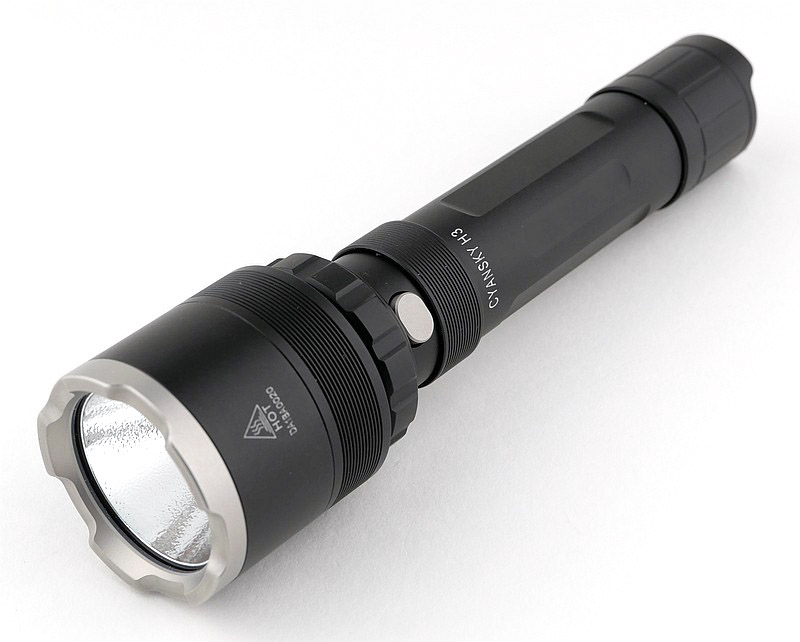
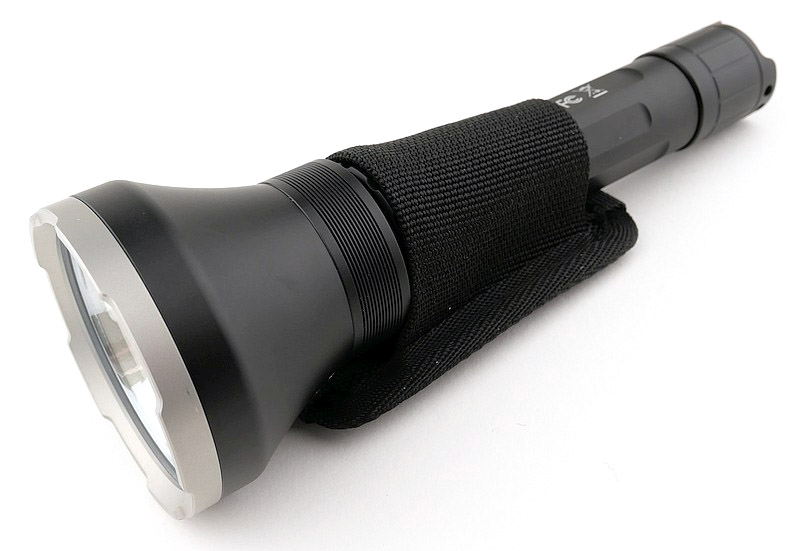
A good look round the H3 – Things to look out for here are:
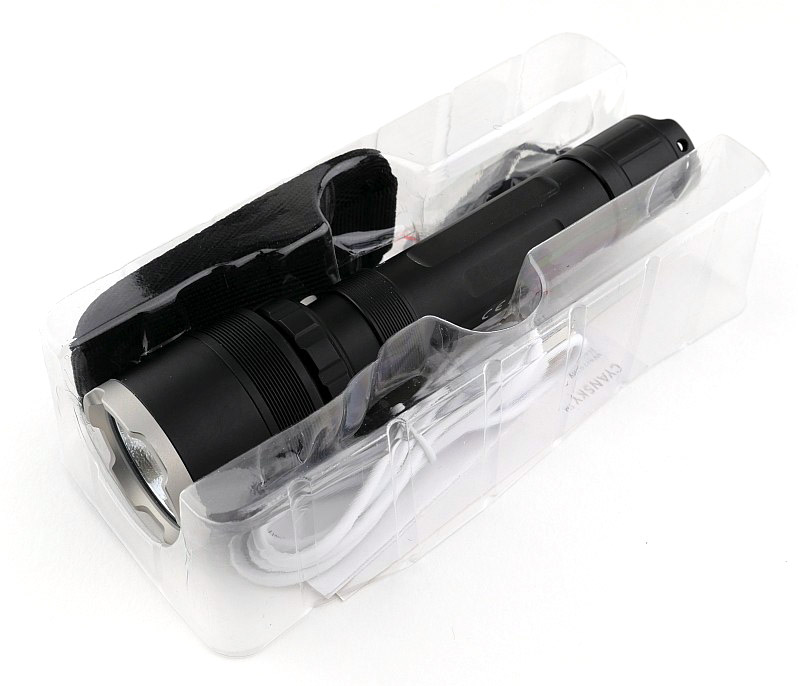
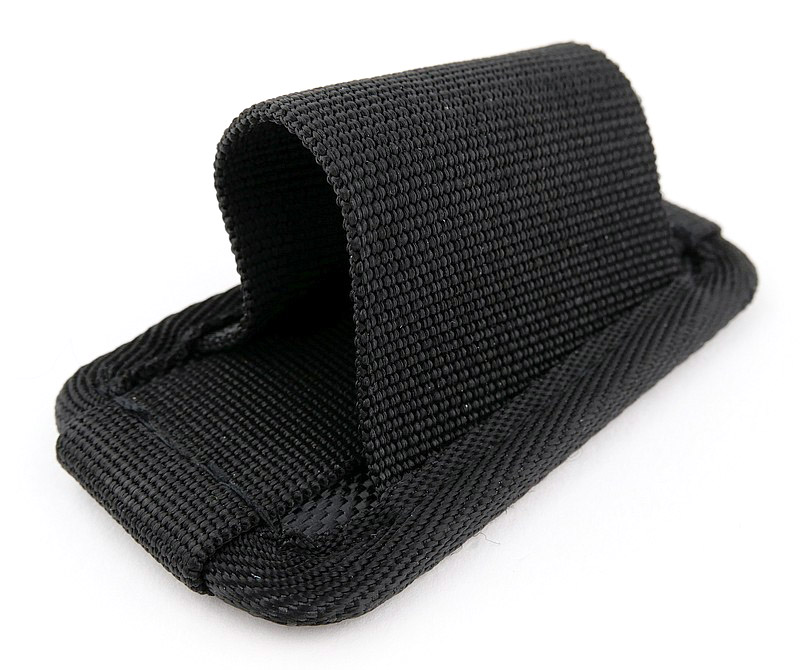
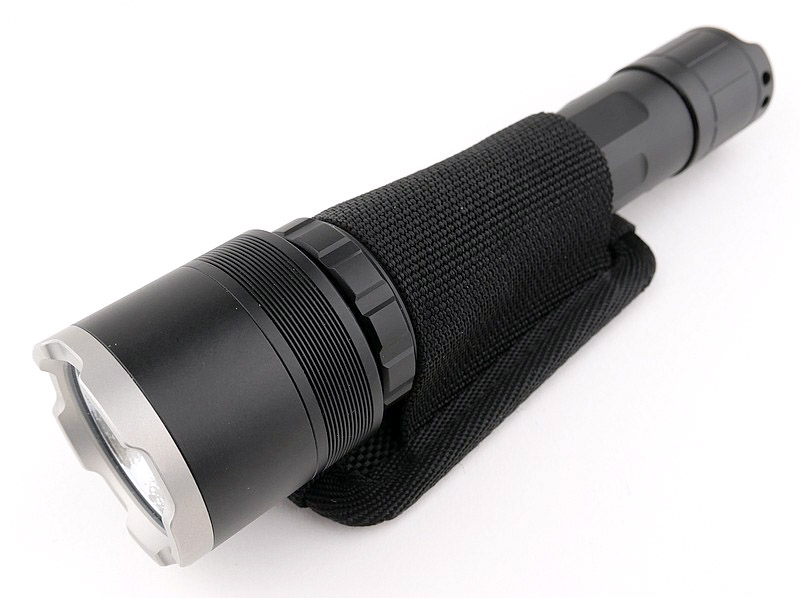
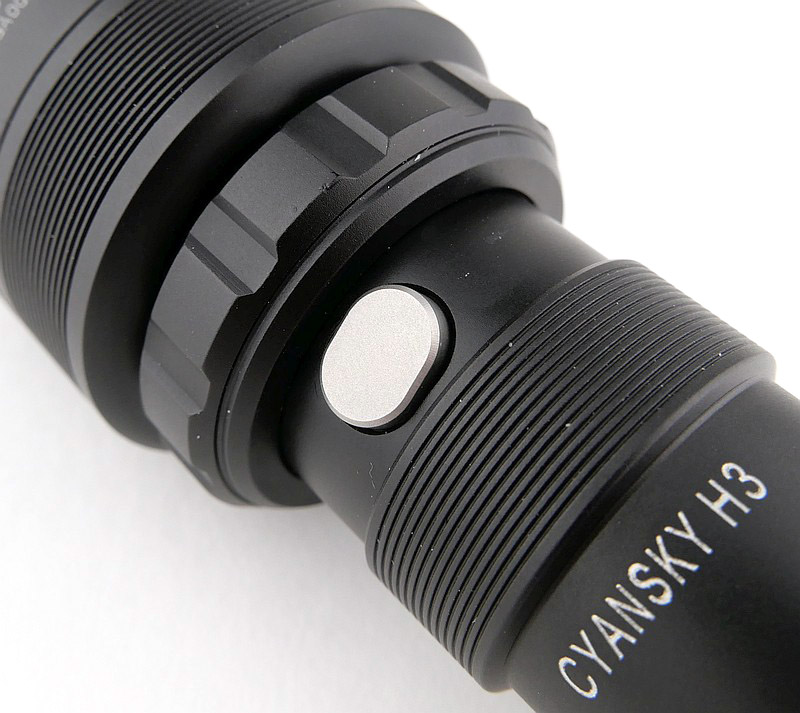
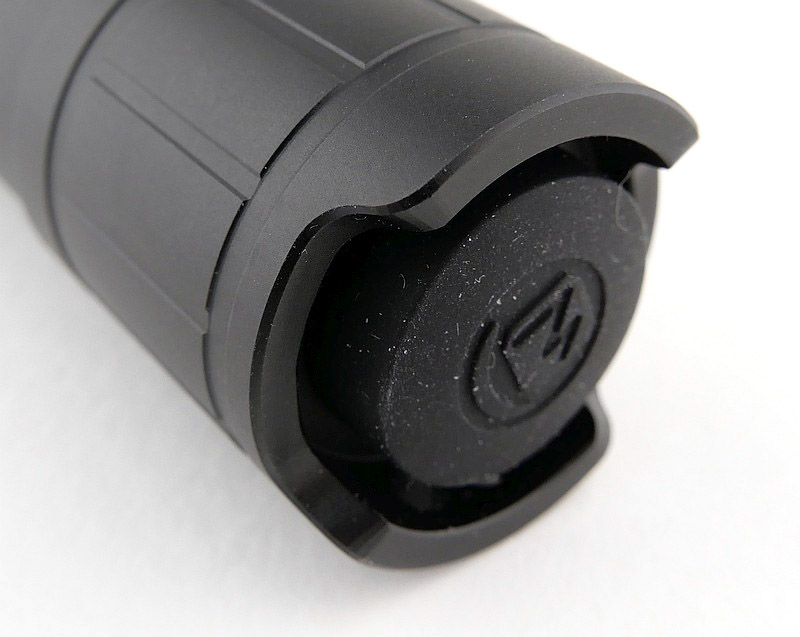
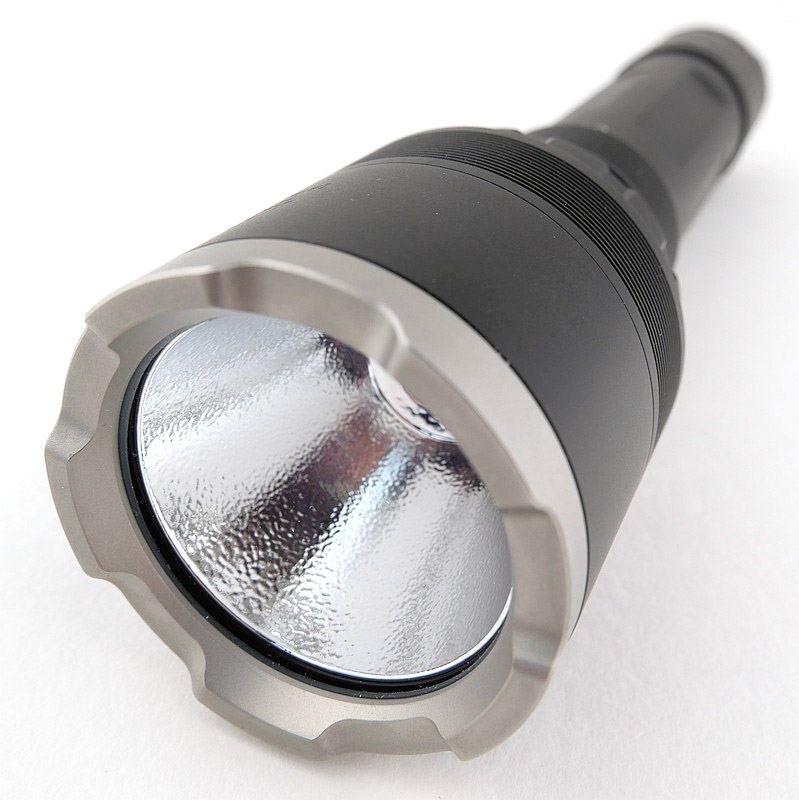
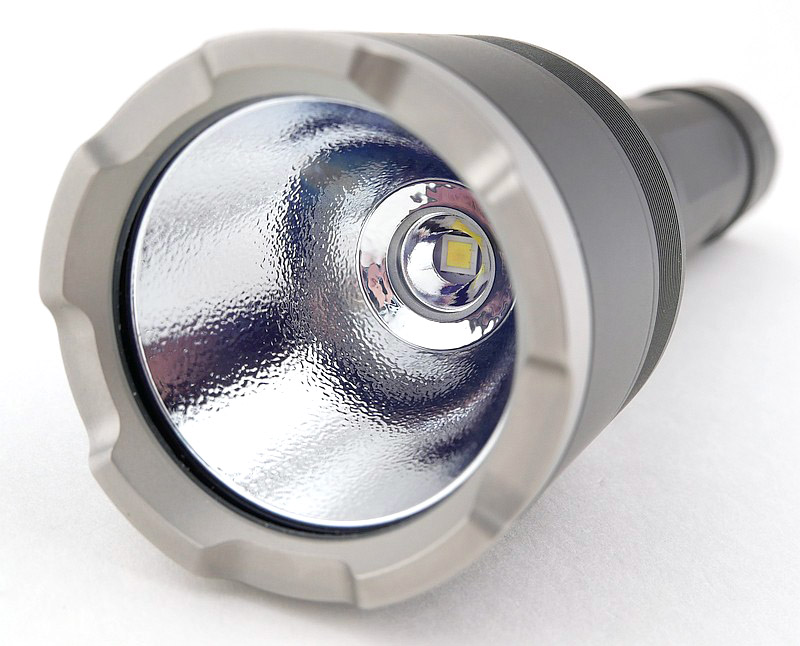
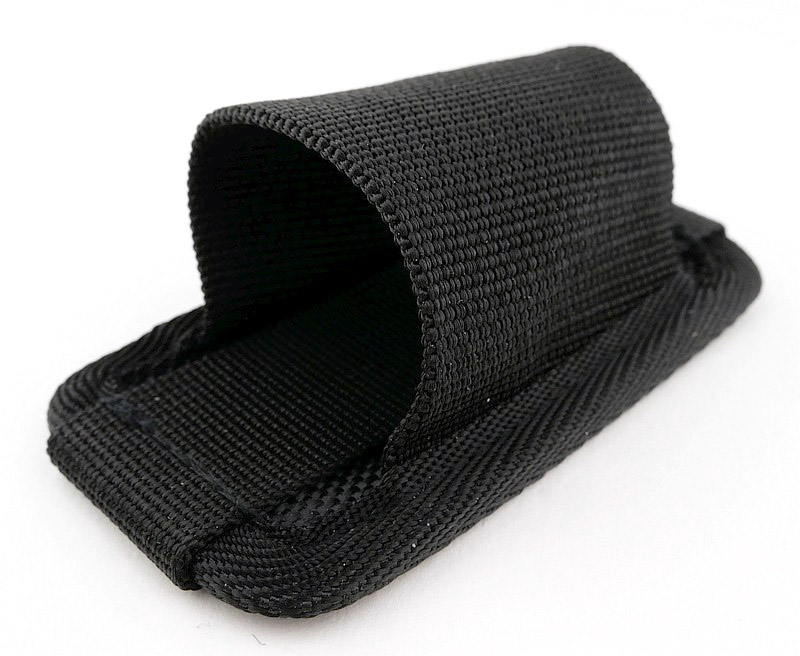
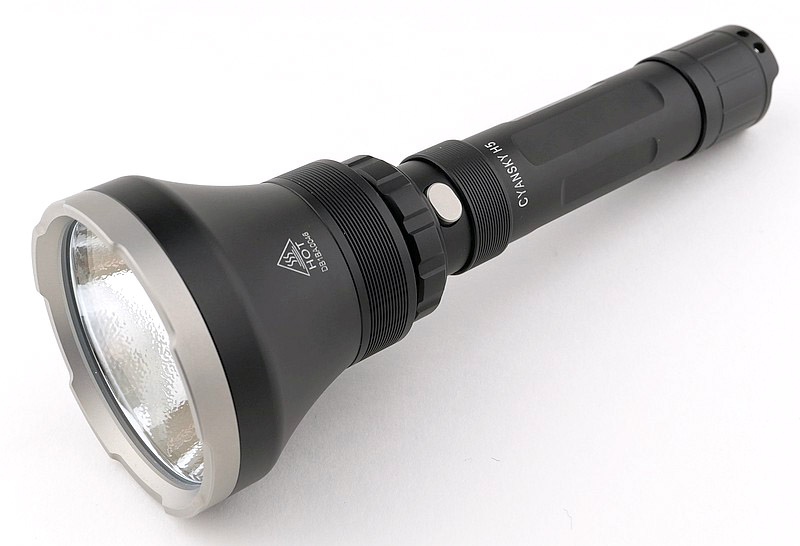
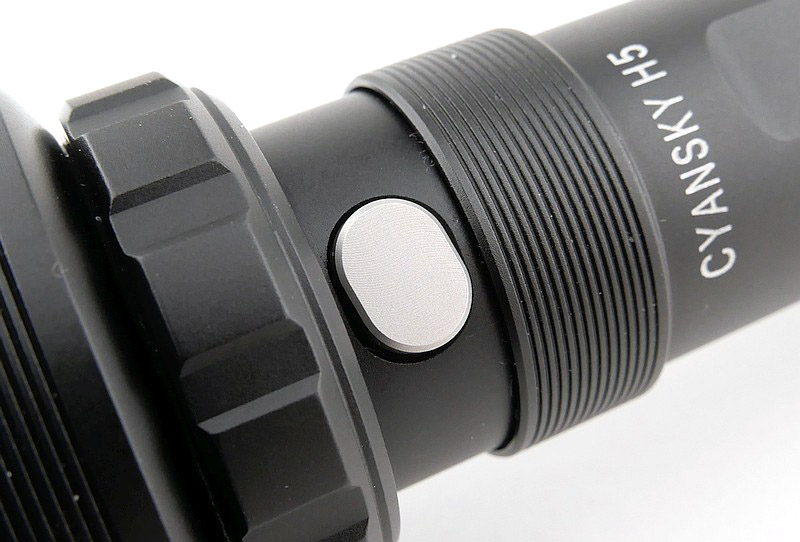
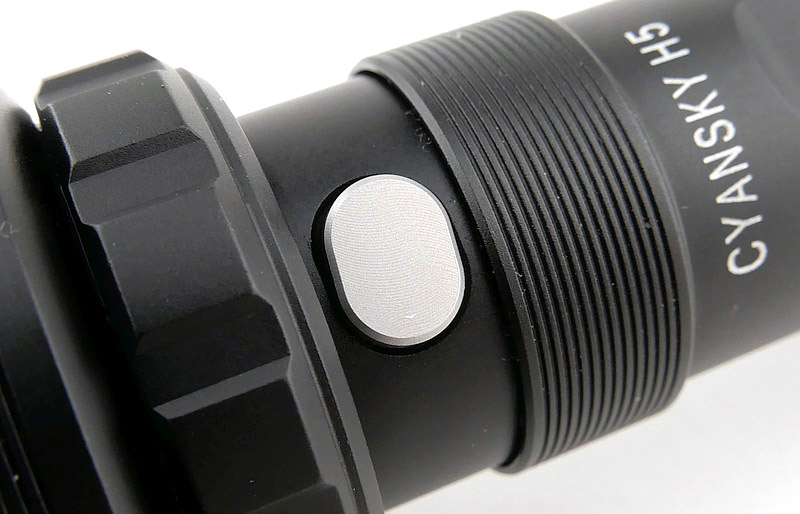
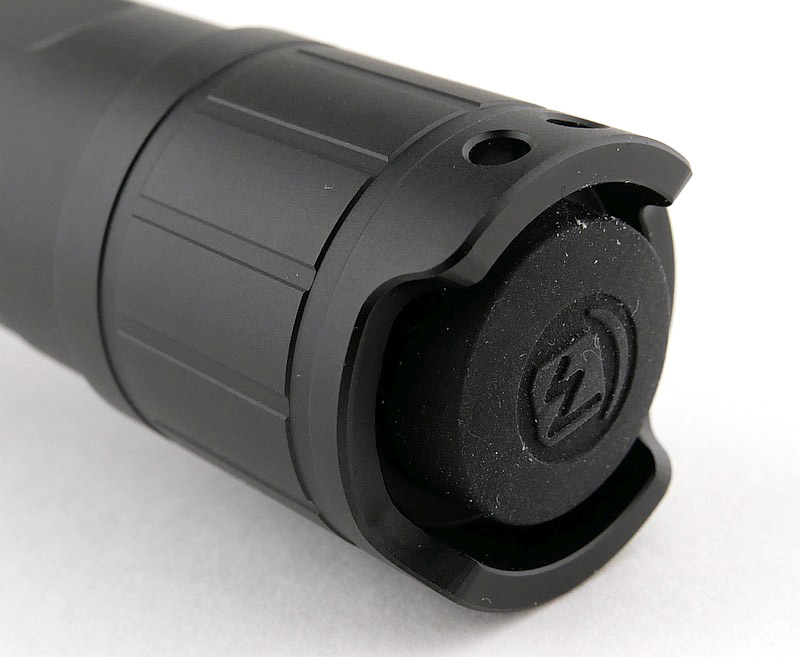
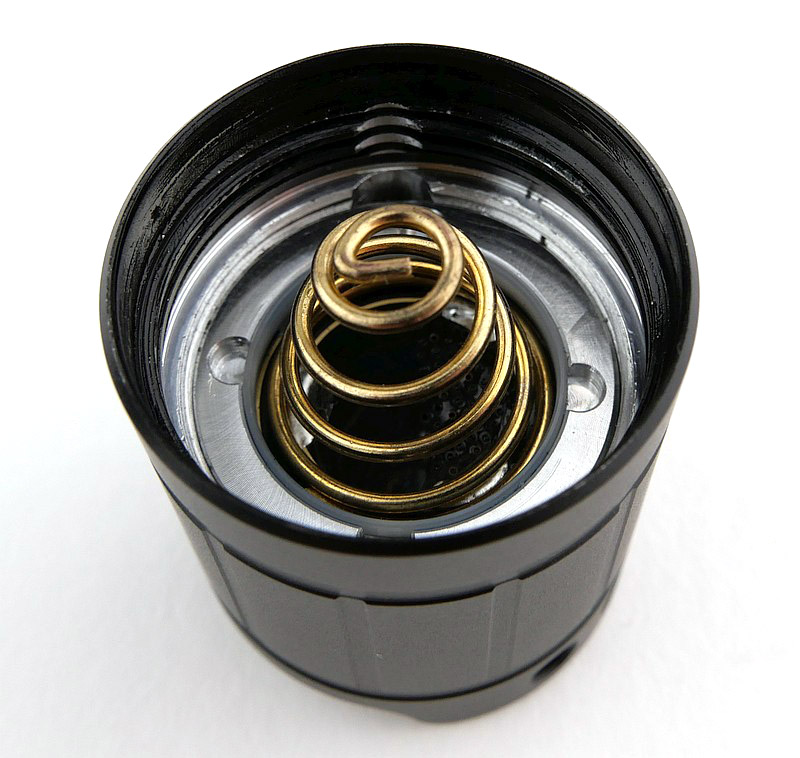
As you may have already seen in the video, first up are the contents of the box. The H3 has a belt hanger (rather than full holster) providing a head-up belt carry option. Moving round the H3 and we get onto the mode switch and filter control ring at the base of the head. The tail-switch is semi-recessed, so allowing for tail standing, but with cutouts to ease access to the switch. The stainless bezel ring is wide and well finished. And then a first look at one of the filters.
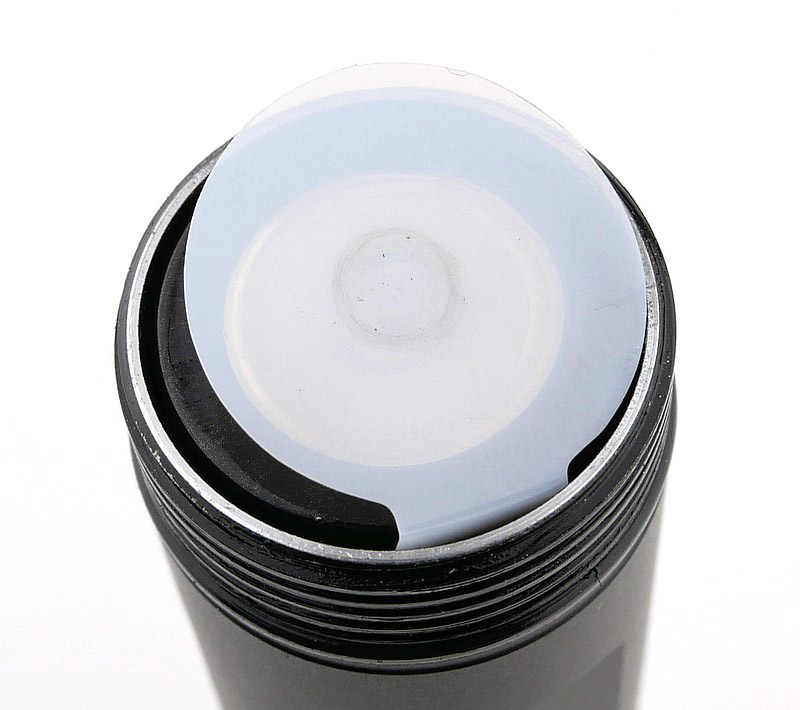
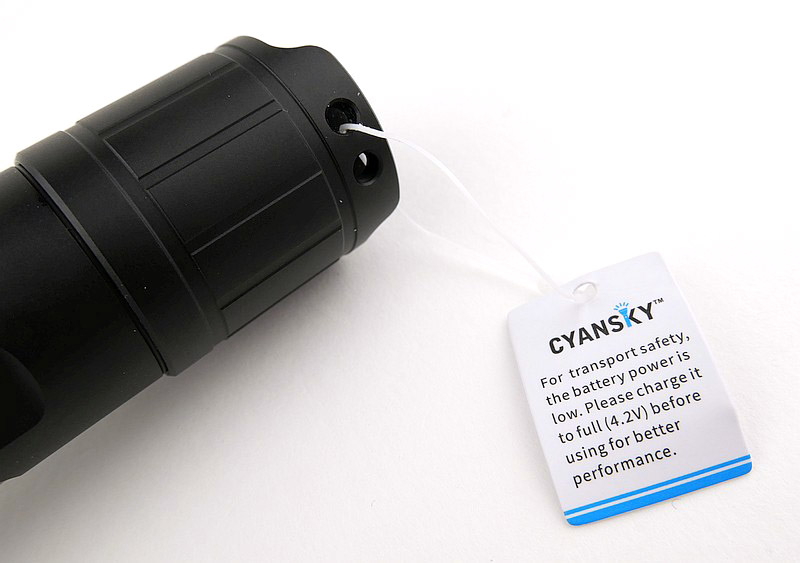
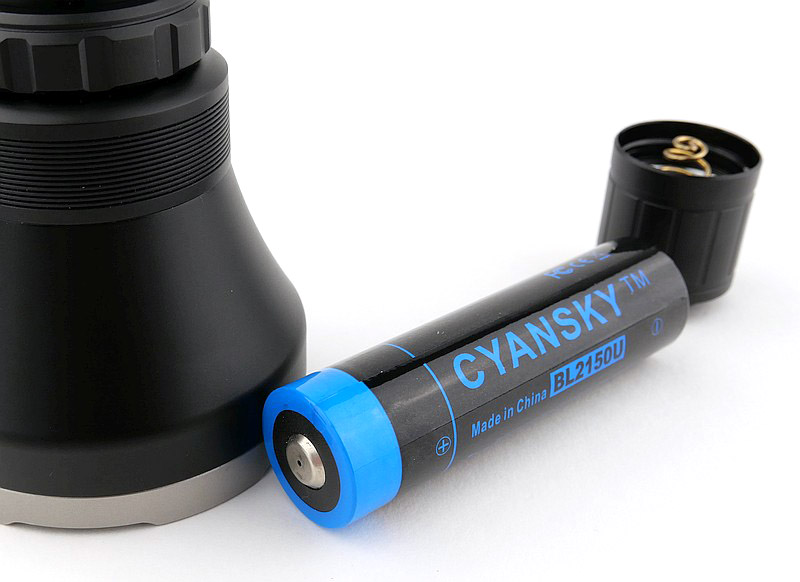
The H3 comes with a 21700 with built-in USB-C charging. As it arrives there is a plastic insulator to prevent accidental discharge in the light.


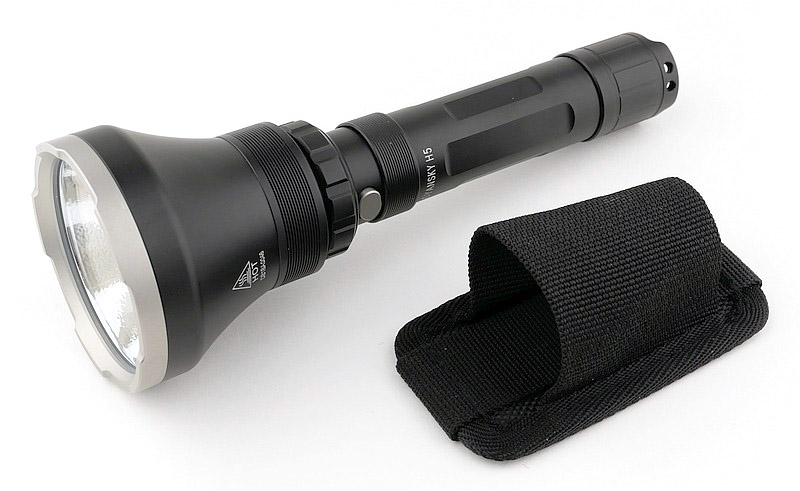
A good look round the H5 – Things to look out for here are:
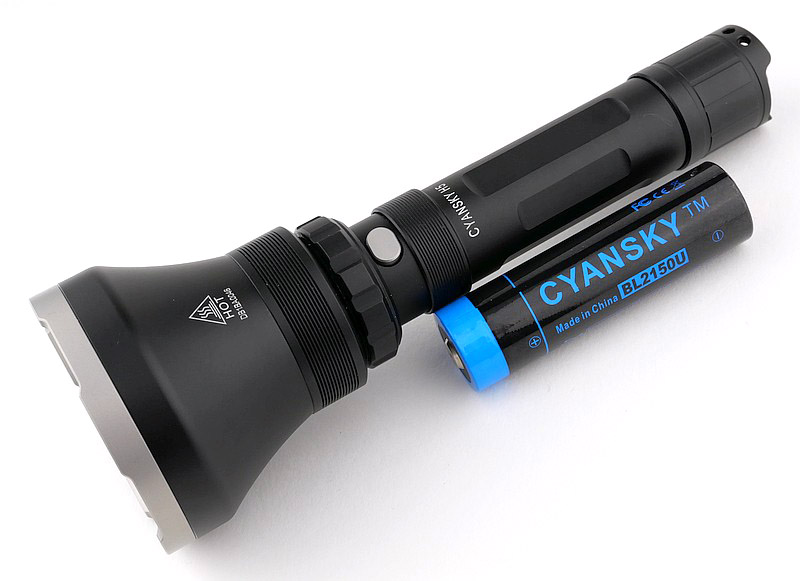
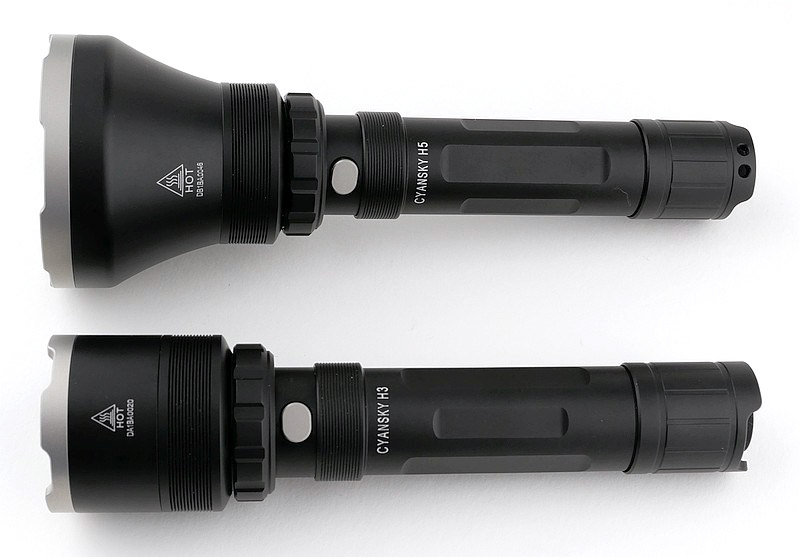
With the H5, the details are the same as for the H3, so I won’t repeat them, the difference is in the much larger head and reflector to give extra beam range.
One small observation which doesn’t affect function at all is that the mode switch has room to move about and twist, so might look a little ‘off’. This doesn’t affect function at all, and is only mentioned in case you see the button looking slightly twisted (this is the same for both models).


The Remote Switch and scope mount:
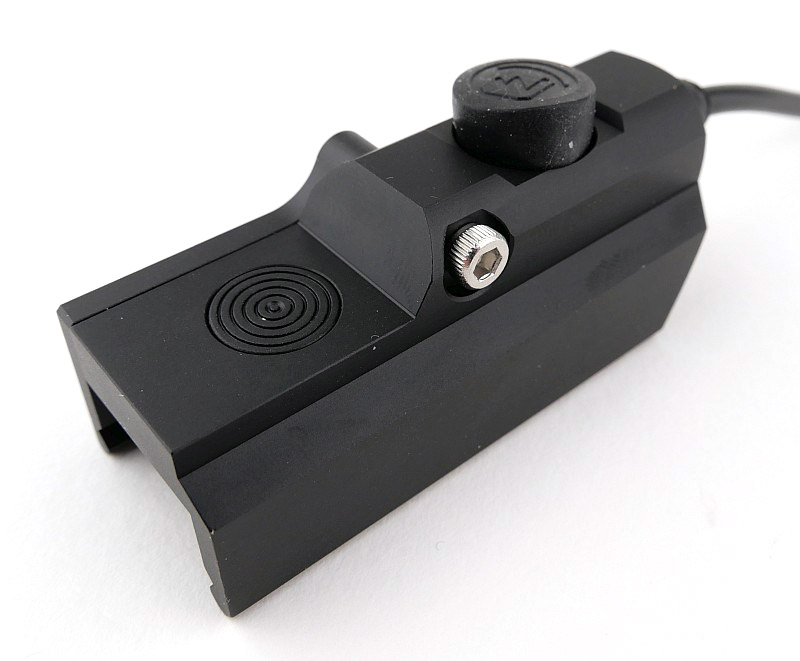
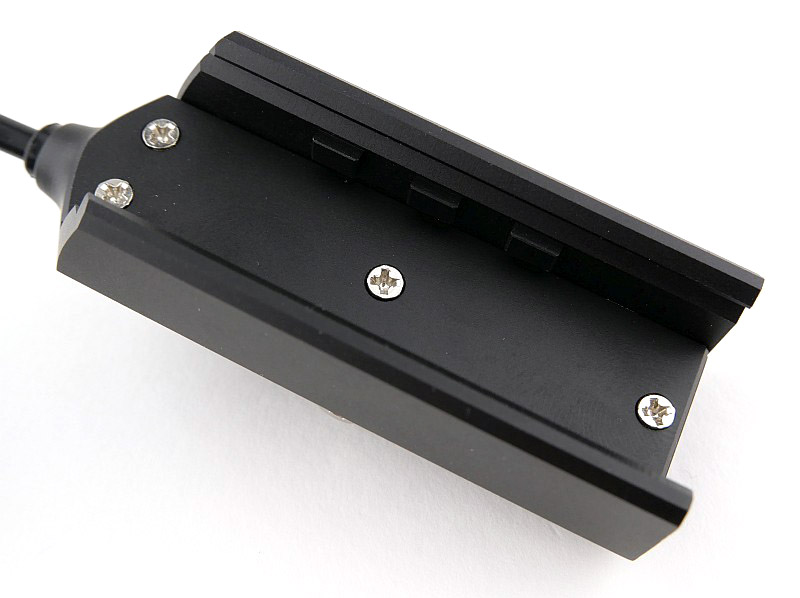
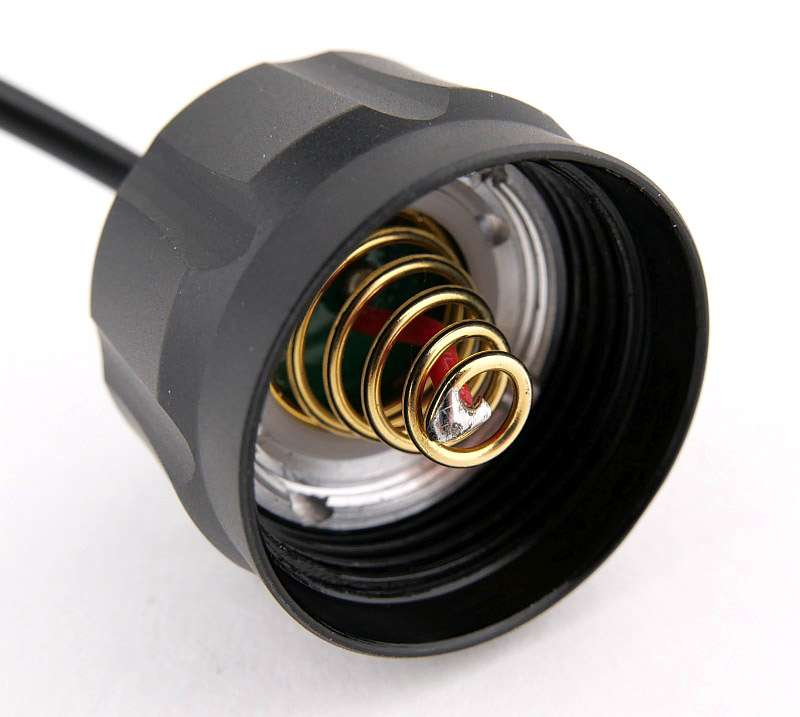
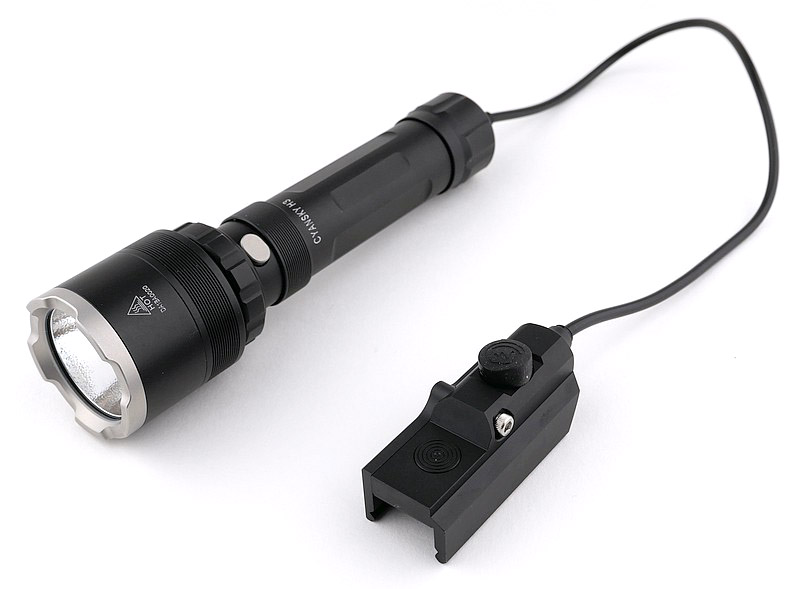
The supplied remote switch replaces the tail-cap of either the H3 or H5. The remote switches are in a rail-mount unit, and you have a momentary only switch, plus a forward clicky latching switch much like the original tail switch.
The scope mount is basic and easy to use, but I would not use it for heavy duty setups. For smaller calibers and for quick tool-less mounting it works well, and has enough stand off for the H3 or H5.


The Cyansky special feature – built-in colour filters:
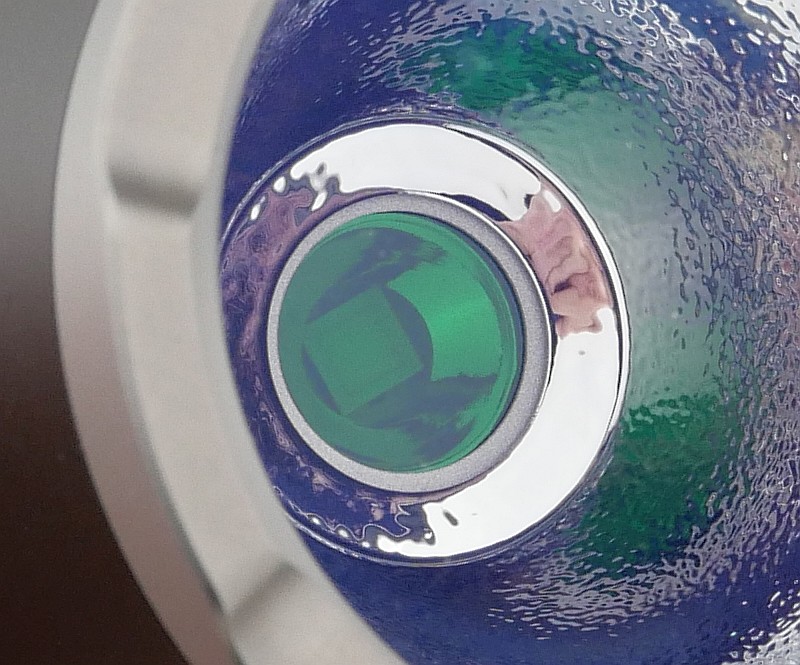
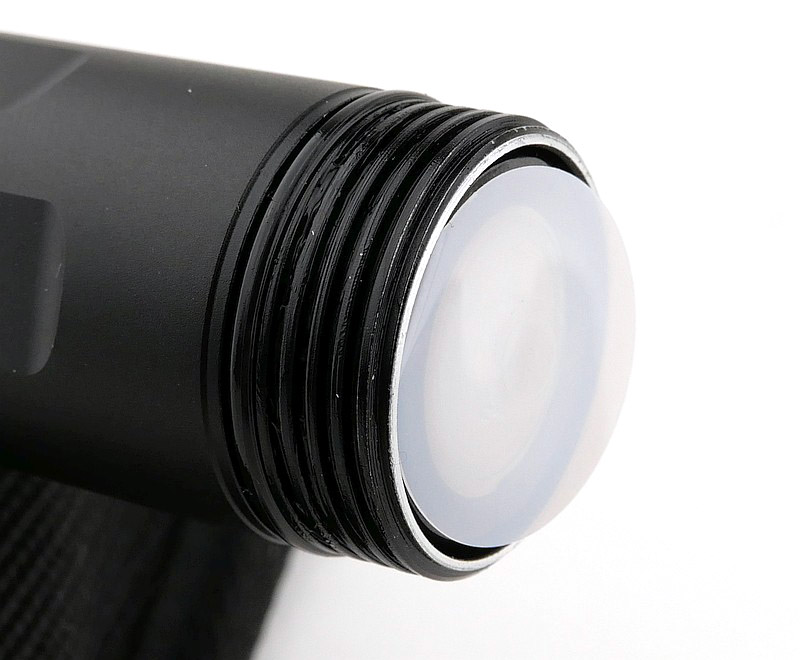
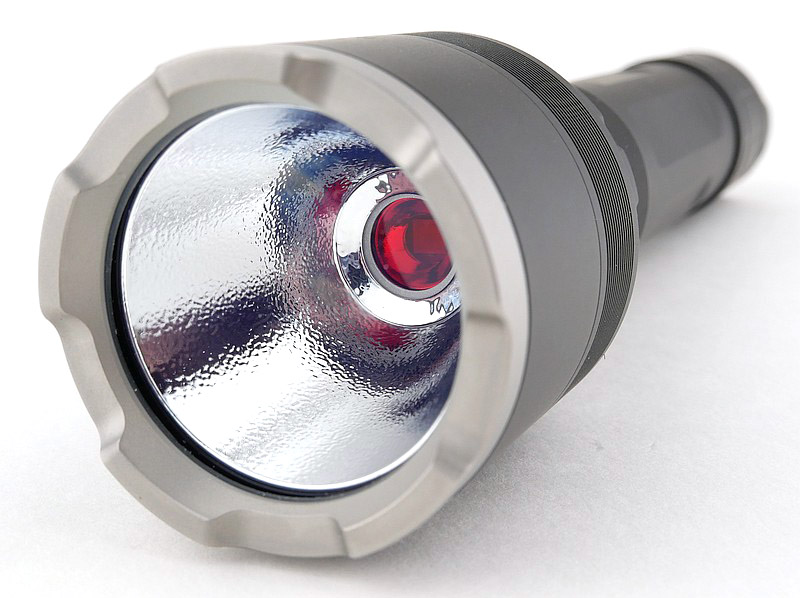
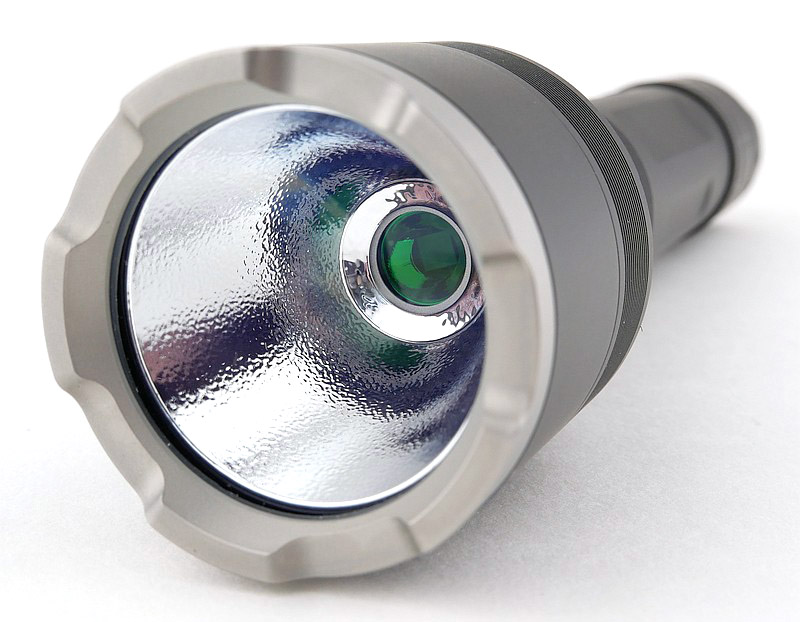
Now for a set of images to just show the built-in filter change. I’ve used the H3 here as with the smaller head it is easier to see the filter better than with the H5. First no filter – with the filter holder just having a little bit of extra reflector round the base of the LED. Then part of the way to dropping a filter in place (this is NOT how you use it, just showing the filter holder disk rotating). Finally with the red and green glass filters shown in place over the LED.


The beam

Please be careful not to judge tint based on images you see on a computer screen. Unless properly calibrated, the screen itself will change the perceived tint.

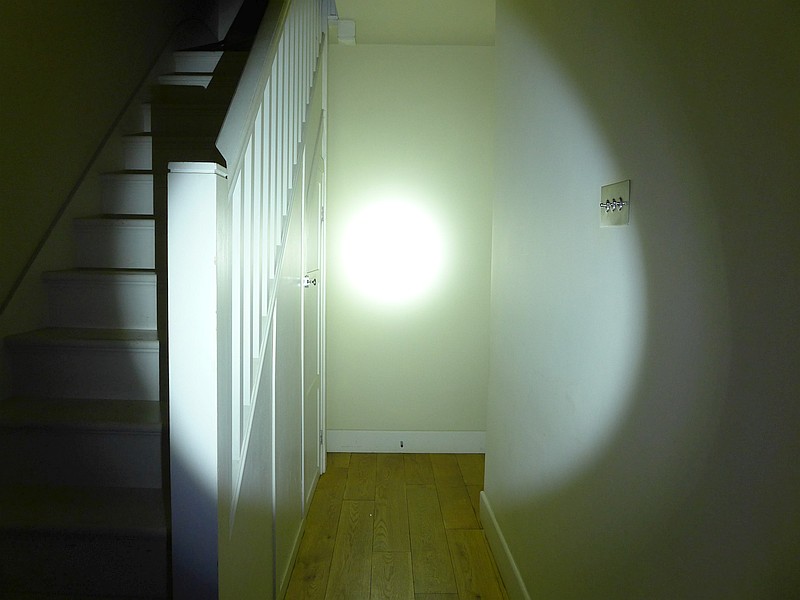
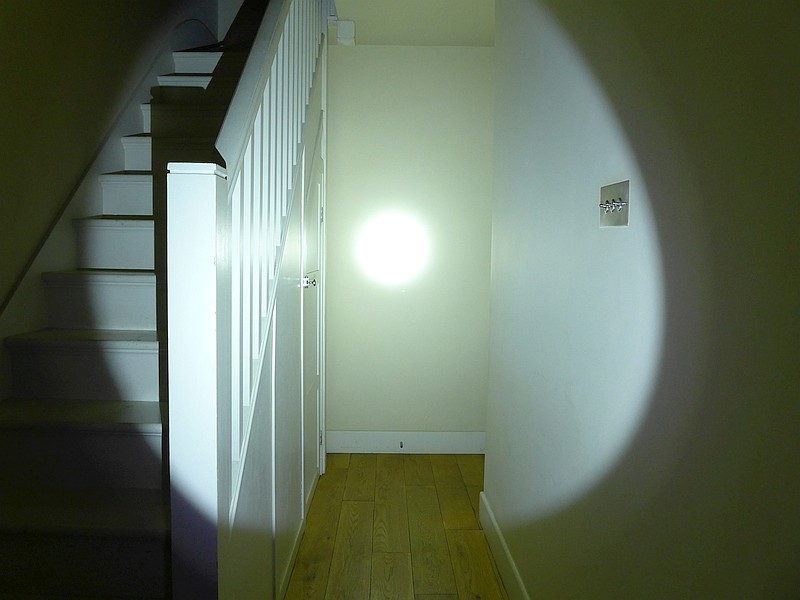
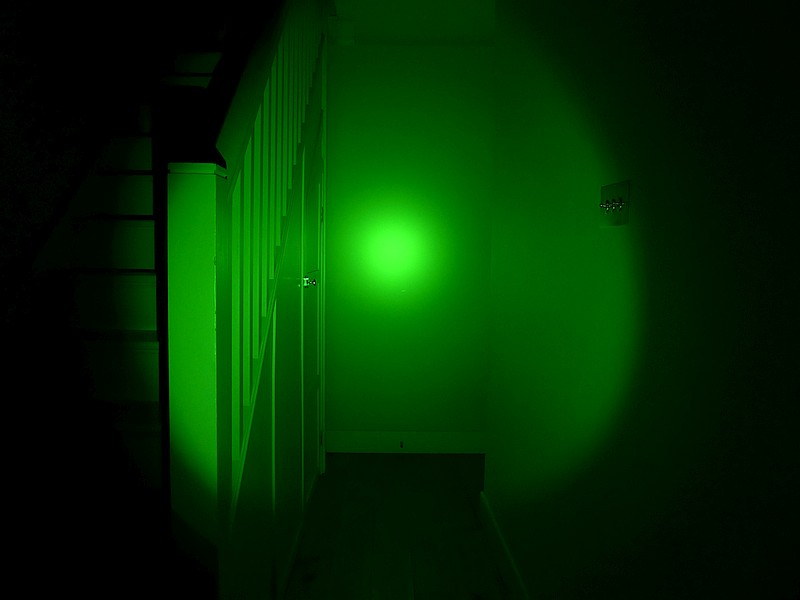
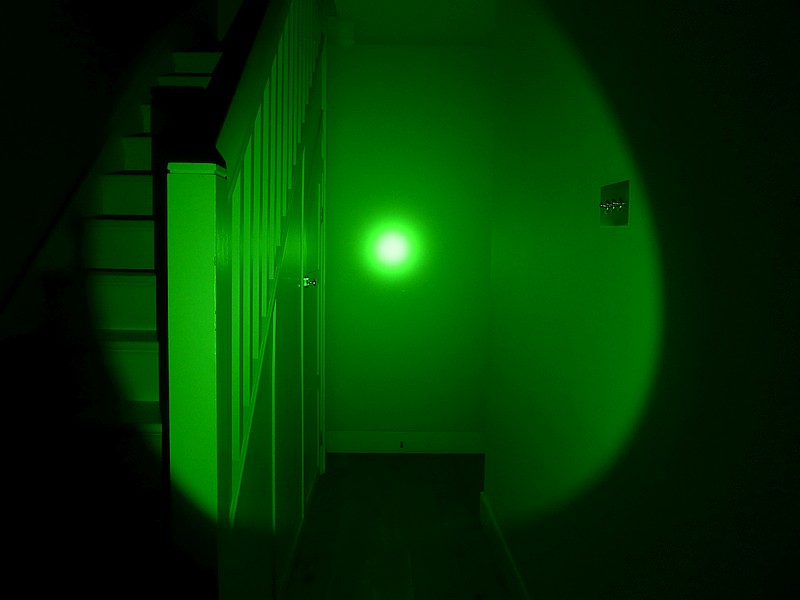
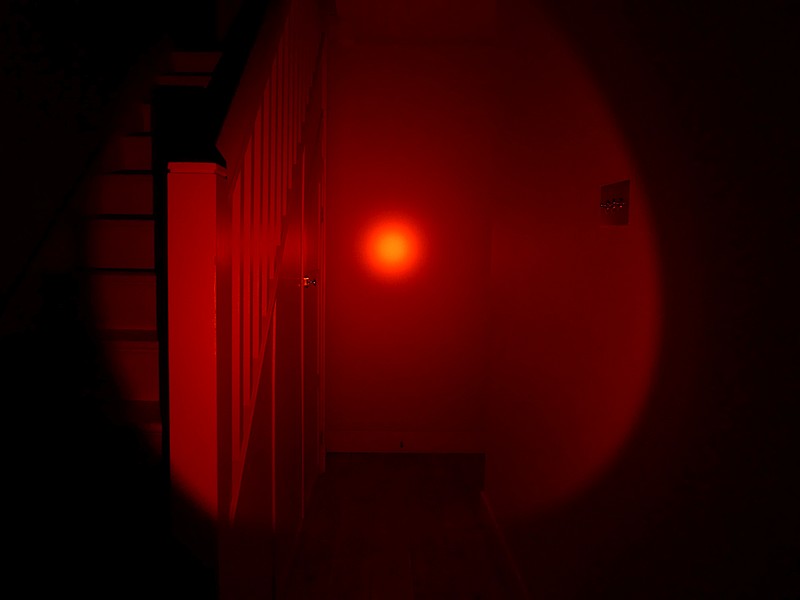
The indoor beamshot is intended to give an idea of the beam shape/quality rather than tint. All beamshots are taken using daylight white balance. The woodwork (stairs and skirting) are painted Farrow & Ball “Off-White”, and the walls are a light sandy colour called ‘String’ again by Farrow & Ball. I don’t actually have a ‘white wall’ in the house to use for this, and my wife won’t have one!

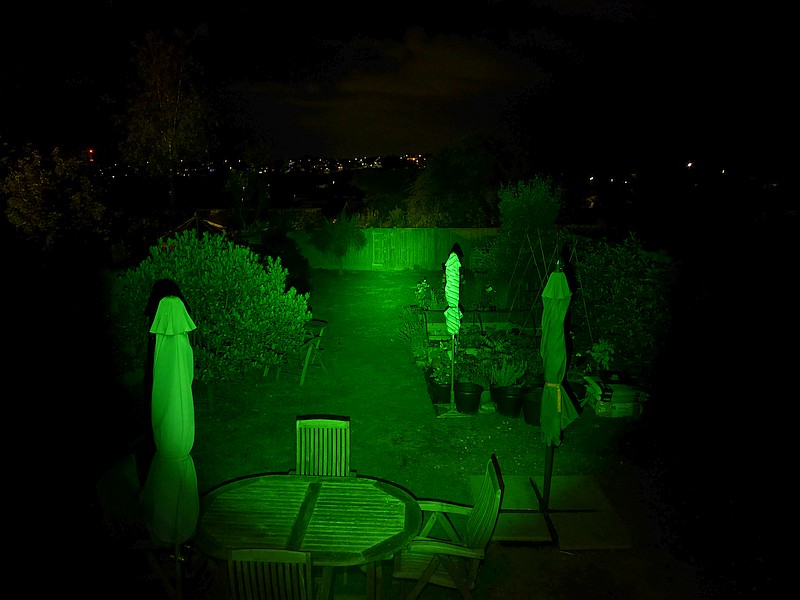
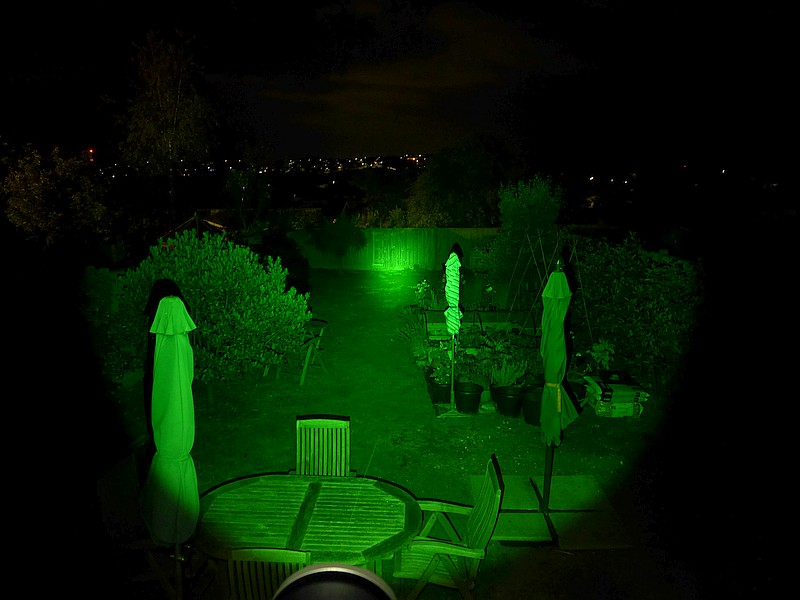
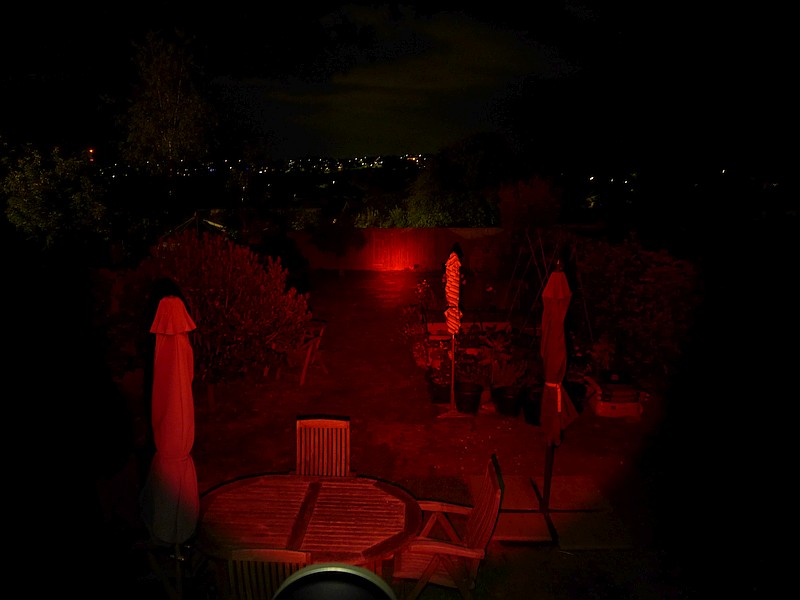
Stepping through these beamshots we have the H3 white beam, then H5 white beam, and as you go through the gallery it is H3 then H5 to show a direct comparison on each colour indoors and out.


Batteries and output:

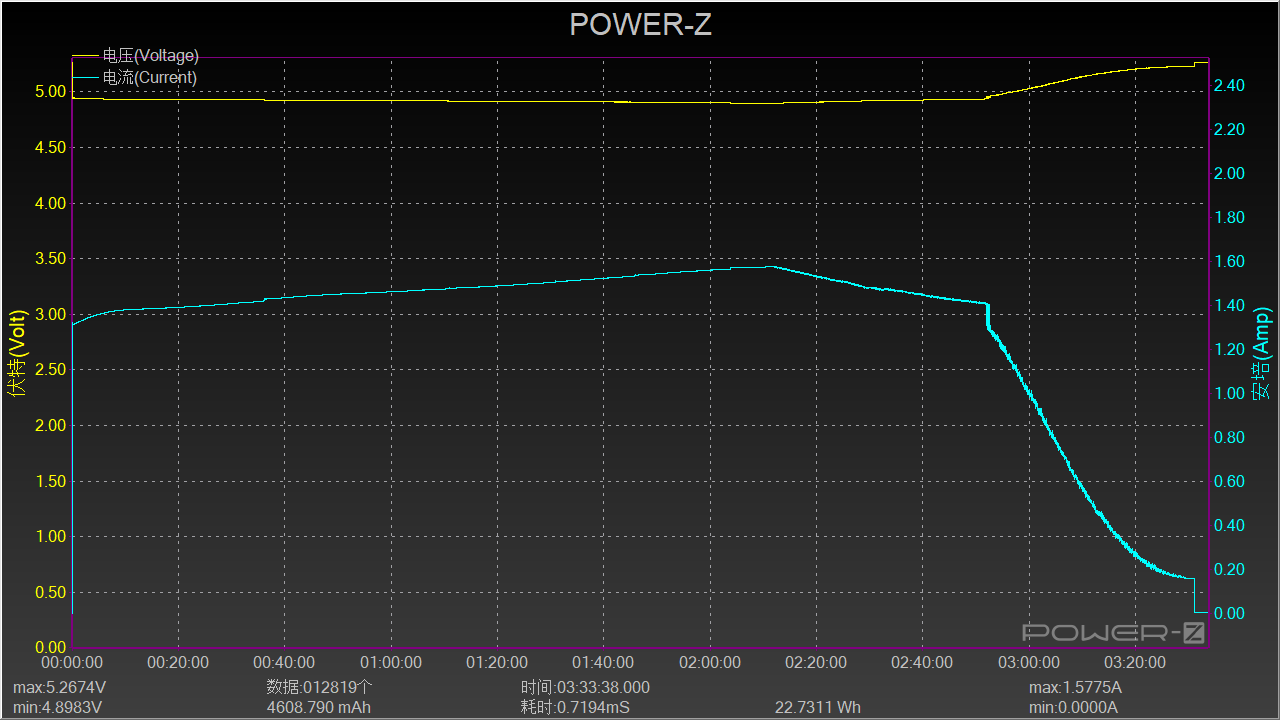
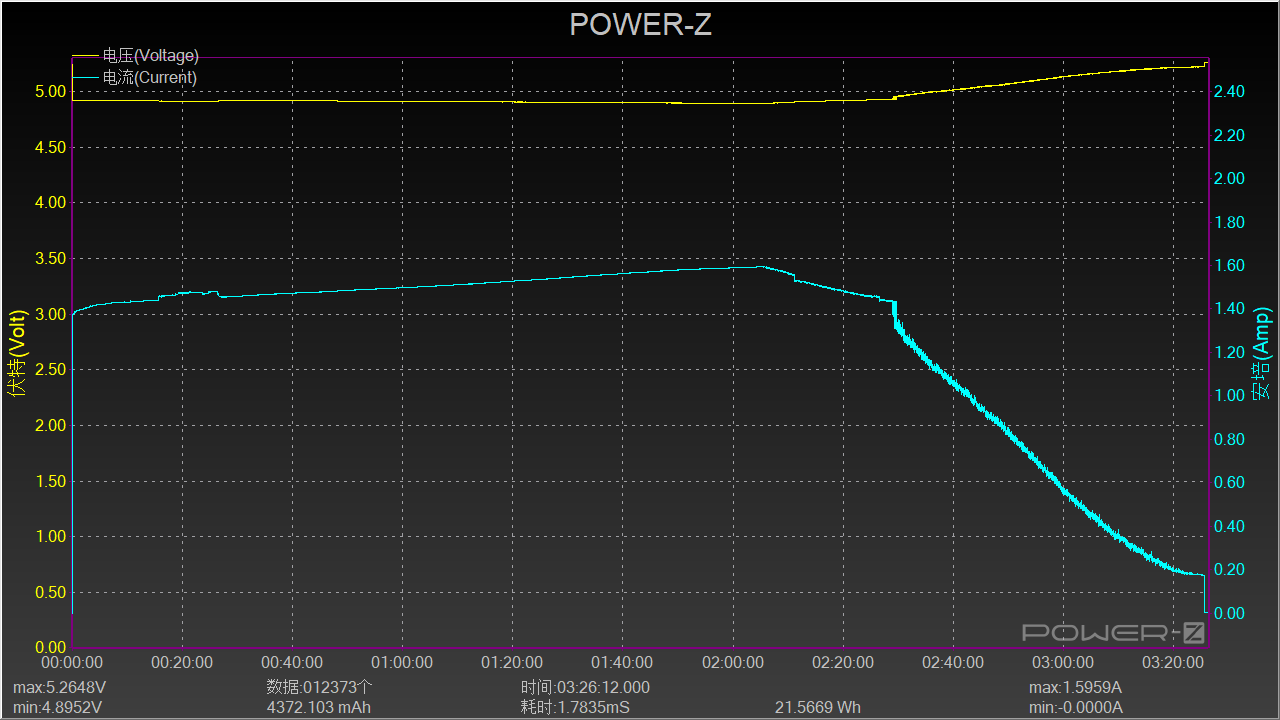
The two models runs on 21700 cells. Logging the built-in USB-C charging gives these traces for the cell provided with each light.

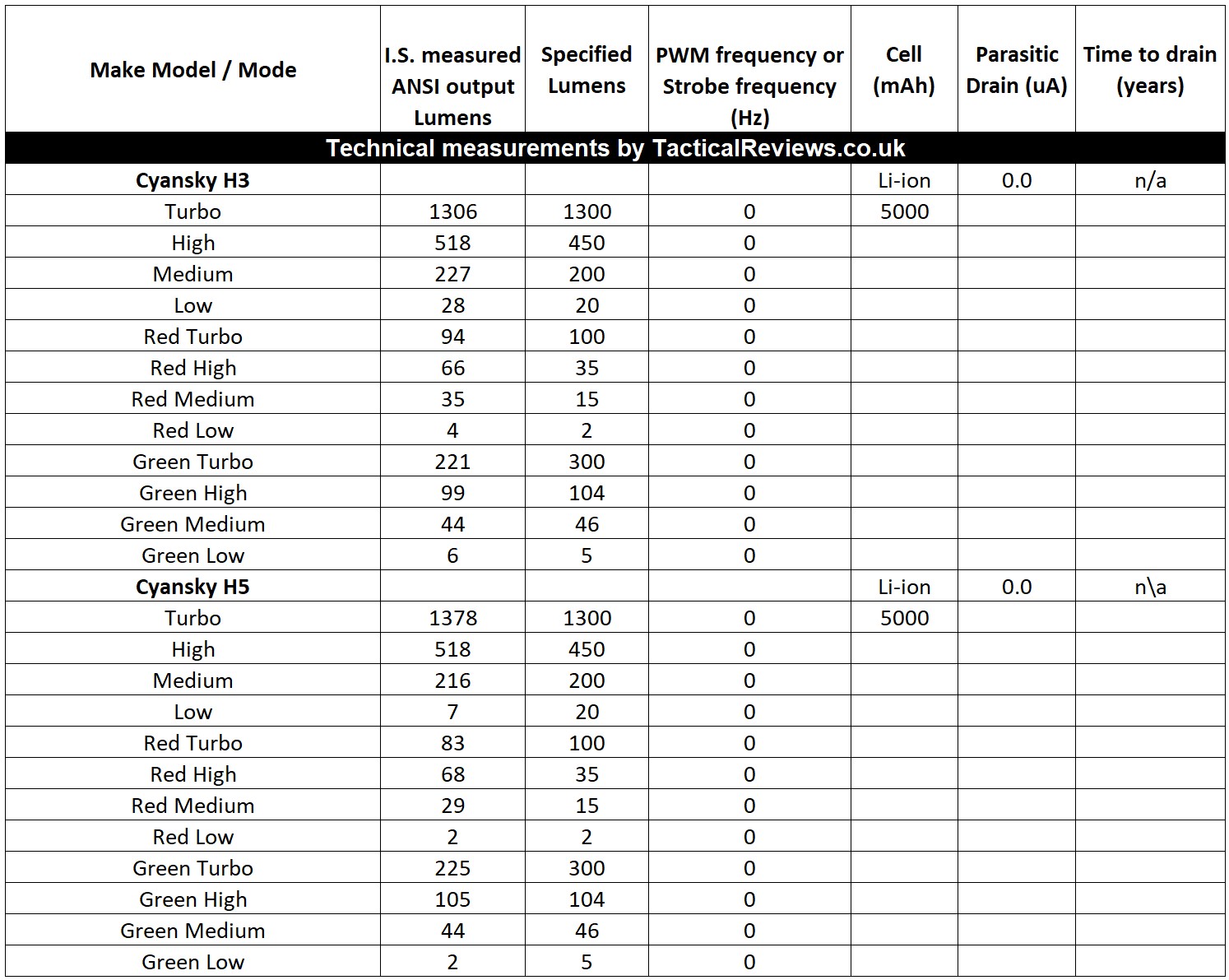
Please note, all quoted lumen figures are from a DIY integrating sphere, and according to ANSI standards. Although every effort is made to give as accurate a result as possible, they should be taken as an estimate only. The results can be used to compare outputs in this review and others I have published.

The Output table also includes the manufacturer specified lumens for comparison.

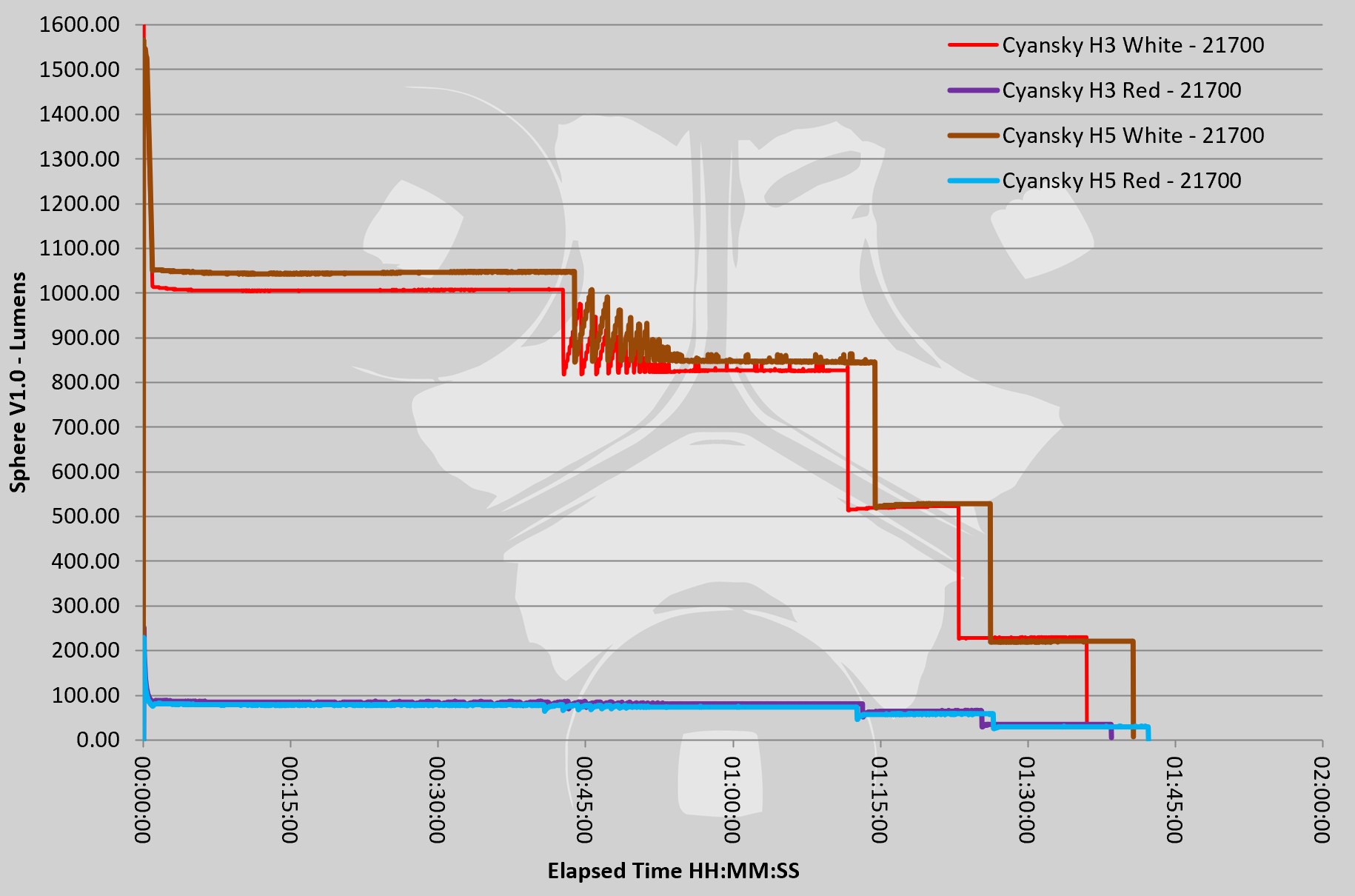
For the runtime trace, only the highest and lowest output colours were used (white and red) and all traces were run on maximum power.


The H3 and H5 in use

The first aspect to mention is how the H3 and H5 themselves compare. Actually this photo doesn’t show it accurately, but from the control ring to tail-cap, the H3 and H5 are identical. Not a surprise as they run on the same cell, have the some output specifications (apart from beam range), and have the same controls. So when holding them, they are the same for grip and controls.

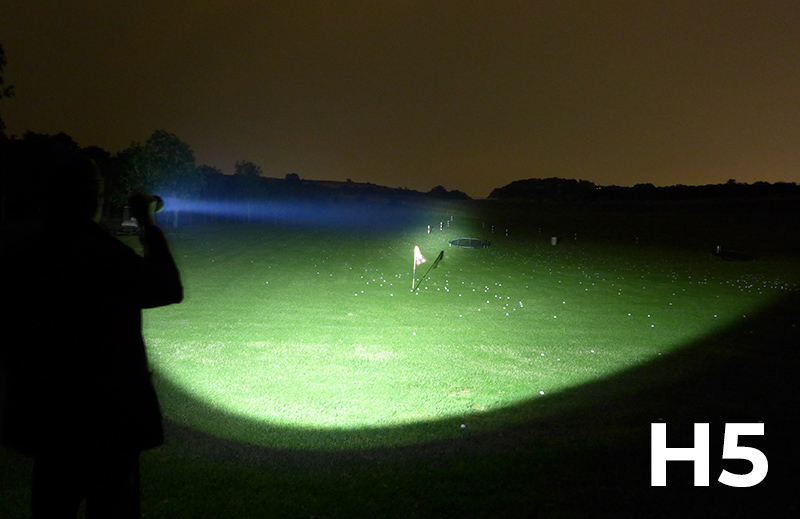
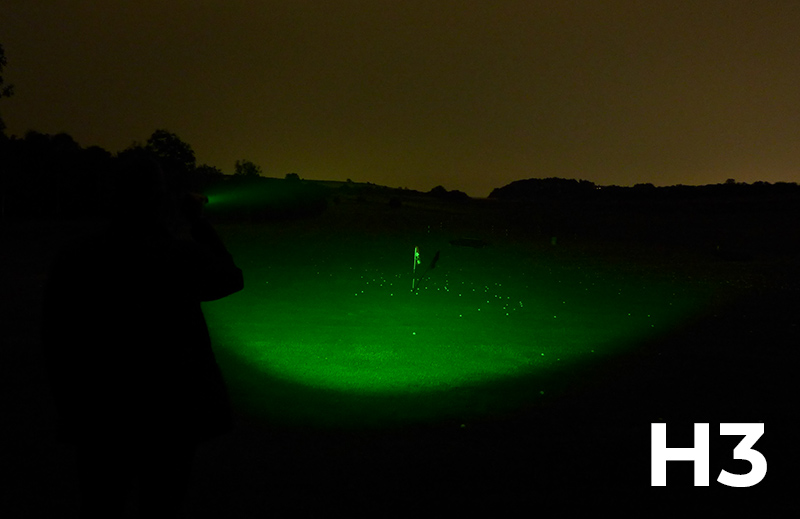
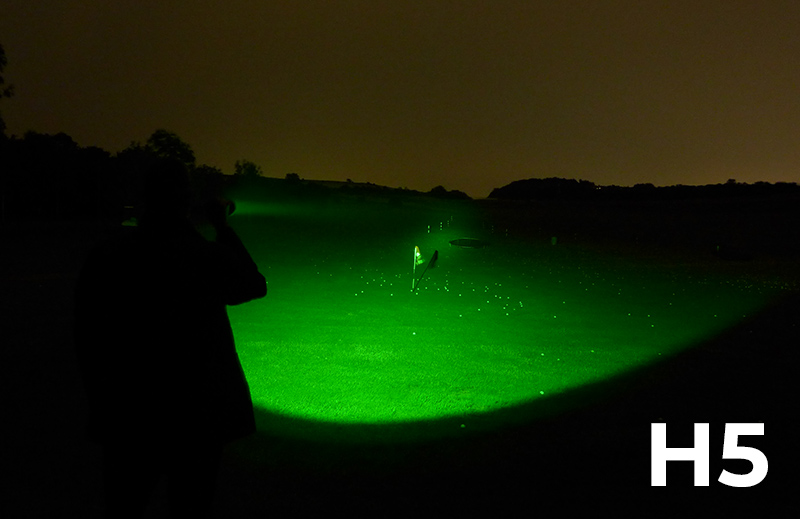
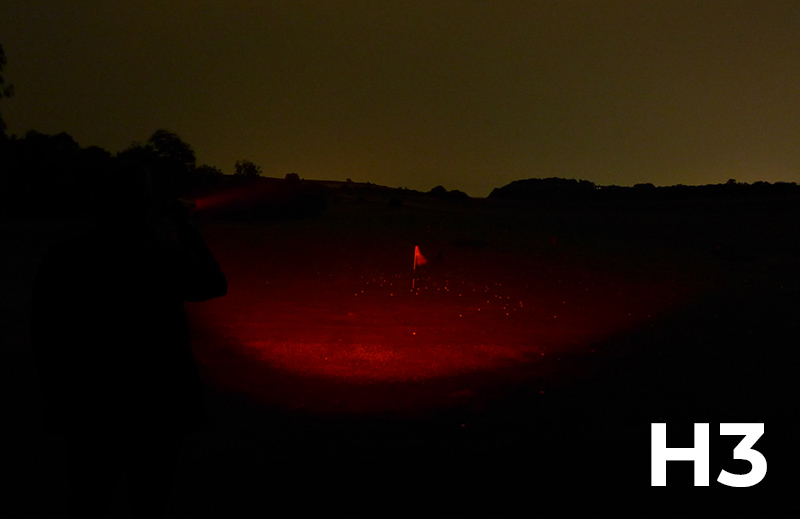
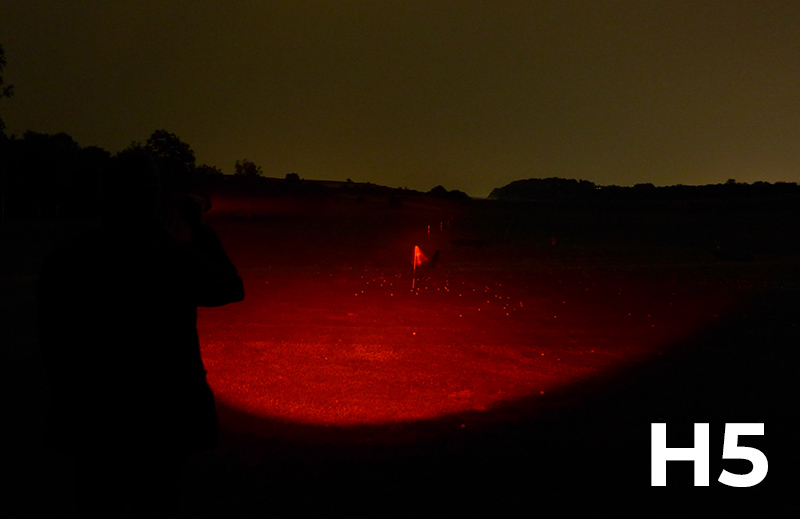
With the larger head, and larger reflector, the H5 does have the edge in overall output, and it focuses the beam more for a longer reach. This gallery shows some longer distant photos on a golf course driving range. The H3 and H5 beams compared directly. The focus of the H5 is clearly visible at these longer ranges.


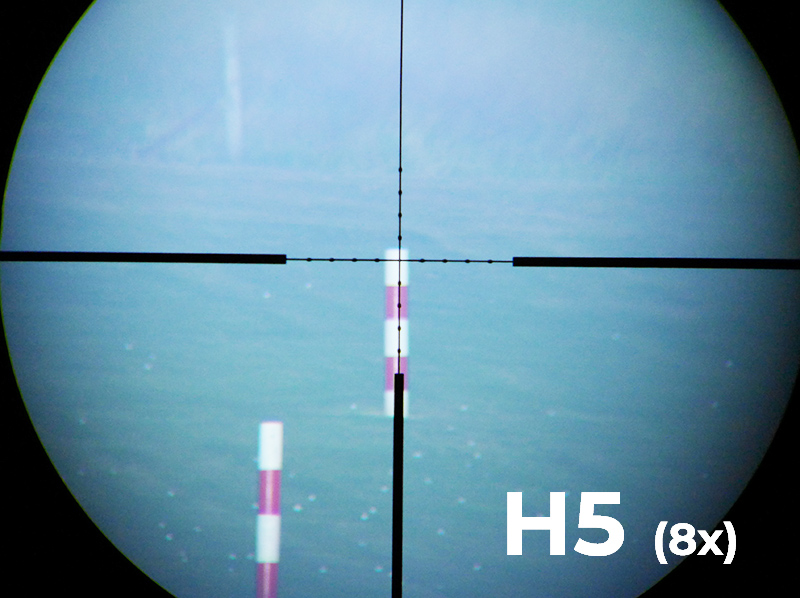
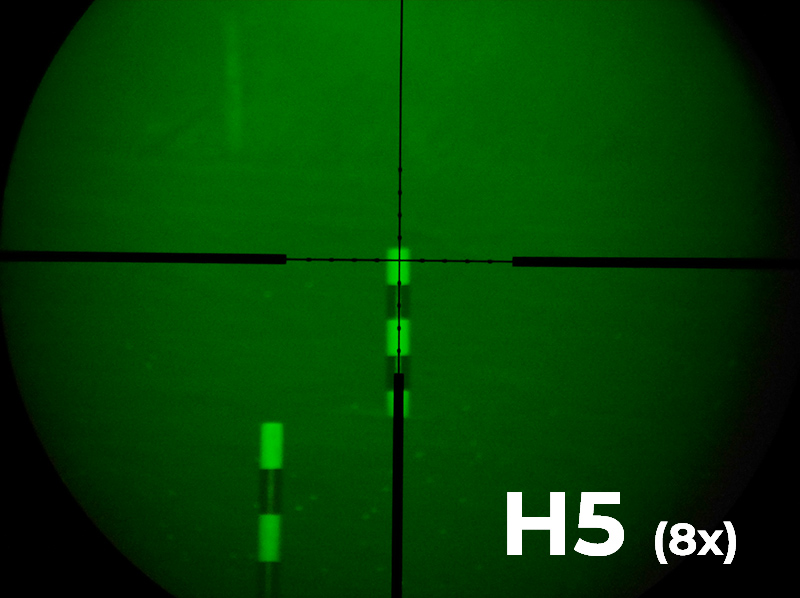
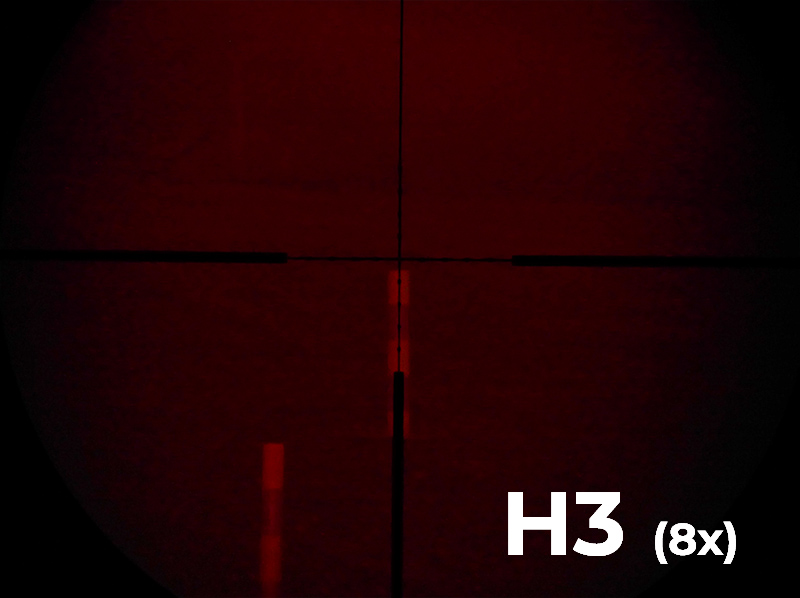
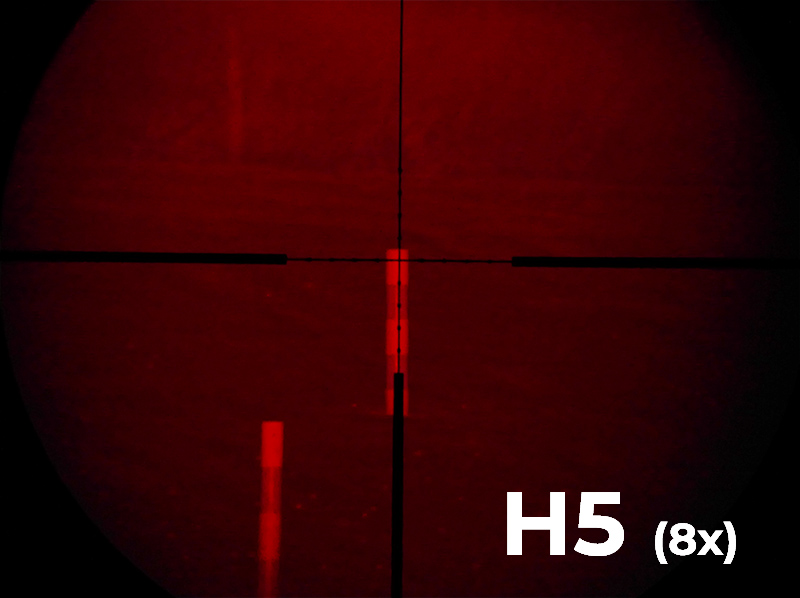
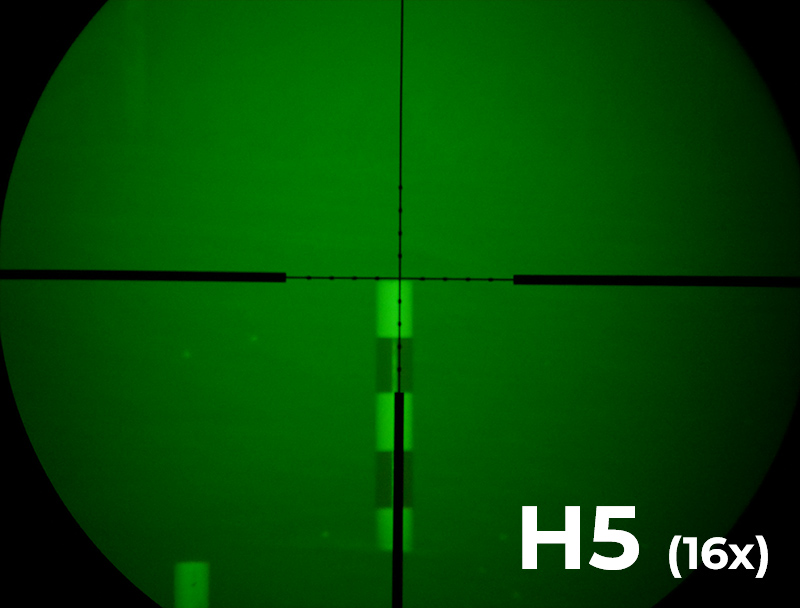
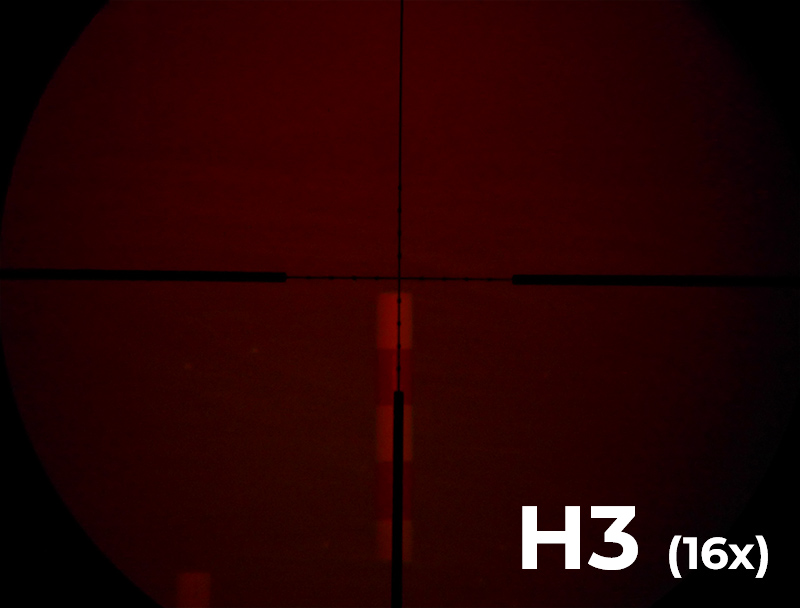
Using a zoom rifle scope this gallery has a set of images at the same exposure to show the gain in distance the H5 has over the H3. The magnification is set to 8x in this first gallery.
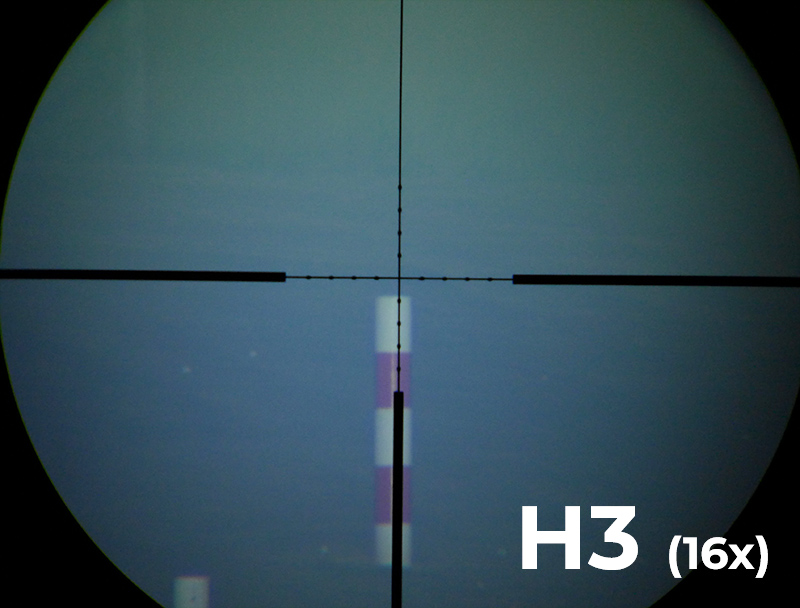
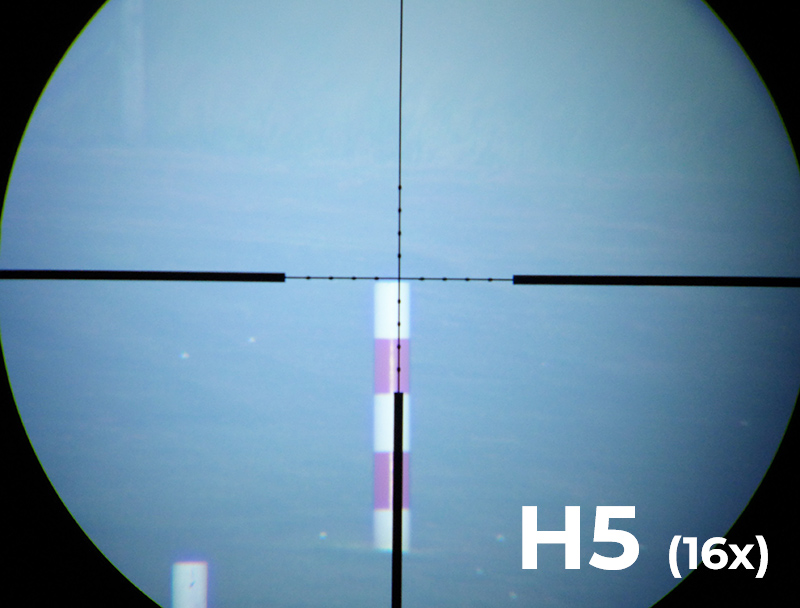
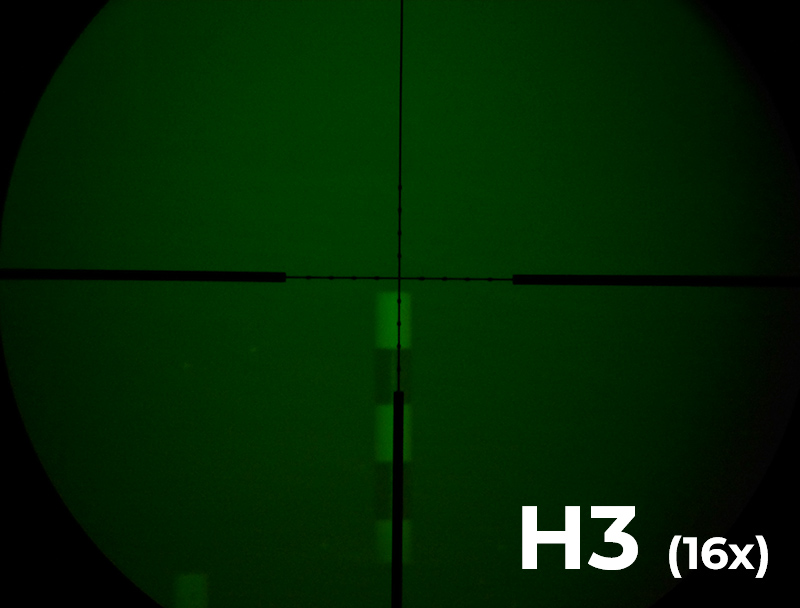
Important to note is that the distance markers the scope is aimed at are 250 yards, and that the H3 is still usable on white output, but struggles a bit at this range on the coloured output.
Also bear in mind that I am using a .22lr on this course, so 250 yards it beyond the limit I would take a shot.


Now taking the scope to 16x magnification. Although all the images here are the same exposure, I have had to use a longer exposure than for the 8x magnification. At this range and magnification the H3 was pushed too far. the H5 was still working well.
This was to test the limits for range and scope magnification. (At 32x magnification I could not get any photos to come out.)

All of the above proves the H3 and H5 work well on or off a rifle, and the coloured output filters, being built-in, are so convenient, allowing for changes of output colour with nothing but a turn of the control ring.
Although I normally use dedicated coloured lights (so the LED is red or green) due to being most efficient and having the best quality of beam, it means I need to carry entire replacement lights to change colour. There are also LED swapping lights on the market but these compromise the thermal path as the heat sink has to move. With the H3 and H5, the single LED has an optimal thermal path for heat sinking.
Using filters on any light does reduce efficiency as you are ‘wasting’ up to 93% of the actual output (in the case of the red 1306lm down to 94lm). This is the cost of the convenience of instant access to red green or white light.

As long as you have a suitable rail to mount the remote switch on, this switch works really well. By including both a dedicated momentary switch, and a latching forward-clicky switch that gives you momentary and permanent on options, you have all you might want. If you don’t have a rail in the right place, this switch won’t really work for you, so consider this before choosing.

If you normally use a dedicated coloured light, then do you switch to the H3 and H5? – if you ever have a need to change between red, white, and green, then the all-in-one solution these Cyansky lights give you allows you to stop carrying additional separate lights.
If you use, or would consider using colour filters, then the H3 and H5 are no-brainers. Why would you want external filters you can lose, that are often a plastic filter material, when you can have self-contained selectable glass filters?

Review Summary
The views expressed in this summary table are from the point of view of the reviewer’s personal use. I am not a member of the armed forces and cannot comment on its use beyond that covered in the review.

Something that might be a ‘pro’ for one user can be a ‘con’ for another, so the comments are categorised based on my requirements. You should consider all points and if they could be beneficial to you.

_______________________________________________
What doesn’t work so well for me
_______________________________________________

Using filters is not efficient compared to dedicated coloured lights.
The mode button can look a little twisted as it has a little too much room to move.
Basic belt hanger provided.

_______________________________________________
Things I like
_______________________________________________

Glass filters are used.
Simple turn of the control ring to change filter colour.
21700 power (plus can use 18650 or CR123 if needed).
Supplied 21700 is USB-C chargeable.
Good choice of beam pattern between the H3 and longer reaching H5.

You can find the Official Cyansky Store Here, if you would like to get hold of these lights. (I have no affiliation and get no reward for you buying from this link).