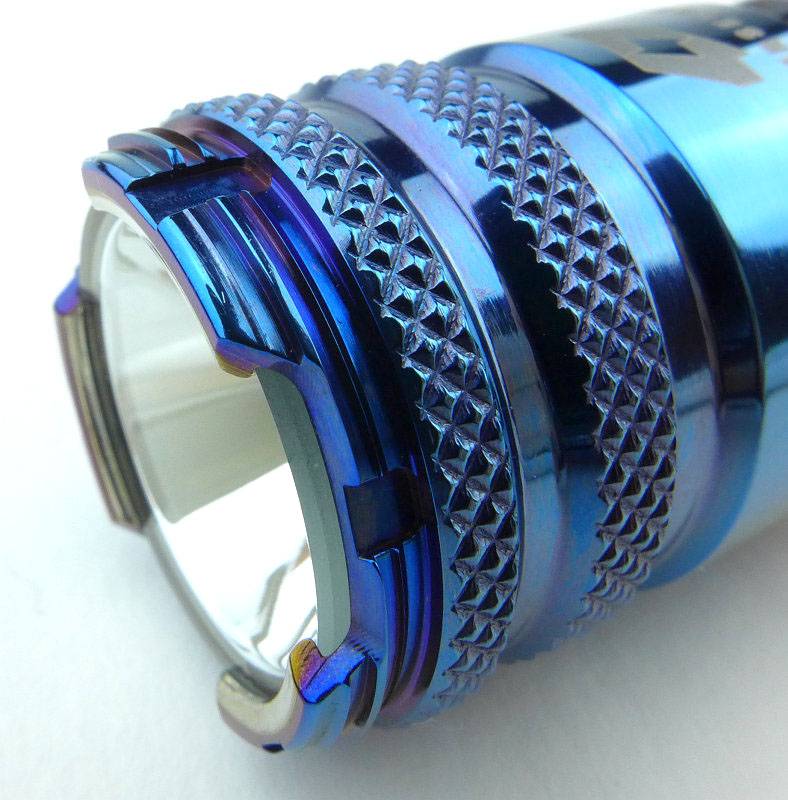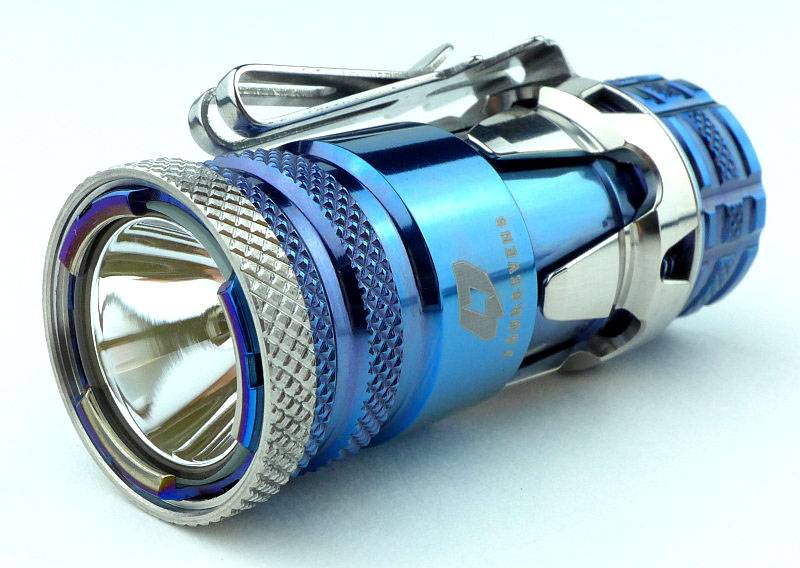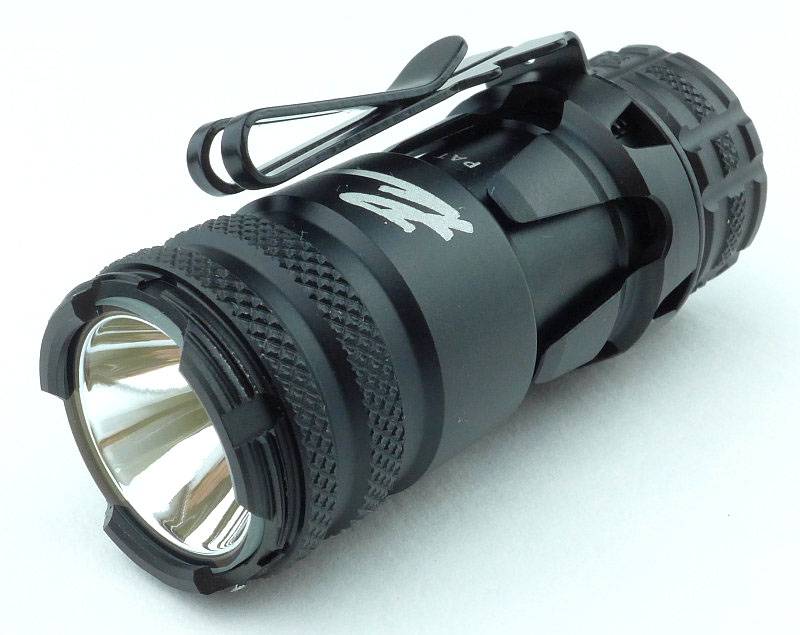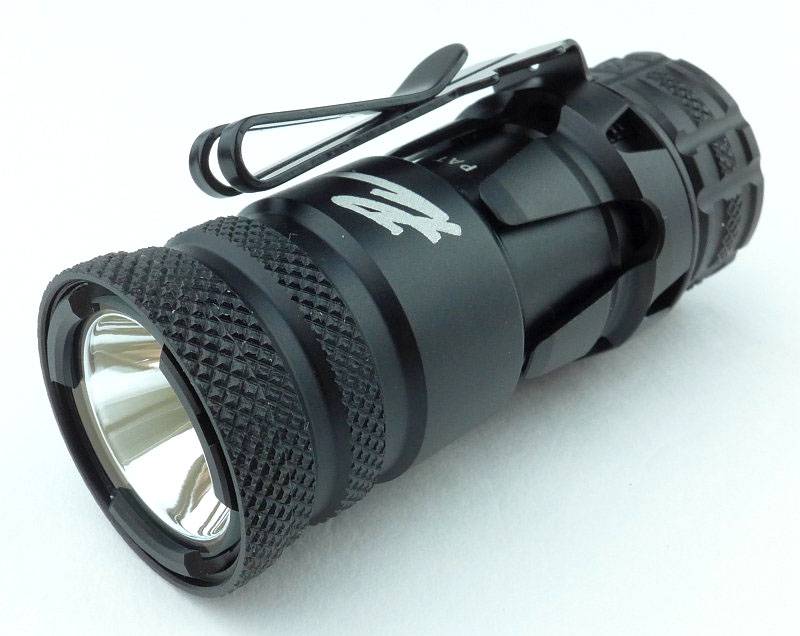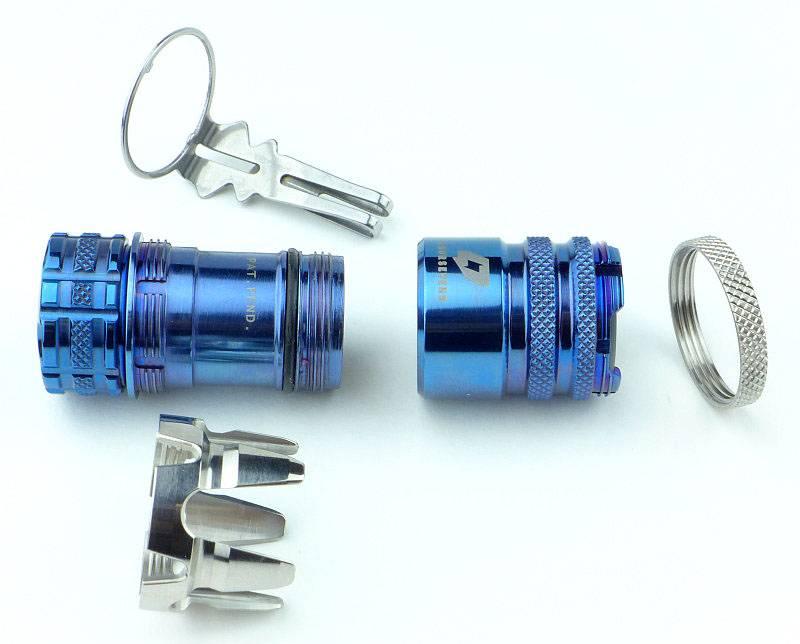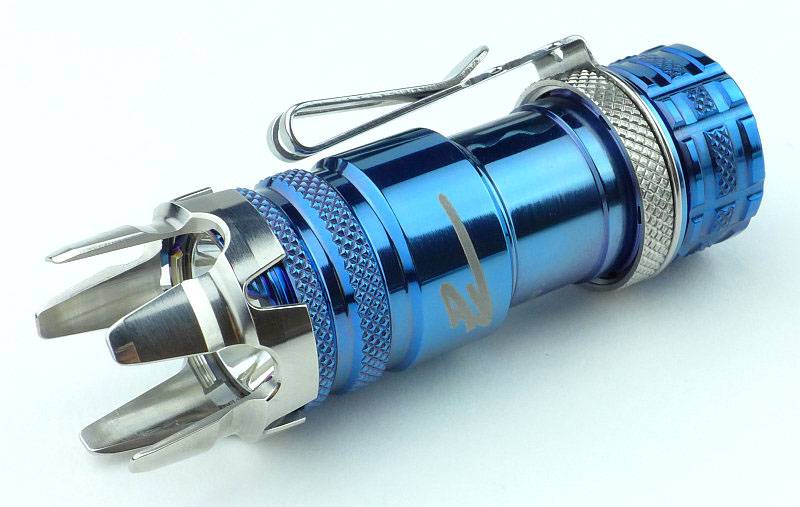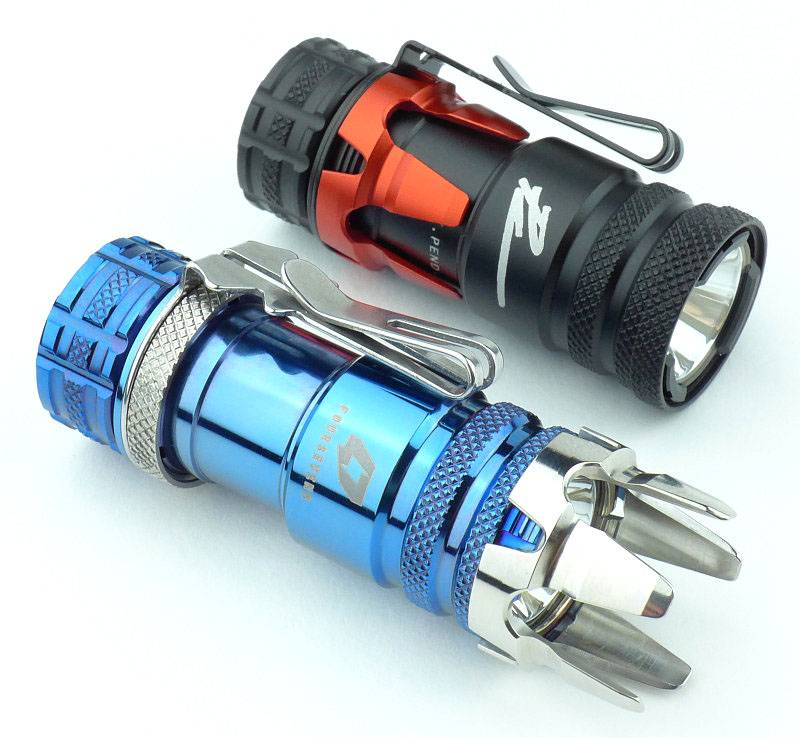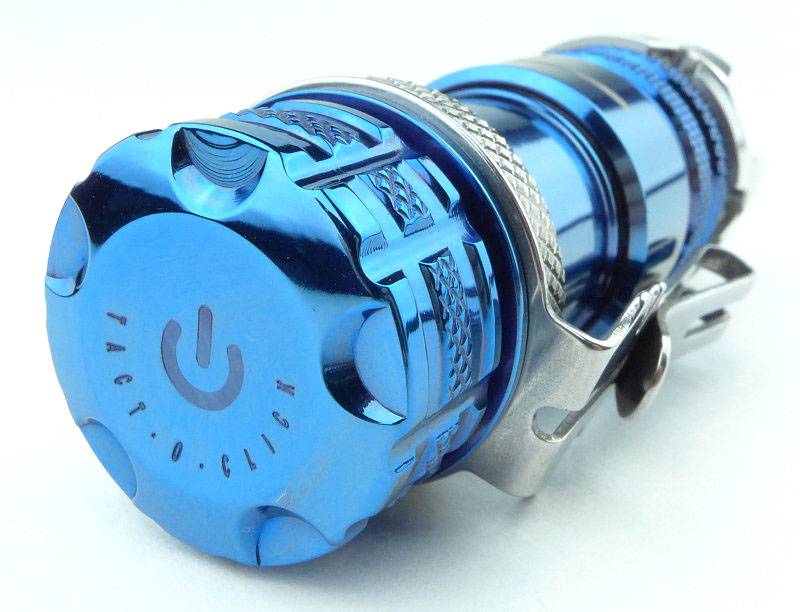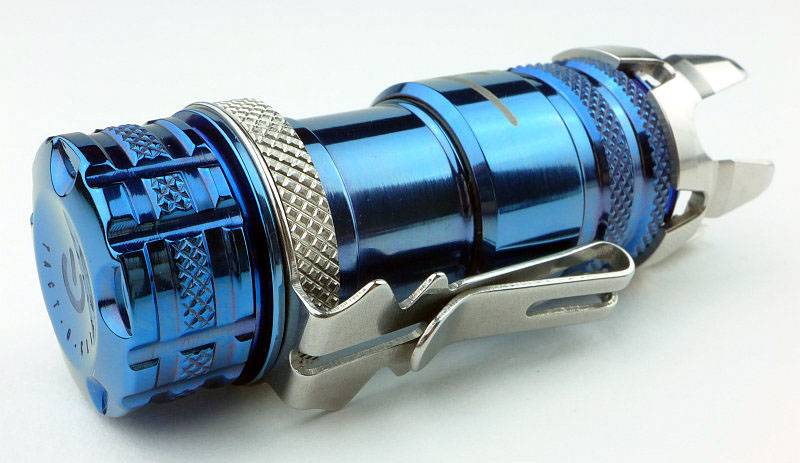
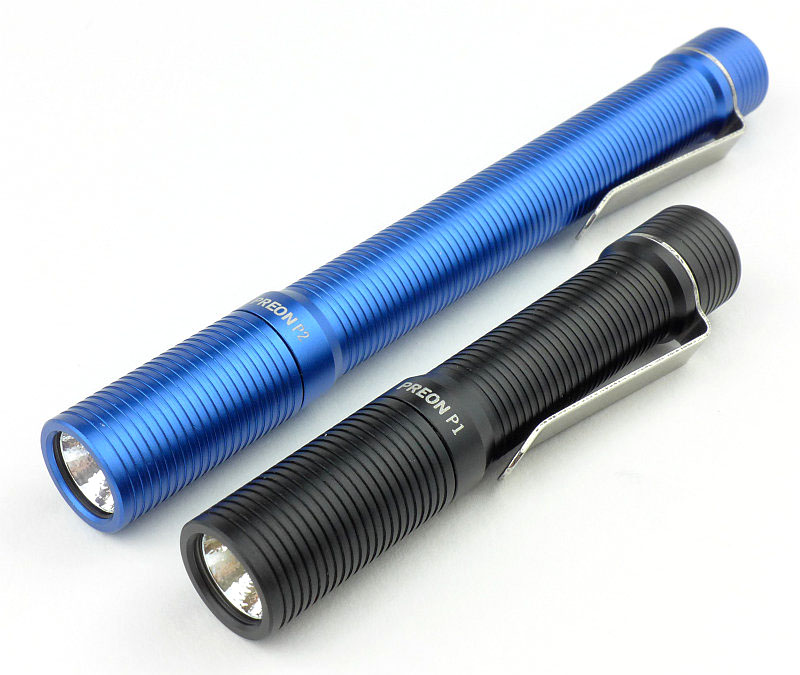
Light Review: FOURSEVENS Preon P1 and P2

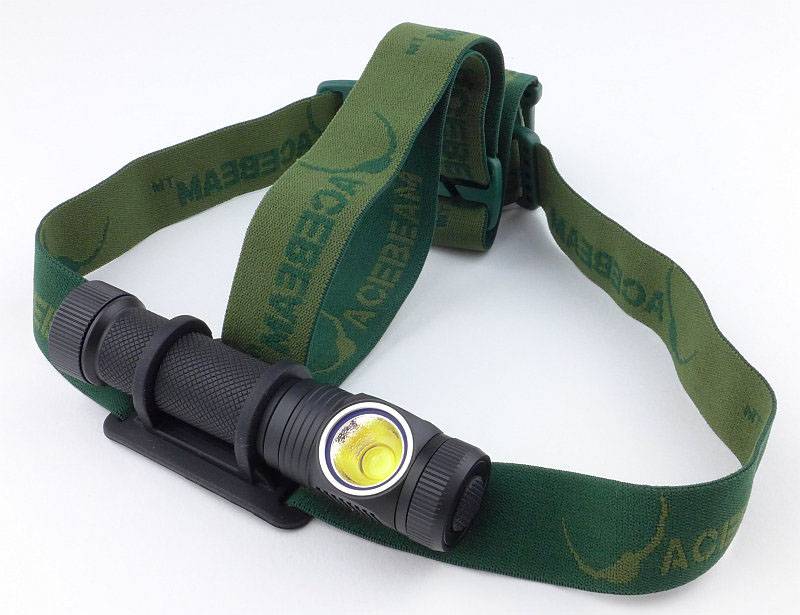
FOURSEVENS’ Preons have been very popular and well regarded AAA powered EDC lights. Being time for a reboot, here are the current updated versions of the Preon P1 and P2.

(And yes, they do have a high efficiency XP-L LED.)
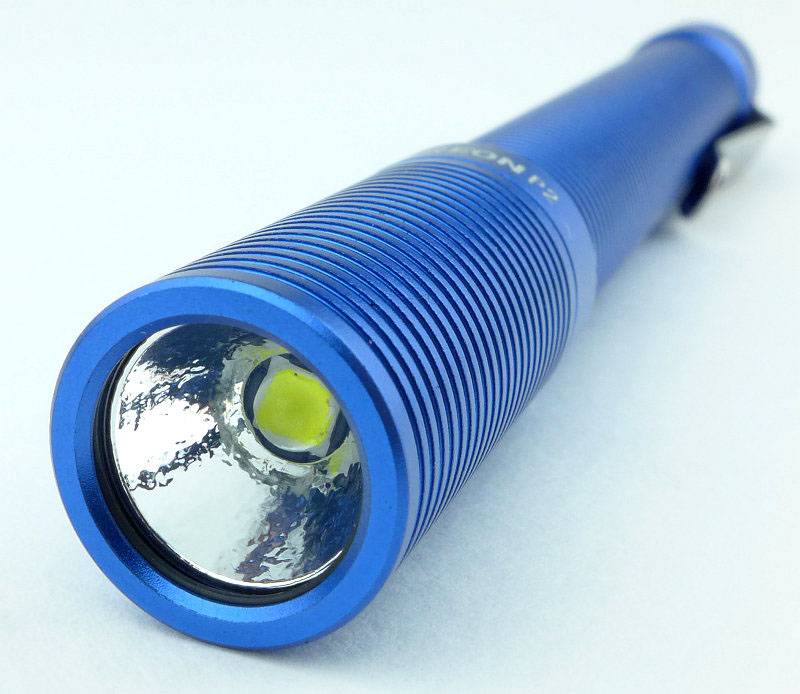
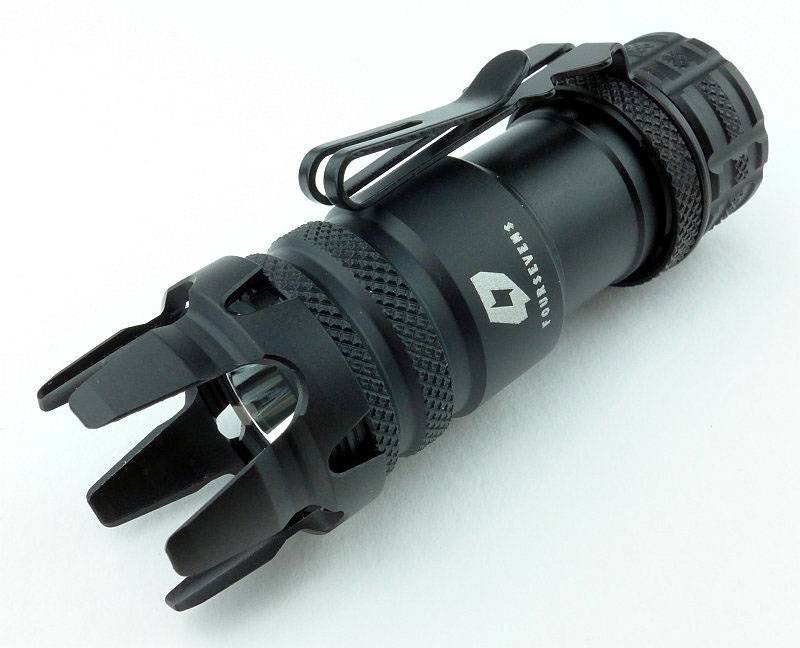
 photo 09 Preon P2 angle LED P1160829.jpg

Taking a more detailed look:

Presentation is great with FOURSEVENS’ standard clear plastic box packaging.
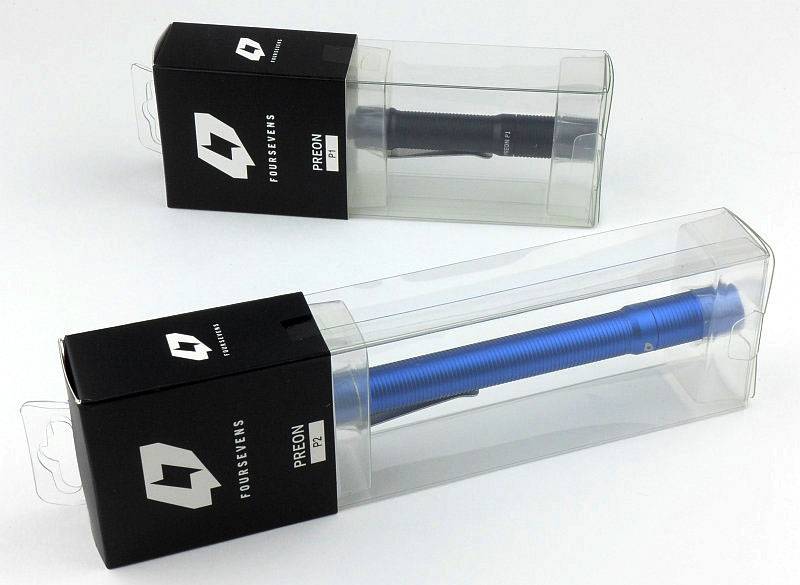
 photo 01 Preon P1P2 boxed P1160796.jpg

Each Preon comes with one set of AAA Alkaline cells, two spare O-rings and the instructions.
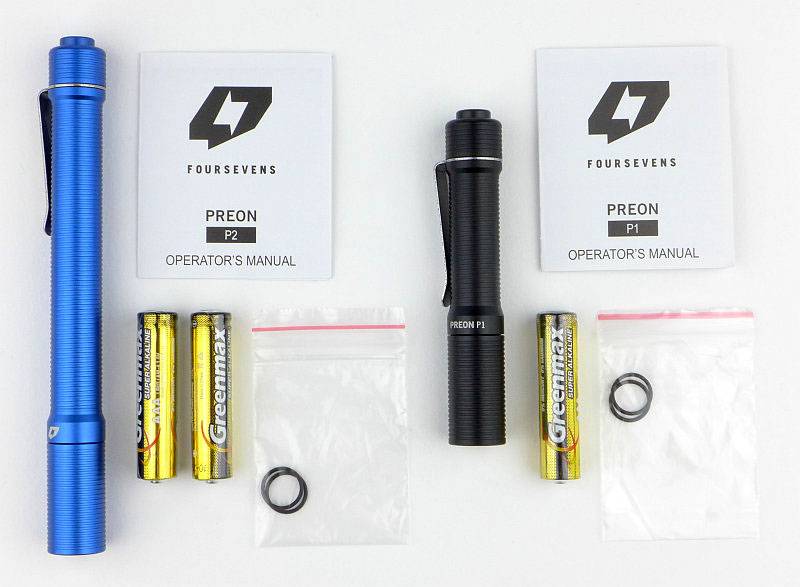
 photo 02 Preon P1P2 unboxed P1160798.jpg

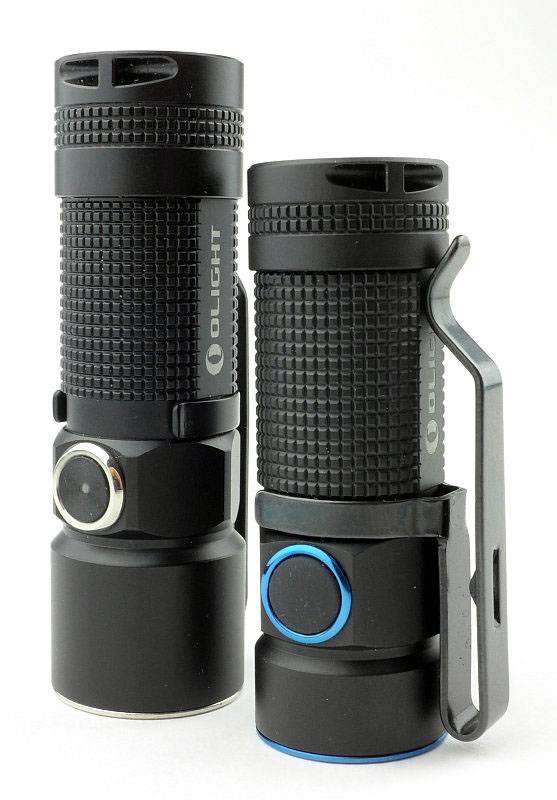
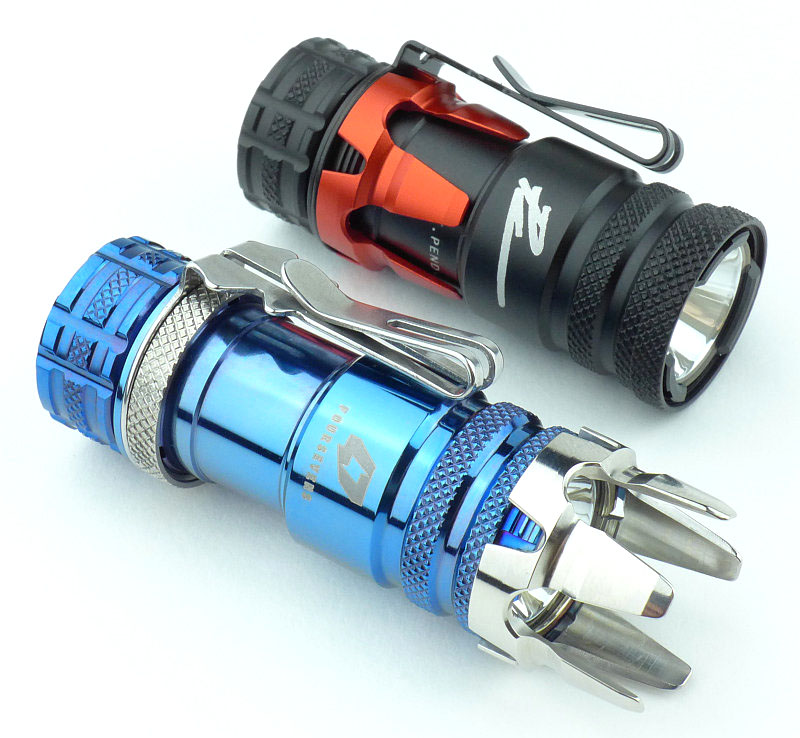
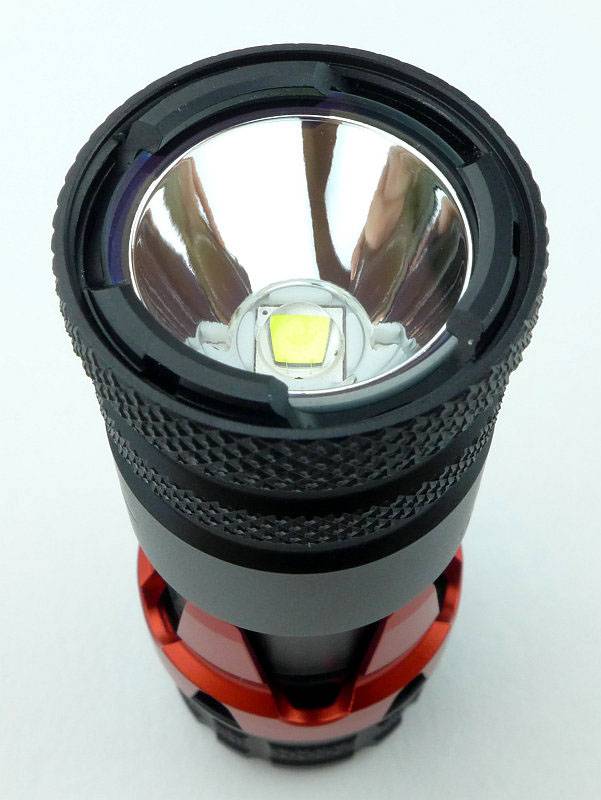
A quick look at the previous generation Preon P2 (in toxic green) with the latest generation Preon P1 and P2.
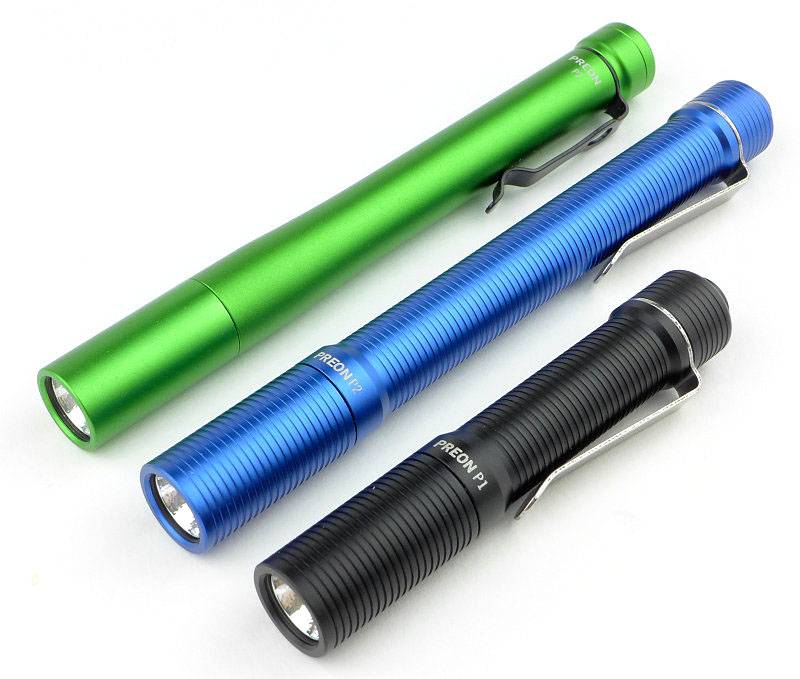
 photo 04 Preon P1P2 trio angle P1160808.jpg

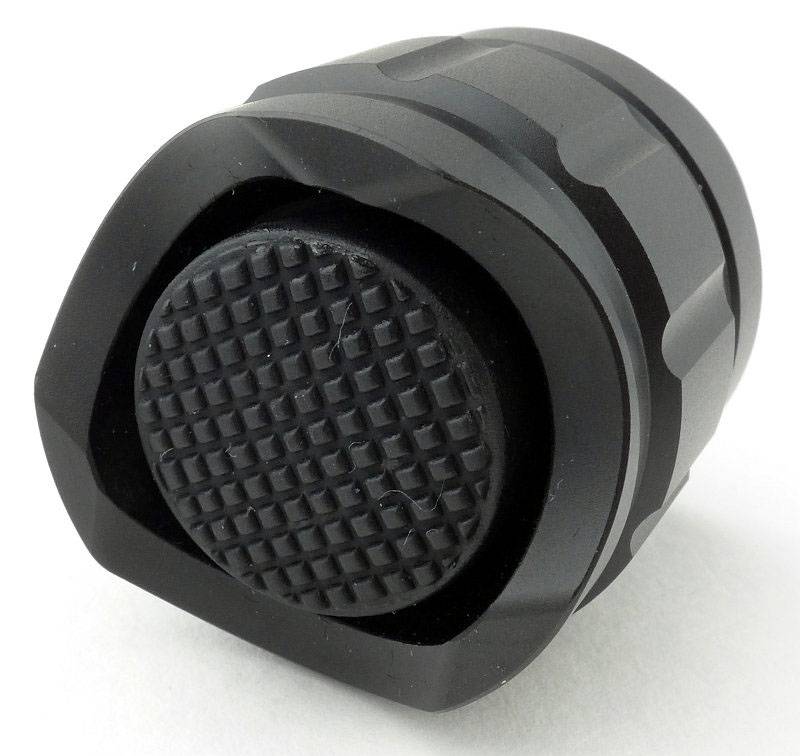
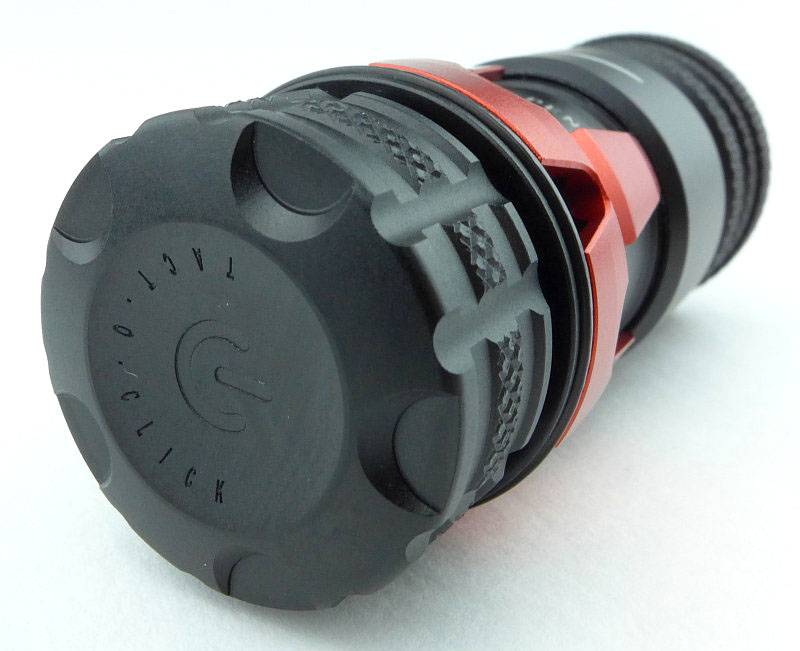
A feature of the Preons is the metal switch button. Prior to anodising, this has been engraved with the FOURSEVENS logo.
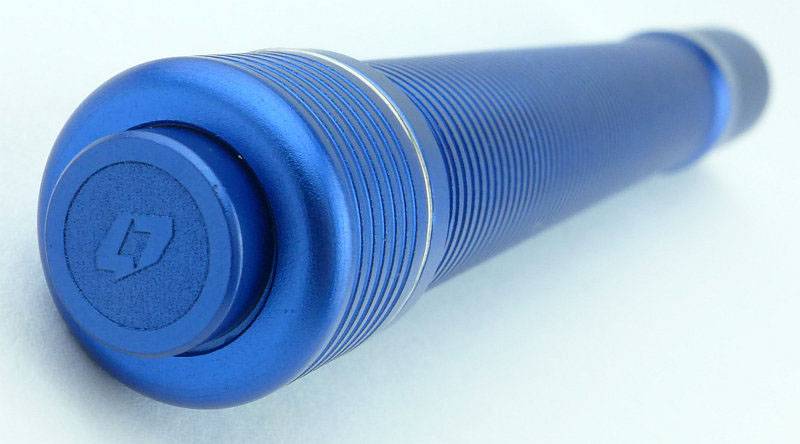
 photo 05 Preon P2 switch engraving P1160815.jpg

The stainless steel pocket clip is a well finished and has a well-suited tension (not too stiff) to the size and weight.
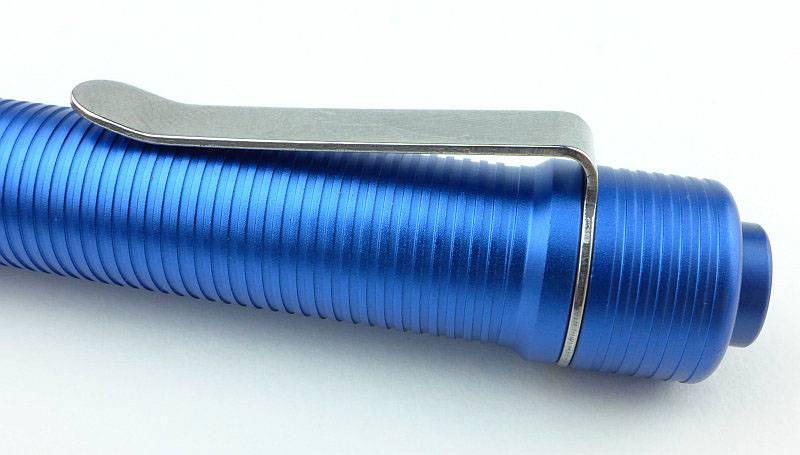
 photo 06 Preon P2 clip P1160819.jpg

Just above the head of the light the FOURSEVENS logo is laser engraved through the anodising.
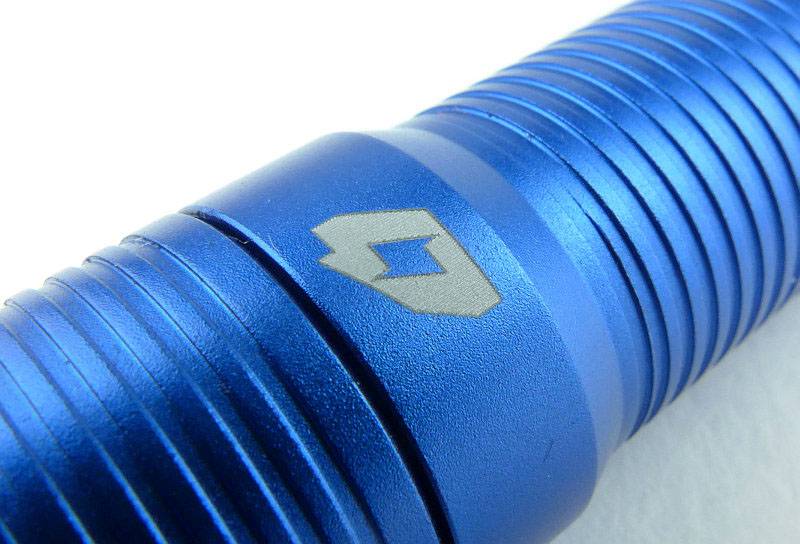
 photo 07 Preon P2 engraving P1160821.jpg

On the opposite side the model is engraved.
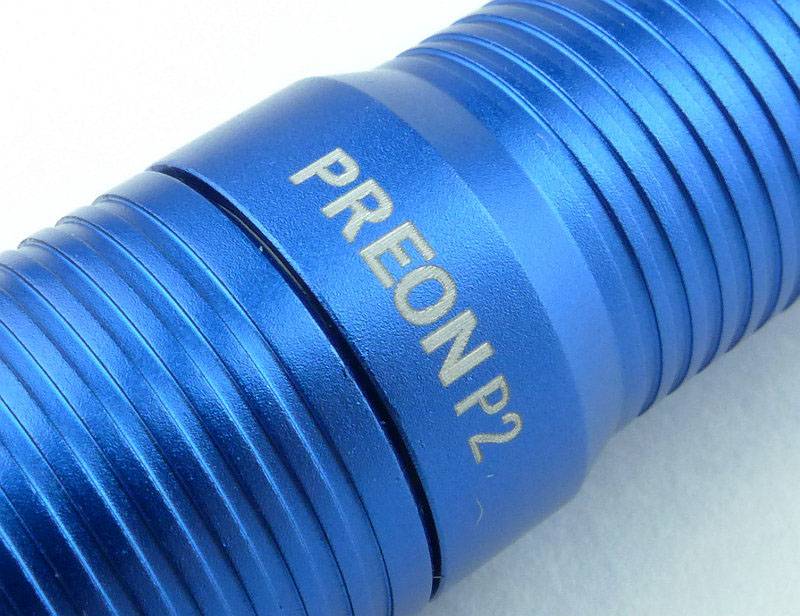
 photo 08 Preon P2 engraving2 P1160825.jpg

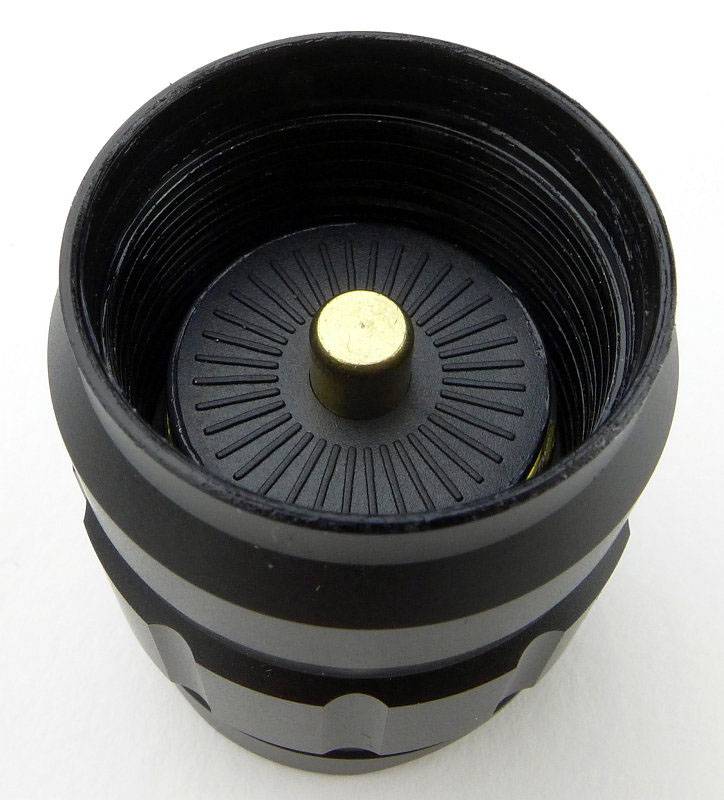
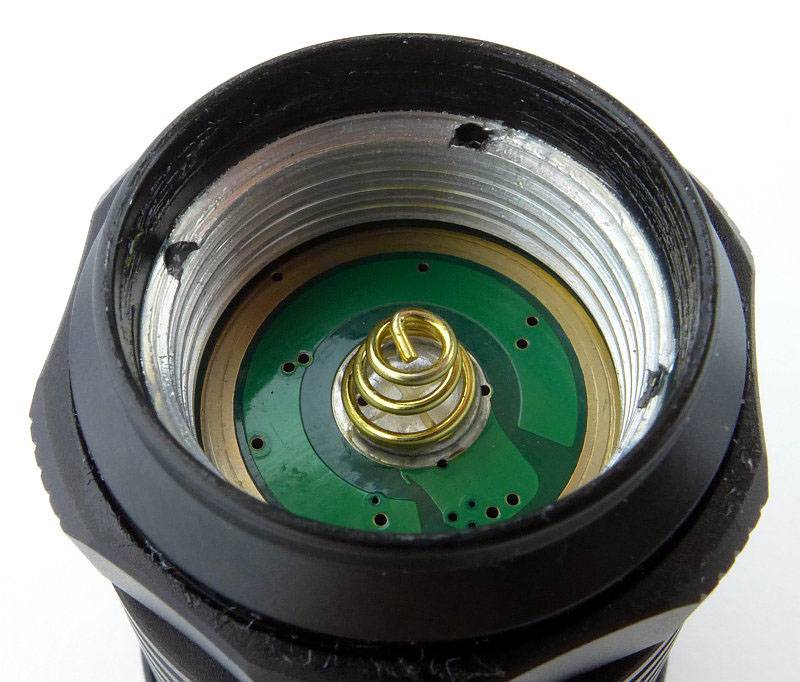
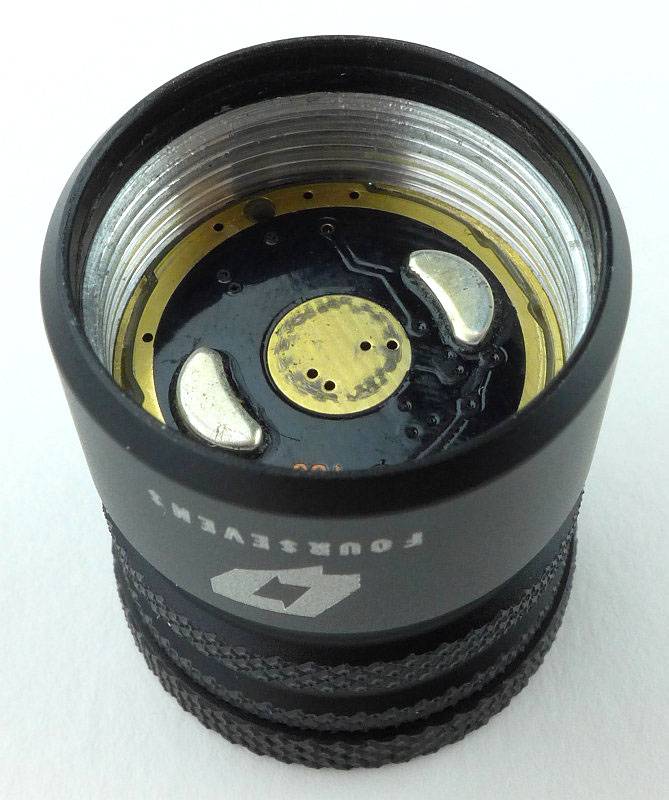
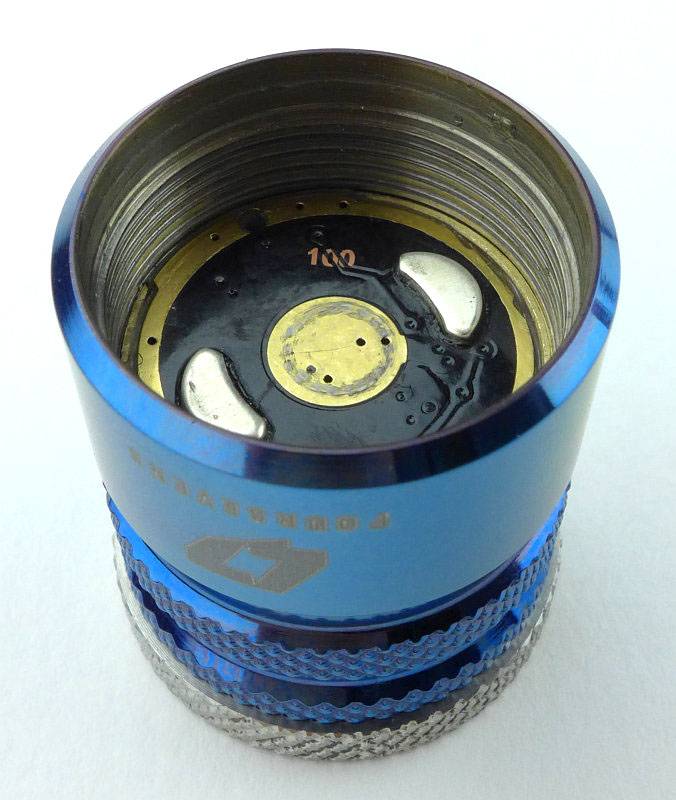
A view of the contacts inside the head. (This is the same for the P1 so the P1 is not being shown.)
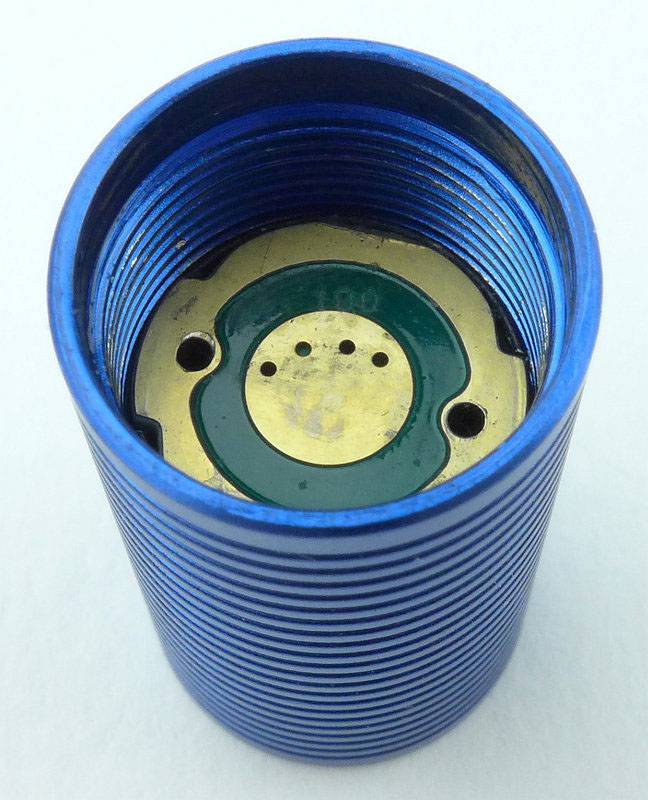
 photo 10 Preon P2 head contact P1160831.jpg

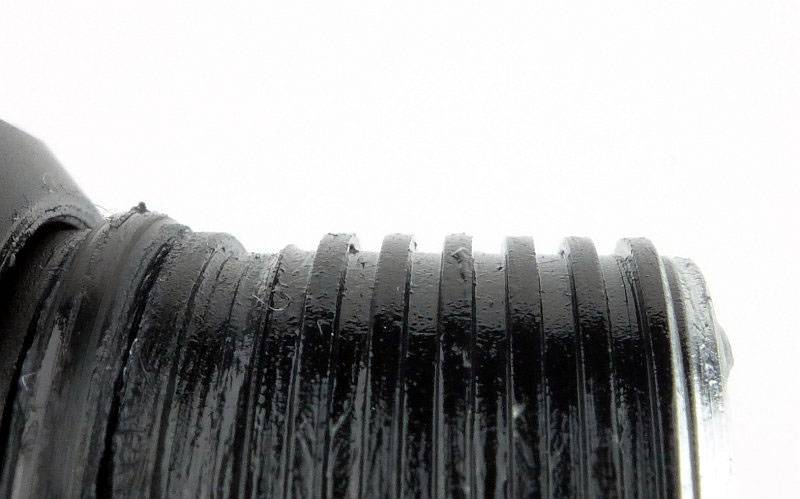
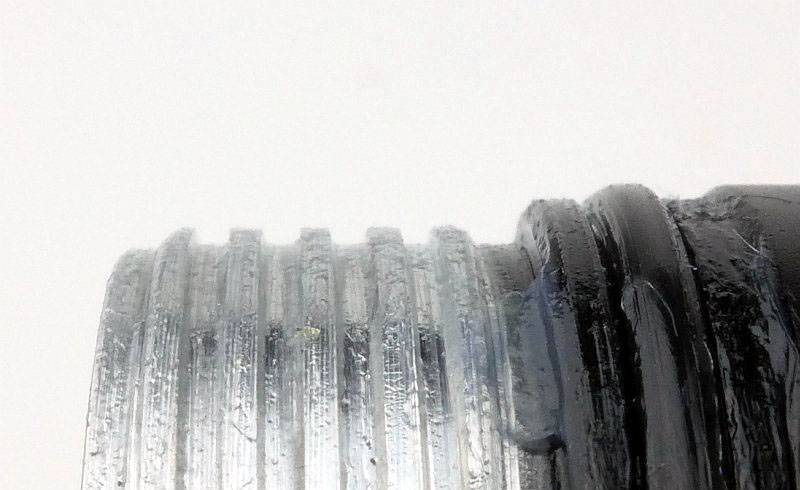
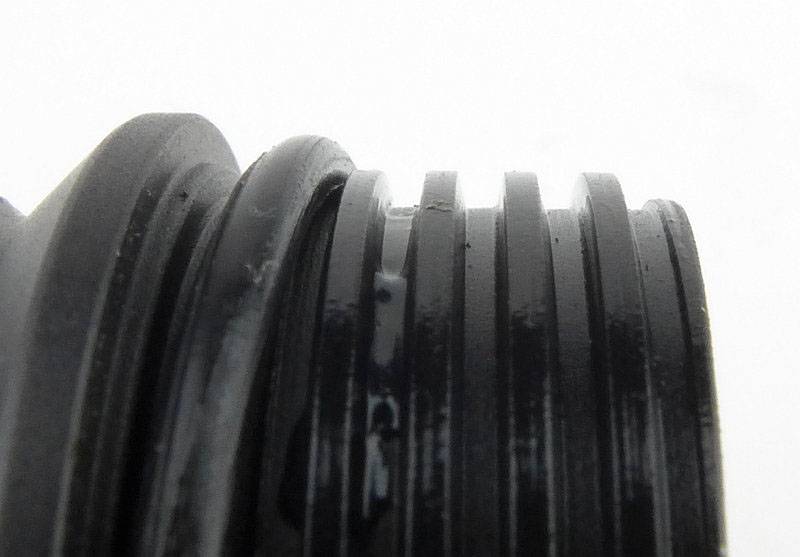
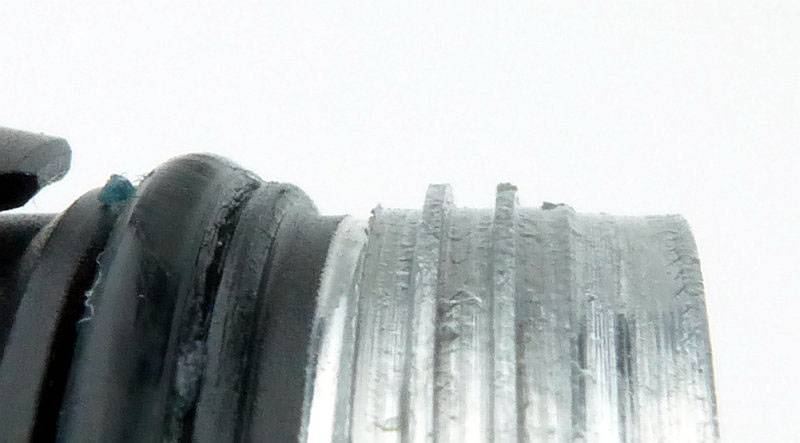
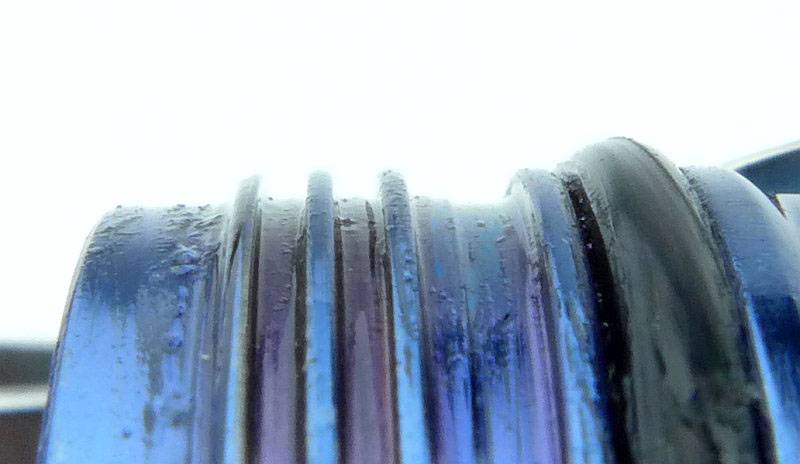
The threads are a standard form, and are well lubricated. (This is the same for the P1 so the P1 is not being shown.)
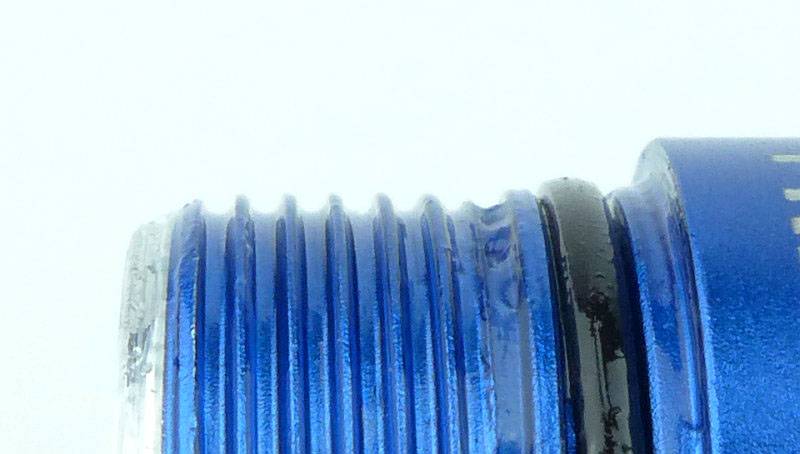
 photo 11 Preon P2 threads P1160834.jpg

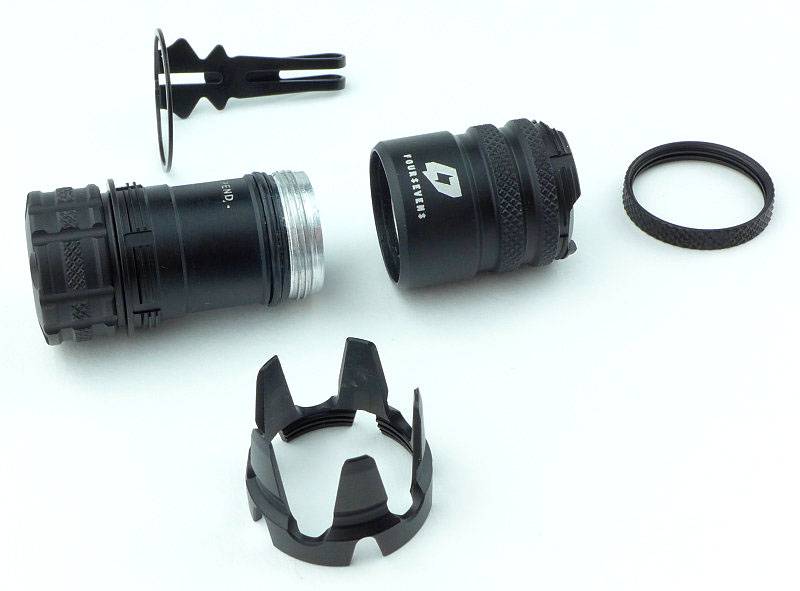
You can unscrew the switch cap and take the clip off, but this does not give access to the battery chamber.
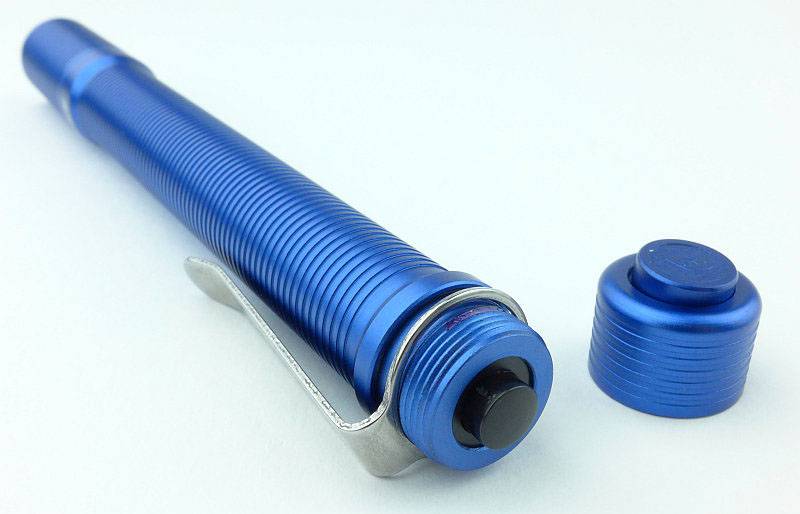
 photo 12 Preon P2 switch cap off P1160837.jpg

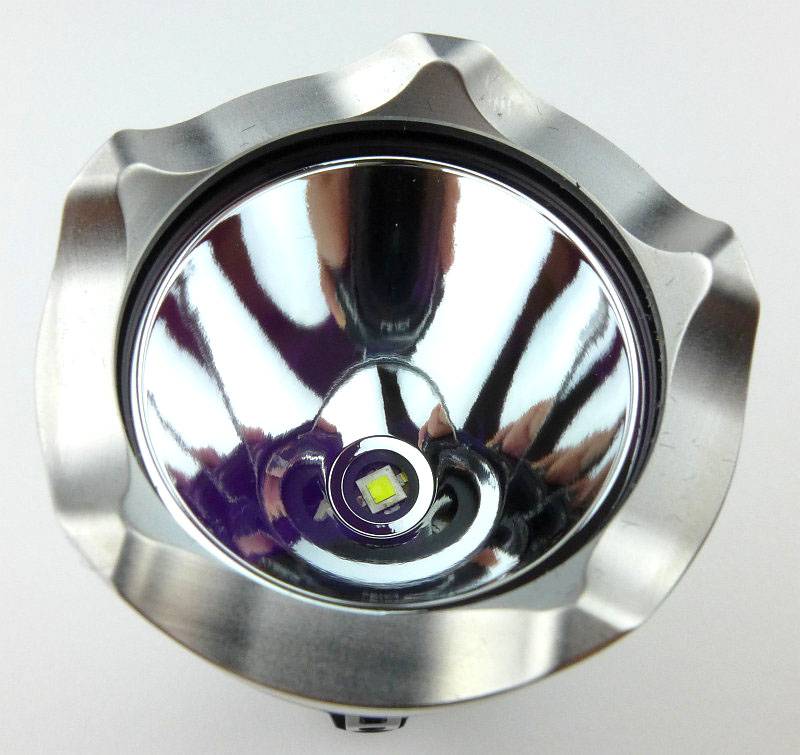
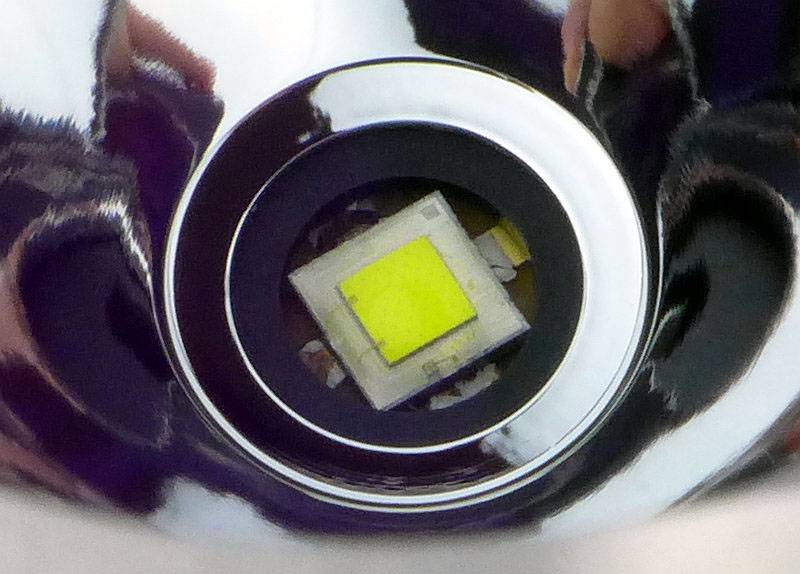
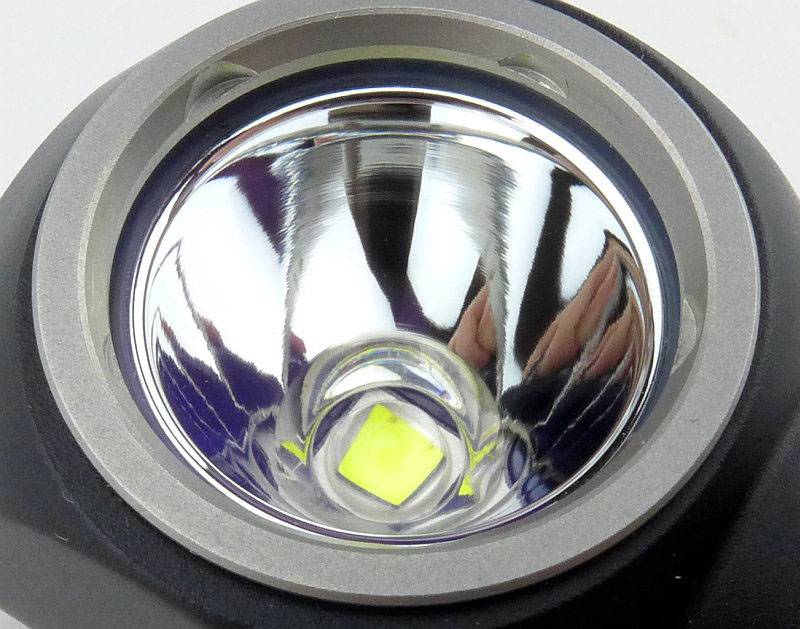
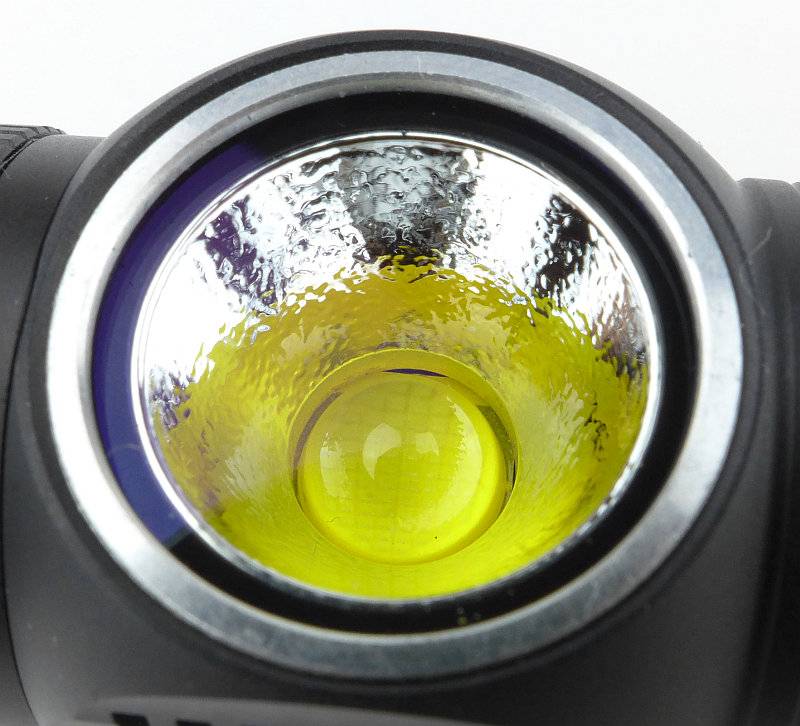
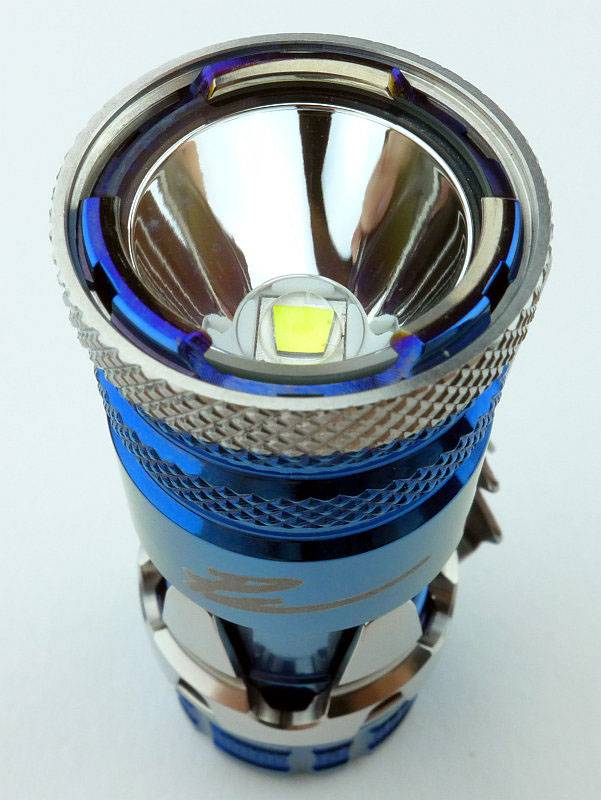
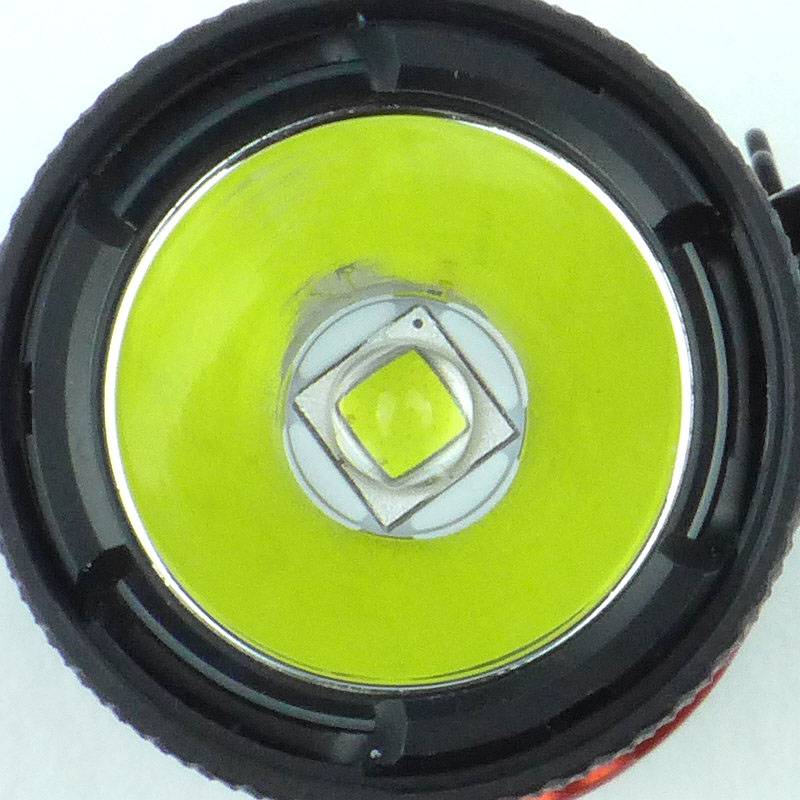
An XP-L LED sits in a small textured reflector.
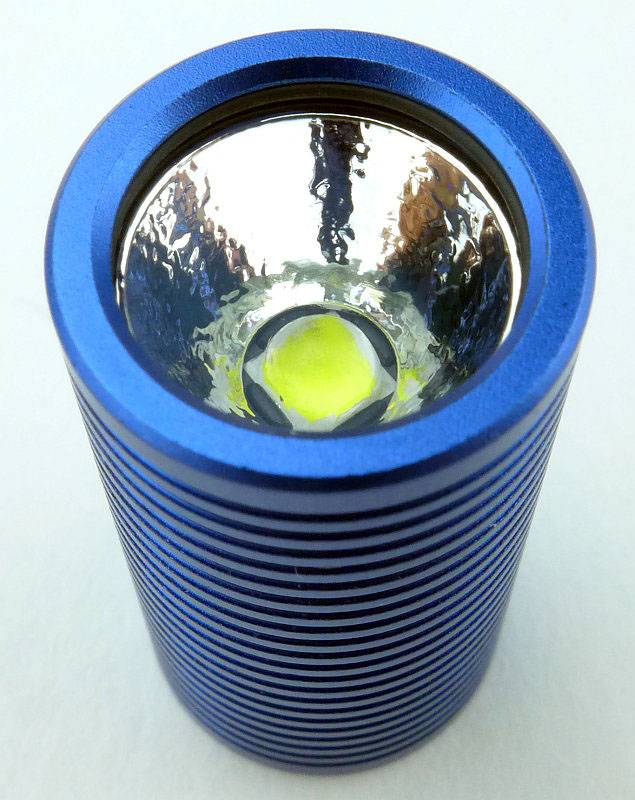
 photo 13 Preon P2 reflector P1160839.jpg

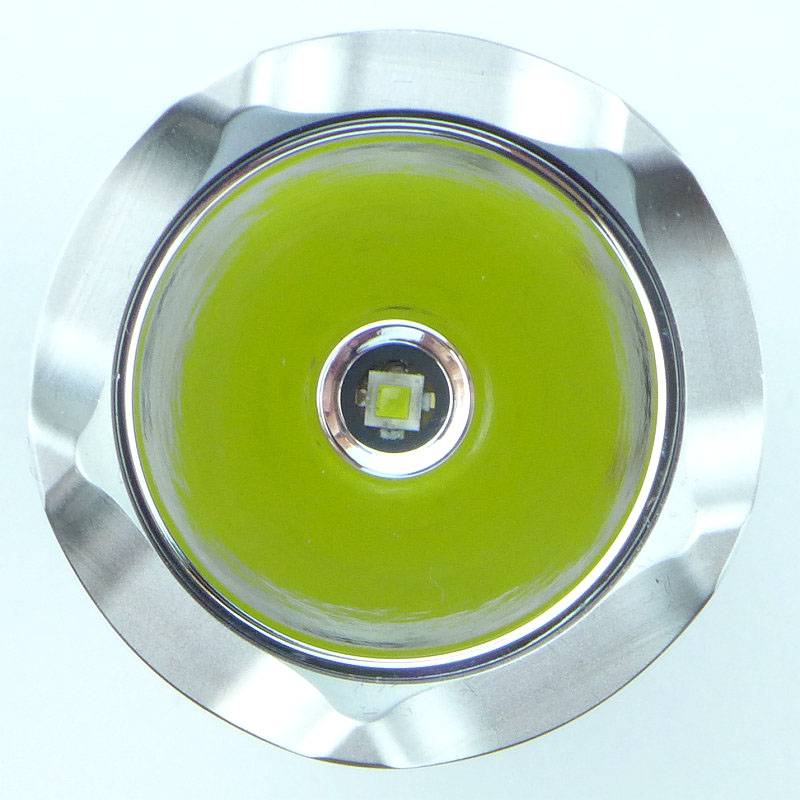
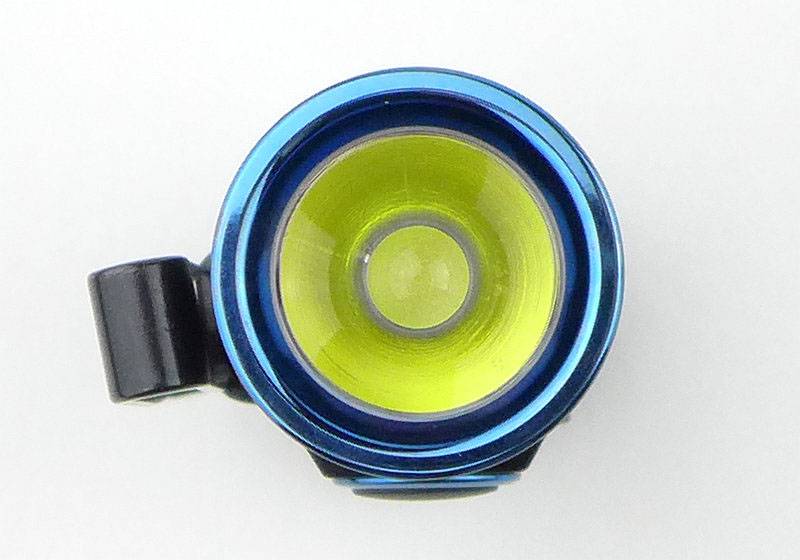
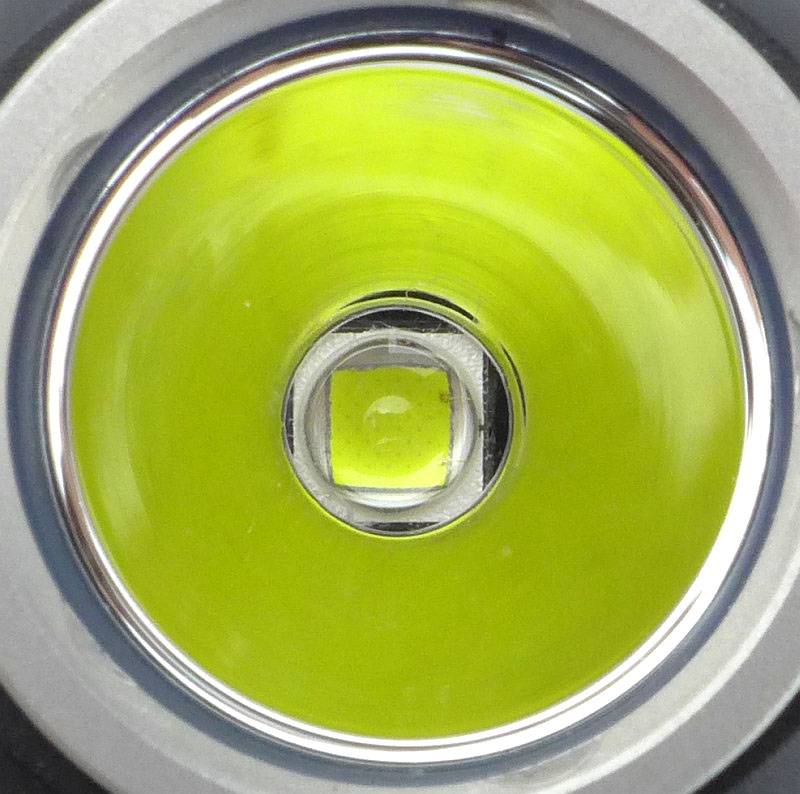
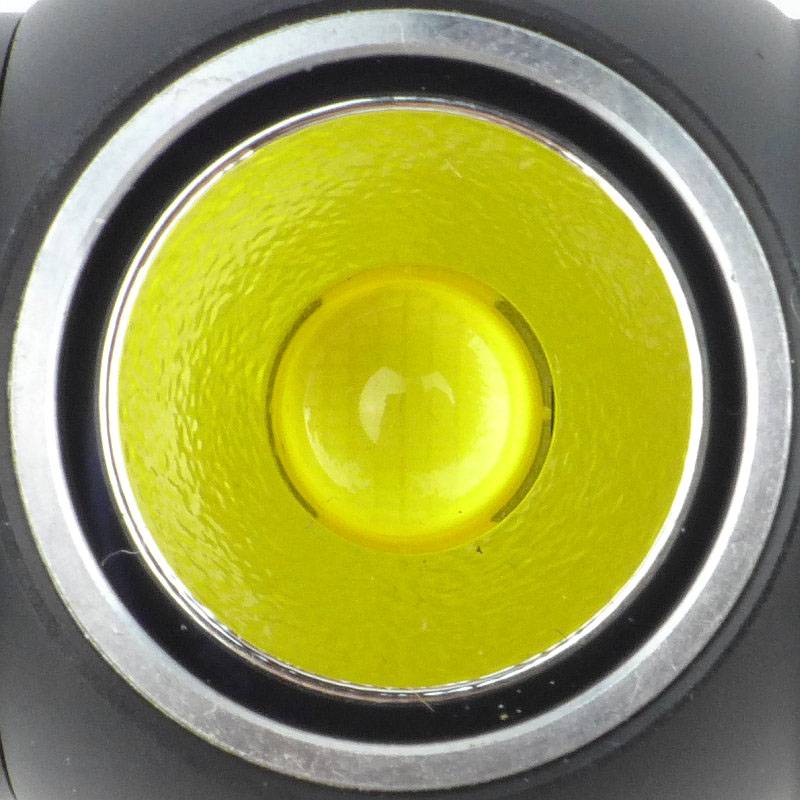
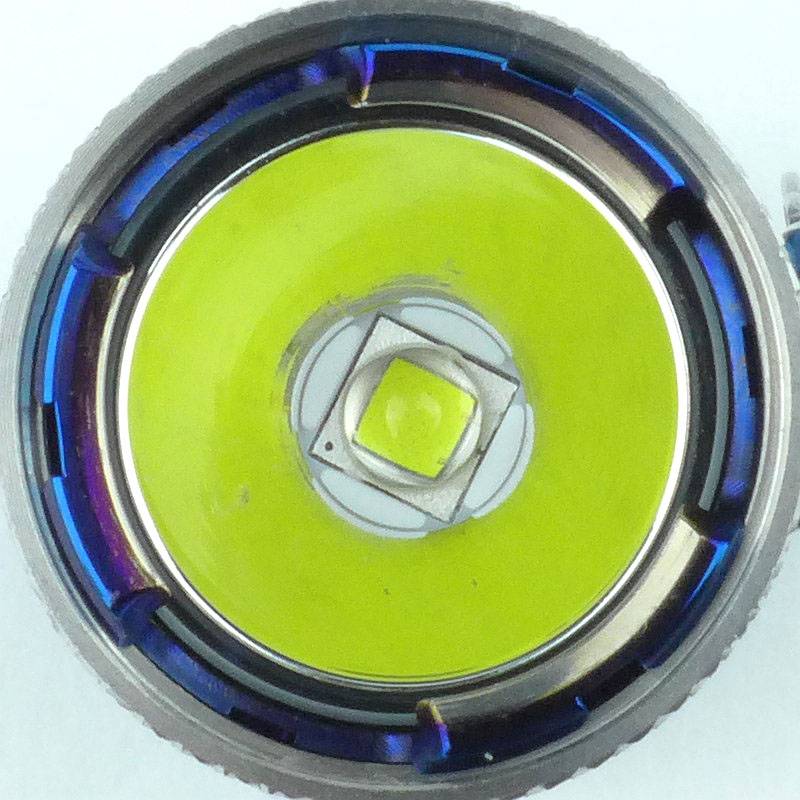
Looking straight into the small reflector.
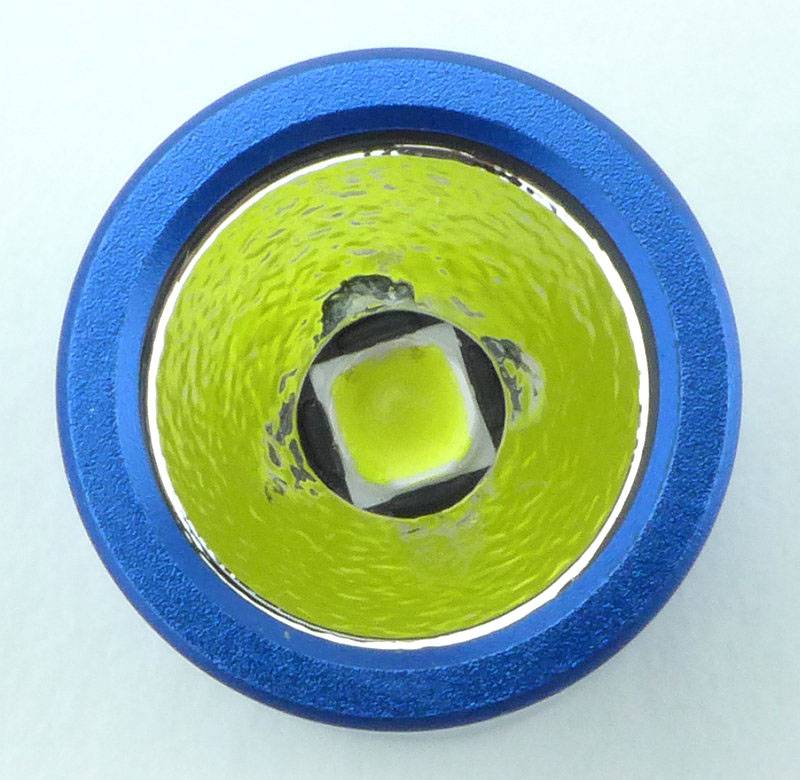
 photo 14 Preon P2 LED P1160845.jpg

The clip on the P1 is the same, but here is a view from a different angle.
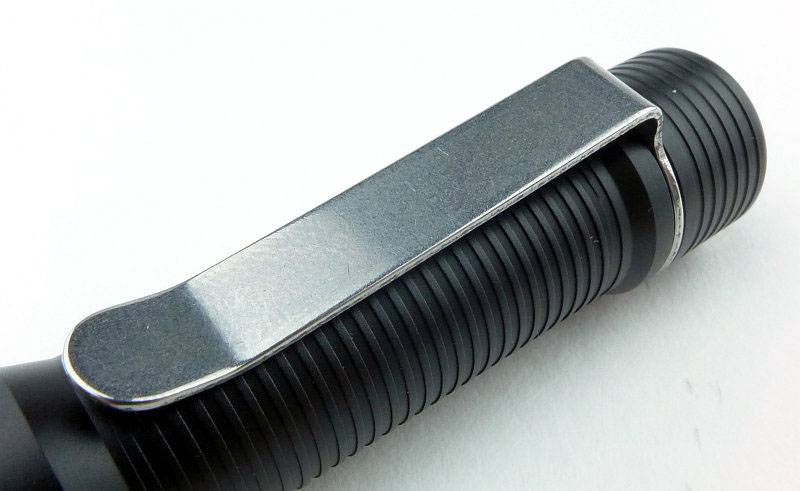
 photo 15 Preon P1 clip P1160848.jpg

The P1 also has a metal switch cap over a forward-clicky switch.
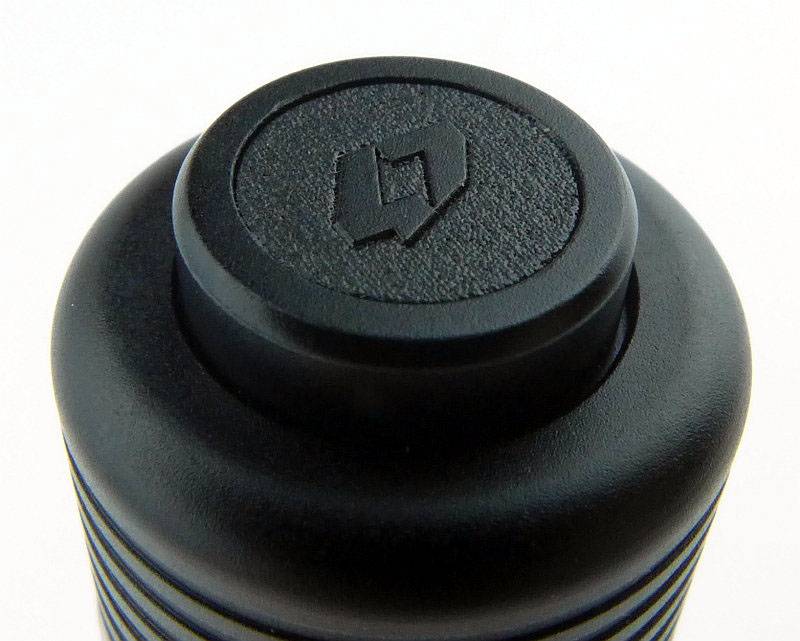
 photo 16 Preon P1 switch P1160854.jpg

The new Preons feature a fully textured body with grooves for grip along the entire length.
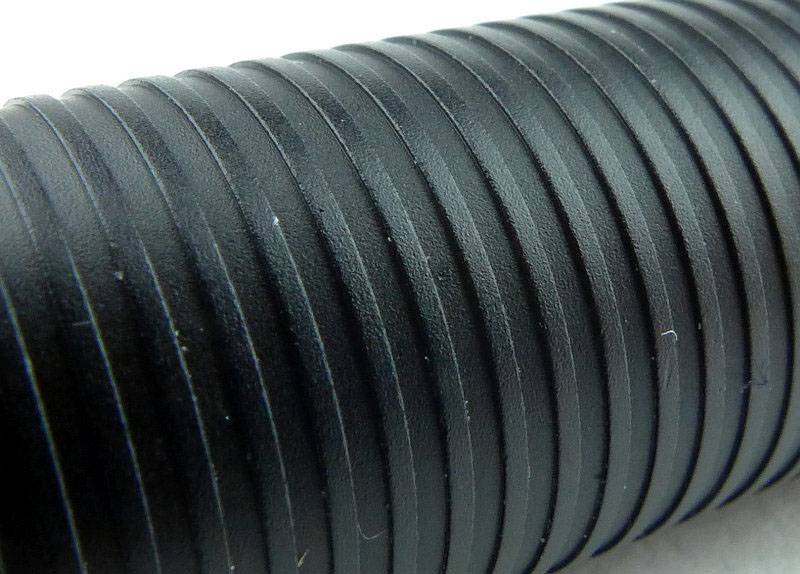
 photo 17 Preon P1 body P1160855.jpg

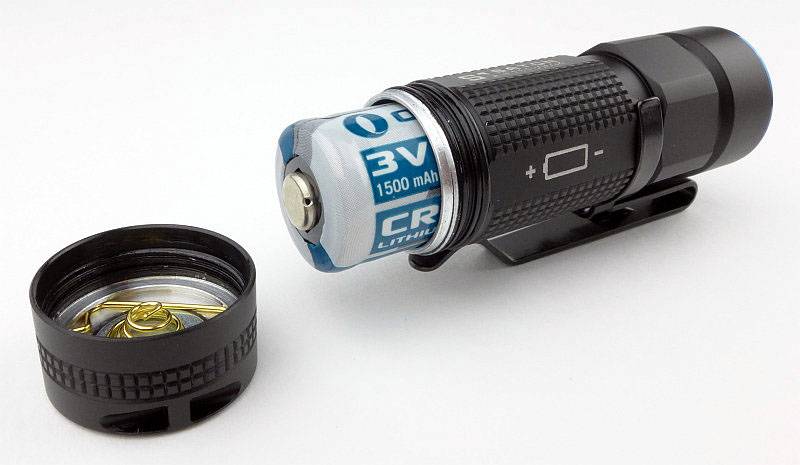
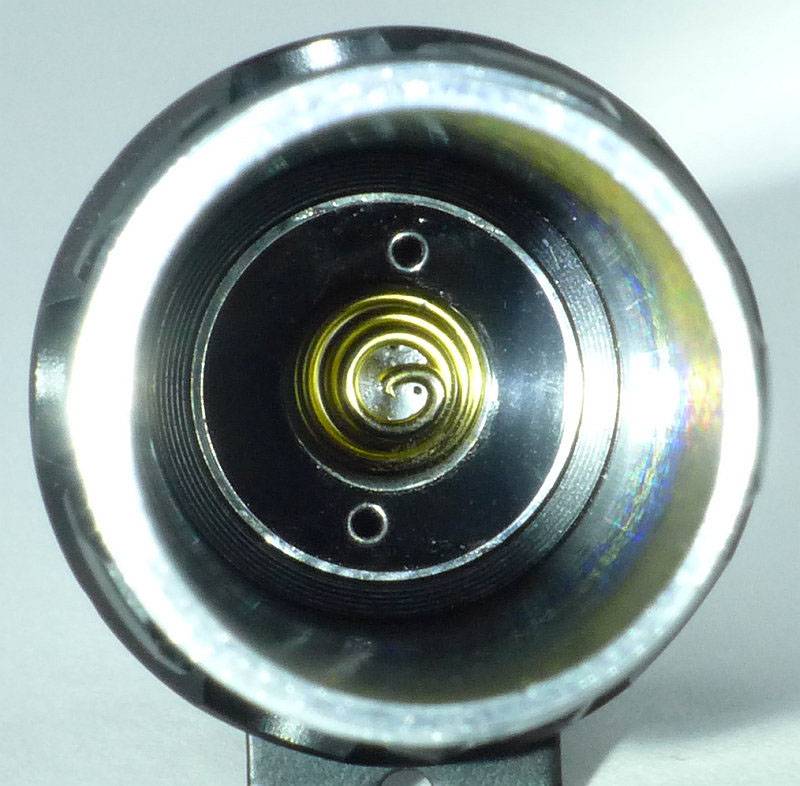
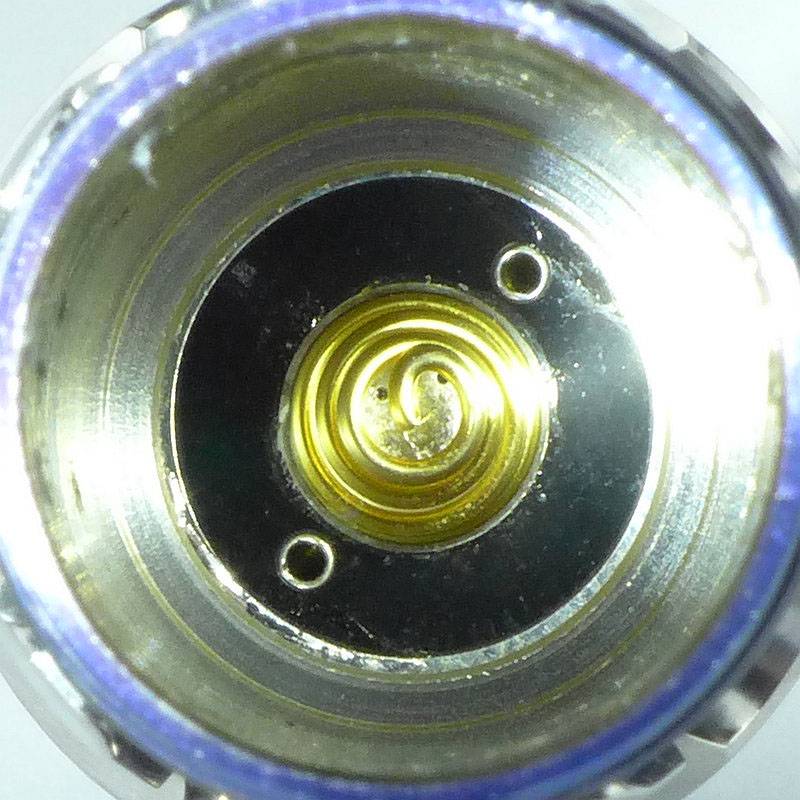
With it shorter battery tube it is just possible to show the positive contact spring terminal.
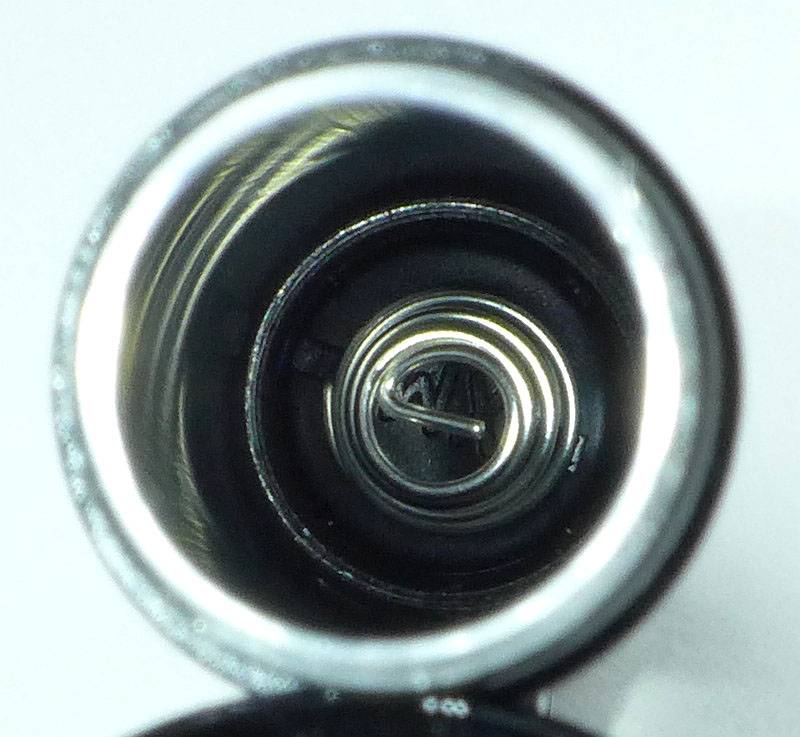
 photo 18 Preon P1 negative terminal P1160864.jpg

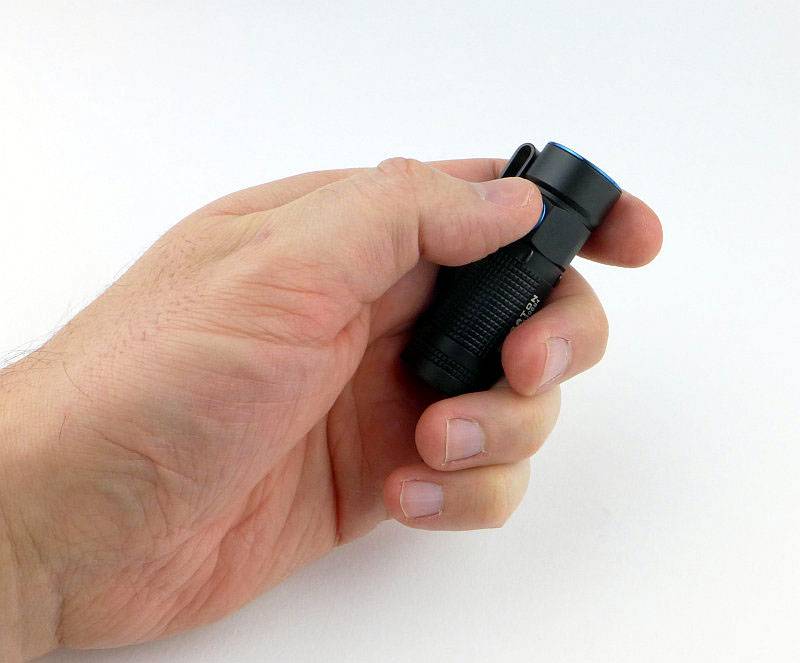
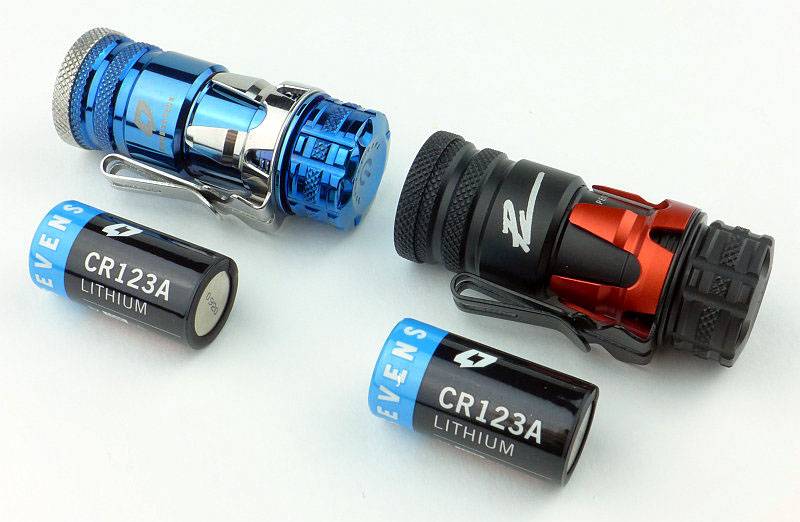
For scale, each Preon is shown with its AAA cells next to it.
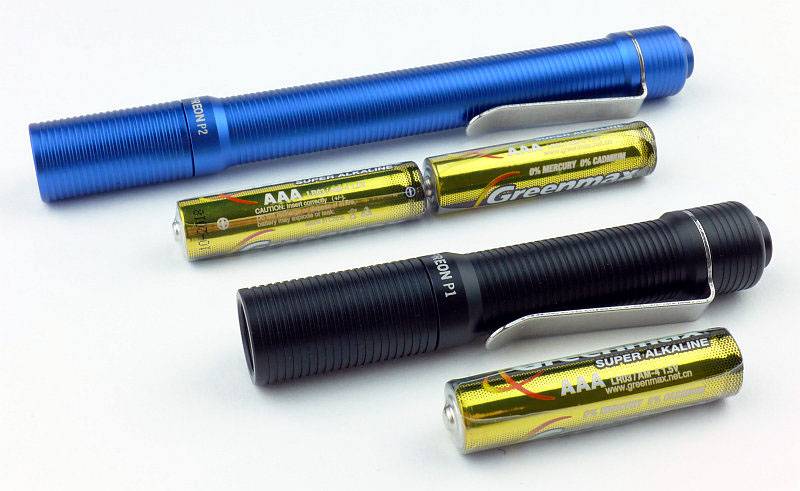
 photo 19 Preon P1P2 size P1160870.jpg

The beam

Please be careful not to judge tint based on images you see on a computer screen. Unless properly calibrated, the screen itself will change the perceived tint.

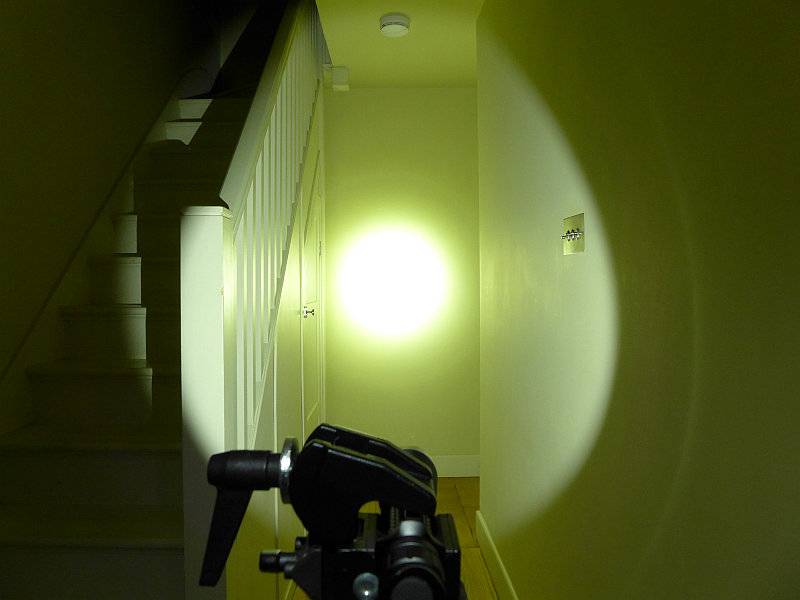
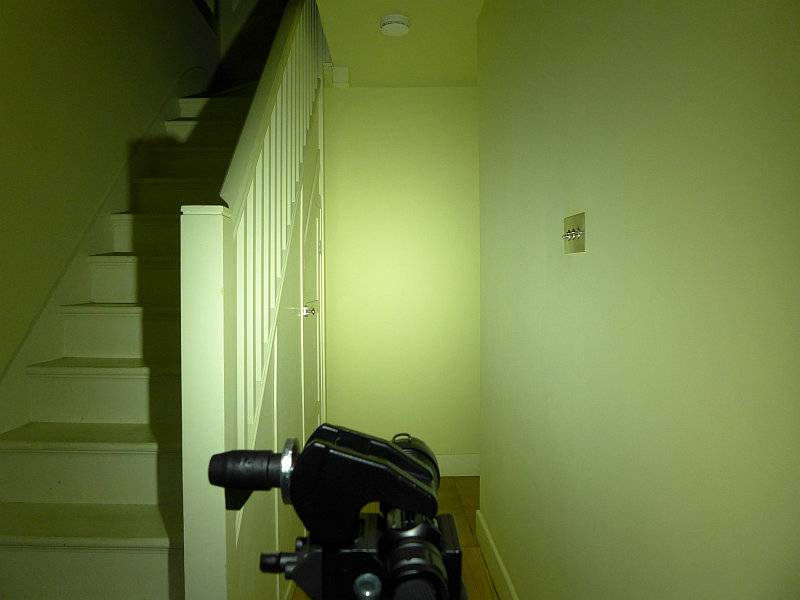
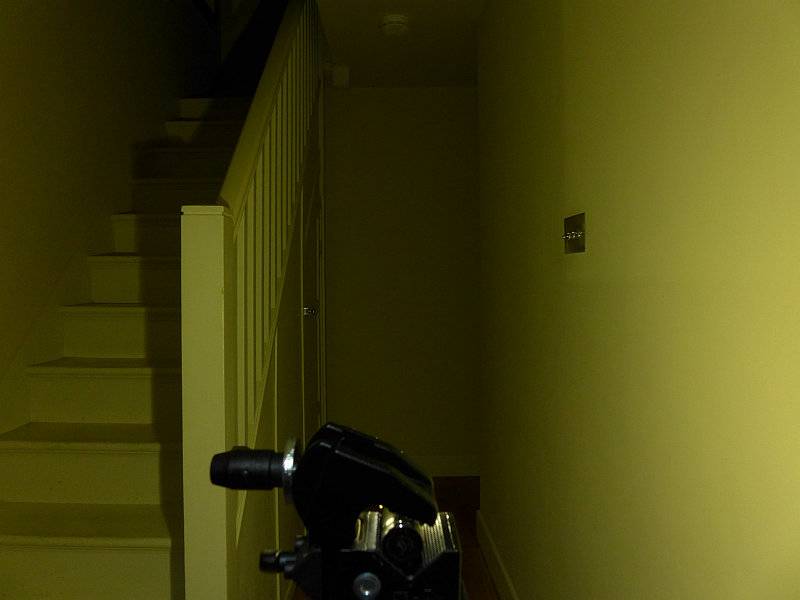
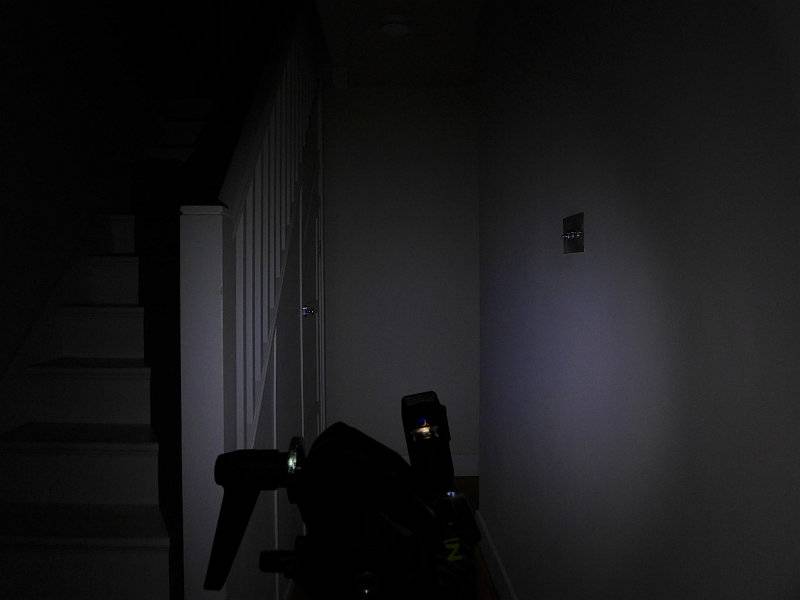
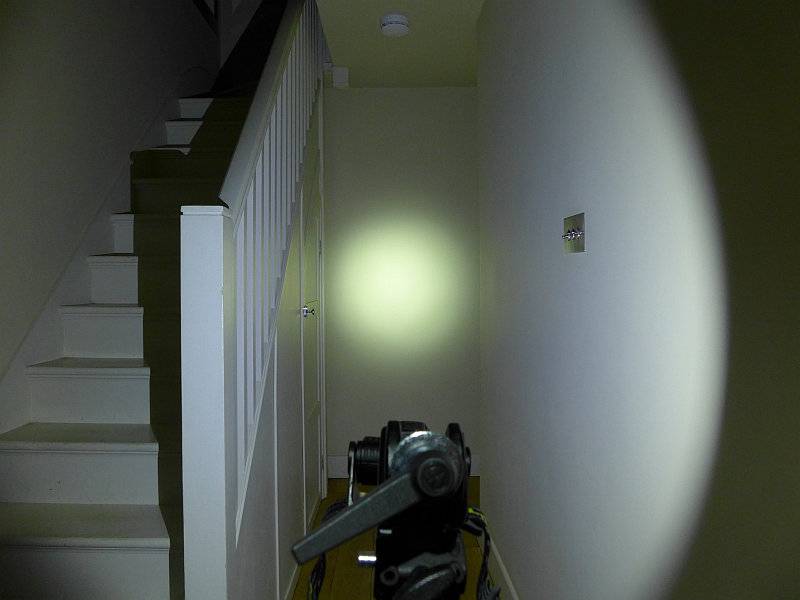
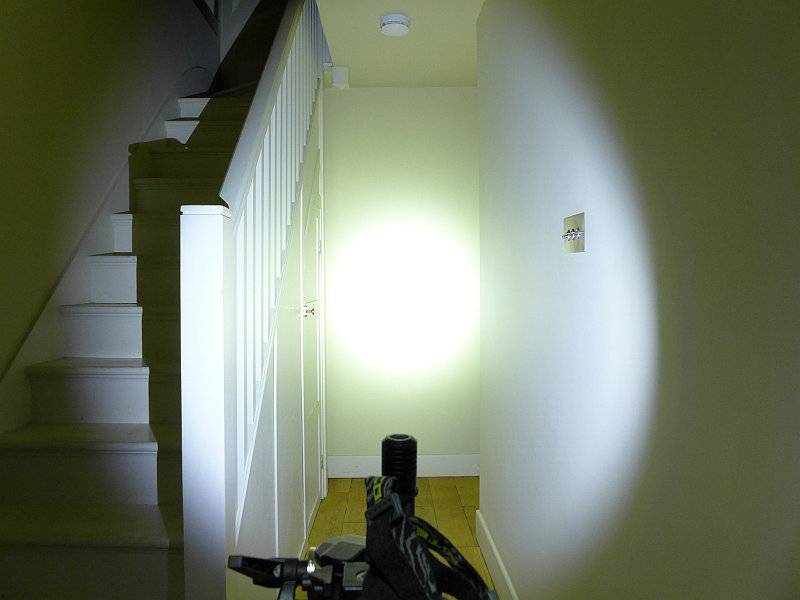
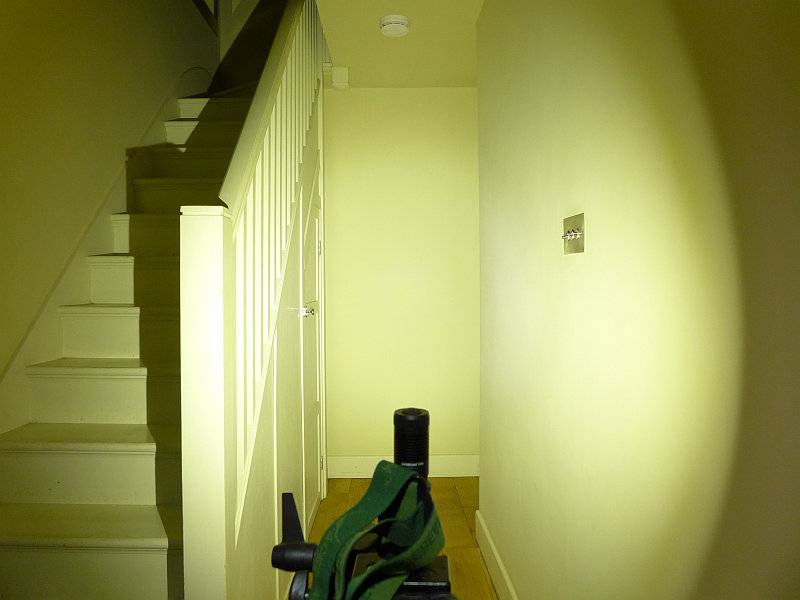
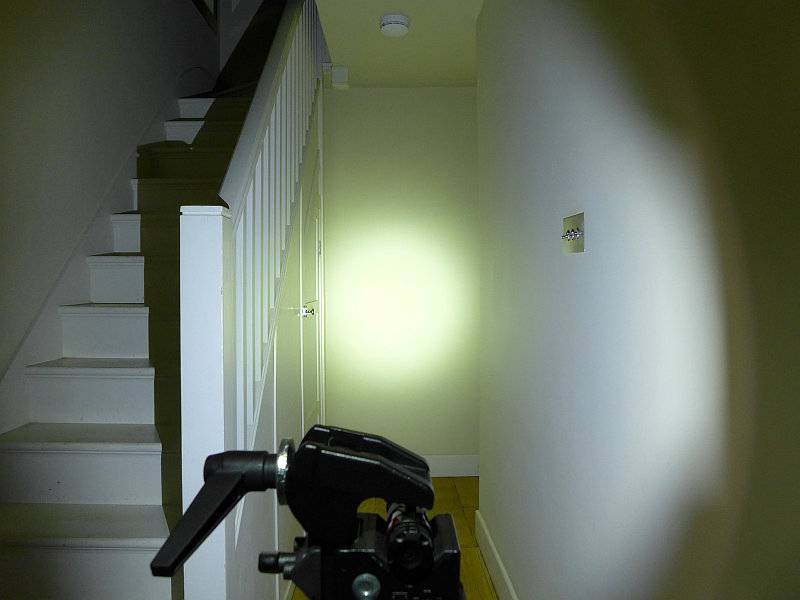
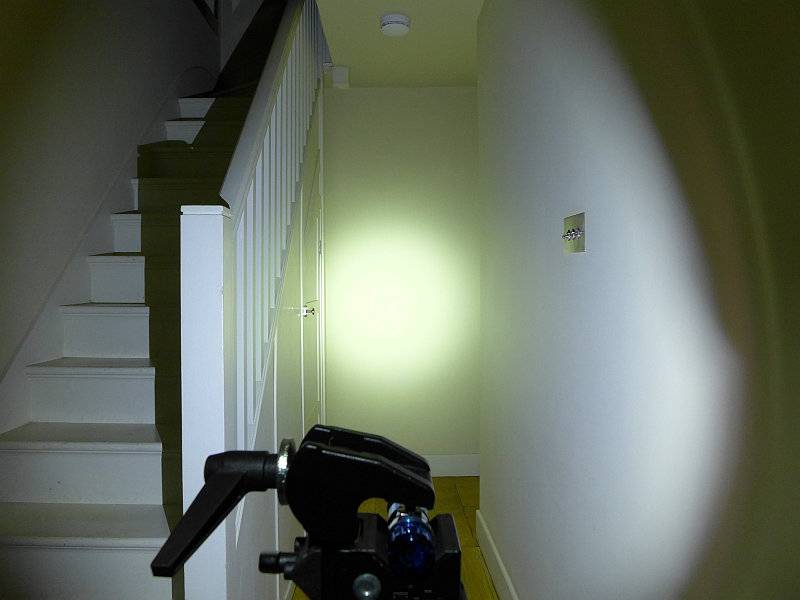
The indoor beamshot is intended to give an idea of the beam shape/quality rather than tint. All beamshots are taken using daylight white balance. The woodwork (stairs and skirting) are painted Farrow & Ball “Off-White”, and the walls are a light sandy colour called ‘String’ again by Farrow & Ball. I don’t actually have a ‘white wall’ in the house to use for this, and the wife won’t have one!

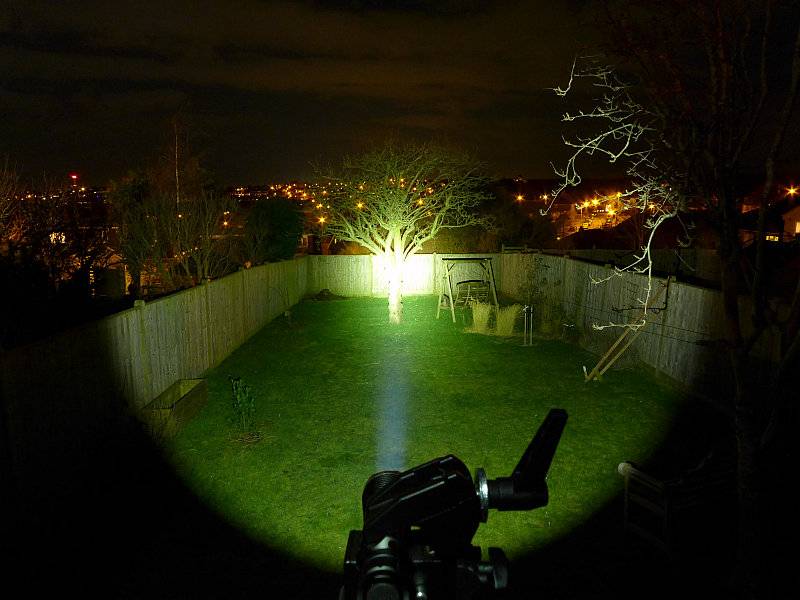
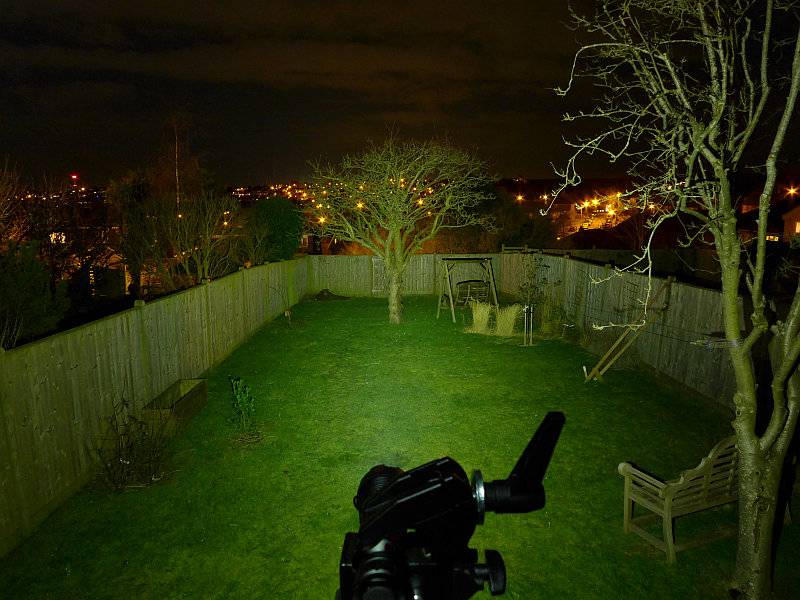
For this set of beamshots, the exposure has been kept the same for the P1 and P2 to show their relative brightness.

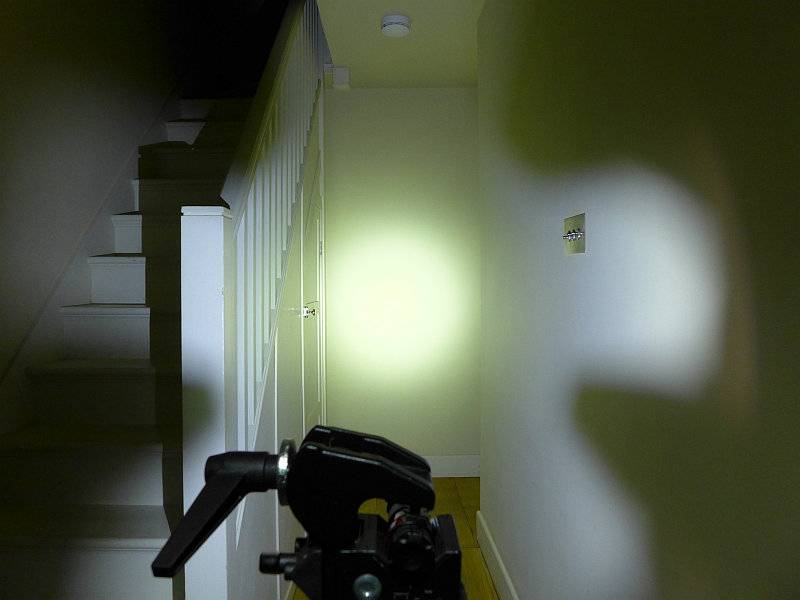
Starting indoors with the P1, it has plenty of power for your close range EDC needs, with a nice wide, soft, hotspot and wide spill.
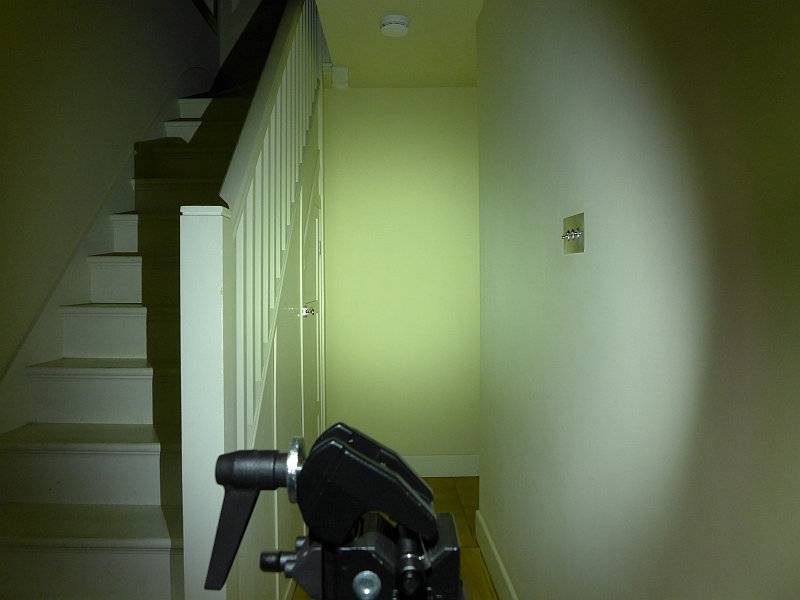
 photo 20 Preon P1 indoor beam P1170374.jpg

With the P2 it looks the same just brighter, as the P2 has double the output of the P1.
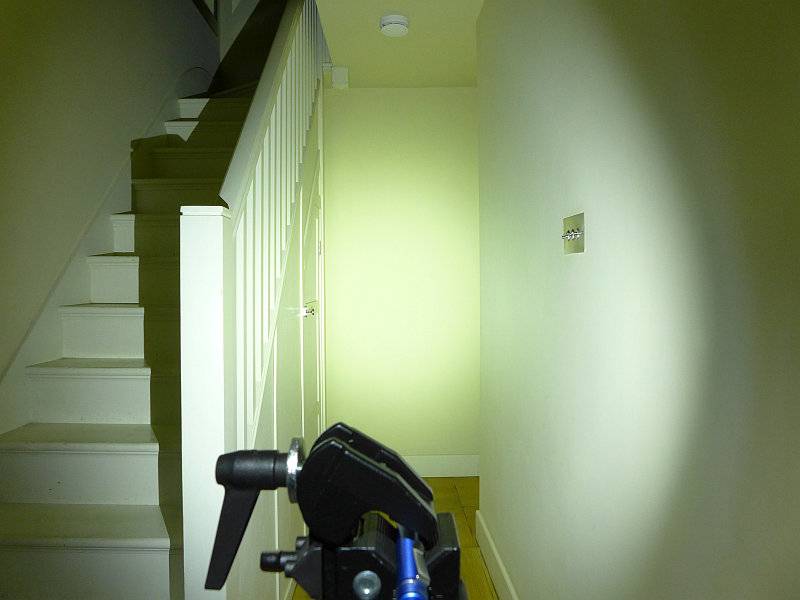
 photo 21 Preon P2 indoor beam P1170370.jpg

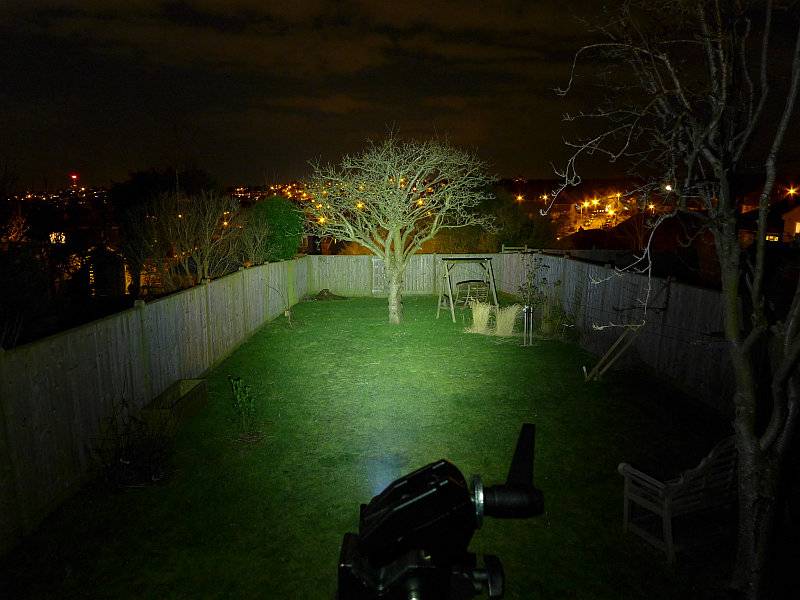
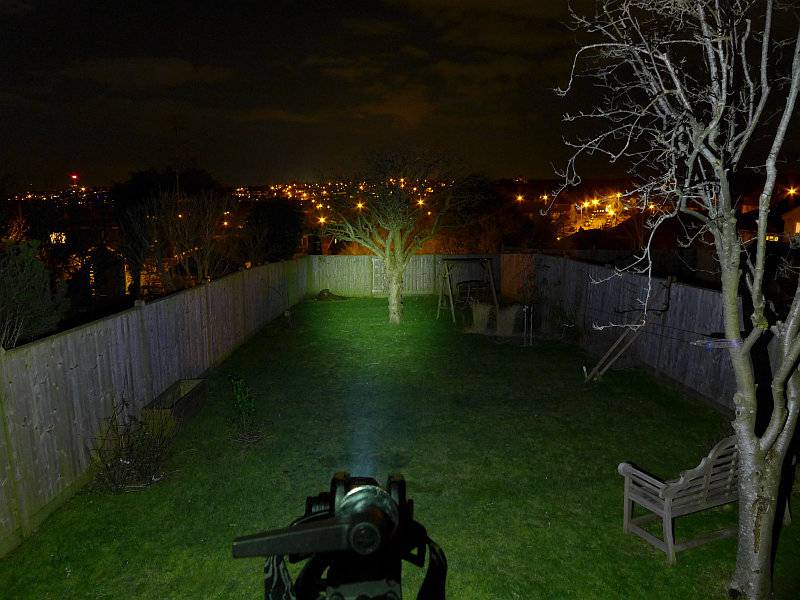
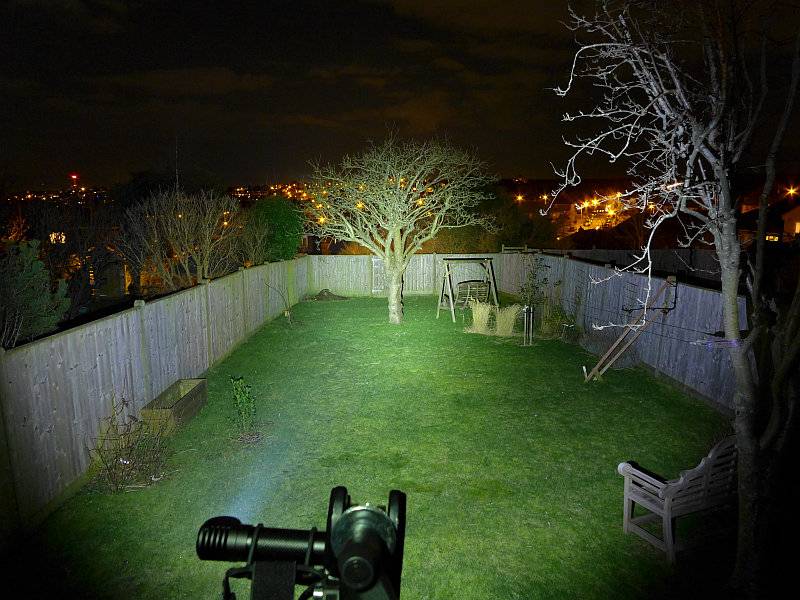
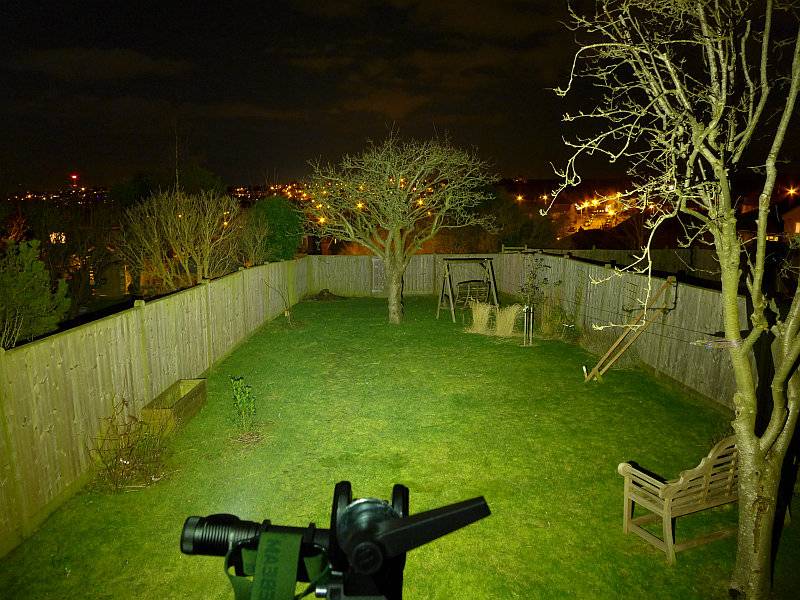
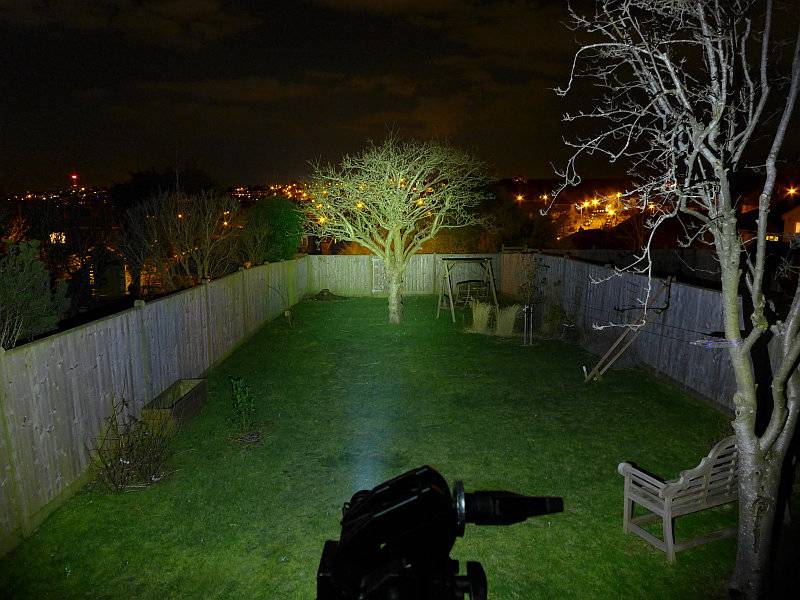
At outdoor ranges the Preons struggle as they are only AAA powered and have a flood orientated beam. These exposures are long to show anything. The P1 doesn’t have much impact.
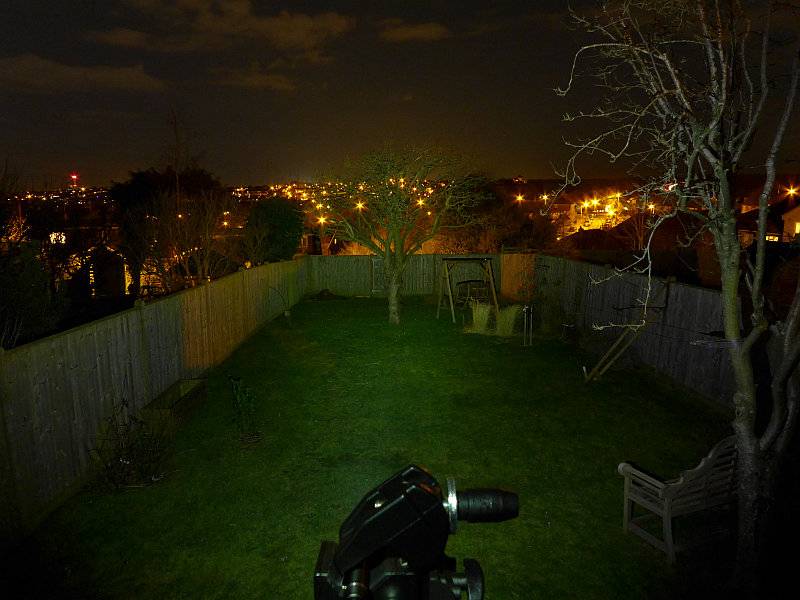
 photo 22 Preon P1 outdoor beam P1170293.jpg

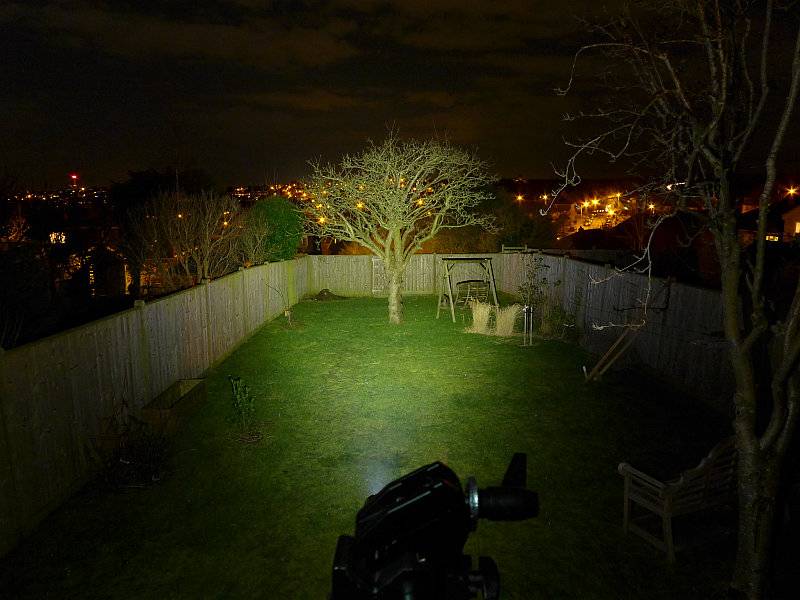
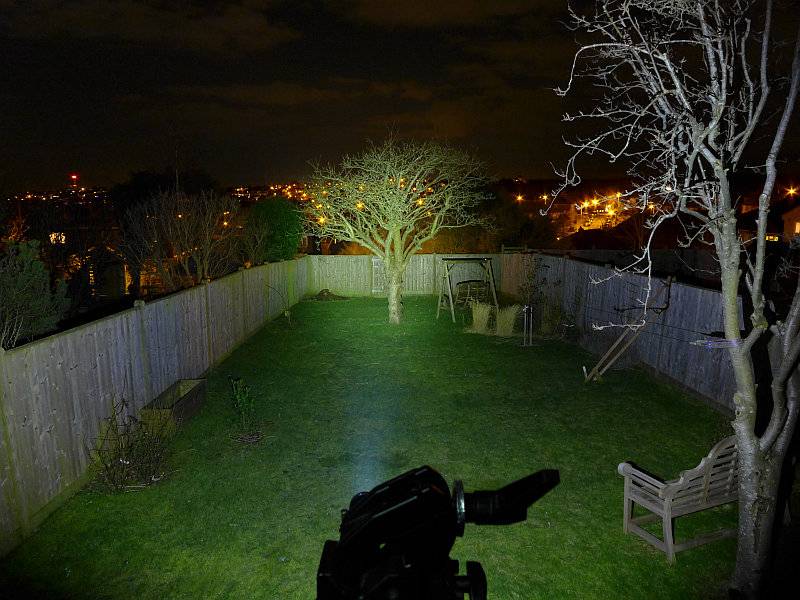
With the same exposure to allow direct comparison, the P2 looks a bit better, but this is a long exposure, so don’t expect too much at this range.
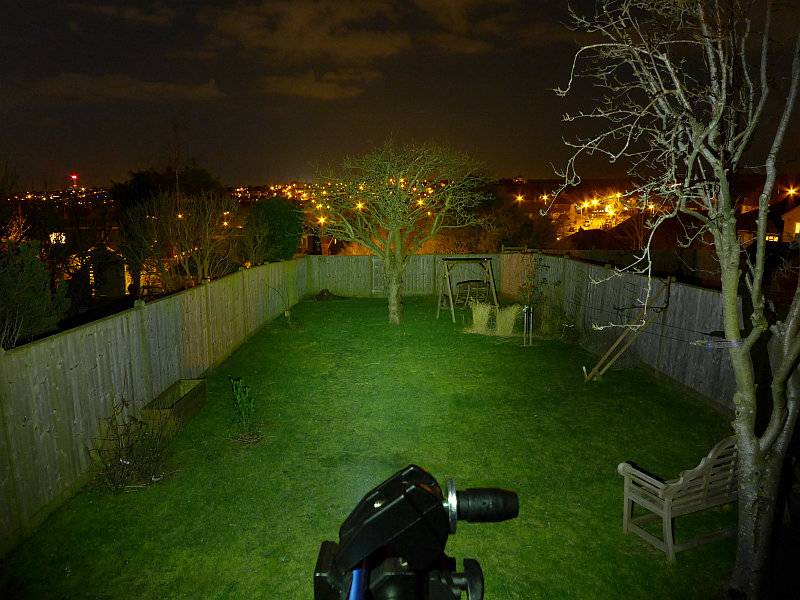
 photo 23 Preon P2 outdoor beam P1170285.jpg

Modes and User Interface:

Both the Preon P1 and P2 operate in the same way with a forward-clicky switch.
In total, there are 7 output modes which can be used – Low, Medium, High, Strobe, SOS, Beacon (high), Beacon (low).

To fine tune the Preon to your needs, you can set one of 5 possible ‘Configurations’ which have only certain modes available:
Configuration 1: High
Configuration 2: Previous, High, Low
Configuration 3: Previous, High, Strobe
Configuration 4: Previous, Low, Medium, High, Strobe
Configuration 5: Previous, Low, Medium, High, Strobe, SOS, Beacon (high), Beacon (low)

By default, configuration 2 is set. To change configuration, rapidly press the switch 10 times within 2s, holding or clicking the tenth press.
At this point the Preon will flash 1 to 5 times to indicate the selected configuration.
Quickly turn the Preon OFF and ON again to move to the next configuration, and repeat until you have the desired configuration. To memorise the setting, turn the Preon OFF for 5 seconds.

The Preon has a memory of the last mode used. This is relevant only on Configurations 2, 3, 4 and 5.
To change to the next mode in the chosen configuration, turn the Preon OFF and ON again within one second.
As shown in the Configuration list above, when you first turn the Preon ON, you get the ‘previously used’ output mode. When you then change mode, you jump to the start of the set of modes for that Configuration.
For example, if you are set to Configuration 5 and previously used Strobe, when you first turn the Preon ON you get Strobe, and when changing modes the next mode becomes Low, Medium… (In this example you do not go to SOS as the next mode).

Batteries and output:

The Preon P1 runs on 1x AAA and the P2 on 2x AAA; either Alkaline of NiMh cells can be used (maximum input voltage 3.0V).

To measure actual output, I built an integrating sphere. See here for more detail. The sensor registers visible light only (so Infra-Red and Ultra-Violet will not be measured).

Please note, all quoted lumen figures are from a DIY integrating sphere, and according to ANSI standards. Although every effort is made to give as accurate a result as possible, they should be taken as an estimate only. The results can be used to compare outputs in this review and others I have published.

___________________________________________ ________________________________ ________________________________
P1/P2 using AAA Eneloop I.S. measured ANSI output Lumens PWM frequency or Strobe frequency (Hz)
___________________________________________ ________________________________ ________________________________
P1 – High 127 1000
P1 – Medium 63 1000
P1 – Low 7 1000
P2 – High 259 950
P2 – Medium 137 950
P2 – Low 33 950

* Beacon and Strobe output measurements are only estimates as the brief flashes make it difficult to capture the actual output value.

Peak Beam intensity for the P1 measured 200 lx @1m giving a beam range of 28 m.
Peak Beam intensity for the P2 measured 600 lx @1m giving a beam range of 49 m.

There is no parasitic drain.

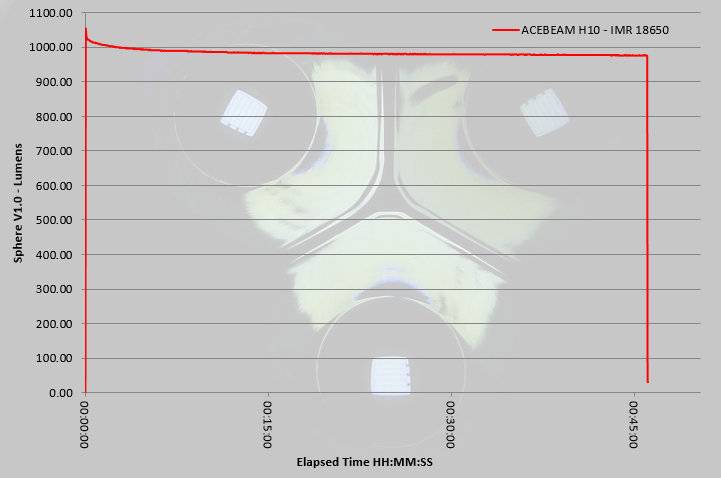
The two Preon models are also shown next to the Bolt-Mini, as this was another FOURSEVENS AAA light I have tested (check index page for this review). Thanks to its two AAA cells, the P2 is the only light to display full regulation in the output. With only one AAA, the P1 is always pushing this limited power source, but runs with a pretty consistent output after the initial drop from the 3 minute ‘burst’ at turn-on.
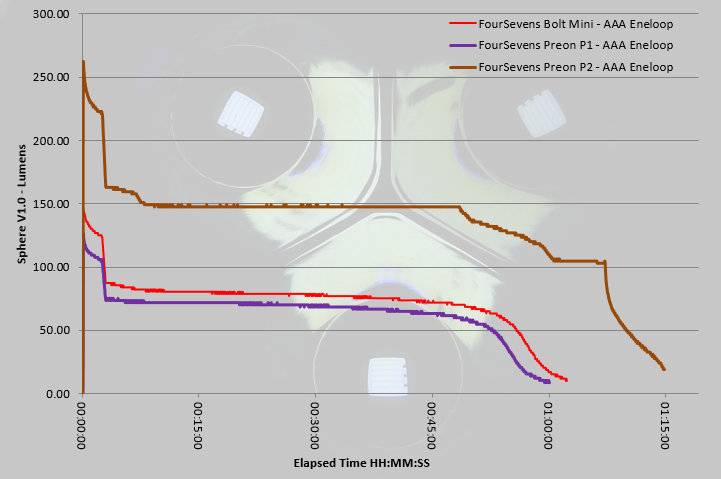
 photo Foursevens Bolt mini Preon P1 P2 runtime.jpg

Troubleshooting

This section is included to mention any minor niggles I come across during testing, in case the information helps anyone else.

No issues were encountered during testing.

As per the description of this section, this information is provided in case anyone else finds a similar ‘issue’ that might be fixed in the same way.

The Preon P1 and P2 in use

When compared to the previous generation Preons, these new versions are slightly chunkier, and initially I was not entirely convinced, as the point of an AAA light is to be very small. But then I remembered that as much as I love the older P2 shown in the photos, it was always a bit slippery. The smooth body wanting to slide around and not giving much of a grip.

With the new Preons having a grip pattern over the entire length of the light, no longer do you get this slippery feeling. One further observation though, is that these grooves tend to pick up pocket fluff nicely, which does somewhat spoil the look.

Personally I preferred the previous UI where it had no memory, but for some a memory is a requirement as you can pre-select the output you generally use. However, as the memory only affects the mode at switch-on, after which the mode selection goes to the first of the modes in the current Configuration, it only takes one mode change to return to Low (if Low was not the previously used mode). On the P2, the Low is much brighter than it used to be (3lm in the previous version) as it is now 33lm. The P1’s low is still pretty low at 7lm so if you need a lower output the P1 is the way to go.

Unfortunately another aspect has changed in the new version, PWM is rearing its head. The previous P2 had PWM but at 2500Hz and was not noticeable to the naked eye; the new version has PWM at 1000Hz. On High and Medium this has not really been visible, but on Low, I do catch the strobing effect out of the corner of my eye. A minor irritation and not what I would expect of FOURSEVENS. It slightly takes the edge off what could be a great update to this well loved series.

It used to be more common for smaller EDC lights to go with a reverse-clicky switch, but as in earlier versions, the Preon does use a forward-clicky and gives you that immediate response to pressure on the switch.

A great feature that has been added to the Preons is the user-changeable configuration that allows you to limit which output modes can be selected. You don’t get to choose which modes are included in a ‘configuration’ but you can choose one of the five available ‘configurations’ to best suit your needs. This user configuration has great potential and I hope FOURSEVENS expand the number of configurations that can be chosen from including a lower level in the P2, and perhaps configurations with no memory. Remember when choosing your configuration that the new Preon has a memory so starts on the last used mode.

With the small power source of AAA, the added efficiency of the XP-L (though only around 9%) makes a difference. Thanks to the XP-L having an XM-L2 size die in a smaller package, it is compact enough to be fitted into the Preon’s head and provide a great EDC beam.

The new Preon doesn’t just have a new body design, it has user-configuration and an XP-L LED.

Review Summary

_______________________________________________ _______________________________________________
Things I like What doesn’t work so well for me
_______________________________________________ _______________________________________________
XP-L LED in a truly pocket-sized light. PWM at 1000Hz giving some strobe effects on low.
New ‘grippy’ body design. P2’s lowest level is a bit high at 33lm.
User configurable.
Great EDC beam.


Discussing the Review:

Please feel free to add comments to the review, but the ideal place to freely discuss these reviews is on a forum. If you started reading the shorter forum version of the review, but followed the link this full exclusive review, please return to that forum to discuss the review there.
If you read the review entirely on Tactical Reviews, please consider one of the following to join in any discussion.

CandlePowerForums – Flashlight Reviews Section (Largest and Friendliest Flashlight Community Forum)

EdgeMatters – Sponsored Reviews (UK based Forum for Knife Makers and Collectors)
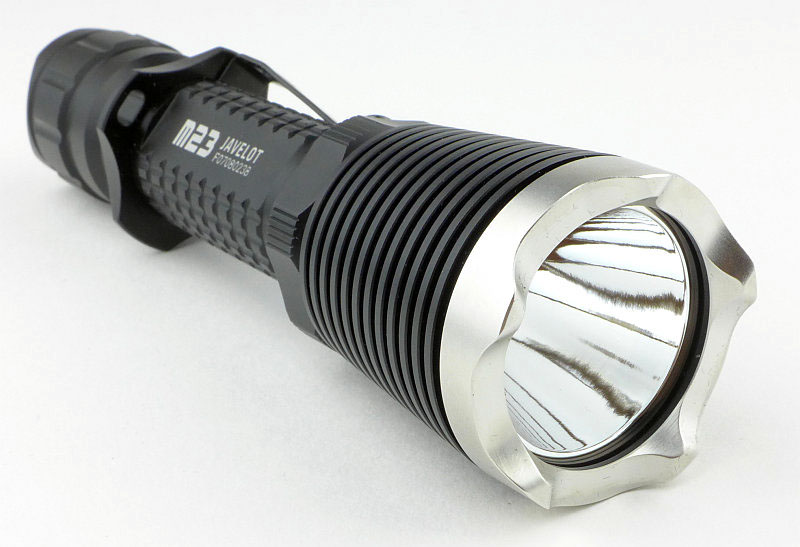
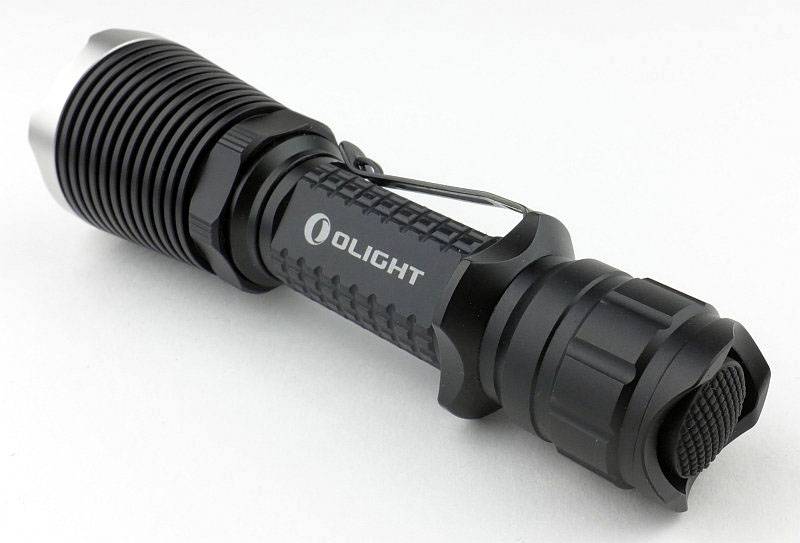
Light Review: Olight M23 JAVELOT

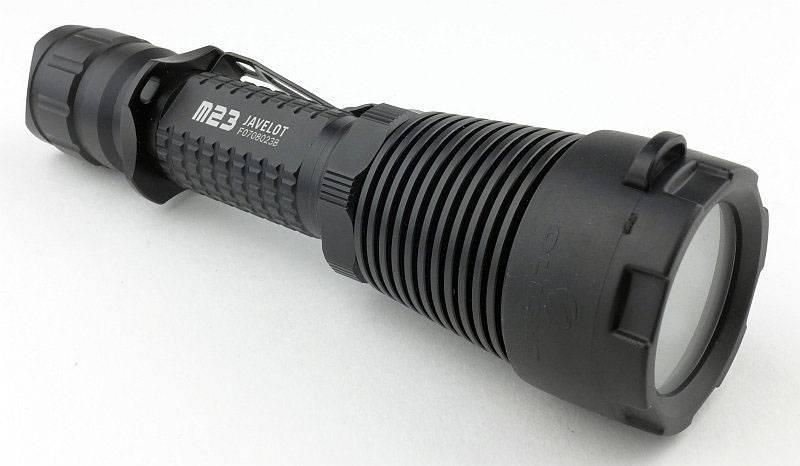
Olight have taken the popular M22 Warrior and updated it by giving it the ‘JAVELOT’ treatment. The result is the M23 JAVELOT. After the success of the first few Javelot models, Olight have been updating a few existing models, like the S30RII and M22 into Javelot versions with uprated emitters and throw.

 photo 09 M23Javelot angle reverse P1160532.jpg

Taking a more detailed look:

The M23 JAVELOT is supplied in a sturdy plastic case.
 photo 01 M23Javelot boxed P1160500.jpg

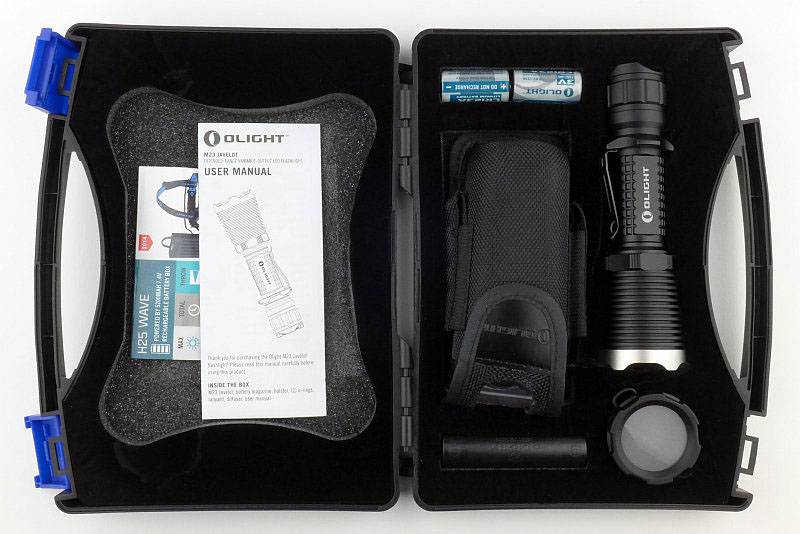
Everything is held in cut-outs in the foam liner.
 photo 02 M23Javelot box open P1160506.jpg

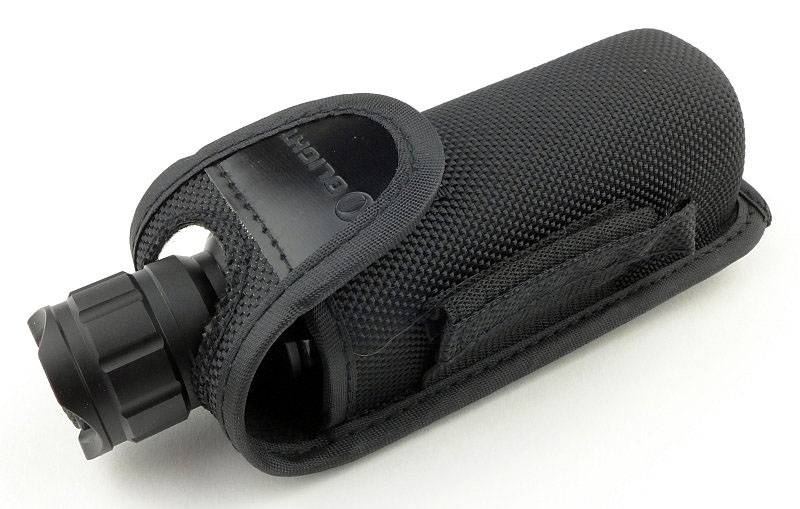
Starting off with a look at the unconventional holster design. The retention flap has a hole cut into it through which the tail-cap protrudes. This gives access to the tail-cap switch.
 photo 03 M23Javelot holstered P1160512.jpg

Both sides of the holster feature cell holders. For CR123 these are not that secure, but for 18650 they work well enough (though the cell is partly exposed and could be damaged.
 photo 04 M23Javelot holster cells P1160513.jpg

Now we see why you might want access to the tail-cap switch while the light is in the holster. The bottom of the holster has a hole cut in it allowing the M23 to be used while fully inside the holster.
 photo 05 M23Javelot holster base P1160517.jpg

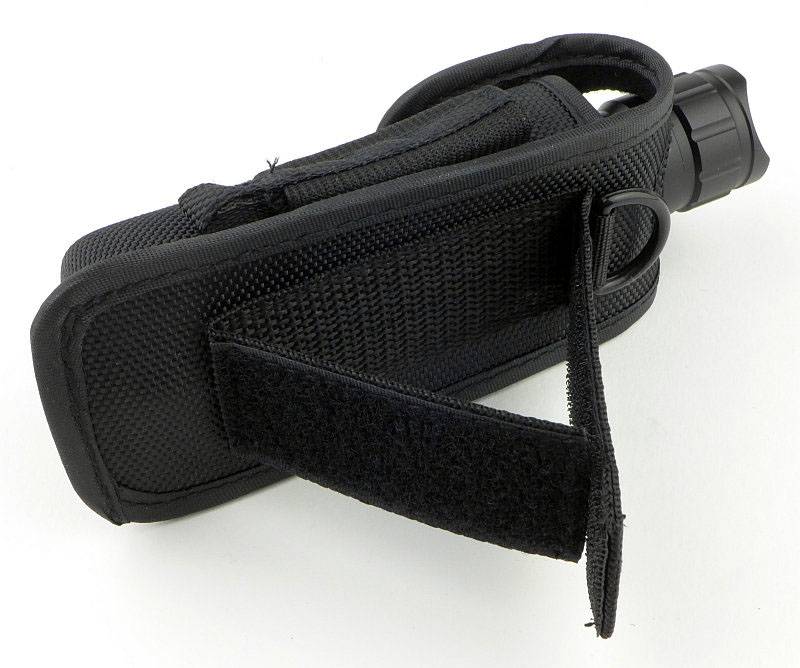
On the back is a Velcro belt-loop and small D-ring.
 photo 06 M23Javelot holster loop P1160519.jpg

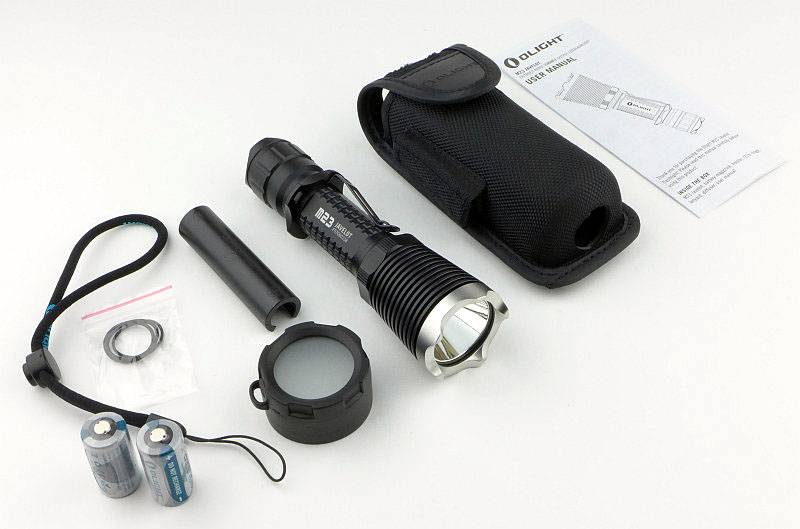
Supplied with the M23 is the holster, CR123 cell holder, diffuser, spare O-rings, a lanyard, the instructions and two CR123 cells.
 photo 07 M23Javelot contents P1160526.jpg

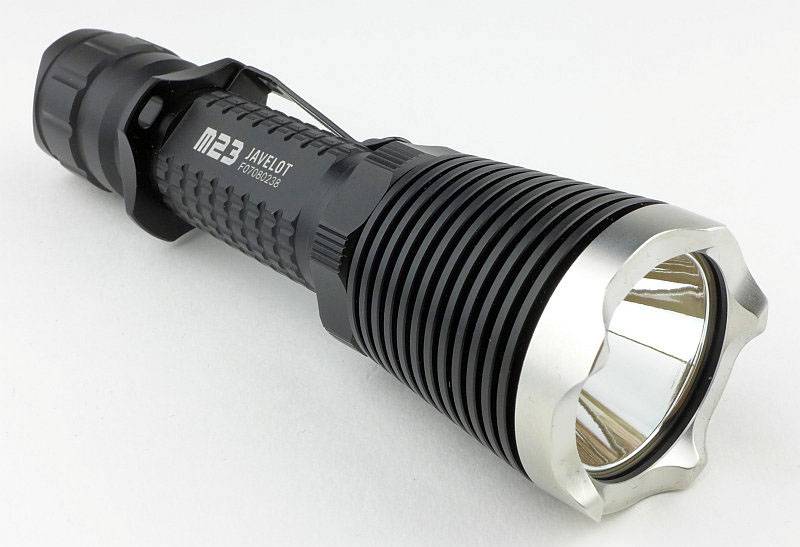
Externally the main difference between the M22 Warrior and the M23 JAVELOT is the stainless steel bezel.
 photo 08 M23Javelot angle P1160528.jpg

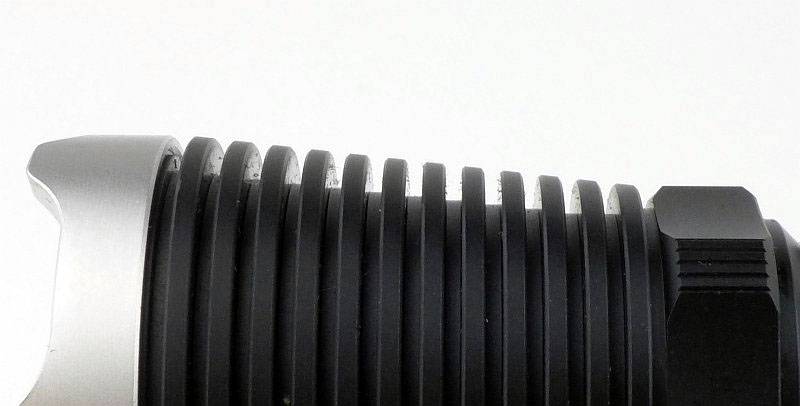
The entire head has heat-sink fins along it.
 photo 10 M23Javelot heat sink fins P1160534.jpg

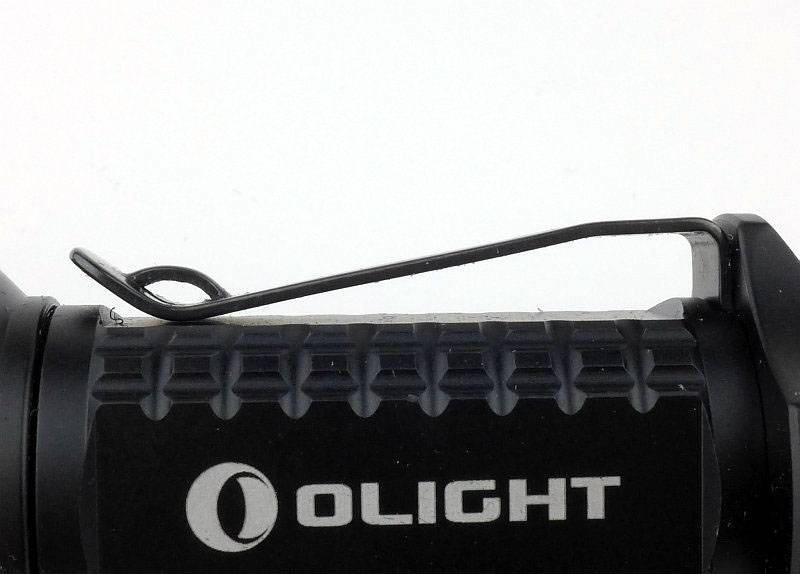
A side view of the steel pocket clip.
 photo 11 M23Javelot clip1 P1160537.jpg

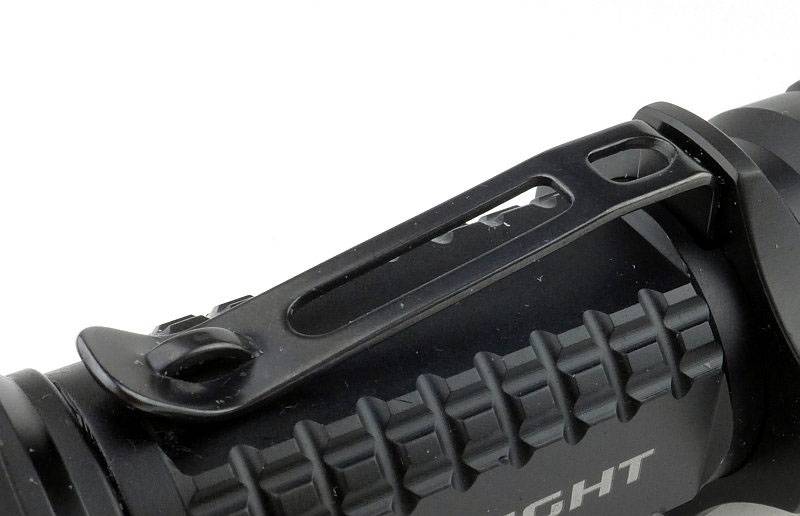
Another view of the strong pocket clip.
 photo 12 M23Javelot clip2 P1160539.jpg

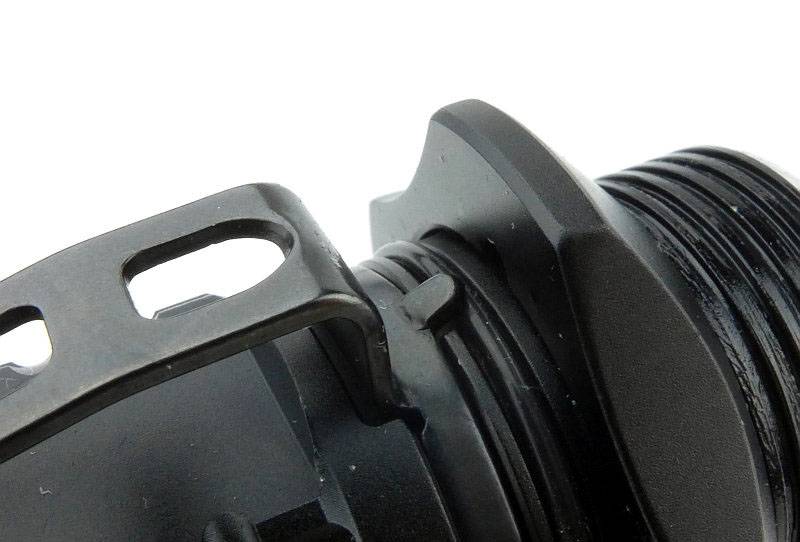
The pocket clip fits into a cut-out on the battery tube, and the grip-ring has a notch in it which fits over a lug on the steel pocket clip. This prevents the pocket clip or grip-ring rotating.
 photo 20 M23Javelot clip fitting P1160564.jpg

With the supplied diffuser fitted, the stainless bezel is hidden. You can’t fit the M23 into its holster like this.
 photo 14 M23Javelot angle diffuser P1160544.jpg

Inside the tail-cap, the negative terminal is a sprung plunger. The tail-cap/battery tube connection is hidden and uses a special design to fit into the conical opening at the end of the battery tube.
 photo 15 M23Javelot tailcap P1160548.jpg

The switch is large and textured.
 photo 16 M23Javelot tailcap switch P1160550.jpg

Threads on the tail-cap end of the battery tube are square cut and fully anodised.
 photo 17 M23Javelot threads P1160555.jpg

Threads on the head end of the battery tube are square cut and bare aluminium.
 photo 18 M23Javelot head threads P1160556.jpg

Unscrewing the battery tube fully shows the contacts in the head, with the positive spring-terminal, bare threads plus ring-terminal for the twisty interface.
 photo 19 M23Javelot head contacts P1160561.jpg

For its excellent throw the M23 uses a deep, smooth reflector.
 photo 21 M23Javelot reflector P1160574.jpg

Looking straight into the reflector.
 photo 22 M23Javelot LED P1160580.jpg

And a closer look at that LED. Olight describe this as a ‘customised high intensity CREE XP-L LED’.
 photo 23 M23Javelot LED close P1160586.jpg

The beam

Please be careful not to judge tint based on images you see on a computer screen. Unless properly calibrated, the screen itself will change the perceived tint.

The indoor beamshot is intended to give an idea of the beam shape/quality rather than tint. All beamshots are taken using daylight white balance. The woodwork (stairs and skirting) are painted Farrow & Ball “Off-White”, and the walls are a light sandy colour called ‘String’ again by Farrow & Ball. I don’t actually have a ‘white wall’ in the house to use for this, and the wife won’t have one!

The beam does have a reasonably warm tint and as expected for a JAVELOT light, there is a very strong hotspot. This might be a bit fatiguing to use indoors which is why there is a diffuser supplied.
 photo 24 M23Javelot indoor beam P1170305.jpg

Popping on the diffuser and we have an entirely different experience (the exposure here is the same as without the diffuser).
 photo 25 M23Javelot indoor beam diffused P1170308.jpg

Outdoors it is clear this is a thrower!
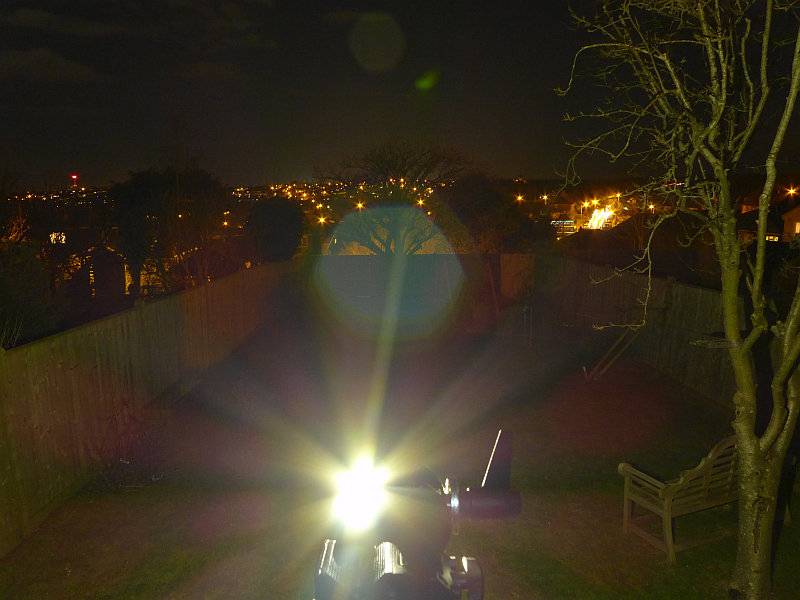
 photo 26 M23Javelot outdoor beam P1170240.jpg

And just to see, the result with the diffuser is good (the exposure here is the same as without the diffuser).
 photo 27 M23Javelot outdoor beam diffused P1170243.jpg

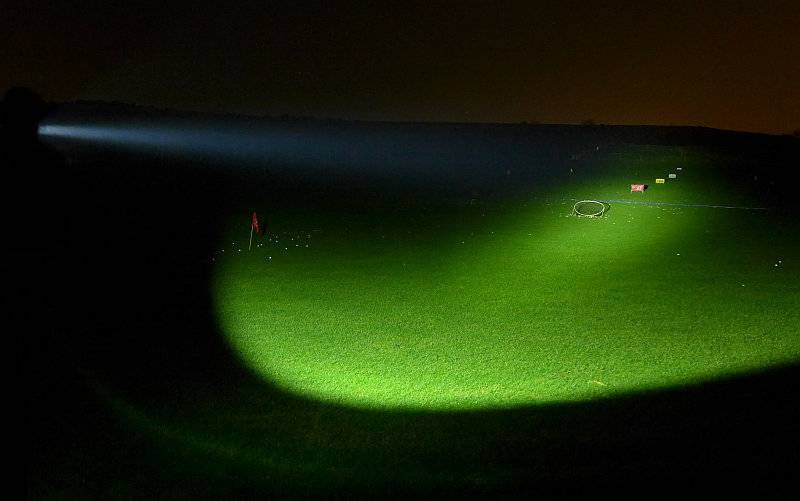
But we need more range, so here we are at a golf driving range with the 250yard marker easily visible, and beyond.
 photo 28 M23Javelot outdoor beam golf P1170221.jpg

Modes and User Interface:

The M23’s output is controlled by the forward-clicky tail-cap switch and twisty interface at the head.

Available modes include High, Medium, Low and Strobe.

From OFF, either click or half-press and hold to turn onto the last-used constant output mode.
From ON, either click the switch or release the half-press to turn OFF.

From OFF, double-tap and click (or hold) the switch to activate High.
From OFF, triple-tap and click (or hold) the switch to activate Strobe. While strobe is activated, the twisty interface does nothing.

From ON, loosen-tighten the head to cycle through High -> Medium -> Low -> High etc. (it is as the head becomes tight again that the mode changes). Tightening the head while the M23 is OFF does nothing.

This operation allows you to set the output to Low, but still have direct access to High (double-tap) and Strobe (triple-tap) via the tail-cap switch alone.

Batteries and output:

The M23 runs on either 1x 18650 or 2x CR123.

To measure actual output, I built an integrating sphere. See here for more detail. The sensor registers visible light only (so Infra-Red and Ultra-Violet will not be measured).

Please note, all quoted lumen figures are from a DIY integrating sphere, and according to ANSI standards. Although every effort is made to give as accurate a result as possible, they should be taken as an estimate only. The results can be used to compare outputs in this review and others I have published.

___________________________________________ ________________________________ ________________________________
Olight M23 JAVELOT using specified cell I.S. measured ANSI output Lumens PWM frequency or Strobe frequency (Hz)
___________________________________________ ________________________________ ________________________________
High – CR123 950 0
Medium – CR123 361 0
Low – CR123 38 0
High – 18650 918 0
Medium – 18650 365 0
Low – 18650 38 0
Diffuser Test High – No Diffuser 861 0
Diffuser Test High – Diffuser 584 0

* Beacon and Strobe output measurements are only estimates as the brief flashes make it difficult to capture the actual output value.

Peak Beam intensity measured 39700 lx @1m giving a beam range of 398 m.

There is no parasitic drain.

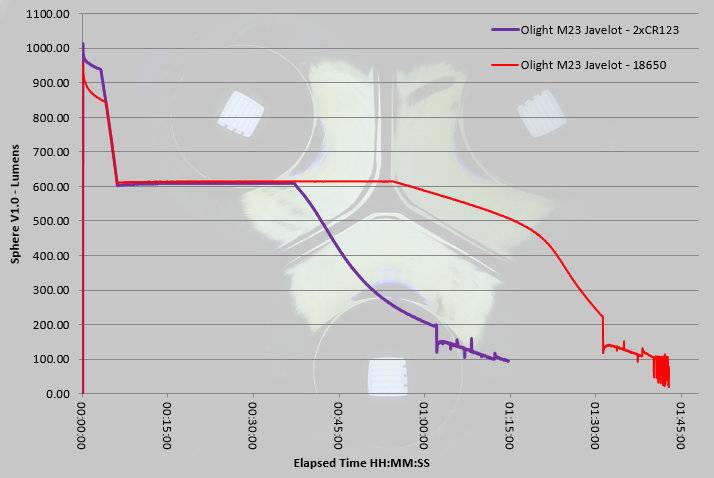
Overlaying the two runtime traces from 2xCR123 and 1×18650 shows that CR123 initially gives a slight boost in output for the first few minutes before the output for both power sources converge. This happens during the controlled output reduction to just over 600lm for the regulated level. CR123 runs out of steam earlier (as expected) falling out of regulation at around 35 minutes. 18650 holds regulation until about 55 minutes with a less sharp fall-off.
Both traces end with a period of inconsistent flickering output instead of cutting out.
 photo Olight M23 Javelot runtime.jpg

Troubleshooting

This section is included to mention any minor niggles I come across during testing, in case the information helps anyone else.

No issues were encountered during testing.

As per the description of this section, this information is provided in case anyone else finds a similar ‘issue’ that might be fixed in the same way.

The M23 in use

I’m going to get the main issue out of the way first – the holster. I can see what was intended with the holster, but for me it presents three main problems in use. Firstly getting the flap over the tail-cap, so you can secure it is far too difficult as it is a tight fit and doesn’t easily go over the M23’s tail-cap. It is possible that as it wears it will become easier, but this will only be due to the material softening and becoming frayed. Secondly the tail-cap switch is exposed, and with the design used for the tail-cap connection, it cannot be locked out; no lock-out and an exposed tailcap is going to lead to accidental activation. Lastly on the holster, though the ability to carry spare cells is welcome, by leaving them partially exposed, they can be lost or damaged; I don’t trust the cells holders myself.

The holster is full of good ideas, but I don’t find them to work terribly well.

Onto the M23 itself, and things swing back to positive – it is a typical single 18650 size light, with solid build quality; you definitely would feel confident that you could use the strike bezel if needed.

Rather than having the typical tail-cap to battery-tube connection that uses a battery tube with a flat end (most common), in the M23, Olight uses a design where the inside of the end of the battery tube is conical and the tail-cap contacts are pushed into the cone as you tighten the tail-cap. This means it is far less likely to break the connection, as the tail-cap needs to move significantly to lose contact. It makes the connection very robust, but does prevent the user from locking-out the M23 by unscrewing the tail-cap.

The pocket clip is very strong, a bit too strong for normal use. If this is going on your load carrier PALS webbing, OK, but for many users it will probably be too stiff.

Of course we must appreciate that JAVELOT beam. The custom XP-L Hi LED certainly does its job with plenty of power and an excellent hotspot. Unlike completely throw-orientated lights, the M23 manages a high beam strength without making the hotspot too small; it seems completely ideal for a light this size.

Normally I’m not keen on using lights with throw at close ranges, but the M23 seems to manage this in a way that is perfectly usable. However as a frosted glass diffuser is supplied, you can easily go full flood (at the expense of 33% loss of output) and have a perfect indoor flood-light beam. With the diffuser fitted it will not fit into the holster.

It is possible to tailstand the M23 even though the large switch boot (18mm) protrudes slightly. The combination of three large cut-outs around the button (giving easy access), and the large button itself make the M23 responsive and reliable to control.

The user interface seems extremely well suited to a ‘tactical’ design. Putting strobe to one side (all serious users of tactical lights I’ve spoken to don’t want strobe as it can be just as disorienting to the person using it), at least it needs a deliberate triple-click to activate it. Unfortunately, if you are ‘signalling’ with the M23 you can accidentally get strobe. Taking just those constant modes, you can easily set the M23 to be effectively a ‘high only’ light or a ‘low-high’ light. Setting high with the twisty interface means that your first press is always high, and if you double-tap the button you still have high. Setting low with the twisty interface means that your first press is always low, and if you double-tap the button you get high. Swapping between these configurations is easy and of course you could also make it ‘medium-high’ as well.

Overall a well thought-out light with solid build and a great beam; another JAVELOT success.

Review Summary

_______________________________________________ _______________________________________________
Things I like What doesn’t work so well for me
_______________________________________________ _______________________________________________
Strong beam with great throw for its size. Holster has issues.
Solid build. No lock-out.
Frosted Glass diffuser included. Strobe can be activated when signaling.
Well though-out UI. Pocket clip too stiff for most users.
Large, easily accessible button.
Can Tail-stand.
Durable tail-cap connection design.


Discussing the Review:

Please feel free to add comments to the review, but the ideal place to freely discuss these reviews is on a forum. If you started reading the shorter forum version of the review, but followed the link this full exclusive review, please return to that forum to discuss the review there.
If you read the review entirely on Tactical Reviews, please consider one of the following to join in any discussion.

CandlePowerForums – Flashlight Reviews Section (Largest and Friendliest Flashlight Community Forum)

EdgeMatters – Sponsored Reviews (UK based Forum for Knife Makers and Collectors)
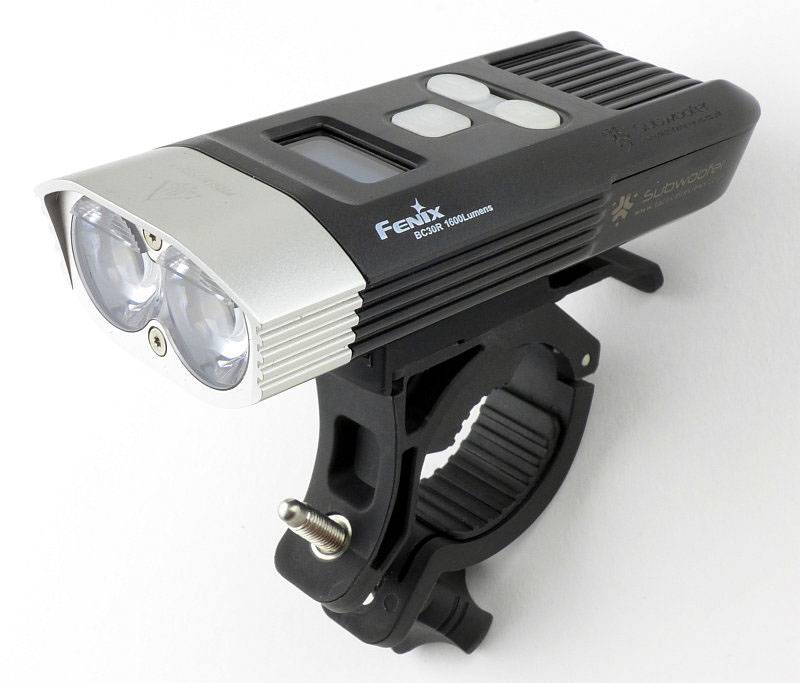
Light Review: Fenix BC30R Bicycle light with OLED Display

Winner of several awards on its release in 2015, the BC30R from Fenix continues to impress. The first light from Fenix to incorporate an OLED digital display, I’m hoping it won’t be the last, as this feature makes a great product outstanding.

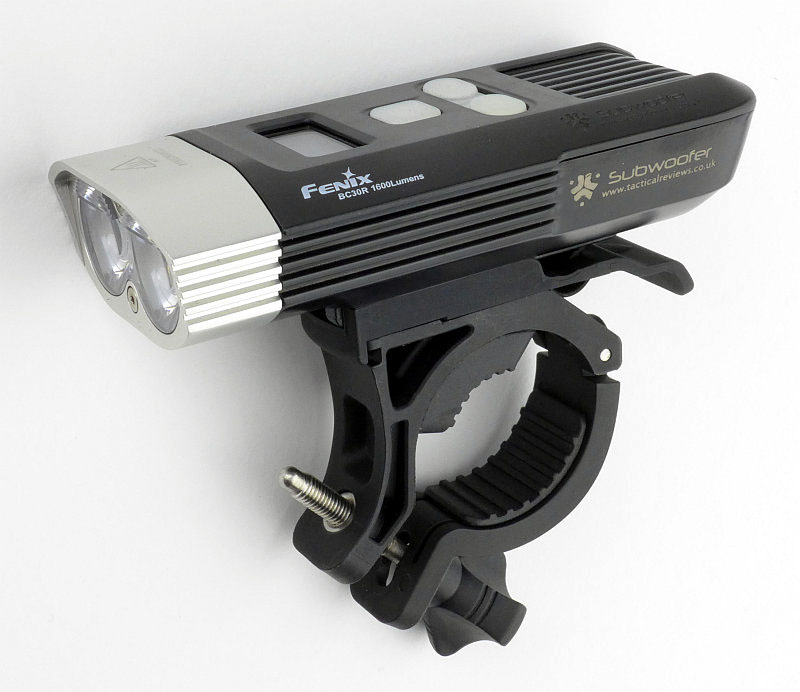
 photo 10 Fenix BC30R angle02 P1150886.jpg
Tactical Reviews takes a closer look and makes comparisons to the previously reviewed BC30.

Taking a more detailed look:

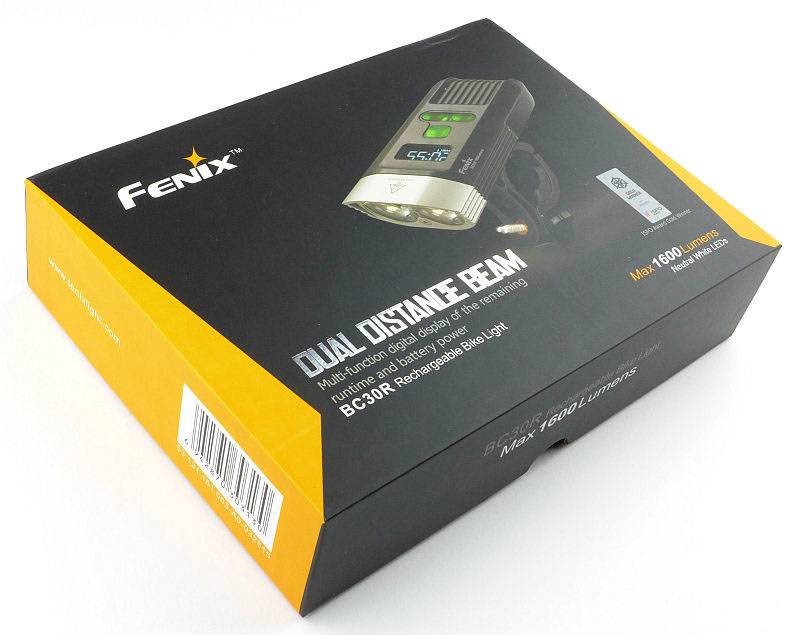
As with the other Fenix Bike lights I’ve had, the BC30R arrives in a presentation box.
 photo 01 Fenix BC30R boxed P1150850.jpg

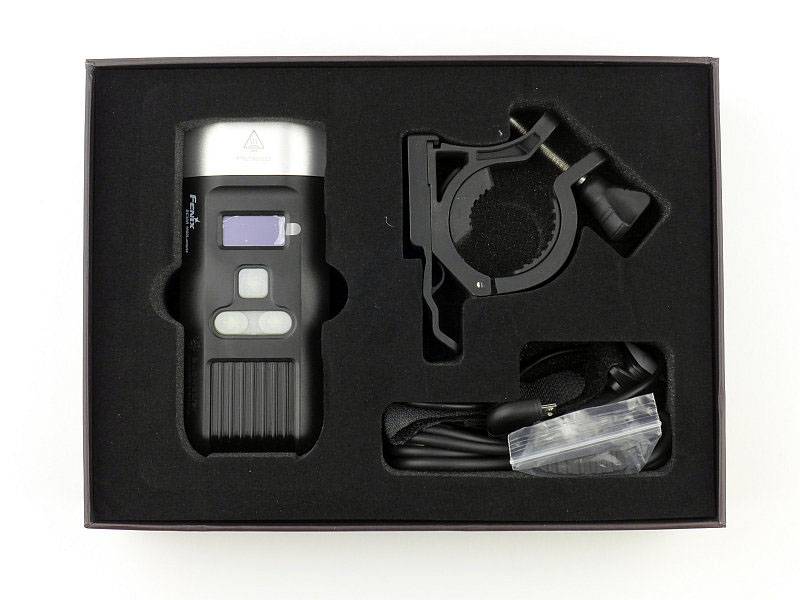
The light unit and accessories are held in shaped cutouts in the foam liner.
 photo 02 Fenix BC30R box open P1150855.jpg

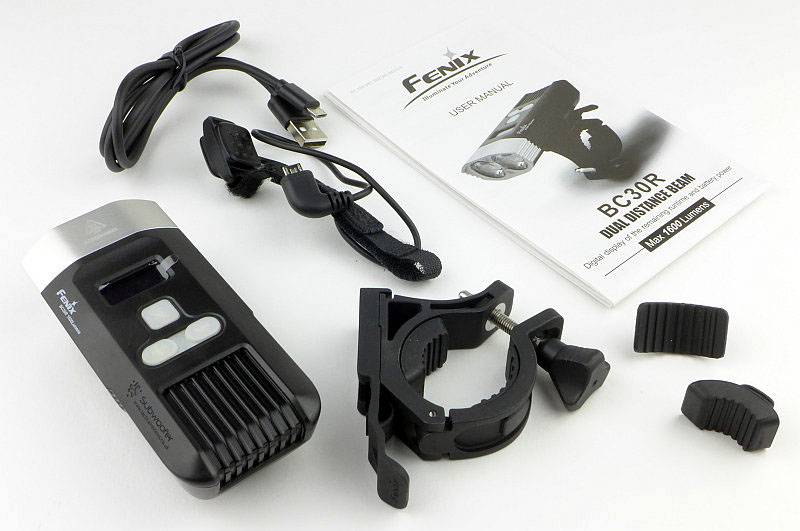
Included with the BC30R is a quick-release mount with rubber spacers (for different size handlebars), a remote switch for Burst mode, a USB charging cable and the instructions.
 photo 03 Fenix BC30R box contents P1150865.jpg

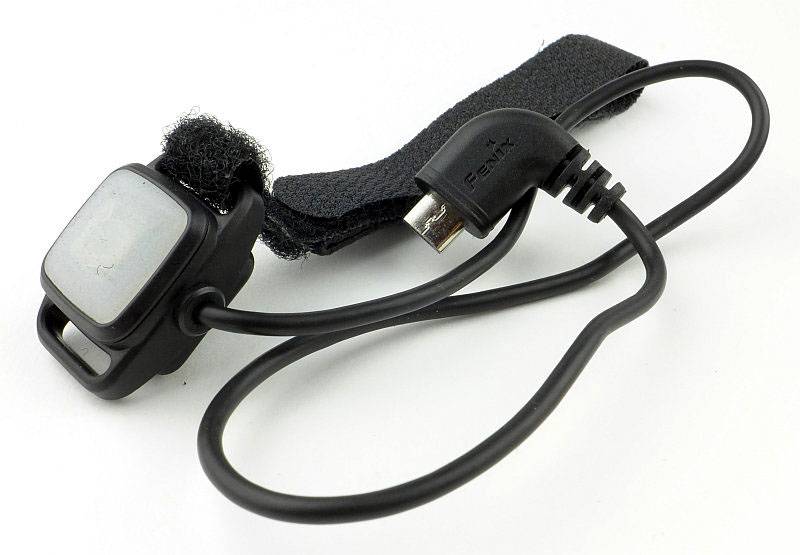
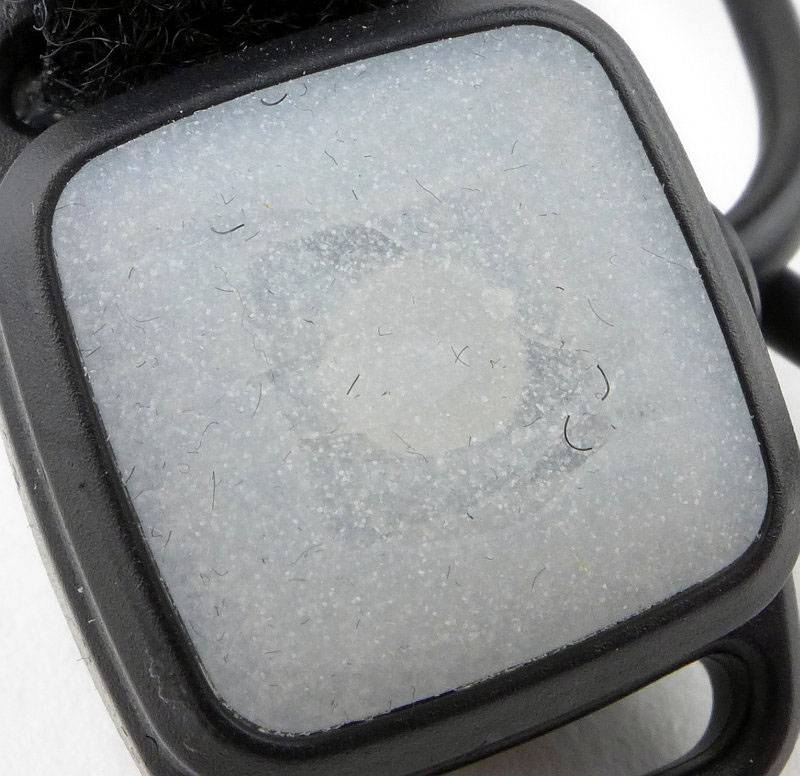
The burst switch has a micro-USB plug to connect to the BC30R, and a Velcro strap for fitting to the handlebar. The button has the Fenix logo moulded into it, but this has proven virtually undetectable in the photographs.
 photo 04 Fenix BC30R burst switch P1150867.jpg

Looking even closer, you can still not really make out the Fenix logo. The switch material is a GITD rubber.
 photo 05 Fenix BC30R burst switch button P1150869.jpg

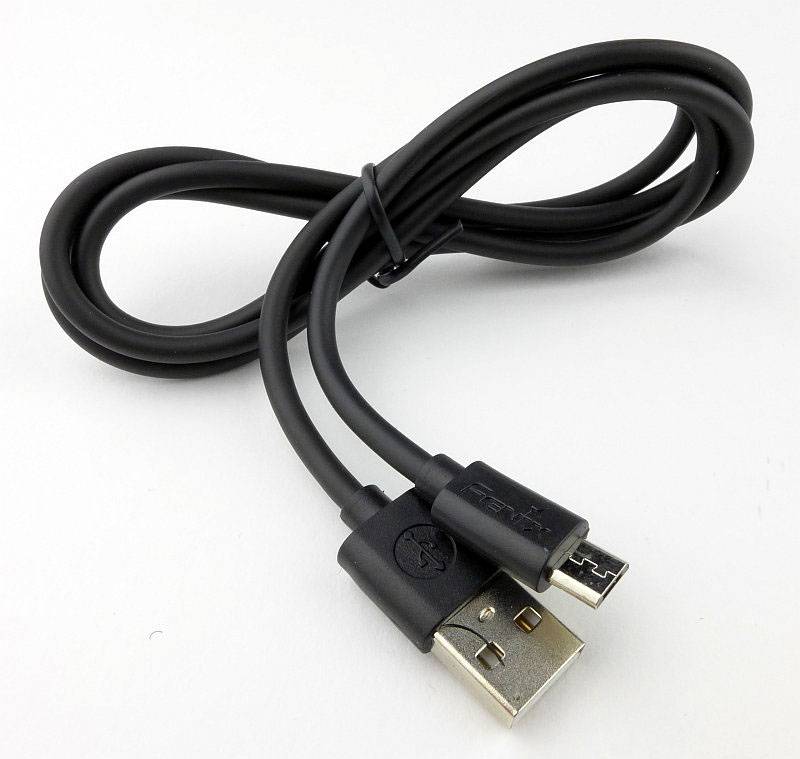
A well made micro-USB cable is included and is branded as Fenix.
 photo 06 Fenix BC30R USB cable P1150870.jpg

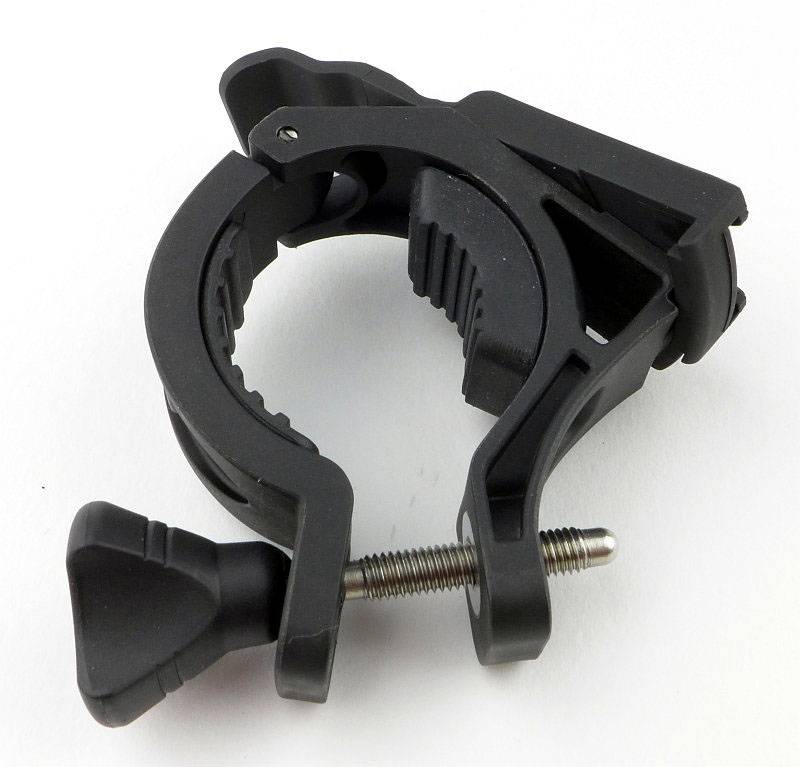
The mount is very sturdy and easy to use. In this photograph the top of the mount has been angled to show the adjustment available to the user.
 photo 07 Fenix BC30R mount P1150872.jpg

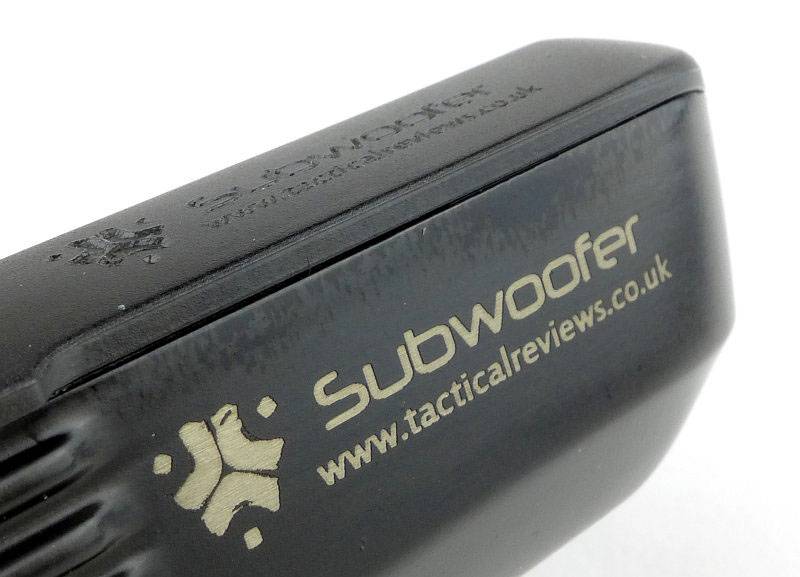
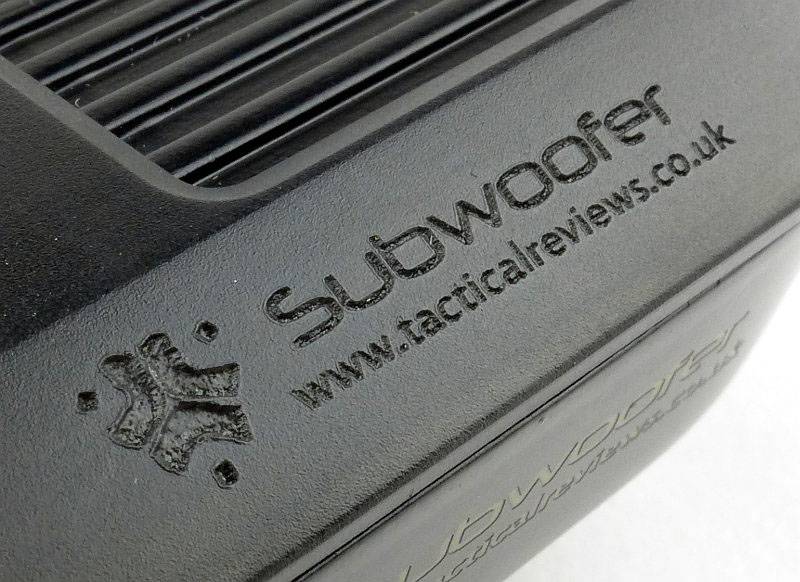
MyFenix have Laser engraved the Tactical Reviews logo onto the upper casing (plastic) and the lower casing (aluminium) giving two very different finishes.
 photo 08 Fenix BC30R rear angle P1150878.jpg

On the metal casing the engraving has taken off the paint to show a slightly golden-brown metal surface.
 photo 11 Fenix BC30R engraving P1150888.jpg

On the plastic casing the engraving looks quite different. Both engraving effects are very appealing.
 photo 12 Fenix BC30R engraving P1150890.jpg

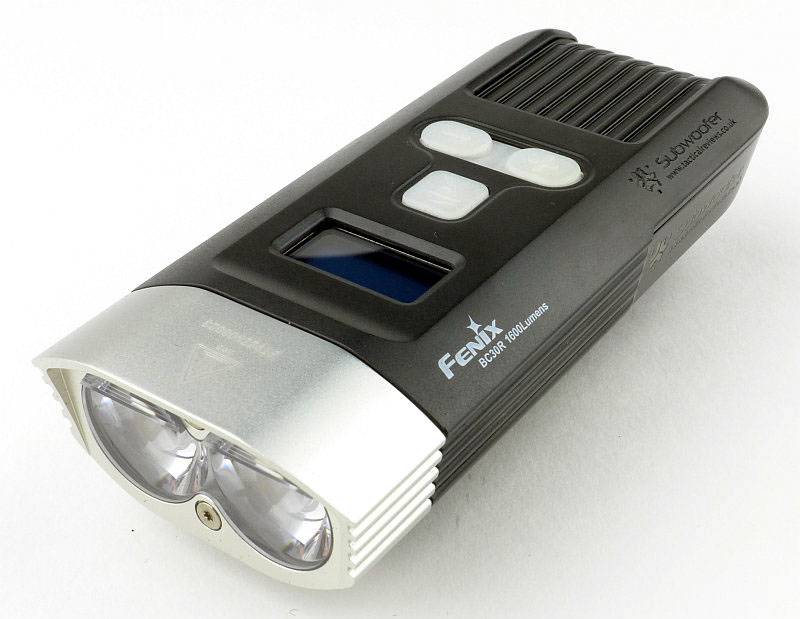
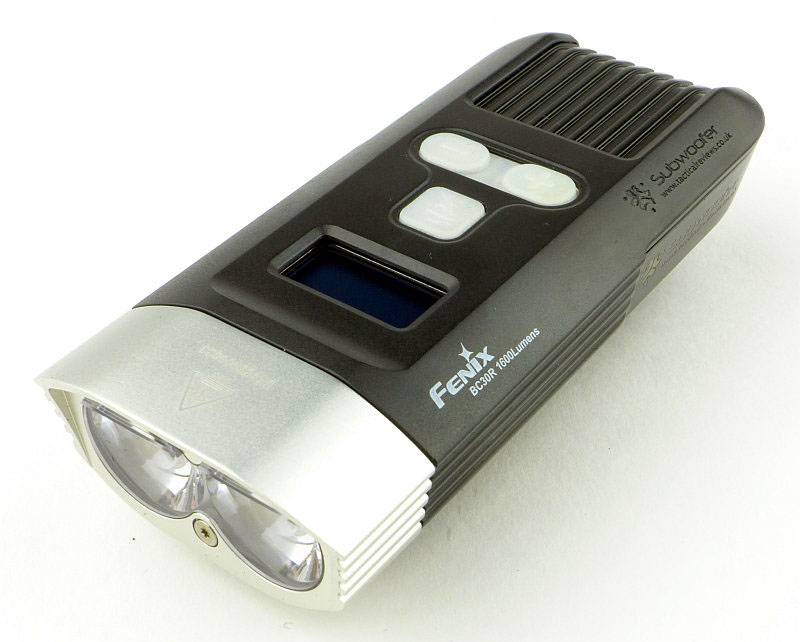
On the top of the BC30R are the three control buttons and the OLED display.
 photo 09 Fenix BC30R angle01 P1150885.jpg

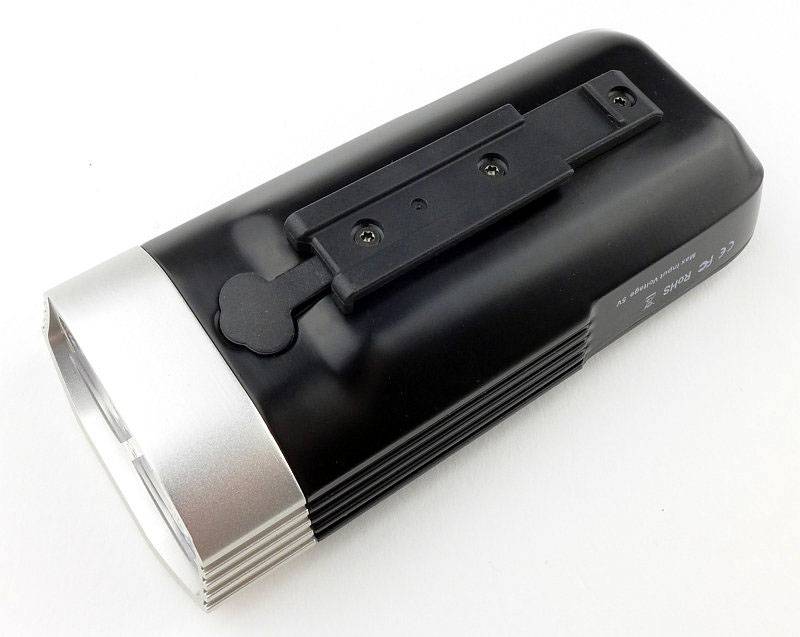
Flipping it over there is the quick-release mounting rail and the USB port cover.
 photo 14 Fenix BC30R underneath P1150899.jpg

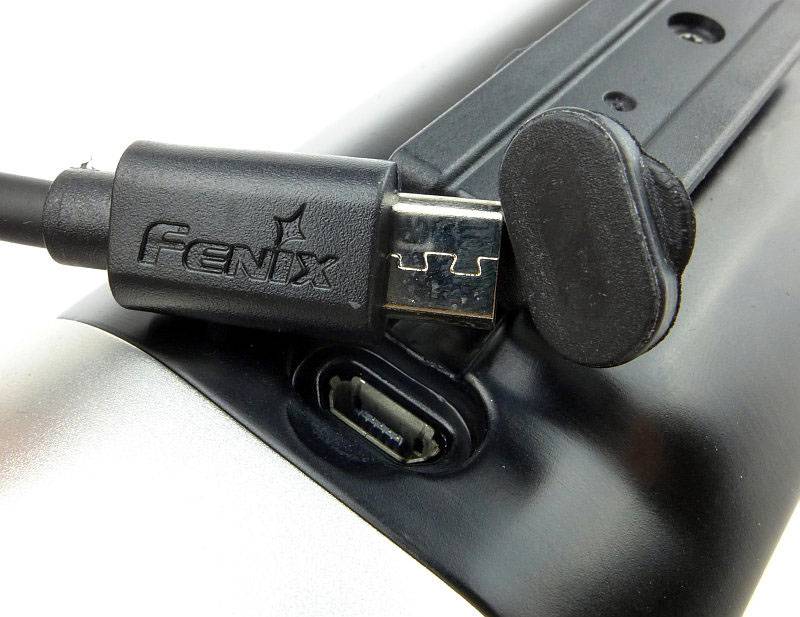
Lifting up the cover reveals the micro-USB port.
 photo 15 Fenix BC30R USB connect P1150902.jpg

The BC30R slides onto the mount from the front, locking into place. The tab at the rear of the BC30R is pushed down to release the unit and allow it to slide forwards.
 photo 16 Fenix BC30R plus mount P1150906.jpg

Two XM-L2 LEDs are used with specially designed optics the produce a reduced glare beam (reduced glare for oncoming traffic).
 photo 21 Fenix BC30R LEDs P1150934.jpg

The top section of the optic is responsible for directing light that would otherwise be wasted upwards (and cause glare to other people) down onto the ground where it is useful.
 photo 22 Fenix BC30R optics P1150941.jpg

To charge, simply connect up the USB cable. The BC30R will charge from any suitable USB port/charger with only the charge time varying. I did not measure more than 1.2A draw across various high power chargers.
 photo 23 Fenix BC30R charging P1150946.jpg

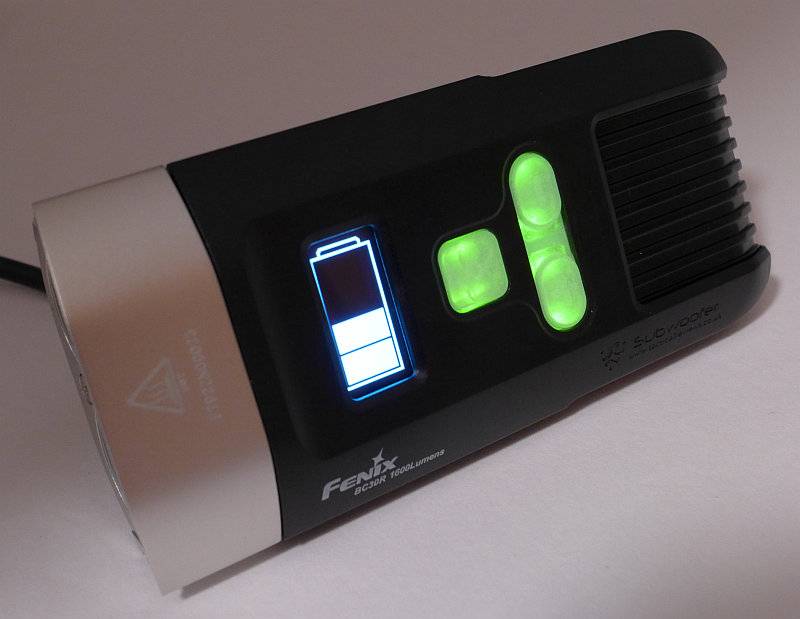
During charging the buttons are lit green, and the OLED display shows the approximate charge level.
 photo 24 Fenix BC30R charging P1150954.jpg

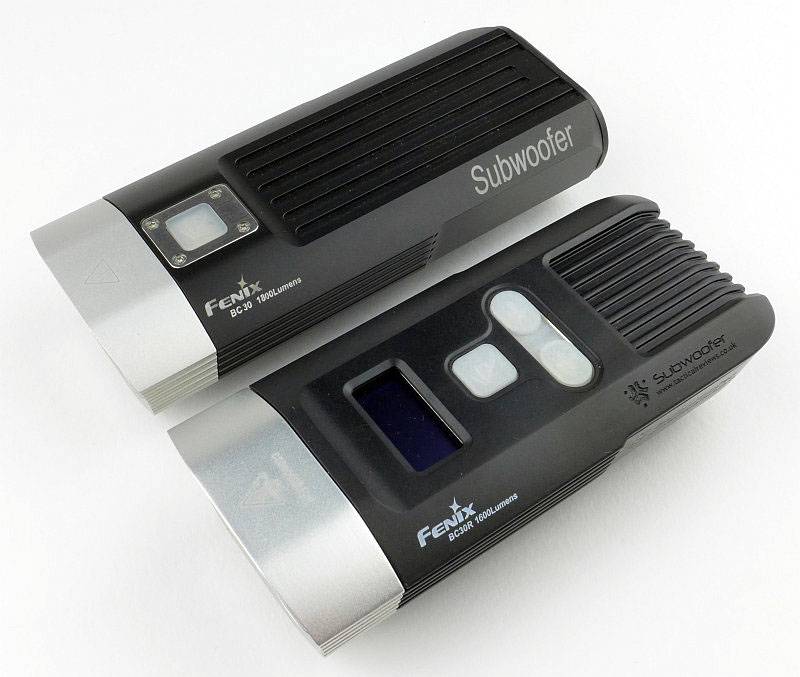
There is an almost direct comparison with another Fenix model, the BC30. The BC30 is a simpler version without the OLED display, but with user-changeable cells. Then next three photographs show how they compare in size.
 photo 25 Fenix BC30R BC30 P1160336.jpg

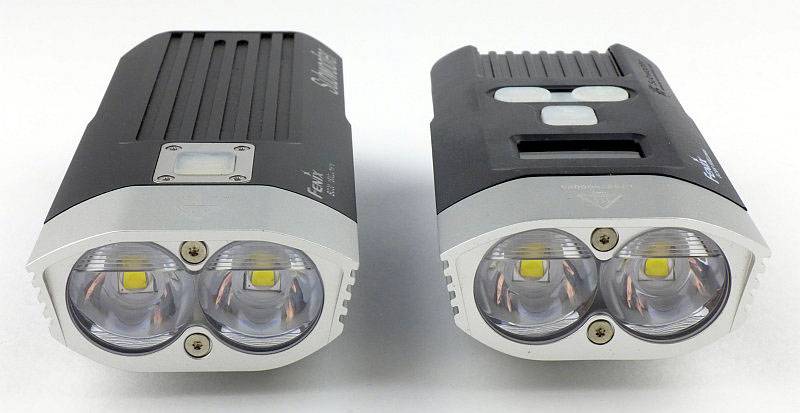
If you look dead on from the front (lower than the view in this photo) you would be pushed to tell the difference as the bezel, optics and LEDs are the same.
 photo 26 Fenix BC30R BC30 P1160343.jpg

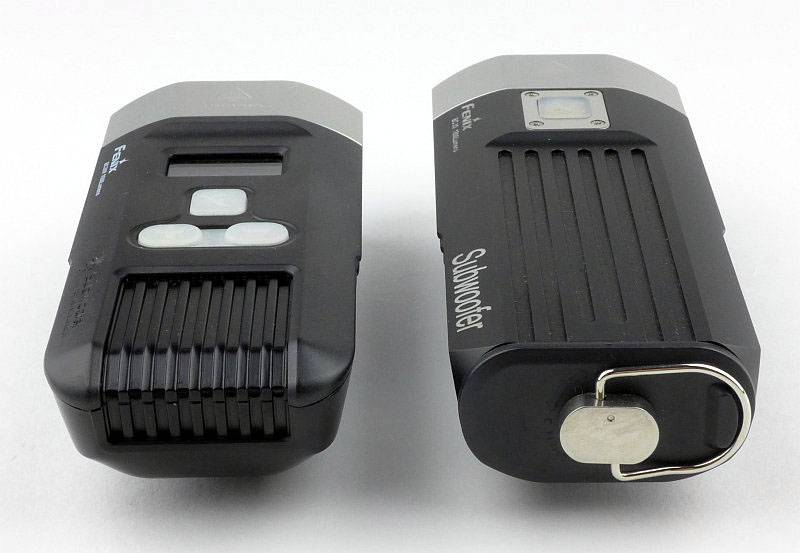
With its changeable cells, the BC30 has a lever to open the battery compartment on the back.
 photo 27 Fenix BC30R BC30 P1160344.jpg

The beam

Please be careful not to judge tint based on images you see on a computer screen. Unless properly calibrated, the screen itself will change the perceived tint.

The indoor beamshot is intended to give an idea of the beam shape/quality rather than tint. All beamshots are taken using daylight white balance. The woodwork (stairs and skirting) are painted Farrow & Ball “Off-White”, and the walls are a light sandy colour called ‘String’ again by Farrow & Ball. I don’t actually have a ‘white wall’ in the house to use for this, and the wife won’t have one!

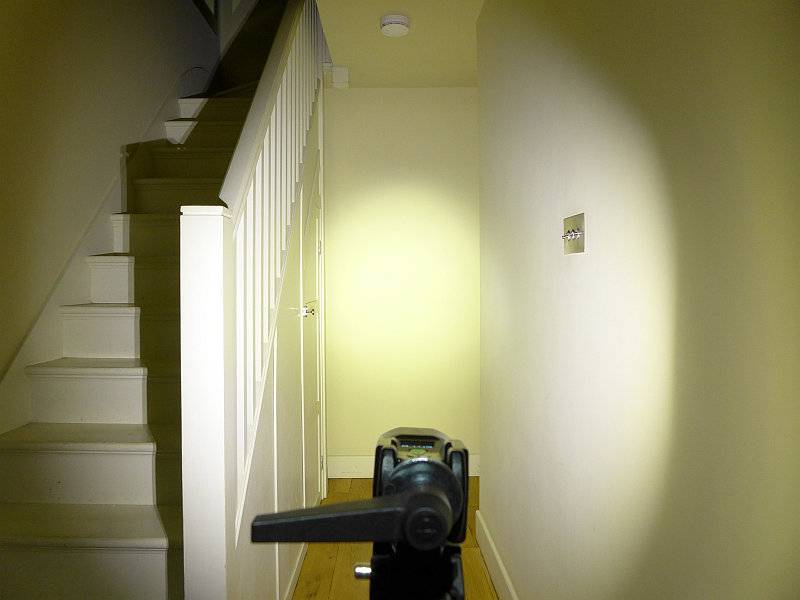
Fenix have concentrated on what makes a real difference to riders. Neutral white emitters are used to help with colour recognition and making the rider’s view clearer. The effects of the optic are not that obvious in this scenario.
 photo 28 Fenix BC30R indoor P1170363.jpg

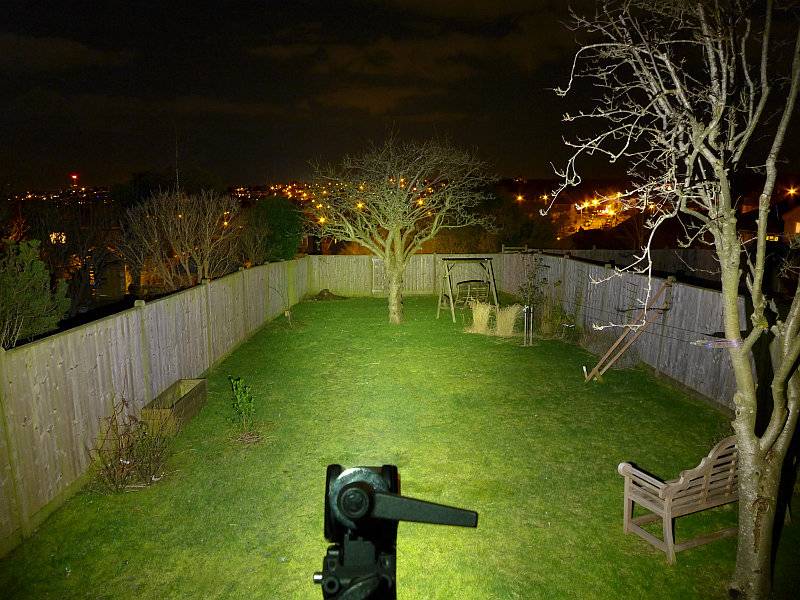
Taking Tactical Review’s standard outdoor shot, the area is well lit right up to the camera. The optic has directed light down to the area directly in front of the user.
 photo 29 Fenix BC30R outdoor P1170279.jpg

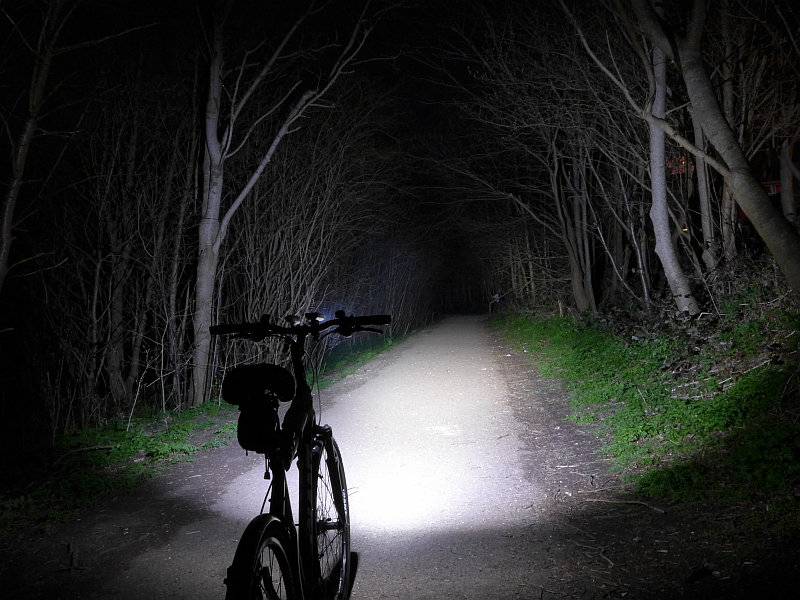
The effect is shown more clearly on the bike trail with the BC30R mounted level, additional light is directed to the area in front of the bike so you can see what you are about to ride over, not just what is well ahead of you.
 photo 30 Fenix BC30R outdoor trail P1170431.jpg

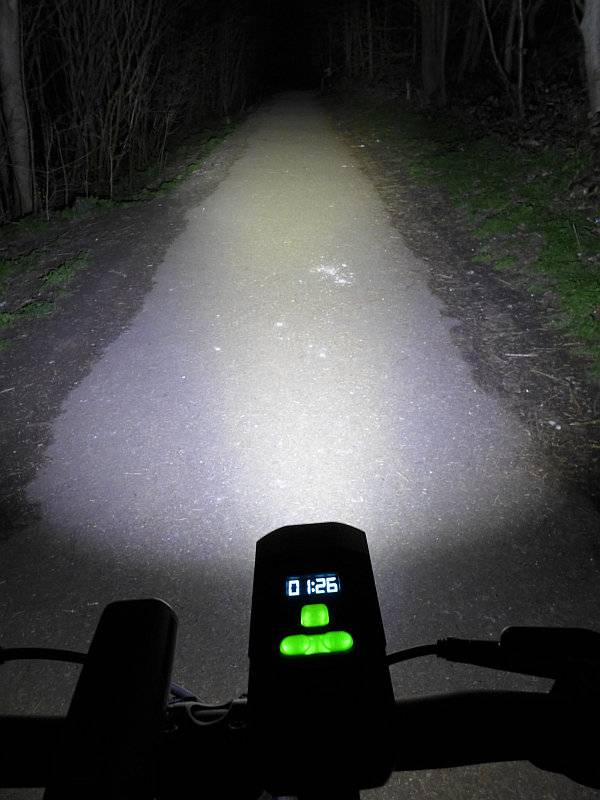
A rider’s eye view looking down onto the BC30R. Remaining runtime is clearly shown, and the buttons are lit green to make them easy to find. Unlike other illuminated switches I’ve tested this is not distracting or too bright.
 photo 31 Fenix BC30R outdoor trail display P1170435.jpg

Modes and User Interface:

A significant differentiator for the BC30R is its OLED display which becomes an outstanding feature of the user interface.
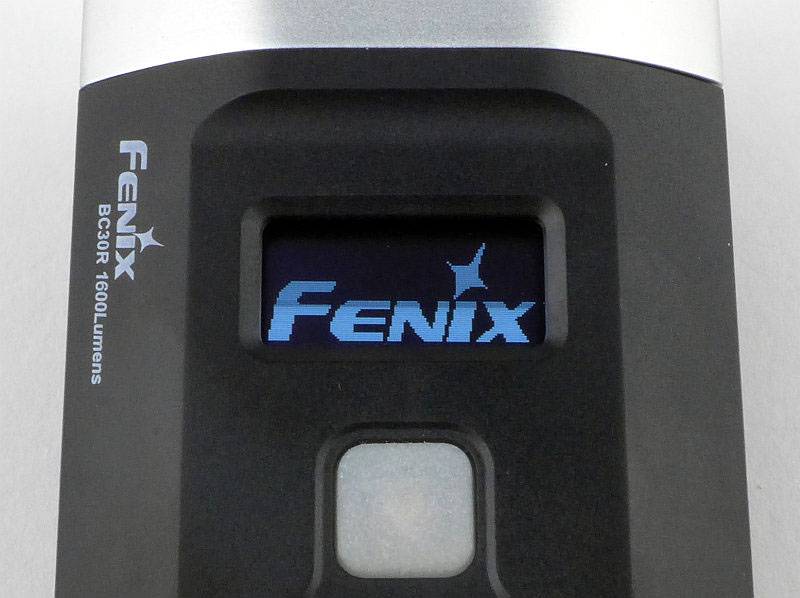
 photo 19 Fenix BC30R screen P1150919.jpg

There are three buttons which are used to control the output, the main power switch and a ‘+’ and ‘-‘ button to go up and down output levels. Also included is a remote switch button which only controls the Burst mode.
You can choose from Burst (using remote switch), High, Medium, Low and Eco plus a flashing mode.

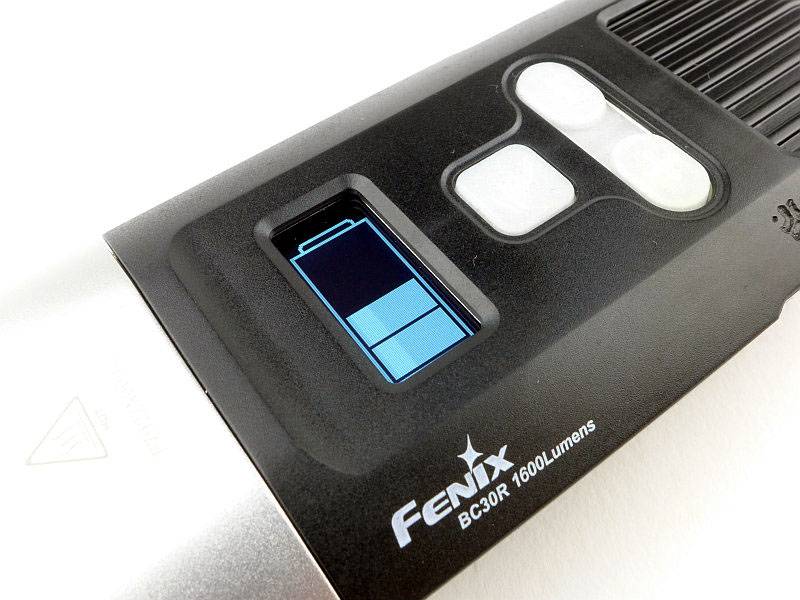
To check the current state of charge of the battery, from OFF, briefly press the power switch and a battery symbol will be displayed on the OLED screen. In this case the cell is between 50% and 75% charged. During charging this charge indicator is also shown.
 photo 13 Fenix BC30R charge level P1150895.jpg

To switch onto Burst, from OFF or ON any mode, press the remote switch.
From OFF press and hold the power button for 1s to turn ON to the last used steady mode.
When ON use the ‘+’ and ‘-‘ buttons to increase or reduce the output. Once you reach the lowest output pressing the ‘-‘ button again does nothing, and the same is true when going the other way.

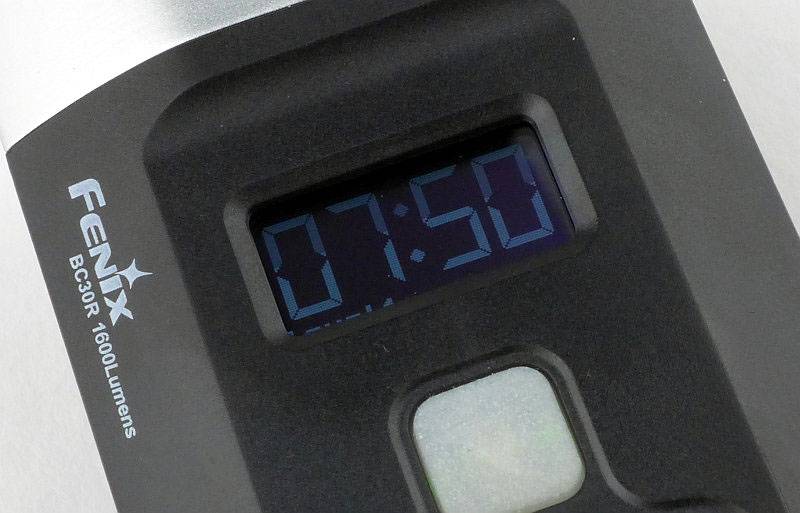
During normal use, the OLED display on the BC30R will show the remaining runtime (an excellent feature) for that mode. When you turn the BC30R ON, its display initially shows the level and the ‘hours’ part of the remaining runtime and then it calculates the ‘minute’ part. Here the remaining runtime for the level 7h50m. If you change mode, this is recalculated and an updated value displayed.
The reason the numbers look dim is due to the display using a raster effect. The shutter speed used has not captured the full display at maximum brightness. To the eye it looks clear and bright.
 photo 20 Fenix BC30R screen P1150925.jpg

For flashing mode, from ON, double-click the power button. A lightning bolt is shown flashing on the OLED display and no runtime is shown. To exit flashing mode press the power button once.
To switch OFF, press and hold the power button for 1s.

Batteries and output:

The runs on a built in battery pack.

To measure actual output, I built an integrating sphere. See here for more detail. The sensor registers visible light only (so Infra-Red and Ultra-Violet will not be measured).

Please note, all quoted lumen figures are from a DIY integrating sphere, and according to ANSI standards. Although every effort is made to give as accurate a result as possible, they should be taken as an estimate only. The results can be used to compare outputs in this review and others I have published.

___________________________________________ ________________________________ ________________________________
BC30R using built in battery pack I.S. measured ANSI output Lumens PWM frequency or Strobe frequency (Hz)
___________________________________________ ________________________________ ________________________________
Burst – Only 20s run on Burst 1883 0
High 1000 0
Mid 597 0
Low 255 0
Eco 130 0

* Beacon and Strobe output measurements are only estimates as the brief flashes make it difficult to capture the actual output value.

Peak Beam intensity measured 3600 lx @1m giving a beam range of 120 m.

There will be parasitic drain but it cannot be measured as the unit is sealed.

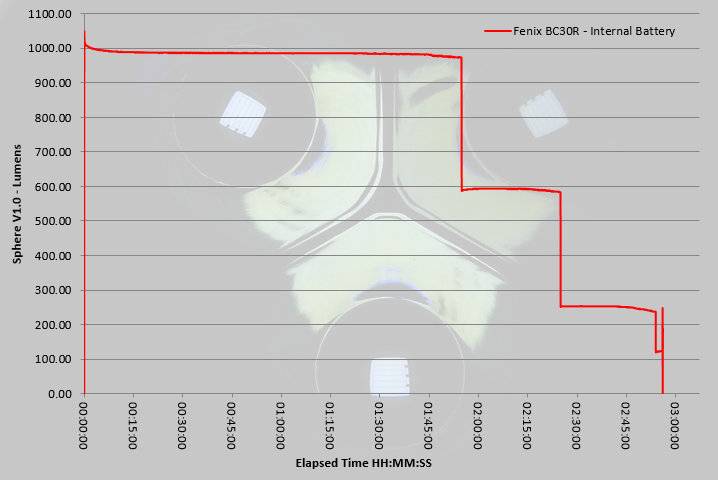
A very predictable runtime profile with a nicely consistent output on High for nearly 2 hours, then stepping down to Medium for around 30 minutes then Low for 30 minutes with a last short time on Eco.
 photo Fenix BC30R runtime.jpg

Troubleshooting

This section is included to mention any minor niggles I come across during testing, in case the information helps anyone else.

No issues were encountered during testing.

As per the description of this section, this information is provided in case anyone else finds a similar ‘issue’ that might be fixed in the same way.

The BC30R in use

If you do a lot of night time riding, the BC30R is something you will really appreciate. Apart from the great beam, it is the OLED display and the information it shows which will make you wonder how you ever did without it.

Having a clear ‘remaining runtime’ showing on the display allows you to plan your ride and ensure you get home without losing light. If you are a bit late and the runtime is not long enough, drop down a level and see if you now have enough light to get back. If not drop down a level again.

Although other lights may have battery low indications, generally once they show up you really have to stop and change the batteries or risk losing light while moving. Though usually not a serious issue, you just don’t get any clearer than the count-down of the actual runtime remaining.

One could argue that as the BC30R has a built-in rechargeable battery pack, that this is then a necessary feature as you can’t swap the batteries if they run out. Before testing it, I might have agreed, but with this information, planning is so easy and you can adjust the output based on your needs at the time. Part of the route might need ‘High’ for you to see by, but other parts might only need ‘Eco’ for you to be seen by. Swapping between these on a standard light will mean any guess you might make for remaining runtime will be wildly inaccurate, especially if spanning a few rides. You will then end up charging the batteries more often than needed just to be safe.

With just the basic charge level indicator, you can quickly see if it is worth a top-up before your ride, then during the ride have the peace of mind it will run for as long as it shows on the display.

Back to the beam, and prior to getting the BC30R, the BC30 had taken over as my primary bike light thanks to its excellent beam shape, power and colour. Despite having a built-in battery, the BC30R has superseded the BC30 (now relegated to a backup light) as my primary light.

The more you come across other riders with LED lights, the more you realise the glare reduction feature is something all bike lights should have. Knowing that you are creating far less glare than a standard reflector or optic gives you a better feeling when you want to turn up the power. This is not just a benefit for other road users but for pedestrians as well. The trails I ride often have dog walkers on them, and some lights I’ve tested have them shielding their eyes, but not the BC30R.

As a right-hander, I have the BC30R mounted to the right of the stem. This places the ‘-‘ button closest to my thumb. Generally my requirement for a quick adjustment in output is to turn it down, so this fits in nicely when coming across other riders or pedestrians on the bike trails.

The first few times I went out with the BC30R I used the remote switch, but more recently I’ve not bothered with it. It is useful to be able to flash up to maximum output (though only for 20s) but less so than I originally thought. The main annoyance is that you have to unplug the cable when taking the BC30R off your bike, and if you are leaving the bike locked up outside you may want to take the switch off too. After doing this a few times, I found the benefits were outweighed by the bother of connecting the switch as you have to do it before sliding into the mount. For a fixed off-road rig where you don’t have any security issues, I would use it, but commuting or rides with stops that require the bike to be locked up, it loses its attraction.

One particular part of a trail I ride regularly has an old very broken-up tarmac section which is very harsh on lights and their mounts. Most light end up shaking round the handlebar or wobbling violently. Like the BC30, which uses the same mount, the BC30R takes this in it stride and doesn’t budge or vibrate.

When fitting the clamp, the screw is very powerful and does cause the mount to rotate around the bar slightly as it gets tighter. Getting it to be in the right final position took a couple of attempts, but once fully tightened in the correct position it is not going anywhere.

It has surprised me how easily the BC30R has overcome my general dislike of lights with built-in batteries, but that OLED display has made all the difference.

Review Summary

_______________________________________________ _______________________________________________
Things I like What doesn’t work so well for me
_______________________________________________ _______________________________________________
OLED display showing remaining runtime. Built-in battery.
Shaped beam. Remote switch can become a nuisance to fit and remove.
Neutral white beam tint. USB port cover rubs off black marks
USB charging. ‘+’ and ‘-‘ symbols difficult to see.
Solid, Quick-Release, bar mount.
Low glare.
1000lm continuous output.


Discussing the Review:

Please feel free to add comments to the review, but the ideal place to freely discuss these reviews is on a forum. If you started reading the shorter forum version of the review, but followed the link this full exclusive review, please return to that forum to discuss the review there.
If you read the review entirely on Tactical Reviews, please consider one of the following to join in any discussion.

CandlePowerForums – Flashlight Reviews Section (Largest and Friendliest Flashlight Community Forum)

EdgeMatters – Sponsored Reviews (UK based Forum for Knife Makers and Collectors)
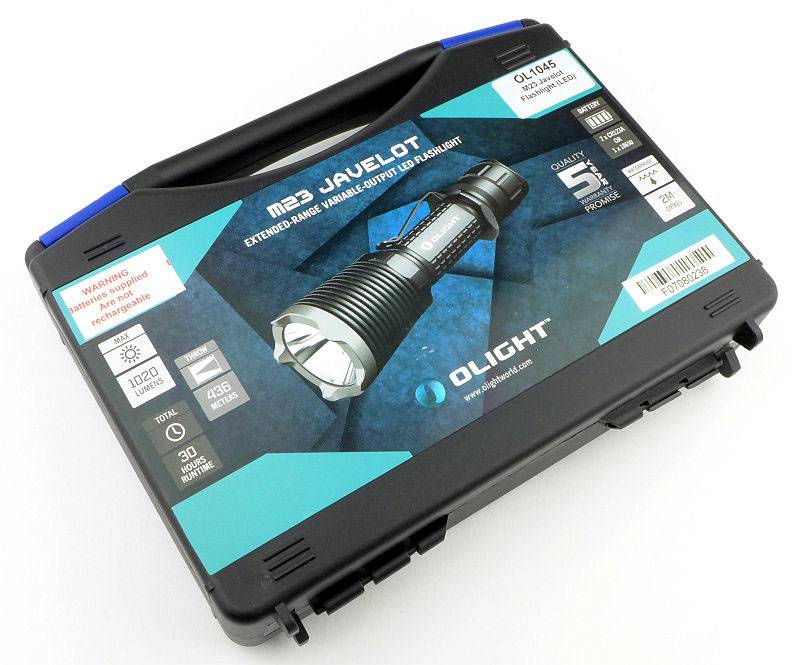
 photo 17 Fenix BC30R plus mount P1150911.jpg

Gear Review: ZTS MBT-1 Pulse Load Battery Tester

In the course of reviewing, I use rather a large number of primary and rechargeable cells. MyFenix generously sent Tactical Reviews a ZTS MBT-1 Pulse Load battery tester to help me keep track, and it has certainly proven its worth.

 photo 05 ZTS probe out P1150583.jpg

Taking a more detailed look:

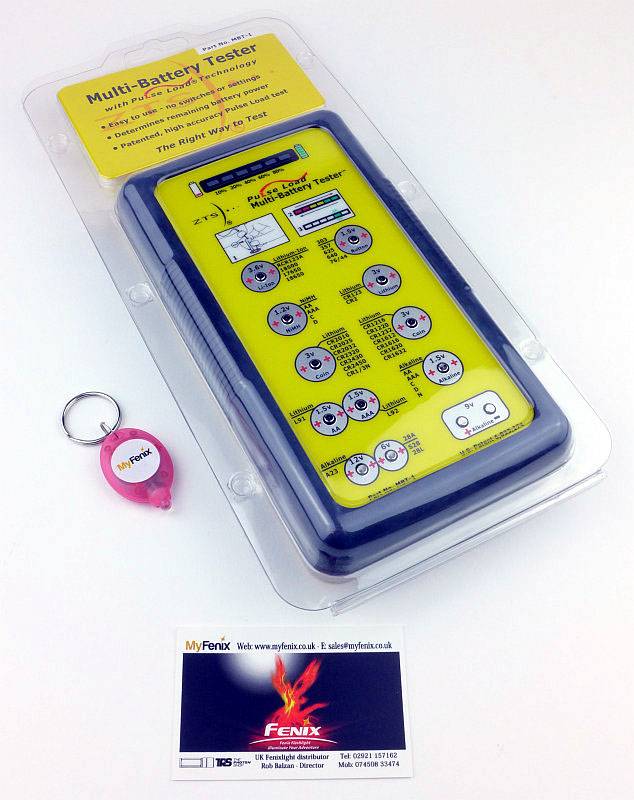
Unlike many blister packs, the MBT-1 has an easy to open blister pack as it is closed by moulded poppers. This means you can use to store the MBT-1 in if you want.
 photo 01 ZTS boxed P1150570.jpg

There are two information leaflets included with the MBT-1.
 photo 02 ZTS unboxed P1150577.jpg

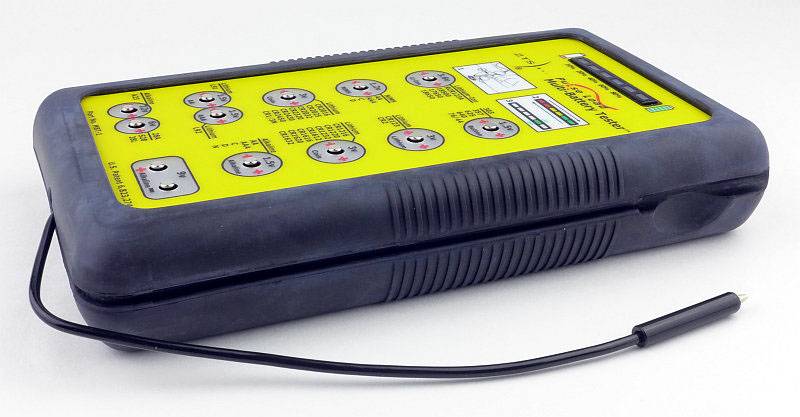
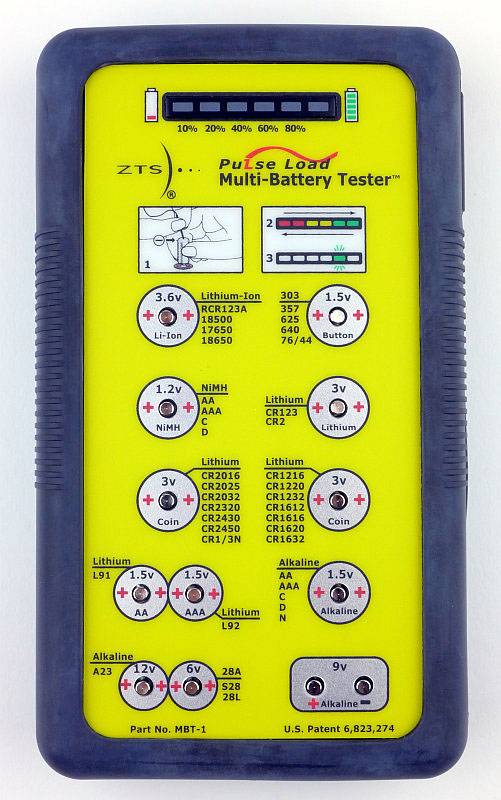
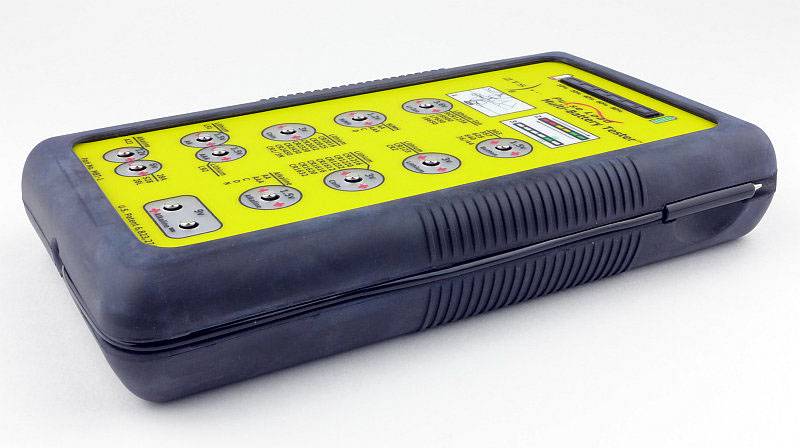
On the front panel are a set of contacts for the positive terminals of the various cells to be placed onto when testing them.
 photo 03 ZTS front P1150578.jpg

Tucked away neatly along the side is a test probe and its wire.
 photo 04 ZTS probe stowed P1150580.jpg

The probe pops out easily for use.
 photo 05 ZTS probe out P1150583.jpg

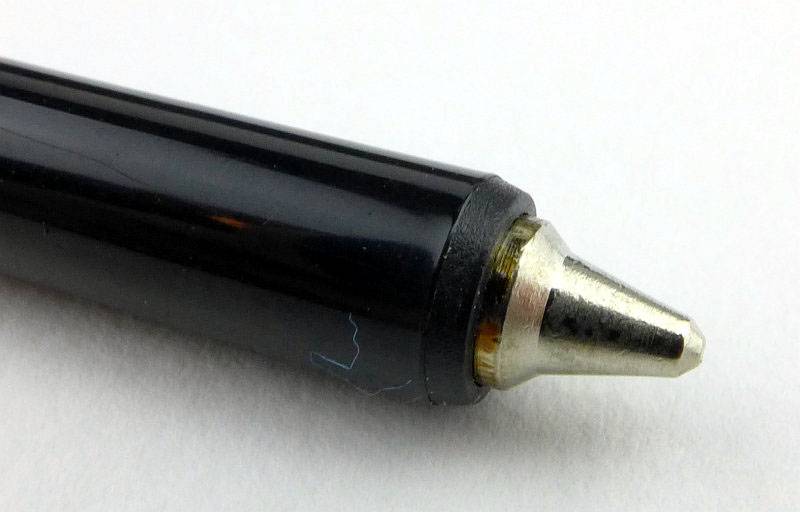
A closer look at the probe tip.
 photo 06 ZTS probe tip P1150587.jpg

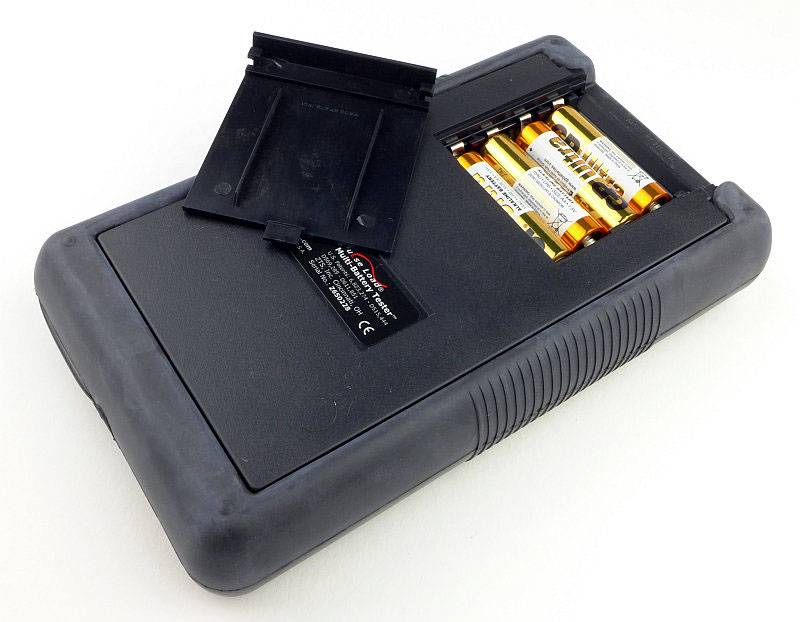
This battery tester, runs on 4xAA batteries fitted into a compartment on the back.
 photo 07 ZTS back cover off P1150592.jpg

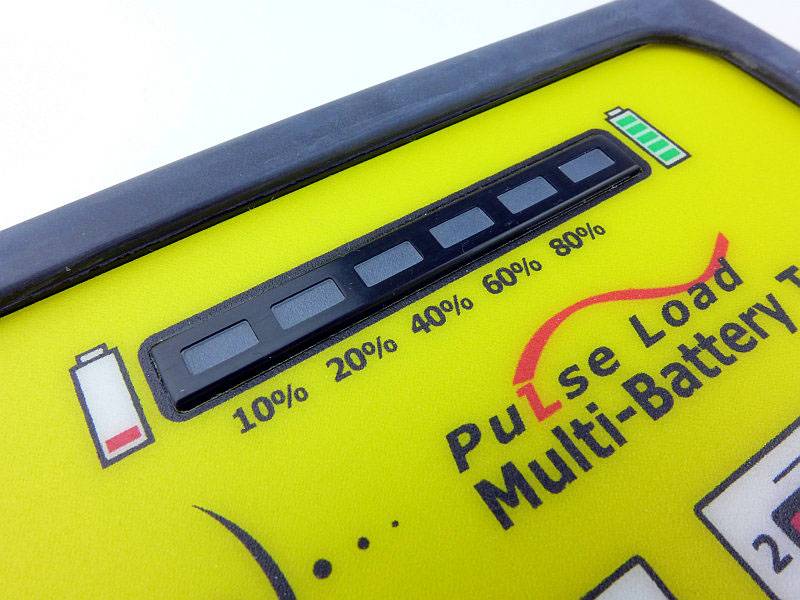
There is a simple display showing percentages from 10% to 100% capacity.
 photo 09 ZTS display P1150602.jpg

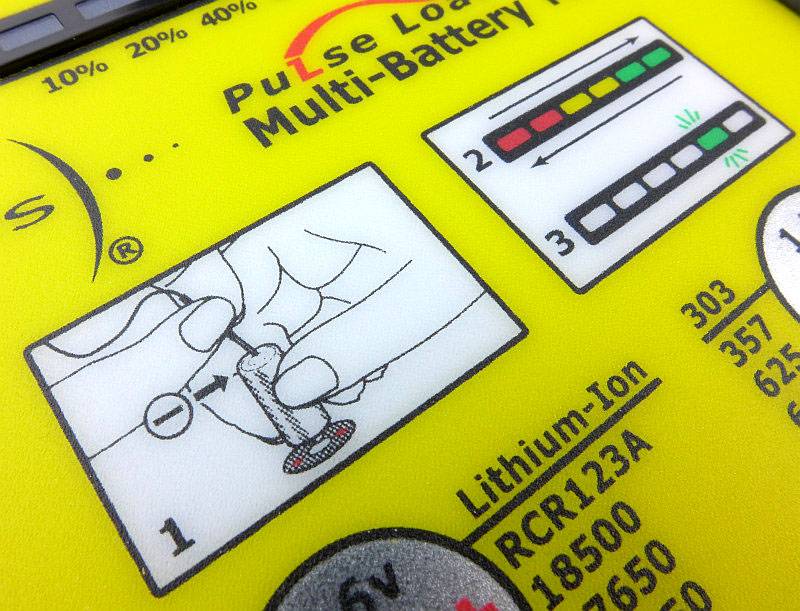
In case you misplace the instructions, there is a reminder on the front panel.
 photo 10 ZTS method P1150603.jpg

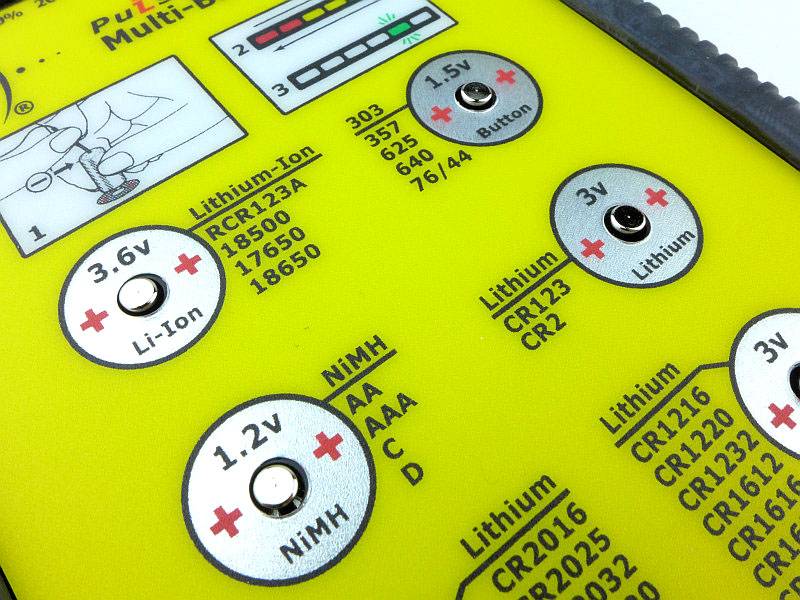
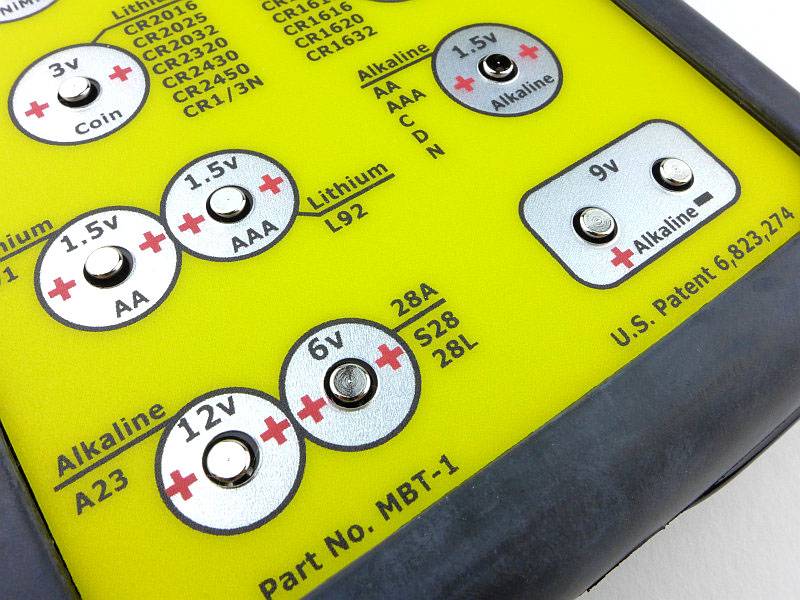
I’m not going to list all the exact cells as they are in the picture, but the tester works with Li-ion, various button cells, NiMh….
 photo 11 ZTS types P1150606.jpg

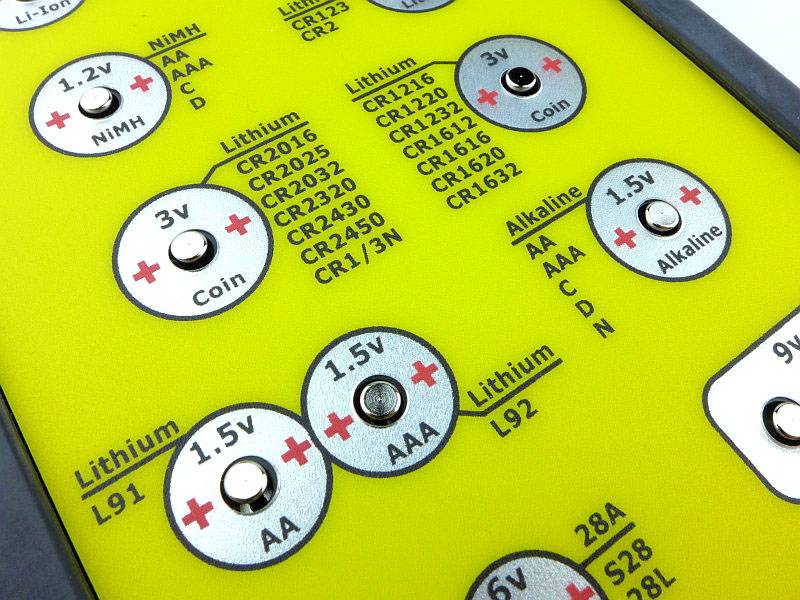
…loads more coin cells, Energizer L91 and L92, 1.5V Alkaline…
 photo 12 ZTS types P1150608.jpg

…12V and 6V Alkaline and 9V Alkaline.
 photo 13 ZTS types P1150609.jpg

Troubleshooting

This section is included to mention any minor niggles I come across during testing, in case the information helps anyone else.

No issues were encountered during testing.

As per the description of this section, this information is provided in case anyone else finds a similar ‘issue’ that might be fixed in the same way.

The MBT-1 in use

Even moderate battery users are going to appreciate the MBT-1. It is easy enough to lose track of which cells are which and then have to start again with new cells or recharging cells. Not so with the MBT-1 as it is so quick and easy to test a cell and find out its real condition. You can also check cells in remote controls, doorbells and other devices that would otherwise have no indication of the condition of the batteries.

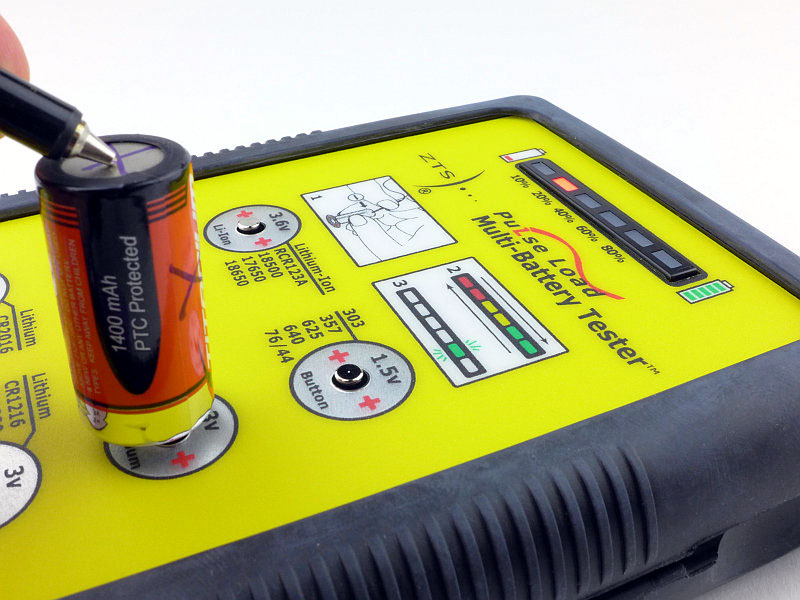
Remember, this is not a voltage based tester, it is a pulse load tester. Cells can often recover their voltage when not loaded, so the reason this tester has so many test contact points for different cells, is because it is actually loading the cell to truly test how it responds when it will actually have to do some work (so needs to use the different responses at each contact point to work out the percentage).

Notice in this photo I have marked an X on the cell with a sharpie to indicate it has been used for a runtime test. Normally I simply discard these cells as I’ve taken the test light down to the ANSI cut-off, but as you can see here the MBT-1 has revealed that this cell still has 20% capacity left. Perfectly fine to use for some low output backup lights and not yet ready for the recycle bin.

I’ve even found that it can be worth testing new cells as I’ve had some turn out not to be matched perfectly for use in multi-cell lights.

The testing methodology is that even during the first set of pulse loads the cell may have recovered and give a false reading, so the recommendation is to test each cell three times. That last reading is the most accurate.

No more guessing with straight voltage readings, simple quick and effective testing.

Review Summary

_______________________________________________ _______________________________________________
Things I like What doesn’t work so well for me
_______________________________________________ _______________________________________________
Pulse load testing (not simply voltage). Relatively expensive.
Huge range of cells can be tested. Relatively bulky.
Very simple to use.
Allows for cells to be matched and graded.
Minimises wastage.

A big thanks to MyFenix for supporting Tactical Reviews with this ZTS MBT-1 Battery Tester (MyFenix is the Official UK Fenix Distributor).

Special Preview: The New Large Inkosi from Chris Reeve Knives

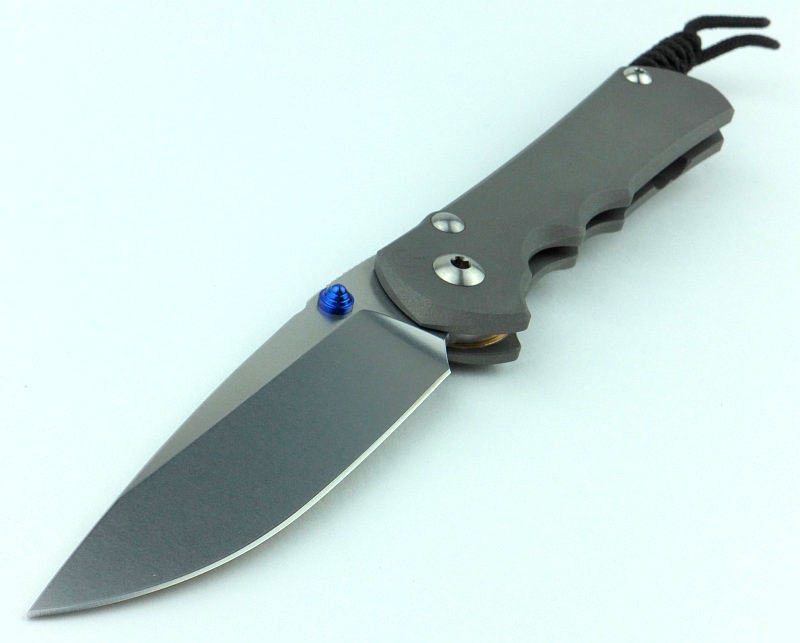
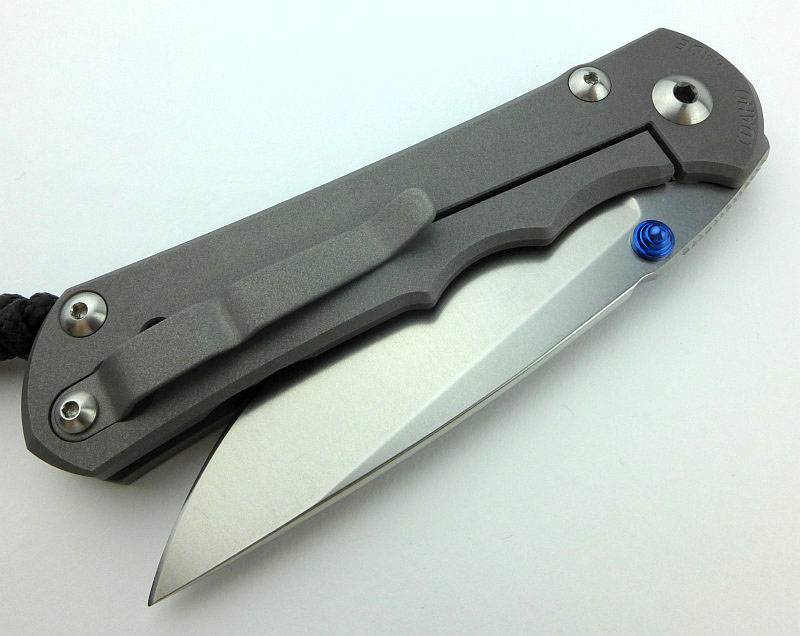
Tactical Reviews is fortunate enough to be able to bring you a quick preview of the new Large Inkosi from Chris Reeve Knives which was launched at BLADE Show 2016. A full review will follow once I’ve been able to test it properly.

 photo 07 L Inkosi cloth P1200349 copy.jpg

The original Inkosi was designed to include improvements to Chris Reeve’s already tried and tested (and industry changing) Sebenza models. Never one to stand still, Chris knew he could improve on his original design with certain key changes to the pivot, bearing, frame and lock. Rather than apply all these changes to the established formula of the Sebenza models, a new line was created to allow these features to be incorporated into the most advanced Chris Reeve folding knife yet. With a trend to smaller more pocketable models, the first Inkosi was created as a compact folding knife, but demand has been strong for a larger version of this knife.

A look over some key design features:

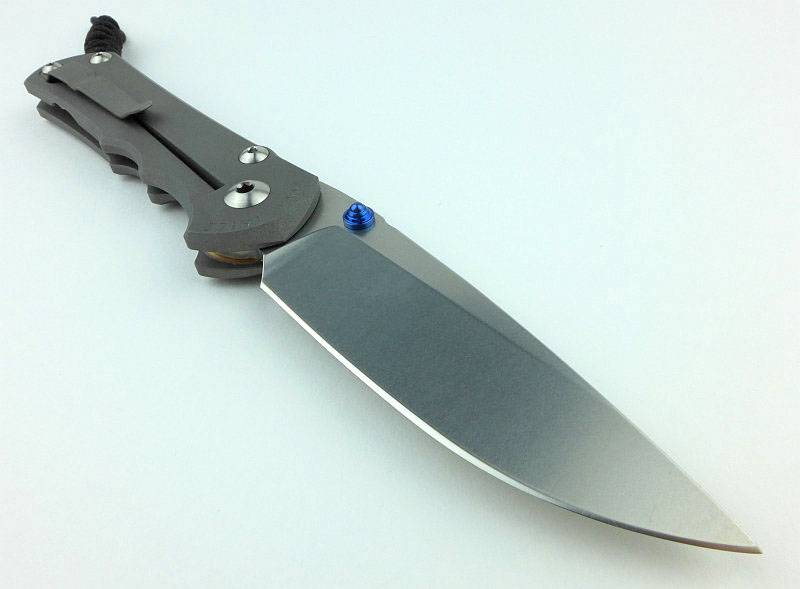
At first the Large Inkosi looks very similar to the Sebenza 25, but we need to look a little closer.
 photo 09 L Inkosi angle P1200355.jpg

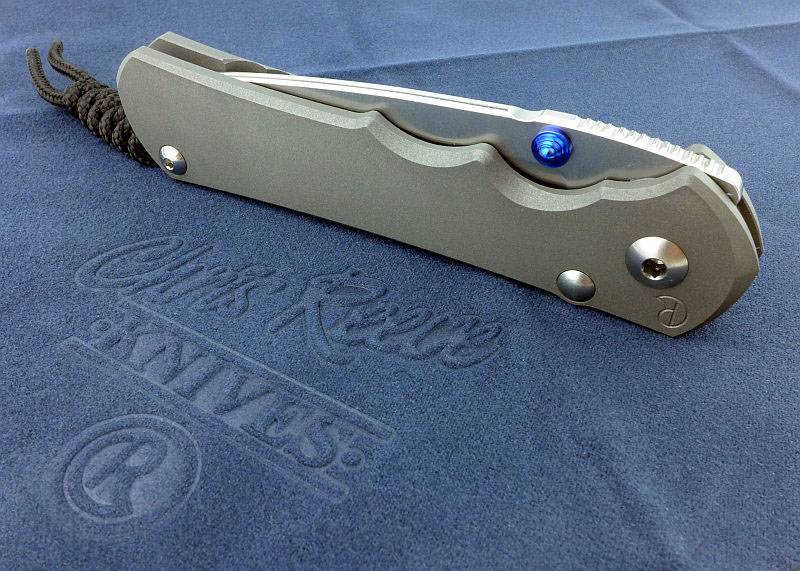
Notice that the stop pin as viewed from this side has no bolt head, just a rounded dome. This is actually floating on this side of the fame with a very precise fit to the hole.
 photo 12 L Inkosi pivot pin stud P1200364.jpg

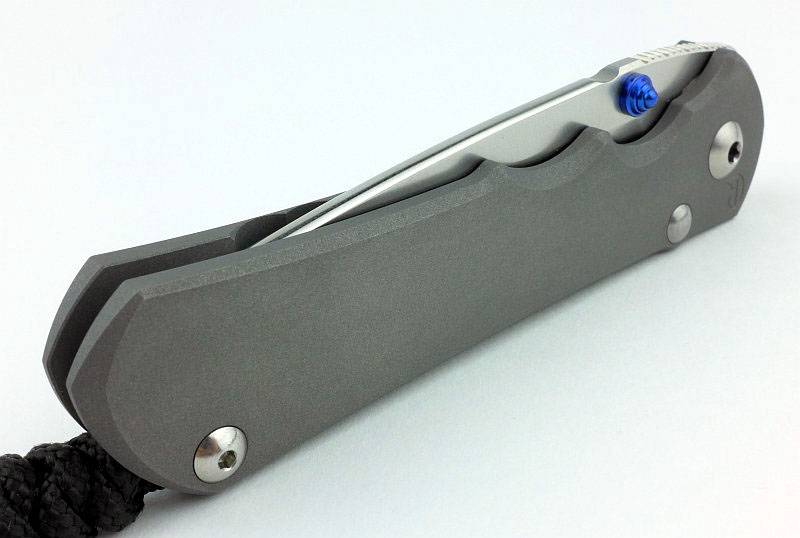
The sharp-eyed will spot the pocket clip sitting differently.
 photo 14 L Inkosi lock side P1200369.jpg

To prevent the pocket clip changing the lock bar tension, it has been angled to sit onto the frame and not push on the lock bar.
 photo 17 L Inkosi clip angle P1200376.jpg

A hint at the extend to which the washer design has been improved with a very large diameter with perforations. The full review will go into this in more detail.
 photo 23 L Inkosi washer lock groove P1200402.jpg

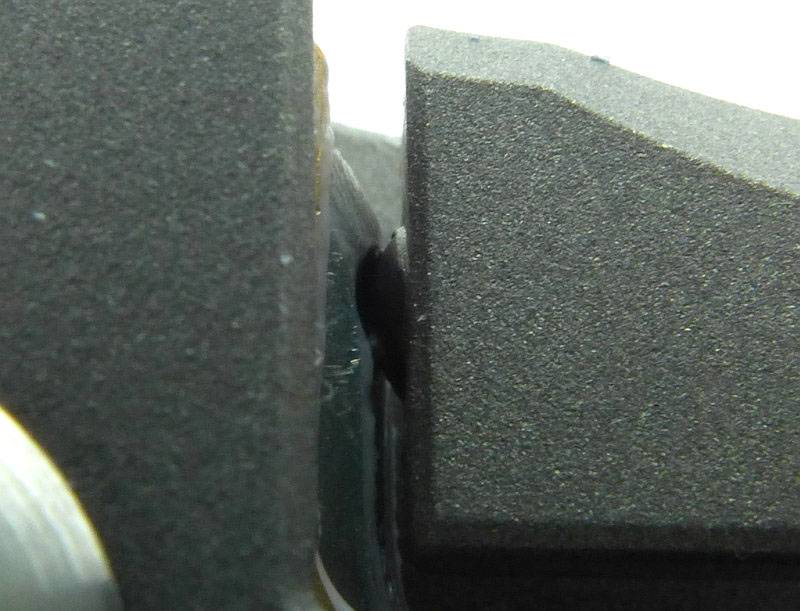
Looking very closely at the lock-bar/blade contact point you can see the ceramic ball sitting into a groove in the blade tang providing positive engagement.
 photo 33 L Inkosi ceramic ball P1200442.jpg

Some first impressions:

This preview is only intended to give a quick first look at this new knife, and though I’ve not been able to put it to any real use yet, the first impressions are strong. The famed CRK quality and precision are clearly evident, and one of the reasons many owners find it hard to start using and mark these works of art.
 photo 28 L Inkosi angle open P1200420.jpg

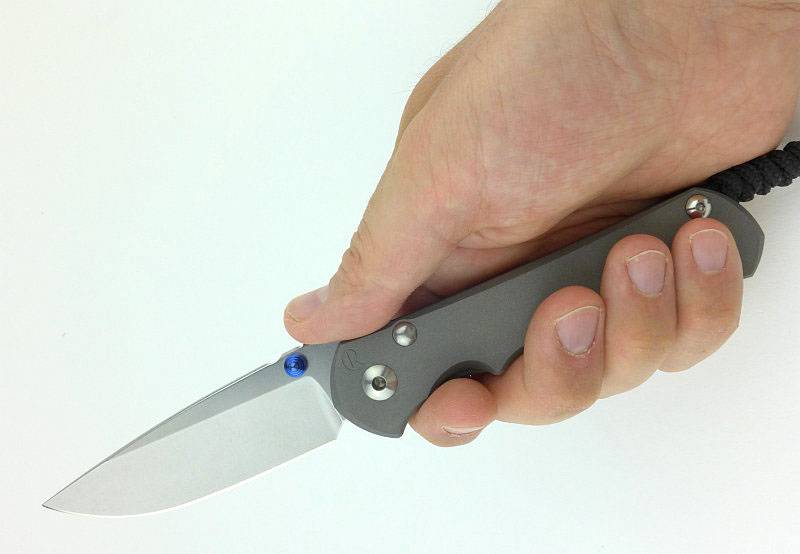
Though the Inkosi is an excellent and easy to carry knife, living in the UK, I can only carry a lock-knife with ‘good reason’ so when I do, I prefer a larger knife. The Large Inkosi is just right.
 photo 38 L Inkosi in hand P1200460.jpg

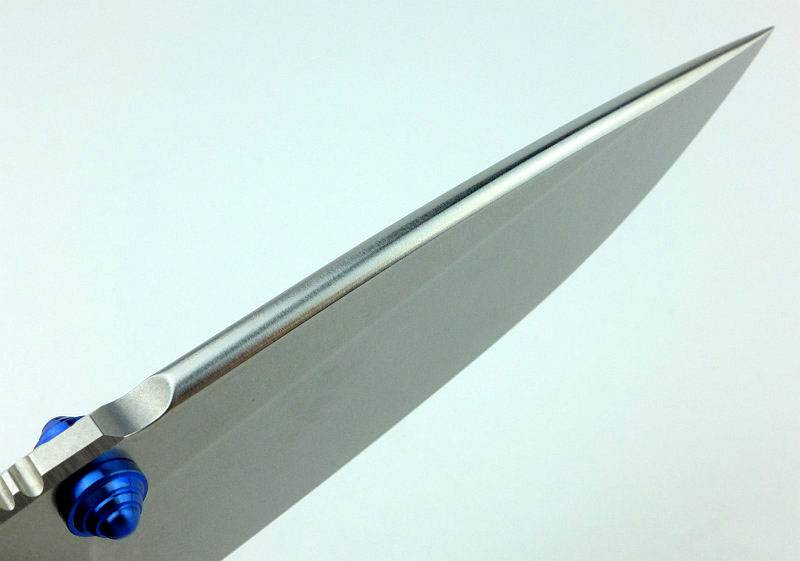
Attention to detail is evident in every aspect of the knife’s design, and every corner and feature has been given a deliberate finish.
 photo 41 L Inkosi spine P1200476.jpg

Though this has been a very brief look over the new Large Inkosi, the full review will contain the normal sections:

The Blade and Handle Geometry:

Explained by the Maker:

A few more details:

What it is like to use?

 photo 43 L Inkosi blade part open P1200494.jpg

Light Review: NITECORE EA45S

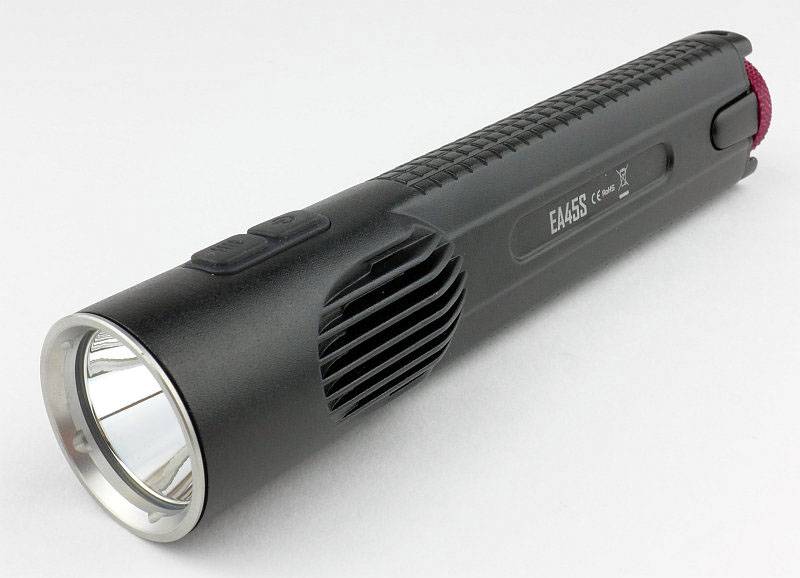
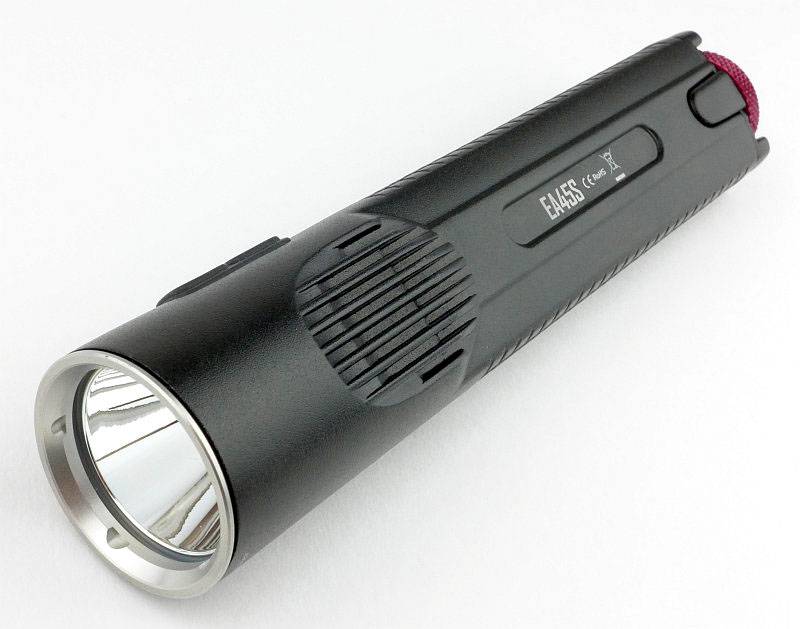
NITECORE’s first die-cast unibody light was the revolutionary EC4 (check the index page for a review link). Developing the idea further, we now have a 4xAA thrower using a similar format die-cast ‘unibody’, the EA45S.

 photo 06 EC45S angle 2 P1150998.jpg

Taking a more detailed look:

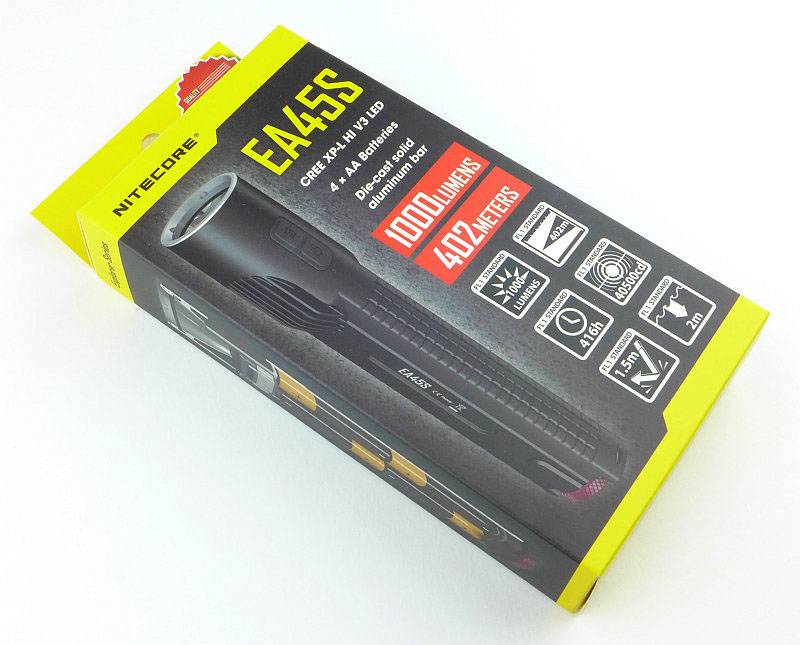
NITECORE’s familiar cardboard packaging is used.
 photo 01 EC45S Boxed P1150979.jpg

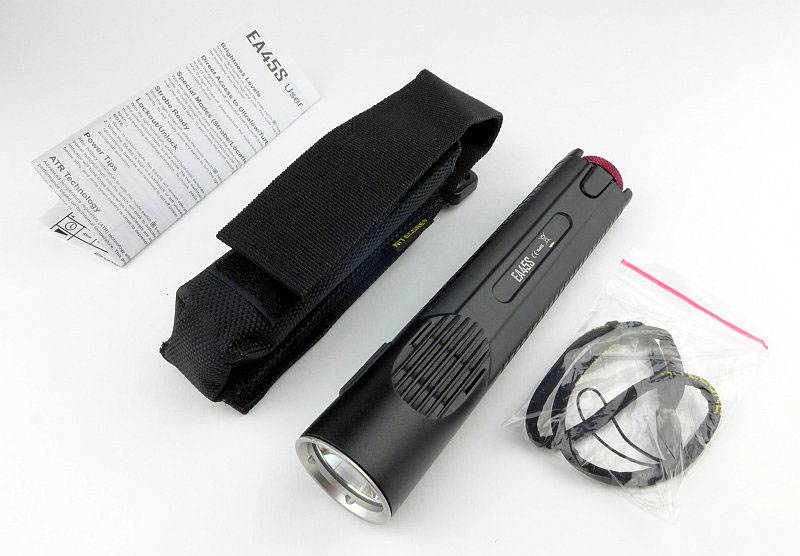
Inside the box is the EA45S, a wrist lanyard, holster and instructions.
 photo 02 EC45S Box contents P1150985.jpg

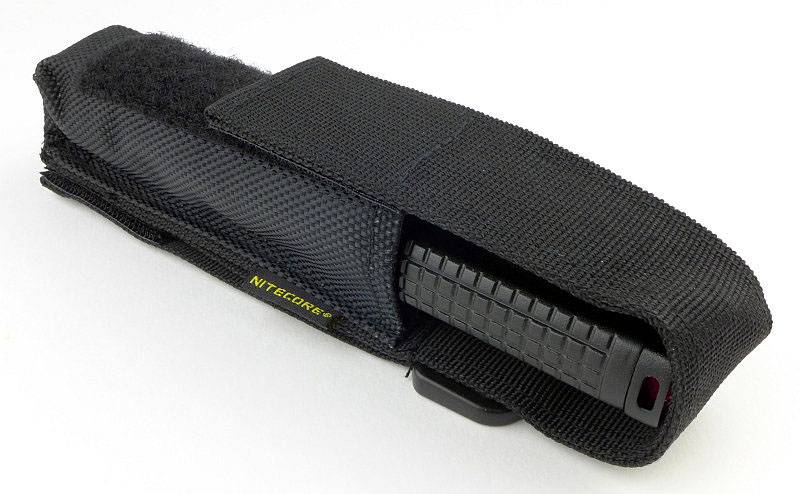
Holsters are always appreciated and this is well made.
 photo 03 EC45S holstered 1 P1150988.jpg

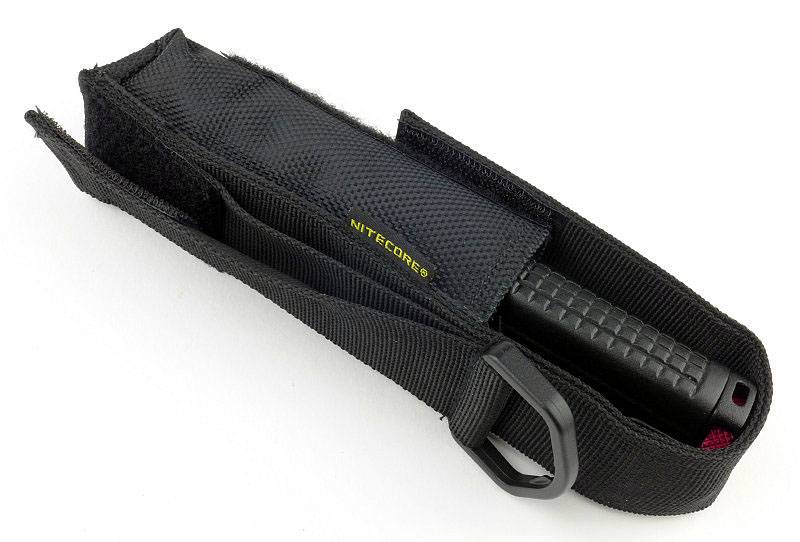
You have the choice of a fixed belt loop, Velcro belt loop and a D-ring.
 photo 04 EC45S holstered 2 P1150991.jpg

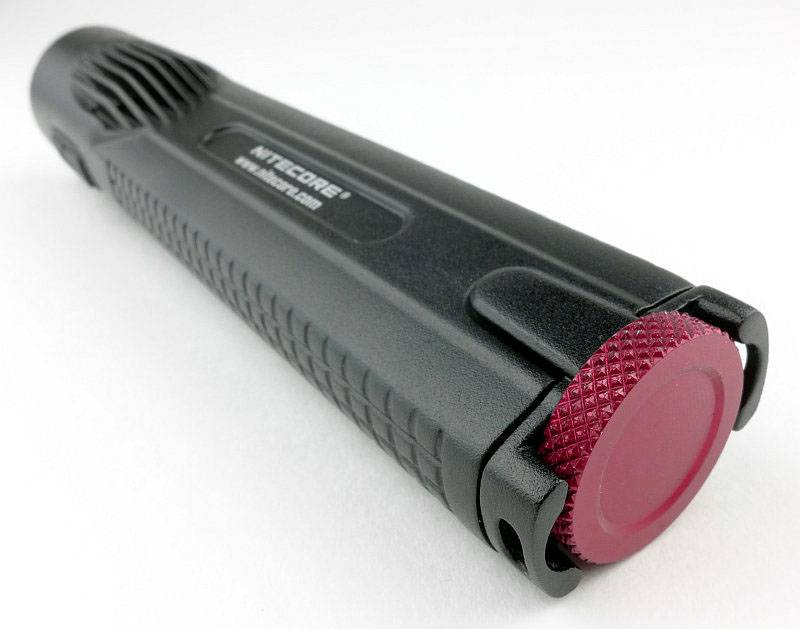
A very distinct feature is the red tail-cap screw that the ‘S’ versions of the die-cast lights have.
 photo 07 EC45S rear angle P1160006.jpg

There is a dual side-switch for operating the EA45S.
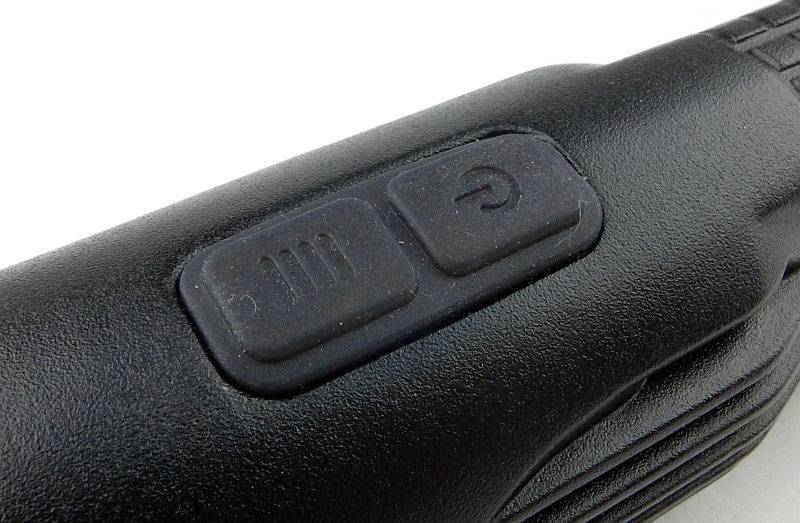
 photo 08 EC45S switch detail P1160011.jpg

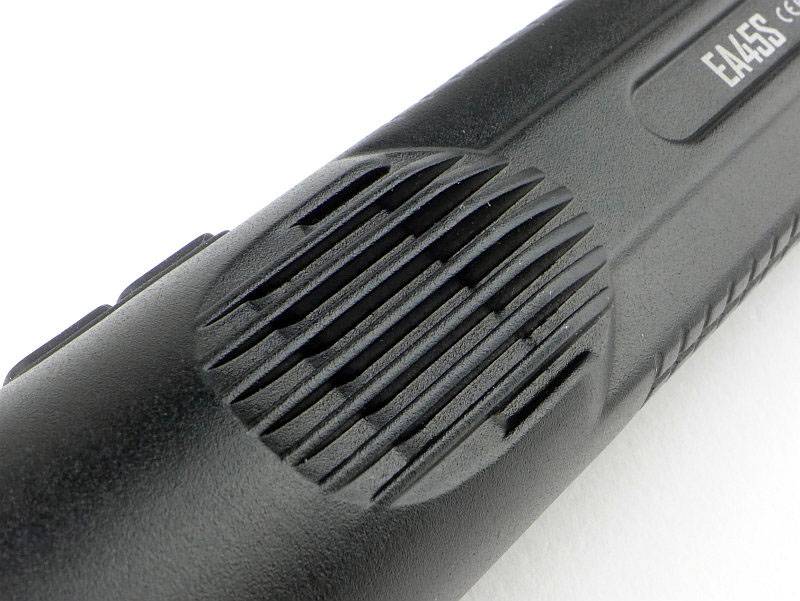
Heat sink fins are cast into the body. Thanks to the die-cast body there is an uninterrupted heat-path from these fins (and the rest of the body) to the LED board mount.
 photo 09 EC45S heat fins P1160012.jpg

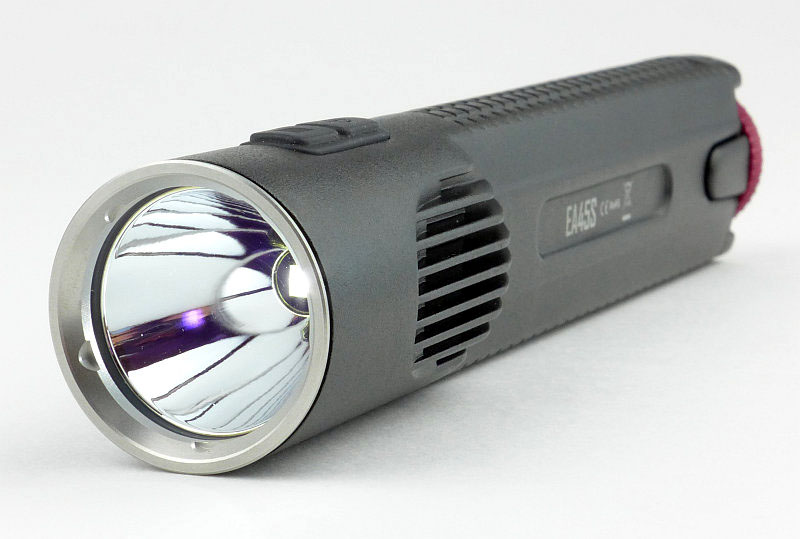
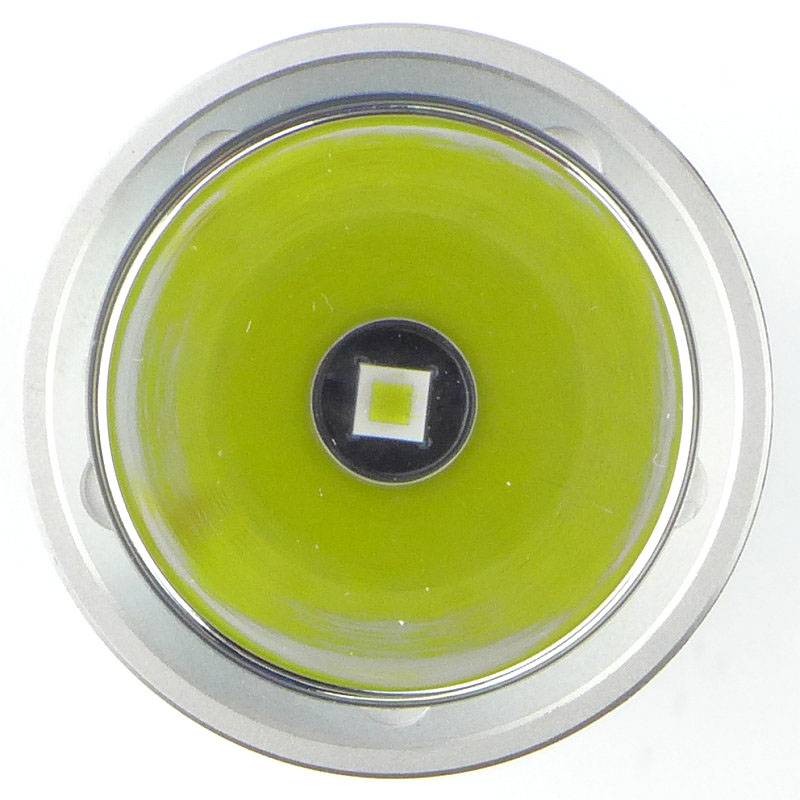
At the base of a smooth reflector is the EA45S’s XP-L Hi V3 LED.
 photo 11 EC45S LED P1160016.jpg

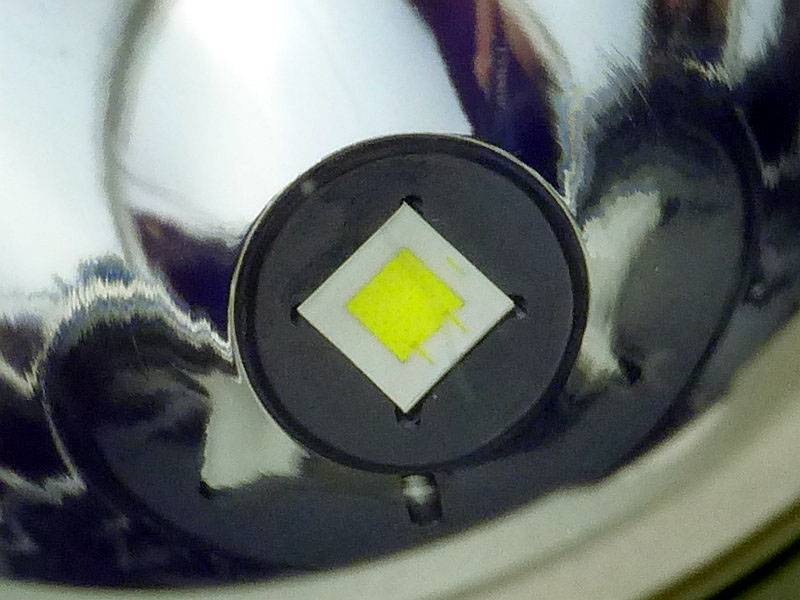
Looking more closely at the XP-L Hi V3 LED.
 photo 12 EC45S LED close P1160026.jpg

NITECORE’s die-cast lights use an unusual tail-cap design. It has lugs to engage with the body, the contact board, and a thumbscrew.
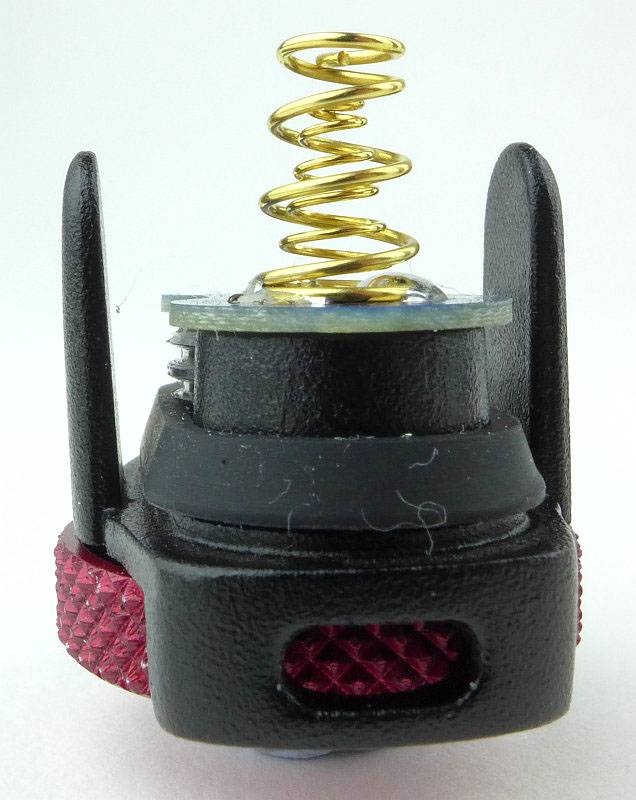
 photo 13 EC45S tailcap contacts P1160030.jpg

Looking slightly left of centre in this photo, you can see the threads which are almost entirely hidden.
 photo 14 EC45S tailcap threads P1160032.jpg

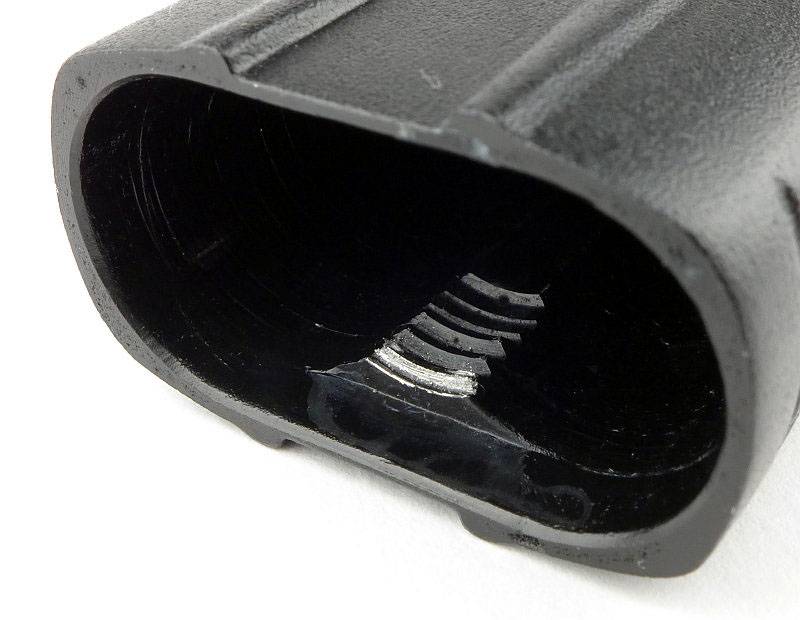
Those threads engage with a small section of threading inside the body.
 photo 15 EC45S internal threads P1160035.jpg

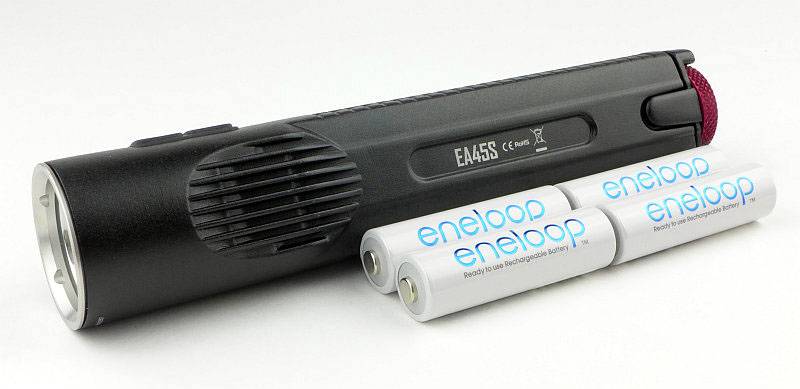
Here you can see the EA45S next to the four AAs it holds.
 photo 16 EC45S with cells P1160042.jpg

The beam

Please be careful not to judge tint based on images you see on a computer screen. Unless properly calibrated, the screen itself will change the perceived tint.

The indoor beamshot is intended to give an idea of the beam shape/quality rather than tint. All beamshots are taken using daylight white balance. The woodwork (stairs and skirting) are painted Farrow & Ball “Off-White”, and the walls are a light sandy colour called ‘String’ again by Farrow & Ball. I don’t actually have a ‘white wall’ in the house to use for this, and the wife won’t have one!

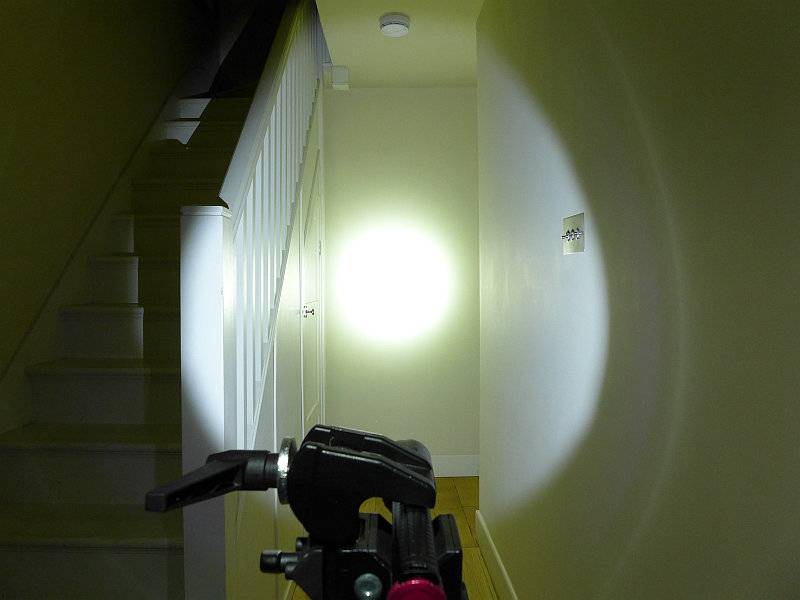
Designed for throw, the EA45S has a very defined and strong hotspot.
 photo 19 EC45S indoor beam P1170299.jpg

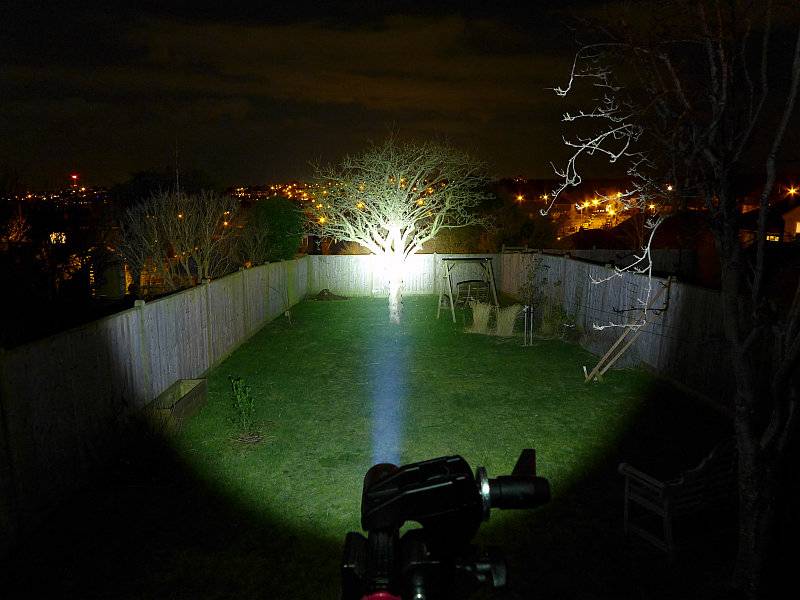
Giving it a bit more range to work with, you can clearly see the power of the beam which is very impressive considering its 4xAA power source.
 photo 20 EC45S outdoor beam P1170234.jpg

Modes and User Interface:

The EA45S has a total of five constant modes (Turbo, High, Medium, Low, Ultra-Low) and three flashing modes (Strobe, Beacon and SOS). Like many other NITECORE lights this is controlled by a dual button.

From OFF, to switch ON to the last used steady white output, briefly press the Power switch. When ON, press the Mode switch to cycle through Turbo -> Ultra-Low -> Low -> Mid -> High back to Turbo etc. To switch OFF briefly press the Power switch.

From OFF, for direct access to Ultra-Low, press and hold the Power switch for more than 1s.

From OFF, for direct access to Turbo, press and hold the Mode switch for more than 1s.

To access White flashing modes, from ON, press and hold the Mode switch for more than 1s. This will activate strobe. Press and hold the Mode switch for more than 1s again to switch to Beacon mode. Press and hold the Mode switch for more than 1s once more to activate SOS.
Once activated, pressing the mode switch briefly returns the EA45S to the previous steady mode, or a brief press of the Power switch will turn the EA45S OFF.

There is a ‘Standby’ mode which uses brief low power flashes of the blue switch indicator LED to act as a locator to allow you to find the EA45S in complete darkness. To activate Standby, from ON press and hold the power switch for over 1s until the blue switch light comes on. Although low power, the flashes are bright enough to disturb someone’s sleep. Exiting standby mode is achieved by switching on the EC4. When using Standby mode the drain is increased but the should still last a year in this mode. Turn ON and OFF again to exit standby.

There is a lockout mode included. With the EA45S ON, press and hold both buttons simultaneously for 1s to enter lockout. When entering Lockout, the EA45S will turn off and give a brief flash of the main beam as you release the buttons. Like this the buttons will not turn the EA45S on. Thanks to the button design this can be done easily with the thumb. To exit Lockout press and hold both buttons simultaneously for 1s and the EA45S will turn ON in the last used mode.

Lastly when first inserting cell/s into the EA45S or briefly pressing the mode switch when OFF, the blue switch light will flash to indicate the battery charge level. It flashes once, twice, or three times. Three flashes indicates full power.

Batteries and output:

The EA45S runs on 4xAA, Alkaline or NiMh. NiMh will give the best performance.

To measure actual output, I built an integrating sphere. See here for more detail. The sensor registers visible light only (so Infra-Red and Ultra-Violet will not be measured).

Please note, all quoted lumen figures are from a DIY integrating sphere, and according to ANSI standards. Although every effort is made to give as accurate a result as possible, they should be taken as an estimate only. The results can be used to compare outputs in this review and others I have published.

___________________________________________ ________________________________ ________________________________
NITECORE EA45S using Eneloop AA I.S. measured ANSI output Lumens PWM frequency or Strobe frequency (Hz)
___________________________________________ ________________________________ ________________________________
Turbo 912 0
High 476 0
Medium 238 0
Low 63 0
Ultra-Low 2 0

* Beacon and Strobe output measurements are only estimates as the brief flashes make it difficult to capture the actual output value.

Peak Beam intensity measured 43100 lx @1m giving a beam range of 415 m.

There is parasitic drain at 102.6uA (2.33 years to drain the cells).

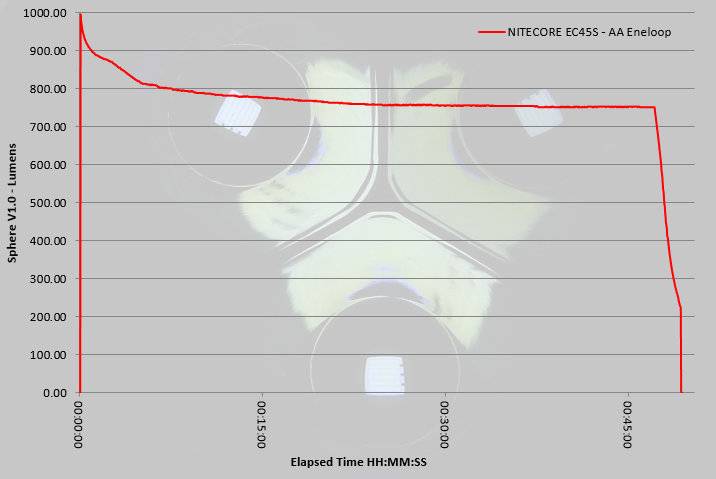
The EA45S does indeed hit 1000lm at switch on, but this drops to a still impressive 912 ANSI lumens. The output gradually declines to around 800lm approximately 7 minutes after switch on, and then remains steady for the remainder of the runtime (just dropping to 750lm) before trailing off sharply once the cells are depleted.
 photo NITECORE EC45S runtime.jpg

Troubleshooting

This section is included to mention any minor niggles I come across during testing, in case the information helps anyone else.

No issues were encountered during testing.

However, I did have a couple of issues with the tail-cap threads not engaging properly. It requires a very firm pressure during the entire fitting of the tail-cap to fit smoothly. The thumb wheel has a convenient smooth depression which allows you to press onto it firmly with your finger while turning the screw.

As per the description of this section, this information is provided in case anyone else finds a similar ‘issue’ that might be fixed in the same way.

The EA45S in use

For those that have followed my reviews for a while, you will most likely know I have always loved the 2xAA format for being easy and comfortable to hold. I’ve tested other 4xAA lights which have had the four cells all together (making quite a handful) or 2×2 as in the EA45S. Thanks to the die-cast unibody and lack of cell holder, the EA45S takes this 4xAA format and fits it into a more compact body.

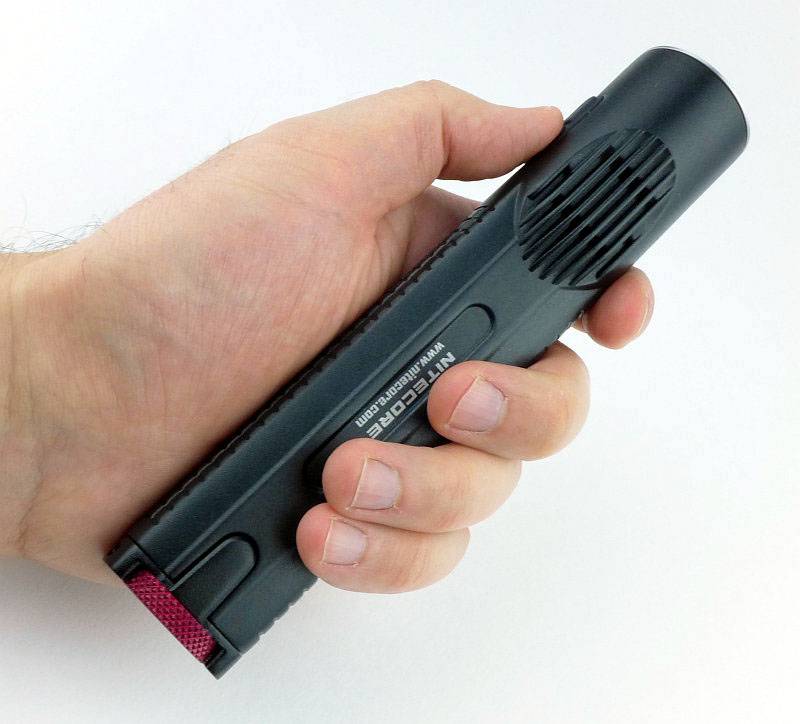
The EA45S has just pushed out the 2xAA as my favourite size/shape, and put itself firmly into pole position with its compact 2×2 4xAA cell layout. It is really comfortable to hold, stable, thanks to the rectangular cross section, and just the right size and weight.

 photo 18 EC45S in hand P1160052.jpg

This is a bigger light than I would EDC, but when I need a step up in performance and runtime without going to something really large, the EA45S fits the bill (and hand) nicely. It is also perfectly reasonable to just throw into a backpack even if you might not need it.

Of course with its throw biased beam, it can be a little fatiguing to use indoors. The Ultra-Low and Low modes are really all you will want to use when inside. Other than that the EA45S’s beam comes into its own. Peering into an engine bay, or deep into storage (loft, or other large space), the throw helps you to see clearly. Outside you can really appreciate the throw the XP-L Hi V3 LED gives you, and how comfortable it is to hold (I might have mentioned that before).

The surface finish on the EA45S is HAIII hard anodised, which can prove challenging on die-cast aluminium, but NITECORE have achieved an excellent quality finish. At first this surface might appear to be a powder-coat due to the graininess, but this is due to having to pre-treat (sand-blast) the die-cast surface before anodising.

A couple of other observations, there is a degree of cell rattle when you knock the EA45S or put it down, but this does not happen with normal handling. Also for use wearing gloves the switches can be a little tricky to hit just right.

Certainly in the sample I have, you have to be careful fitting the tail-cap. Removing it presents no issues, but due to the contact spring strength, it does need constant pressure on it to ensure the threads start and run properly all through the tightening. The thumb-wheel has a shallow smooth depression which makes it easy to apply pressure and turn the wheel to tighten it.

Thanks to the unibody design, heat transfer is managed with ease; nothing gets particularly hot with the entire body acting as a heat-sink.

There are other 4xAA lights with similar output, but NITECORE have delivered it with a superbly ergonomic design. I liked the EC4, but really love the EA45S.

Review Summary

_______________________________________________ _______________________________________________
Things I like What doesn’t work so well for me
_______________________________________________ _______________________________________________
Excellent ergonomics. Tail-cap can be cross-threaded easily.
Over 900lm from four AAs. Beam can be fatiguing at close range.
415m beam range. Parasitic drain could be lower (but is acceptable).
Stable when tail-standing.
Direct access to Ultra-Low and Turbo.

 photo 05 EC45S angle 1 P1150993.jpg


Discussing the Review:

Please feel free to add comments to the review, but the ideal place to freely discuss these reviews is on a forum. If you started reading the shorter forum version of the review, but followed the link this full exclusive review, please return to that forum to discuss the review there.
If you read the review entirely on Tactical Reviews, please consider one of the following to join in any discussion.

CandlePowerForums – Flashlight Reviews Section (Largest and Friendliest Flashlight Community Forum)

EdgeMatters – Sponsored Reviews (UK based Forum for Knife Makers and Collectors)
Light Review: Olight S1 plus Special Edition S1 Ti

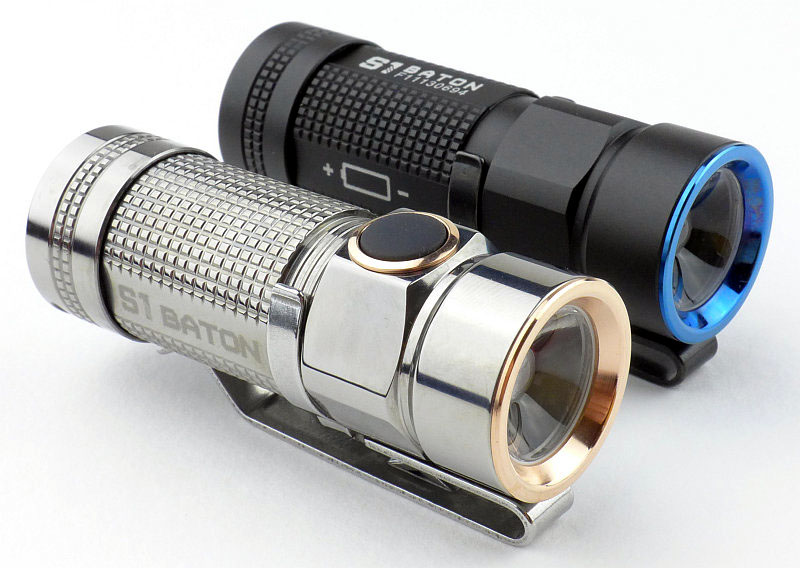
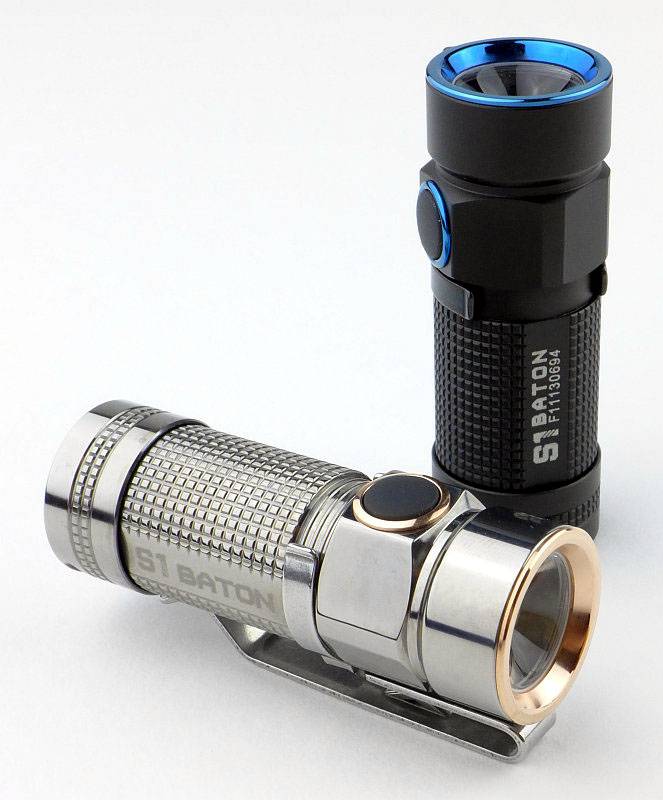
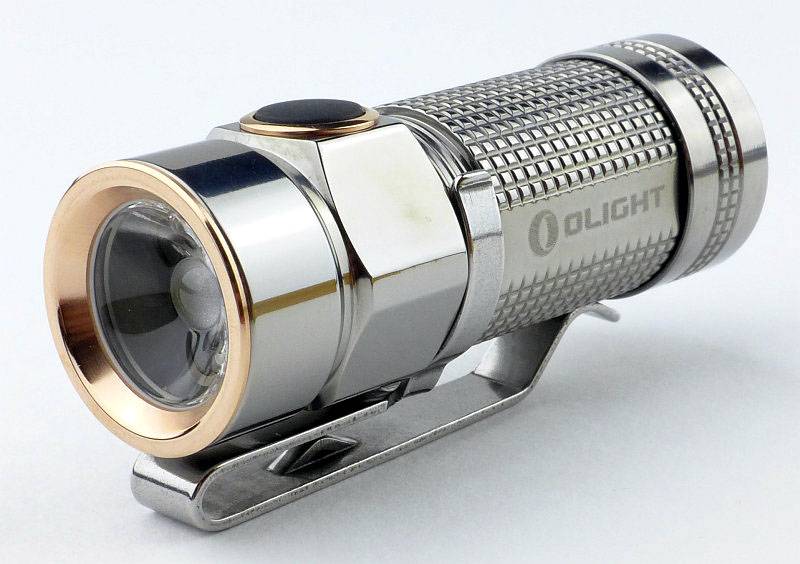
Olight’s S1 is the smallest light they have ever produced with a side switch. Along with the standard aluminium edition, Olight have created quite a storm of interest by also releasing several different Special Editions with different emitters and materials such as Copper, Titanium as well as Gold-plated versions.

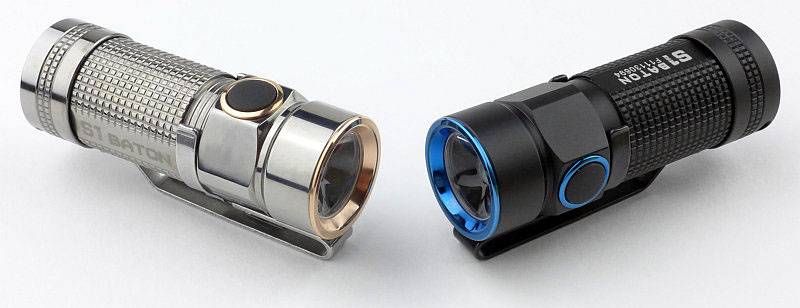
 photo 52 S1 twins3 P1150843.jpg

Taking a more detailed look at the S1 (standard Al edition):

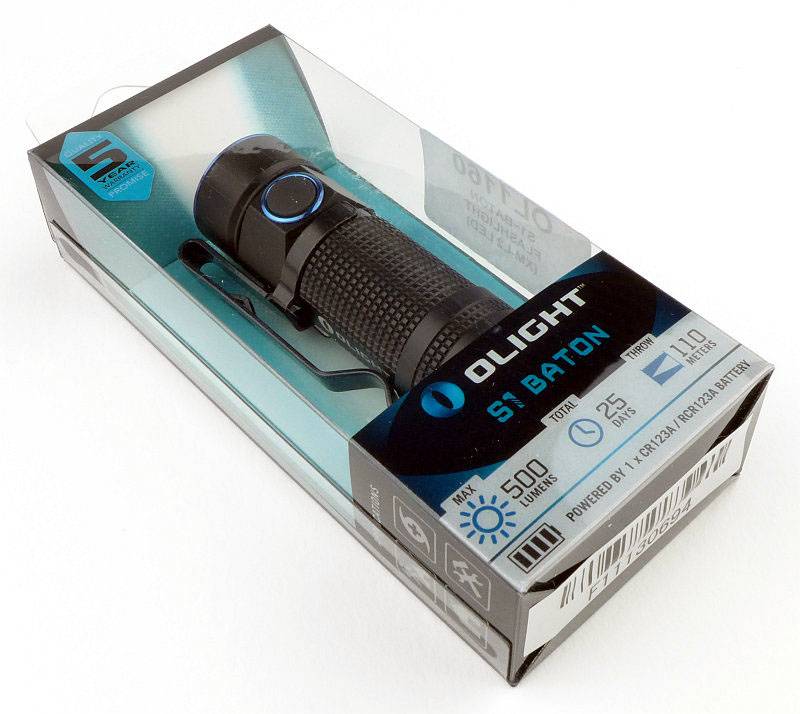
Olight’s standard plastic box packaging displays the S1 nicely.
 photo 01 S1 Al boxed P1150522.jpg

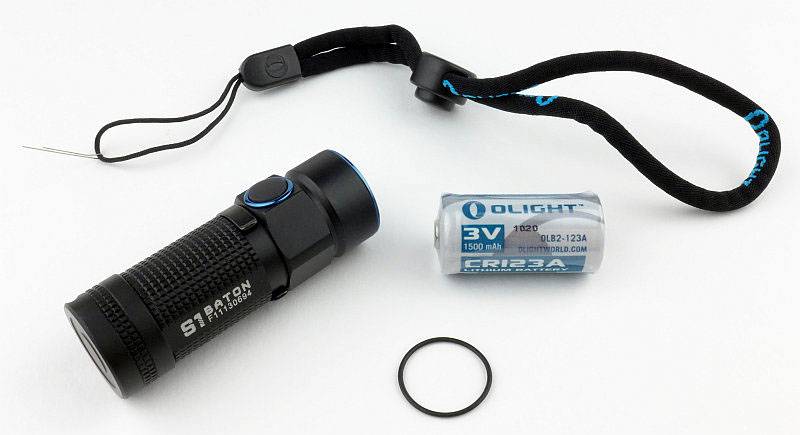
Inside the box is the S1, a CR123 cell, spare O-ring (which is actually used to hold the S1 in place) and a wrist lanyard. A really thoughtful feature is that the lanyard comes with a threading wire fitted to it to make it easy to fit to the S1.
 photo 02 S1 Al box contents P1150526.jpg

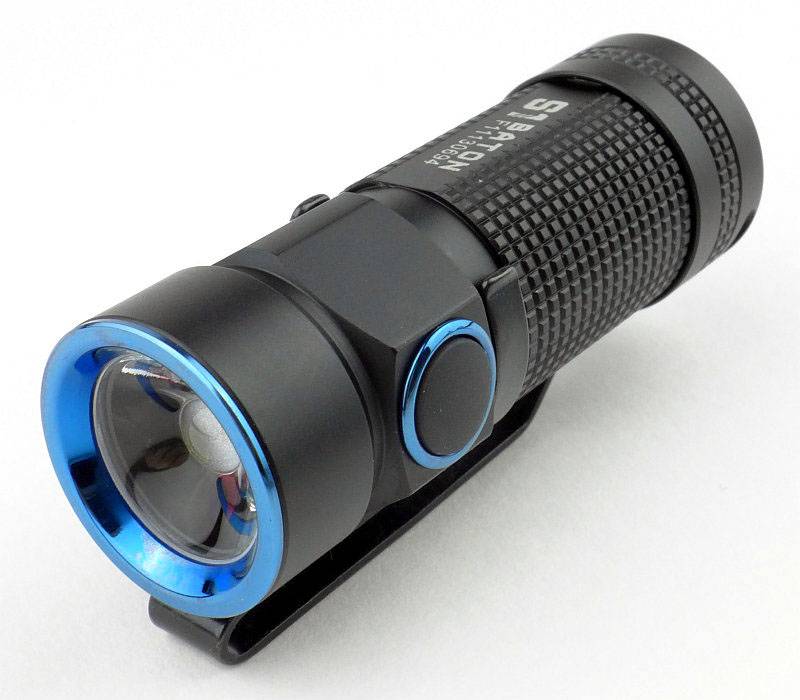
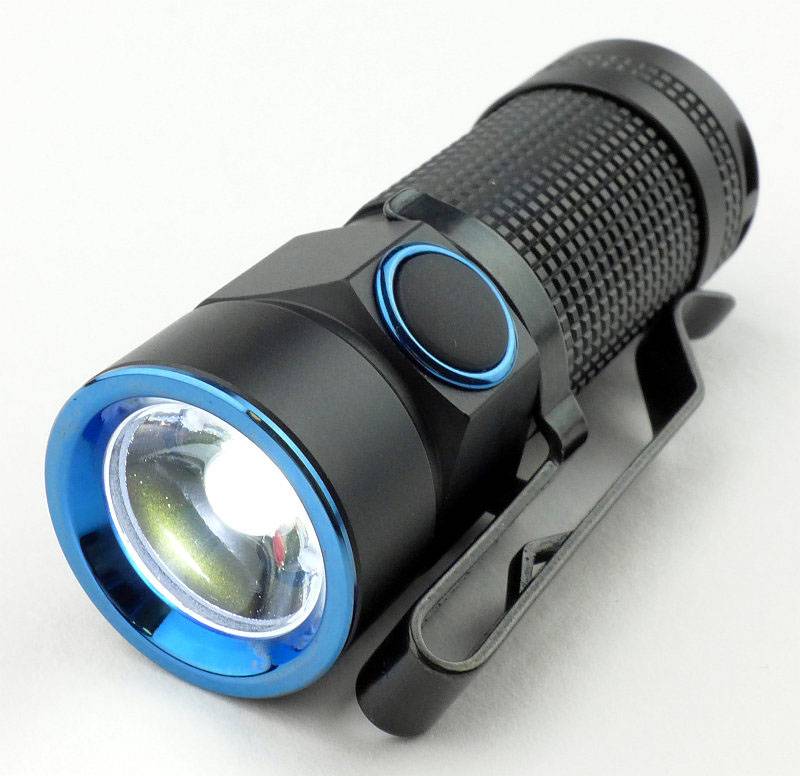
The S1 itself has a stylish two tone appearance with the bezel and switch rings in blue.
 photo 05 S1 Al angle03 P1150532.jpg

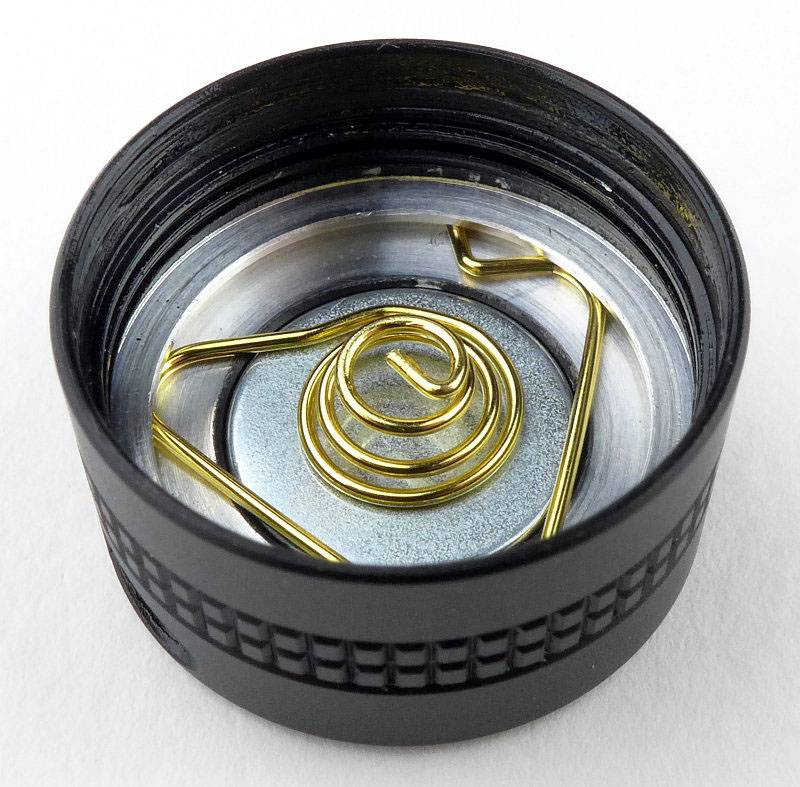
Keeping the size down, the tailcap is a very streamlined design. The spring clips into a slot and is used to hold the magnet in place. This makes it easy for the user to remove and replace the magnet.
 photo 06 S1 Al tailcap P1150537.jpg

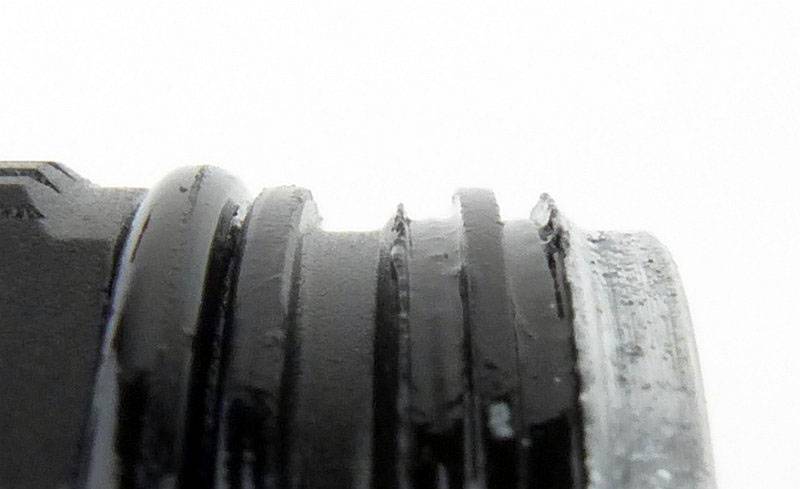
The threads are square cut and as the body is short, there are not many actual threads.
 photo 07 S1 Al threads P1150539.jpg

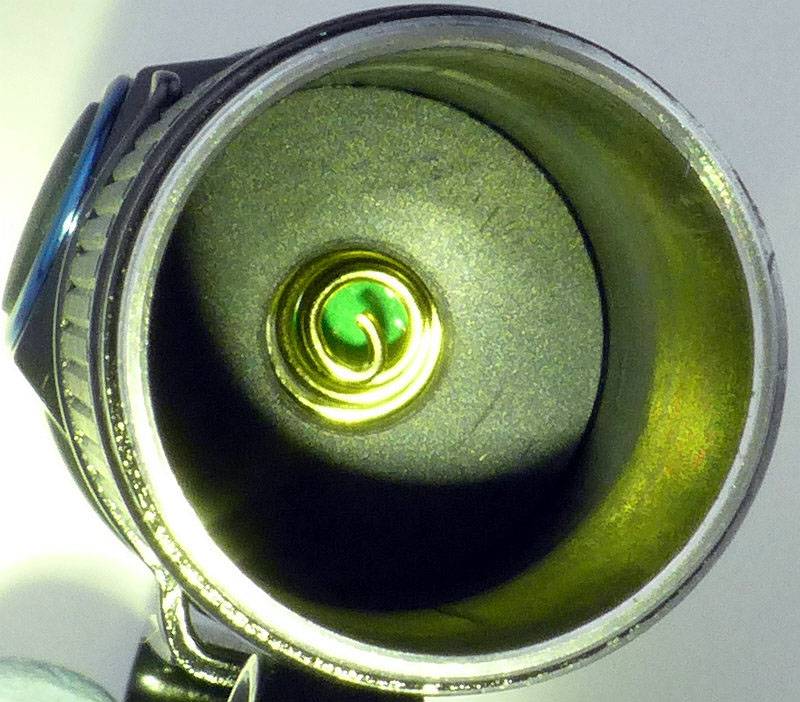
Peering inside there is another spring terminal and an anti-rattle closed-cell foam pad.
 photo 08 S1 Al inside P1150549.jpg

Looking dead-on, the S1 has a TIR optic and the actual LED cannot be seen.
 photo 09 S1 Al TIR P1150553.jpg

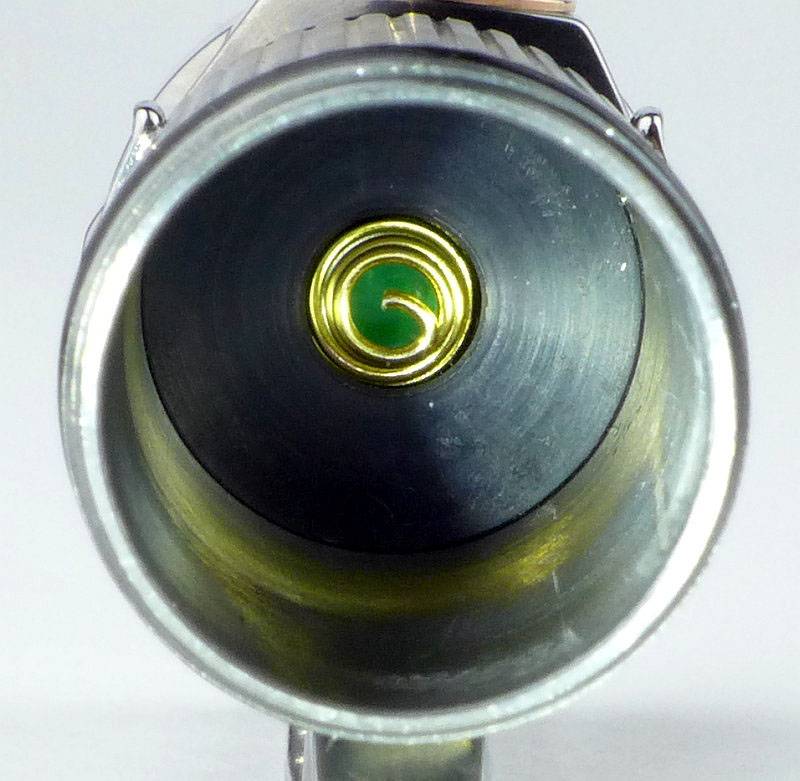
In a less common format, the cell is inserted negative towards the head and this is clearly marked on the side of the S1.
 photo 11 S1 Al Cell P1150563.jpg

Just to give an idea of how compact this light is, here it is next to the already small Olight S10R (another RCR123 light).
 photo 12 S1 Al S10R compare P1150566.jpg

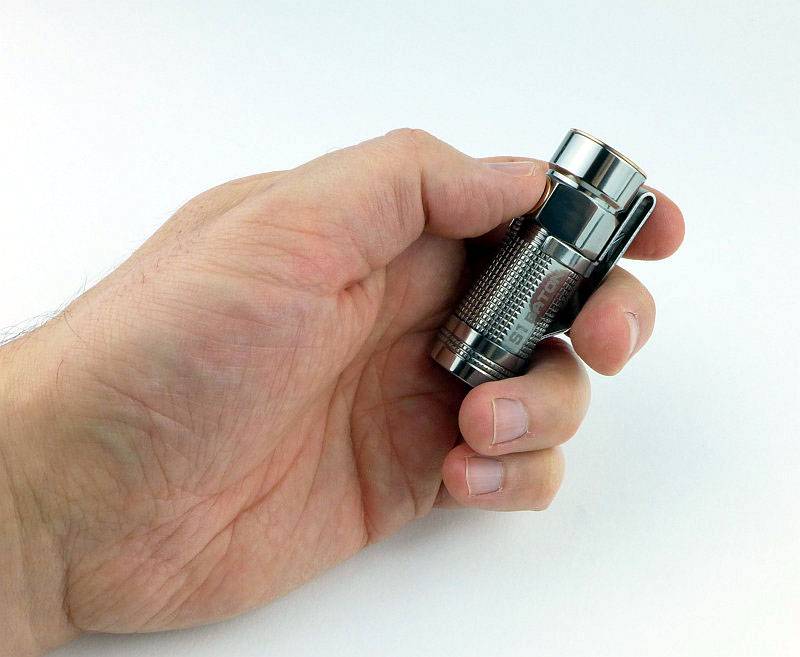
Also for scale here it is in my hand (I take XL gloves)
 photo 13 S1 Al in hand P1160056.jpg

Before moving on to the Special Edition another quick look at those lovely blue PVD trims.
 photo 10 S1 Al TIR lit P1150559.jpg

Taking a more detailed look at the S1 Special/Ti edition:

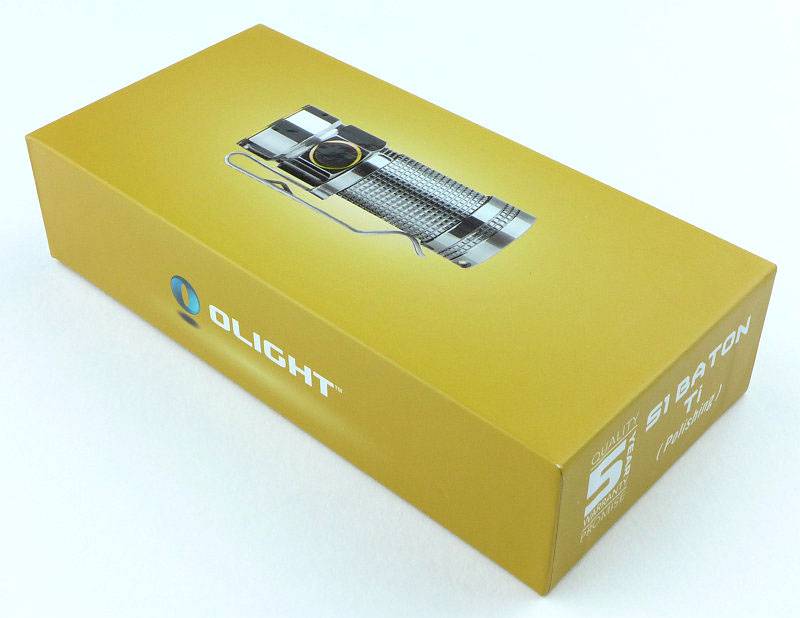
In keeping with its Special Edition status, the Ti S1 gets a different box.
 photo 20 S1 Ti boxed P1150804.jpg

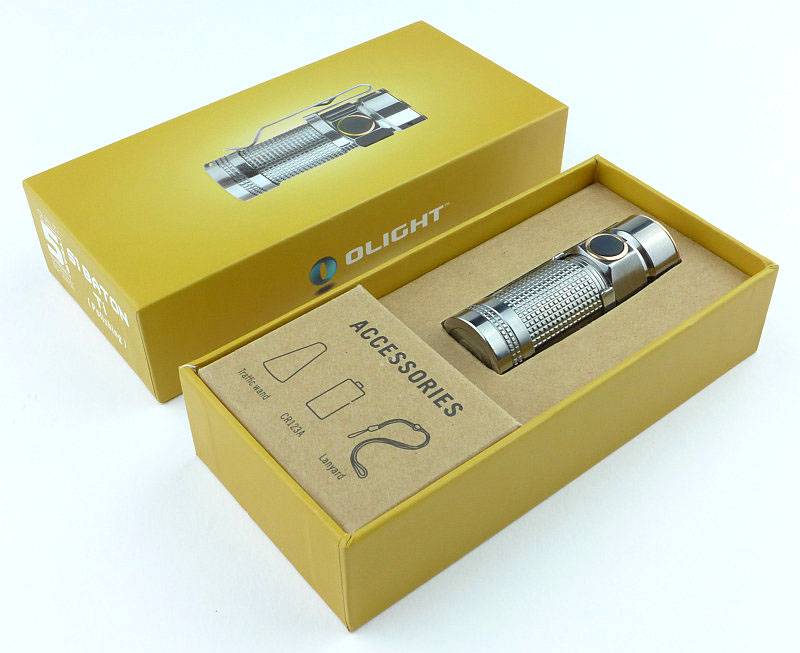
Presentation is excellent.
 photo 21 S1 Ti box open P1150807.jpg

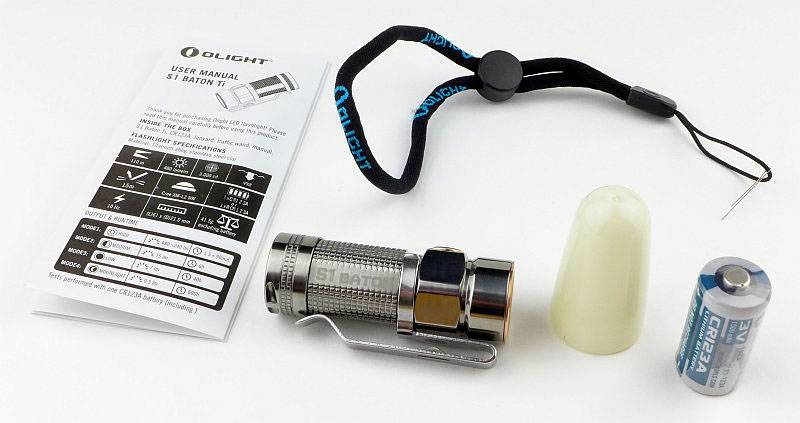
Inside the box is the S1, a CR123 cell, diffuser, instructions and a wrist lanyard. A really thoughtful feature is that the lanyard comes with a threading wire fitted to it to make it easy to fit to the S1.
 photo 25 S1 Ti contents P1150820.jpg

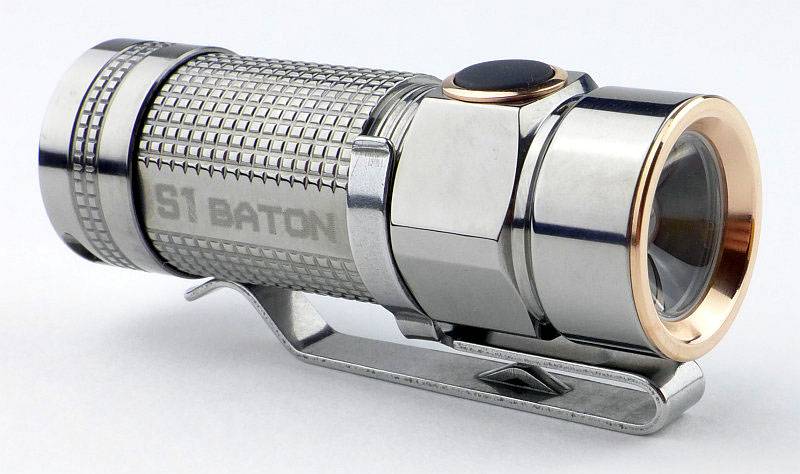
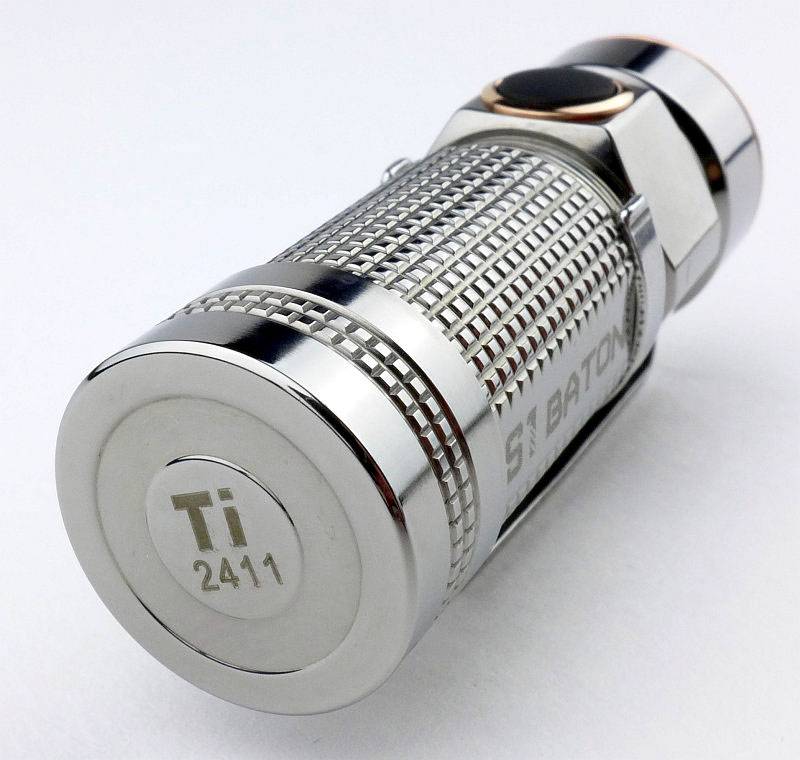
A glorious looking light.
 photo 30 S1 Ti angle3 P1150834.jpg

The clip is removable and reversible.
 photo 24 S1 Ti clip P1150816.jpg

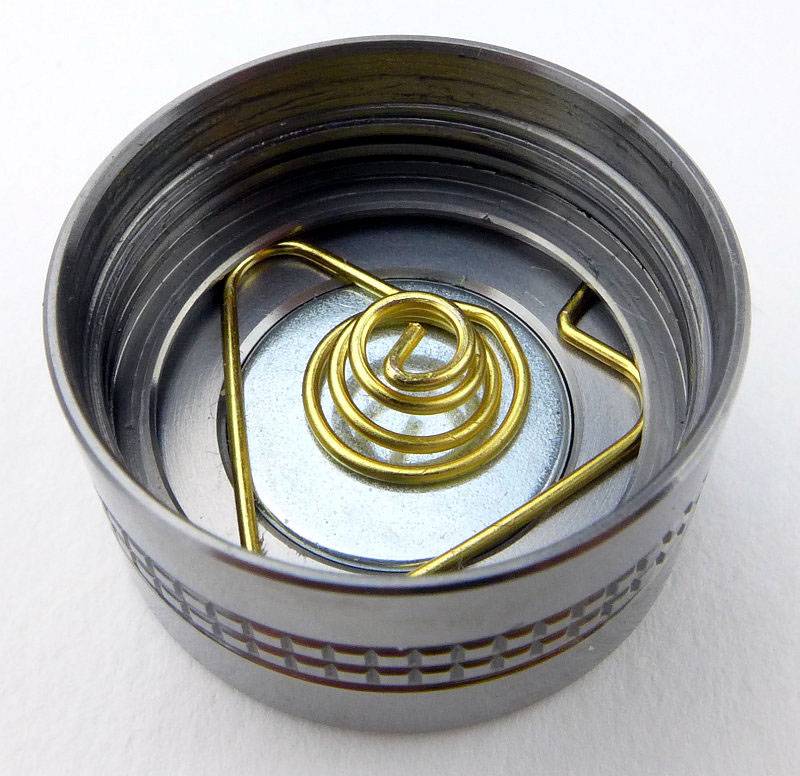
Construction of the tailcap is the same as the standard version with the terminal spring clipped into a groove and used to secure the magnet.
 photo 26 S1 Ti tailcap P1150822.jpg

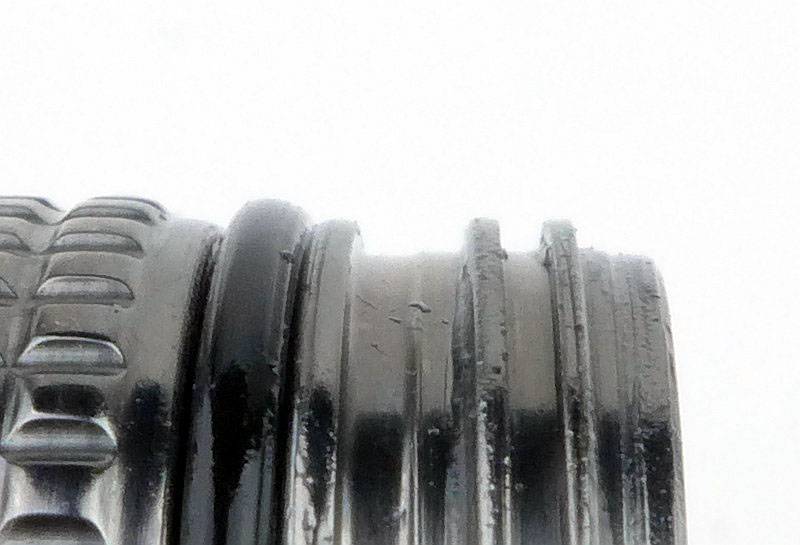
Square threads are used.
 photo 27 S1 Ti threads P1150824.jpg

Looking inside the internals are the same as the standard version.
 photo 28 S1 Ti inside P1150826.jpg

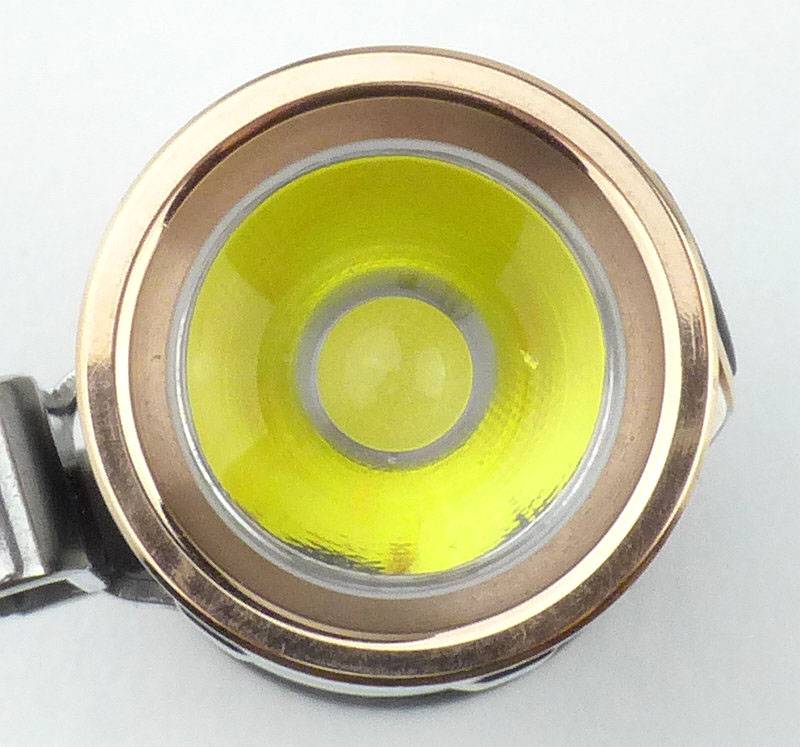
A Rose Gold plated bezel surrounds the TIR optic.
 photo 29 S1 Ti TIR P1150830.jpg

Without the diffuser fitted.
 photo 31 S1 Ti angle4 P1150837.jpg

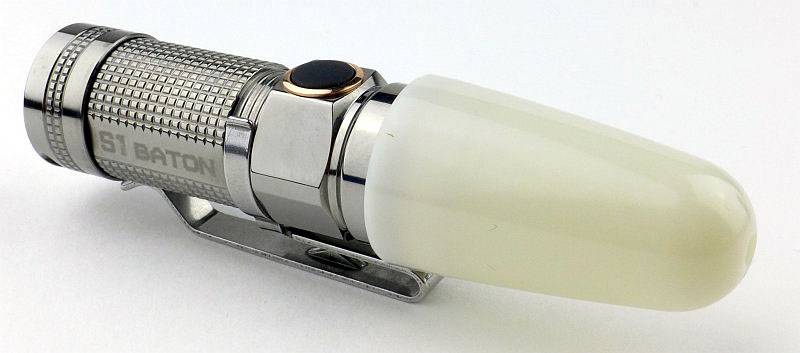
With the diffuser fitted.
 photo 32 S1 Ti diffuser P1150846.jpg

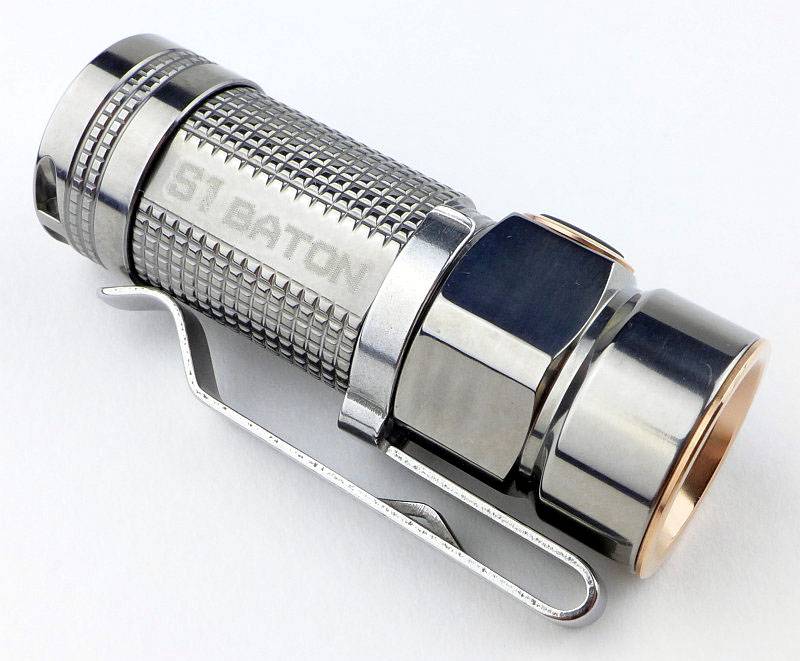
For the special editions they have the identifier ‘Ti’ and a serial number engraved on the tail-cap.
 photo 33 S1 Ti tail view P1150974.jpg

Small, Shiny and Ti, a winning combination.
 photo 34 S1 Ti in hand P1160053.jpg

The beam

Please be careful not to judge tint based on images you see on a computer screen. Unless properly calibrated, the screen itself will change the perceived tint.

The indoor beamshot is intended to give an idea of the beam shape/quality rather than tint. All beamshots are taken using daylight white balance. The woodwork (stairs and skirting) are painted Farrow & Ball “Off-White”, and the walls are a light sandy colour called ‘String’ again by Farrow & Ball. I don’t actually have a ‘white wall’ in the house to use for this, and the wife won’t have one!

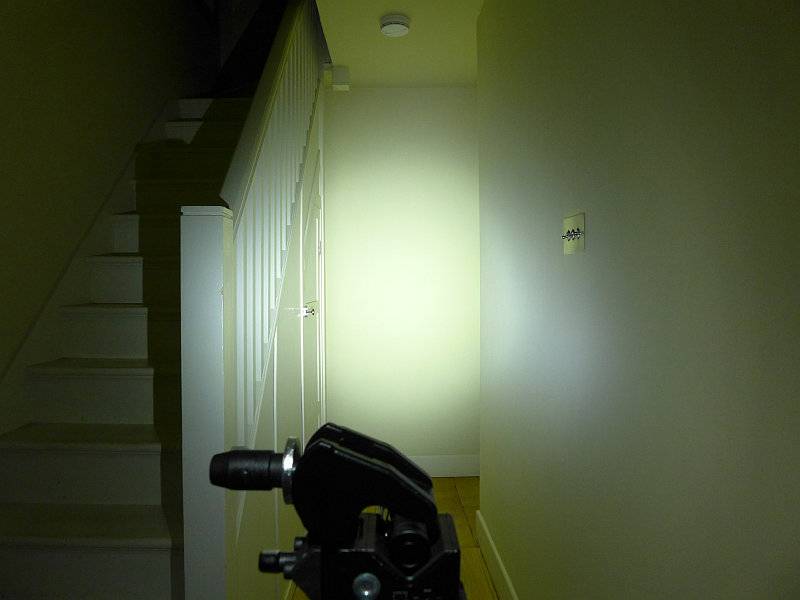
Starting indoors with the Standard S1. The wide hotspot transitions into a wide spill giving a great all round beam, and one that works really well for EDC tasks.
 photo 14 S1 Al indoor beam P1170324.jpg

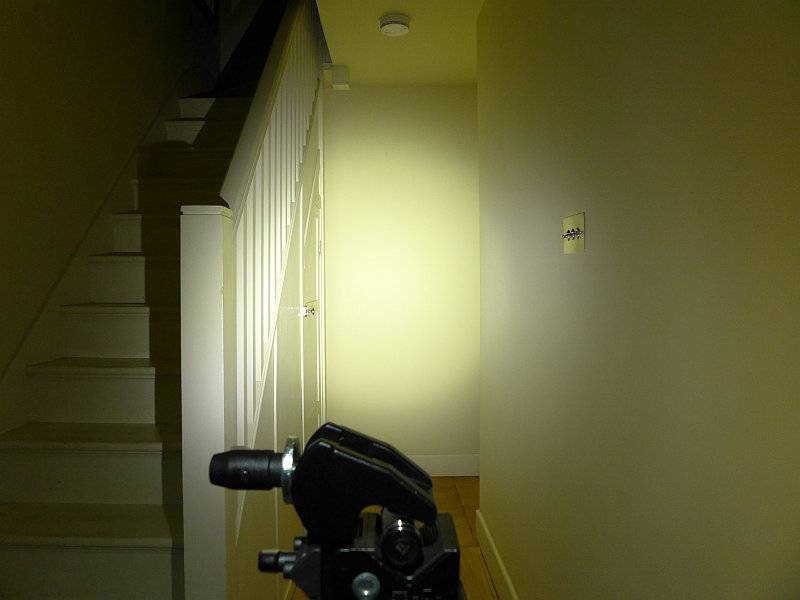
The main difference in the Special Ti Edition is that the LED is neutral white.
 photo 35 S1 Ti indoor beam P1170329.jpg

Fitting the Ti Edition’s diffuser makes a hug difference giving a real lantern like beam.
 photo 36 S1 Ti indoor beam diffused P1170333.jpg

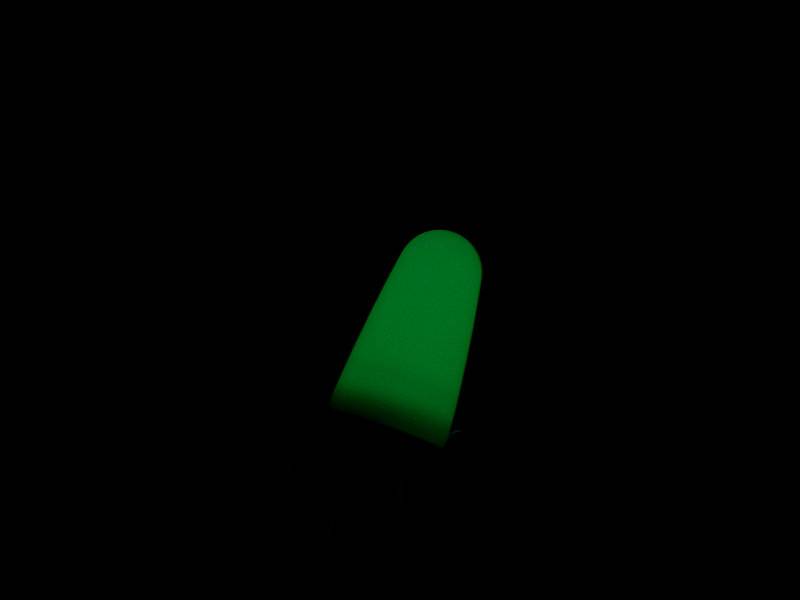
The Diffuser itself is GITD as can be seen here once the test was over.
 photo 37 S1 Ti indoor beam GITD P1170336.jpg

Outdoors, the wide hotspot does well enough up to medium distances.
 photo 15 S1 Al outdoor beam P1170258.jpg

The neutral emitter of the Ti does make the colours appear more natural.
 photo 38 S1 Ti outdoor beam P1170261.jpg

Just to show what happens when the diffuser is fitted – GLARE – lots of glare. On the indoor shot the clamp prevented the glare from hitting the camera, but here it does not. Use the diffuser with caution.
 photo 39 S1 Ti outdoor beam diffused P1170297.jpg

Modes and User Interface:

The S1 has five output modes, High, Medium, Low, Moonlight and Strobe and a single click-switch on the side.

Basic ON/OFF operation is carried out with a single click of the side switch. The S1 will turn on to the last used standard mode (this does not include Moonlight or Strobe).

To change the brightness, while ON, press and hold the switch to cycle through Medium -> High -> Low -> Medium etc. Release the switch once you have the required output.

There are a few special functions:
Moonlight mode – from OFF, press and hold the switch for 1s until the Moon mode is activated.
Direct access to High – from OFF, double-click the switch.
Strobe – From ON, triple-click the switch.
Timer – From ON, double-click the side switch. The S1 will blink one or two times. Once means the 3 minute timer is activated, twice means the 9 minute timer is activated. To swap between 3 and 9 minutes timers, double-click the switch.

Timer mode means that the S1 will turn itself off after the specified time, and this can be started from any mode (including Strobe and Moonlight).

Batteries and output:

The S1 runs on either CR123 or RCR123.

To measure actual output, I built an integrating sphere. See here for more detail. The sensor registers visible light only (so Infra-Red and Ultra-Violet will not be measured).

Please note, all quoted lumen figures are from a DIY integrating sphere, and according to ANSI standards. Although every effort is made to give as accurate a result as possible, they should be taken as an estimate only. The results can be used to compare outputs in this review and others I have published.

___________________________________________ ________________________________ ________________________________
‘Model’ and ‘Mode’ using specified cell I.S. measured ANSI output Lumens PWM frequency or Strobe frequency (Hz)
___________________________________________ ________________________________ ________________________________
S1 Al – High – CR123 428 0
S1 Al – Medium – CR123 92 0
S1 Al – Low – CR123 15 0
S1 Al – Moon – CR123 Below Threshold 0
S1 Al – High – RCR123 555 0
S1 Al – Medium – RCR123 92 0
S1 Al – Low – RCR123 15 0
S1 Al – Moon – RCR123 Below Threshold 0
S1 Ti – High – CR123 461 0
S1 Ti – Medium – CR123 92 0
S1 Ti – Low – CR123 12 0
S1 Ti – Moon – CR123 Below Threshold 0
S1 Ti – High – RCR123 541 0
S1 Ti – Medium – RCR123 91 0
S1 Ti – Low – RCR123 12 0
S1 Ti – Moon – RCR123 Below Threshold 0

* Beacon and Strobe output measurements are only estimates as the brief flashes make it difficult to capture the actual output value.

Peak Beam intensity of the S1 Al measured 3500 lx @1m giving a beam range of 118 m.
Peak Beam intensity of the S1 Ti measured 3000 lx @1m giving a beam range of 110 m.

There is parasitic drain but it is very low. For both the S1 Al and Ti, the drain was 1.1uA (145 years to drain a CR123 cell)

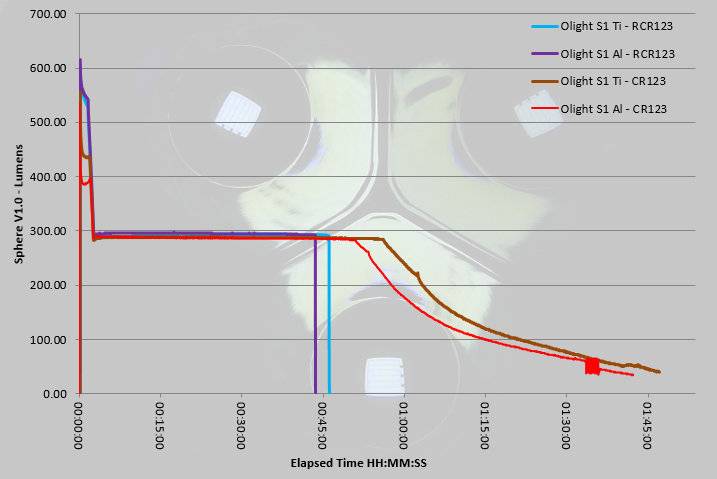
The trace here shows each of the S1 versions running on CR123 and on RCR123. The most distinctive difference is that on RCR123 the initial output is up to 120lm higher than on CR123. Once the light has been running for 3 minutes and the output ramps down to around 300lm, all four traces pretty much overlap. For the RCR123s, there is a sudden shut-off when the cell-protection kicks in. On CR123 the output starts to drop out of regulation at around 50 minutes after turn-on which is approximately halfway through the total ANSI runtime.
 photo Olight S1 runtime.jpg

Troubleshooting

This section is included to mention any minor niggles I come across during testing, in case the information helps anyone else.

No issues were encountered during testing.

As per the description of this section, this information is provided in case anyone else finds a similar ‘issue’ that might be fixed in the same way.

The Olight S1 in use

In reality there is little difference between these two versions in terms of practicality, except perhaps the neutral emitter in the Ti version. Of course the Ti version feels much more special and looks the part, as do any of the S1 special editions.

Regardless of special edition or not, the S1 is an excellent EDC light and won me round straight away. Easy and reliable access to Moon mode, direct access to High and memory of the last standard mode used, all tick the EDC boxes; all this and never forget its super compact size which makes it very easy to carry.

The built in timer is great for giving the light a ‘sleep’ mode so if you are camping or otherwise in need of a period of ‘settling-in’ before going to sleep, but not wanting to then have to turn a light off; it will turn itself off for you. Think of your own uses for this; I really like it even if I don’t use the timer all that much.

Being able to pop out the tailcap spring and remove the magnet is a really clever design. Magnets are useful, but very often I get annoyed with them picking up this and that. Now I can choose to have the magnet or not.

Deciding between CR123 and RCR123 will be personal preference. For heavy users the guilt-free-lumens of RCR123 may be a better match, but check that runtime graph; a sudden cut-off might be a problem for some users. If it is a problem, stick to CR123, as for general light EDC use it will last a long time.

Thanks to the very low parasitic drain, you can be confident that leaving it loaded up with a CR123, the S1 will be ready to go when you need it, and you won’t find it with a run-down cell. If you are super-paranoid, you can lock out the Standard version by unscrewing the tail-cap half a turn. You cannot lockout the Ti Special Edition like this as the threads are not coated.

Although a TIR lens was chosen for better control of the beam shape, it has the added benefit of being pretty much unbreakable. That beam is a general purpose beam which is well suited to closer range typical EDC uses.

Even though I’m use to it, I still have to think twice when putting a new cell in, the ‘negative terminal towards the head’ layout seems a strange choice when convention has the positive terminal towards the head. It does include all the relevant protection in case you get it wrong, but this seems an unnecessary unconventional touch.

The switch is quite low profile and without the clip often needs a bit of ‘hunting’ to find. The clip, which seems relatively large, can act as a guide for finding the button, and also helps stabilise the grip. The S1 is small enough that is can feel insecure to hold, especially when performing multi-clicks of the switch; the clip gives a little something extra to get hold of.

Small, good looking and full of useful modes that are easy to get at. It is no wonder the S1 is proving very popular.

Review Summary

_______________________________________________ _______________________________________________
Things I like What doesn’t work so well for me
_______________________________________________ _______________________________________________
Very compact. Sudden cut-off when using RCR123.
Great UI and selection of modes. Unconventional cell direction.
Takes CR123 or RCR123. Special Edition version cannot be locked out.
Very low parasitic drain.
User removable tail-cap magnet.
‘Proper’ Moon-Mode (with direct access).
Timer mode.

 photo 51 S1 twins2 P1150842.jpg

At the time of posting, the following links are for the Olight S1 on:
Amazon UK
Amazon US


Discussing the Review:

Please feel free to add comments to the review, but the ideal place to freely discuss these reviews is on a forum. If you started reading the shorter forum version of the review, but followed the link this full exclusive review, please return to that forum to discuss the review there.
If you read the review entirely on Tactical Reviews, please consider one of the following to join in any discussion.

CandlePowerForums – Flashlight Reviews Section (Largest and Friendliest Flashlight Community Forum)

EdgeMatters – Sponsored Reviews (UK based Forum for Knife Makers and Collectors)
Light Review: NITECORE Headlamps – T-360, HA20 and HC30

With the launch of three new headlamps from NITECORE, the T-360, HA20 and HC30, I’ve had the opportunity to compare them. Each one is very different and fits a different requirement. Have a look and see which one would be right for you.

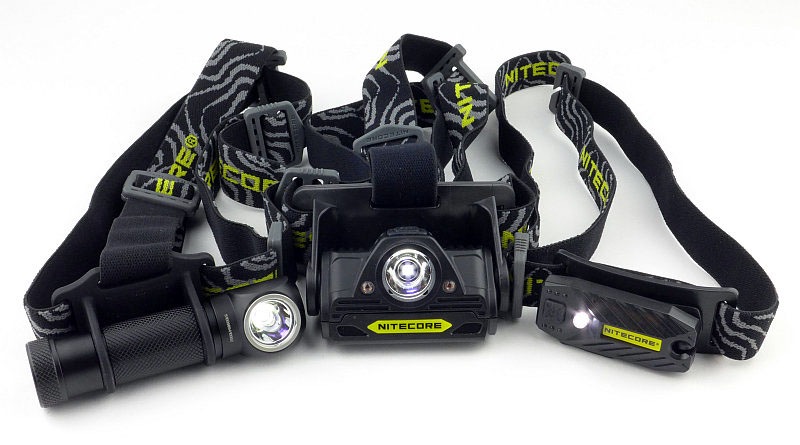
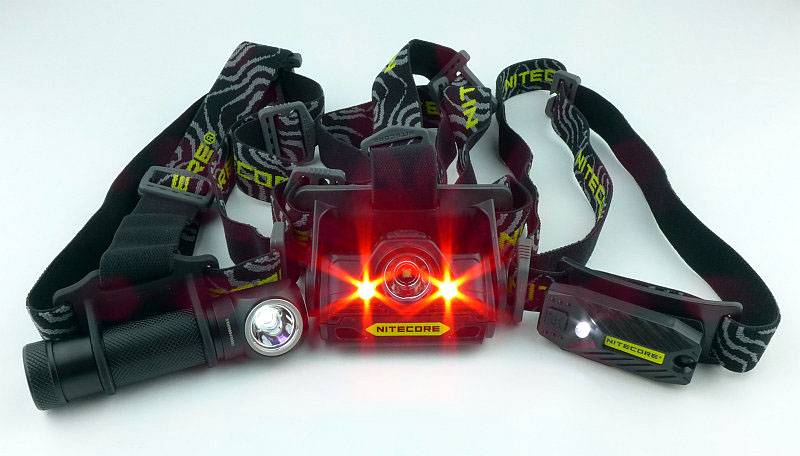
 photo 02 NITECORE headlamps group red P1160494.jpg

Taking a more detailed look at the T-360:

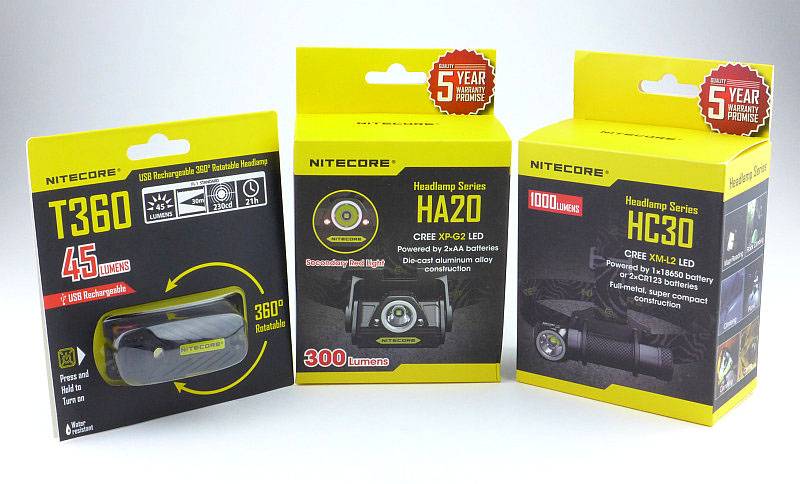
Before diving into the detail here are the three boxed lights together.
 photo 01 NITECORE headlamps boxed P1160364.jpg

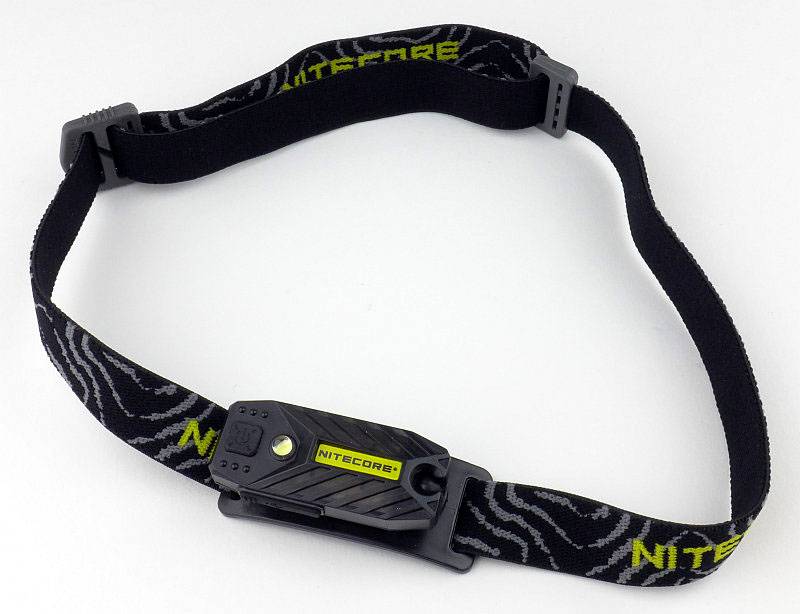
For the T-360, as it has a built-in USB rechargeable cell, there is simply the T-360, a headband and the instructions in the box.
 photo 11 T-360 unboxed P1150736.jpg

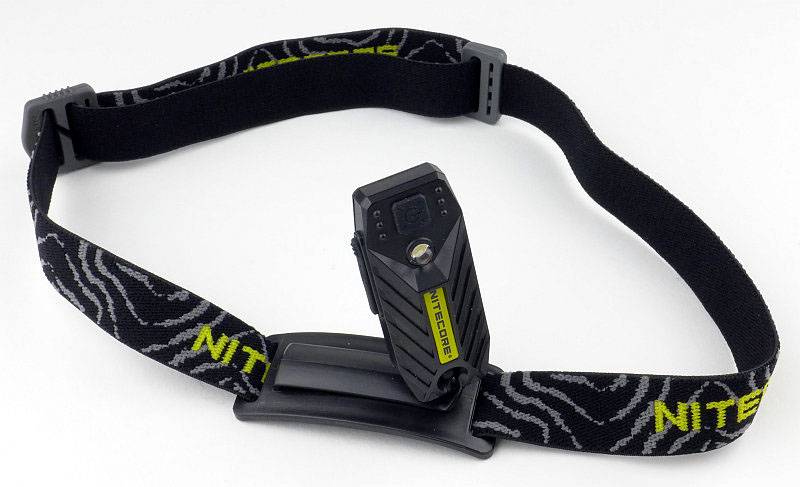
Giving it its unique versatility, the T-360 has a ball joint around which the entire light head swivels and rotates.
 photo 12 T-360 angle head P1150739.jpg

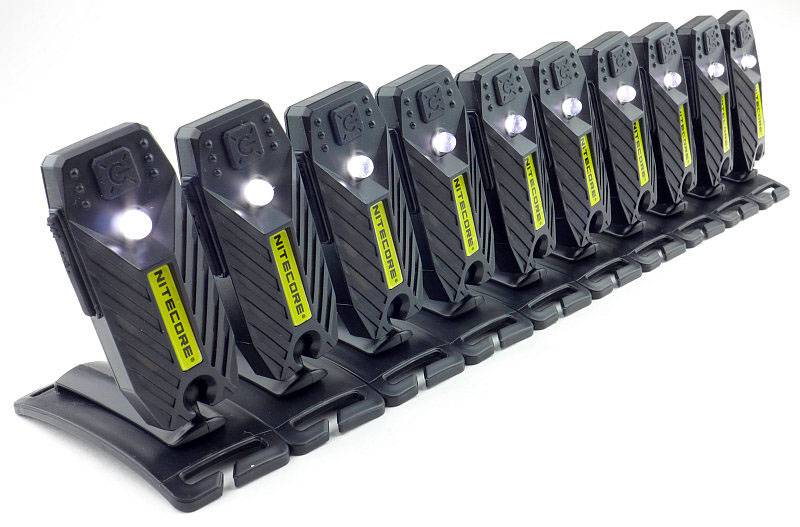
Just slipping in a gratuitous shot of several T-360s lined up.
 photo 13 T-360 lineup P1150757.jpg

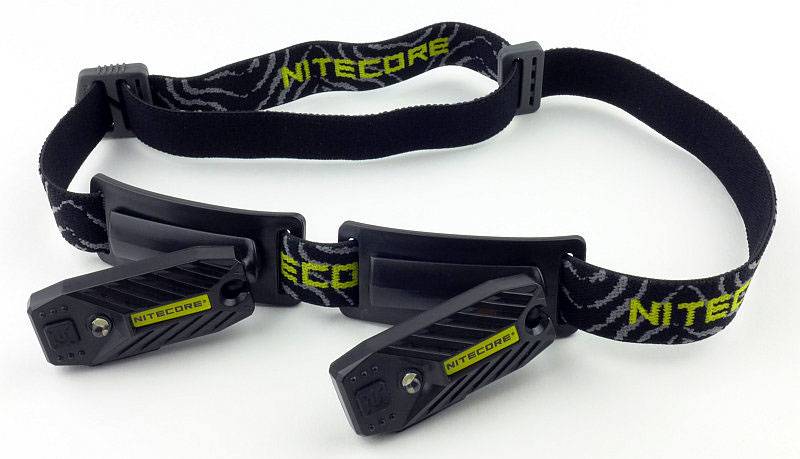
Being so small and light, you can keep a spare one on the same headband!
 photo 14 T-360 backup P1150795.jpg

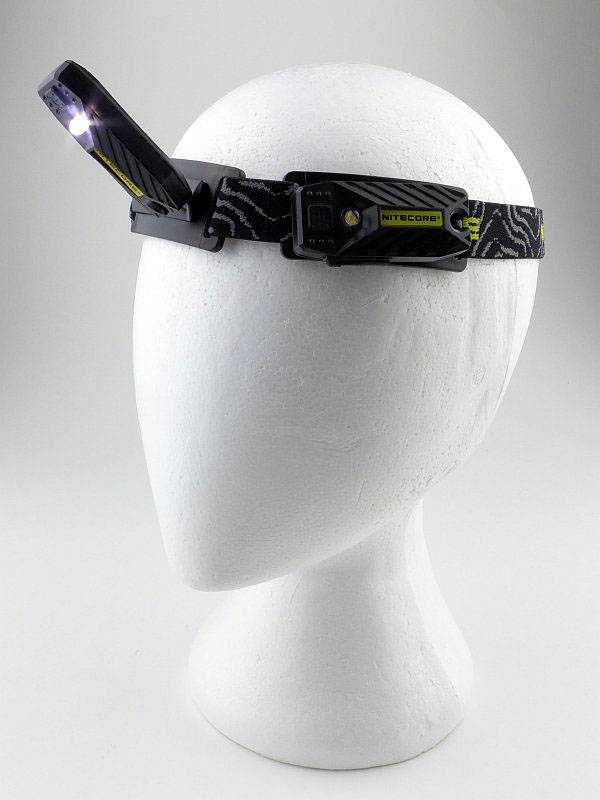
Shown here in its head-mounted configuration with the spare T-360 as well.
 photo 15 T-360 on head P1160352.jpg

Taking a more detailed look at the HA20:

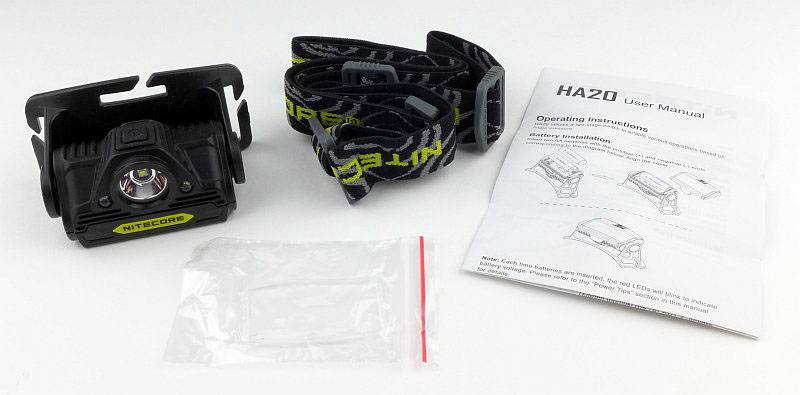
For the HA20, as well as the light unit, there is the headband (with top strap) a special square-shaped O-ring and the instructions.
 photo 20 HA20 contents P1160368.jpg

Fitting the strap is very easy.
 photo 21 HA20 strap fitted P1160376.jpg

You can’t get to the battery compartment with the light unit rotated normally.
 photo 23 HA20 battery01 P1160387.jpg

First you need to rotate the unit forwards to expose the plastic tab.
 photo 24 HA20 battery02 P1160389.jpg

Then you can pop the cover open.
 photo 25 HA20 battery03 P1160390.jpg

Finally you can rotate the light unit all the way back round to allow the door to come off.
 photo 26 HA20 battery04 P1160394.jpg

Each end of the battery compartment has a set of sturdy terminals.
 photo 27 HA20 terminals P1160398.jpg

You have to fit the rear cell first then the front one.
 photo 28 HA20 cells fitted P1160405.jpg

The HA20 has three LEDs, an XP-G2 LED and two F5 red LEDs.
 photo 29 HA20 LEDs P1160414.jpg

A closer look at the main beam XP-G2 and its reflector.
 photo 30 HA20 main LED P1160419.jpg

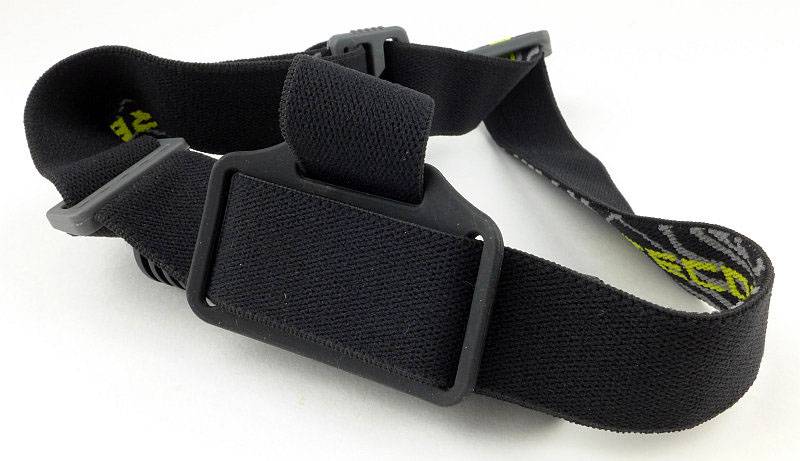
The elastic strap for the main headband is routed through the mount as shown.
 photo 31 HA20 mount back P1160422.jpg

The top strap gives extra stability when wearing the headlamp.
 photo 22 HA20 on head P1160382.jpg

Taking a more detailed look at the HC30:

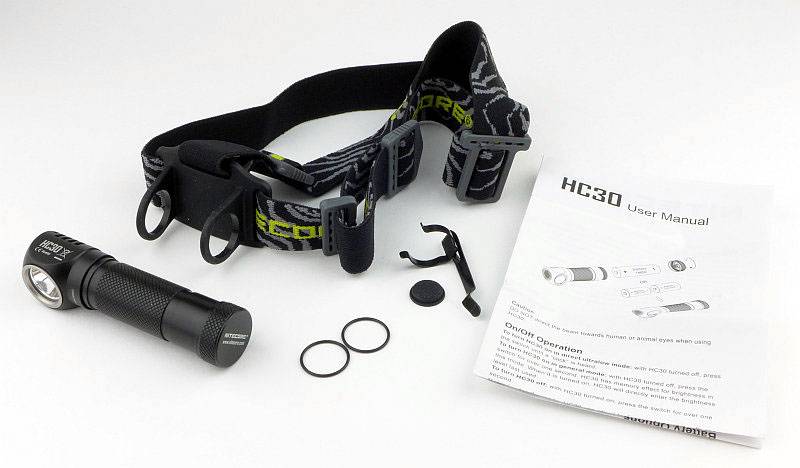
Of these three headlamps, the HC30 has more accessories as it includes two spare O-rings, a spare switch boot and clip as well as the HC30 itself, headband and instructions.
 photo 40 HC30 contents P1160425.jpg

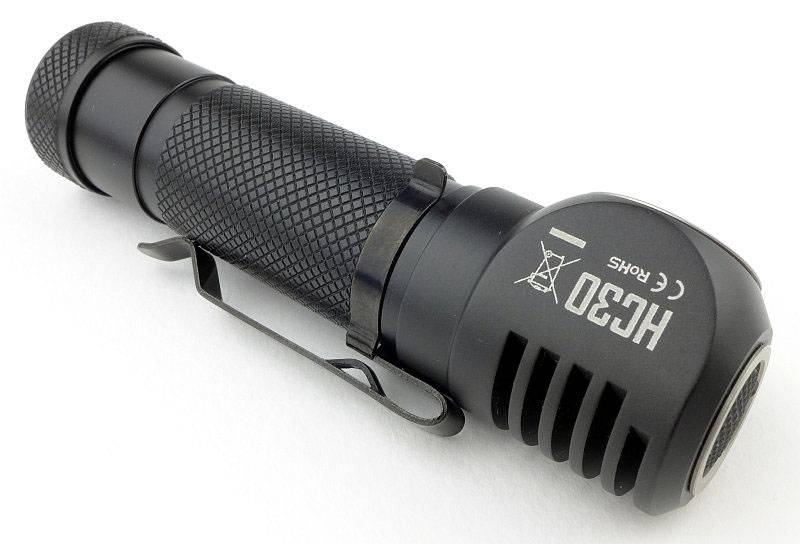
A very sleek design.
 photo 41 HC30 angle P1160431.jpg

On the head of the HC30 is a low profile rubber click switch.
 photo 42 HC30 switch P1160435.jpg

When looking side on you can see the deeply cut heat-sink fins.
 photo 43 HC30 fins P1160441.jpg

The battery tube cap has been laser engraved with NITECORE’s logo.
 photo 44 HC30 tailcap P1160443.jpg

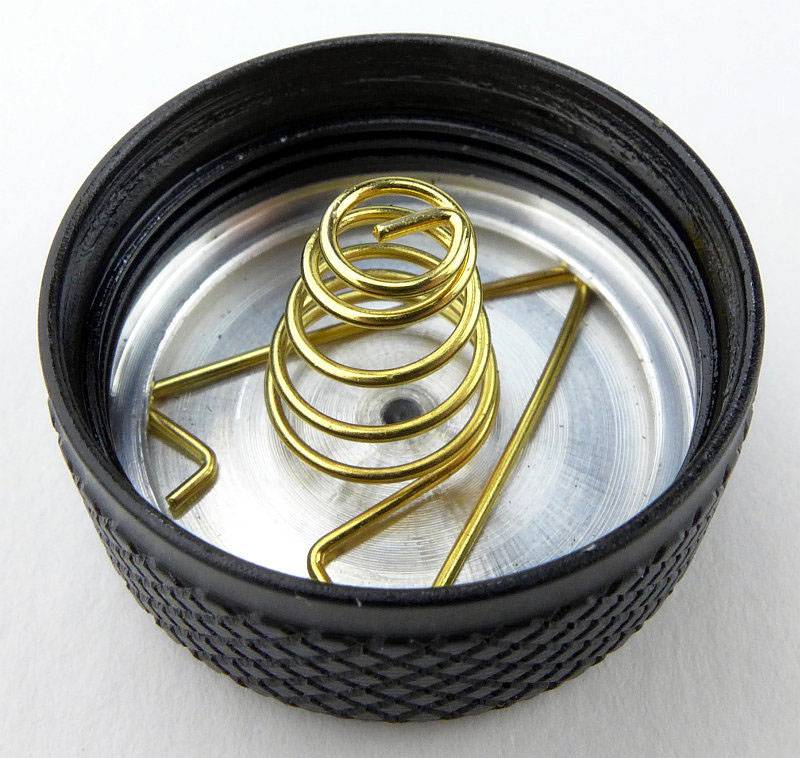
Inside the tail-cap is a spring contact which has been tucked into a groove, removing the need for any circuit board and allowing the depth of the cap to be as shallow as possible.
 photo 45 HC30 tailcap contact P1160446.jpg

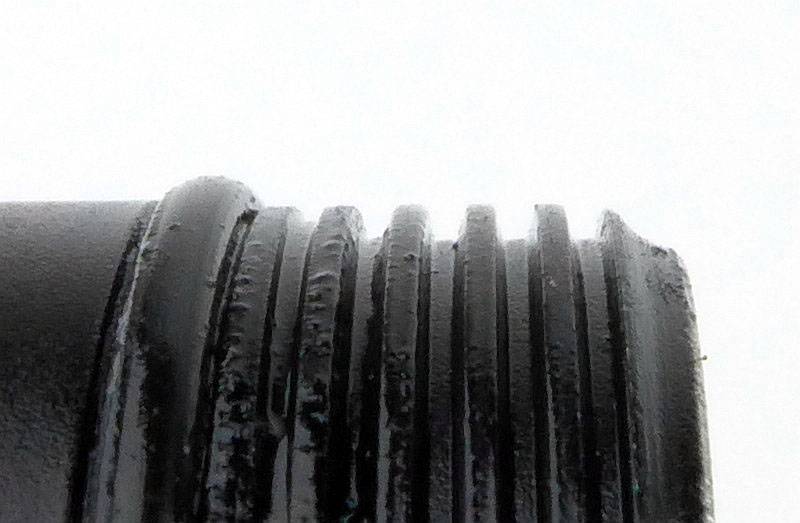
The threads are Acme (trapezoid) in form, well lubricated and fully anodised (allowing lockout).
 photo 46 HC30 tailcap threads P1160451.jpg

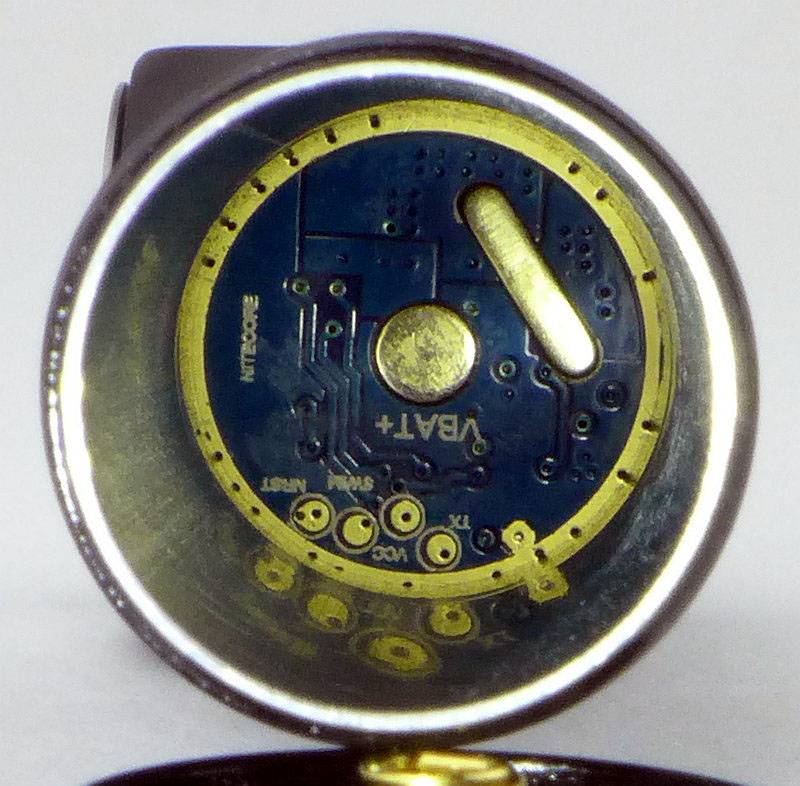
Inside the battery tube you can see the physical reverse polarity protection (also requiring the use of button top cells).
 photo 47 HC30 inside P1160455.jpg

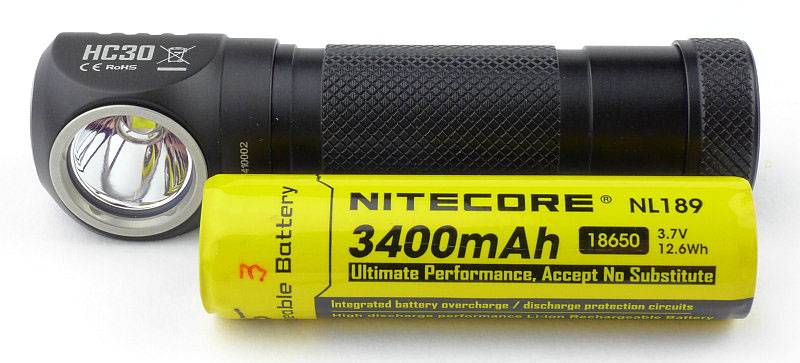
Thanks to a well thought-out design, the HC30 is not much larger than the cell it uses. A very nice compact design.
 photo 48 HC30 with cell P1160456.jpg

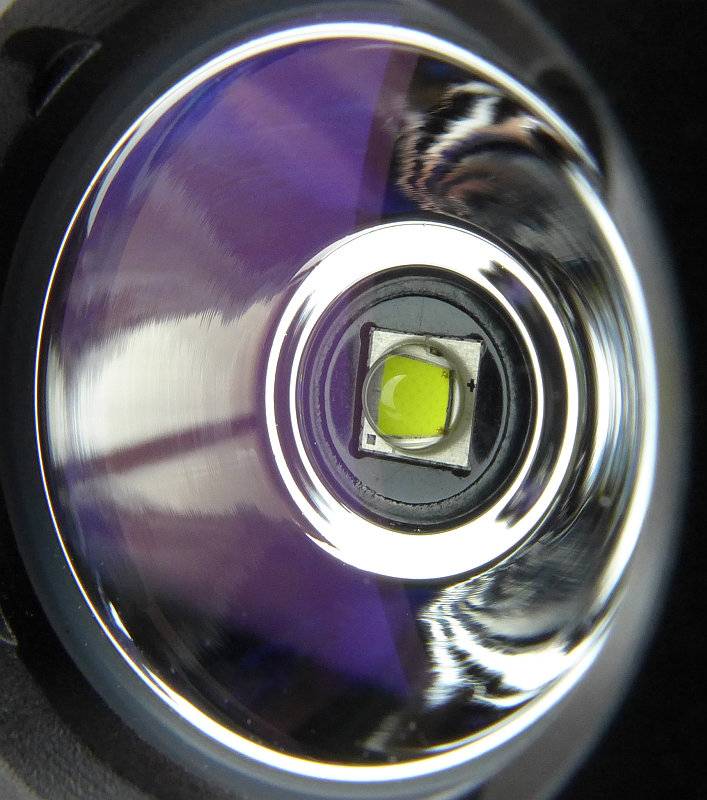
An XM-L2 LED is used.
 photo 49 HC30 LED P1160463.jpg

For such a compact design, the reflector is relatively deep.
 photo 50 HC30 reflector P1160465.jpg

You can fit the optional clip into either groove giving an up or down position. With the clip fitted it does not fit into the headband mount properly.
 photo 51 HC30 clip P1160471.jpg

With the strap sitting against your head, and the mount being low profile, you have maximum comfort.
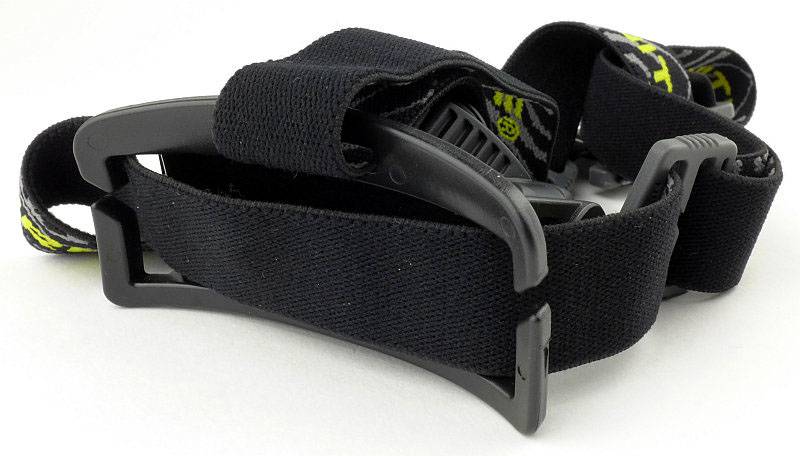
 photo 55 HC30 mount back P1160487.jpg

The fully assembled headlight.
 photo 52 HC30 in mount P1160473.jpg

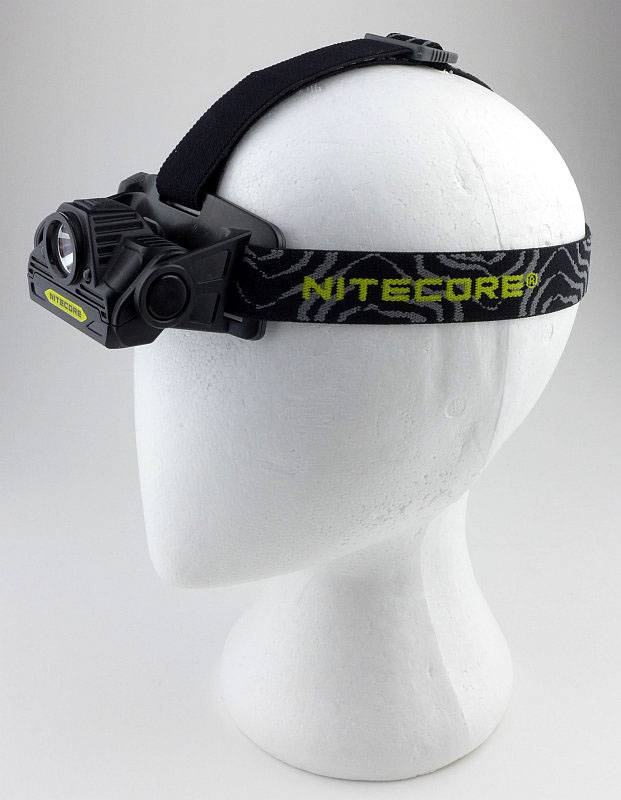
On the head, the HC30 is very comfortable, light and stable.
 photo 53 HC30 on head P1160479.jpg

The LED on the Ultra Low mode showing the dots on the phosphor surface – just because…
 photo 54 HC30 LED close low P1160485.jpg

The beam

Please be careful not to judge tint based on images you see on a computer screen. Unless properly calibrated, the screen itself will change the perceived tint.

The indoor beamshot is intended to give an idea of the beam shape/quality rather than tint. All beamshots are taken using daylight white balance. The woodwork (stairs and skirting) are painted Farrow & Ball “Off-White”, and the walls are a light sandy colour called ‘String’ again by Farrow & Ball. I don’t actually have a ‘white wall’ in the house to use for this, and the wife won’t have one!

Being a comparison review, we have the opportunity for some side-by-side (or top-to-bottom) comparisons using the same exposures. However BEFORE we start that comparison, as the T-360 is a tiny lightweight low powered light, to just get an idea of the beam, this first photo is at an exposure to give the best impression of the beam.
 photo 16 T-360 indoor beam P1170378.jpg

Now we start the comparison and the exposure has been set for the HA20 and HC30 to show correctly so the T-360 appears rather dim in comparison.
 photo 17 T-360 indoor beam exposure comparison P1170380.jpg

On the same exposure, the HA20 – there is a very defined hot-spot and a wide smooth spill.
 photo 32 HA20 indoor beam exposure comparison P1170355.jpg

Again on the same exposure, the HC30 shows its power. It has a broad hot-spot and bright spill, but the spill is narrower than the HA20.
 photo 57 HC30 indoor beam exposure comparison P1170351.jpg

For the outdoor beamshots, the T-360 did not have enough power to show, so is not included.
As before the exposure has been fixed to allow the HA20 and HC30 to be directly compared. Starting here with the HA20. The purpose of it hot-spot becomes clear as the lower power of the HA20 needs this to extend the range.
 photo 33 HA20 outdoor beam exposure comparison P1170273.jpg

The HC30, of course, has much more power and this is very clear in this direct comparison.
 photo 56 HC30 outdoor beam exposure comparison P1170270.jpg

Modes and User Interface:

Three different headlamps, and three very different interfaces.

T-360
–Control:
Single click button

–Modes:
High, Mid, Low and Flash/Strobe at 1Hz, 2Hz and 10Hz

–UI:
From OFF, press-and-hold the switch for over 1s to turn ON to Low. Press briefly to cycle through Mid, High, Low etc.
Press-and-hold again for 1s to turn OFF.
From OFF double-click the switch to enter flashing mode at 1Hz. Press briefly to cycle through 2Hz, 10Hz, 1Hz etc.
Press-and-hold for 1s to turn OFF.
There is no memory for constant of flashing modes. Both will always start from Low or 1Hz.

HA20
–Control:
Two-stage switch

–White Modes:
Turbo, High, Mid, Low, Ultra Low and ‘Special Modes’ (Police Warning/Location Beacon/SOS)
(Police Warning is a slow flashing mode at approximately 1Hz)

–Red Modes:
Constant, Flashing and Power Indicator.

–White UI:
From OFF press the switch fully until it clicks to turn ON.
While ON, half-press the switch to cycle through Low, Mid, High, Turbo, Ultra Low etc.
To switch OFF, press the switch fully until it clicks.
While ON, half-press the switch for over 1s to enter Special modes. Half-Press the switch to cycle through Police Warning, Location Beacon, SOS, Police Warning etc
To Exit Special modes and switch OFF, press the switch fully until it clicks.

–Red UI:
From OFF, half-press the switch for over 1s to turn on the Constant Red output.
To swap between constant and flashing Red output, half-press the switch.
To switch OFF, press the switch fully until it clicks.

–Power Indicator:
On first inserting cells into the HA20, the Red LEDs flash to indicate the battery voltage, first whole Volts, then after a pause 0.1V.
From OFF, half-press the switch briefly to indicate power level with one (<10%), two (<50%) or three (>50%) flashes.

HC30
–Control:
Single click button

–White Modes:
Turbo, High, Mid, Low, Lower and ‘Special Modes’ (Strobe/SOS/Location Beacon)
UI: From OFF press the switch to turn directly ON to Lower mode (regardless of the previously used mode).
From OFF, press-and-hold the switch for over 1s to turn ON to ‘Last used constant mode’.
From OFF, press-and-hold the switch for over 2s to turn ON to Turbo.
While ON press the switch briefly to cycle through Lower, Low, Mid, High, Turbo, Lower etc.
To turn OFF press-and-hold the switch for over 1s.
From OFF, double-click the switch to enter Strobe. While ON Strobe, press the switch briefly to cycle through SOS, Location Beacon, Strobe etc. To turn OFF, press-and-hold the switch for over 1s.

Batteries and output:

The T-360 runs on its built-in cell.
The HA20 runs on 2xAA (Alkaline, NiMh or L91).
The HC30 runs on 1×18650 (button top), 2xCR123 or 2xRCR123.

To measure actual output, I built an integrating sphere. See here for more detail. The sensor registers visible light only (so Infra-Red and Ultra-Violet will not be measured).

Please note, all quoted lumen figures are from a DIY integrating sphere, and according to ANSI standards. Although every effort is made to give as accurate a result as possible, they should be taken as an estimate only. The results can be used to compare outputs in this review and others I have published.

___________________________________________ ________________________________ ________________________________
Model/Mode using specified cell I.S. measured ANSI output Lumens PWM frequency or Strobe frequency (Hz)
___________________________________________ ________________________________ ________________________________
T-360/High – Built-in 62 0
T-360/Medium – Built-in 24 0
T-360/Low – Built-in 2 0
HA20/Turbo – AA Eneloop 342 0
HA20/High – AA Eneloop 202 0
HA20/Medium – AA Eneloop 106 0
HA20/Low – AA Eneloop 39 0
HA20/Ultra Low – AA Eneloop 2 0
HC30/Turbo – 18650 1058 0
HC30/High – 18650 503 0
HC30/Medium – 18650 245 0
HC30/Low – 18650 82 0
HC30/Ultra Low – 18650 2 0

Peak Beam intensity for the T-360 was not measured.
Peak Beam intensity for the HA20 measured 2800 lx @1m giving a beam range of 106 m.
Peak Beam intensity for the HC30 measured 6800 lx @1m giving a beam range of 165 m.

There is parasitic drain in the T-360 but this was not measured due to the built-in cell.
There is parasitic drain in the HA20; the drain was 194uA (1.23 years to drain the cells).
There is parasitic drain in the HC30; the drain was 51.5uA (6.87 years to drain the cell).

All shown on the same graph, the performance of each of these light is very different on maximum output.
The T-360 is very consistent for 30 minutes and then tails off to the point of being no use by 45 minutes.
The HA20 drops from maximum after around 10 minutes, and after stabilising again, remains consistent up to the last part of the run.
The HC30 however, has a strange behaviour which is only really noticeable using measuring equipment. After the initial drop after 5-6 minutes, the output rises, stabilises, then rises again before starting a gradual decline. Having a wide input voltage range from 3V to 8.4V, this will be a consequence of having to manage the quite different cell characteristics. Remember this is the maximum output, so it is testing the limits of the cell as well as the HC30. To the naked eye this behaviour doesn’t stand out.
 photo NITECORE Headlamps HC30 HA20 T360 runtime.jpg

Troubleshooting

This section is included to mention any minor niggles I come across during testing, in case the information helps anyone else.

No issues were encountered during testing.

As per the description of this section, this information is provided in case anyone else finds a similar ‘issue’ that might be fixed in the same way.

The T-360, HA20 and HC30 in use

Do I have a favourite? Yes, but more on that later, as each of these headlamps gives you different benefits and capabilities.
—–
You are probably familiar with the NITECORE TUBE key-chain light. The T-360 is a spin off of this USB rechargeable featherweight light and gives you a featherweight headlamp. As I showed earlier it is so lightweight you can install two (or even three) on the same headband so you have hot-spares ready for when the cell becomes depleted. The T-360 means anyone can EDC a headlamp. Of course it is not just a headlamp as when you take it off the strap it will stand by itself, or can be clipped over a cap peak or pocket edge. Unlike the TUBE, the T-360 does not use any PWM so is superbly good to use on any level.

As shown in the head mounted photo, I have found the T-360 benefits from rotating the body out, so that it sticks out, when you use it. With the full flood beam, if you leave it flat on your forehead, half the light just goes upwards, so by rotating it as shown you can direct this down and make better us of the available light.
—–
Moving up in size and in power to the HA20. AA power is a significant benefit simply due to the ease of getting AA cells; this is not to be underestimated. This also makes it easier to give as a gift. With the HA20 there is a bit of a trade off in providing one of the features. The head has a really good range of adjustment, including upwards; The result of this is that the HA20 has been placed further from the head to provide the space to be able to rotate so far in the mount. With an aluminium body, this creates a slightly front-heavy design making the HA20 feel heavier on the head than it really is. Once you start moving about more it can become noticeable.

Still on the HA20, the two-stage button has proven to be a little difficult to work with. The half-press is somewhat indistinct so you are not entirely sure you have pressed it enough. The full-press is a substantial press needing the button to be pushed well into the switch boot.

Having Red light as an option in the same headlamp is one of the strong points. When I’m out hunting and using red light on the gun-light, the last thing I want is to then switch on a white light, so the pure red light (not filtered) is just what is needed. Just be aware that this is not ‘Star Party’ friendly red light as it is quite bright.
—–
Finally we have the bright and compact HC30. NITECORE have done really well in keeping the size down, and the HC30 is not much bigger than the 18650 it uses. A single 18650 is a great compromise for a headlamp as it typically has the energy of 3-4 AAs but weighs roughly the same as 2xAA(NiMh) cells and is a single cylinder (so more compact). This allows for greater output or longer runtimes from a smaller lighter headlamp. So as long as you are into li-ions (or happy to burn through CR123s), then it makes an ideal choice.

Even though it has only a single-stage button, the interface is very well thought out. With no delay at all you can click onto ‘Lower’, then cycle up to a level you want. Alternatively you can return straight to a previously used level if you are happy to press-and-hold for 1s. You also still have direct access to Turbo with a slightly longer press-and-hold of 2s. But there is more, as if you are into your flashing modes, a double-click brings them to life.

With all the modes available, I couldn’t have asked for more from this single button interface.

Comfort is top notch as the weight is kept close to your head (increasing stability) and the mount doesn’t touch you at all and has no hard/hot-spots.

For my own uses, I would have preferred a more flood orientated beam, but with its mixed use as a right-angle light and a headlamp the beam’s mix of flood and throw is very good.
—–
So could you spot my favourite? The HC30 has it, if I had to pick one.

Which would you pick?

Review Summary

_______________________________________________ _______________________________________________
Things I like What doesn’t work so well for me
_______________________________________________ _______________________________________________
T-360 – Featherweight. T-360 – Limited runtime with built-in cell./td>
T-360 – Easy to EDC. T-360 – Press-and-hold to turn on.
T-360 – MicroUSB rechargeable.
T-360 – Can be used as a clip light.
HA20 – Easy AA power. HA20 – Front heavy.
HA20 – White and Red output HA20 – Switch can be tricky to half-press reliably.
HA20 – Wide range of angle adjustment HA20 – Relatively high parasitic drain.
HA20 – Aluminium body for good heat-sinking.
HC30 – 1000lm output. HC30 – Cannot use flat-top cells.
HC30 – Super compact. HC30 – Ultra-Low mode could be lower.
HC30 – Excellent weight distribution.
HC30 – Can be used as a right-angle hand-held light.
HC30 – Direct access to Turbo, Ultra-Low and Strobe modes.
HC30 – Parasitic drain can be stopped by locking-out the tail-cap.

 photo 03 NITECORE headlamps group white P1160491.jpg


Discussing the Review:

Please feel free to add comments to the review, but the ideal place to freely discuss these reviews is on a forum. If you started reading the shorter forum version of the review, but followed the link this full exclusive review, please return to that forum to discuss the review there.
If you read the review entirely on Tactical Reviews, please consider one of the following to join in any discussion.

CandlePowerForums – Flashlight Reviews Section (Largest and Friendliest Flashlight Community Forum)

EdgeMatters – Sponsored Reviews (UK based Forum for Knife Makers and Collectors)
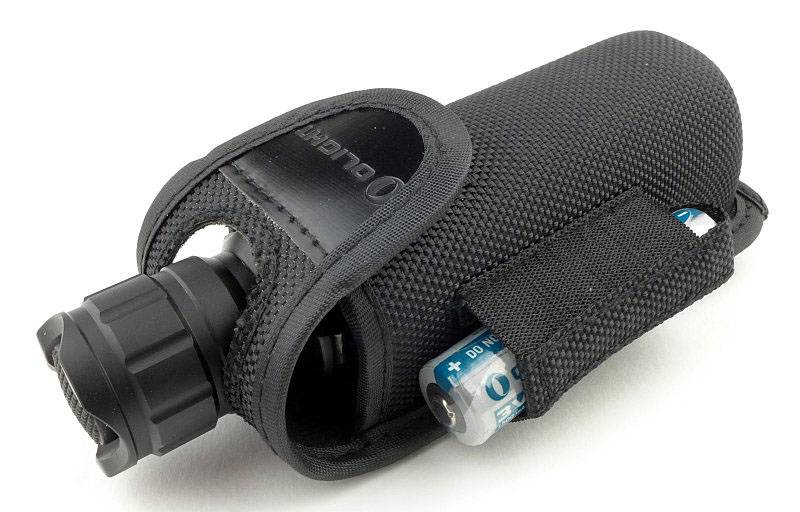
Light Review: ACEBEAM H10 Headlamp

The H10 is ACEBEAM’s most powerful Headlamp with an impressive 2000lm burst mode (using an IMR 18650) and uses the high power MT-G2 LED array.

 photo 06 H10 angle P1150631.jpg

Taking a more detailed look:

Presentation is good with the ACEBEAM packaging. The box is sealed with a tamper evident tape.
 photo 01 H10 boxed P1150612.jpg

Inside there is a foam liner holding the contents in place.
 photo 02 H10 box open P1150614.jpg

In the box there is the H10 (with unlabelled 18650 inside it), spare O-rings, pocket clip, headband and mount, plus the instructions.
 photo 03 H10 box contents P1150621.jpg

The headband is fully assembled and opens out like this.
 photo 04 H10 headband P1150625.jpg

The headband mount has two retaining rings that line up with grooves in the body of the H10.
 photo 05 H10 holder P1150627.jpg

Looking at the back of the H10 you can see the shallow heat sink fins on the head, and the domed switch on top.
 photo 07 H10 tall P1150637.jpg

Surrounding the domed switch button is a rotating selector ring.
 photo 08 H10 switch P1150640.jpg

On the battery tube cap, the make, model and serial number are engraved.
 photo 09 H10 tailcap P1150643.jpg

As we will see further on, there is parasitic drain, so for transit (and to prevent accidental activation) as the supplied 18650 is fitted inside the H10, an insulating disc is included to break the circuit and lock-out the H10. You need to discard that white plastic disc to use the H10.
 photo 10 H10 tailcap off P1150644.jpg

Inside the tail-cap the negative terminal is a spring. The top edge of the battery tube makes contact with the gold ring-terminal on the circuit board.
 photo 11 H10 tailcap P1150648.jpg

Peering inside the battery tube there is a simple positive terminal surrounded by a plastic insulator.
 photo 12 H10 inside P1150652.jpg

The threads are almost square, perfectly cut, fully anodised and well lubricated.
 photo 13 H10 threads P1150655.jpg

With a large MT-G2 LED the reflector is relatively small and is textured to further smooth the beam.
 photo 14 H10 reflector P1150660.jpg

Looking straight at the MT-G2 LED.
 photo 15 H10 LED P1150662.jpg

Of course the H10 can be used as a right-angle light, but it is intended as a headlamp. Here it is fitted in the headband mount.
 photo 16 H10 mounted P1150666.jpg

At the back, the top strap fits into the headband adjustment loop to help keep it centred.
 photo 17 H10 strap detail back P1150669.jpg

Though the mount is a soft rubber, the strap is threaded through the mount to keep the elastic strap itself against the user’s head. This provides maximum comfort.
 photo 18 H10 mount detail back P1150673.jpg

Some of the detail in the rubber mount’s moulding.
 photo 19 H10 mount detail front P1150682.jpg

A pocket clip is provided for when the H10 is used out of the headband mount. It clips into either one of the grooves that are used for the headband mount. You cannot leave the clip on and fit it back into the headband mount properly. The clip is stiff to fit and has already marked the anodising.
 photo 20 H10 clip P1150687.jpg

The beam

Please be careful not to judge tint based on images you see on a computer screen. Unless properly calibrated, the screen itself will change the perceived tint.

The indoor beamshot is intended to give an idea of the beam shape/quality rather than tint. All beamshots are taken using daylight white balance. The woodwork (stairs and skirting) are painted Farrow & Ball “Off-White”, and the walls are a light sandy colour called ‘String’ again by Farrow & Ball. I don’t actually have a ‘white wall’ in the house to use for this, and the wife won’t have one!

For most purposes, a headlamp benefits from a flood beam, as it is generally used as task light. The H10, with its large LED and small reflector doesn’t disappoint, with a wide and even flood beam.
 photo 22 H10 indoor beam P1170359.jpg

Moving outdoors, this headlamp does have enough power to give it some range despite the flood beam and the area is evenly lit.
 photo 21 H10 outdoor beam P1170276.jpg

Modes and User Interface:

The H10 has a two-stage domed button switch, and surrounding this a selector ring. The selector ring has four tactile stops for the four normal modes (1000lm, 500lm, 200lm, 30lm).

At any time (either from OFF or from any normal mode) a full press of the button gives you the maximum output 2000 lm Burst mode. When the button is released, the H10 returns to the previous state (either from OFF or any normal mode).

To turn onto a normal mode, half-press the button and hold for 2s. The H10 will then come onto the mode set by the selector ring. The mode can be pre-selected before turning on, or selected once the H10 is on.
To turn OFF, half-press the button and hold for 2s.

Batteries and output:

The runs on a supplied LG18650HE2 20A 2500mAh IMR 18650 cell, but can use any button top 18650 or 2xCR123, both of which will limit the maximum output.

To measure actual output, I built an integrating sphere. See here for more detail. The sensor registers visible light only (so Infra-Red and Ultra-Violet will not be measured).

Please note, all quoted lumen figures are from a DIY integrating sphere, and according to ANSI standards. Although every effort is made to give as accurate a result as possible, they should be taken as an estimate only. The results can be used to compare outputs in this review and others I have published.

___________________________________________ ________________________________ ________________________________
ACEBEAM H10 using supplied 20A IMR cell I.S. measured ANSI output Lumens PWM frequency or Strobe frequency (Hz)
___________________________________________ ________________________________ ________________________________
Burst 1940 0
High 998 0
Medium 481 0
Low 211 0
Firefly 31 0

Peak Beam intensity measured 6800 lx @1m giving a beam range of 165 m.

There is parasitic drain at and average of approximately 62uA (it varies between 32 and 93uA) which would mean a fully charged 2500mAh cell will take 4.6 years to drain.

Due to the extreme nature of the 2000lm Burst mode and the requirement to keep the button pressed, the runtime was not measured for this output level. Instead the runtime was for the highest constant output level the 1000lm high mode. This 1000lm output is well regulated for as long as the cell can maintain it; a very good performance.
 photo ACEBEAM H10 runtime.jpg

Troubleshooting

This section is included to mention any minor niggles I come across during testing, in case the information helps anyone else.

No issues were encountered during testing.

As per the description of this section, this information is provided in case anyone else finds a similar ‘issue’ that might be fixed in the same way.

The ACEBEAM H10 in use

Two highlights of the H10 are its lovely smooth flood beam and the neutral/warm tint of the MT-G2 LED. These features allow you to focus entirely on the task you are doing and not even think about the headlamp.

A single 18650 makes for a comfortable weight to have head mounted, and thanks to the use of a top-strap as well, you don’t need to have the headband very tight for it to stay securely in place. A top-strap really does improve comfort. With the strap routed through the mount so that it is the strap itself that is against your forehead, again comfort is very good.

What I don’t like are interfaces that make you wait for the light to come on or go off, and unfortunately, the H10 requires a half-press, wait, and 2s later the light comes on (with the same for off). If you fully press the button by mistake you get the full 2000lm burst output, which is not a nice surprise, and you have to try again to get the H10 to come on. For every day use, I’d much prefer the on/off to be controlled by a simple click, and the burst to require a longer hold, but perhaps only 1s before it activates.

With gloves on, or with cold hands, I found the half-press unreliable, or at least my ability to find the half-press position. 2000lm when you wanted 30lm is not good.
Still, that beam is worth the wait when you are not rushing to do anything, and once on and running, the H10 melts away and you just have light.

Depending on how many lights you use, you might also not hit the right mode first time. There are no marks on the selector ring to indicate which mode you have chosen. A few simple marks would make the pre-selection of modes so much easier. If this was your main light you would quickly learn the positions, and there is a stop at each end of the selections, so you can simply turn it all the way one way until it stops, then count the clicks back to the mode you want.

Parasitic drain is acceptable, but with fully anodised threads you can lock-out the H10 easily.

The optional clip can be fitted into either groove on the body to give up or down positioning. Fitting is very stiff and does mark the anodising, so depending on if this bothers you, you may choose to make it a dedicated right-angle light or leave it as a headlamp. Swapping between the two will scratch the H10.

The H10 gives its specified outputs effortlessly including the impressive 2000lm burst mode (as long as you use IMR), and has not had any issues with heat. In normal use and for indoor jobs, I find the 1000 lm output too high so use it on 500lm or below. When outdoors I have ramped up to the 1000 lm mode but the added airflow seems to cope with the extra heat easily.

The lowest mode is named ‘firefly’…I would not want to meet the firefly that provides 31 lm! that 31 lm output with the flood beam is a great mode, and one I use a lot, but I’d prefer it if there was a 1lm or lower mode as a true firefly level.

Review Summary

_______________________________________________ _______________________________________________
Things I like What doesn’t work so well for me
_______________________________________________ _______________________________________________
2000 lm Burst mode. Half-Press-and-Hold for 2s to turn on and off.
Smooth flood beam. ‘Firefly’ mode a bit bright at 31 lm.
Secure and comfortable to wear. Mode selector ring has no markings.
Well regulated output. Pocket clip scratches the anodising.
Nice tint from the MT-G2 LED. Needs IMR for best performance.
20A IMR cell supplied.
Well spaced modes.

See ACEBEAM’s Website for more of the manufacturer’s specifications


Discussing the Review:

Please feel free to add comments to the review, but the ideal place to freely discuss these reviews is on a forum. If you started reading the shorter forum version of the review, but followed the link this full exclusive review, please return to that forum to discuss the review there.
If you read the review entirely on Tactical Reviews, please consider one of the following to join in any discussion.

CandlePowerForums – Flashlight Reviews Section (Largest and Friendliest Flashlight Community Forum)

EdgeMatters – Sponsored Reviews (UK based Forum for Knife Makers and Collectors)
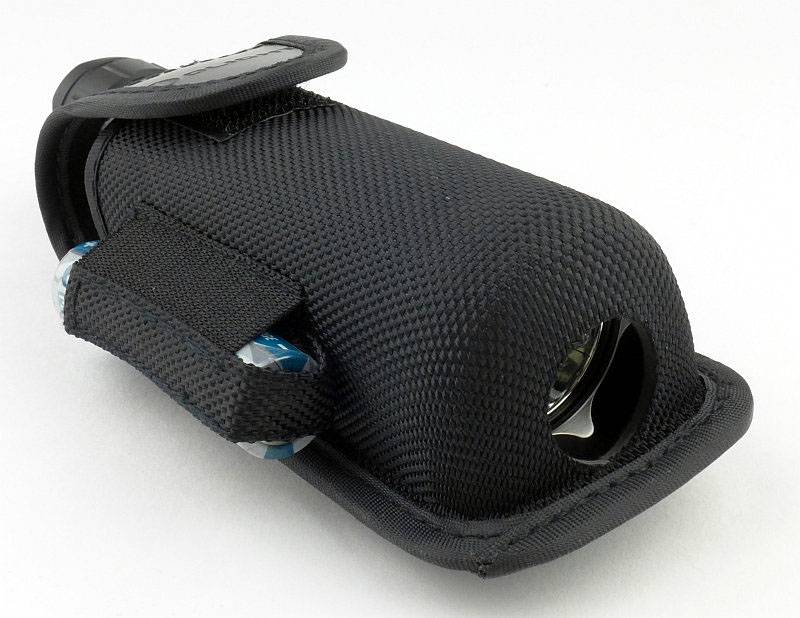
Light Review: FOURSEVENS Knight and Paladin

First revealed at SHOT Show 2015, FOURSEVENS have collaborated with PK (Paul Kim aka the Photon King) to produce these two exciting, fun and altogether usable lights – The Knight and Paladin. These are effectively the same light but the Knight is an Aluminium version and the Paladin is Titanium.
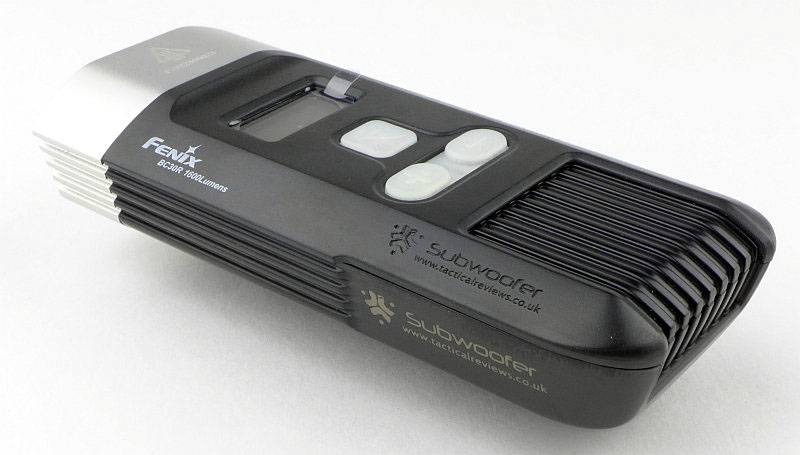
 photo 27 KnightPaladin plain P1170178.jpg

Taking a more detailed look:

FOURSEVENS’ packaging is ideal for showing off the design. Available separately are two versions of the strike bezel (a red one is shown here).
 photo 01 KnightPaladin Boxed P1170036.jpg

In the box you find the light itself, a spare O-ring, a CR123 cell and the front bezel ring which comes separately and not fitted to the light.
 photo 02 KnightPaladin unBoxed P1170053.jpg

So as it comes out of the package, the front bezel threads are exposed. Here the beautiful blue tones of the Paladin’s PVD finish can be seen clearly.
 photo 03 KnightPaladin bezel thread P1170058.jpg

While we are looking at the front, both these lights use a curious lens holder where the edges of the lens are exposed in three places. Once the bezel ring is in place this becomes less noticeable. Also note the small notches through the bezel threads; these allow the pocket clip to be fitted to the front of the light and held in place by the bezel ring.
 photo 04 KnightPaladin lens edge P1170060.jpg

Fitting the bezel ring completes the initial assembly.
 photo 05 KnightPaladin P angle P1170065.jpg

The same goes for the Knight.
 photo 06 KnightPaladin K angle bezel P1170071.jpg

Being all black, the bezel ring blends in more on the Knight.
 photo 07 KnightPaladin K angle P1170079.jpg

The positive and negative terminals in the head are gold plated. Despite the bare threads, these are not used as an electrical path. Physical reverse polarity protection is also included.
 photo 08 KnightPaladin K head P1170083.jpg

The threads are square cut and of a asymmetrical design with the grooves being much wider. This introduces ‘backlash’ into the threads and I suspect this relates to the special tailcap switch, but more on that later…
 photo 09 KnightPaladin K thread P1170086.jpg

A gold plated spring is used for the negative contact.
 photo 10 KnightPaladin K inside P1170087.jpg

Part of the design of the Knight and Paladin is that the light breaks down into several parts which can be swapped around in a Lego-like way to achieve different configurations.
 photo 11 KnightPaladin K apart P1170094.jpg

Swapping the bezel ring and the strike bezel components around creates a very different looking light!
 photo 12 KnightPaladin K crown P1170101.jpg

For the Paladin, the internals are the same in the head.
 photo 13 KnightPaladin P head P1170106.jpg

And when looking into the battery tube.
 photo 14 KnightPaladin P inside P1170111.jpg

As on the Knight, the threads are square and thin in profile.
 photo 15 KnightPaladin P thread P1170115.jpg

Taking the Paladin apart.
 photo 16 KnightPaladin P apart P1170118.jpg

Swapping the bezel ring and the strike bezel components and the Paladin too becomes a very different looking light!
 photo 17 KnightPaladin P crown P1170123.jpg

A couple of the options (not showing the clip fitted to the bezel), with the strike bezel on the front and along the battery tube, as well as the optional red strike bezel substituting the original black one on the Knight.
 photo 18 KnightPaladin configurations P1170134.jpg

Every part of these lights has had a great deal of attention paid to it. A special Tact-O-Click switch is used (more on that in the UI section).
 photo 19 KnightPaladin P Switch P1170138.jpg

The Paladin especially, deserves to be viewed from every angle to take in all the details.
 photo 23 KnightPaladin P reverse P1170154.jpg

A mid-depth reflector is used.
 photo 24 KnightPaladin P reflector P1170164.jpg

The reflector is the same on both models.
 photo 25 KnightPaladin K reflector P1170167.jpg

With an XM-L2 LED for the emitter.
 photo 25 KnightPaladin P LED P1170172.jpg

And the same again for the Knight.
 photo 26 KnightPaladin K LED P1170176.jpg

Though not the smallest of 1 x CR123 lights (with FOURSEVENS own Mini ML and Atom AL lights being smaller), but they are compact enough to be very easy to carry.
 photo 28 KnightPaladin size P1170190.jpg

The beam

Please be careful not to judge tint based on images you see on a computer screen. Unless properly calibrated, the screen itself will change the perceived tint.

The indoor beamshot is intended to give an idea of the beam shape/quality rather than tint. All beamshots are taken using daylight white balance. The woodwork (stairs and skirting) are painted Farrow & Ball “Off-White”, and the walls are a light sandy colour called ‘String’ again by Farrow & Ball. I don’t actually have a ‘white wall’ in the house to use for this, and the wife won’t have one!
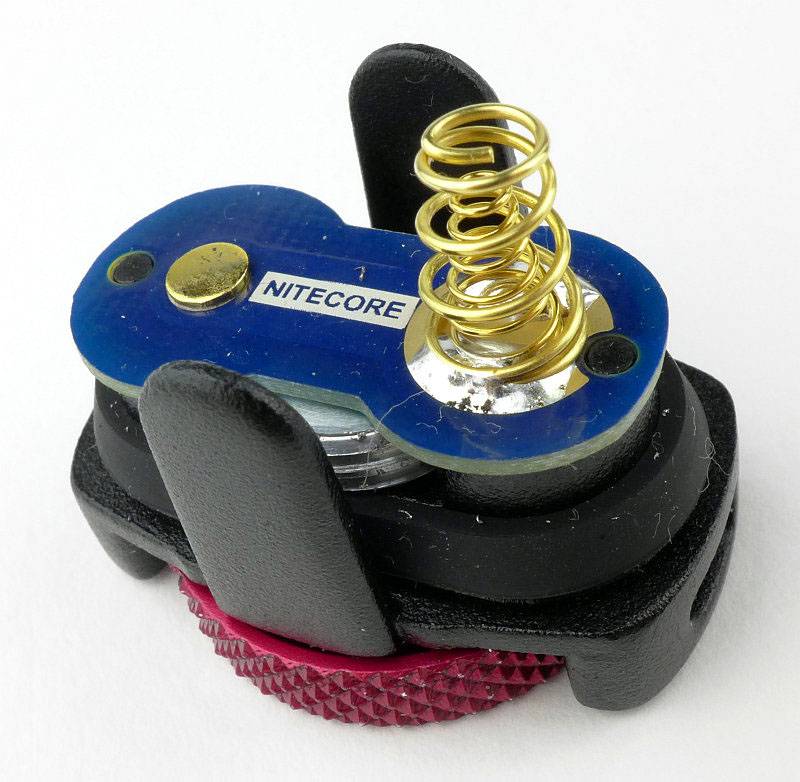
With the Knight’s mid-depth reflector a well defined hotspot is present, but the spill is bright, wide and even until you reach the outer spill, where the lens holder cut-outs become visible.
 photo 30 KnightPaladin K indoor plain P1170343.jpg

Unsurprisingly the Paladin’s beam is the same.
 photo 33 KnightPaladin P indoor plain P1170338.jpg

If you fit the strike bezel to the front, the effect on the beam is just a little noticeable.
 photo 31 KnightPaladin K indoor crown P1170347.jpg

Outdoors (with the Knight) that hotspot gives you some reasonable range, and the bright spill fills in the rest well enough.
 photo 32 KnightPaladin K outdoor P1170267.jpg

Snap! the Paladin’s beam looks the same outdoors.
 photo 34 KnightPaladin P outdoor P1170264.jpg

Modes and User Interface:

A special TACT-O-CLICK switch is used for these lights. It combines a rotary and momentary click-switch into one design. The threads used for the switch have approximately 0.5-1mm play in them, and under this switch cap there is a momentary click switch.
 photo 20 KnightPaladin K Switch P1170143.jpg

If you tighten the switch cap it presses on the switch and turns the light on and keeps it on.
 photo 21 KnightPaladin K SwitchON P1170185.jpg

If you loosen the switch cap about 1/4 of a turn the light will go off, but there is sufficient movement in the switch cap that you can press on it and click the switch to turn the light on. Like this it operates as a non-latching momentary click switch.
Should you click the light on and wish to keep it on, you can then simply keep pressure on the switch and tighten the switch cap.
When loosening the switch cap, at slightly under one full turn, you reach a ‘stop’ where the switch cap is ‘tight’ against that stop. Like this the light is locked out, and pressure on the switch cap will not operate it.
 photo 22 KnightPaladin K SwitchOFF P1170182.jpg

You have two sets of modes available, Regular and Special. The last used mode is remembered if the light is left off for 1s.
Regular: High – Low
Special: Strobe – Medium – SOS – Beacon (High) – Beacon (Low)
To access the special modes you must first cycle through the Regular modes three times within 1.5 seconds
(Last used Regular or Special) – Low/High – High/Low – Low/High – High/Low – Low/High – Strobe – SOS – Medium – Beacon (High) – Beacon (Low) – (back to Low)

If your last used mode was a Special mode, then it counts as a regular mode when you count the clicks to access the special modes (the same number of clicks is used to access each special mode whatever mode was last used).

From OFF this becomes:

Strobe – 6 clicks
SOS – 7 clicks
Medium – 8 clicks
Beacon (High) – 9 clicks
Beacon (Low) – 10 clicks

Batteries and output:

Both the Knight and Paladin run on CR123 and RCR123.

To measure actual output, I built an integrating sphere. See here for more detail. The sensor registers visible light only (so Infra-Red and Ultra-Violet will not be measured).

Please note, all quoted lumen figures are from a DIY integrating sphere, and according to ANSI standards. Although every effort is made to give as accurate a result as possible, they should be taken as an estimate only. The results can be used to compare outputs in this review and others I have published.

___________________________________________ ________________________________ ________________________________
Knight/Paladin using specified cell I.S. measured ANSI output Lumens PWM frequency or Strobe frequency (Hz)
___________________________________________ ________________________________ ________________________________
Knight – High – CR123 449 0
Knight – Low – CR123 22 0
Knight – High – AW RCR123 585 0
Knight – Low – AW RCR123 22 0
Paladin – High – CR123 443 0
Paladin – Low – CR123 26 0
Paladin – High – AW RCR123 582 0
Paladin – Low – AW RCR123 26 0

* Beacon and Strobe output measurements are only estimates as the brief flashes make it difficult to capture the actual output value.

Peak Beam intensity of the Knight measured 3800 lx @1m giving a beam range of 123 m.
Peak Beam intensity of the Paladin measured 3600 lx @1m giving a beam range of 120 m.

There is no parasitic drain.

The main part of the runtime is almost identical for both lights and both CR123 and RCR123. RCR123 give a higher ‘burst’ part of the output (the initial 3 minutes of higher output). When using RCR123, these lights do not change their voltage response for the tailing off of the output; the result is that when using RCR123 the output will suddenly cut out when the protection activates.
 photo FourSevens Knight Paladin Runtime.jpg

Troubleshooting

This section is included to mention any minor niggles I come across during testing, in case the information helps anyone else.

No issues were encountered during testing.

As per the description of this section, this information is provided in case anyone else finds a similar ‘issue’ that might be fixed in the same way.

The Knight and Paladin in use

Nothing in the design of these lights has just ‘happened’, everything is designed for function or aesthetics.

Take the pocket clip for example. It is a double-action clip so will clip on in either direction without being turned around. Each ‘side’ of the clip will accommodate thicker or thinner material (thicker next to the body and thinner on the outer part). The two points sticking out sideways either side of the clip provide grip on the pocket and also grip for the user when unscrewing the battery tube. The groove cut into each end of the clip allows a lanyard to be threaded through. Finally inside the clip ring which fits over the body of the light are two tabs which fit into corresponding notches on the body or bezel to prevent it rotating. Details.
 photo 23 KnightPaladin P reverse P1170154.jpg

Also highly functional is the TACT-O-CLICK switch. Once you have got used to the ideal positions for the switch cap to click (1/4 turn undone from the fully ON position) or lockout (3/4 turn from fully ON), and swapping between these (so from lock-out to click is a half turn), the UI comes to life and the click or twist of the switch cap just fits the task at hand.

Personally I find the strike bezel to be more of a decorative item than anything practical, due to the length of the crenellations (not to mention the short overall length of the light). They are too long to be strong enough on the aluminium versions, and even the stainless steel strike bezel will bend if used with any real force (as you would if defending yourself). They are also too long to leave fitted all the time as they just stick into things. So are you really going to take the light apart to swap the bezel ring for the strike bezel ‘if’ you feel threatened? Not likely. BUT, who cares?! They Look great! (And you have an executive toy to play with.)

Ignoring the Special modes, the two Regular modes have covered what I need almost entirely. Those two light levels of 25lm and 450lm, though seemingly a long way apart, work perfectly with the beam profile. For my indoor, round-the-house use, the 22lm setting is ideal, especially as it is backed up by the 450lm. Using the Tact-O-Click switch in the momentary press-and-hold approach, with the two modes you can quickly bump it up or down depending on the distance you are looking at. I’ve not personally ever felt the need for the Medium mode (or Strobe or SOS), but have dipped into the Beacon modes for marking a location. What would improve it for me is adding a moonlight mode into the Special modes.

The timing for the mode changes works really well and I’ve not changed mode by mistake so far. Speaking of the Tact-O-Click switch again, the ability to lock the output on while you are using it as a momentary switch, is useful and can be achieved one handed. Also, by simply backing the switch cap off a bit you lock out the light means the lockout is a specific feature of the light and doesn’t require loosening any other parts. Like this, when you come to turn it on, you just twist it on as normal without having to remember to tighten the tailcap first.

A true fusion of function and aesthetics, even if not every feature is entirely practical.

Review Summary

_______________________________________________ _______________________________________________
Things I like What doesn’t work so well for me
_______________________________________________ _______________________________________________
Tact-O-Click switch (twist/click interface combined). Strike Bezel too long.
Can use CR123 or RCR123 Activates protection circuit when using RCR123.
Excellent all-rounder beam profile. No Moon mode.
Mode-change timing works very well. Strike Bezel strongly affects the beam shape.
Well chosen ‘Regular’ Modes.
Lego-like changes in a single light.


Discussing the Review:

Please feel free to add comments to the review, but the ideal place to freely discuss these reviews is on a forum. If you started reading the shorter forum version of the review, but followed the link this full exclusive review, please return to that forum to discuss the review there.
If you read the review entirely on Tactical Reviews, please consider one of the following to join in any discussion.

CandlePowerForums – Flashlight Reviews Section (Largest and Friendliest Flashlight Community Forum)

EdgeMatters – Sponsored Reviews (UK based Forum for Knife Makers and Collectors)