Knife Review: Ontario Knife Company – Group Review

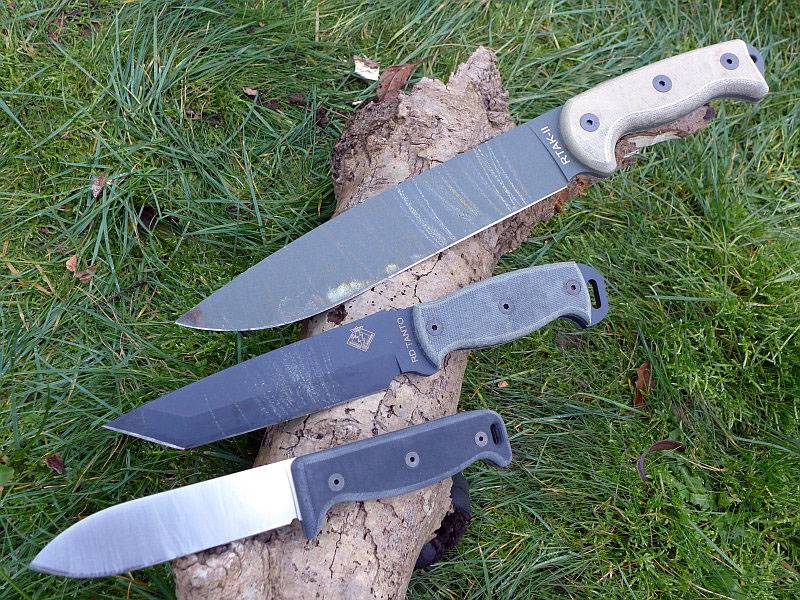
After selecting a set of three knives I felt represented what Ontario Knife Company bring to the market (Blackbird SK-5, Ranger RD Tanto and RTAK-II), I originally intended to present a single group review.
As I have got to know them better, I found that individual reviews would work better, so this page is to tie together the review series and provide a single point of reference to link to all three reviews, plus provide a few group shots for comparison.
This article includes some exclusive images and comments, so is worth getting to the end of before going to an individual review.

03 Apr 2016 – ‘Ranger’ RD Tanto
06 Apr 2016 – RTAK-II
18 Apr 2016 – Blackbird SK-5

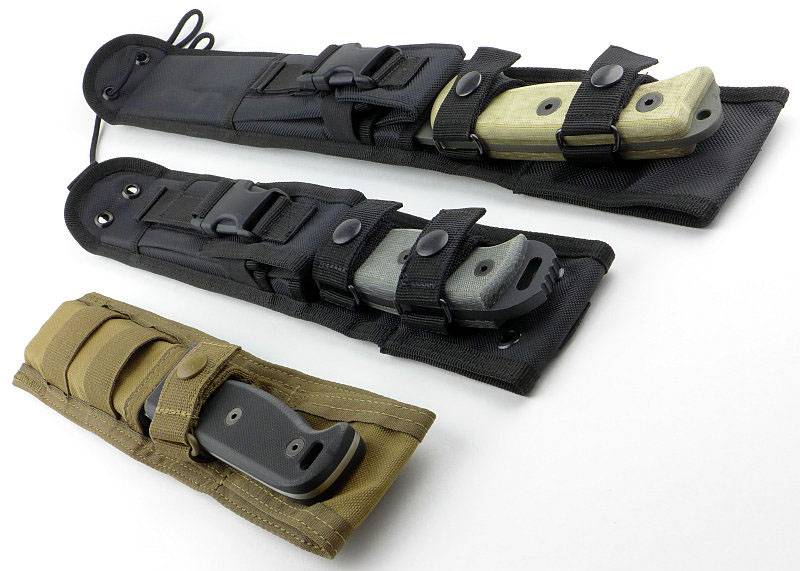
 photo 01 OKCtrio sheathed P1140542.jpg

 photo 09 OKCtrio in log P1160300.jpg

Explained by the Maker:

The reasons for certain design choices may not be clear when simply looking at an object, so this section is intended to give an insight into the thinking behind a design by speaking to the designer themselves.

See individual reviews for this exclusive information.

A few more details:

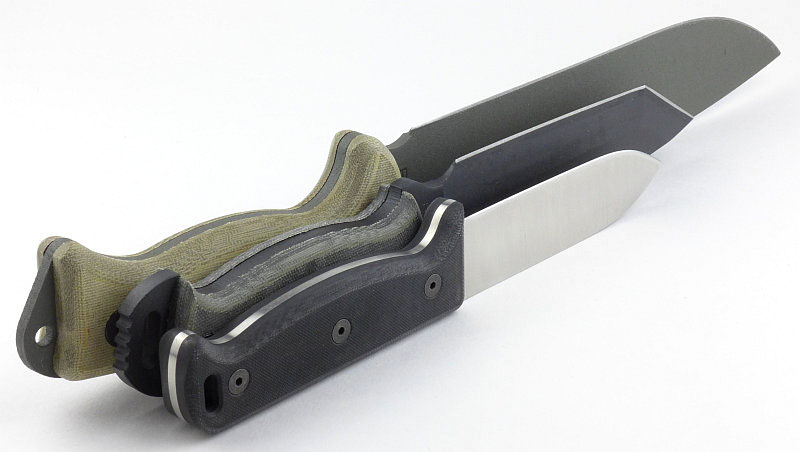
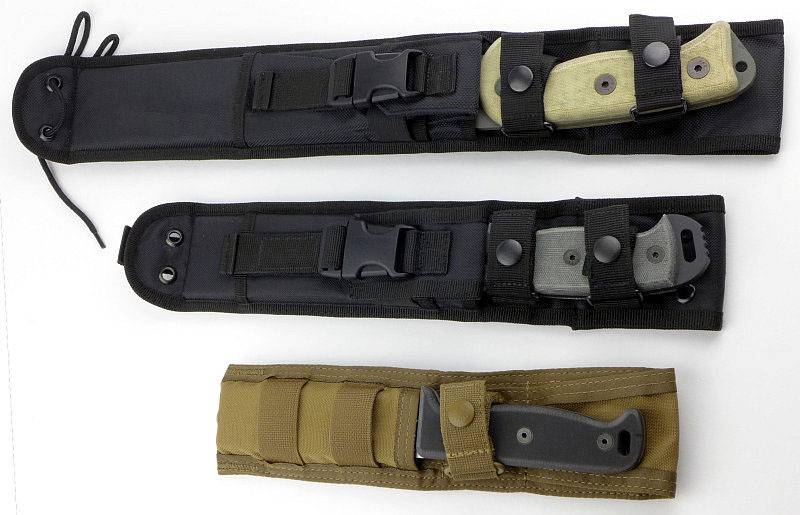
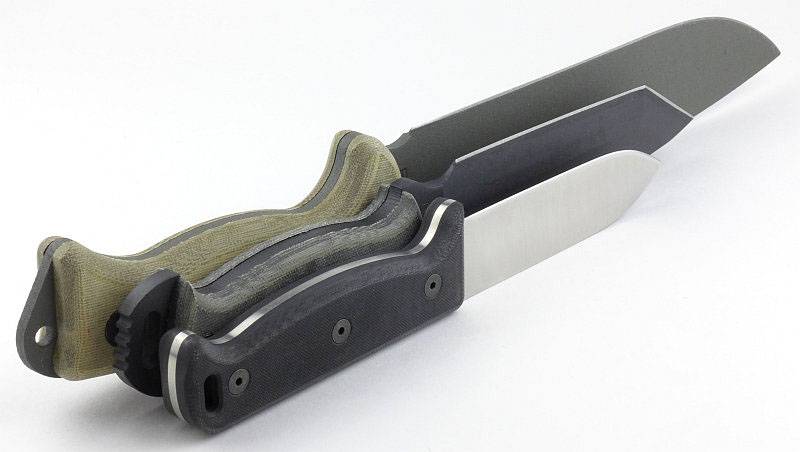
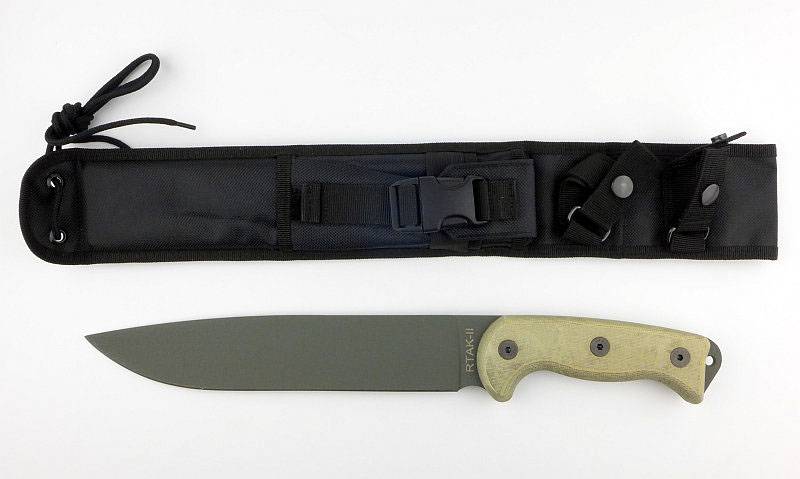
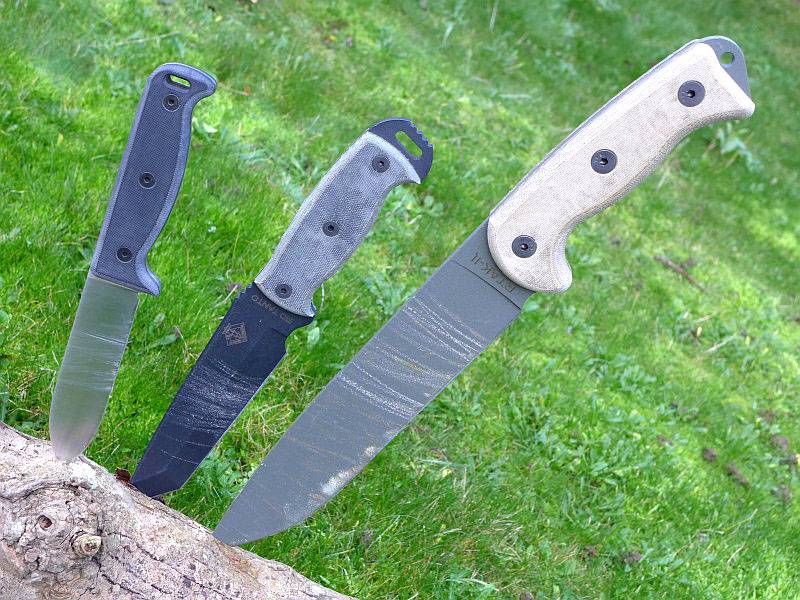
The images at the beginning of this group review page show the unsheathed knives together. This image better shows how the sheathed knives compare in size.
 photo 02 OKCtrio sheathed P1140548v2.jpg

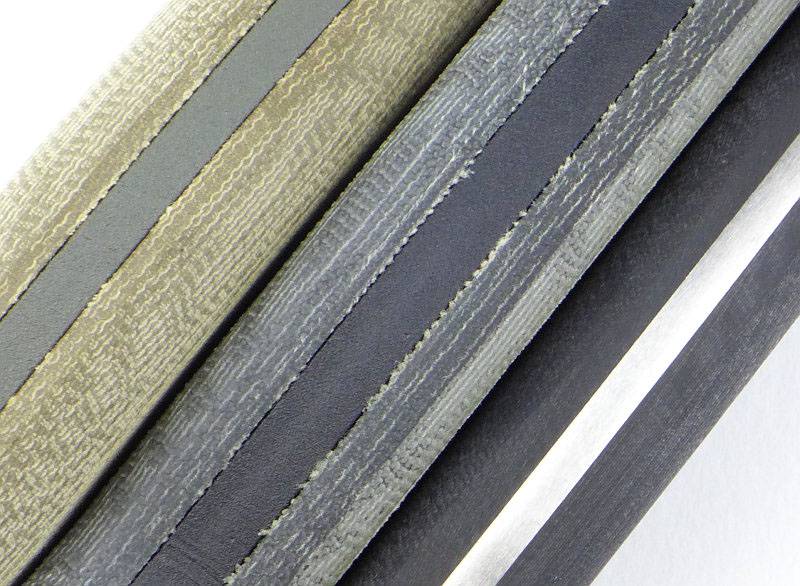
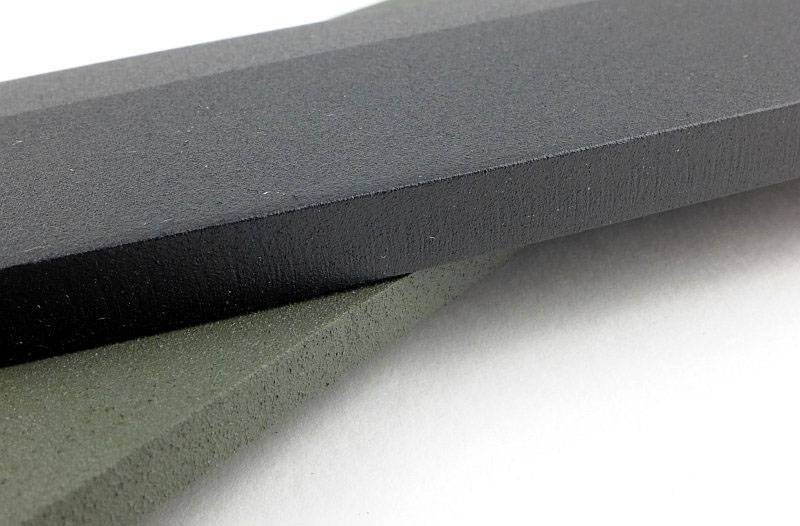
Looking at blade stock thickness, top left is the RTAK-II, middle RD Tanto and bottom right is the Blackbird SK-5.
 photo 03 OKCtrio blade thickness P1140571.jpg

Moving back to show the three blades sitting next to each other.
 photo 04 OKCtrio comparison P1140575.jpg

The Blade and Handle Geometry:

Most knives specifications have a basic description of the blade geometry, but in this section I will be taking a more detailed look at geometry and balance.

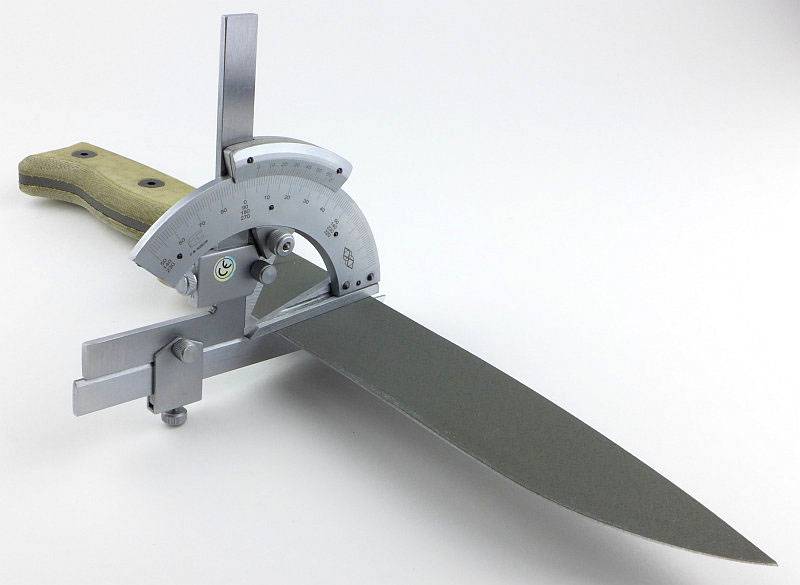
 photo 36 RD Tanto flat grind P1140603.jpg

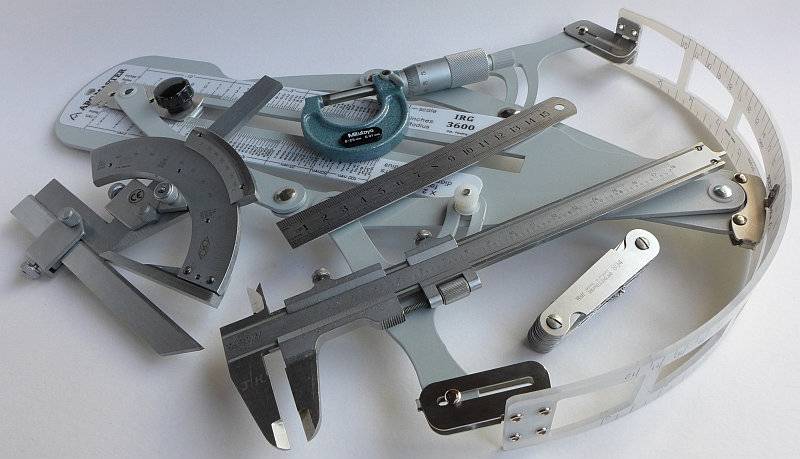
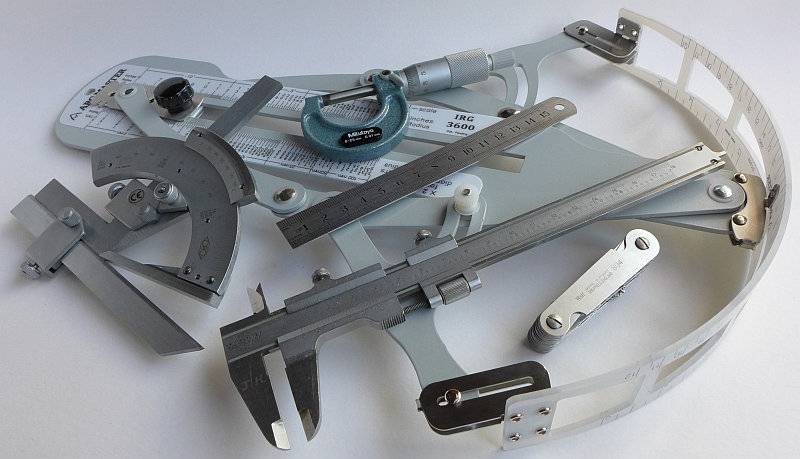
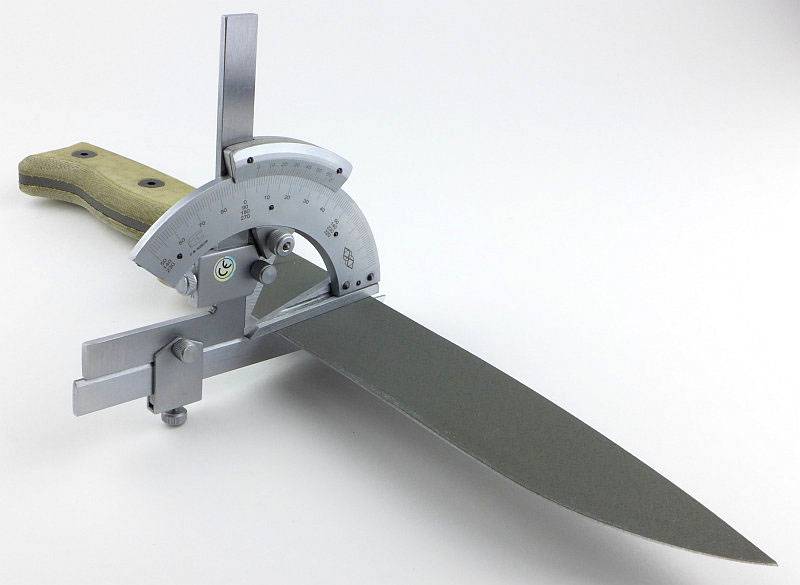
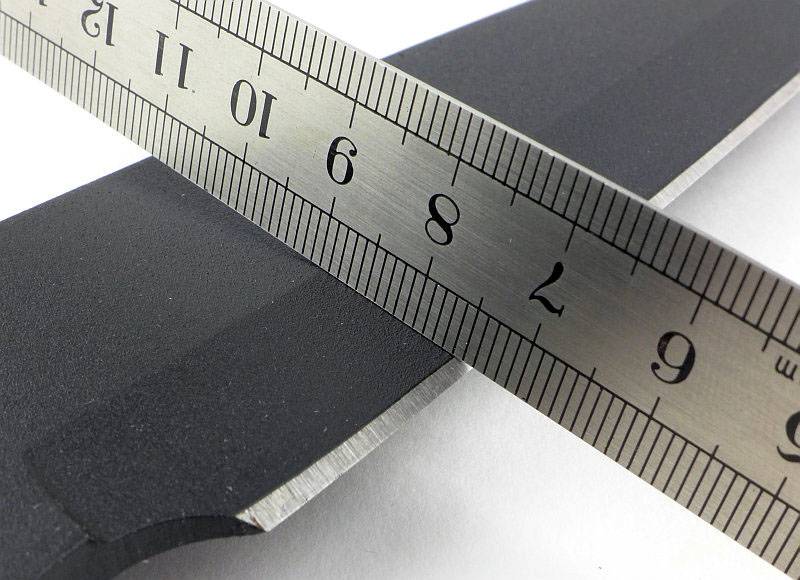
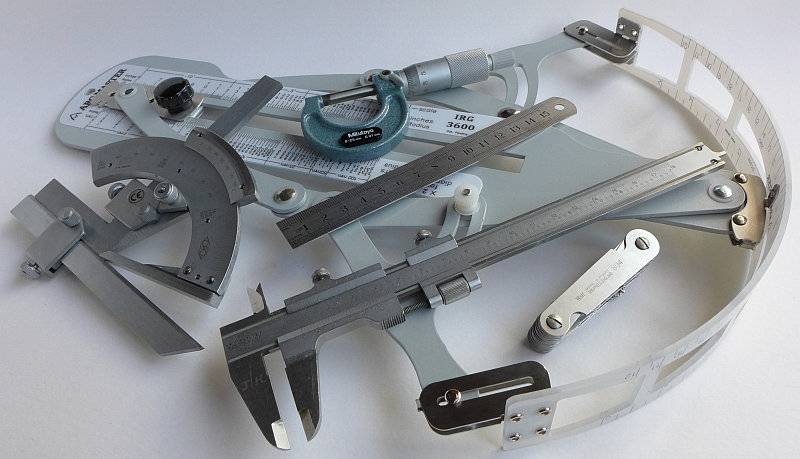
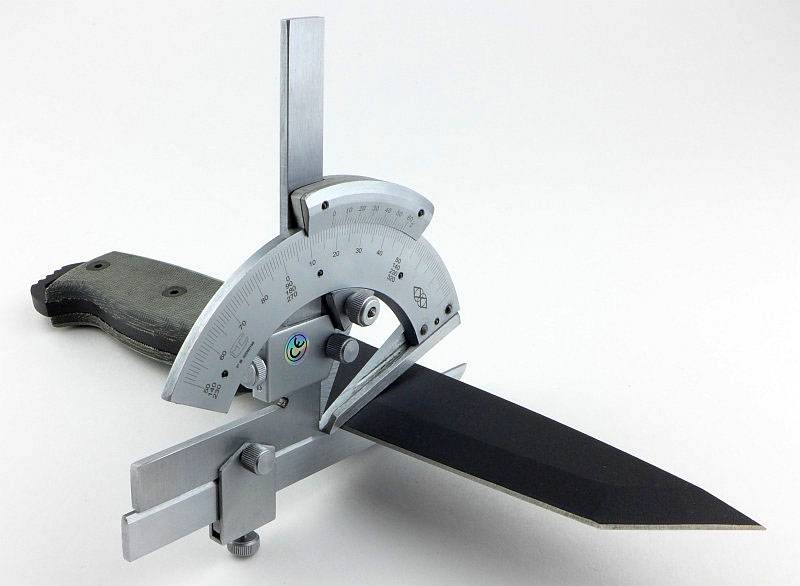
Using a set of gauges and precision measuring equipment including a Vernier protractor, callipers, fixed radius gauges and the unique Arc Master adjustable radius gauge (the one that looks like a crossbow).

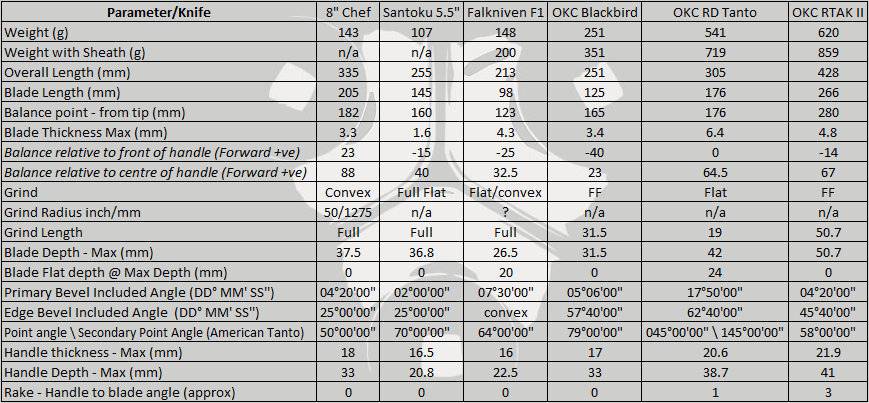
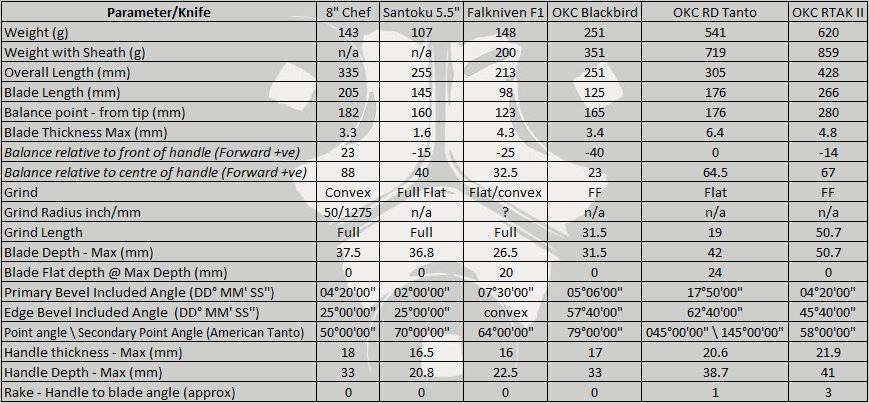
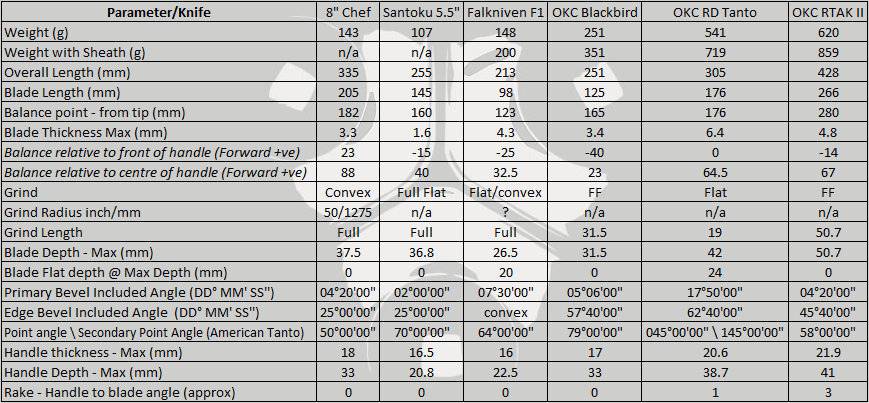
These measurements have been tabulated and are presented along with a few reference blades (8″ Chef’s Knife, 5.5″ Santoku and the popular Fällkniven F1).

Key aspects such as the primary bevel angle, grind type, blade depth, blade thickness, length, weight are detailed, along with balance information.
 photo 32 RTAK II angle P1140389.jpg

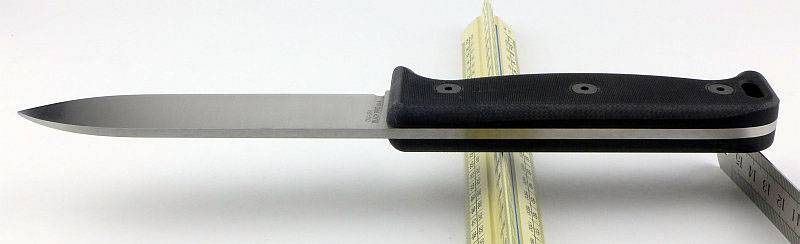
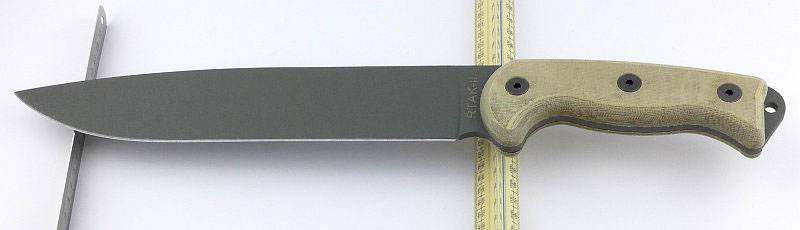
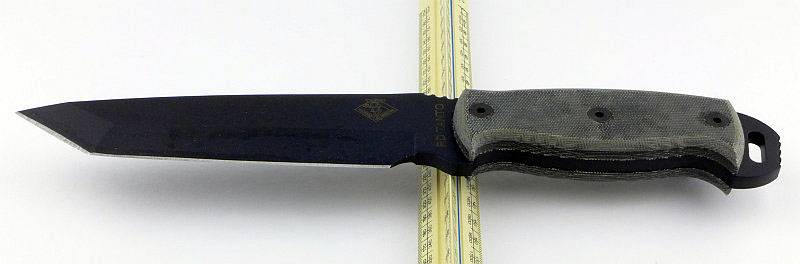
The ‘Balance relative to the front of the handle’ tells you if the knife will feel front heavy, or if the weight is in your hand (a positive value means the weight is forward of the front of the handle). The ‘Balance relative to the centre of the handle’ indicates how close to a ‘neutral balance’ the knife has in the hand.
 photo 31 Blackbird balance P1140196.jpg

In the case of full convex grinds the approximate centre of the grind is used for the primary bevel angle estimate. This table includes the parameters for all the OKC knives in this series of reviews.
 photo OKC Parameters BlackbirdRDTantoRTAKII.jpg

What they are like to use?

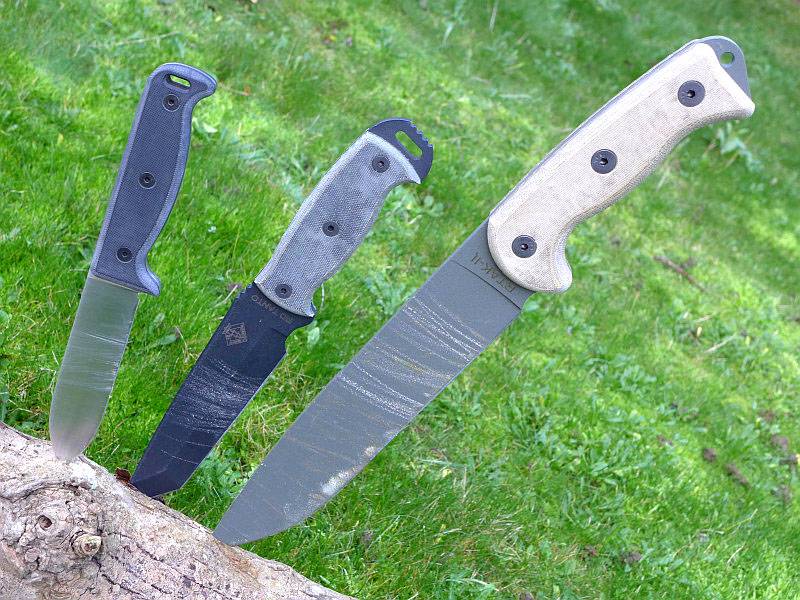
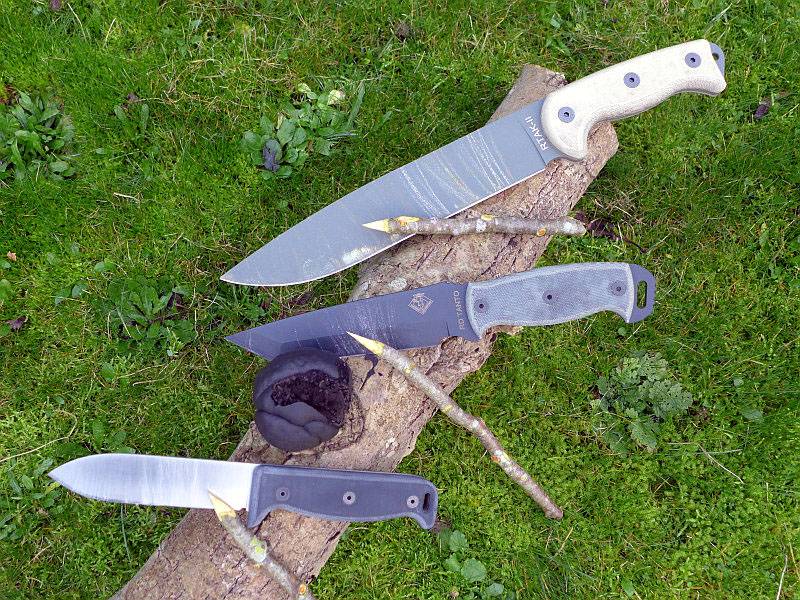
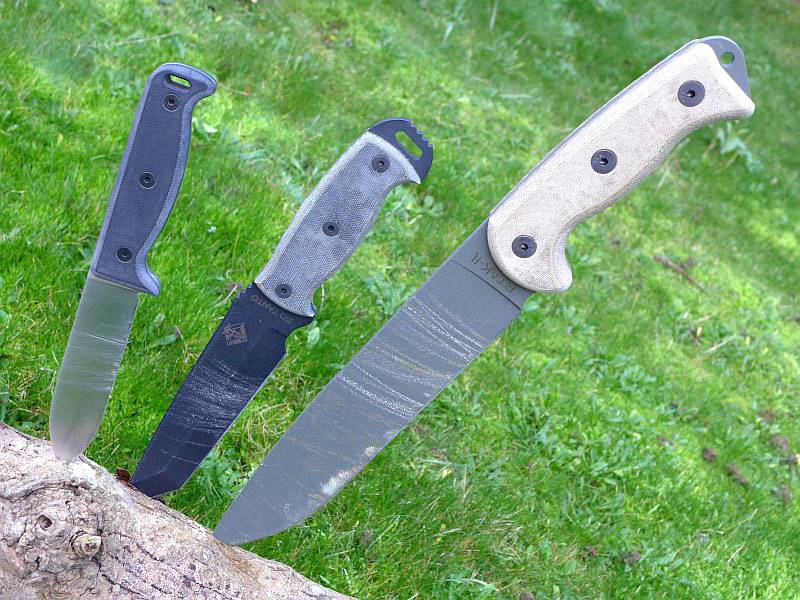
There is too much detail to describe each of these blades strengths and weaknesses in detail, so I’ll just use this opportunity to show the pointed-stick comparison side-by-side
 photo 05 OKCtrio whittlers P1160278.jpg

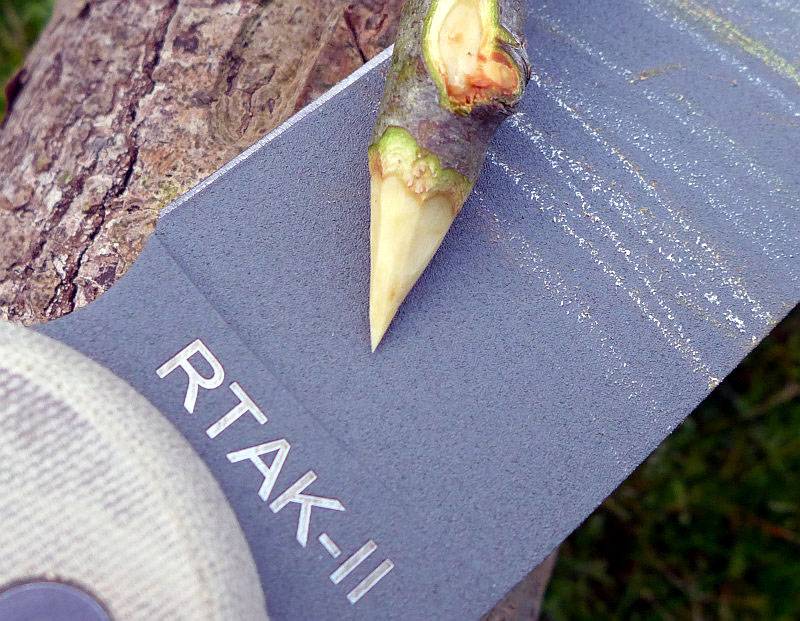
The RTAK-II is an excellent cutter.
 photo 06 OKCtrio RTAKII stick P1160289.jpg

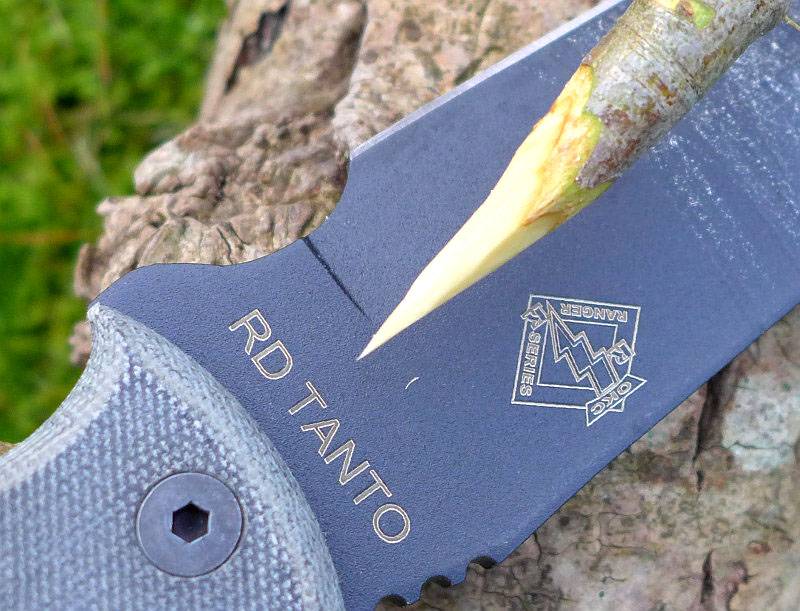
As a super tough extraction/digging/rescue tool, the RD Tanto struggles a bit for some basic cutting. It excels at heavy tasks though.
 photo 07 OKCtrio RDTANTO stick P1160291.jpg

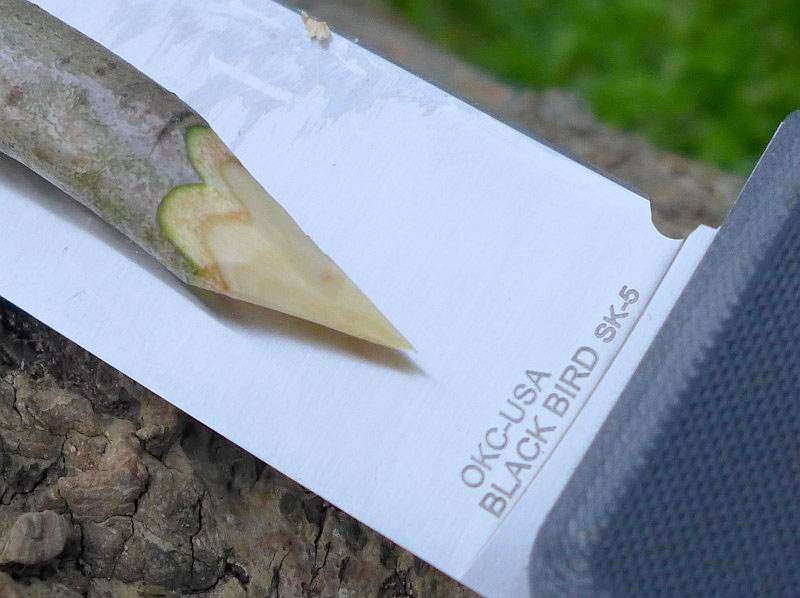
With the factory edge the Blackbird works well enough, but the edge angle is steep. This photo is from before an edge reprofiling after which the SK-5 cuts furiously well.
 photo 08 OKCtrio Blackbird stick P1160293.jpg

Review Summary

The views expressed in this summary table are from the point of view of the reviewer’s personal use. I am not a member of the armed forces and cannot comment on its use beyond a cutting tool or field/hunting knife.

Something that might be a ‘pro’ for one user can be a ‘con’ for another, so the comments are categorised based on my requirements. You should consider all points and if they could be beneficial to you.

Here I’ve included a very basic summing up of each knife. See individual reviews for detailed information.

_______________________________________________ _______________________________________________
Knife In a nutshell
_______________________________________________ _______________________________________________
Blackbird SK-5 No-nonsense survival knife
Ranger RD Tanto Super tough extraction/rescue tool
RTAK-II Fantastic all-rounder

 photo 10 OKCtrio on log P1160316.jpg


If you enjoyed my reviews, please remember to ‘Like’ me on Facebook and follow me on Twitter to get all the latest updates and news. You can also find exclusive insights on Instagram and Pinterest

Knife Review: Ontario Knife Company RTAK-II

The Ontario Knife Company RTAK II review is the second of a three-knife review series featuring the Blackbird SK-5, RD Tanto and RTAK II. (See – OKC Group Review.)

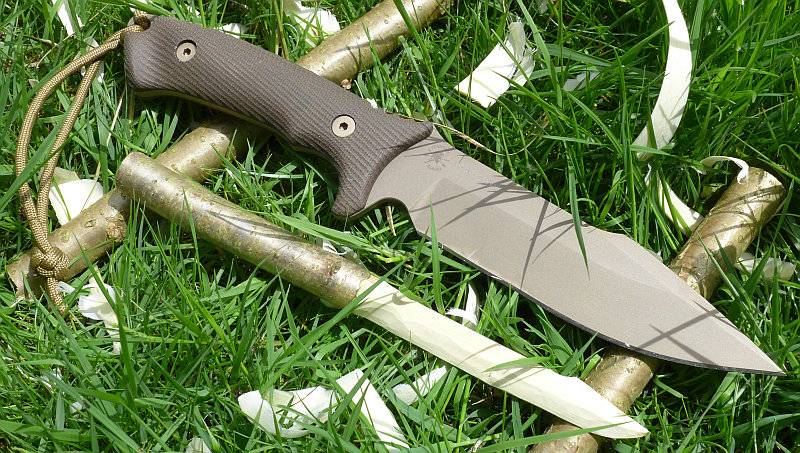
 photo 09 OKCtrio in log P1160300.jpg

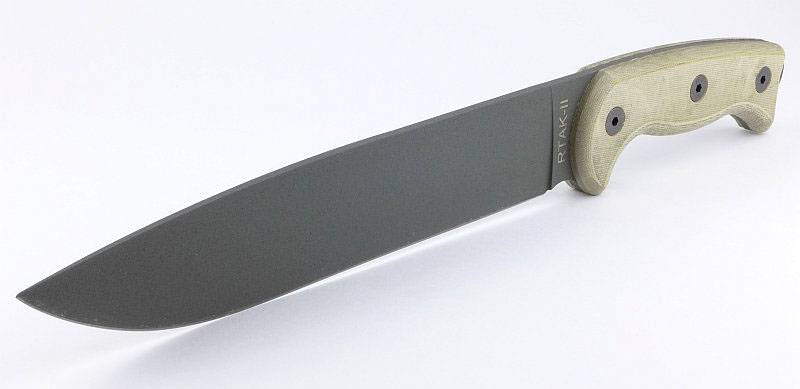
Part of the OKC RAT series, and designed by Jeff Randall and Mike Perrin of ‘Randall’s Adventure and Training’, the RTAK II (Randall’s Training and Adventure Knife) is the largest of the series. This review is looking at the plain edge variant (you can also get a part-serrated version).

 photo 28 RTAK II angle P1140355.jpg

The Blade and Handle Geometry:

Most knives specifications have a basic description of the blade geometry, but in this section I will be taking a more detailed look at geometry and balance.

 photo 31 RTAK II flat grind P1140382.jpg

Using a set of gauges and precision measuring equipment including a Vernier protractor, callipers, fixed radius gauges and the unique Arc Master adjustable radius gauge (the one that looks like a crossbow).

These measurements have been tabulated and are presented along with a few reference blades (8″ Chef’s Knife, 5.5″ Santoku and the popular Fällkniven F1).

Key aspects such as the primary bevel angle, grind type, blade depth, blade thickness, length, weight are detailed, along with balance information.
 photo 32 RTAK II angle P1140389.jpg

The ‘Balance relative to the front of the handle’ tells you if the knife will feel front heavy, or if the weight is in your hand (a positive value means the weight is forward of the front of the handle). The ‘Balance relative to the centre of the handle’ indicates how close to a ‘neutral balance’ the knife has in the hand.
 photo 30 RTAK II balance P1140378.jpg

In the case of full convex grinds the approximate centre of the grind is used for the primary bevel angle estimate. This table includes the parameters for all the OKC knives in this series of reviews.
 photo OKC Parameters BlackbirdRDTantoRTAKII.jpg

The blade is made from 5160 steel.

Explained by the Maker:

The reasons for certain design choices may not be clear when simply looking at an object, so this section is intended to give an insight into the thinking behind a design by speaking to the designer themselves.

 photo 21 RTAK II with sheath P1140289.png

Though this knife is well established, and Jeff Randall is no longer directly associated with OKC, he was kind enough to give me a few insights into the history and design of this knife.

The RTAK was designed based on Jeff’s and Mike’s experiences in the jungle back in the mid-90s. There were no specific plans when designing the knife, as at the time R.A.T. were simply designing a knife that would be a compromise between a full length machete and a fixed blade. Machetes are still the preferred tool in jungle environments but shorter fixed blades work better for finer work. The RTAK was Jeff’s and Mike’s vision of that compromise.
Before moving to Ontario Knife Company to be able to increase production capacity, the first RTAKs were made by Wicked Knife Company (Newt Livesay).
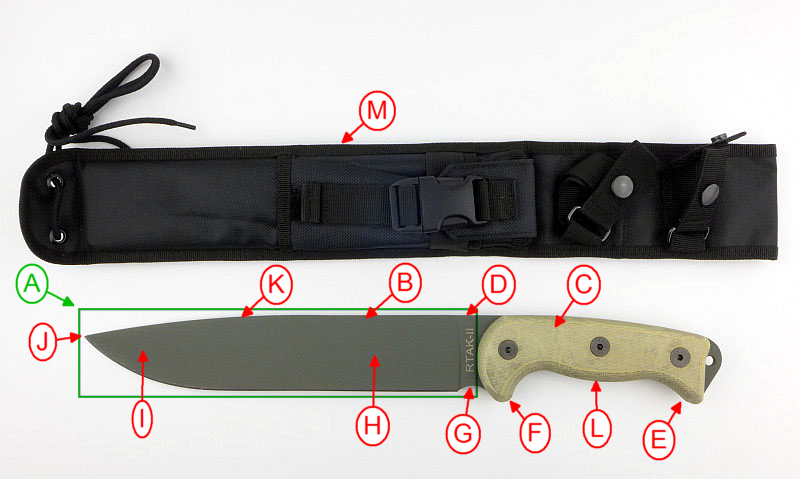
Mike and Jeff had been running around in the jungle and using knives enough to know what felt good in the hand. Basically they knew nothing about making a knife when they came up with the RTAK and simply based the blade length (A) and other design aspects on what works, nothing more.
The problem with a lot of big knives is the steel is too thick for the width of the blade, even on full flat grinds. This causes a geometry issue with regard to cutting efficiency, and the choice of a 3/16″ blade thickness (B) and a full flat grind (H) for the RTAK II is a compromise between toughness and cutting efficiency. A machete works so well because its overall blade geometry is thin.
When talking about the handle material / style (C) and the fact that this is seen on many OKC knives, Jeff commented that R.A.T. had introduced this handle style to OKC. Simple to produce and doesn’t have a lot of bumps and hotspots that will fatigue you during extended use.
As it is a large knife, choking up to do finer work means moving your control hand out towards the point and pinch gripping the blade; for this reason, jimping was not worth adding to the spine near the handle (D), so it was left plain. It is possible to use the choil (G) for choking up on the blade, but it was not intended for that purpose; it was mainly put in as an edge grind relief.
A long finger guard (F) and grip hook (E) come from various machete designs. Considering the finger guard specifically, after using a large knife for a while under tough conditions you want as much protection as you can get. Overall the grip and palm swell (L) were made a generous size as large handles stress you less on extended use.
Using a drop-point (I) goes back to the compromise between a fixed blade and machete; drop points do well for most tasks in the field.

A few more details:

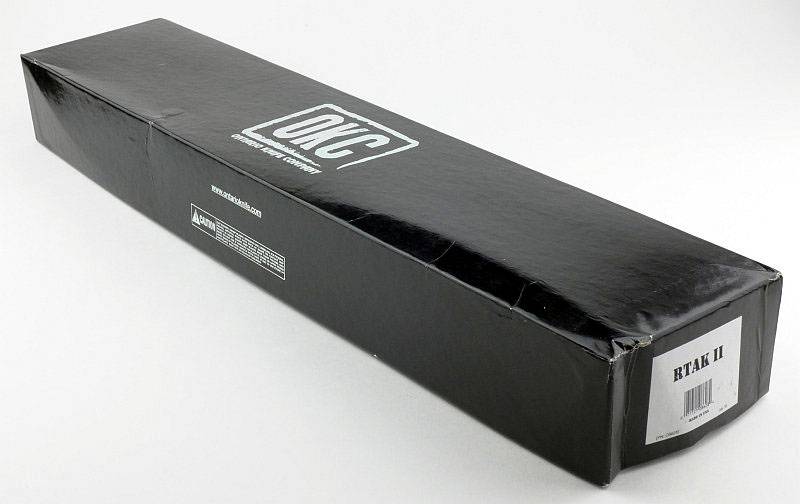
Ontario Knife Company’s standard knife box.
 photo 01 RTAK II boxed P1140203.jpg

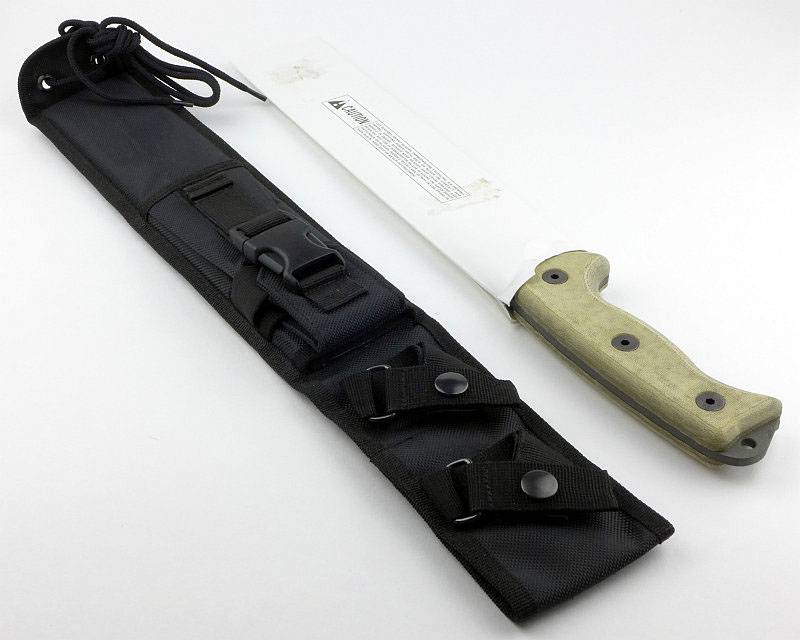
Inside the box the knife has a cardboard protector over the blade, and the knife is not fitted into the sheath.
 photo 02 RTAK II unboxed P1140209.jpg

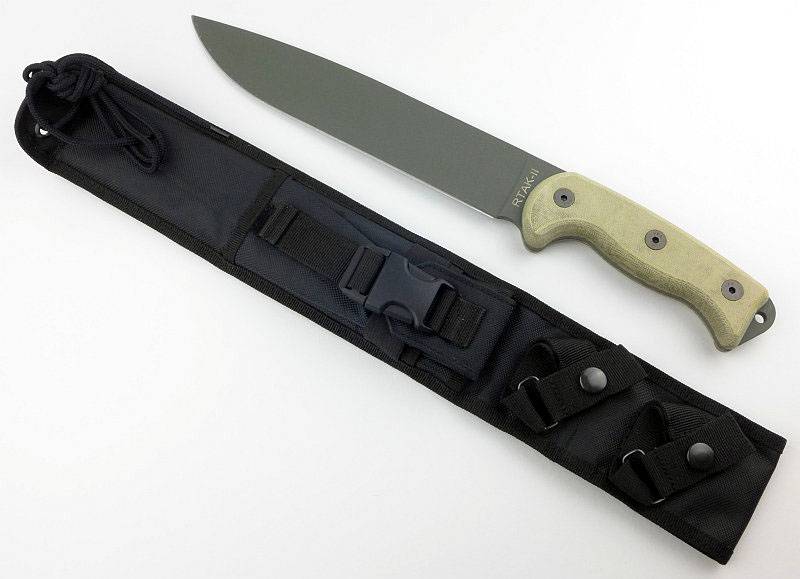
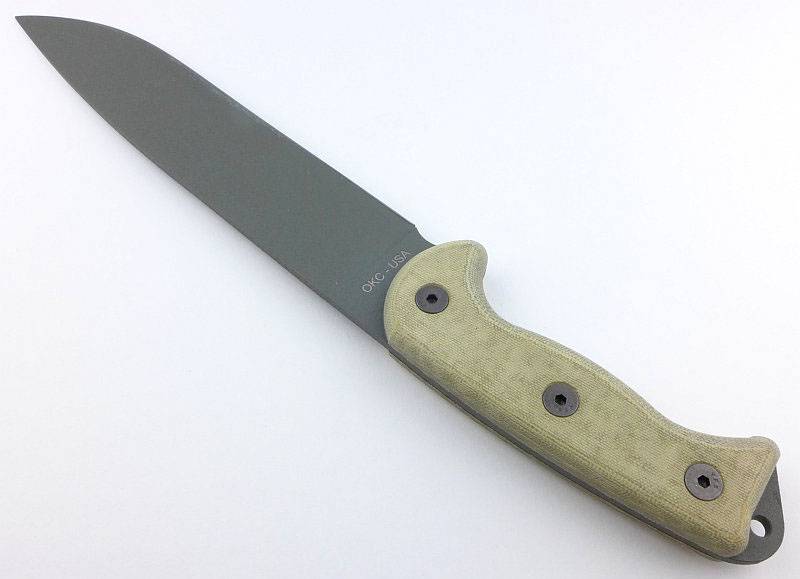
The first view of the RTAK II – now THAT is a knife!
 photo 03 RTAK II revealed P1140220.jpg

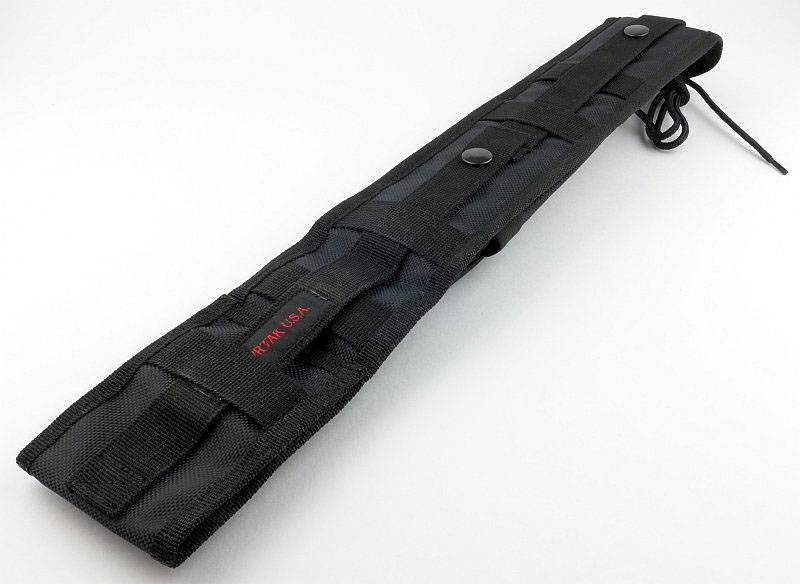
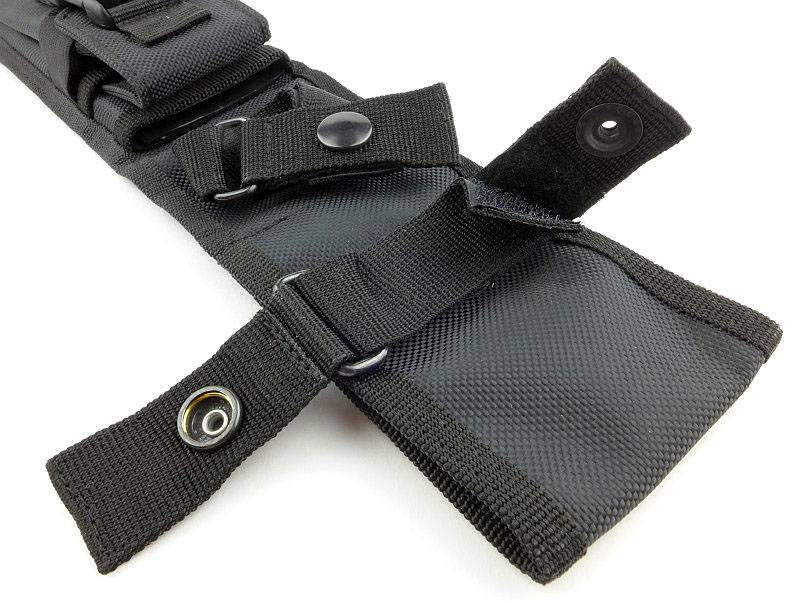
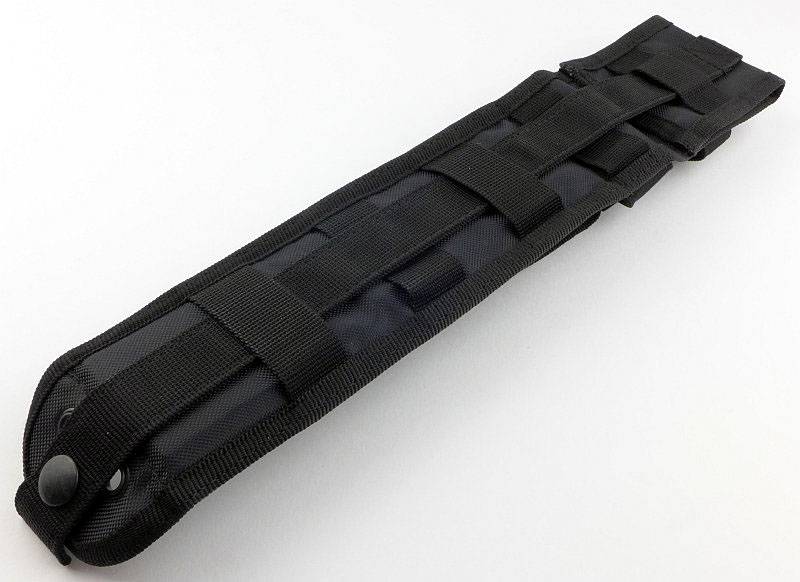
Before going back to the knife, a quick look at a few details for the sheath. On the back, the sheath has a combination PALS/MOLLE/belt loop system. Effectively you use the top PALS strap for a belt loop and can change the placement and size using the webbing.
 photo 04 RTAK II sheath back P1140223.jpg

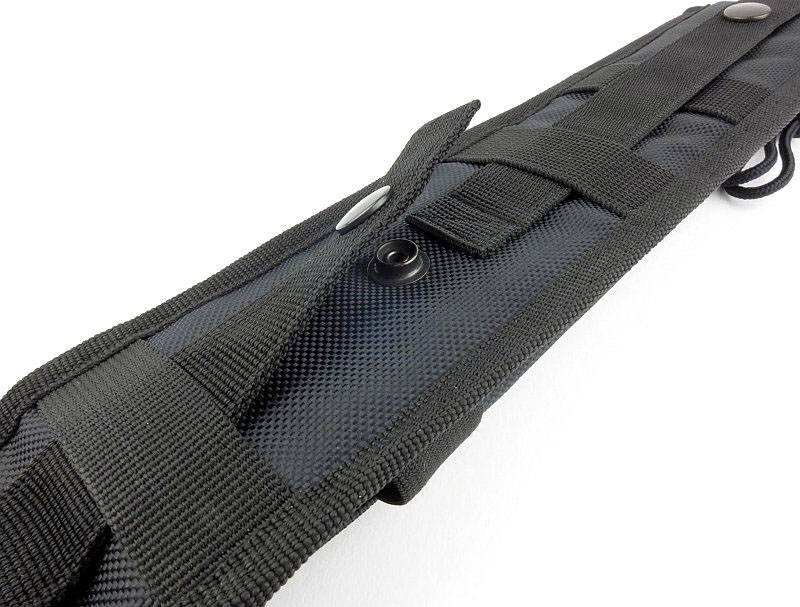
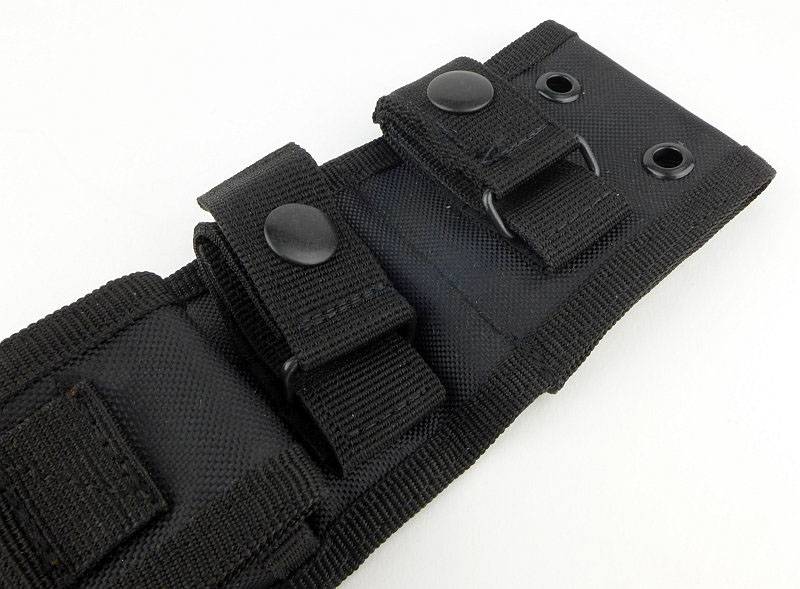
There are two PALS straps as the sheath is very long. Both using poppers to secure the end of the strap.
 photo 05 RTAK II sheath PALS P1140227.jpg

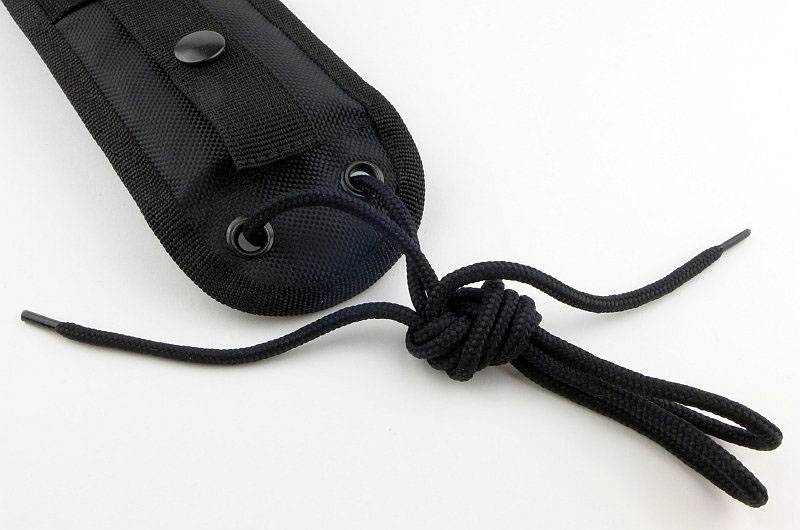
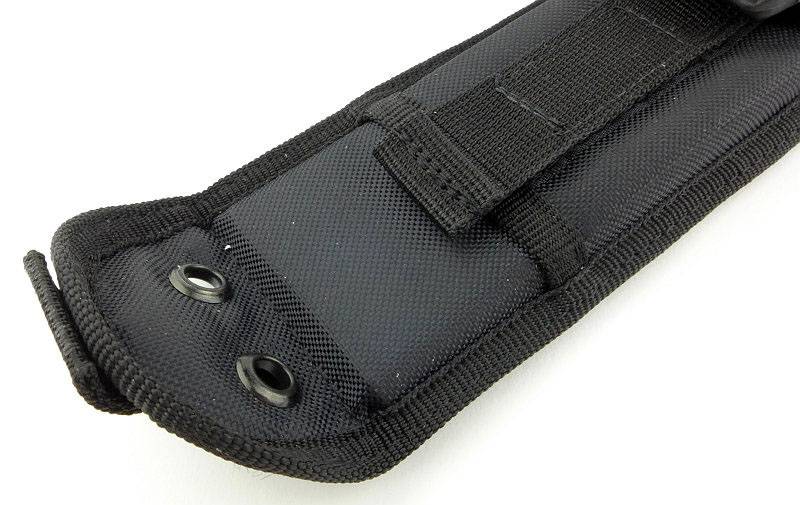
Metal eyelet holes are provided for a leg tying point and it comes with a lace fitted through the holes.
 photo 06 RTAK II sheath leg lace P1140230.jpg

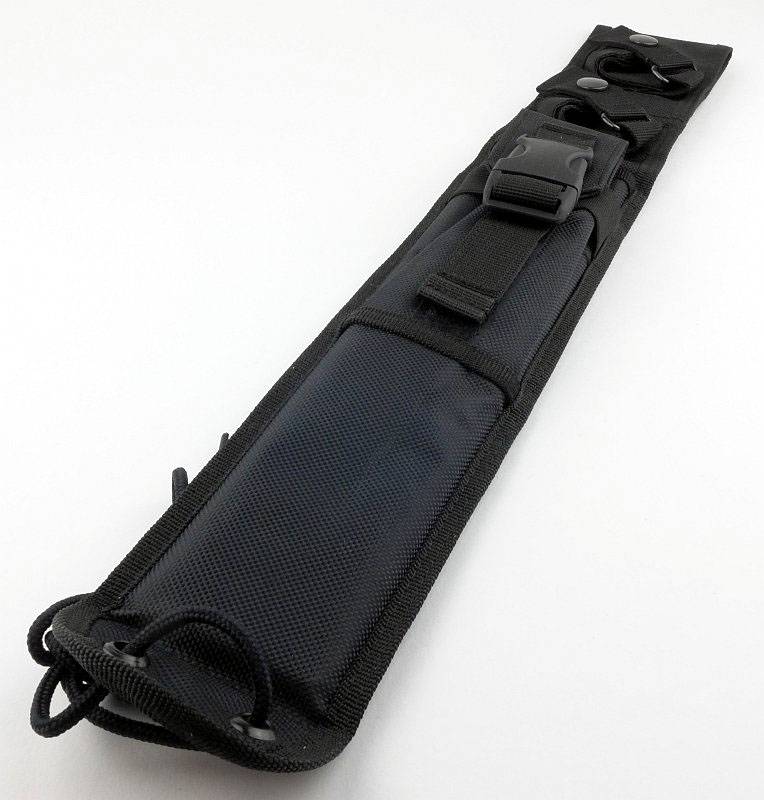
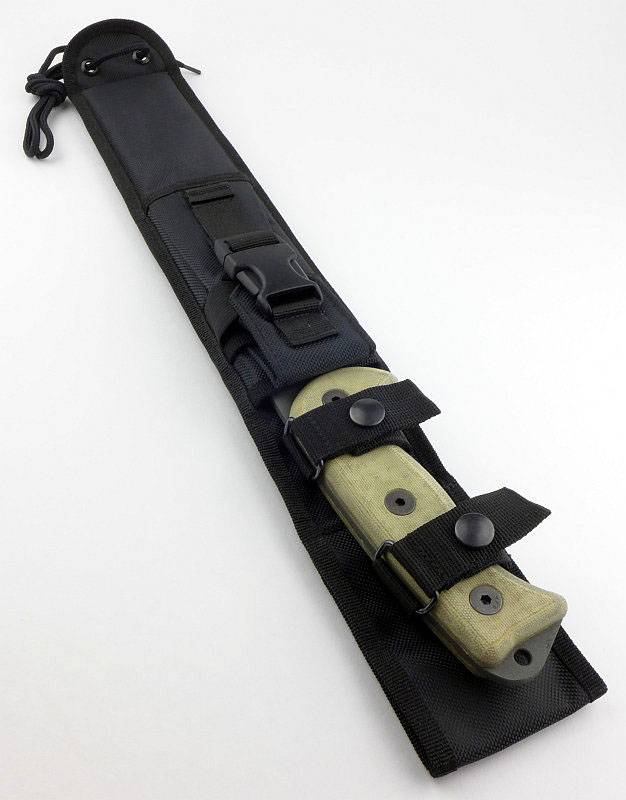
This is a long sheath, and has a pocket and twin straps to hold the handle.
 photo 07 RTAK II sheath front P1140233.jpg

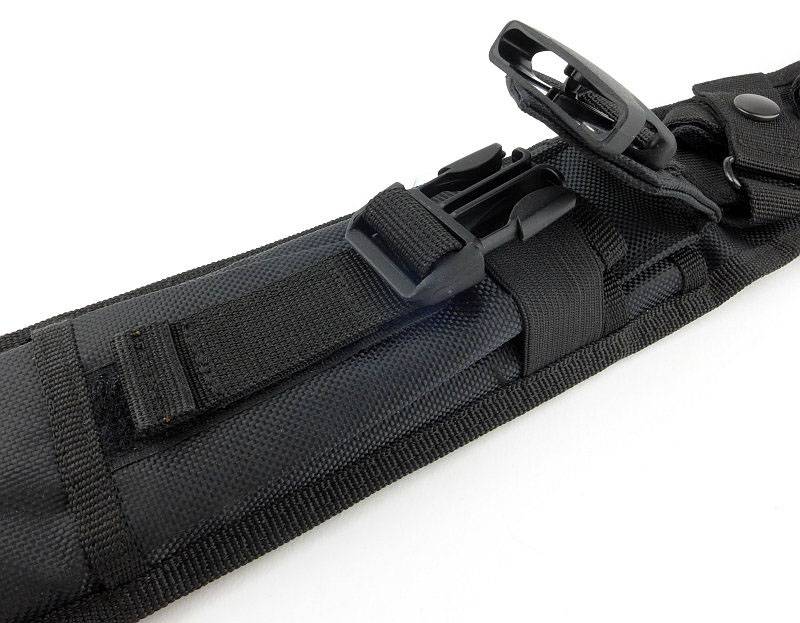
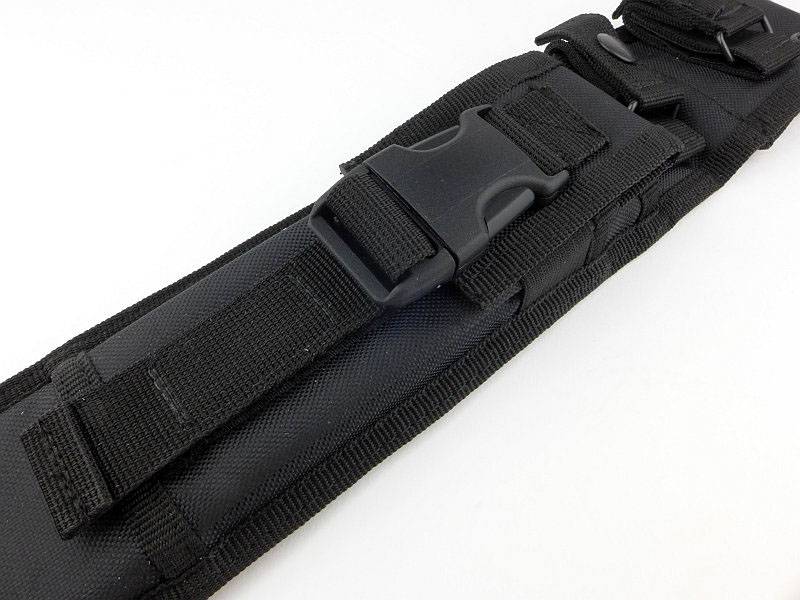
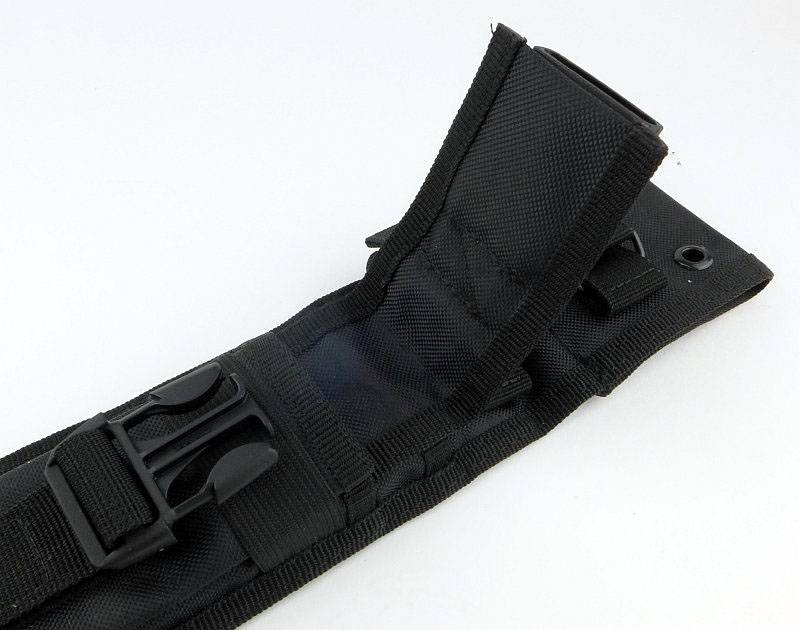
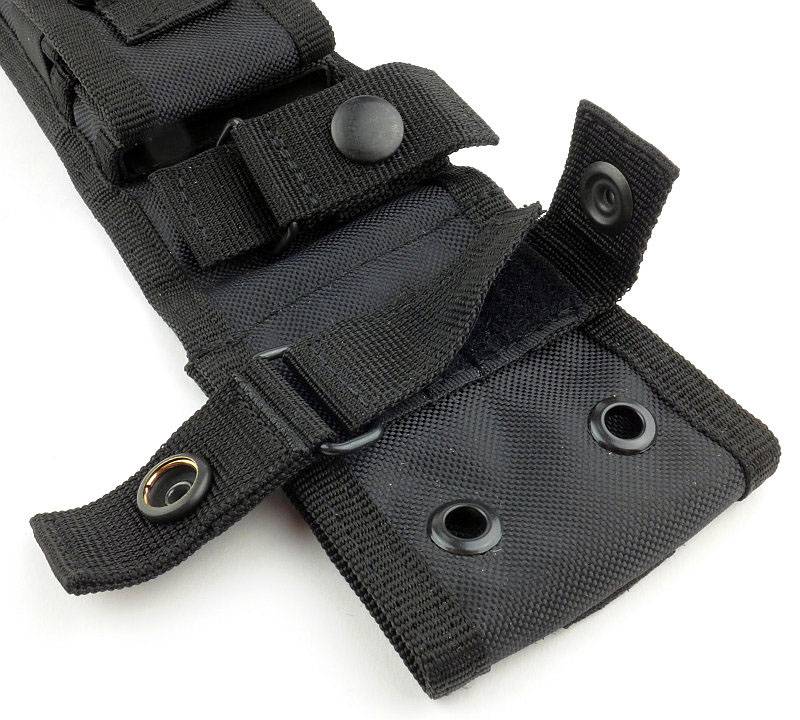
Exactly as with the RD Tanto, an expanding pocket is kept closed with a plastic snap-buckle. Opening the pocket shows a fixed elastic strap keeps the pocket neat and tight onto whatever is held in the pouch.
 photo 08 RTAK II sheath pocket P1140238.jpg

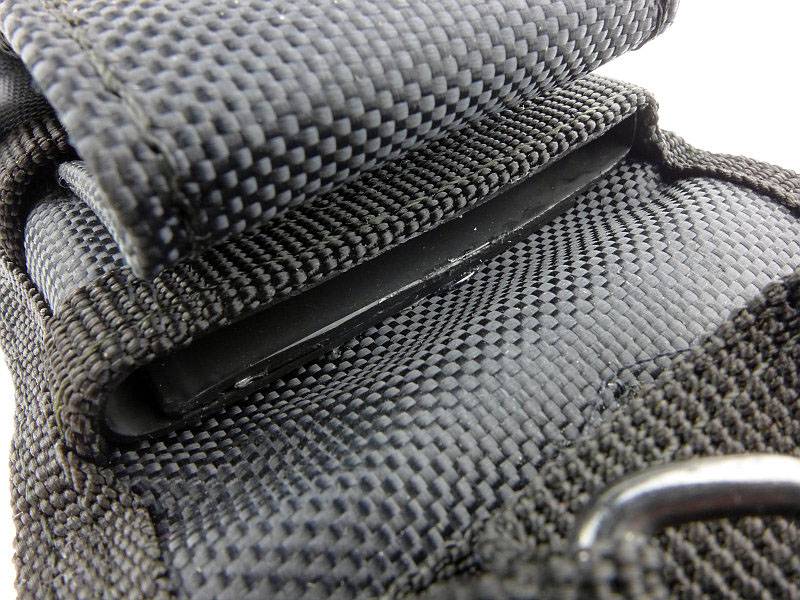
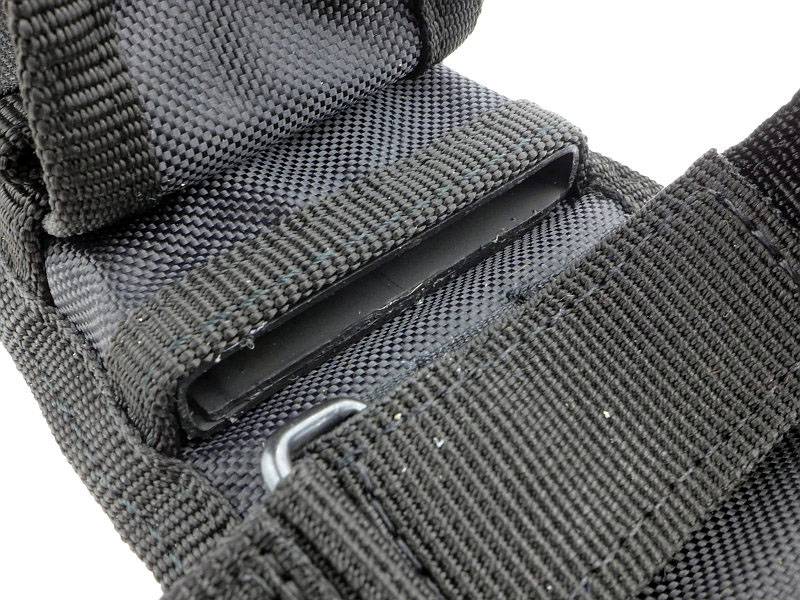
A kydex liner is provided in the sheath, and in this case the blade fits easily without rubbing.
 photo 09 RTAK II sheath liner P1140240.jpg

Both the knife retention straps are adjustable to allow the user to tighten or loosen the grip on the knife to suit.
 photo 10 RTAK II sheath straps P1140246.jpg

Overall a substantial package.
 photo 21 RTAK II with sheath P1140289.jpg

Fit of the blade to the sheath is just right.
 photo 24 RTAK II inserting P1140336.jpg

Two straps with popper closures are used to secure the handle when in the sheath.
 photo 25 RTAK II in sheath P1140338.jpg

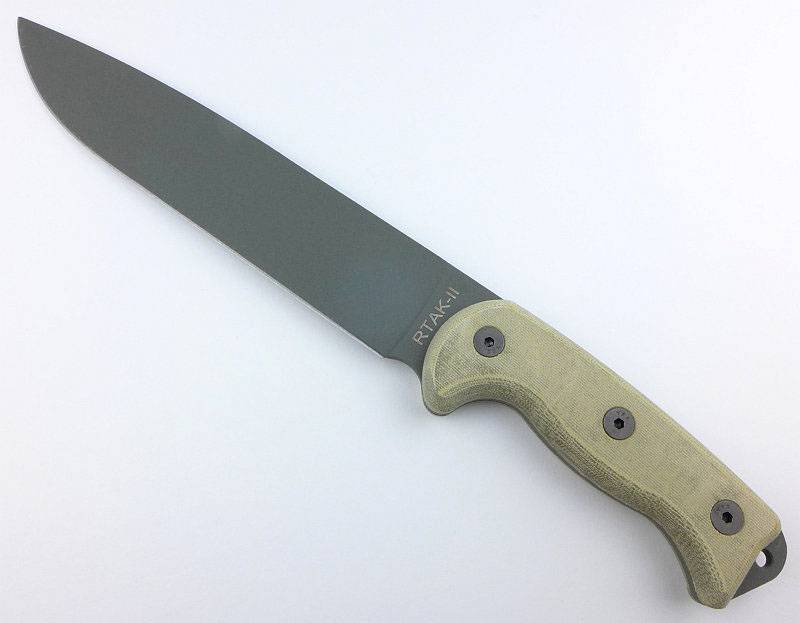
Despite its size everything looks nicely in proportion.
 photo 11 RTAK II angle P1140249.jpg

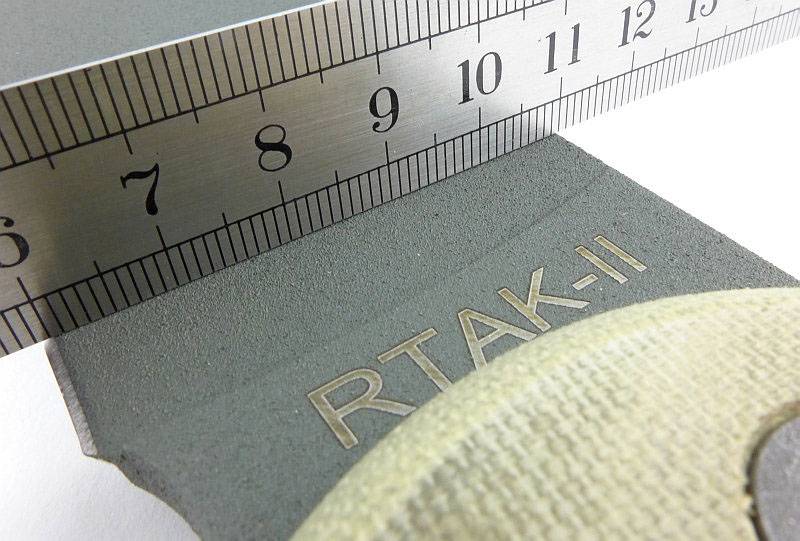
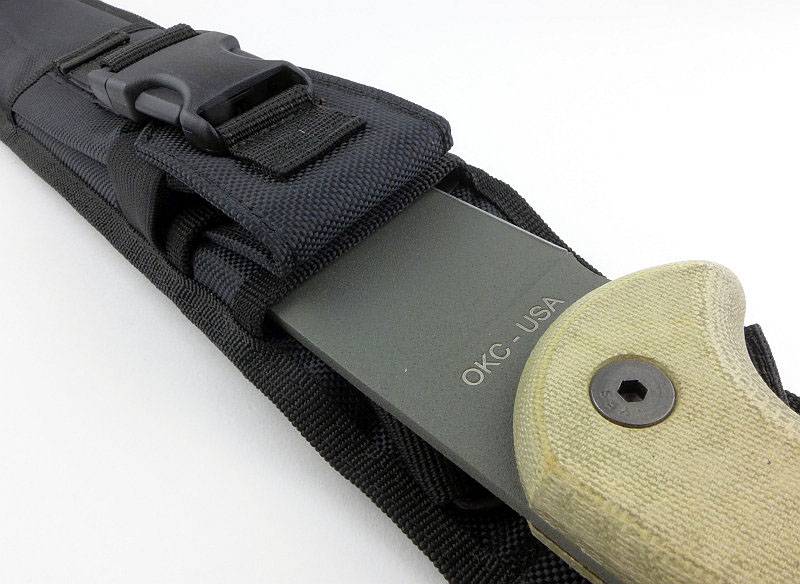
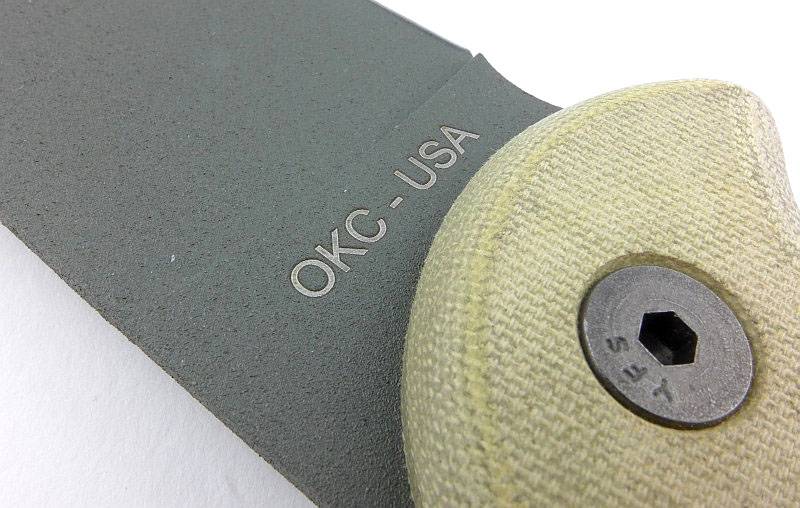
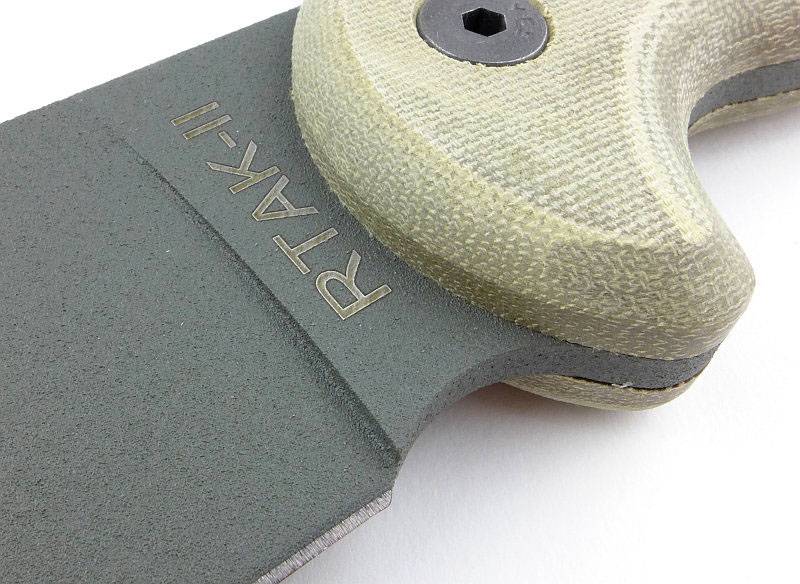
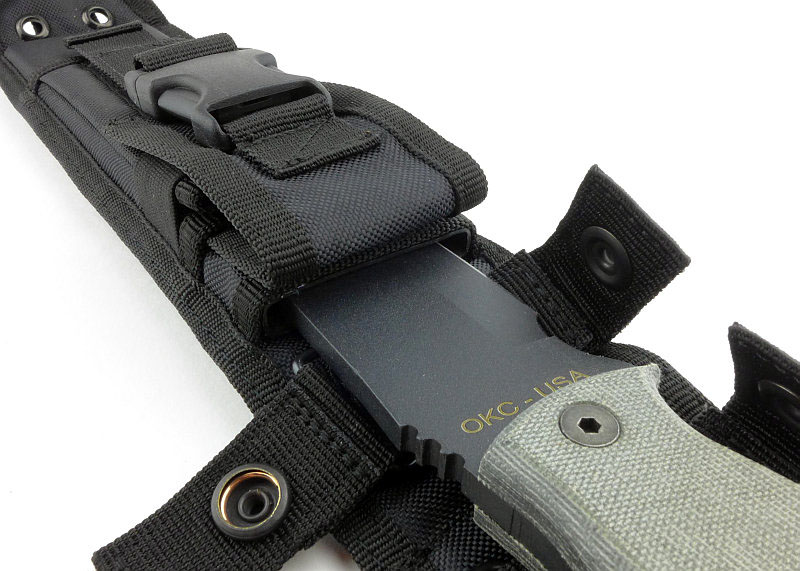
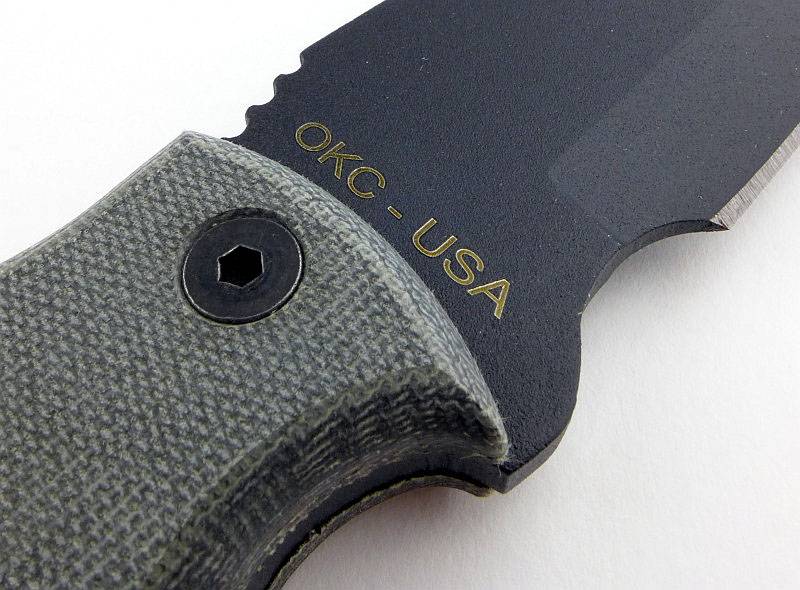
OKC-USA is stamped into the blade coating on one side.
 photo 12 RTAK II detail logo P1140253.jpg

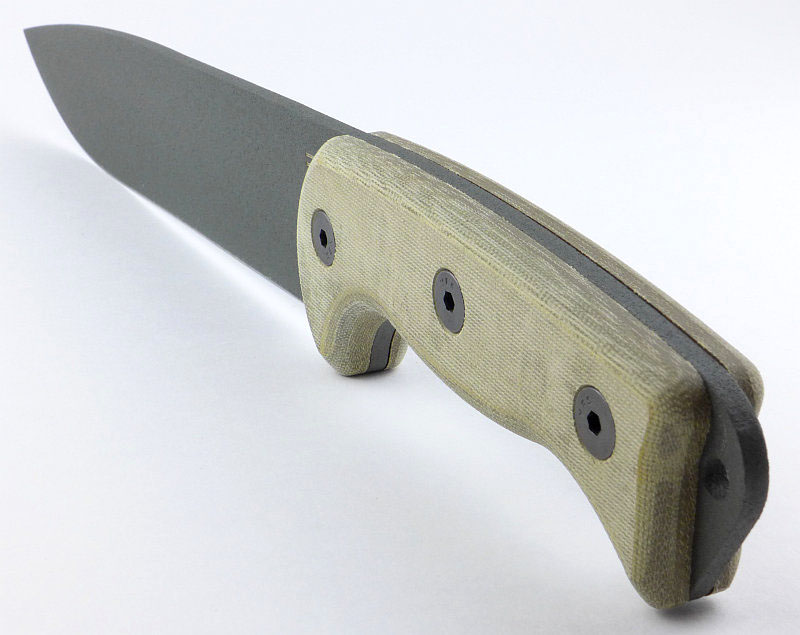
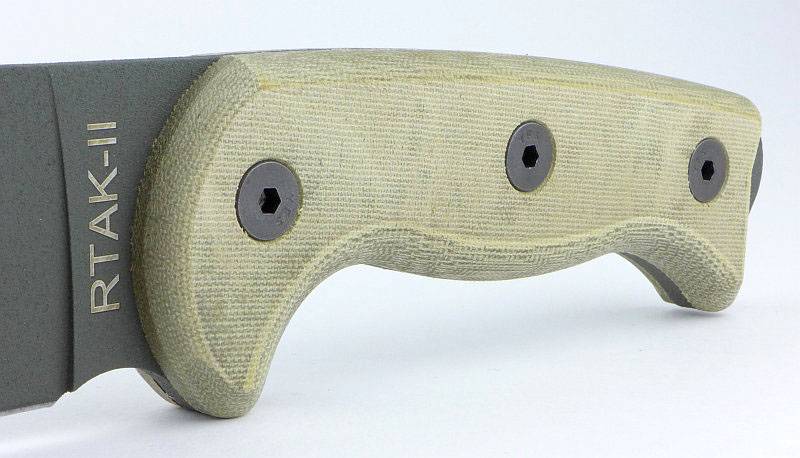
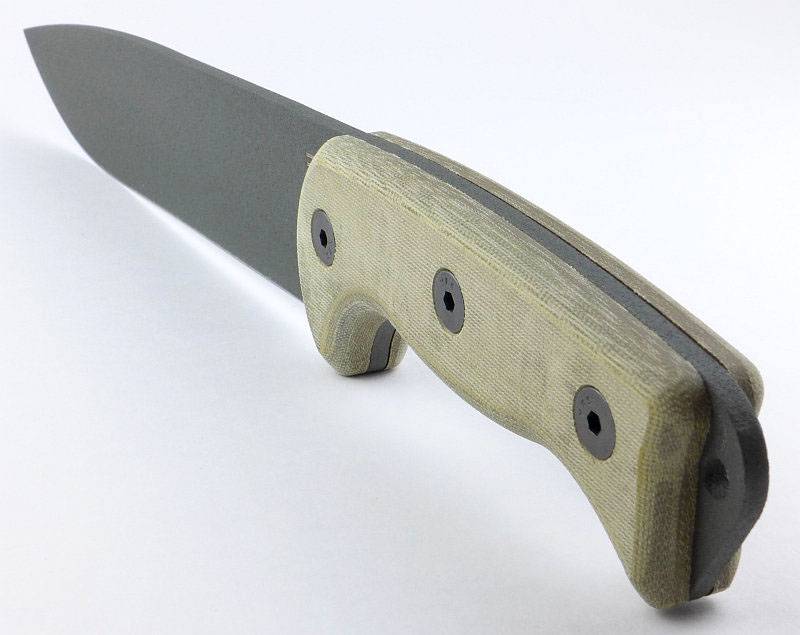
The micarta handle slabs are secured with three bolts.
 photo 29 RTAK II detail handle contour P1140363.jpg

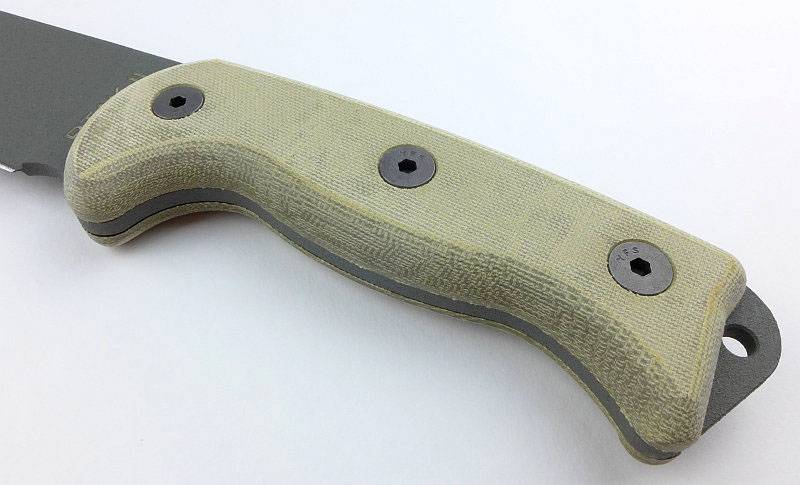
All handle edges are nicely rounded over making the grip very comfortable.
 photo 16 RTAK II detail handle contouring P1140265.jpg

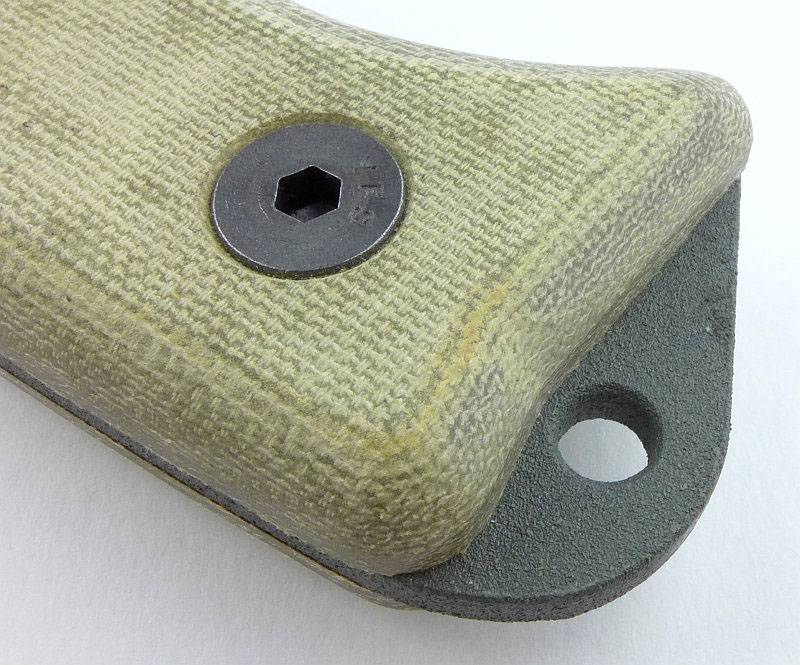
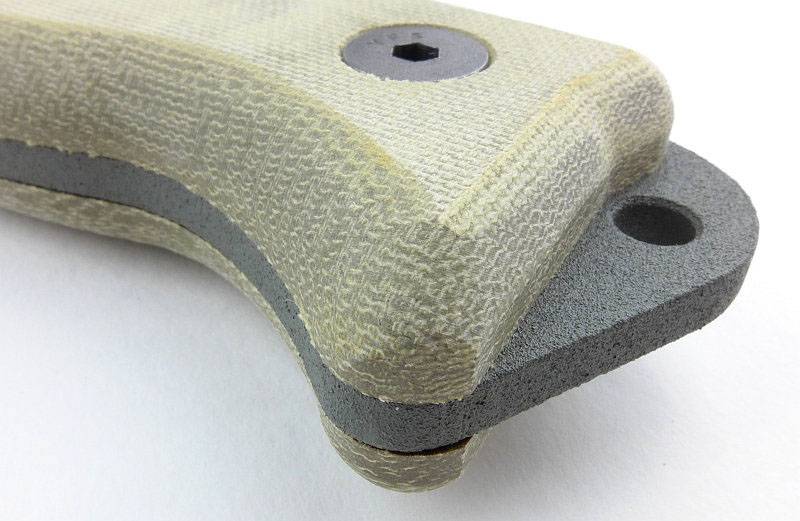
A lanyard hole is included in the exposed pommel.
 photo 14 RTAK II detail handle lanyard P1140257.jpg

There is a slight overlap of the handle slabs which are shaped separately to the blade tang. You don’t notice this in use.
 photo 17 RTAK II detail handle fit P1140266.jpg

Not intended as a finger choil, here is the edge relief choil and its relationship to the plunge line.
 photo 18 RTAK II detail choil P1140274.jpg

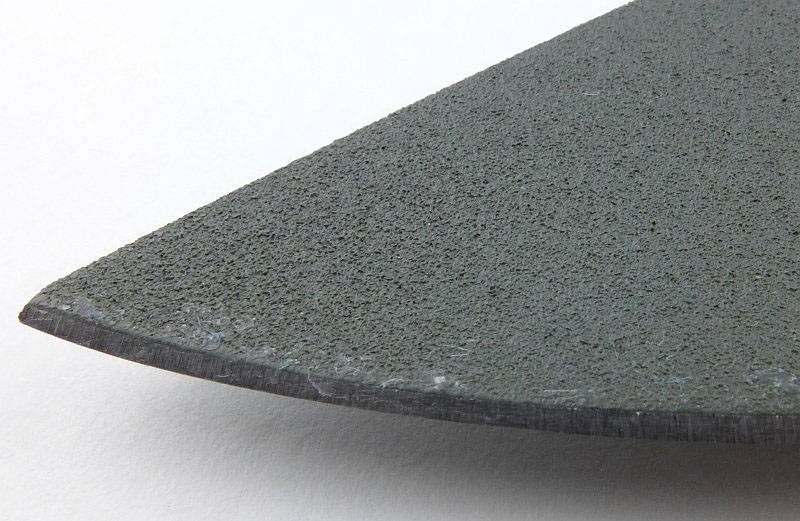
For corrosion resistance, there is a blade coating. It was much rougher than I expected and is somewhat abrasive. (Any marks on the edge are due to there being a waxy protective film on the blade.)
 photo 19 RTAK II detail coating P1140280.jpg

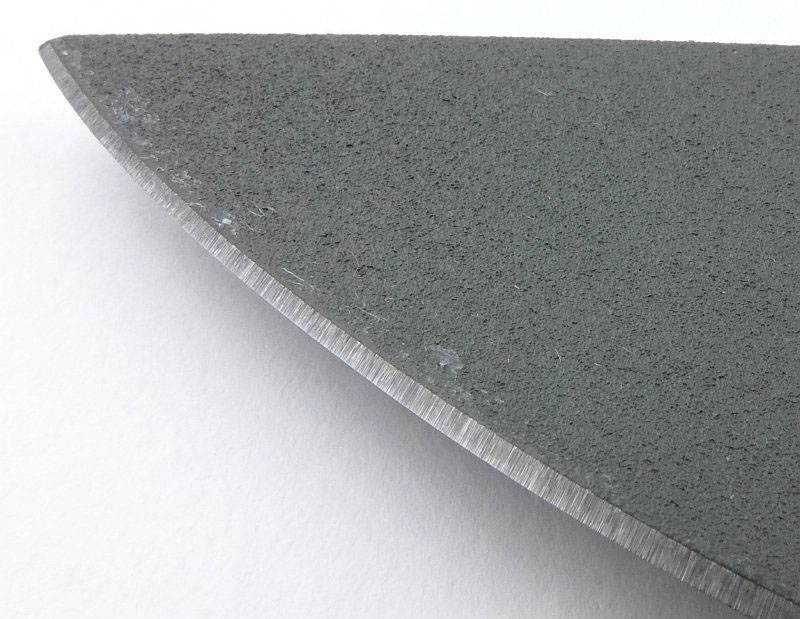
This RTAK II arrived with a great working edge.
 photo 20 RTAK II detail edge P1140282.jpg

Once you pick it up, that large blade feels like it has shrunk and is as manoeuvrable as a much smaller blade.
 photo 27 RTAK II angle reverse P1140351.jpg

What it is like to use?

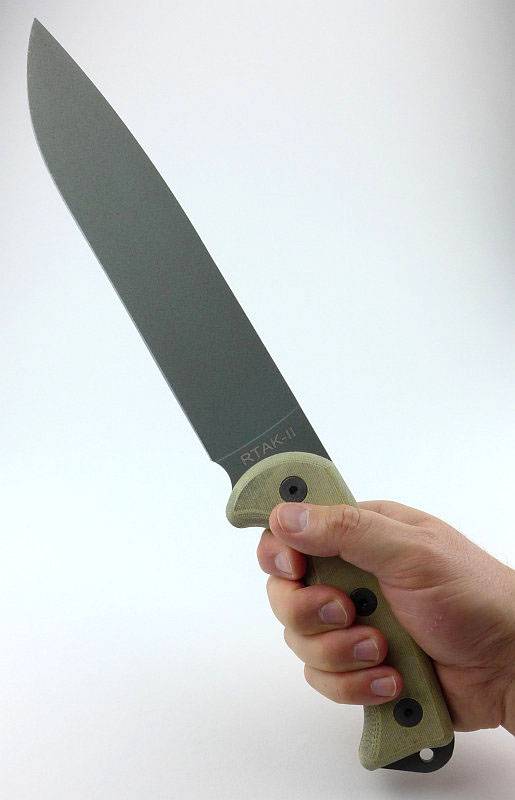
The first thing that struck me, as soon as I had the RTAK II in my hand, was how much lighter than expected it felt for a knife this large. Immediately I could see myself being able to do a lot of work with minimal effort. It is a big knife but simply doesn’t feel big. Here you can see it in my hand (I take XL sized gloves) and the grip fills my hand well, and despite being one of the largest grips I’ve used, doesn’t feel a stretch.
 photo 22 RTAK II in hand P1140300.jpg

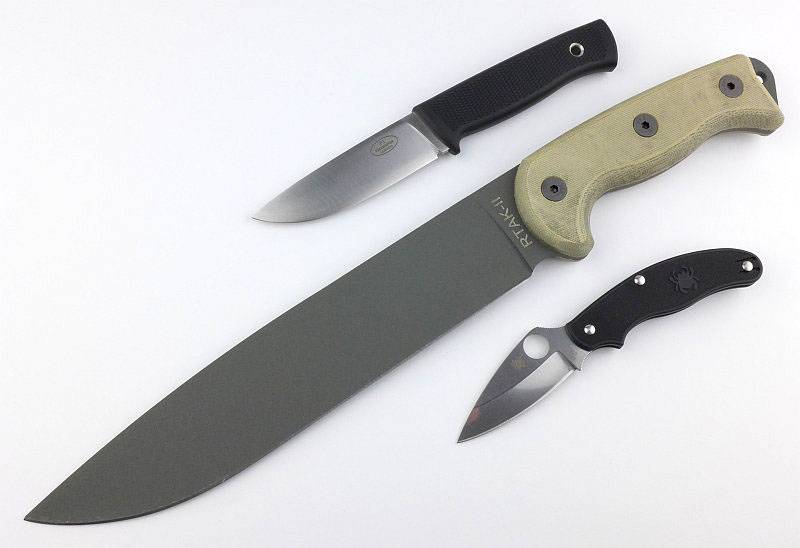
To give another idea of scale, here it is next to the Fällkniven F1 and a Spyderco UK Pen Knife. (Yes, they do look tiny next to the RTAK II.)
 photo 23 RTAK II size P1140328.jpg

Taking the RTAK II out for a few woodland tasks, it was in its element; chopping, carving, slicing, splitting, feathering all done with ease. The only real issue I could see was that rough blade coating and its tendency to pick up ‘rubbings’ (for want of a better word). This would make it less than ideal to follow up with food prep, as it will have contamination in the coating and is not easy to clean.

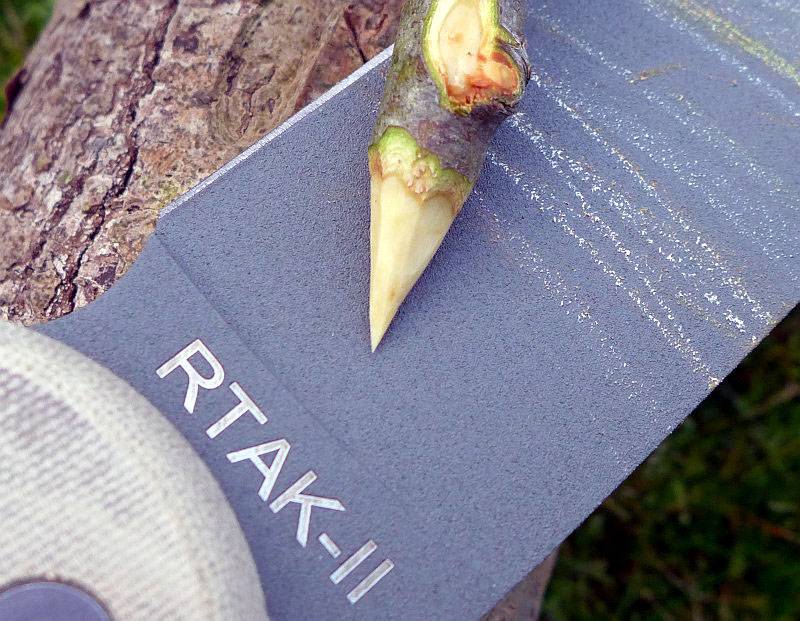
One of the comparisons I made to the other OKC knives was in putting a point on a stick. Due to the full flat grind, the RTAK II cut extremely well letting you chose the cut direction easily. The edge bites well, eagerly getting stuck into all woodland tasks.
 photo 06 OKCtrio RTAKII stick P1160289.jpg

Review Summary

The views expressed in this summary table are from the point of view of the reviewer’s personal use. I am not a member of the armed forces and cannot comment on its use beyond a cutting tool or field/hunting knife.

Something that might be a ‘pro’ for one user can be a ‘con’ for another, so the comments are categorised based on my requirements. You should consider all points and if they could be beneficial to you.

_______________________________________________ _______________________________________________
Things I like What doesn’t work so well for me
_______________________________________________ _______________________________________________
Fantastic handling. You know this knife is strapped to your leg.
Can work comfortably for long periods. Rough blade coating.
Great slicer. Grip could be too large for some.
Curent version is 5160 steel
‘Feels’ light
Big enough to slash, small enough for fine work.

 photo 15 RTAK II angle2 P1140262.jpg


Discussing the Review:

Please feel free to add comments to the review, but the ideal place to freely discuss these reviews is on a forum. If you started reading the shorter forum version of the review, but followed the link this full exclusive review, please return to that forum to discuss the review there.
If you read the review entirely on Tactical Reviews, please consider one of the following to join in any discussion.

EdgeMatters – Sponsored Reviews (UK based Forum for Knife Makers and Collectors)

BladeForums – Knife Reviews (US based Forum for Knife Discussion)

CandlePowerForums – Knife Reviews Section (Largest and Friendliest Flashlight Community Forum)

Knife Review: Ontario Knife Company’s Ranger RD Tanto

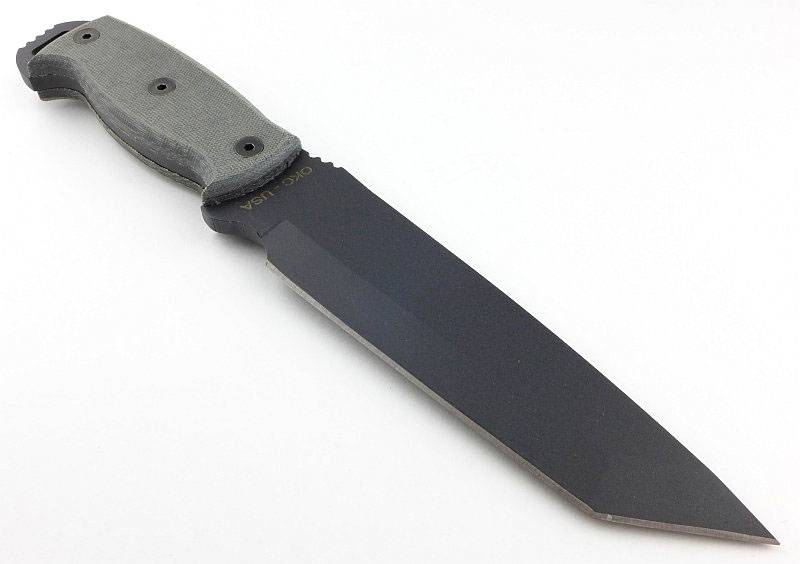
The Ontario Knife Company RD Tanto is the first of a three-knife review series featuring the Blackbird SK-5, RD Tanto and RTAK II. (See – OKC Group Review.)

 photo 09 OKCtrio in log P1160300.jpg

The RD Tanto is one of the ‘Ranger series’ of OKC knives, a heavy duty high performance range of knives designed by Justin Gingrich.
 photo 11 RD Tanto angle P1140443.jpg

The Blade and Handle Geometry:

Most knives specifications have a basic description of the blade geometry, but in this section I will be taking a more detailed look at geometry and balance.

 photo 36 RD Tanto flat grind P1140603.jpg

Using a set of gauges and precision measuring equipment including a Vernier protractor, callipers, fixed radius gauges and the unique Arc Master adjustable radius gauge (the one that looks like a crossbow).

These measurements have been tabulated and are presented along with a few reference blades (8″ Chef’s Knife, 5.5″ Santoku and the popular Fällkniven F1).

Key aspects such as the primary bevel angle, grind type, blade depth, blade thickness, length, weight are detailed, along with balance information.

 photo 38 RD Tanto angle P1140623.jpg

The ‘Balance relative to the front of the handle’ tells you if the knife will feel front heavy, or if the weight is in your hand (a positive value means the weight is forward of the front of the handle). The ‘Balance relative to the centre of the handle’ indicates how close to a ‘neutral balance’ the knife has in the hand.
 photo 37 RD Tanto balance P1140616.jpg

In the case of full convex grinds the approximate centre of the grind is used for the primary bevel angle estimate. This table includes the parameters for all the OKC knives in this series of reviews.
 photo OKC Parameters BlackbirdRDTantoRTAKII.jpg

The blade is made from 5160 steel.

Explained by the Maker:

The reasons for certain design choices may not be clear when simply looking at an object, so this section is intended to give an insight into the thinking behind a design by speaking to the designer themselves.

Though no longer directly involved with OKC, Justin Gingrich was happy to talk to me about the RD Tanto, how it came into being, and some of the design’s details.

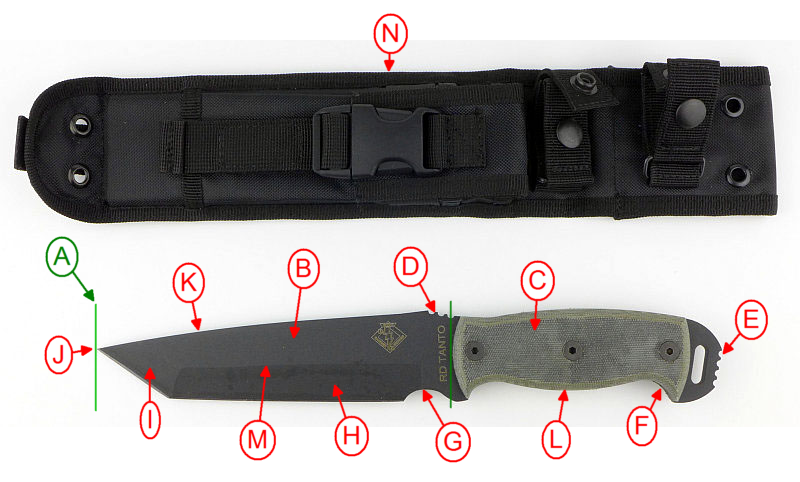
As this was done by phone to help our discussion I sent this marked up image and include it now so I can use the same reference labels in the description.
 photo 24 RD Tanto with sheath front P1140515 002 002.png

The entire OKC Ranger series comes from Justin’s original company ‘Ranger Knives’ which he started in 2002 and eventually sold to OKC in 2008. Under OKC, Ranger Knives became the ‘Ranger series’. All Ranger Series knives have been designed by Justin and the original Ranger Series included four knives, the RD-4, 6, 7 and 9 as well as two versions of the RD Hawk. Justin continued to design the Ranger Series for around three years after selling Ranger Knives to OKC, and the RD Tanto was one of the knives designed for the OKC Ranger series.

During the time he worked with OKC, Justin continued to design various different knives and presented them to OKC for consideration. The Tanto was added as he had received a lot of demand for this style of knife.

With the RD Tanto being an additional design to an existing series, many of the design parameters were already set. Specifications such as the blade stock being 1/4 inch thick and using 5160 steel, as well as the handle design and materials, were kept the same to maintain continuity.

The final blade length (A) was chosen for a couple of reasons, but the main one actually being aesthetics. It had to look in proportion to the RD series handle and 6 1/2 – 7 inches was a sweet spot for this blade. To better understand the purpose of this blade length you need to consider that it doesn’t really fit into the category of a fine-work blade or a heavy-work blade. This blade length is a hybrid of the two and though it won’t do anything really well, it will do everything moderately well. For the person who doesn’t want to carry more than one knife, and doesn’t want to carry a heavy tomahawk or hatchet, the 6-7 inch blade allows them to more-or-less do anything they need to do, without it being too bulky to carry.
Looking at the very heavy blade stock (B), though this was carried over from the other knives in the Ranger series, the intention is to allow it to be a heavy duty tool with powerful stabbing ability. The design needed to be suitable to open a can of beans, dig, carry out extraction work such as prying open car doors or interior doors and to allow the user to really be able to lever on that blade without fear of it breaking.
Handle style (C) is something Justin has gone over with OKC a lot as he would prefer there to be more rounding on the handle slabs to increase comfort. The design originally comes from a time when the slab style of handle was very popular as a straightforward Tactical design. When working on the Ranger knives, Justin had just come out of the military so this tactical style was the one he adopted, however, his original knives had a more rounded handles than the current OKC versions.
Next to the handle, a thumb ramp with jimping (D) is included to provide additional grip strength when thrusting the knife.
Though the exposed pommel (E) allows the knife to be hammered with or hammered on, the jimping on it is not to stabilise the hammer strikes but is intended to keep your thumb in place when using a reverse grip for digging or stabbing.
There are well pronounced hooks front and back of the handle (F) as well as a palm swell (L), asking Justin how these were sized and spaced he explained that the handle shape and size came about because he designs so that it is comfortable for him to use with or without gloves.
Though views vary about the safety of using a choil (G) such as this for choking up on, Justin specifically did design this to be used for a finger to sit in and change the grip for finer work. It was sized for comfort and to enable one finger to sit in it without riding up onto the edge. He was careful not to go too big as it does increase the overall length of the blade. Asking Justin about the choil pushing the cutting edge further from the handle, he responded that with a 6 inch blade you won’t be doing a lot of food prep type cutting and if you are holding the handle you are going to be chopping, digging and slashing. For finer work where you want the edge as close to your first finger as possible you choke up on the blade and use the finger choil to get you back right up on the edge so you can apply more pressure. With a choil, when choking up on it, the change in grip takes a 6 inch blade and brings the blade back to a more manageable 4-5 inch length. Not leaving this subject right now, I pressed Justin as to why not just leave the choil out and bring the edge back to the handle? His reply was that removing the choil increases the blade length making it more daunting to do tip work with. The choil gives you two blade lengths in one knife for greater control in finer tasks.
A flat grind (H) was chosen simply for strength though this can bind or stick when chopping wood.
When asking about the use of a Tanto point (I), as mentioned earlier, there was a high demand for a Tanto design, so this piece was specifically added to fill that gap in the series.
Placing the tip position (J) directly in line with centre of grip was to make the tip as effective as possible. Whether stabbing/thrusting or using the tip as a drill, you get the most power behind the tip when it is in the centre line. If the tip is off centre the point has a tendency to travel in the direction it is already going.
The spine (K) has been kept plain and with no swedges partly for strength, but mainly to give you better purchase if you baton with it. A swedge grind chews up the baton and does not provide any real weight reduction.
Grind line position (M); though the steepness of the primary grind limits slicing sharpness, the more material there is behind the edge the less likely you are to chip that edge. When you are doing tasks like cutting through car doors, prying or processing a lot of wood, with all the material behind it you are less likely to chip the edge. You can still cut paper with it and you can still shave with it if you take the time to hone the edge, but it is not meant for super fine cutting tasks.
In the design specification, the steel is 5160. Though 1095 is a proven blade steel and has been around forever, 5160 is much tougher than 1095, and has the same or better edge retention as 10 series steel. At 56-58 HRC you will be hard pressed to break the knife because it is made from a spring steel. Typically 5160 is used for truck leaf springs as it is meant to take repeated abuse, back and forth motion, and flexing of the blade without forming stress risers or stress cracks in the steel that would lead to catastrophic failure. Failure should never happen with a knife made of 5160 and it should flex/come back, flex and come back for the life of the user.
Lastly looking at the Sheath (N), this is a standard item used by OKC and by Justin when working as Ranger Knives. It is a nylon sheath with a pouch and snap closures, plus a plastic liner to stop you cutting through it if you fall or drop the sheath. Working to a price point, the compromise of using a relatively basic but serviceable sheath was made rather than pushing the price up with a spectacular sheath.

A few more details:

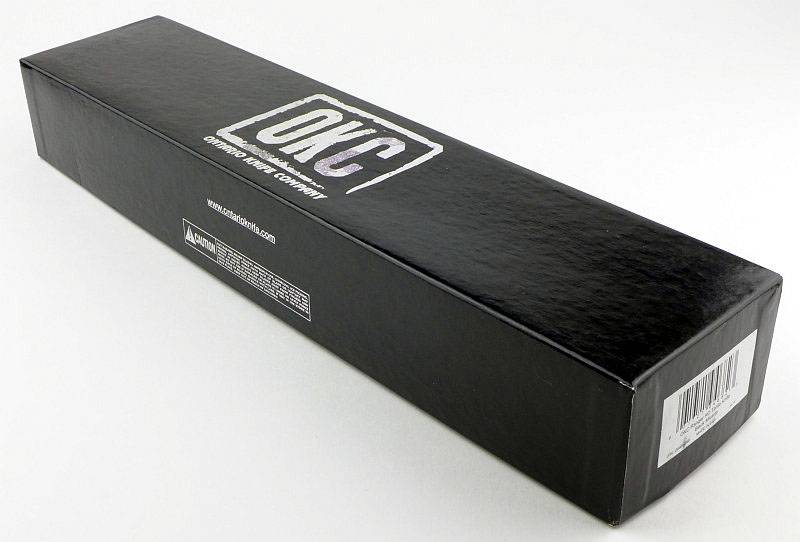
Ontario Knife Company’s standard knife box.
 photo 01 RD Tanto Boxed P1140397.jpg

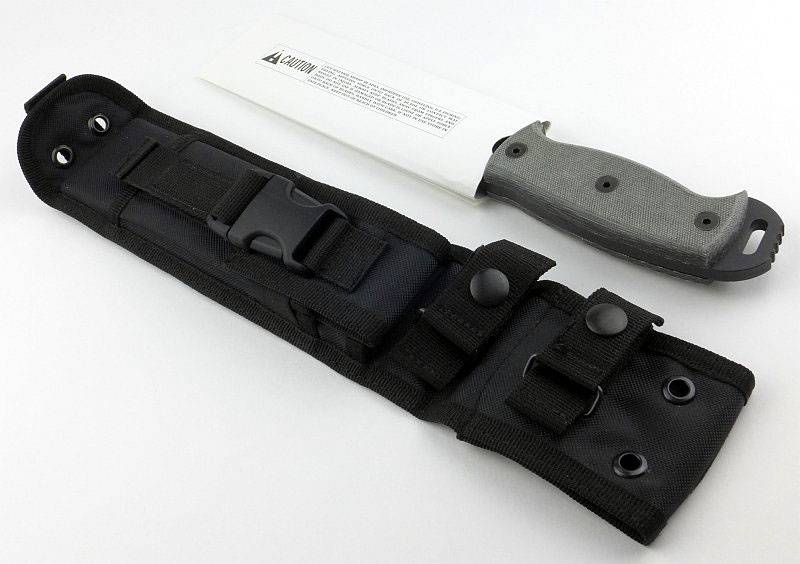
Inside the box the knife has a cardboard protector over the blade, and the knife is not fitted into the sheath.
 photo 02 RD Tanto UnBoxed P1140407.jpg

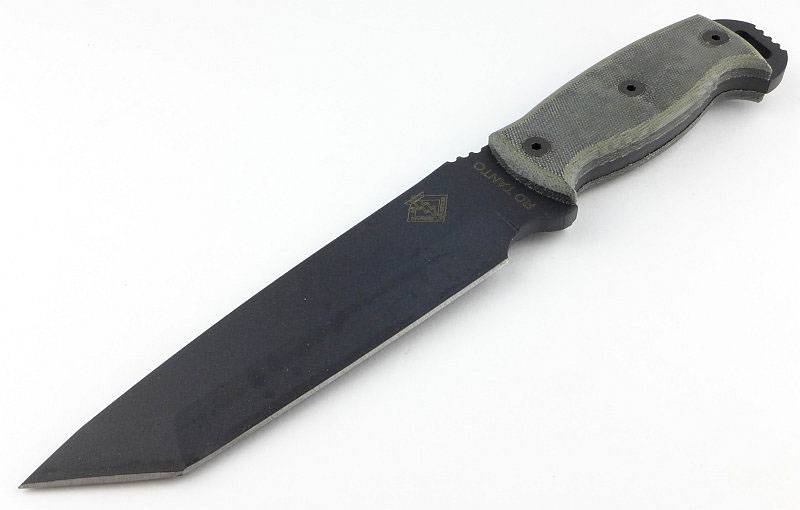
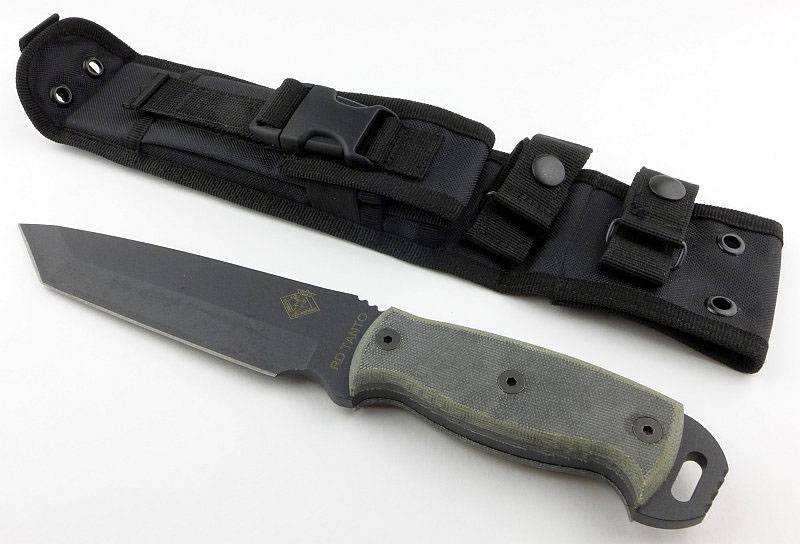
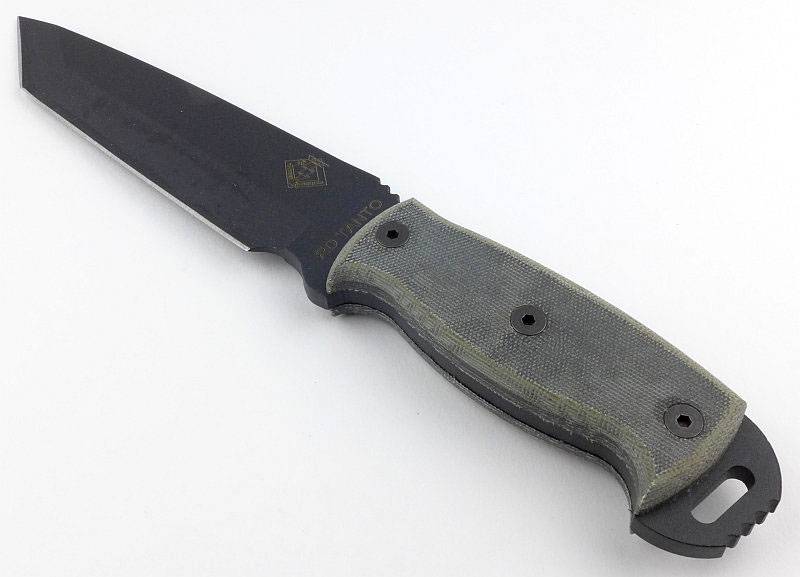
The first view of the RD Tanto – Heavy Duty! (Any marks on the blade are due to there being a waxy protective film on the blade.)
 photo 03 RD Tanto revealed P1140415.jpg

Before going back to the knife, a quick look at a few details for the sheath. Metal eyelet holes are provided for a leg tying point.
 photo 04 RD Tanto sheath detail 01 P1140421.jpg

An expanding pocket is kept closed with a plastic snap-buckle.
 photo 05 RD Tanto sheath detail 02 P1140422.jpg

Opening the pocket shows a fixed elastic strap keeps the pocket neat and tight onto whatever is held in the pouch.
 photo 07 RD Tanto sheath detail 04 P1140424.jpg

Two straps with popper closures are used to secure the handle when in the sheath.
 photo 06 RD Tanto sheath detail 03 P1140423.jpg

Both the knife retention straps are adjustable to allow the user to tighten or loosen the grip on the knife to suit.
 photo 08 RD Tanto sheath detail 05 P1140431.jpg

A kydex liner is provided in the sheath. Due to the thickness of the blade, the fit is snug.
 photo 09 RD Tanto sheath detail 06 P1140434.jpg

The back of the sheath has PALS webbing (MOLLE compatible).
 photo 10 RD Tanto sheath detail 07 P1140441.jpg

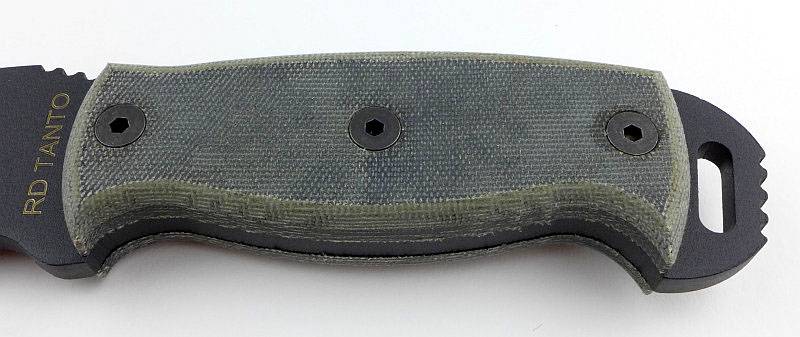
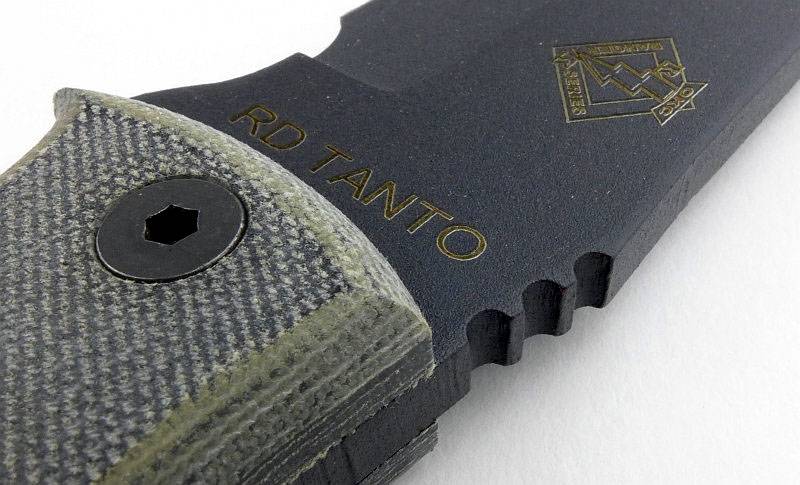
Enough of the sheath, back to the RD Tanto. Each slab handle is held in place with three screws.
 photo 12 RD Tanto angle reverse P1140445.jpg

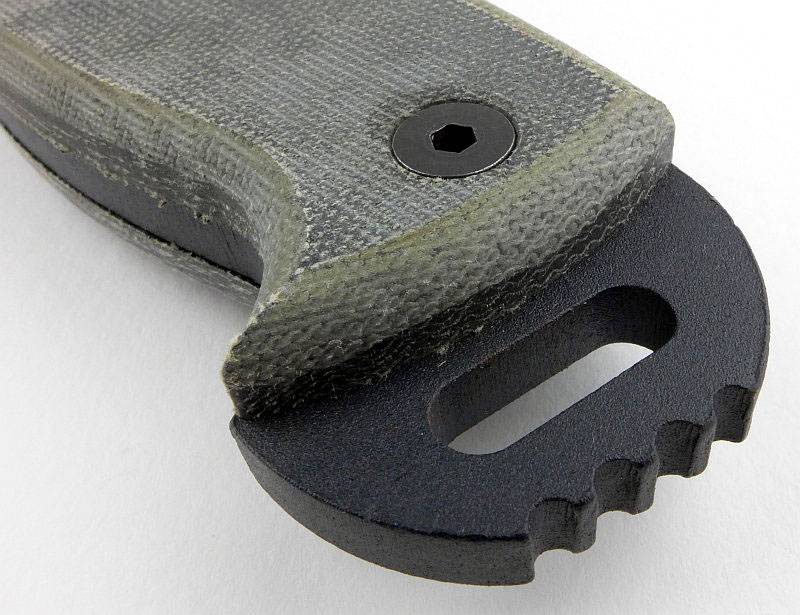
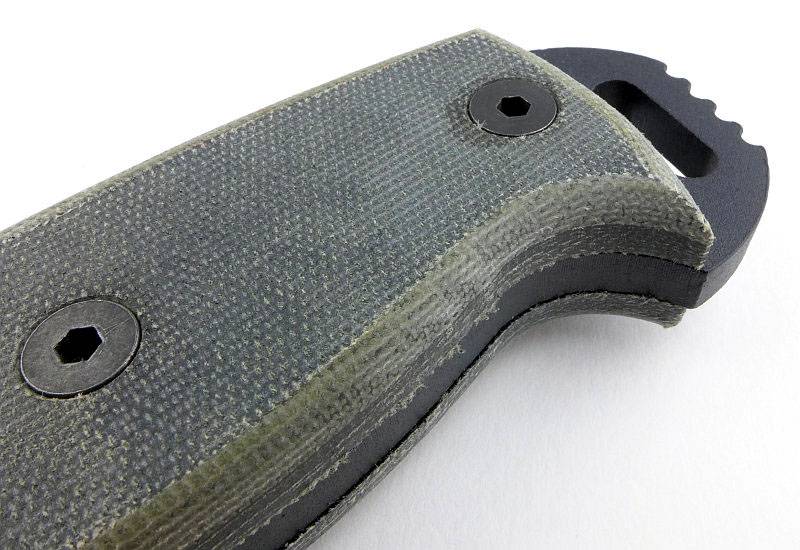
The RD Tanto has an exposed pommel with thumb-grip jimping. You can also see the texture and layers in the micarta handle slabs.
 photo 13 RD Tanto detail butt P1140448.jpg

The Ranger Series handle around which this Tanto was designed.
 photo 14 RD Tanto detail handle P1140450.jpg

A finger choil allows you to choke up the grip for finer work.
 photo 15 RD Tanto detail choil P1140453.jpg

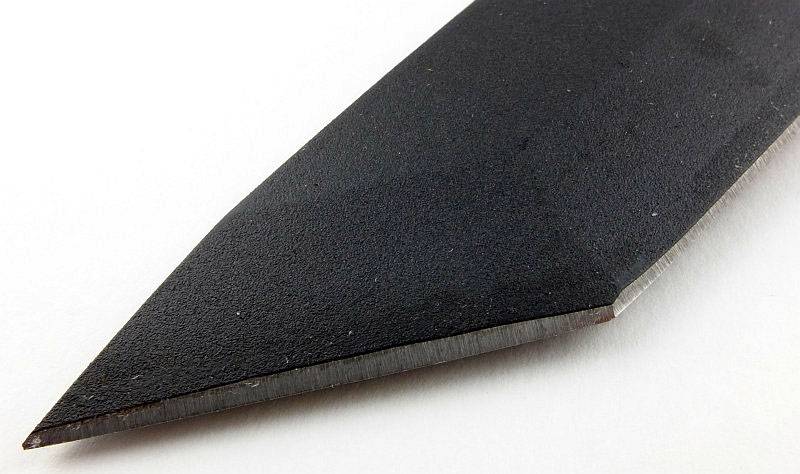
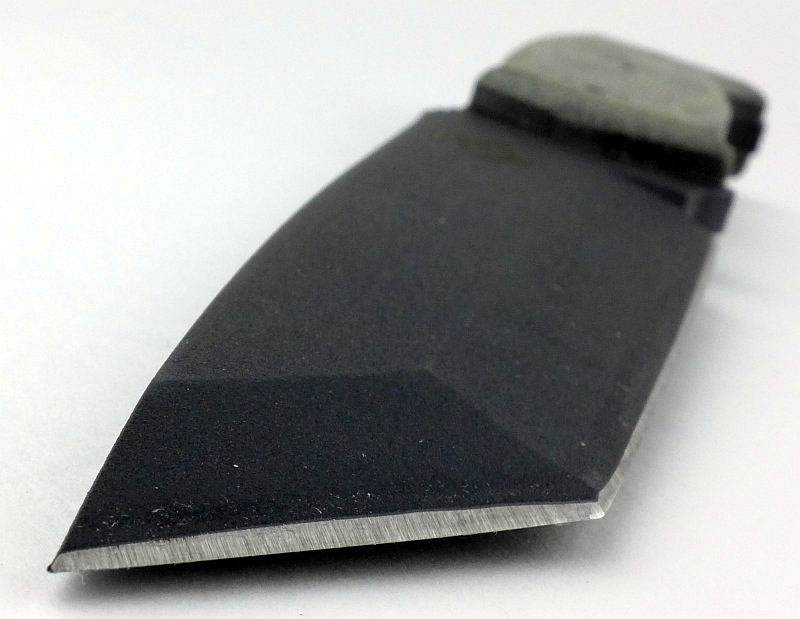
With the 1/4″ blade stock and V-grind, this tanto has a very strong point.
 photo 16 RD Tanto detail point P1140462.jpg

Another look at the grip hook. Here you can also see the micarta handle slabs extend slightly beyond the tang.
 photo 18 RD Tanto detail hook P1140472.jpg

At the front of the handle is a similar hook forming the finger guard, and in front of that the finger choil.
 photo 20 RD Tanto detail choil P1140481.jpg

Jimping on the thumb ramp is coarse but effective.
 photo 21 RD Tanto detail jimping P1140483.jpg

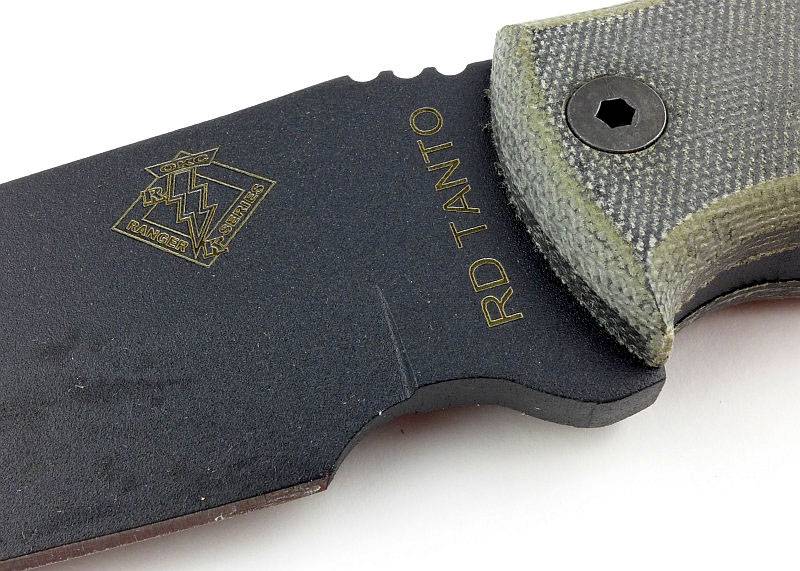
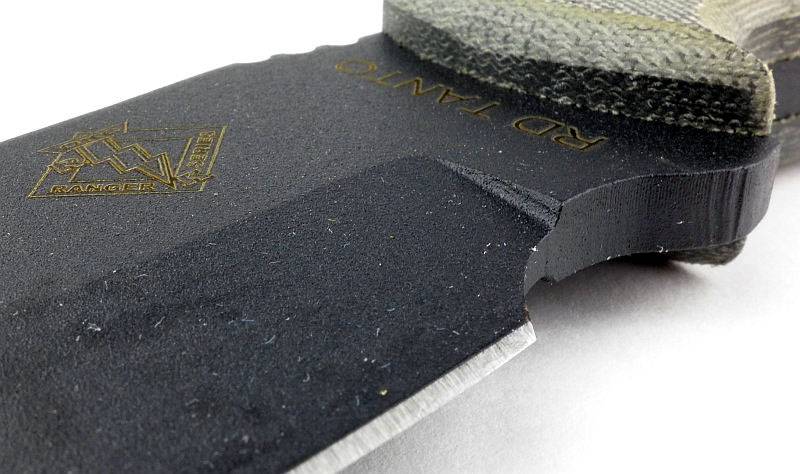
There is slight rounding on the plunge line. You can also see some evidence of the water-jet cutting used to create the basic blade shape.
 photo 22 RD Tanto detail plunge line P1140497.jpg

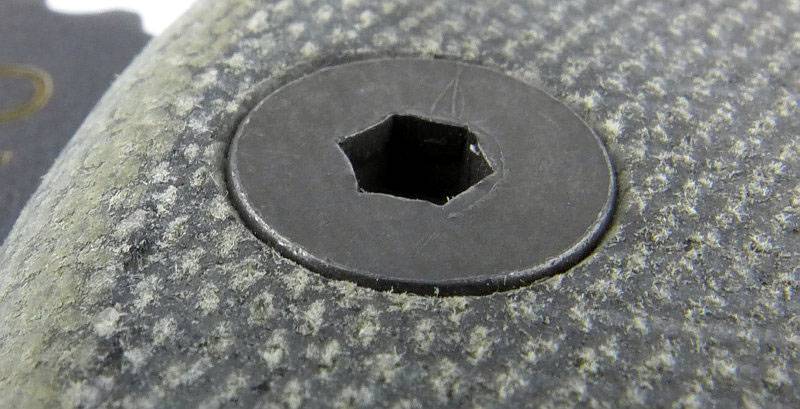
A closer look at one of the handle bolts and the raw sanded surface of the micarta grip.
 photo 27 RD Tanto detail grip texture P1140529.jpg

This is a HEAVY DUTY blade!
 photo 23 RD Tanto detail phat blade P1140504.jpg

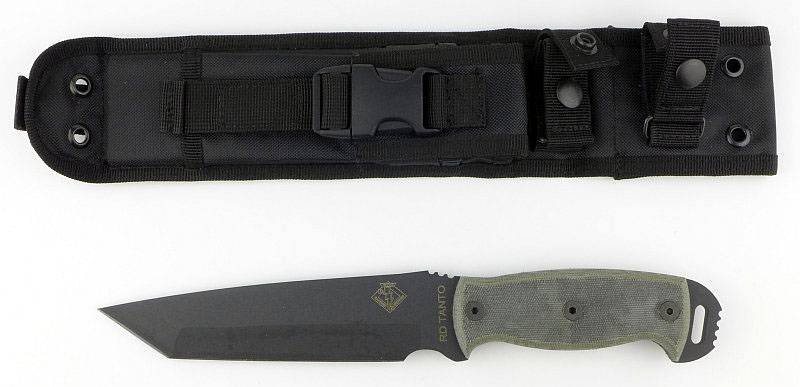
Next to the sheath for an overall view of the RD Tanto and the front of the sheath.
 photo 24 RD Tanto with sheath front P1140515.jpg

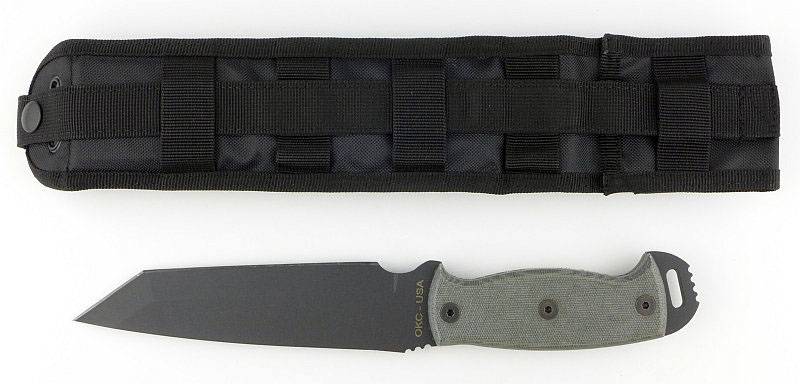
Flipping both over to check the other side.
 photo 25 RD Tanto with sheath back P1140512.jpg

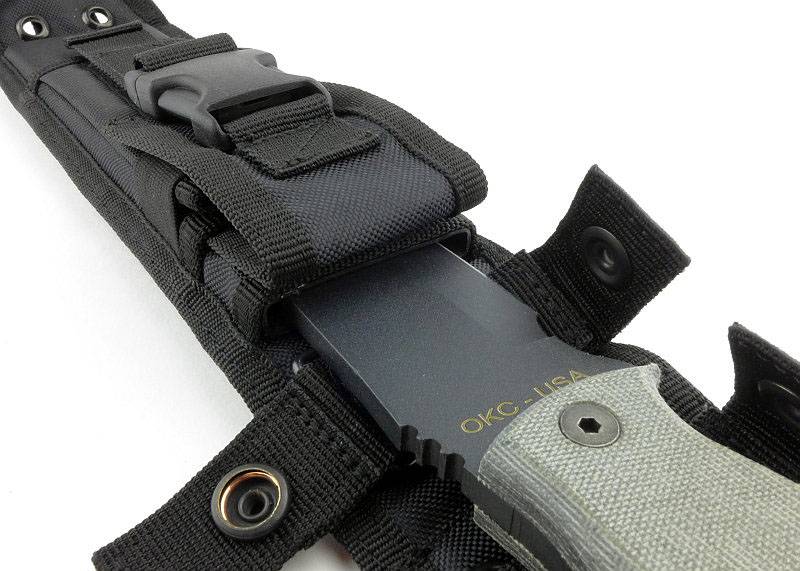
Due to its thick blade stock, the RD Tanto rubs all the way in when inserting into the sheath.
 photo 28 RD Tanto detail inserting P1140532.jpg

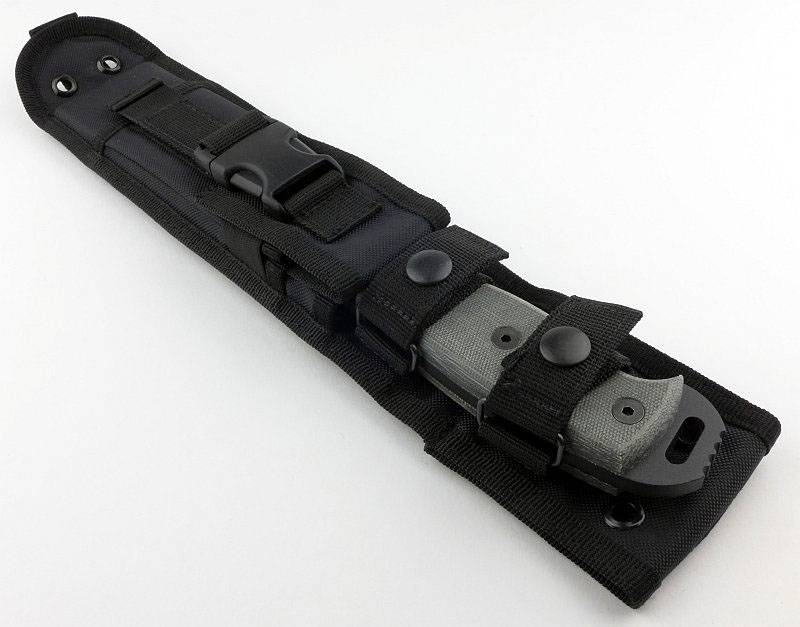
With both straps closed there is no chance of this knife coming loose.
 photo 29 RD Tanto sheathed P1140537.jpg

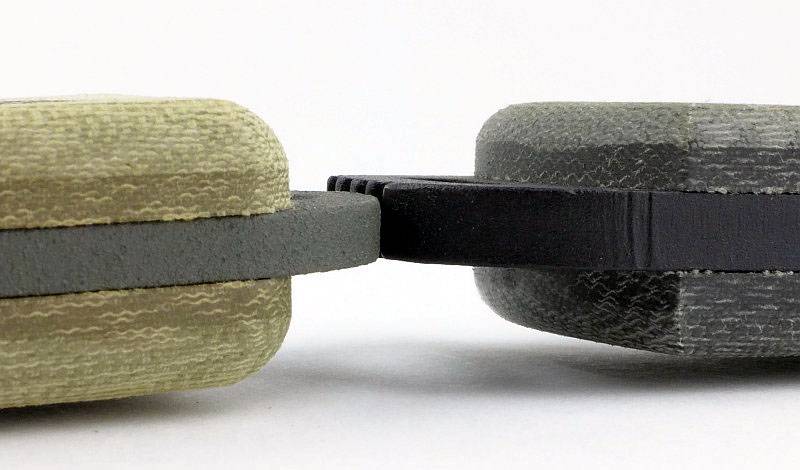
We will see more comparisons of blade thickness in other reviews in this OKC series, but here is a comparison to the RTAK II. The RD Tanto is substantially thicker.
 photo 30 RD Tanto thickness P1140552.jpg

Placed pommel to pommel, the RTAK II and RD Tanto compared again.
 photo 31 RD Tanto thickness2 P1140558.jpg

What it is like to use?

With a seriously heavy duty knife such as the RD Tanto, before looking at what it is like to use, it is important to consider your expectations for a knife like this and what it will give you.

There is little finesse in a knife of such heavy build – it is a bruiser and unashamed of that. Built for those jobs you would balk at using a knife for, but you want to be prepared for and can only justify carrying one knife/tool.

So if you want to do some delicate whittling and sophisticated food preparations but still want to be able to breeze through a fire door or release someone trapped in a vehicle, you will be disappointed.

For everyday tasks this knife is vastly over engineered and will disappoint most with its cutting characteristics. But, this is NOT why you choose a knife like this.

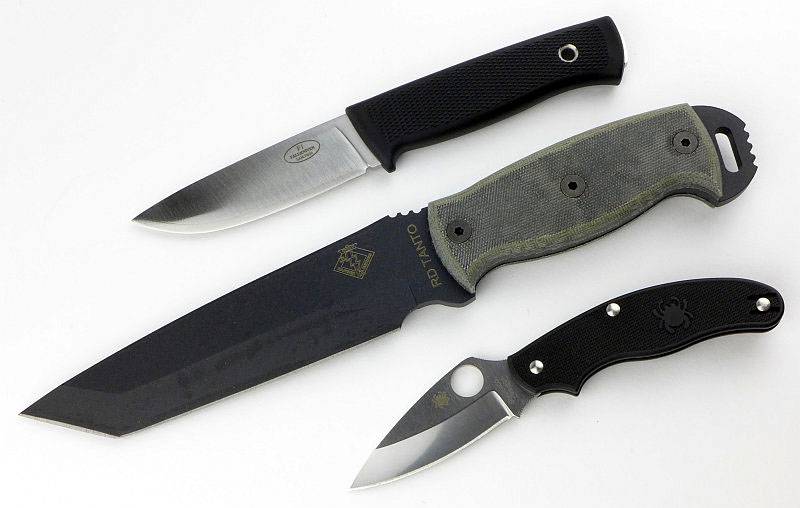
Look at it next to the Fällkniven F1 and a Spyderco UK Pen Knife. This photo doesn’t do justice of the heavy build in relation to those other knives.
 photo 32 RD Tanto size P1140581.jpg

Having put aside the notion that this might go on your belt or pack for ‘normal’ knife work, we can move onto its more serious purpose – Heavy Work.

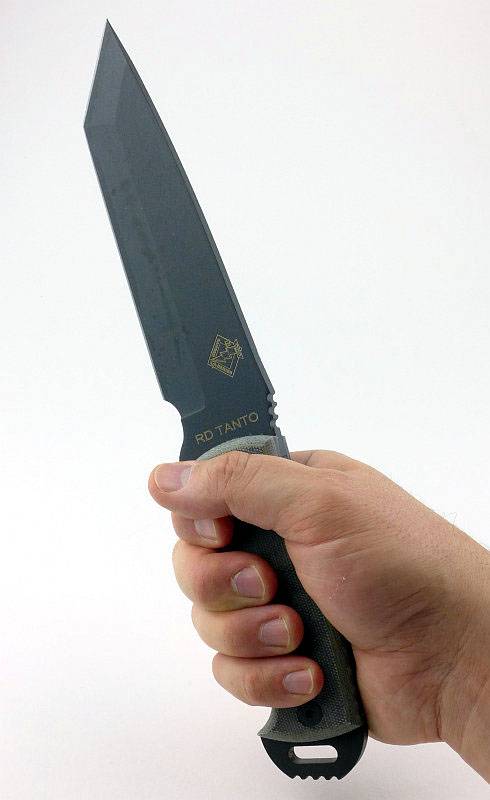
My hands take XL sized gloves and the grip fills my hand well. When you are really going to be beating a knife the last thing you want is a slim grip, so a good handful makes for a solid grip.
 photo 33 RD Tanto in hand P1140587.jpg

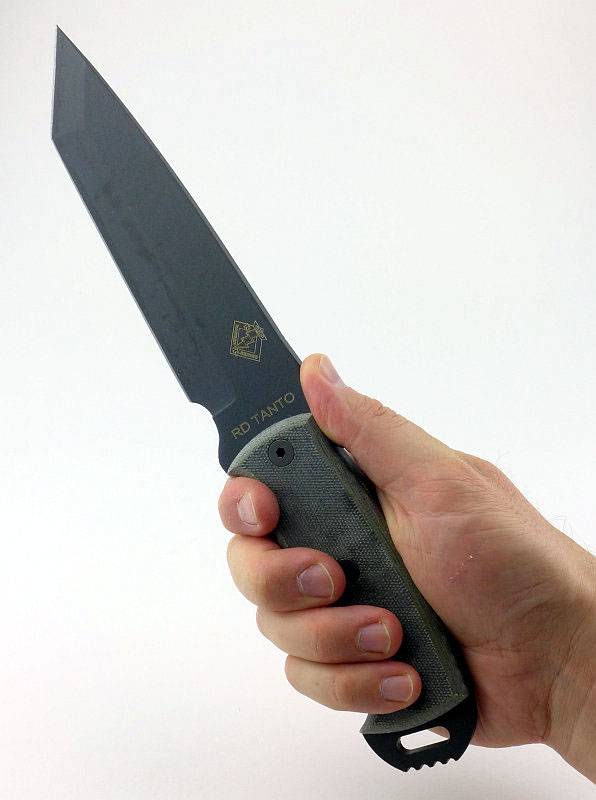
As penetration is a Tanto’s strong point (pun intended) the thumb ramp combined with deep hooks on the grip gives you a great power behind the thrust.
 photo 34 RD Tanto in hand2 P1140589.jpg

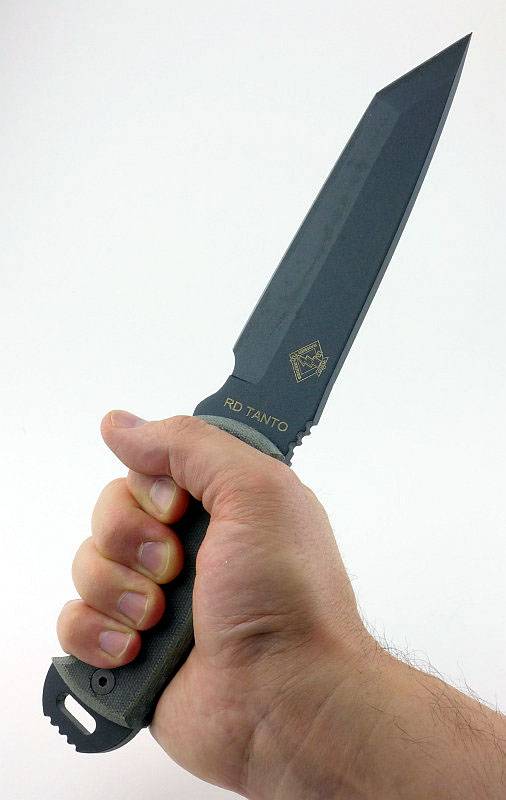
You can either hammer on the exposed pommel or in this case give something a good pounding with it.
 photo 35 RD Tanto in hand3 P1140596.jpg

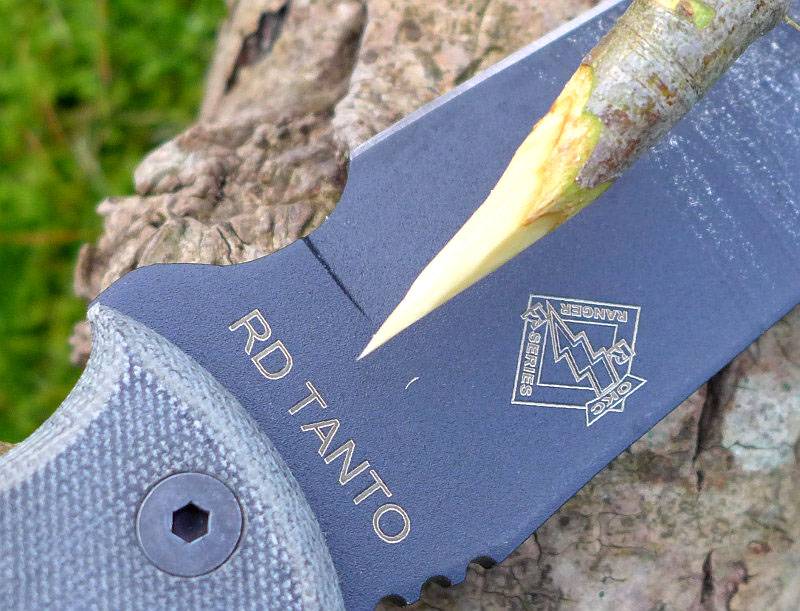
Taking the RD Tanto out for a few woodland tasks it was surprisingly capable, but does feel heavy. One of the comparisons I made to the other OKC knives was in putting a point on a stick. Due to the steep edge bevel, the RD Tanto had a tendency to slide off the stick and this resulted in a long point which was formed like this due to the cutting action tending to push away from the centre of the stick. The edge itself is sharp and cuts cleanly but needs to be angled far more ‘into’ the material than most.
 photo 07 OKCtrio RDTANTO stick P1160291.jpg

Will you want a knife like this? If you want to be prepared for all eventualities, then yes I would say you do. It would not be my every day choice, but it is a choice I want to have and a knife I continue to grab when preparing for certain situations.

To date I’ve not had any doors to demolish, or vehicles to gain entry to, but can tell you this is a tool I would happily take for the task. During some severe weather, which was threatening structural damage to buildings, the tool I kept within arm’s length at all times during the threat was the RD Tanto, and it gave me confidence to know I had it.

Review Summary

The views expressed in this summary table are from the point of view of the reviewer’s personal use. I am not a member of the armed forces and cannot comment on its use beyond a cutting tool or field/hunting knife.

Something that might be a ‘pro’ for one user can be a ‘con’ for another, so the comments are categorised based on my requirements. You should consider all points and if they could be beneficial to you.

_______________________________________________ _______________________________________________
Things I like What doesn’t work so well for me
_______________________________________________ _______________________________________________
Super Heavy Duty Build in 1/4″ blade stock ‘Feels’ too heavy for daily tasks
5160 spring steel Steep edge angle
Tanto point penetration Edge can bind during wood preparation
You can confidently work this knife hard!

 photo 19 RD Tanto angle P1140474.jpg


Discussing the Review:

Please feel free to add comments to the review, but the ideal place to freely discuss these reviews is on a forum. If you started reading the shorter forum version of the review, but followed the link this full exclusive review, please return to that forum to discuss the review there.
If you read the review entirely on Tactical Reviews, please consider one of the following to join in any discussion.

EdgeMatters – Sponsored Reviews (UK based Forum for Knife Makers and Collectors)

BladeForums – Knife Reviews (US based Forum for Knife Discussion)

CandlePowerForums – Knife Reviews Section (Largest and Friendliest Flashlight Community Forum)

Sunglasses Review: Wiley X MEGA Test – Saber, Twisted and Knife

I first came across Wiley X due to the fact they manufacture 5.11 Tactical’s range of sunglasses. It is a real compliment that 5.11 chose Wiley X, and when you see more of what Wiley X make you will understand why they are a brand you can trust if you want protection as well as style.

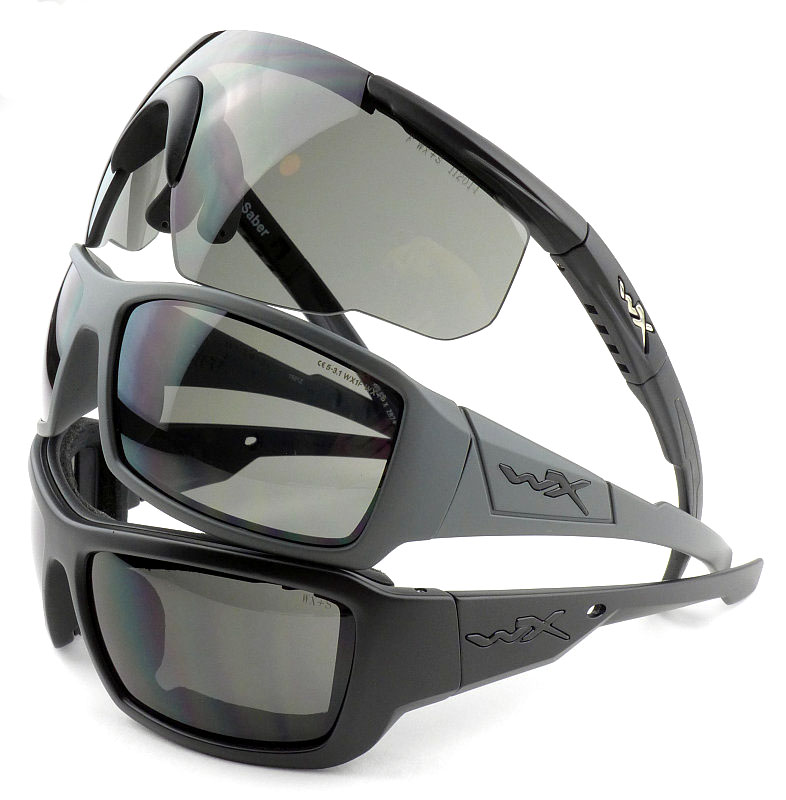
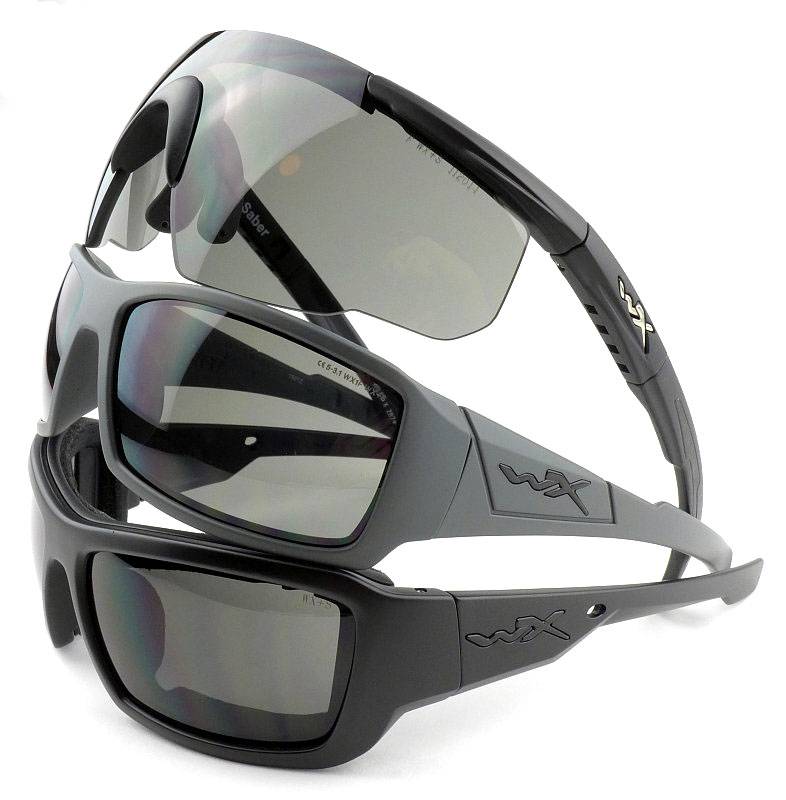
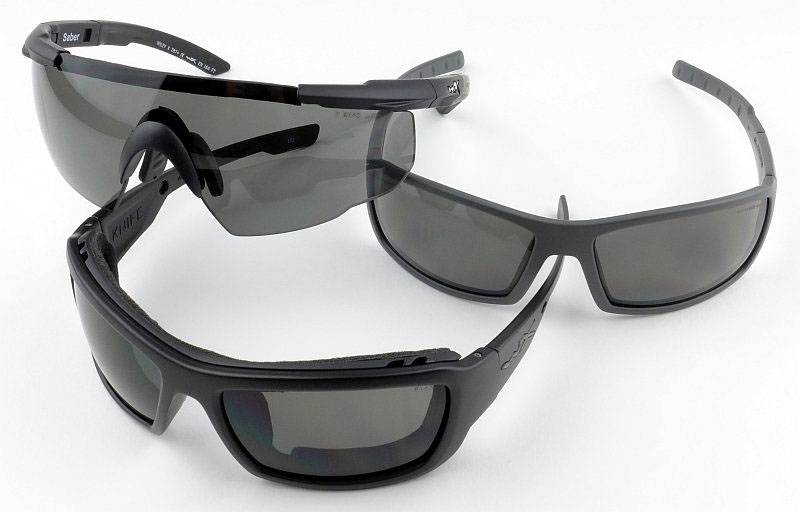
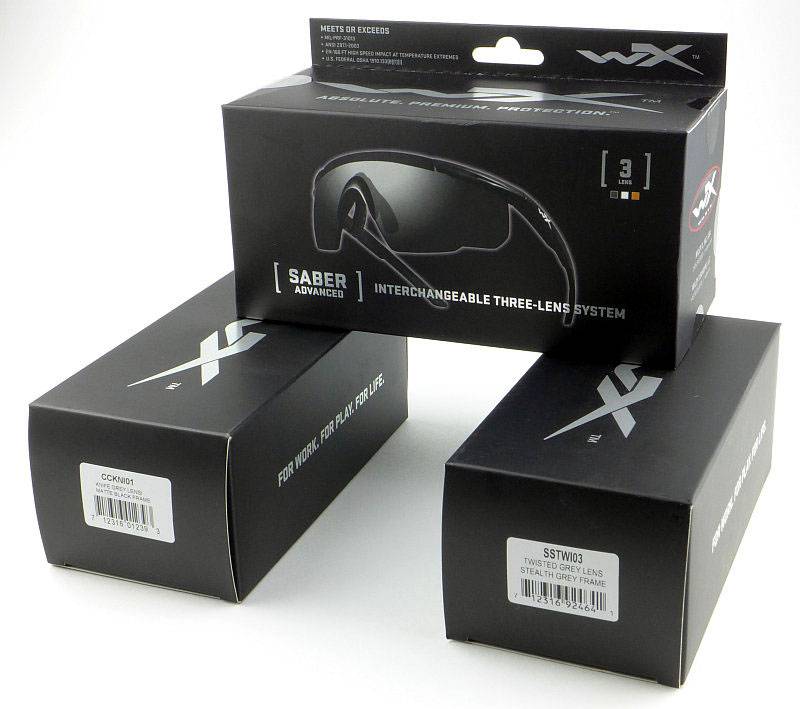
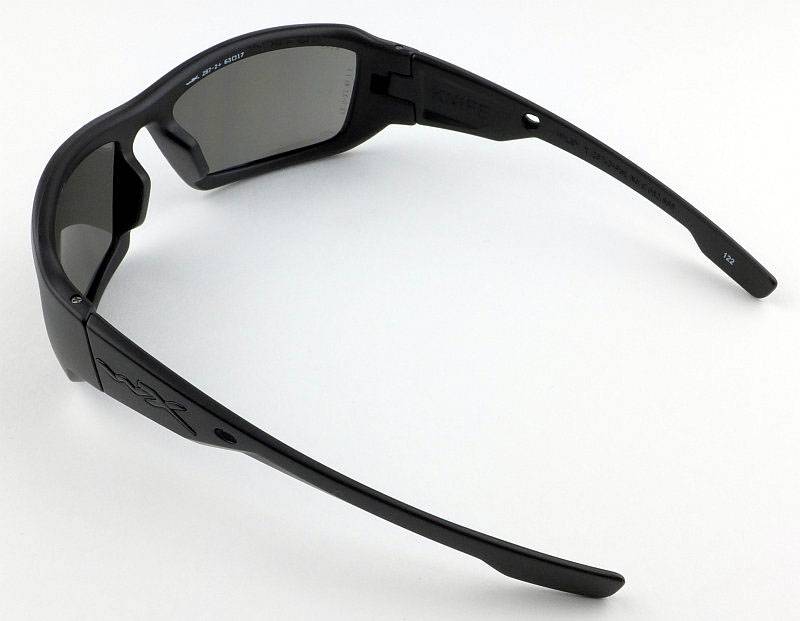
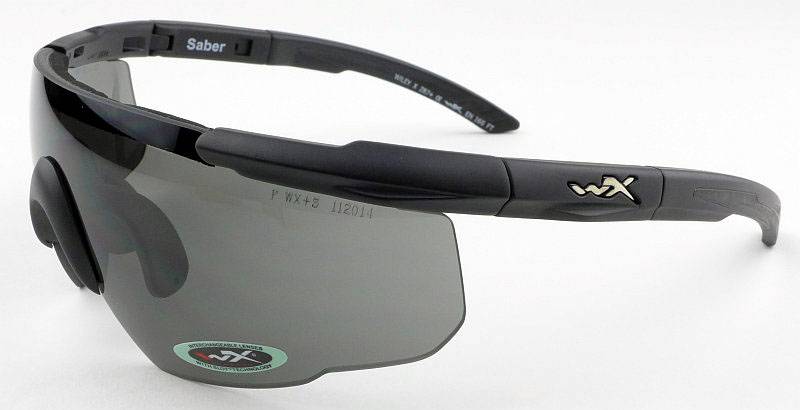
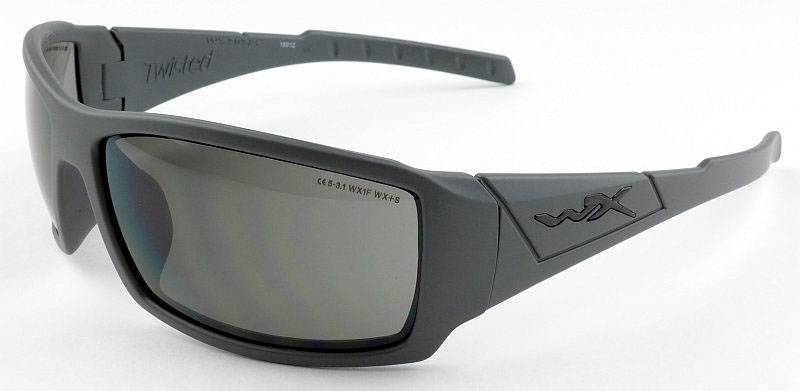
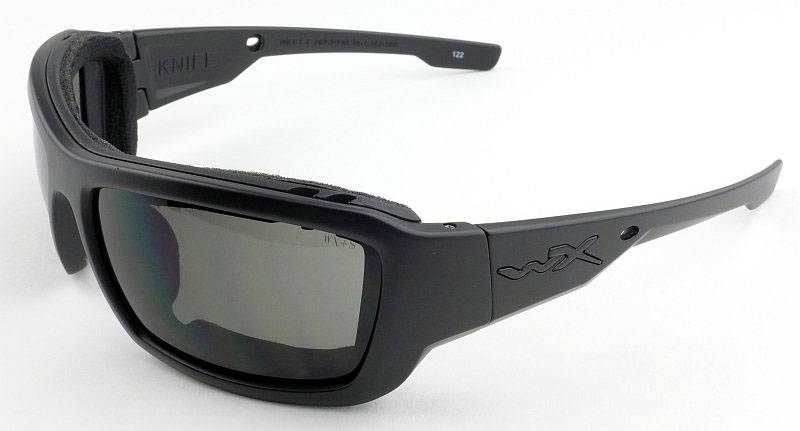
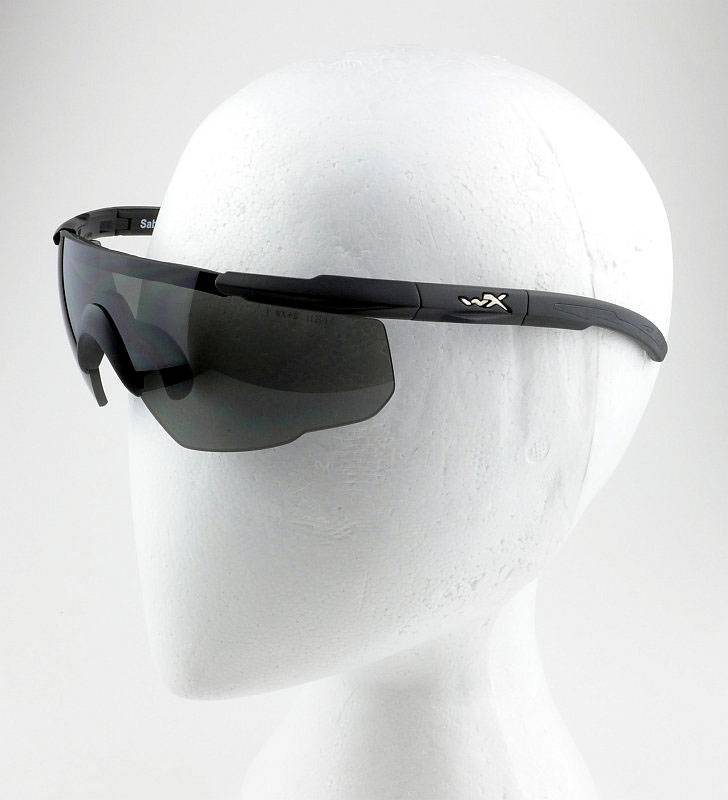
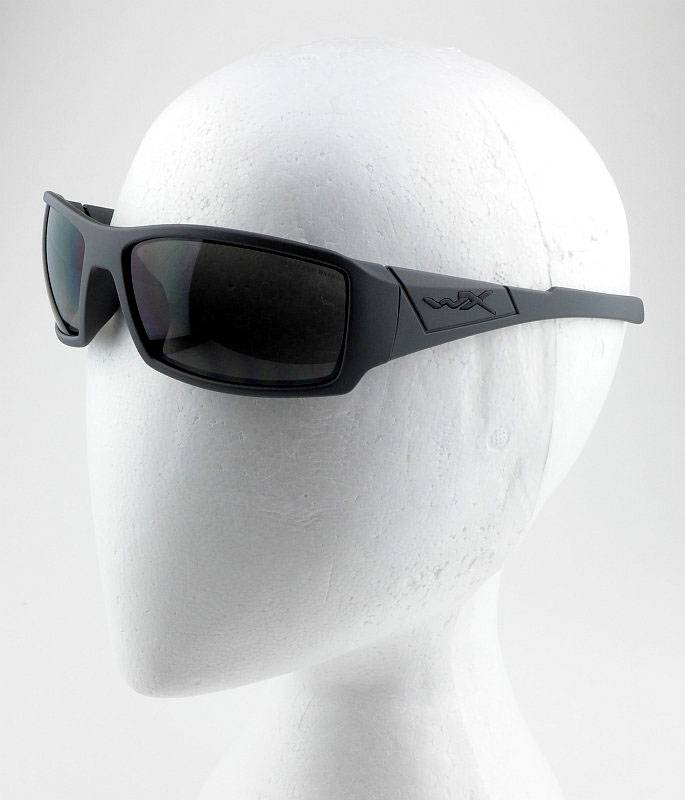
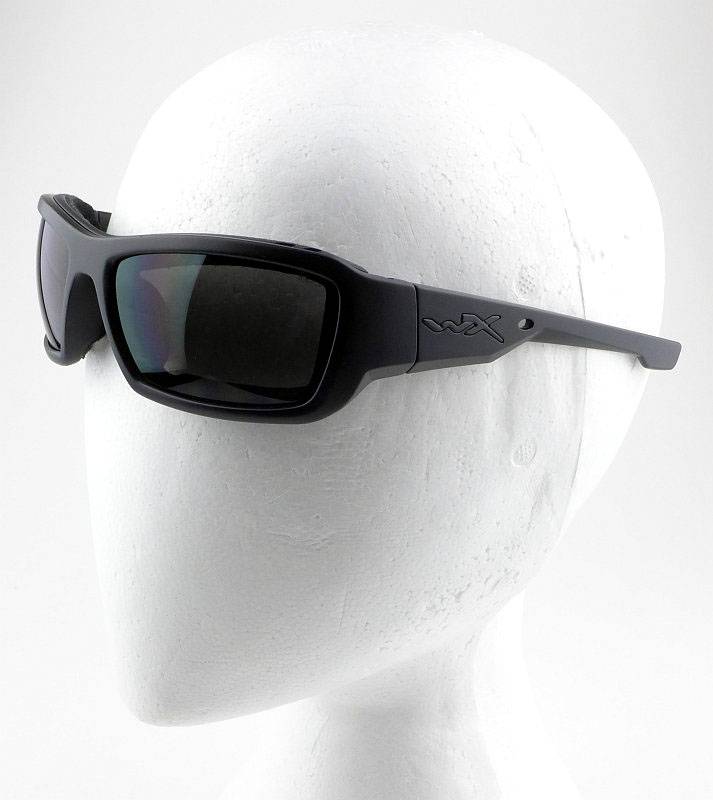
In this group review I’m looking at three very different pairs of glasses showing some of the key benefits Wiley X offer. On test we have the Sabre – wrap around ultra-protective shooting glasses, Twisted – the simplest glasses but in a special Stealth Grey frame, and Knife – using Wiley X’s Facial Cavity Seal making them as close fitting as goggles.
All three are in a non-polarized grey lens aimed at tactical use. For tactical use you want to avoid polarized lenses due to their tendency to cause issues with various device displays – it is just not worth the risk.
There is a lot to show as each of these models have features specific to Wiley X. Many of these features are repeated across the Wiley X range. The models in this MEGA review will help you understand what options you have.

Taking a more detailed look at the Saber:

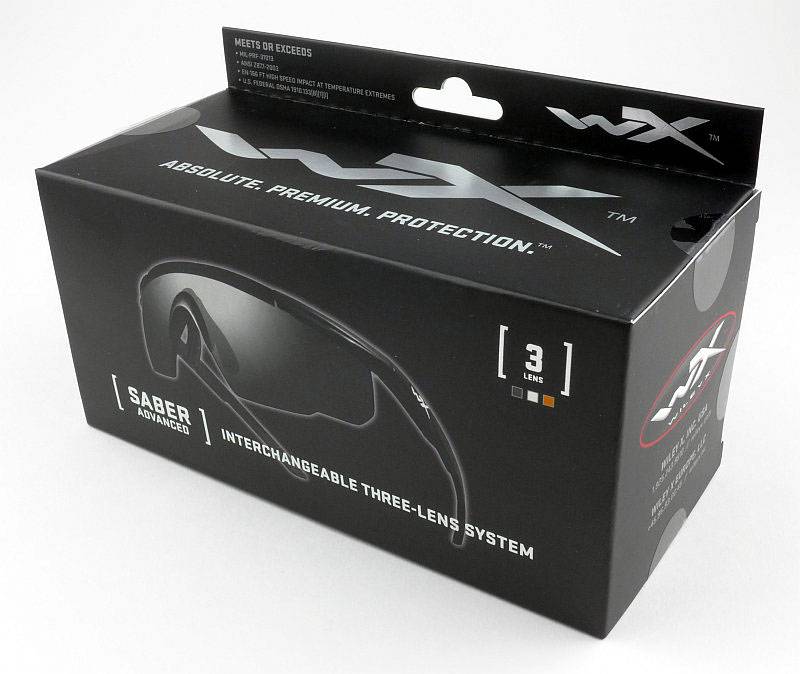
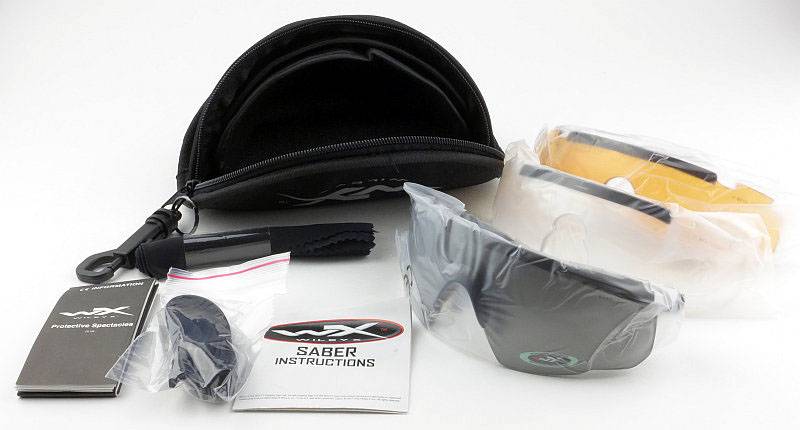
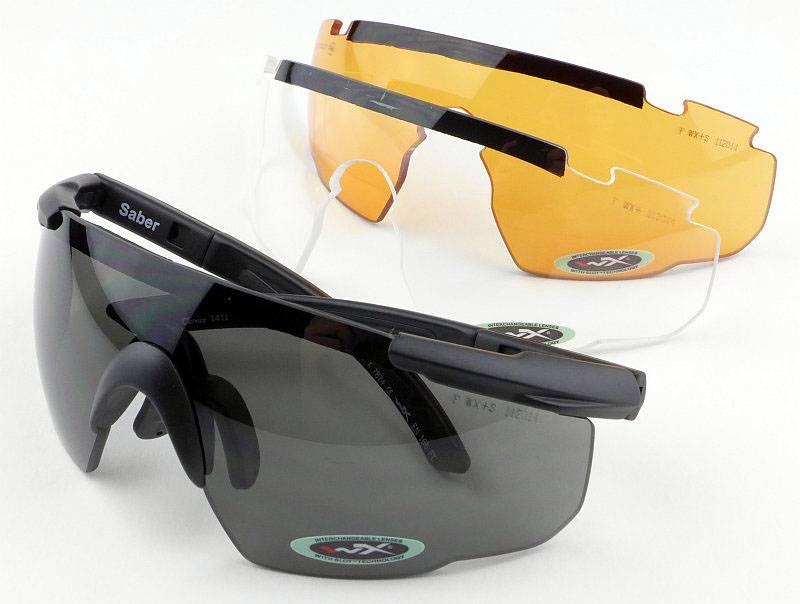
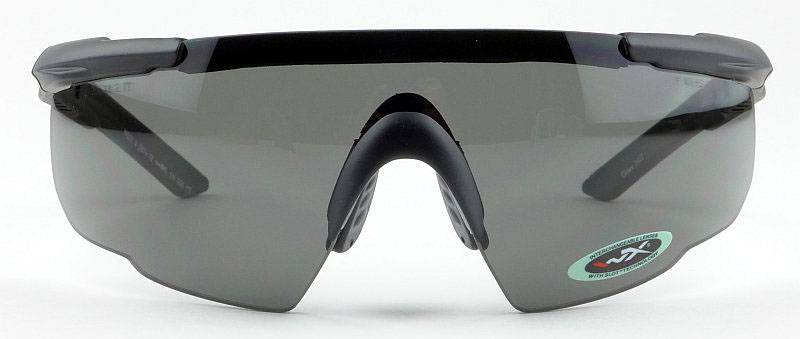
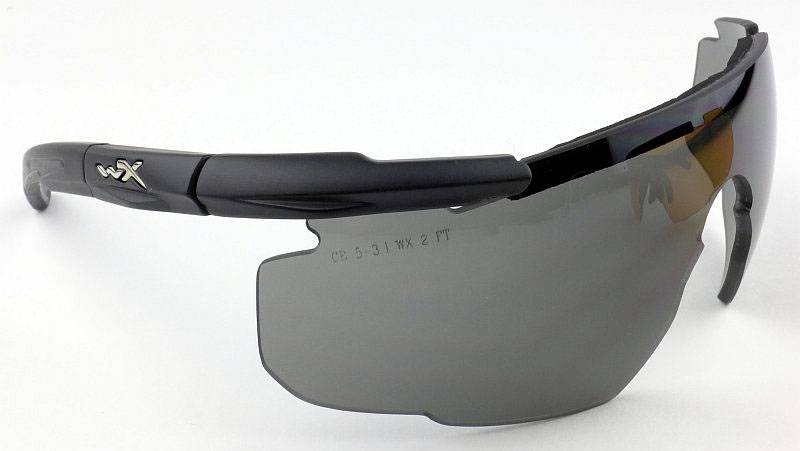
There are several options for the Saber, from individual lenses to a full set, and this is the full triple lens set.

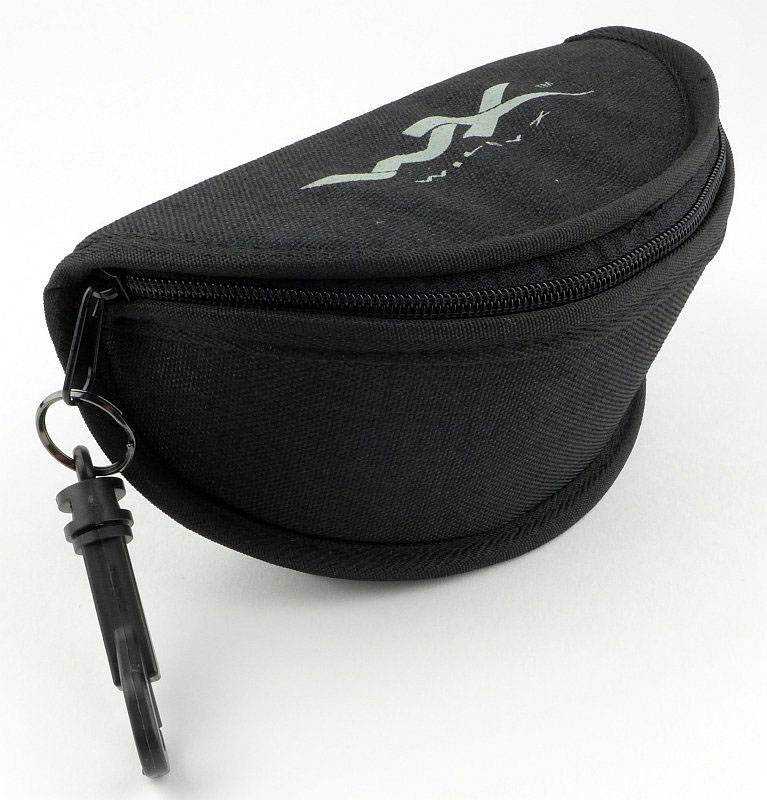
Everything is supplied in a Wiley X multi-lens case.

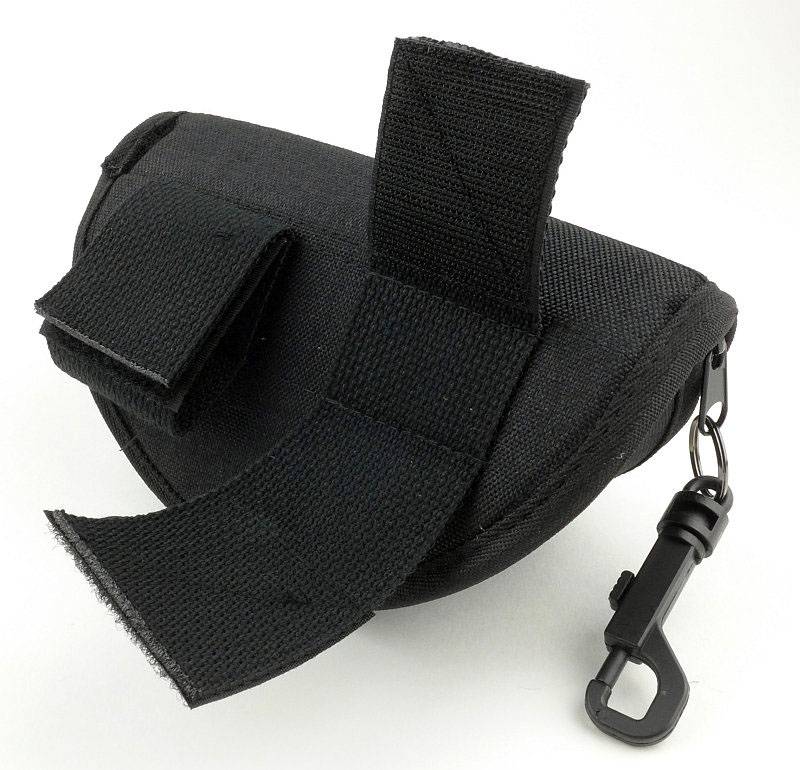
The case has two Velcro loops on the back for mounting to a belt/strap/etc.

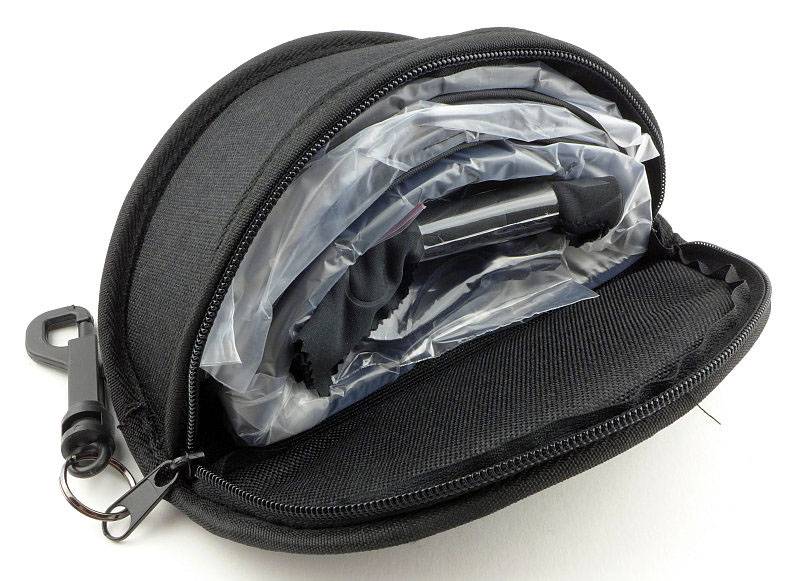
Each component arrives wrapped in a protective plastic bag so it is in perfect condition when you first unpack it. After that, well, it is up to you.

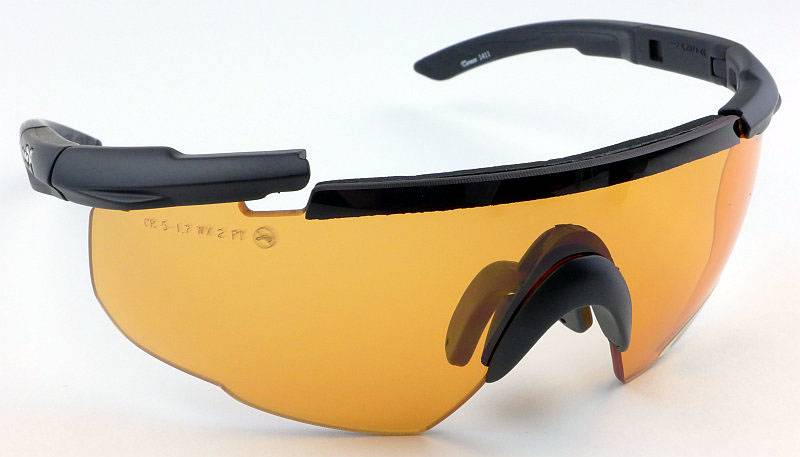
In the case is the Saber with grey lens, a clear lens, orange lens, strap, cleaning cloth and instructions.

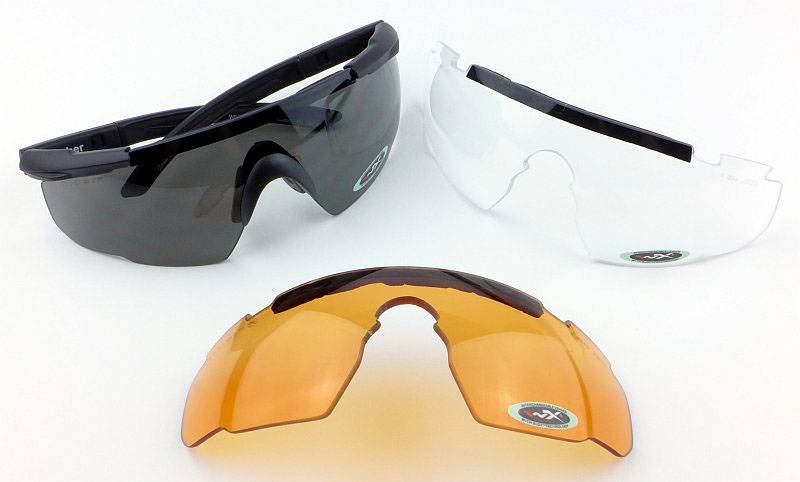
The set of lenses fresh out of its wrapping.

Each lens is a compound curve to fully wrap the eyes.

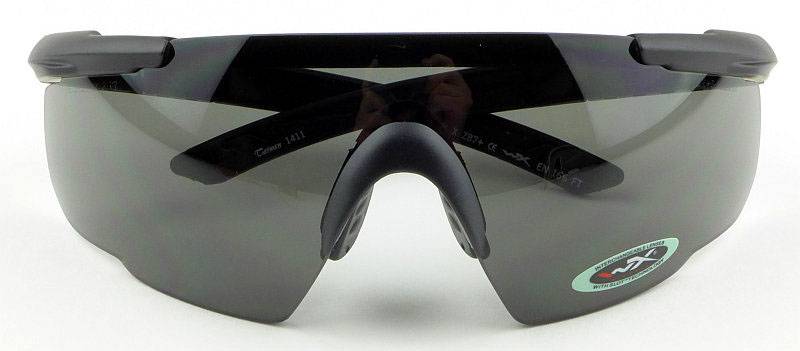
Taking a closer look round the Saber here it is from the front with arms folded.

And arms unfolded.

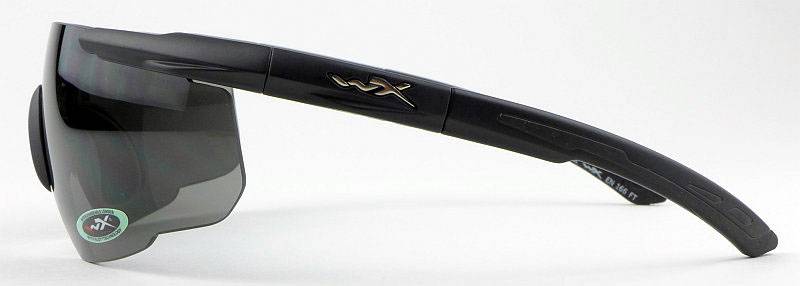
From the side.

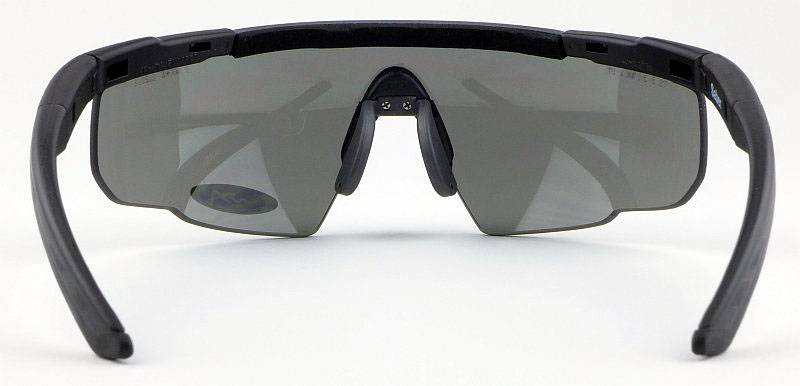
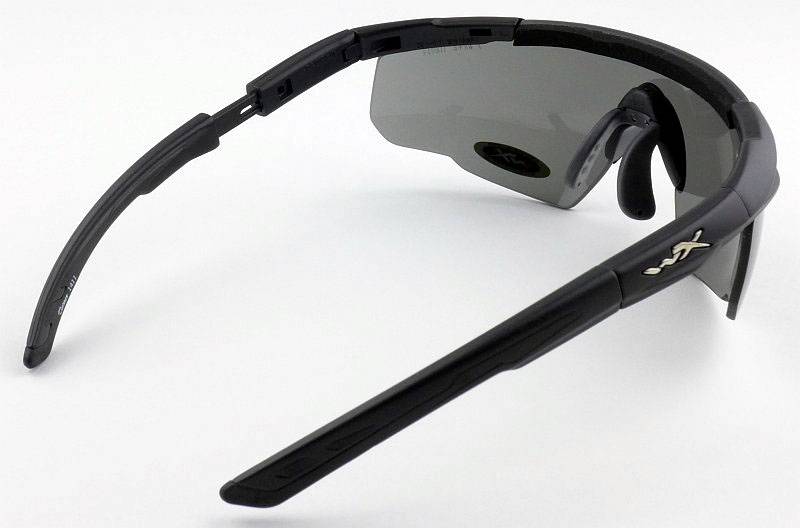
Then from the inside.

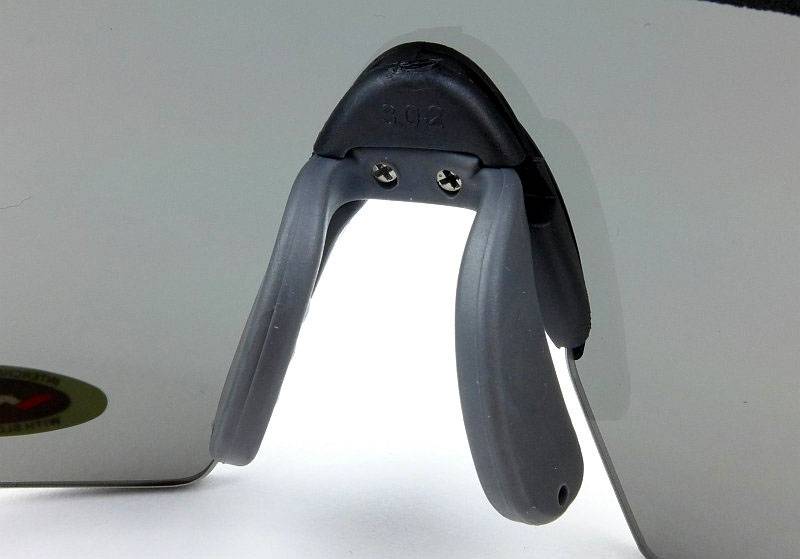
The nose piece has fully adjustable rubber covered pads. You simply bend them to fit.

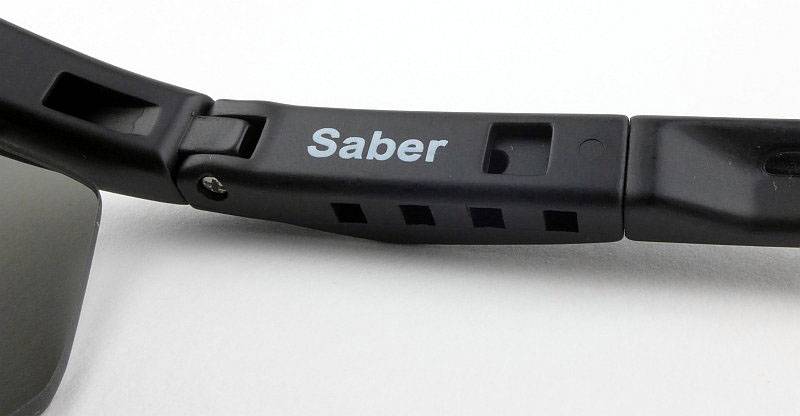
On the inside of the arm, the model name is printed on the ‘active’ section of the arm.

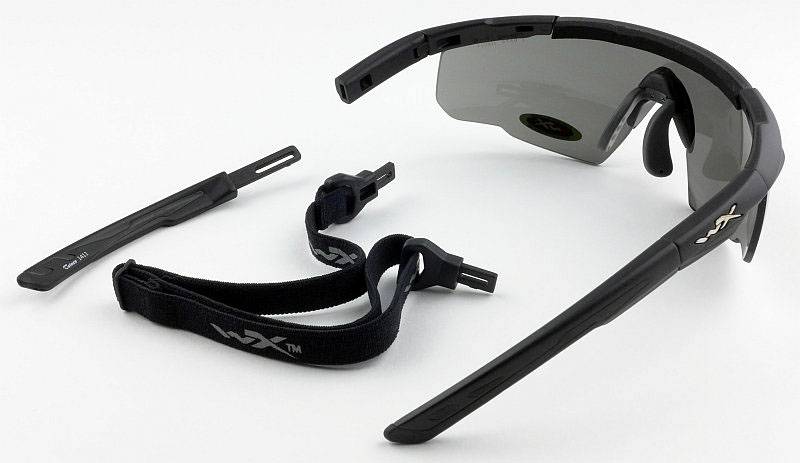
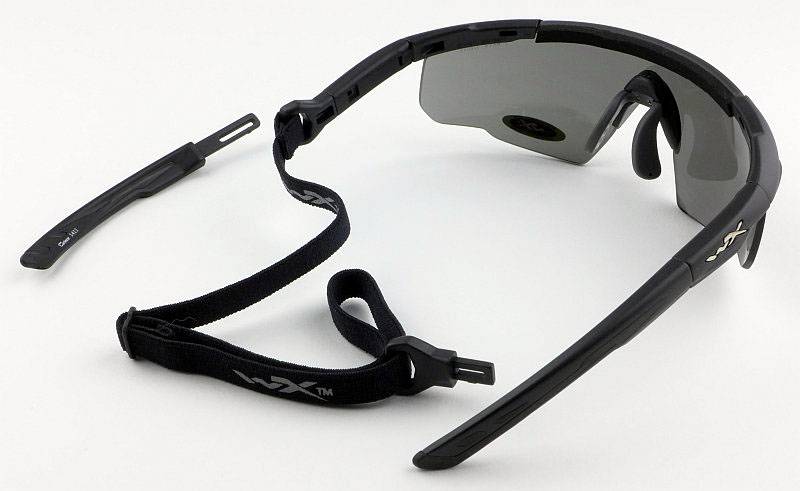
The first ‘active’ feature of the arm is that you can remove the rigid arm and replace it with a goggle style strap. First pull out the arm.

Plug in the first end of the strap.

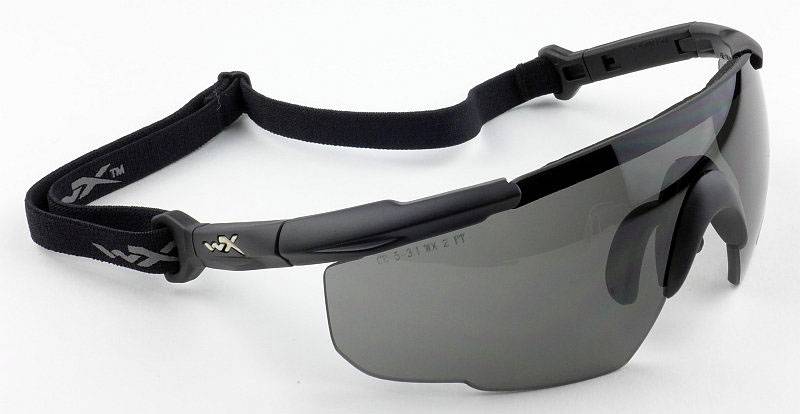
Repeat with the other arm and strap end.

Instead of just pulling the arm out entirely, each arm has length adjustment to enable the best possible fit for each person.

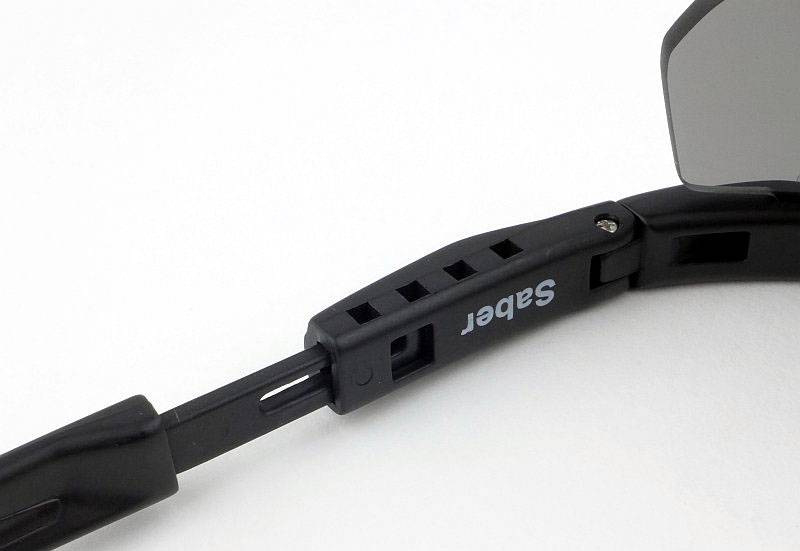
The arm has four ‘stops’.

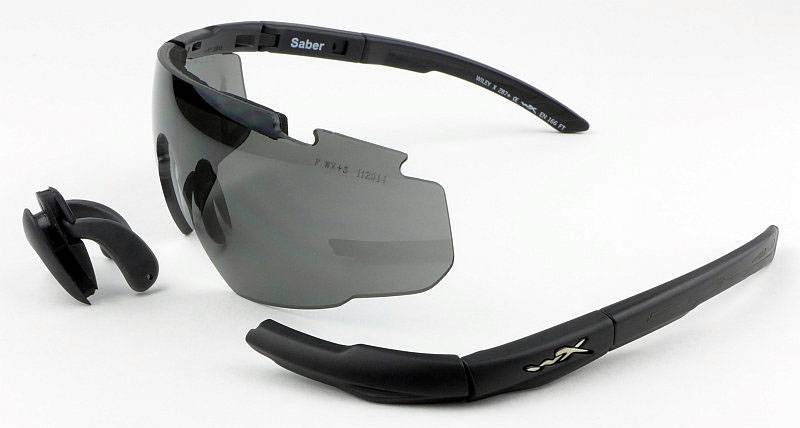
Being a frameless interchangeable lens system, you need to remove the arms and nose part and transfer these over to the lens you want to use. The fit of these parts is really quite firm.

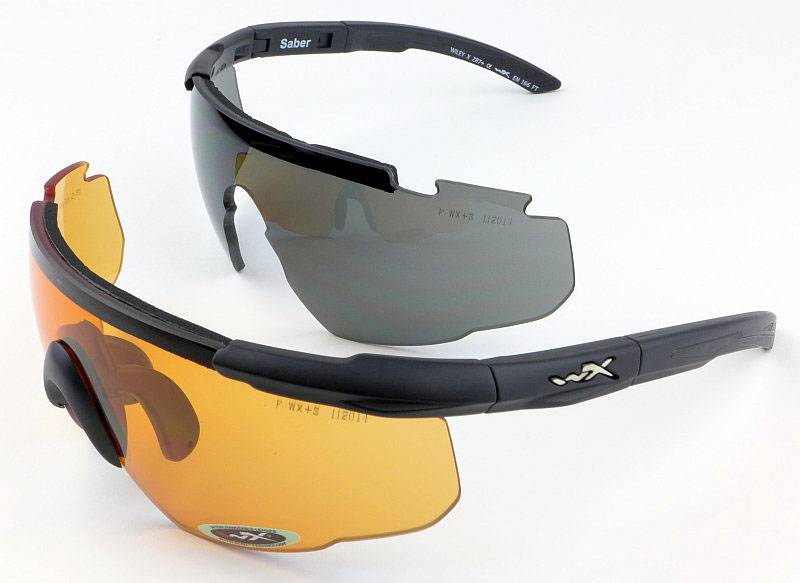
Here we are 2/3 transferred over to the orange lens, just the second arm to move.

I found the easiest process was to pull the arm outward and then lift the hinge upward ensuring you don’t try to lever with the whole arm, instead applying pressure as close to the lens as possible. The arm then pops up.

Fitting the arm was easiest doing this the other way round, first seating the hinge side of the mount, pressing the arm inwards and then pushing down on the mount.

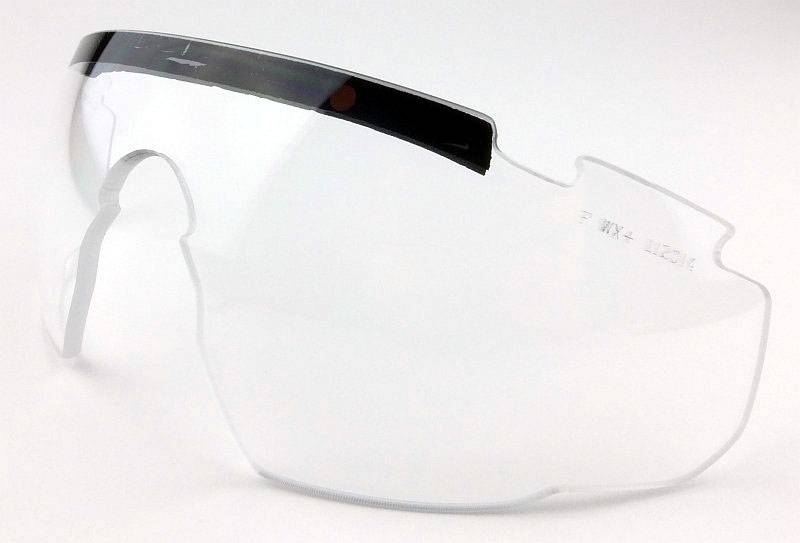
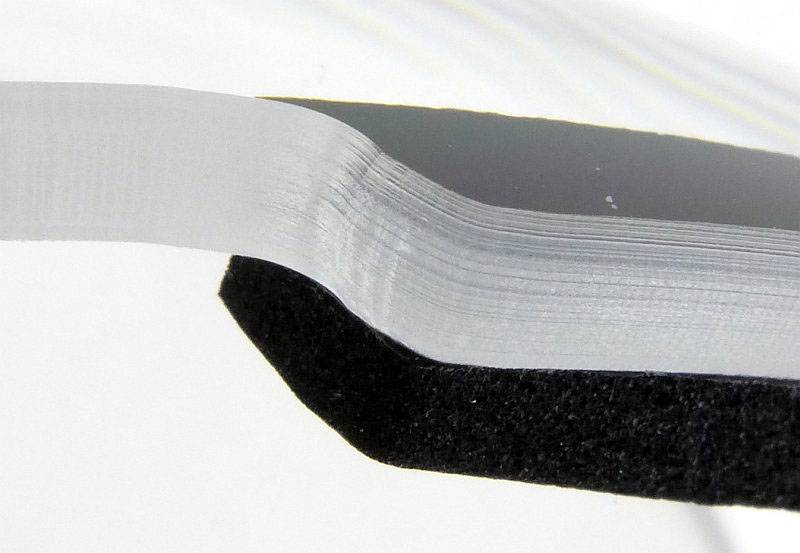
The clear lens almost disappears in the photo despite one of the Saber’s special features. The Sabre has the thickest lens, at 3mm thick, I’ve ever come across. This gives it probably the highest protection rating for any glasses of this type. With the bare lens you can see this thickness at the nose cut out.

Looking closer to where the brow foam padding is attached you can see the machining marks in the lens edge.

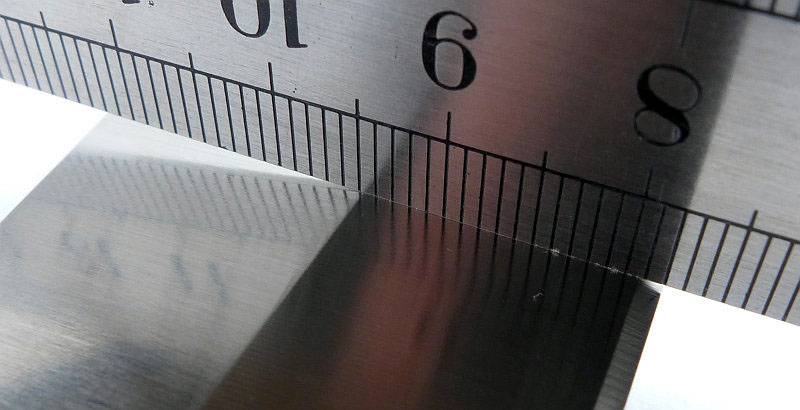
And next to a ruler with mm graduations.

Taking a more detailed look at the Twisted Stealth Grey:

The Twisted model originally came in a black frame, but with more demand for grey, Wiley X have released a special ‘Stealth Grey’ version.

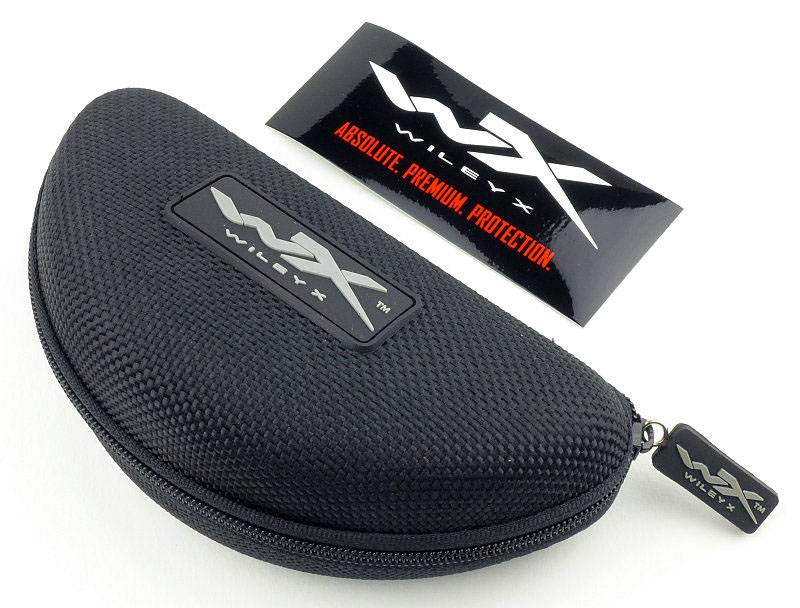
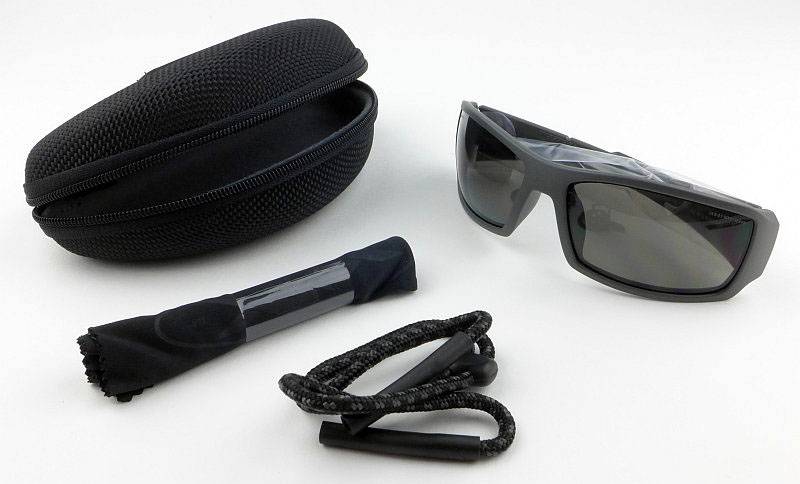
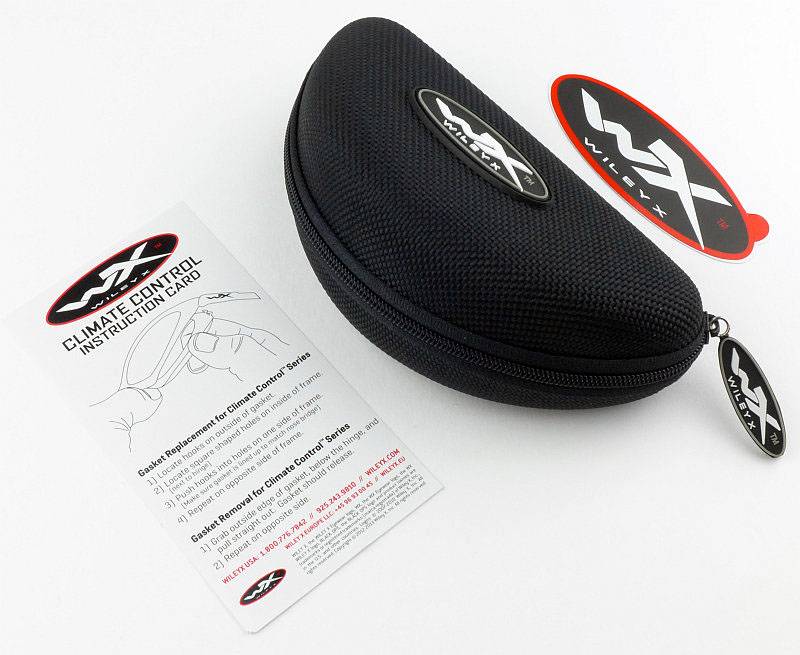
With no additional lenses to carry, the case for the Twisted is the Wiley X standard case. You also get a sticker in the box.

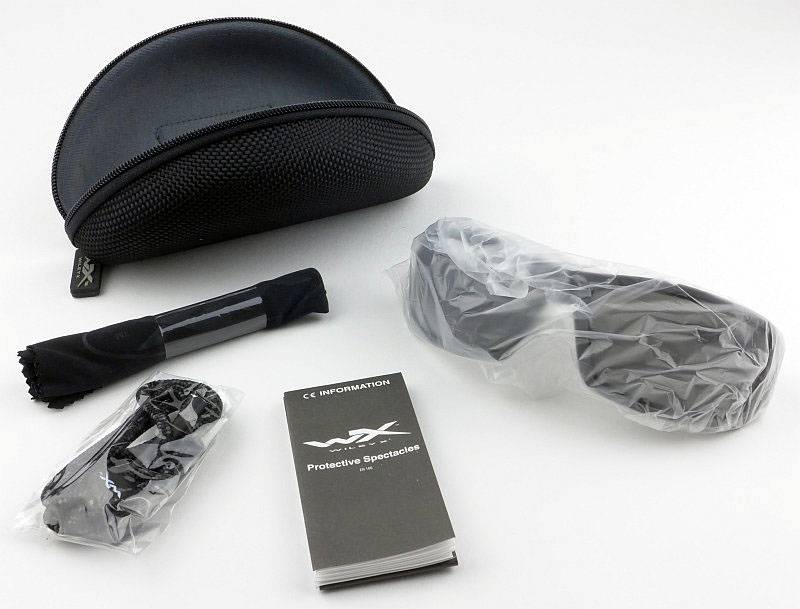
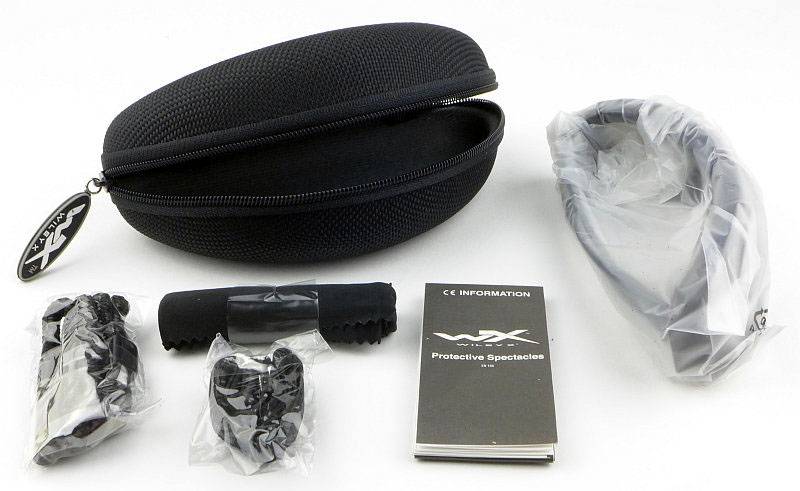
Inside the case are the plastic wrapped glasses, a cleaning cloth, information leaflet and a neck strap.

Getting rid of some of the plastic wrap for a better look.

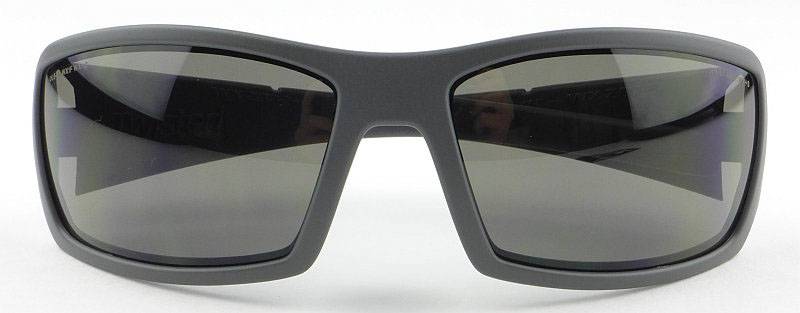
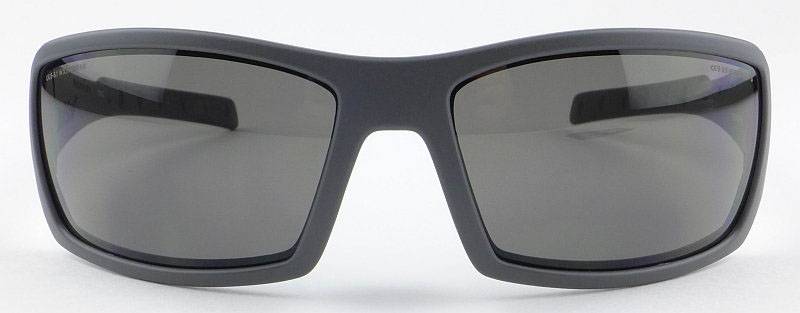
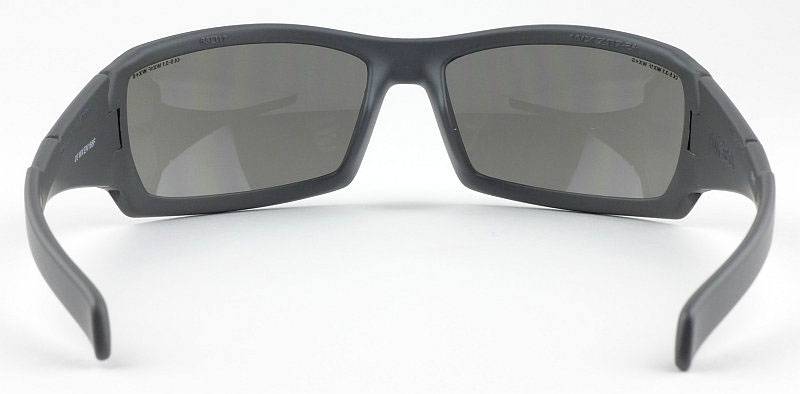
Taking a closer look round the Twisted here it is from the front with arms folded.

And arms unfolded.

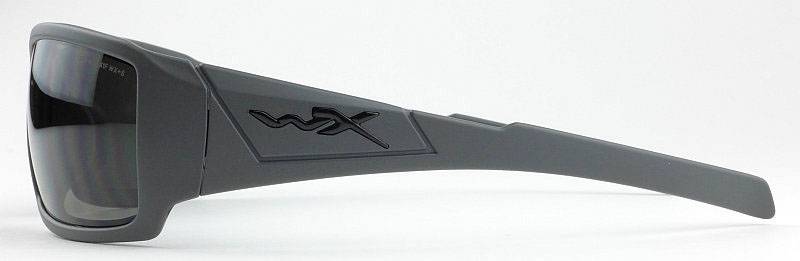
From the side.

Then from the inside.

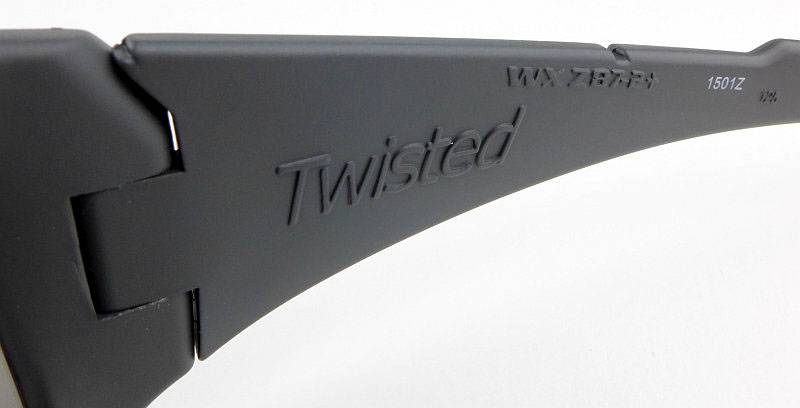
The arm is wide at the hinge which helps shade the wearer from light and debris coming from the side.

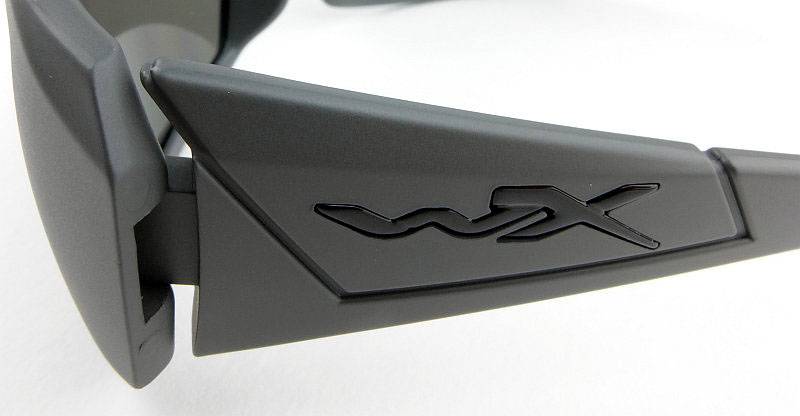
A detail of the hinge.

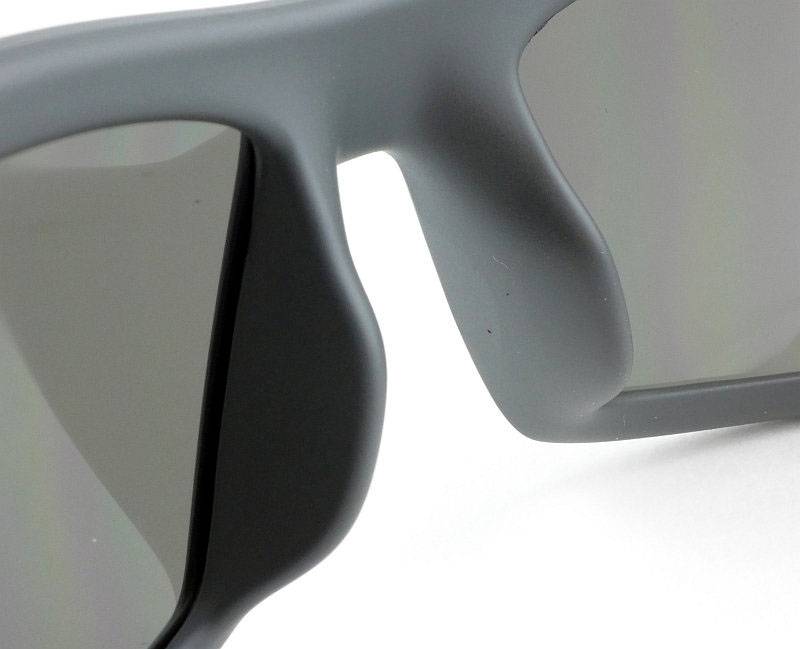
On the Twisted, the nose bridge is a fixed, moulded design. The surfaces are all rounded with no corners to dig in.

Taking a more detailed look at the Knife:

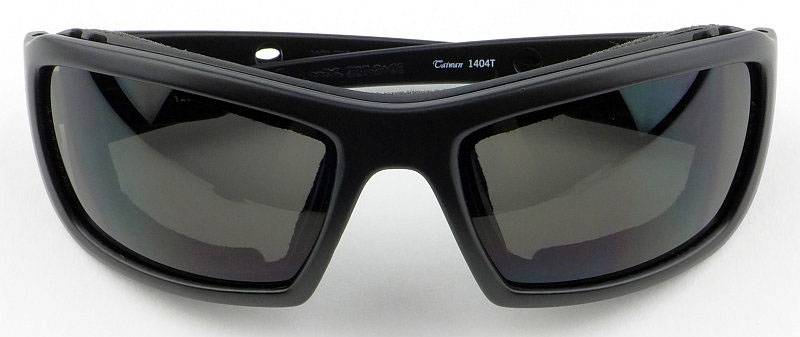
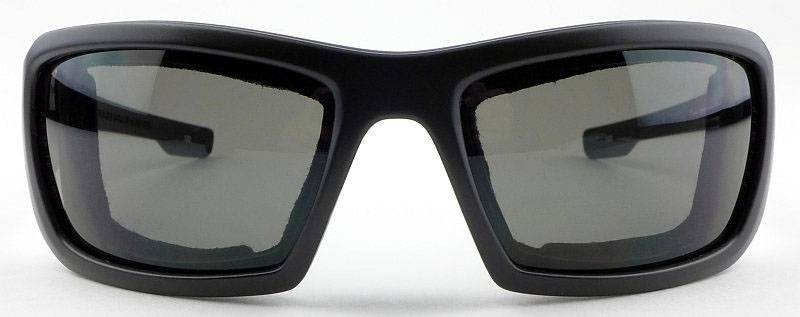
The last in this set is the Knife which features Wiley X’s facial cavity seal.

As well as the cased glasses and sticker, the Knife comes with an instruction leaflet for the facial cavity seal.

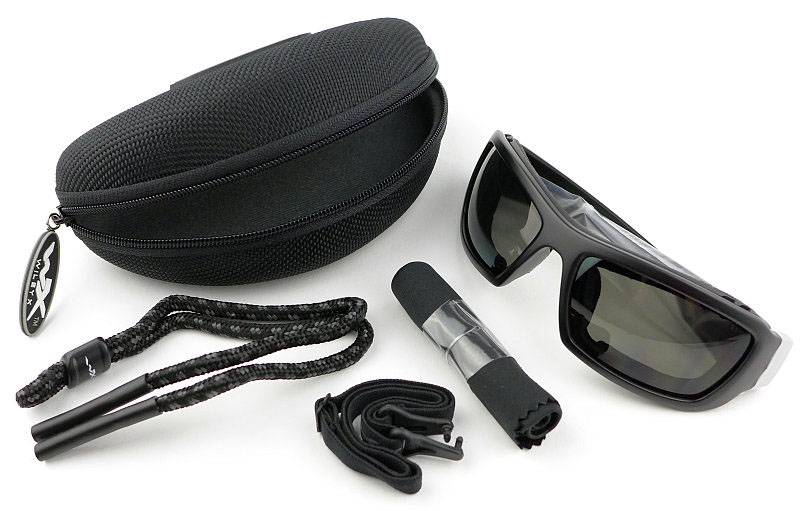
With the Knife you get a cleaning cloth, neck strap, and T-bar ‘goggle’ strap (more on that later).

Everything unwrapped.

Taking a closer look round the Knife here it is from the front with arms folded.

And arms unfolded.

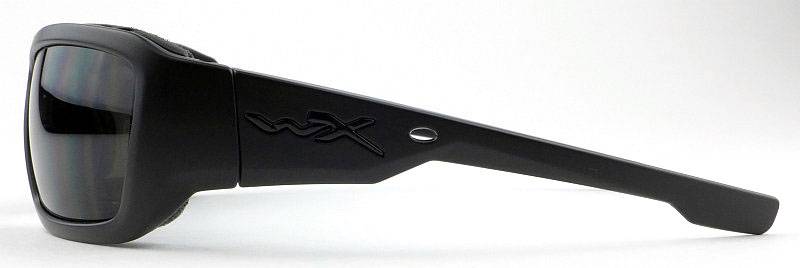
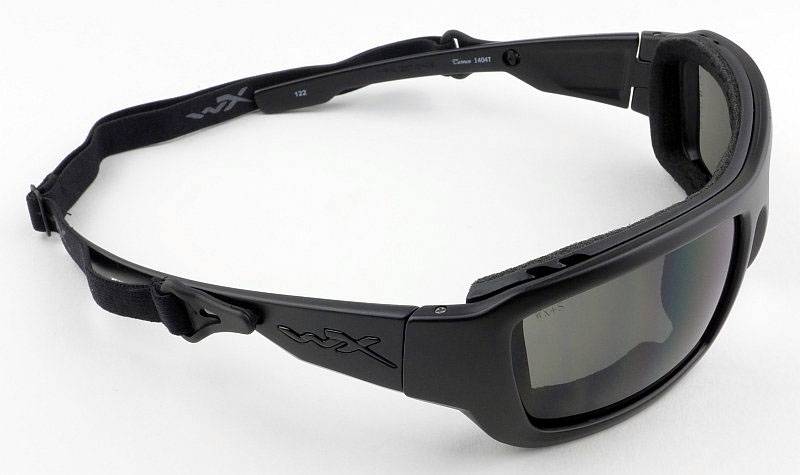
From the side.

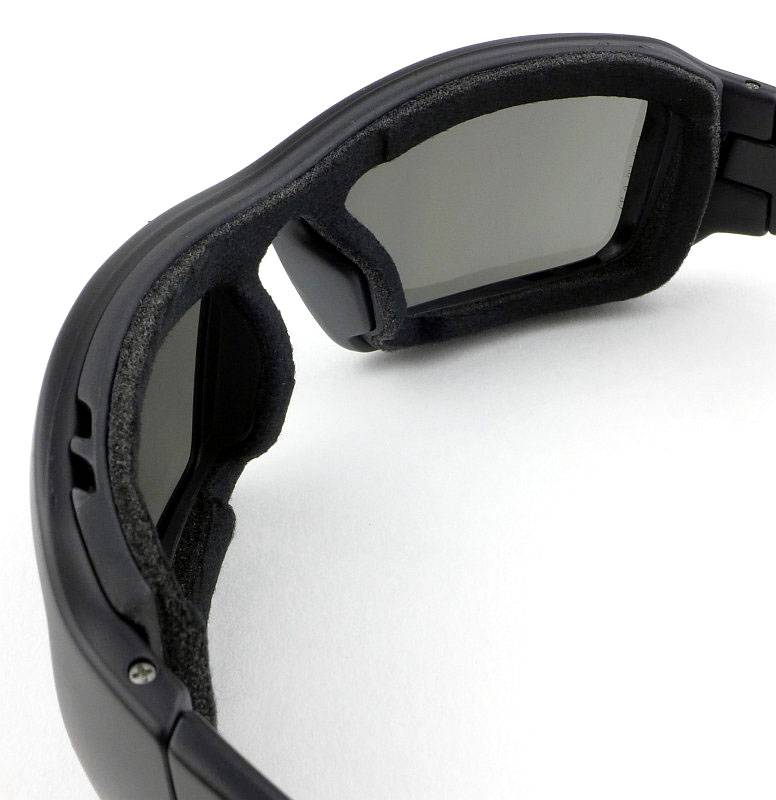
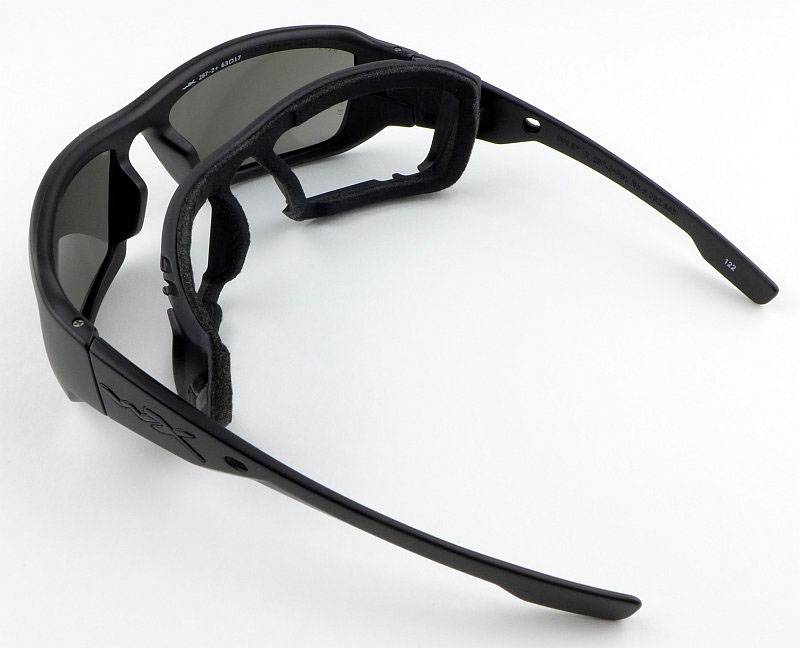
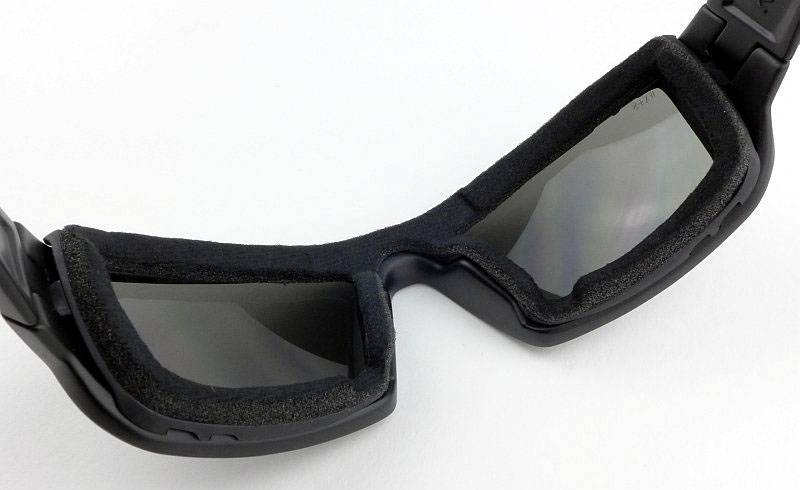
Then an inside view to show the facial cavity seal insert.

The Knife’s hinge.

Each arm has a mounting hole for the T-bar strap system. This is a strap to hold the glasses firmly onto the face. With the facial cavity seal, these glasses become almost goggles, so this system makes perfect sense as it keeps the seal good.

The T-bar strap fits in pointing downwards.

Then rotates back to lock in place. You can only release the strap by rotating the mount back down to the previous position.

Inside the arm you can see the T-bar in the locked position.

Here the knife has the goggle strap fully fitted.

It is possible to remove the facial cavity seal for cleaning or to use the glasses without the seal. There are times when the extra ventilation is needed.

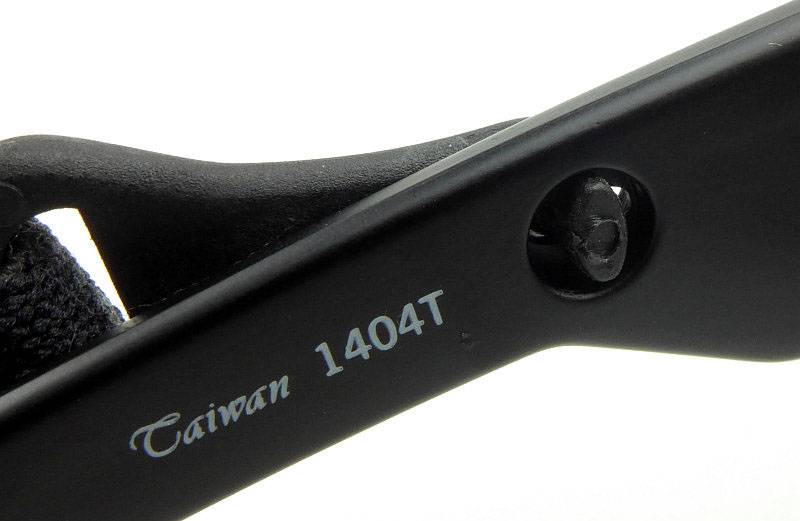
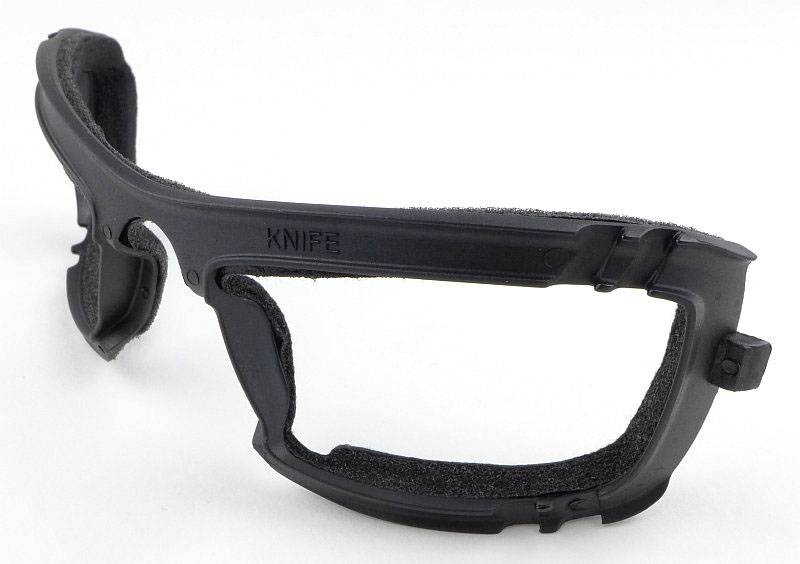
The seal is specific to the model and is labelled for the Knife.

Here is the Knife without the seal.

The facial cavity seal has a soft foam edge to fit closely to the face.

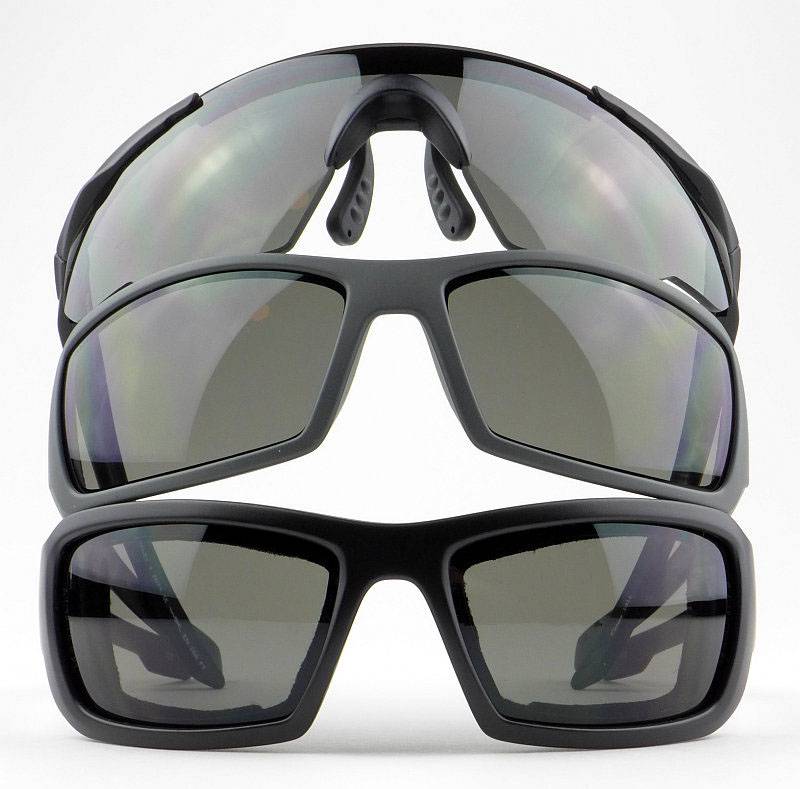
Comparing the three:

We’ve spent some time looking at each one in detail, now a first quick comparison series.

And now with each one on a display head:

Troubleshooting

This section is included to mention any minor niggles I come across during testing, in case the information helps anyone else.

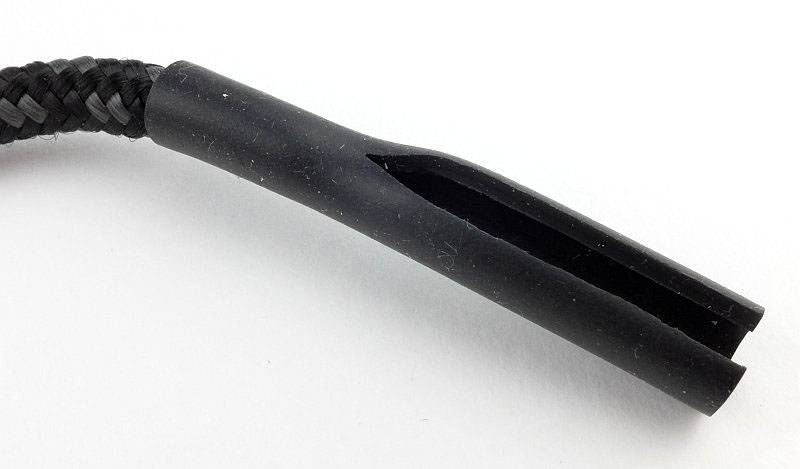
The standard neck straps that were supplied with the Twisted and Knife both failed with the rubber tubing splitting.
From the moment they were fitted there appeared to be stress lines in the rubber.

This line turned into a split.

Altogether I’ve had three of these straps, and all three have split.
As per the description of this section, this information is provided in case anyone else finds a similar ‘issue’ that might be fixed in the same way.

In use

Each of these Wiley X models was chosen to represent a different use or requirement, and provide an excellent representation of what Wiley X offer.
For the utmost in protection you need to choose a wrap-around lens as this does not reply on the frame, or how well individual lenses fit in the frame, for protection. You have a one-piece protector positioned over your eyes.
The Saber is exceptional in its lens thickness at 3mm and exceeds all the safety standards, military and civilian, for protective eyewear. It does this without any distortion to your vision. I am very sensitive to poor lens design and have used compound curvature lenses that distort the wearer’s view. The Saber has not caused any visual distortions or strange sensations at all.
The full wrap gives excellent all round vision well around your peripheral vision giving uninterrupted views, just like your uncovered eyes, but protected from bright conditions and flying objects. What this does mean is that you are not protected from glaring light such as low sun to your side which the arms of certain glasses would shade you from.
For use as shooting glasses or to guard against flying objects (not dust) the Saber will give you exceptional protection.
Adjustable arms allow the maximum comfort for most users. You also have a great deal of fit adjustment with the nose piece which can be bent to raise or lower the Saber and bring it closer or further from the face. Do not neglect this, you can get a fantastic fit and comfort by taking the time to adjust the nose piece, and don’t be afraid to experiment to find the optimum fit.

Of the three, the Twisted is the most conventional ‘fit’ with no actual adjustment. On this point, of course, unlike the Saber, the Twisted will not fit everyone, but Wiley X give you excellent size information for every model so you can look for those suitable for small, medium and large heads and also at the detailed specifications of lens width, arm length and bridge width to find your best fitting model.
The arms of the Twisted curve inwards to wrap around the head and provide a good level of grip to keep them in place. The entire frame flexes as you put them on, and acts like a spring to prevent sliding. Coupled with their light weight, this makes them some of the most securely fitting glasses I’ve used without creating hotspots and discomfort when wearing for extended periods.
With the lenses curving round, there is minimal frame visible in my peripheral vision, yet the wide arms protect from low-angle light coming in from the side. An excellent compromise, and one reason the Twisted has become my most worn of the three and great for driving as well as outdoor activities.
The Stealth Grey frame is also a bit different and it is good to have a break from the normal black.

Last up in this group is the Knife. Its key feature to look at is the FACIAL CAVITY SEAL which also appears on several other models, but provides a very specific function.
When you first put on a model with the FACIAL CAVITY SEAL they feel more like goggles than glasses and it can take a little while to get used to. However as you get used to it, the feeling becomes more comforting and the benefits can be very obvious.
The FACIAL CAVITY SEAL is designed to protect you from wind, fine dust and pollen as well as blocking light that normally leaks in around the edges of sunglasses.
I’ve found that in situations where I would want to wear a peaked hat, the FACIAL CAVITY SEAL provides sufficient protection from the light that would normally leak in around the frame that I didn’t need the hat.
Where the FACIAL CAVITY SEAL really shines is in wind and dust protection. Though normal sunglasses provide a degree of protection from wind, once it is coming from the side this is far less effective. Add in dust and your normal sunglasses are not much use. The FACIAL CAVITY SEAL immediately shields you from this and stops the blinking and squinting. You could use actual goggles, but Wiley X’s FACIAL CAVITY SEAL gives you the protection of goggles in a pair of sunglasses.
You also have the option of removing the seal and using the sunglasses as normal sunglasses. This is crucial as they do also come with some of the issues of goggles.
Although the FACIAL CAVITY SEAL has some venting built in, yes, just like goggles you do get fogging. I found that this was particularly bad when driving (due to the lack of airflow), and other situations where I was hot and there was little or no airflow.
When it is windy, the small vents seem to cope with preventing fogging very well, but once conditions are calm, you are at the mercy of the temperature of the sunglasses and your immediate humidity (a nice way of describing the body’s output of moisture).
Knowing that when using the FACIAL CAVITY SEAL you can get fogging is just something you need to work with. When the situation demands the extra protection, the Knife delivers exactly that.
Remember though, that unlike goggles, you can remove the seal and they become normal sunglasses.
Due to hyper sensitivity to light, I wear sunglasses 100% of the time during daylight hours when I’m outside, so get a lot of wearing time. I would never consider having only one pair of sunglasses and have many different types and styles. Just as most people have many shoes and jackets to suit different situations, I consider sunglasses the same in that you benefit from a choice of different features. (I’m also a lens quality perfectionist)

The reason for explaining that is that now I’ve experienced it, Wiley X’s FACIAL CAVITY SEAL has become an essential part of my eyewear options.

Sunglasses are not just sunglasses and are not just eye protection. These three different models give three very different experiences and features while ensuring your eyes are protected to standards above and beyond most requirements

Review Summary

_______________________________________________ _______________________________________________
Things I like What doesn’t work so well for me
_______________________________________________ _______________________________________________
Saber – 3mm thick super tough wrap-around lens
Saber – interchangeable lenses
Saber – adjustable nose bridge and arms
Twisted – Lightweight, comfortable and secure Twisted – supplied neck strap failed
Twisted – Stealth Grey frame option
Knife – FACIAL CAVITY SEAL technology Knife – fogging in still conditions
Knife – T-bar retention system Knife – supplied neck strap failed

Return from a Fantastic IWA 2016

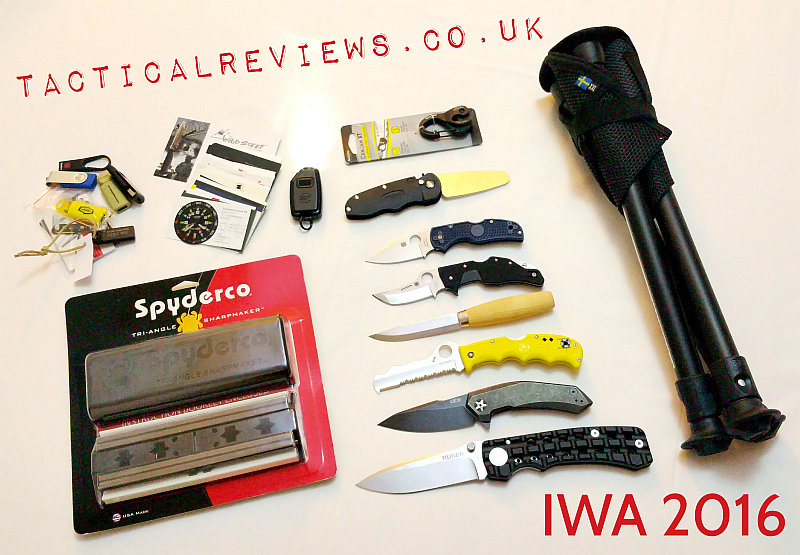
IWA 2016 has been fantastic and there is just not enough time to do everything, even attending all-day, every-day of the show. IWA 2016 has been a great opportunity to put names to faces, meet new people, see new products and get together with like minded people.

I’m looking forward to getting my teeth into the IWA inspired reviews and sharing the results.

Here are the first few review candidates which came back from the show with me. (please excuse the hotel bedroom photo) With samples from Spyderco, CRKT/Ruger, Morakniv, Zero Tolerance, Fällkniven, Surefire, Nite Ize and Walkstool. There will be more, so make sure to follow me on Facebook, Instagram and Twitter for all the latest exclusive updates.

IWA first reviews

IWA-OutdoorClassics-2016-banner800
 

IWA 2016 approaches!

IWA-OutdoorClassics-2016-banner800

It is now just one week to go until IWA 2016 opens its doors to showcase the best in hunting guns, shooting sports, outdoor equipment and equipment for official agencies, especially for civilian and official self-defense.

I will be there to bring you as many Tactical Reviews as I can.


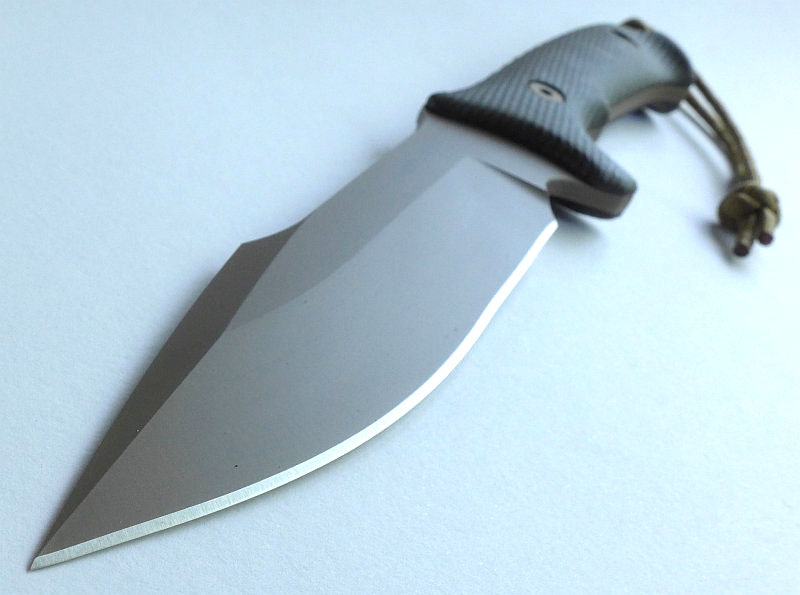
Knife Review: Spartan Blades’ Harsey Model II (6.125″ blade – S35VN)

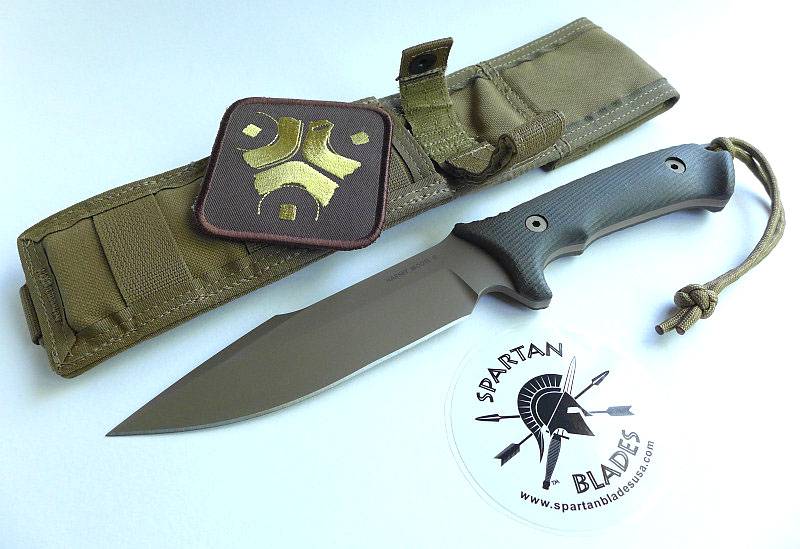
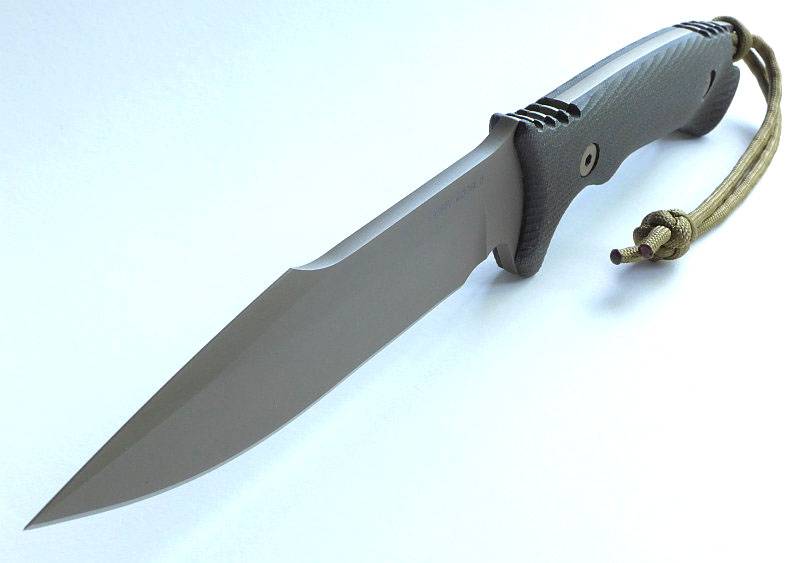
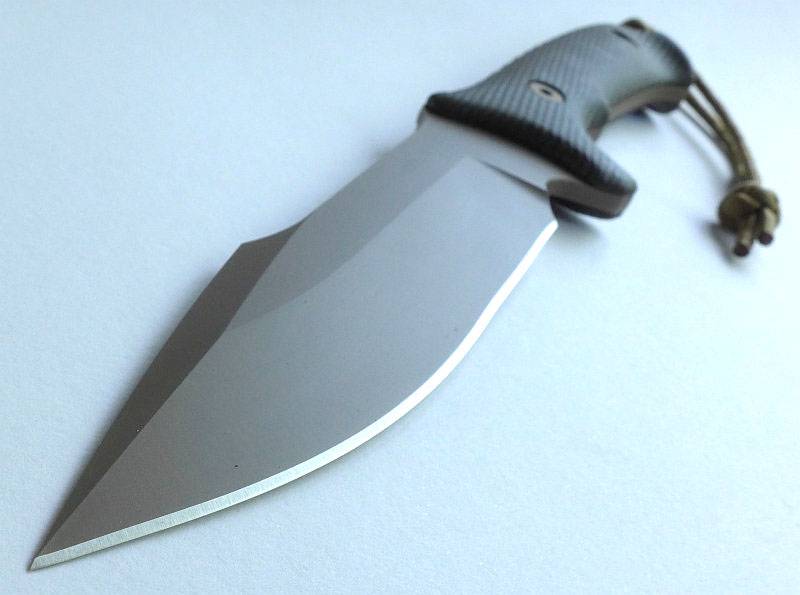
The SPARTAN HARSEY MODEL II is Spartan Blades’ third collaboration with world renowned knife maker, William “Bill” Harsey Jr. The Harsey Model II was designed to be sturdy knife that would serve equally well as both a field and combat knife. The ergonomic and textured canvas micarta handle is specifically intended to provide comfort and confidence of grip.
The Blade and Handle Geometry:

Most knives specifications have a basic description of the blade geometry, but in this section I will be taking a more detailed look at geometry and balance.
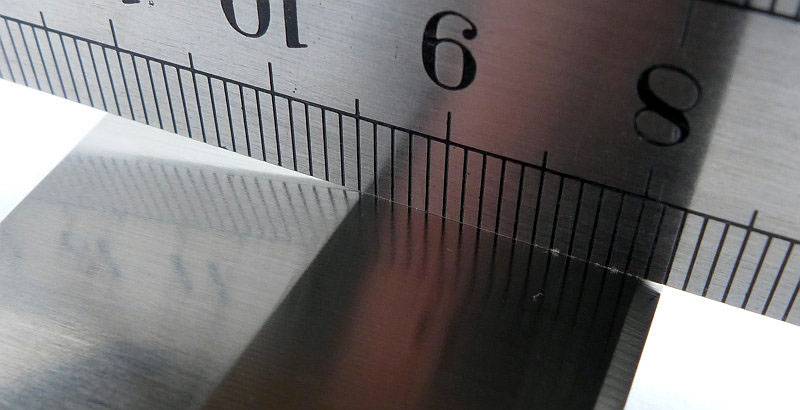
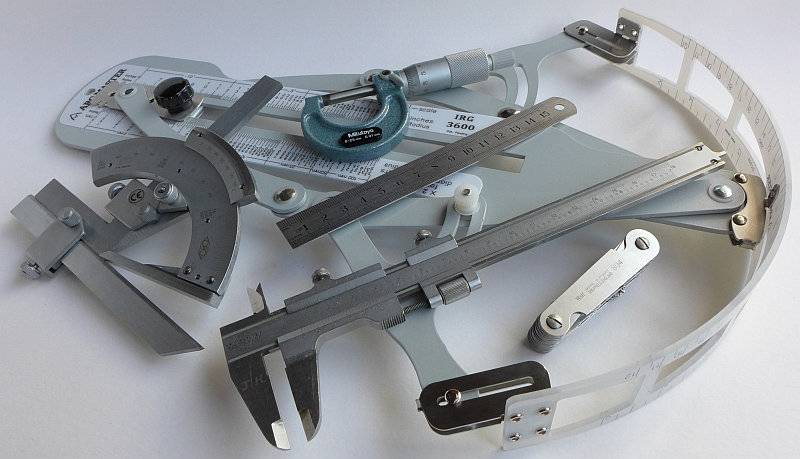
Using a set of gauges and precision measuring equipment including a Vernier protractor, callipers, fixed radius gauges and the unique Arc Master adjustable radius gauge (the one that looks like a crossbow).
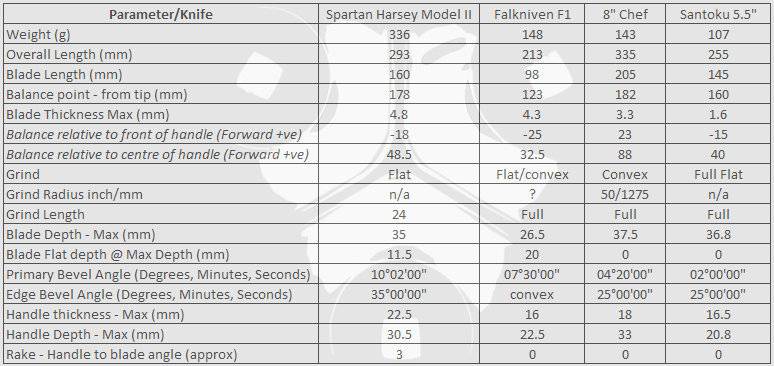
These measurements have been tabulated and are presented along with a few reference blades (8″ Chef’s Knife, 5.5″ Santoku and the popular Fallkniven F1).

Key aspects such as the primary bevel angle, grind type, blade depth, blade thickness, length, weight are detailed, along with balance information.

The ‘Balance relative to the front of the handle’ tells you if the knife will feel front heavy, or if the weight is in your hand (a positive value means the weight is forward of the front of the handle). The ‘Balance relative to the centre of the handle’ indicates how close to a ‘neutral balance’ the knife has in the hand.

In the case of full convex grinds the approximate centre of the grind is used for the primary bevel angle estimate..

The blade is made from S35VN.
Explained by the Maker:
The reasons for certain design choices may not be clear when simply looking at an object, so this section is intended to give an insight into the thinking behind a design by speaking to the designer themselves.

Many thanks go to Bill Harsey (knife designer) and Mark Carey (co-owner of Spartan Blades) for taking the time to explain the details of the knife and sheath design to me.
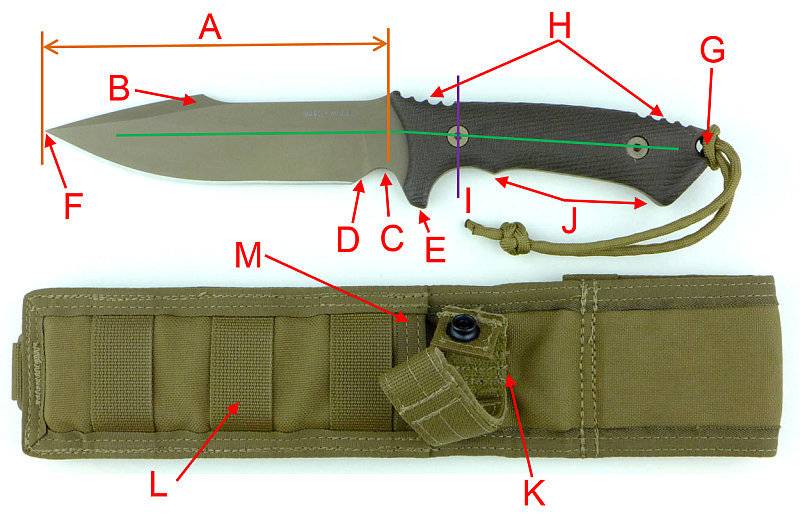
Though not quoting Bill and Mark directly, the following is an explanation of how the final design was arrived at.

Bill spoke with Spartan about the intended use before he started the prototype process. Having already done the Model 1 limited edition, Spartan Blades told Bill they would like to use handle shape but make it a bit smaller (so it would be more usable for more people). It was decided to shrink handle by 5% and change blade length.

In this case the blade length (A) was chosen to fill a specific gap in the Spartan product line.

A harpoon point (B) was used to reinforce the point, with the additional blade width used to make point stronger without making it thicker. The unsharpened edge of the harpoon point could be sharpened if required.
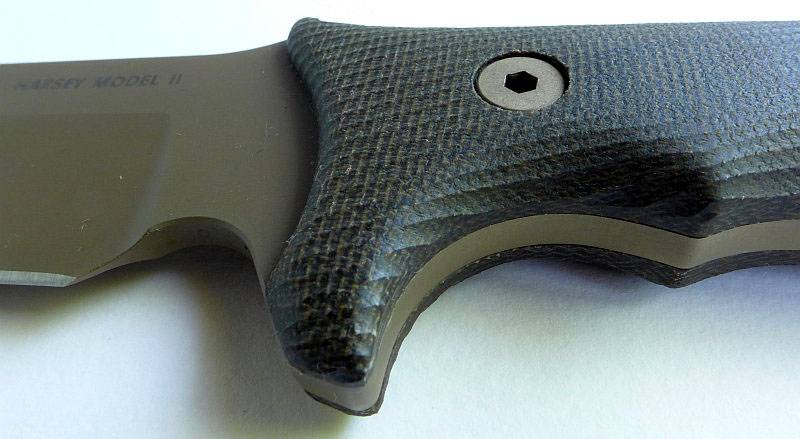
Looking at the area just in front of the guard (C) it might appear to be a finger choil, however, Bill emphasised that this is not a finger choil. Instead it is a relief between the end of edge and front of handle. “Don’t put your finger in it.”
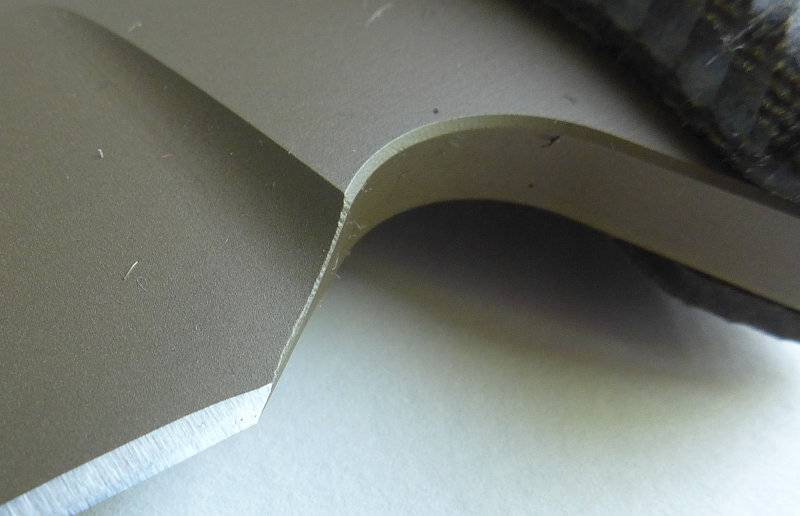
The cutting edge has been pushed away from the plunge line (D), extending the choil. Though this slightly reduces the length of the cutting edge, the knife has the edge where Bill intended it to be on this model. This also takes the end of cutting edge away from the radiused plunge line.
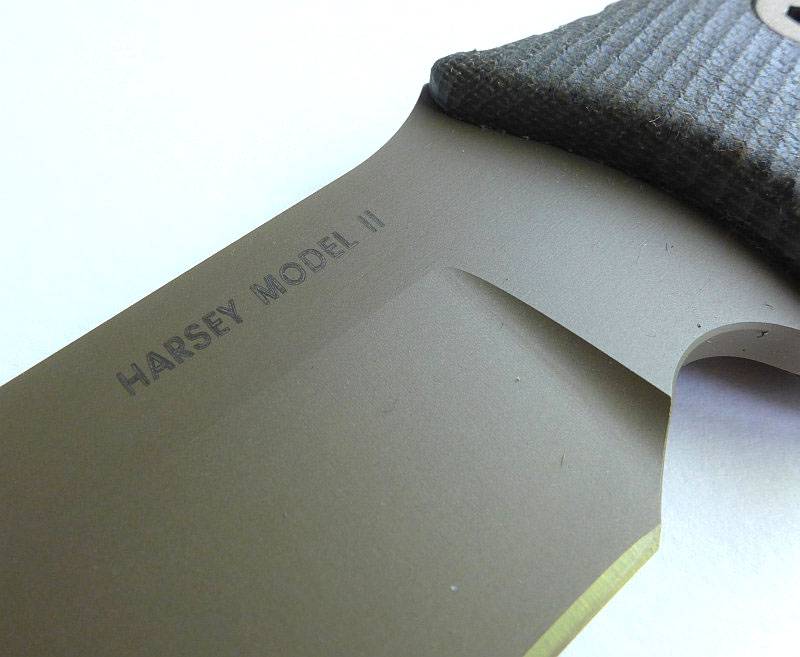
Bill made the guard (E) protrude enough to be useful without getting in the way. (Based on over 30 years of experience rather than any specific guidelines)
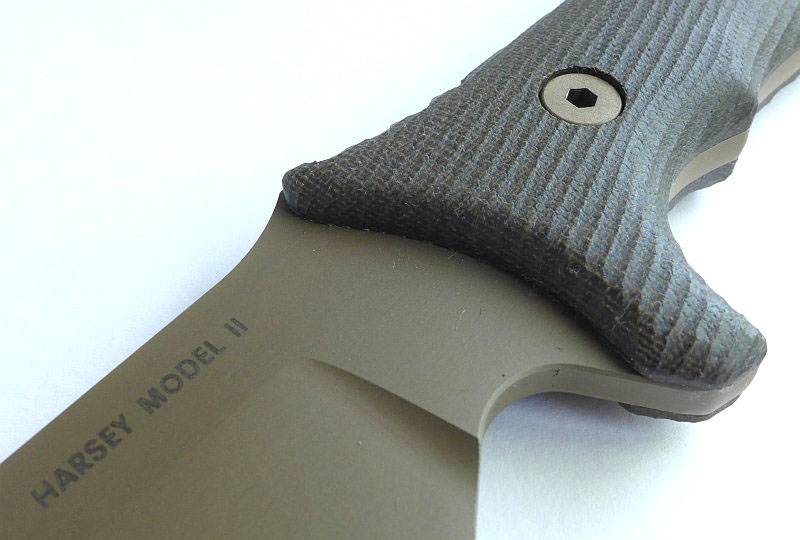
As with many of the knife’s ergonomic features, the slight negative rake (F) was chosen by Bill “because it felt right”.

Discussing the single lanyard hole in the butt of the knife (G) and the subject of lanyard use and safety, Bill indicated that this feature is especially useful when working over water, and that ultimately it is the individual owner’s decision of exactly how to use the lanyard when there is a safety aspect to consider (Author’s note – when chopping, use of a lanyard can be dangerous). What was expressly ruled out was the possibility of adding a lanyard hole in the guard.
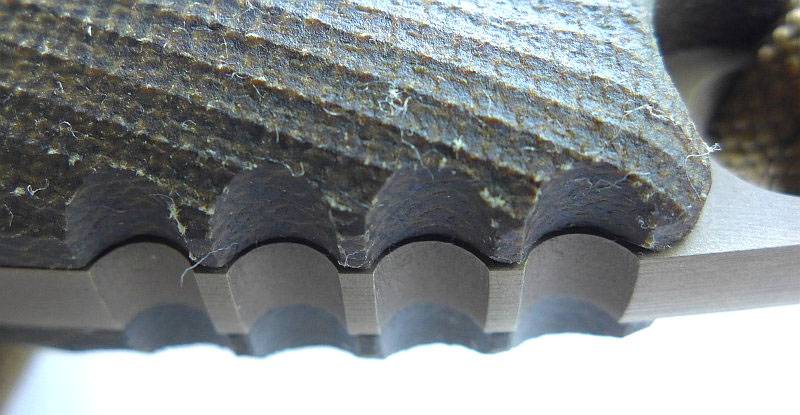
As well as providing grip, the jimping (H) is for tactile reference. Jimping on the rear of the handle is for same reason but when using a reverse grip.

Front jimping.

View of both areas of jimping.
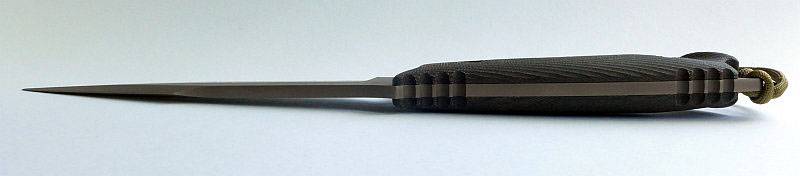
Rear jimping.
The balance point (I) has been adjusted by selecting appropriate material thicknesses and removing material where it doesn’t need to be (such as drilling the tang).

Featuring a fully sculpted handle, the Harsey Model II’s grip is highly functional with finger grips and pommel hook/swell (J). Placement is of these elements is chosen to ensure function even when user is wearing gloves in adverse conditions.
*Now a temporary move to consider the Sheath design details….

During testing, it was noticed that the position of the strap makes it vulnerable to being cut when inserting or withdrawing the knife.
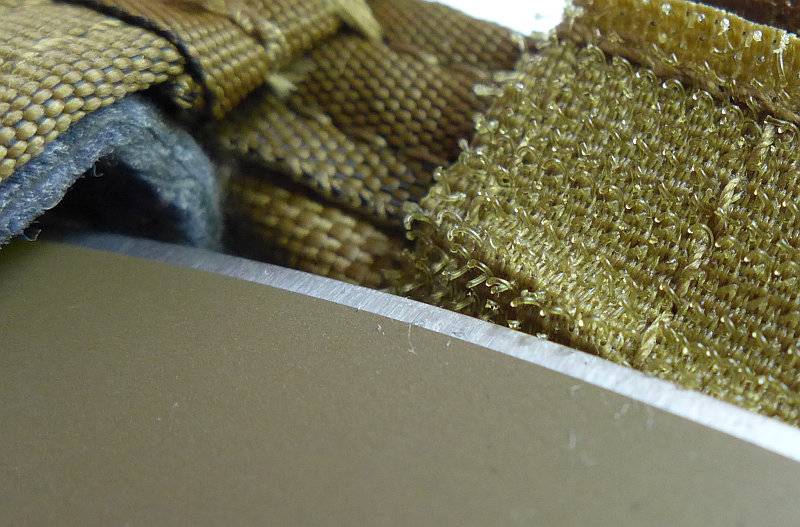
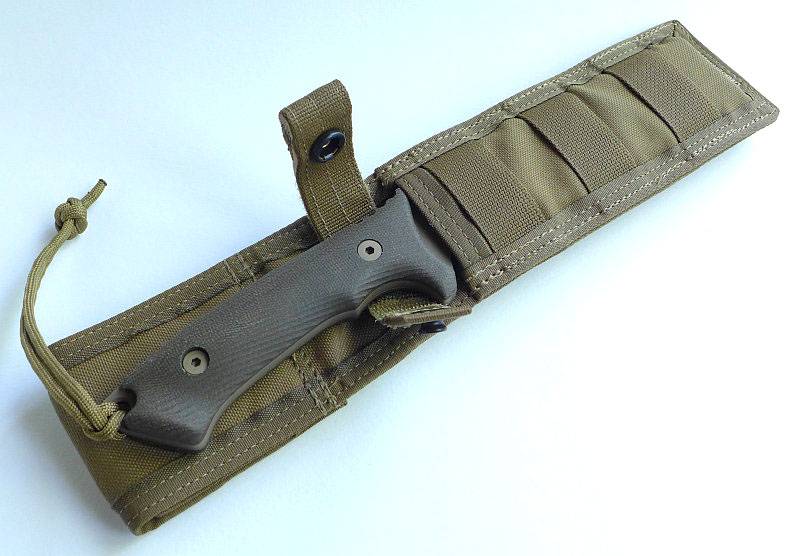
However Mark explained that the retention strap was positioned at handle choil level to insure a good fit and allow the user to get full grip on the exposed handle. The user can then flip the snap closure with their thumb (and sweep the strap out of way with their finger). While a user could cut the retaining strap, it is unlikely if deliberately drawing. The sheath is adjustable to allow it fit a range of Spartan’s other knives.
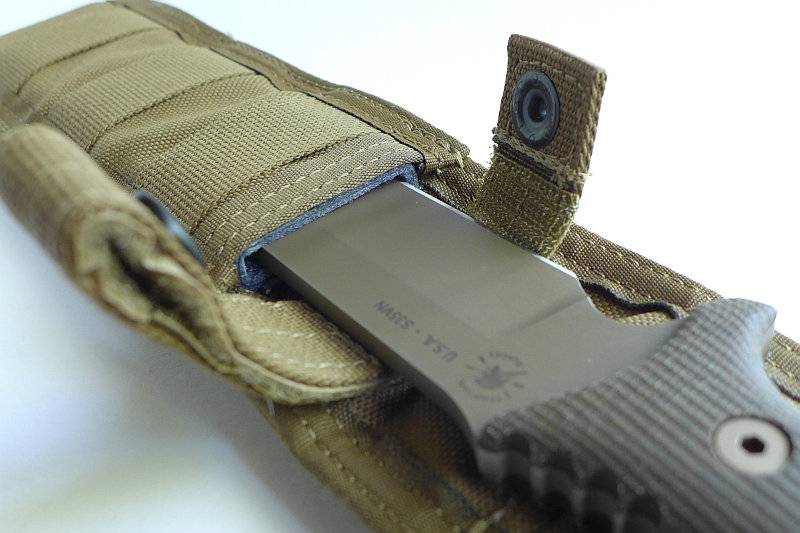
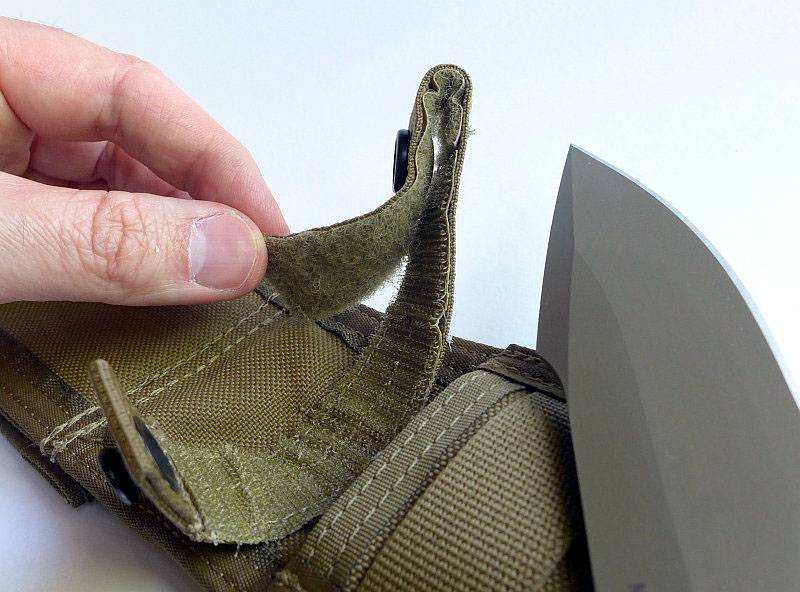
Showing the detail of the retention strap’s adjustment. You can alter the fit, or use it for another knife.
Though limited in space, the PALS webbing on the front (L), can, and has been, used for a small pouch or to place pistol holster over it for chest draw.
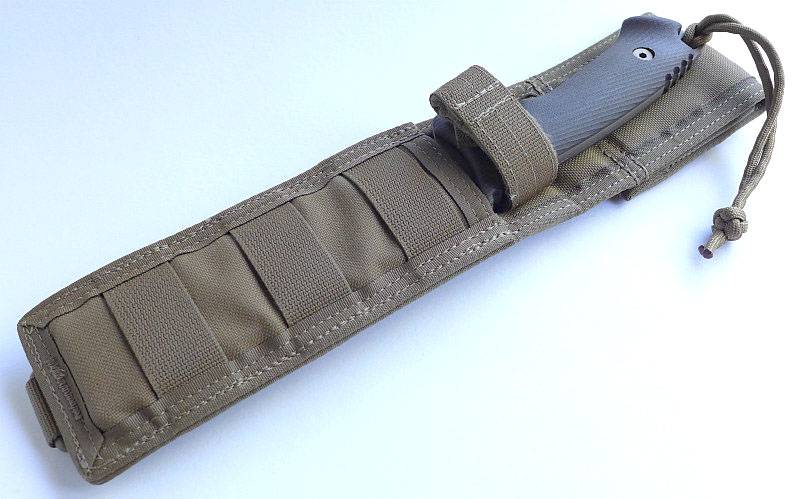
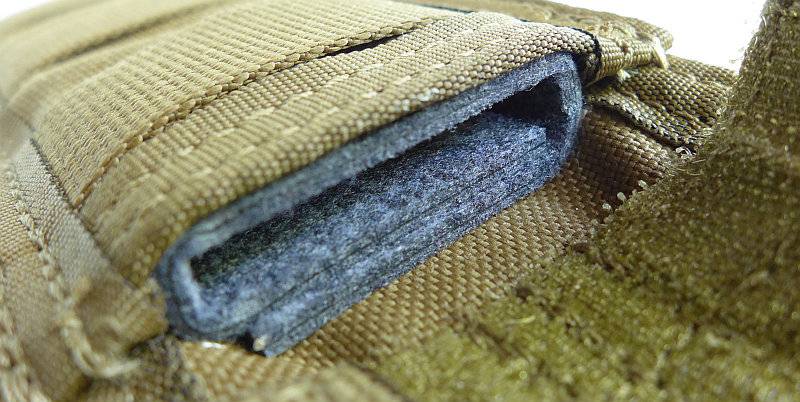
There is a Felt liner (M) inside the sheath. It is made from a recycled kydex like plastic which is laminated between layers of felt. This has the advantage that it provides some retention and is extremely quiet when drawing making it ideal for use in the field as well as when moving as there is no rattle.
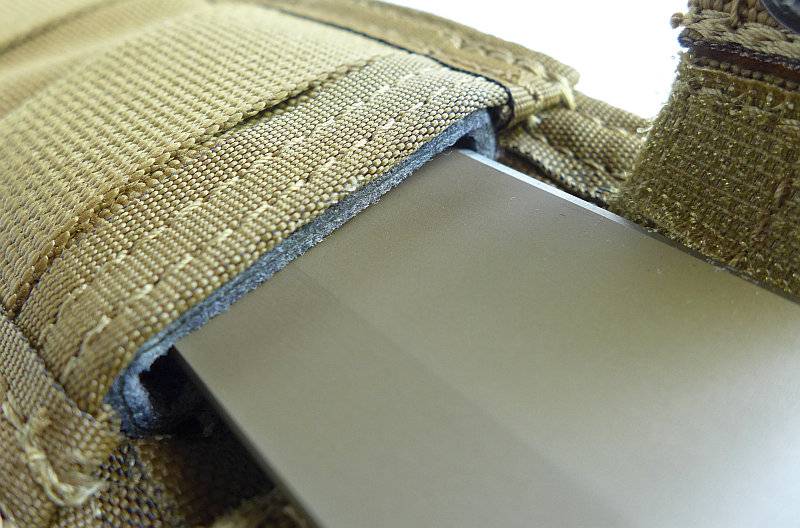
A closer look at the liner.
Looking at the back of the sheath:
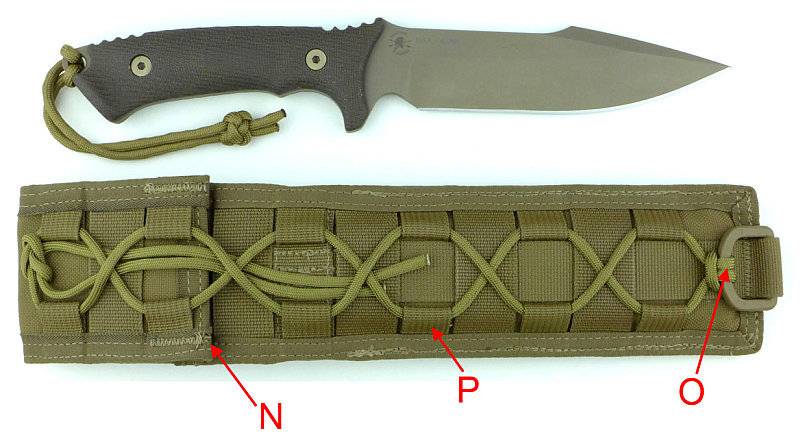
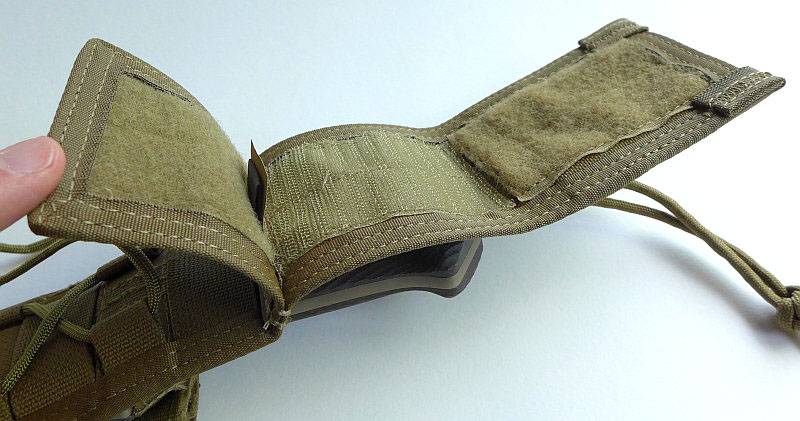
Use of Velcro throughout the entire belt loop (N) allows it to be fitted on a 1”-4” belt width and the Velcro keeps the sheath tight onto the belt whatever its size.
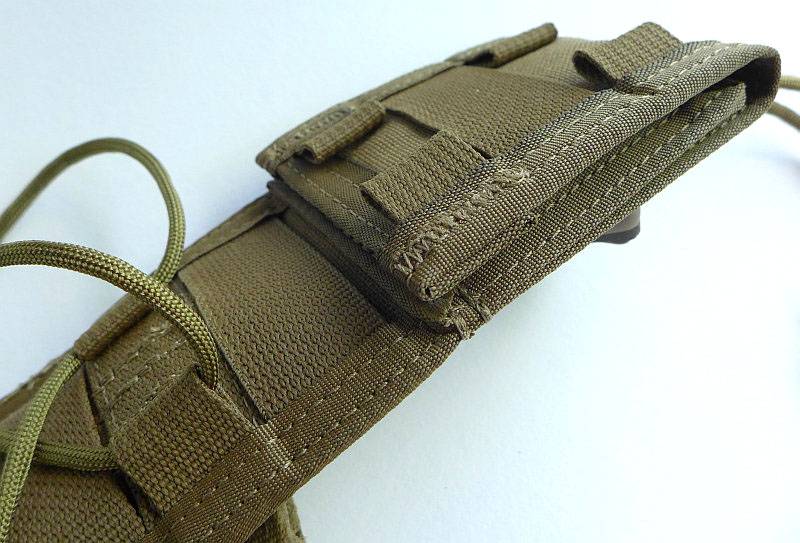
There is Velcro on the outer flap.
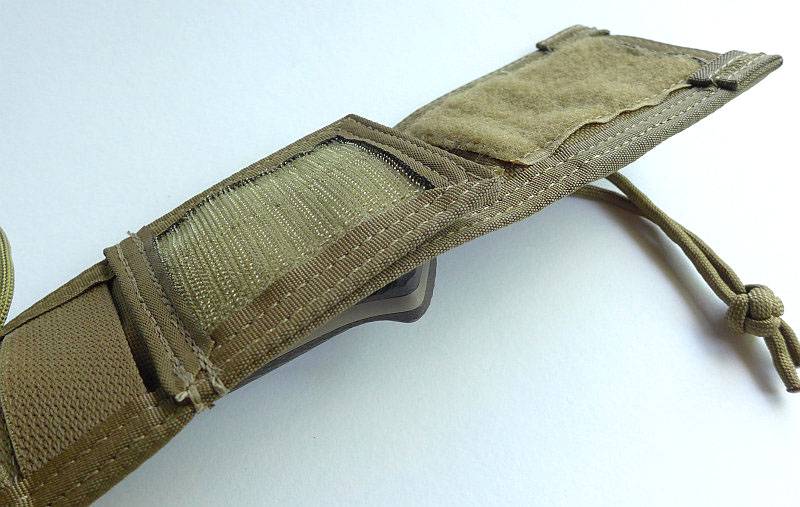
As well as inside the actual belt ‘loop’ as well.
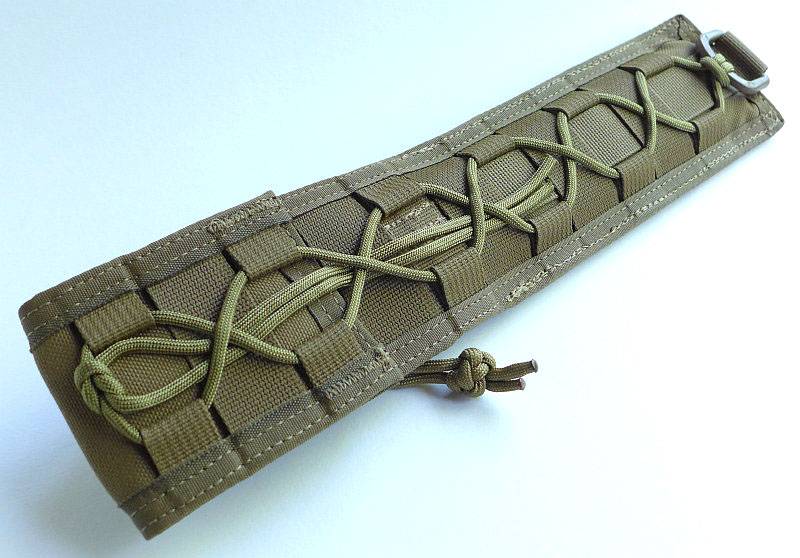
Rather than just using the webbing loop (into which the D-ring is fitted), a D-ring (O) was introduced to provide better directional stability on the leg and allows for other items to be attached.

There are copious tie loops (P) on the back of the sheath which allow the leg tie down to act as a way to lace the sheath to a vest or pack in any direction (vertical, horizontal or diagonal) as well as allowing it to be mounted to packs or vehicle roll cages.
For the final part of ‘Explained by the maker’ we return to the knife…
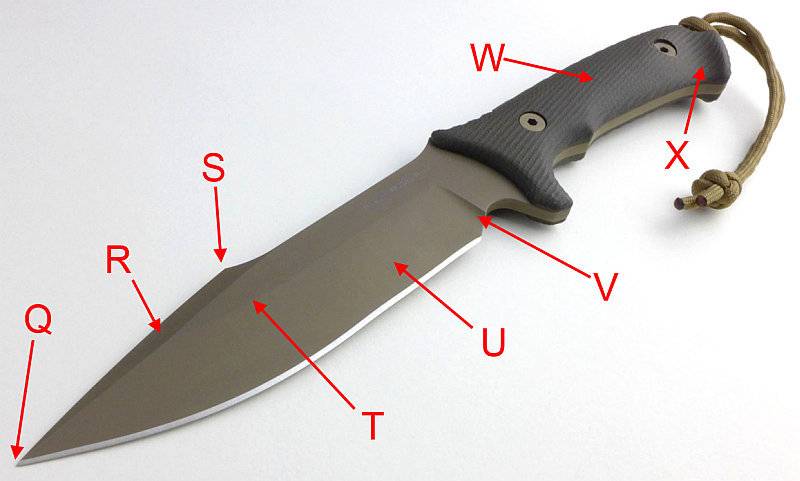
Point position (Q) relative to the centre line gives a best ‘user friendly’ position for most tasks.

Though supplied unsharpened, the Swedge (R) can be sharpened like an Axe to allow for use in tinder preparation and splitting wood, which saves the main blade from being used for those tasks.

As explained earlier, the harpoon point strengthens the tip. The position of the end of this feature (S) is dictated by overall form and function.

The final height of the grind line (T) is the result of the desired bevel angle intersecting with the 3/16” blade stock. The bevel angle used in the Harsey Model II allows for good sharpness while maintaining toughness.

A flat grind (U) is used purely as it is stronger than a hollow grind, and in this design, strength and durability are key requirements.

Use of a rounded plunge line (V) is related to providing stress relief during the heat treat / cryo process, and ergonomics when using.

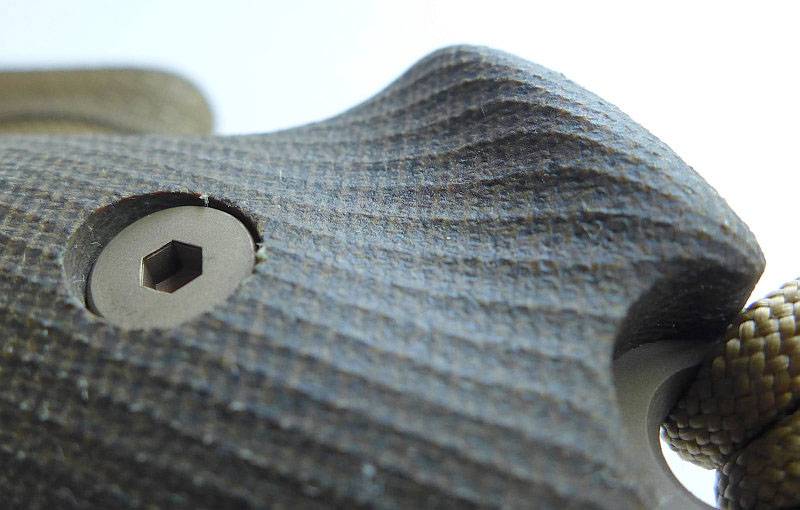
One of the special features of this knife are the sculpted handle scales (W). Spartan Blades scanned a handle Bill had hand ground in the 1970’s that was too hard to make at that time. Both Col Applegate and Al Mar wanted to use it, but at the time technology could not reproduce it – Spartan Blades now have.
The detailed profiling in the butt swell/hook area (X) where the handle scales have a double-swell with swell in the side profile and top profile, came about over many years with Bill’s own experience combined with feedback from users. It greatly aids grip and general ergonomics for all tasks.
The selected blade steel (S35VN), which is used almost exclusively across the Spartan range, has been a logical choice for Spartan. S30V was the first CPM steel specifically created for cutlery and S35VN, a product improvement, just fits with what most soldiers and outdoorsman want. Good corrosion resistance, excellent edge retention and good toughness. Spartan really like it and it is also a great choice for many users who cannot re-sharpen when deployed for 6 months or a year.

A few more details:

Picking up on a few details not covered during the ‘Explained By’ section.

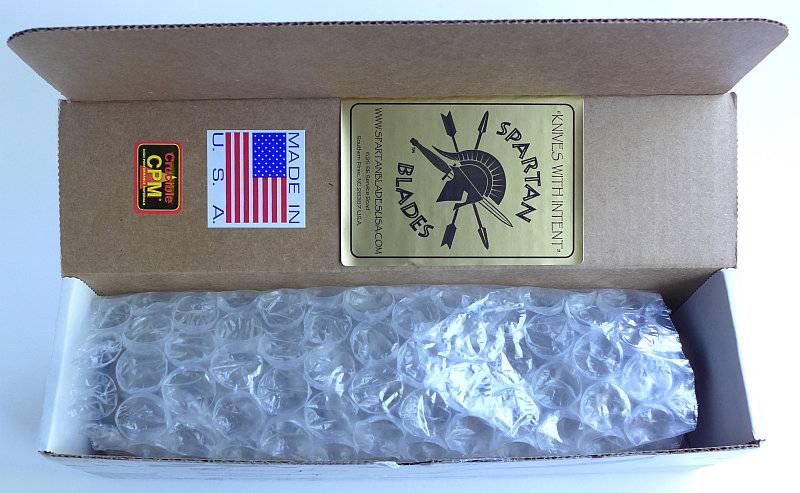
The Harsey Model II is a knife to be used, so the box reflects this simple intent. No fancy presentation packaging, it is a plain box that just gets the knife to you.
Here is another view of the knife out of its sheath with the felt liner visible.
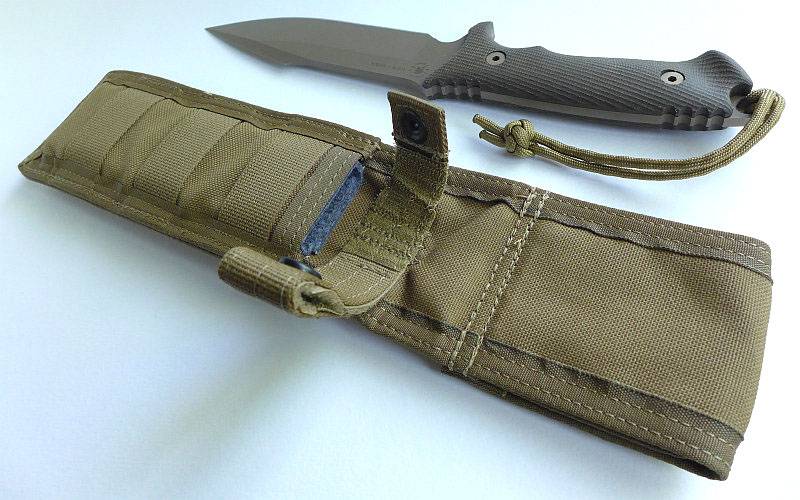
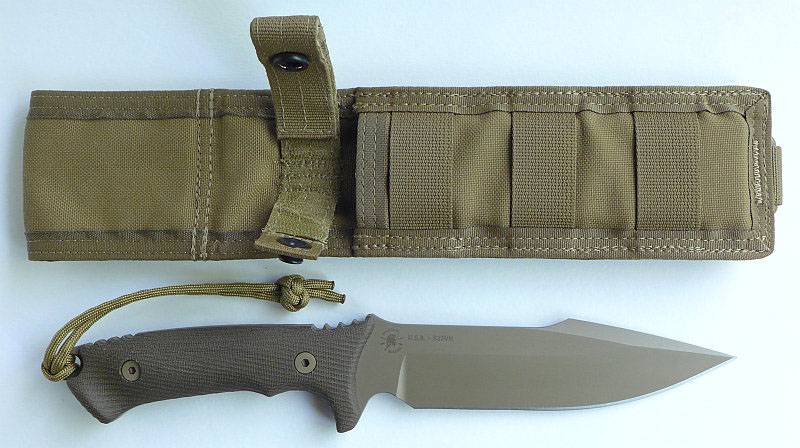
And the side view of the same.
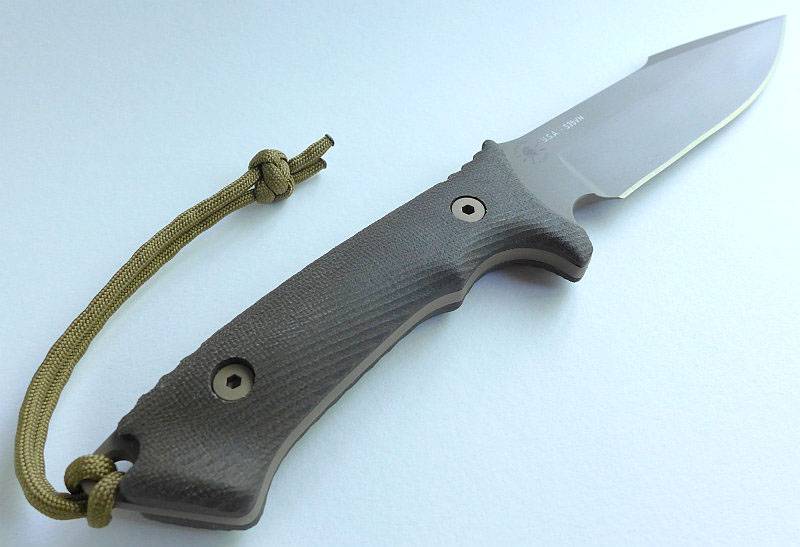
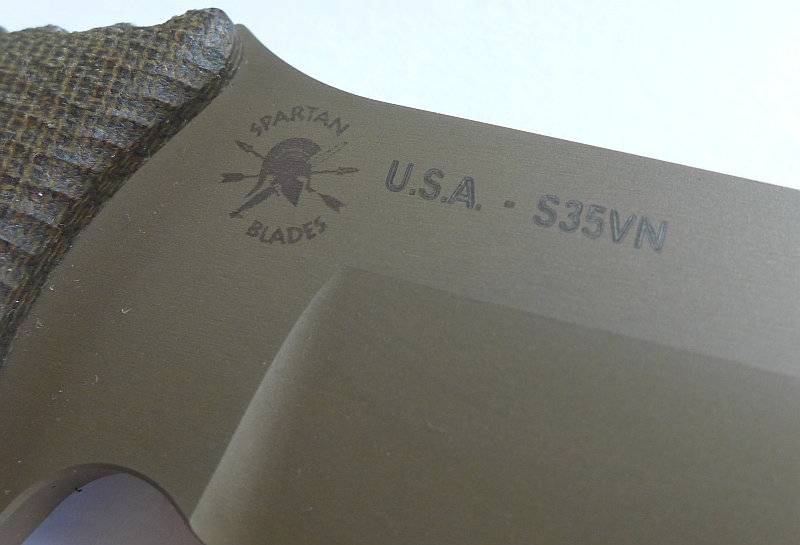
Spartan Blades logo etched onto the blade with U.S.A and the blade steel. This knife is the Flat Dark Earth colour and has a ZrN PVD ‘SpartaCoat’ coating.
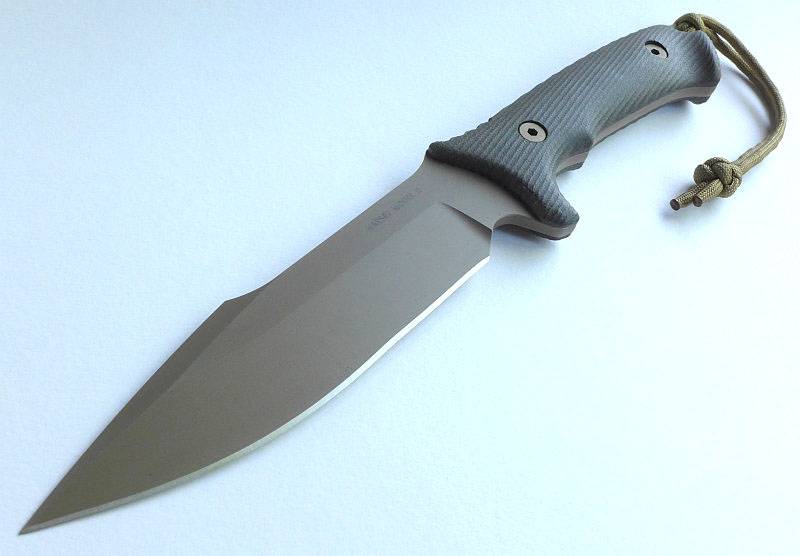
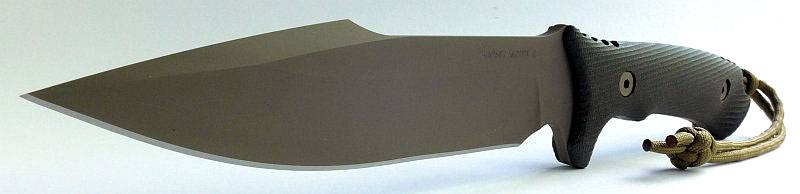
So right now, just bear with me as I’m really just enjoying looking at the blade profile…
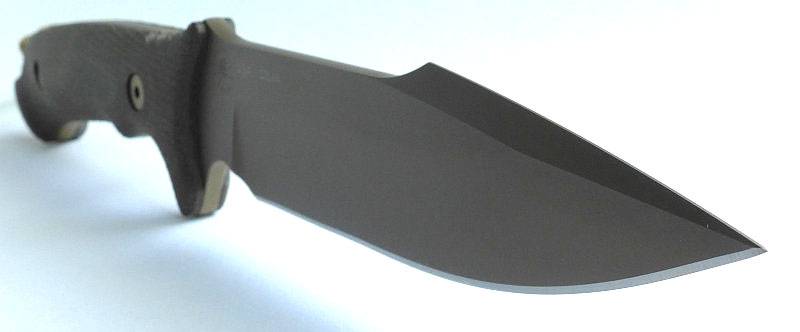
…along with that sculpted grip and harpoon point
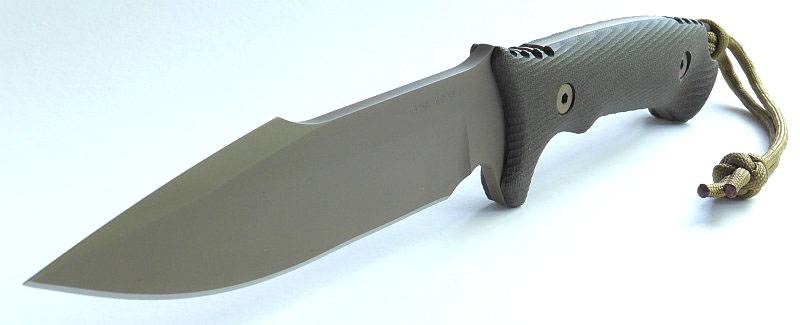
Yes, still enjoying that profile…..
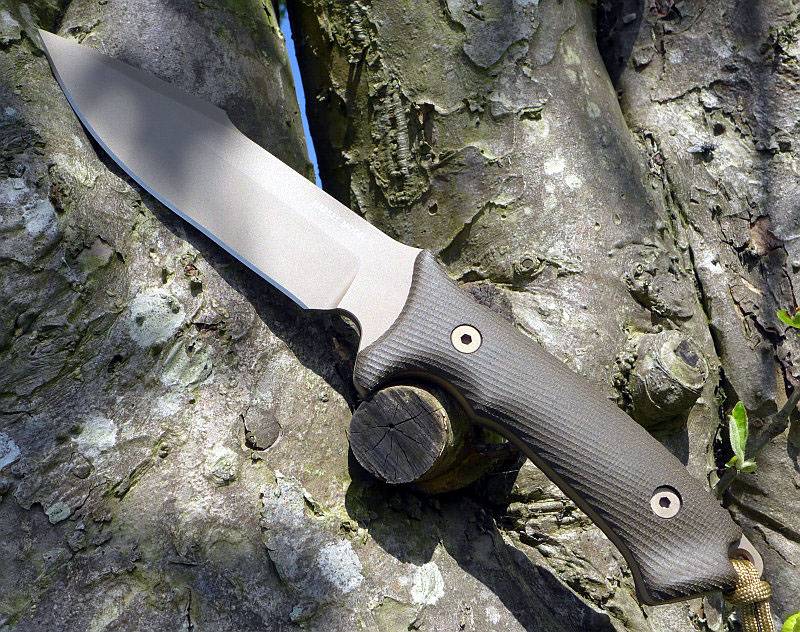
The Flat Dark Earth colouring is a very subdued looking finish that fits right in.
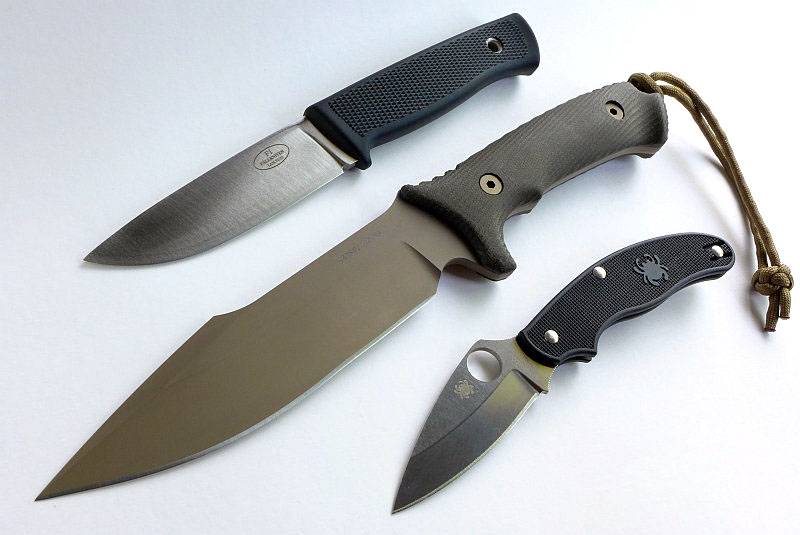
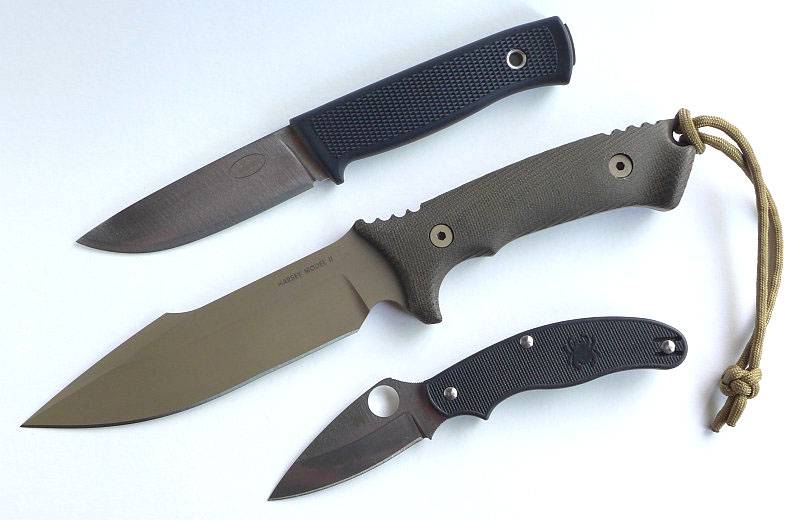
To get an idea of the size of the Harsey Model II, it is shown here with the Fallkniven F1, and Spyderco UKPK FRN.
And straight on.
What it is like to use?

This is a knife I’ve loved the look of from first sight of it. However in a tool designed to cut, looks are not everything, and as it happens the Harsey Model II does cuts just as well as you would hope.

Taking the Harsey Modell II into my daily use gear it has been with me for several months now. (In this photo it is still looking spotless as it had not had any real use at that time).
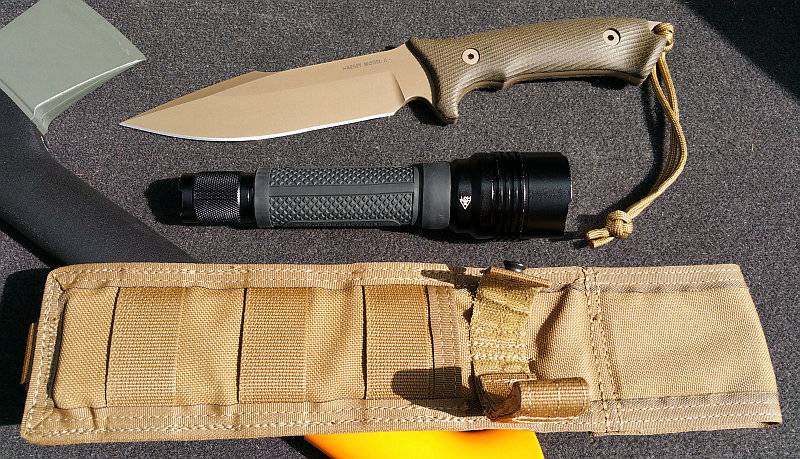
It has been with me out hunting and on the range.
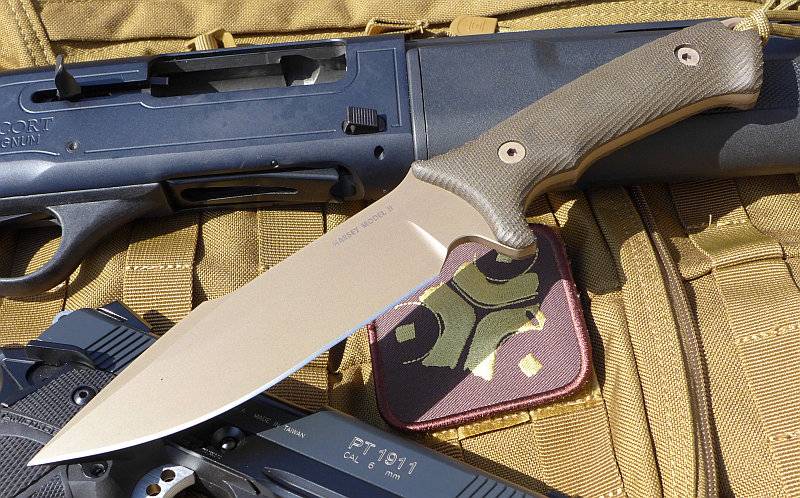
Out and about in the field.
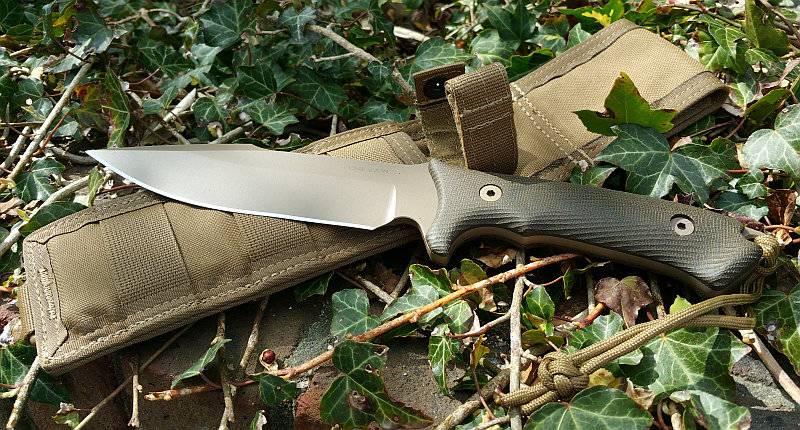
For a sturdy knife, the Harsey Model II worked perfectly well carving and shaping wood. Pictured in the process of making a ‘mini-me’ letter opener…
For some cutting tasks I have found the Harsey Model II a little too ‘pointy’. The tip is very eager to cut and resulted in more aggressive cuts than I intended in certain situations. Admittedly, these are situations I would normally have used a smaller knife with a less prominent point, but I had the Harsey Model II with me, so had to use it.

It is one of the most natural feeling knives I’ve used. The handle’s curves and sculpted profile just fit my hand and allow it act as an extension of my arm rather than a foreign object. The milling lines from the CNC machining of the G10 provide an ideal surface roughness giving excellent grip yet no rubbing. Without gloves, my hand became tired long before I felt any pressure points or anywhere in danger of blistering. With gloves, the limiting factor are the gloves own seam lines which tend to add a source of pressure and rubbing, but what was clearly evident was that the handle works just as well with gloves or without.

Still on my to-do list is to sharpen the harpoon swedge. Though I like the idea, in my normal use, I already find the point very aggressive, so sharpening the top edge as well is only going to make it even more so.

The sheath has proved very versatile in its mounting options, however there are a couple of points I’ve found that don’t seem to work so well. Though any sheath retaining strap can be in danger of being cut, the retaining strap seems to need to be positively pushed out of the way to avoid being cut. Depending on how you mount it this can be easier or quite difficult.

Though it provides a very secure fit, the use of Velcro on the internal part of the belt loop, means that this is quite abrasive on the belt itself and causes fraying on fabric belts and scratching on leather belts. In military applications you probably won’t care, but ‘sporting’ users might.

Its blade length, at just over 6”, combined with a great balance makes this a very nimble blade despite its sturdy 3/16” blade stock. I’ve not handled the larger Harsey Model I Limited edition, but think that most users would find the Model II more manageable and useful for general tasks even if they could still get a Model I.

The S35VN is standing up to its promises of edge retention. I’ve not been using it for extended periods of chopping (I use an axe for that), but instead just using it as and when I need to, and so far there has been no need to bother with a strop or otherwise maintain the edge. Only further use and time will tell just how long the edge will last before I need to touch it up. The only maintenance I have done so far is washing various ‘residues’ off the blade.

This knife has made itself a firm favourite of mine due to its excellent handling and balance, and a fantastic grip, not forgetting the excellent steel too.

Review Summary

The views expressed in this summary table are from the point of view of the reviewer’s personal use. I am not a member of the armed forces and cannot comment on its use beyond a cutting tool or field/hunting knife.

Something that might be a ‘pro’ for one user can be a ‘con’ for another, so the comments are categorised based on my requirements. You should consider all points and if they could be beneficial to you.

_______________________________________________ _______________________________________________
Things I like What doesn’t work so well for me
_______________________________________________ _______________________________________________
Sculpted handle The point can cut very aggressively
S35VN blade steel Possible to cut the retaining strap by mistake
Versatile sheath Belt loop will mark/fray most belts
Superb balance
Jimping for forward and reverse grips

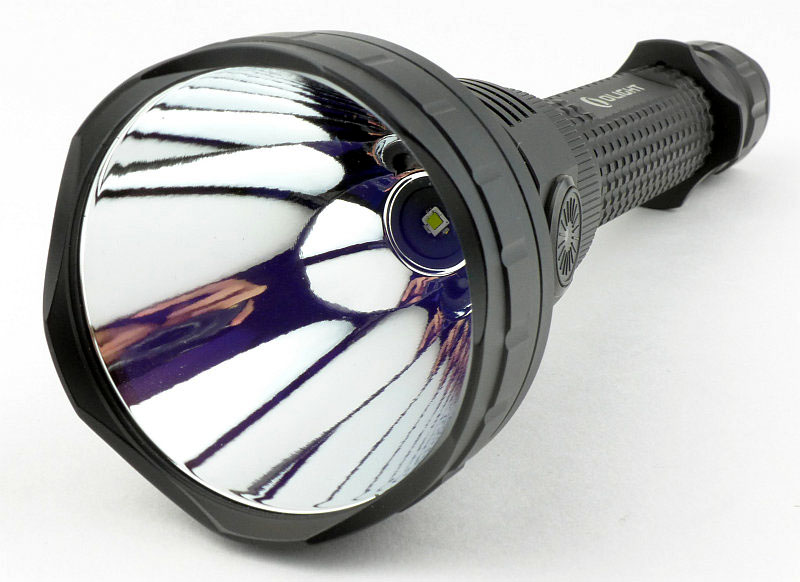
Light Review: Olight M3XS-UT Javelot – Super Thrower (3/4xCR123, 2×18650)

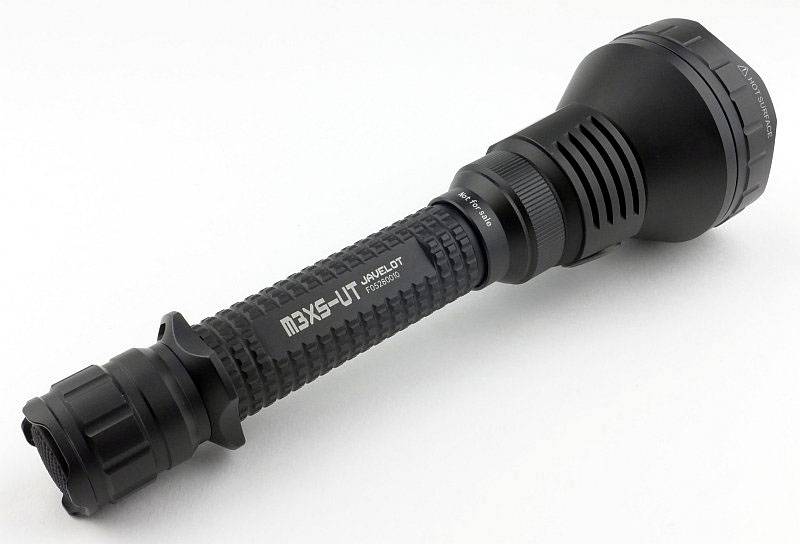
Olight have been building up performance levels with the other Javelot models. These Javelots have been getting noticed for their enhanced throw, and then Olight released the M3XS-UT taking performance up another notch. The M3XS-UT is currently the top of performer amongst the Javelots.

Taking a more detailed look:

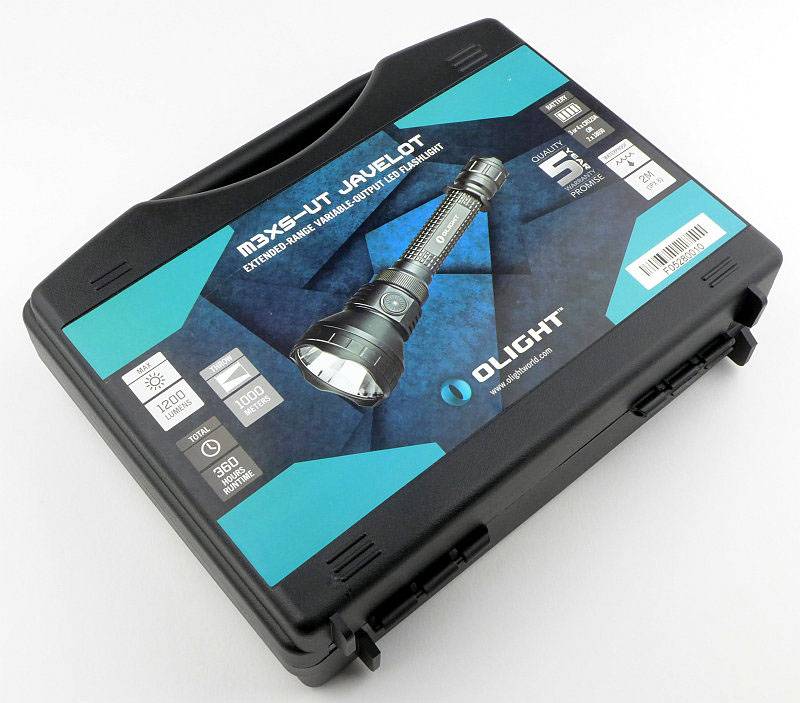
Like all the Javelots I’ve tested, the M3XS-UT comes with a plastic carry case rather than a disposable cardboard box.

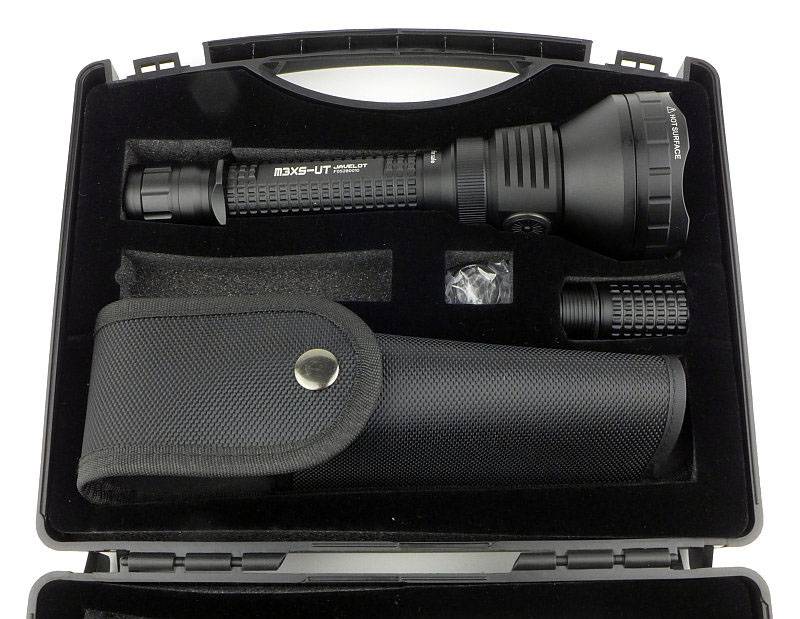
Inside, the contents are held in place with a foam liner. The empty slot would contain the CR123 holder, but in this case this demonstration light had a set of cells fitted into the light when it arrived.

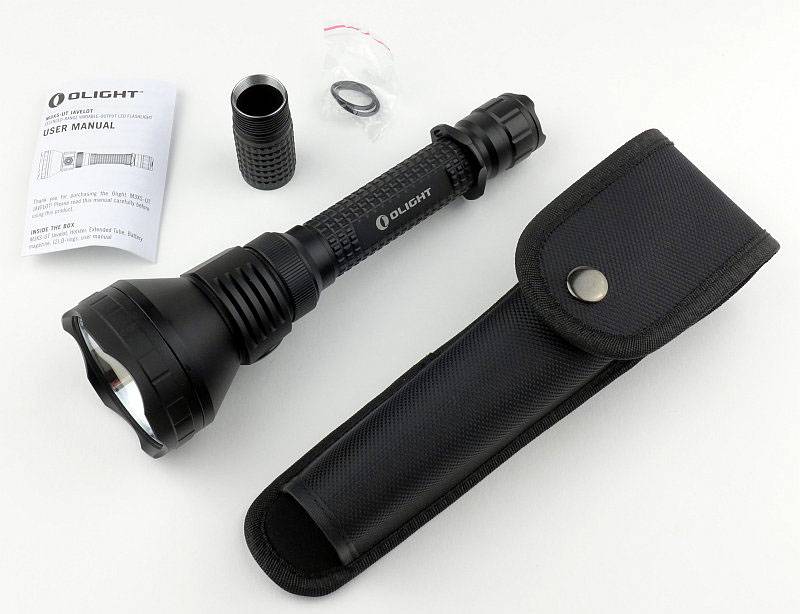
Included are the M3XS-UT, an extender tube, holster, two O-rings and the instructions. (the CR123 cell holder is already in the light here).

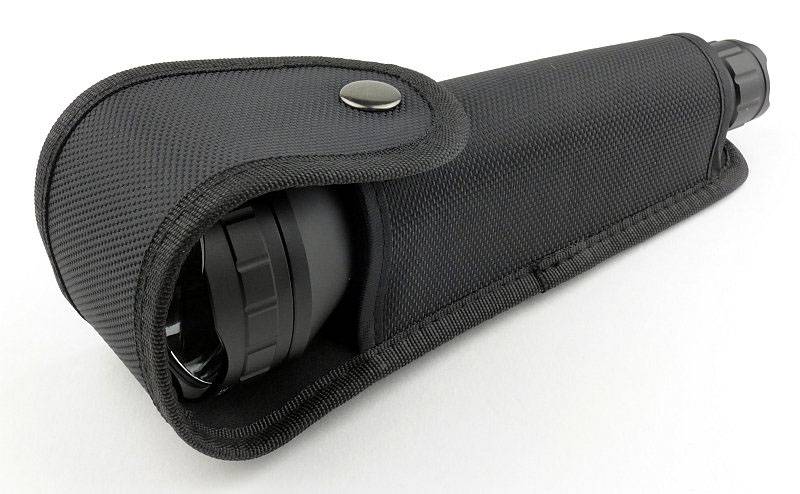
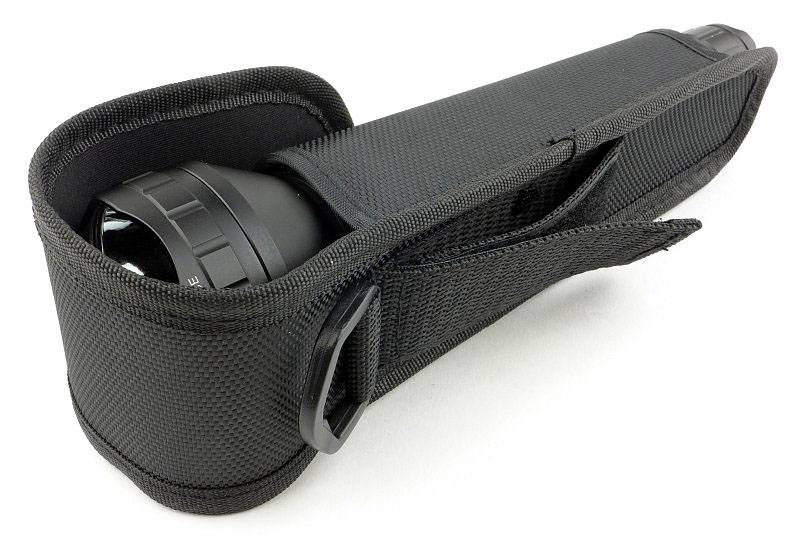
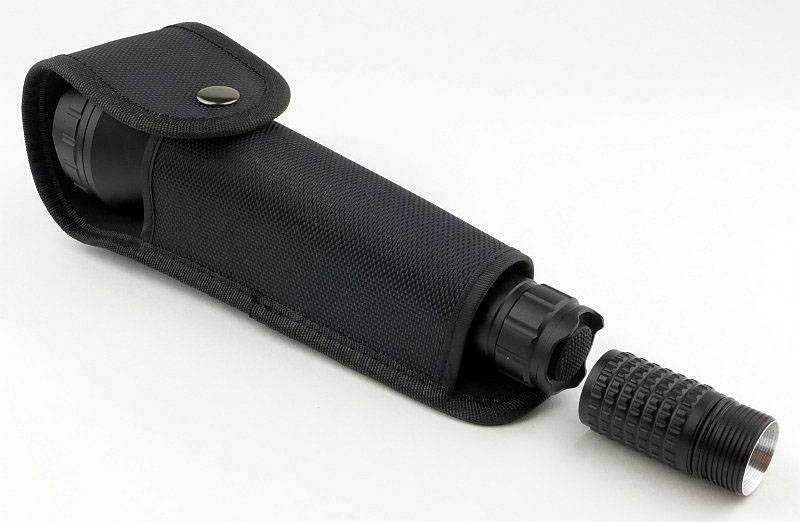
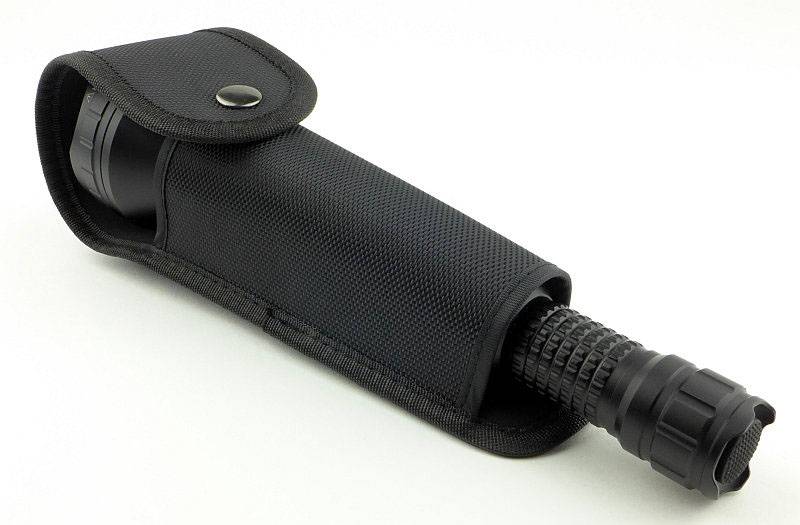
Out of necessity, the M3XS-UT has an open bottom holster.

You have the choice of D-ring or Velcro-closed belt loop.

This is why there is an open bottom in the holster.

This holster can be used with or without the extension tube.

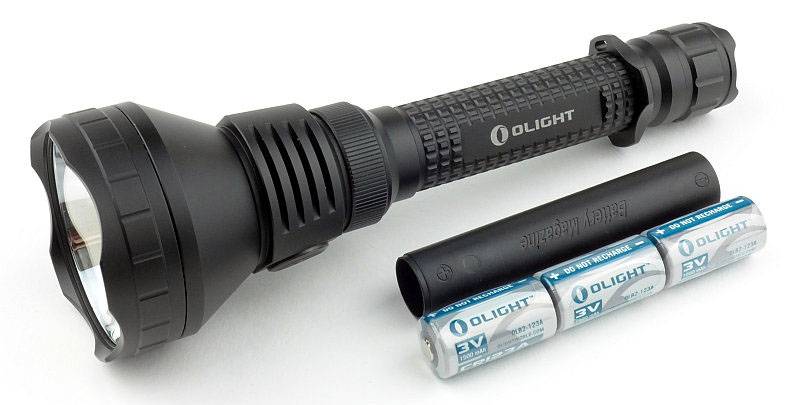
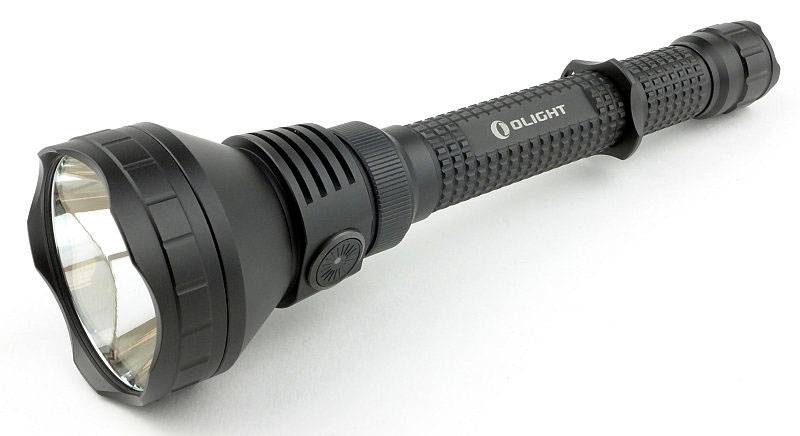
The M3SX-UT has a removable grip ring.

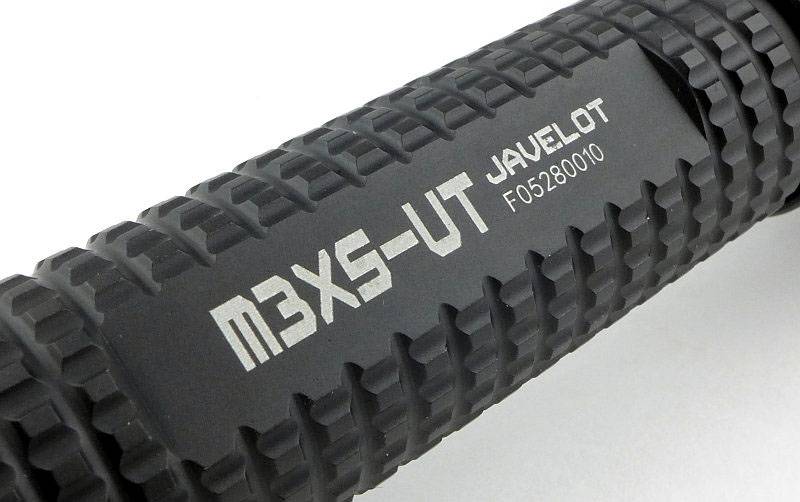
Instead of standard knurling a very effective pattern is machined into the body.

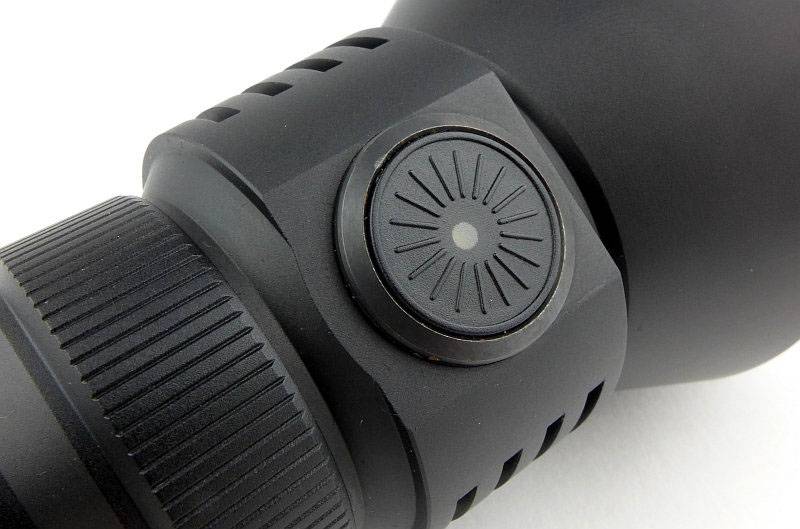
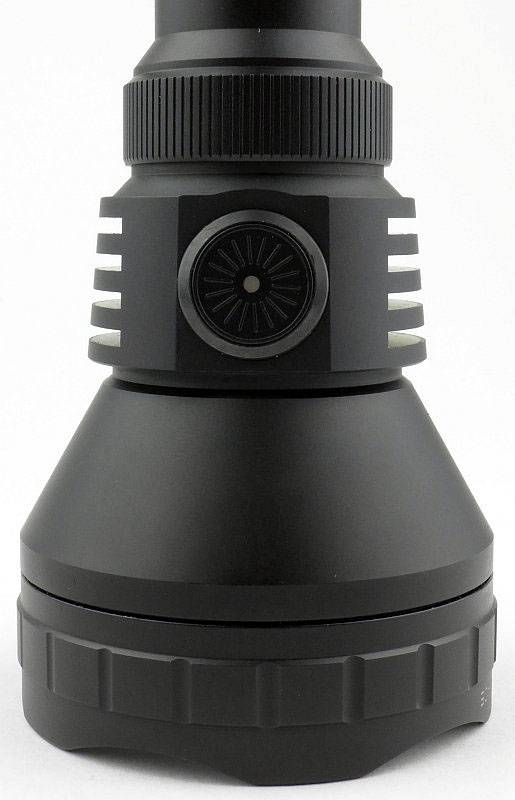
In addition to the tail-cap switch, there is a side-switch for mode selection.

Either side of the side-switch are heat sink fins.

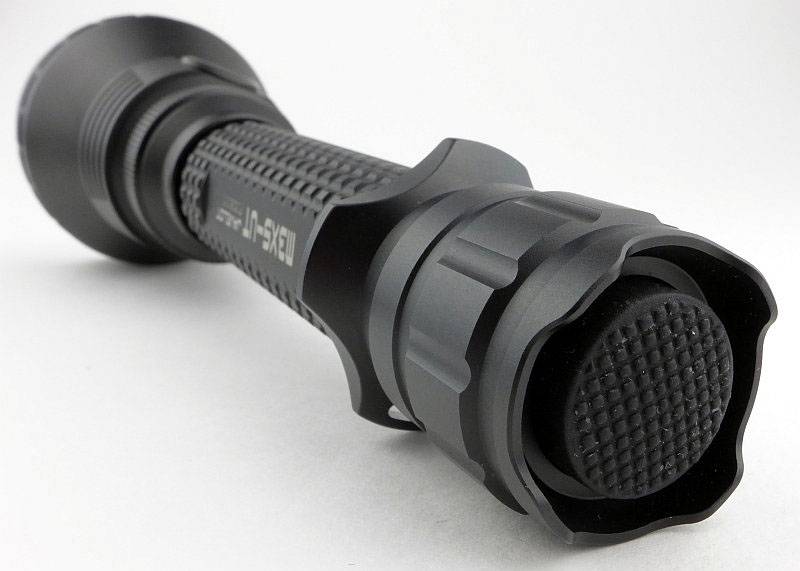
The switch boot is wider than most and the tail-cap has four small raised lugs which allow it to tail-stand (though not very stable).

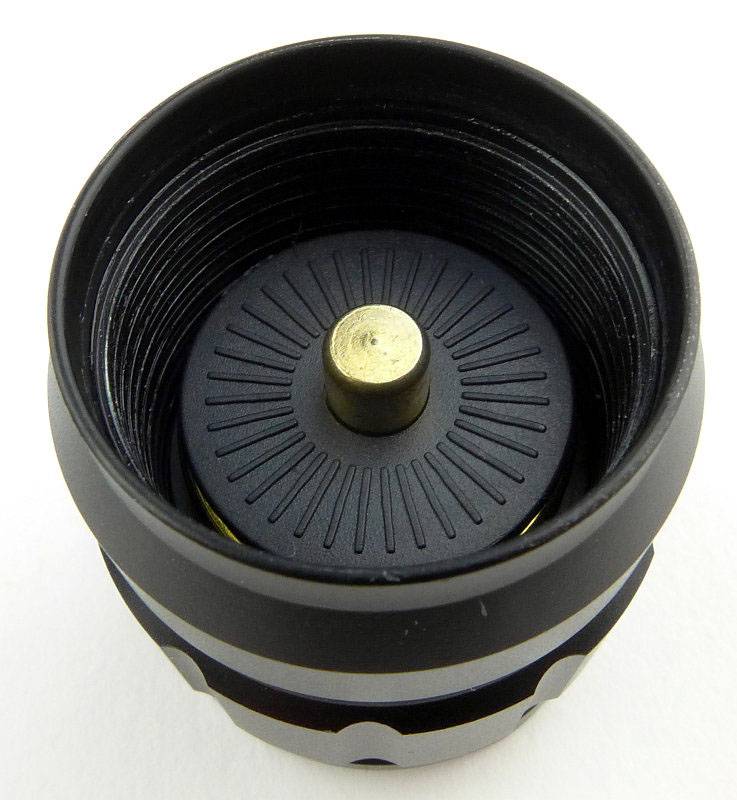
Looking into the tail-cap, the negative terminal is clearly visible, but the contact for the battery tube is only seen as small glimpses. This is due to the design not using a contact point on the end of the tube, but instead fitting into the cone shaped inner edge.

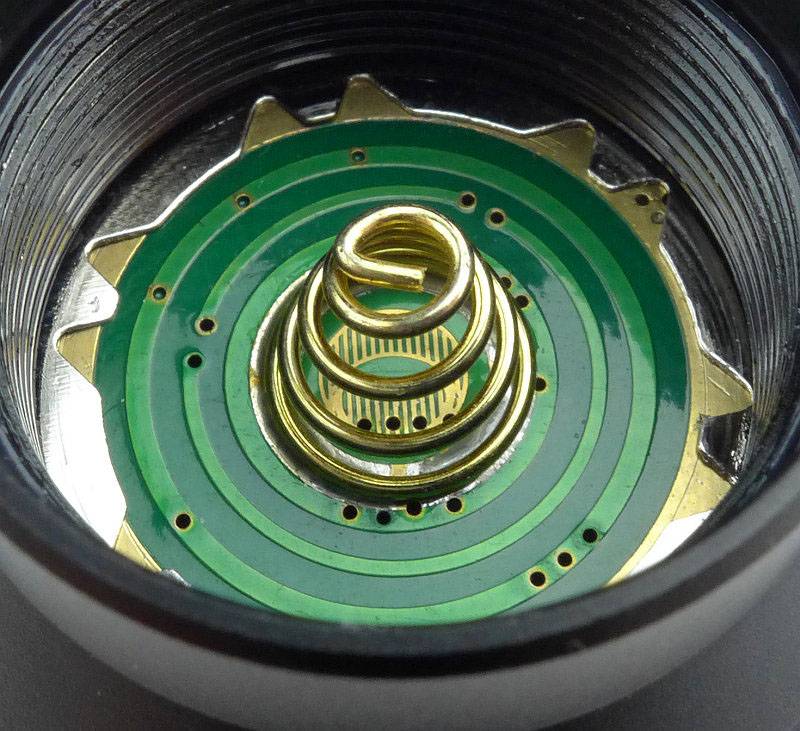
Removing the battery tube completely shows the positive contact in the head as well as the circular battery tube contact.

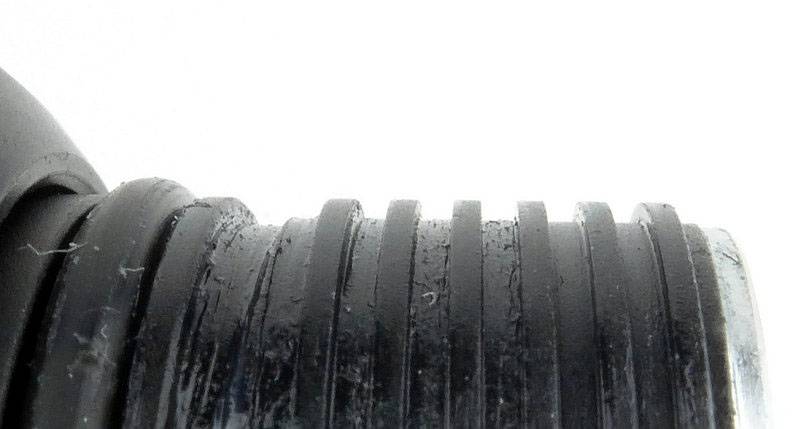
For the tail-cap end of the battery tube, the threads are a square-cut.

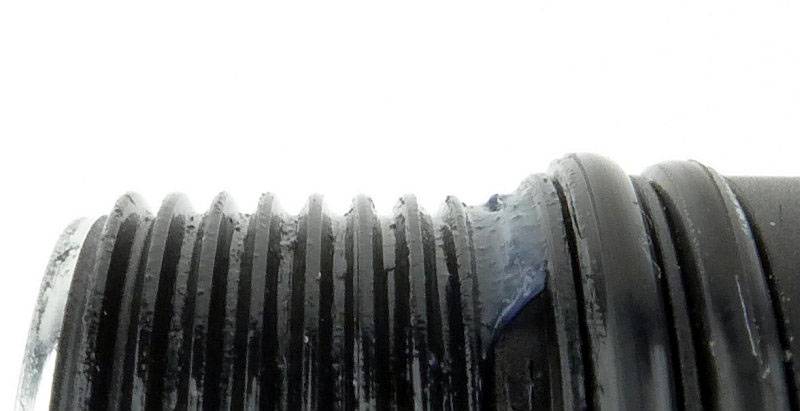
At the head end of the batter tube, the threads are standard and two O-rings are used.

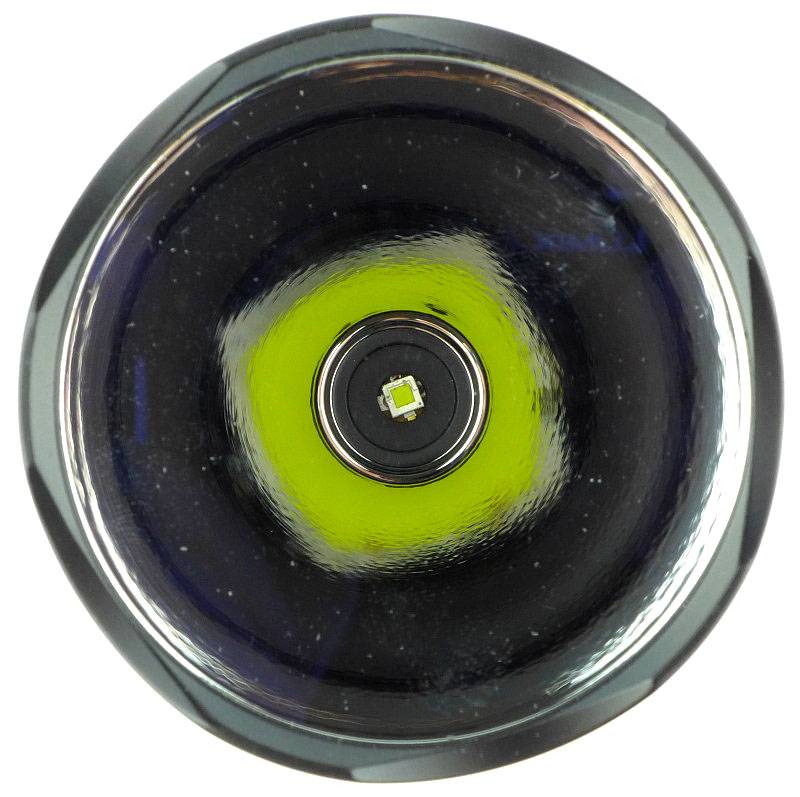
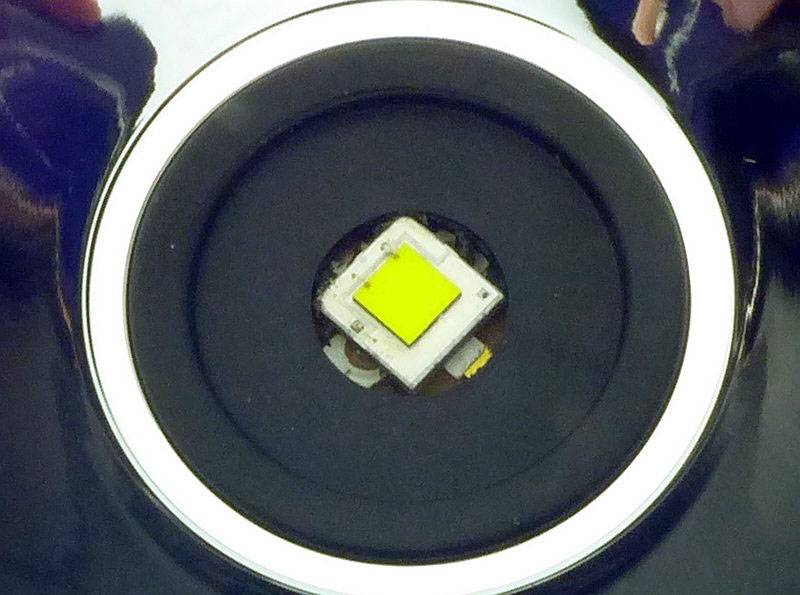
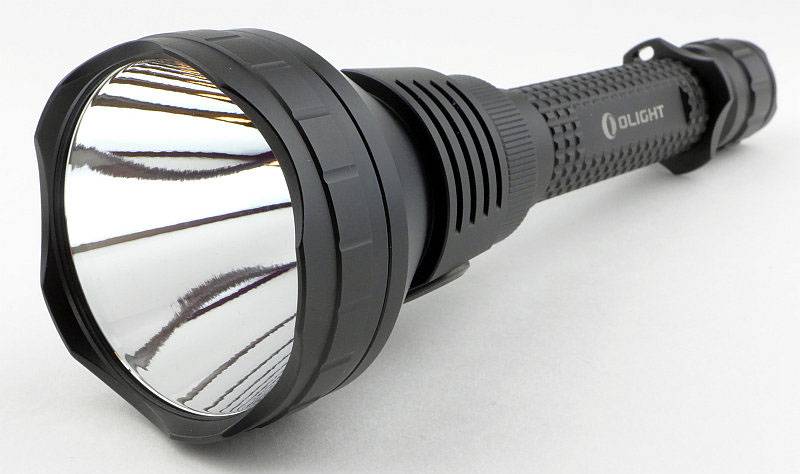
There is just a tiny hint of texturing in the large reflector, and at its heart, a fully exposed XP-L HI LED.

A closer view of the bare phosphor of the XP-L HI.

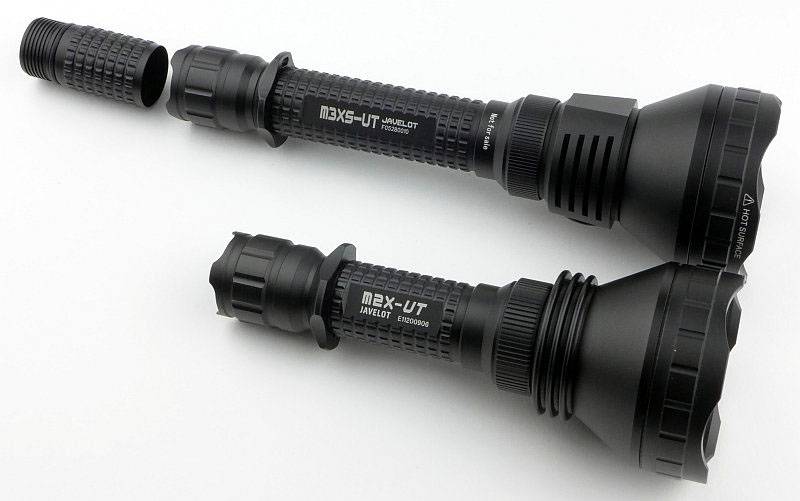
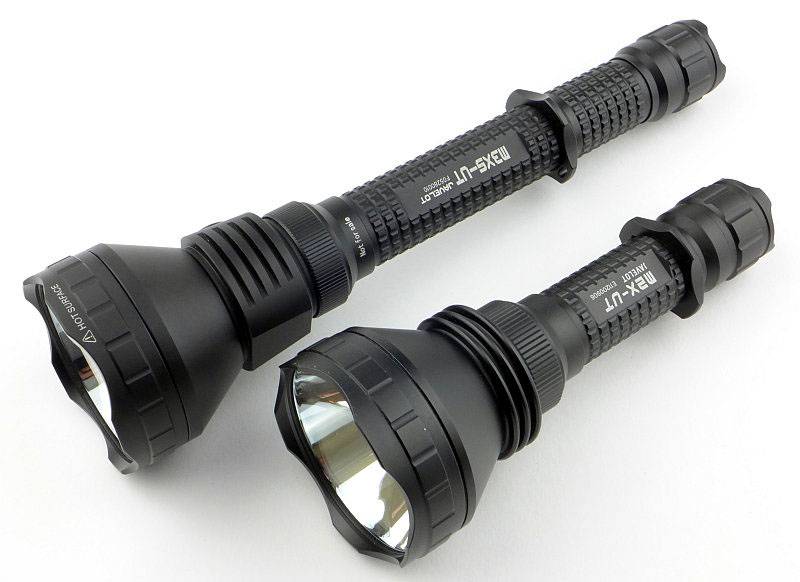
Making comparison to the M2X-UT (using 1×18650), this larger version is clearly longer from the lens to the battery tube due to the inclusion of the side switch and larger heat sink. The non-extended battery tube is also 3xCR123 in length.

Comparing again with the extension tube fitted.

Taking the M3X-UT at its smallest size, it runs on 3xCR123 and has a cell holder to stop any rattle.

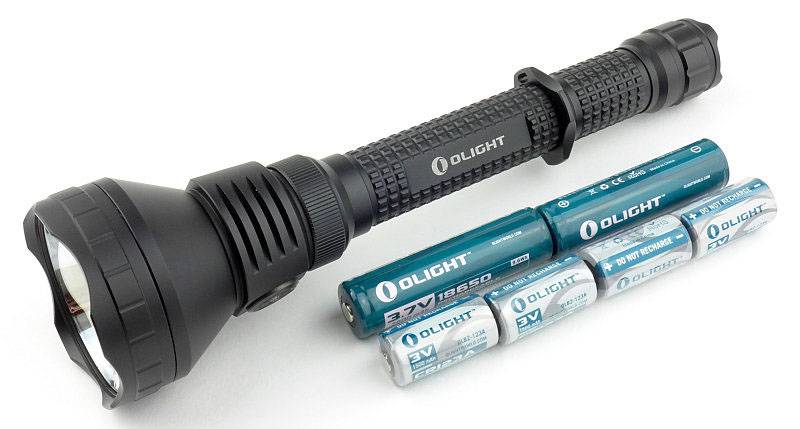
Stepping up to the full length M3XS-UT it runs on 2×18650 or 4xCR123.

To get the most runtime out of the M3XS-UT use it with the extension tube fitted.

The beam

Please be careful not to judge tint based on images you see on a computer screen. Unless properly calibrated, the screen itself will change the perceived tint.
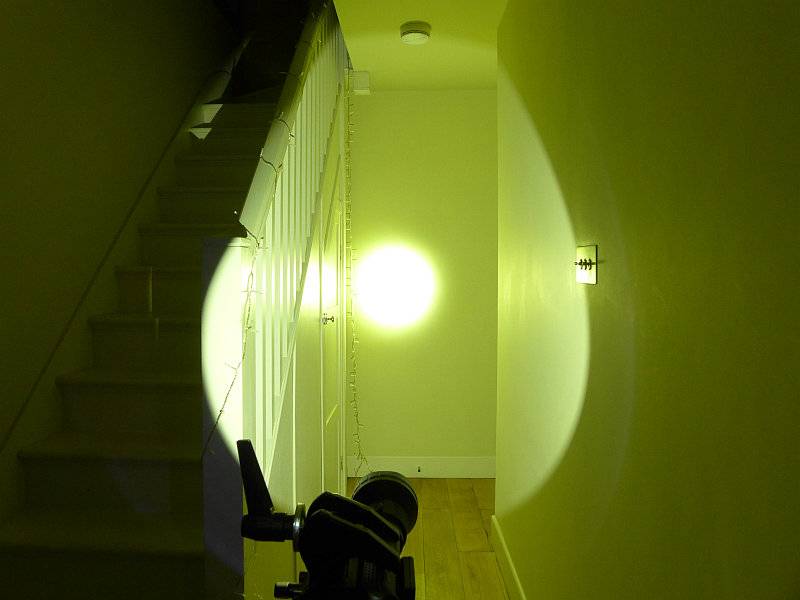
The indoor beamshot is intended to give an idea of the beam shape/quality rather than tint. All beamshots are taken using daylight white balance. The woodwork (stairs and skirting) are painted Farrow & Ball “Off-White”, and the walls are a light sandy colour called ‘String’ again by Farrow & Ball. I don’t actually have a ‘white wall’ in the house to use for this, and the wife won’t have one!

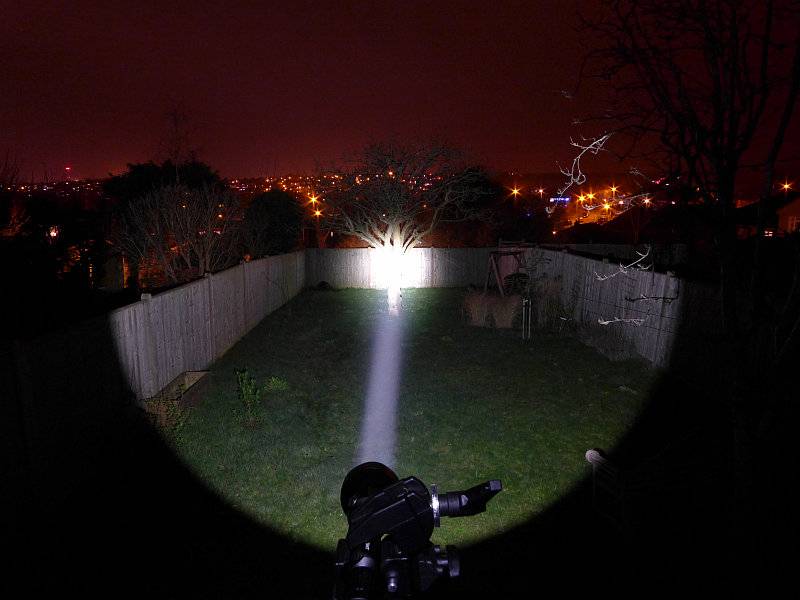
Starting indoors, it is immediately obvious we have a super-high intensity hotspot. In fact what you can see in this photograph is the effect of the hotspot being of such high brightness it is acting as a significant source of light. The edge of the spill is easy to see, but the whole scene is lit behind the spill edge due to the hotspot’s light bouncing back.

Outdoors the hotspot burns out the centre of the image.

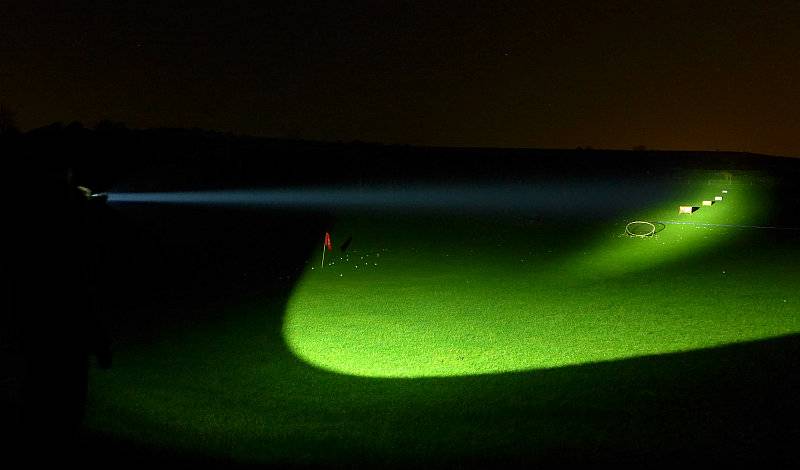
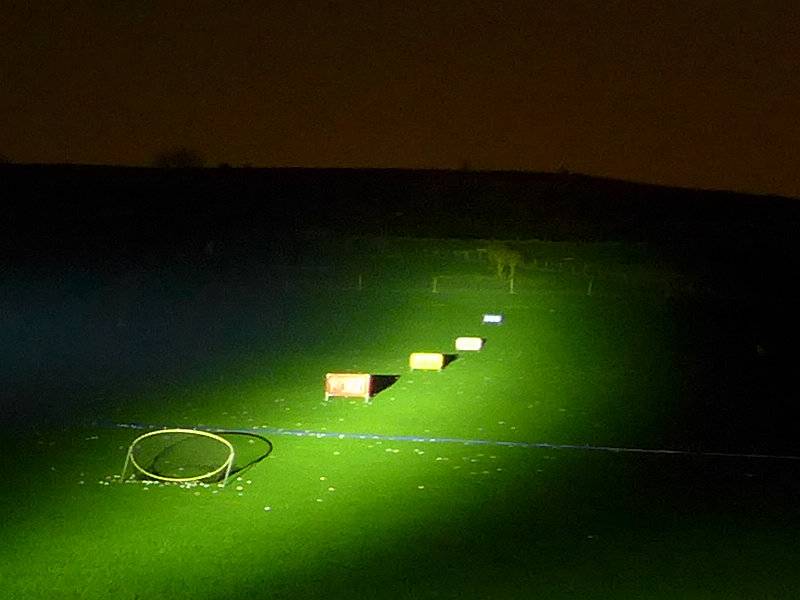
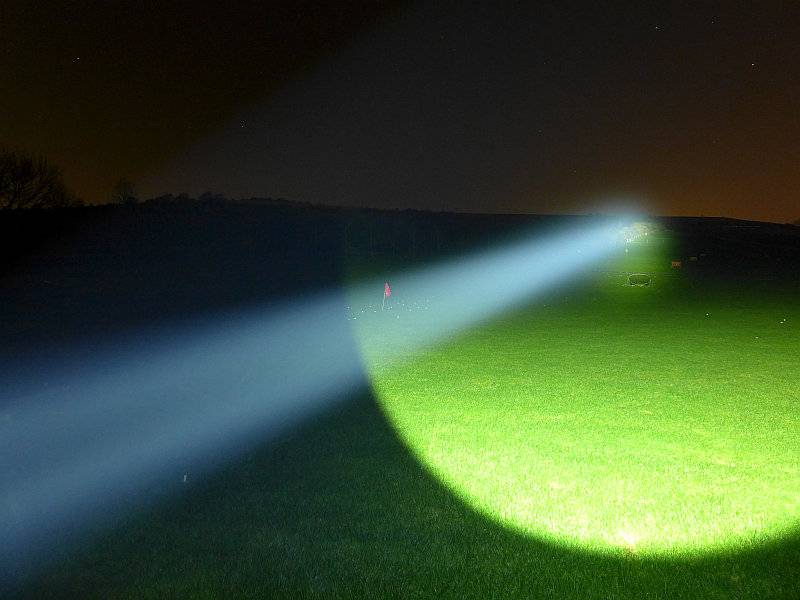
To really appreciate the full power of the M3XS-UT we need a little more range. How about a driving range?

The beam is aimed at a set of four distance markers behind a circular net. The closest marker is 100 yards, with the others set 50 yards apart going up to the furthest at 250 yards.

The beam lights well beyond the markers.

Modes and User Interface:

There are four constant output modes, High, Medium, Low and Moonlight as well as a Strobe mode.

Access to these is via a series of clicks of the forward-click tail-cap switch combined with the side switch.

Turning the M3XS-UT ON with the tail-cap switch, the steady modes are cycled through using the side switch Low -> Medium -> High -> Low etc. The selected mode is memorised for the next time the tail-cap switch is used.

While ON, pressing and holding the side switch turns the output to Strobe.

From OFF, half-pressing or fully pressing the tail-cap switch activates the memorised output level.
From OFF, a rapid double tap of the tail-cap switch activates High. This is not memorised.
From OFF, a rapid triple tap of the tail-cap switch activates Strobe. This is not memorised.
From OFF, holding the side switch while activating the tail-cap switch turns the output to Moonlight. This is not memorised.

Batteries and output:

The Olight M3XS-UT runs on 3/4x CR123 or 2×18650.

To measure actual output, I built an integrating sphere. See here for more detail. The sensor registers visible light only (so Infra-Red and Ultra-Violet will not be measured).

Please note, all quoted lumen figures are from a DIY integrating sphere, and according to ANSI standards. Although every effort is made to give as accurate a result as possible, they should be taken as an estimate only. The results can be used to compare outputs in this review and others I have published.

___________________________________________ ________________________________ ________________________________
Olight M3XS-UT Javelot using specified cell I.S. measured ANSI output Lumens PWM frequency or Strobe frequency (Hz)
___________________________________________ ________________________________ ________________________________
High using 3x Olight CR123 cells 1243 0
Medium using 3x Olight CR123 cells 678 0
Low using 3x Olight CR123 cells 118 0
High using 2x Olight 18650 cells 1234 0
Medium using 2x Olight 18650 cells 666 0
Low using 2x Olight 18650 cells 116 0

* Beacon and Strobe output measurements are only estimates as the brief flashes make it difficult to capture the actual output value.

Peak Beam intensity measured 249000lx @1m giving a beam range of 998m.

There is no parasitic drain.

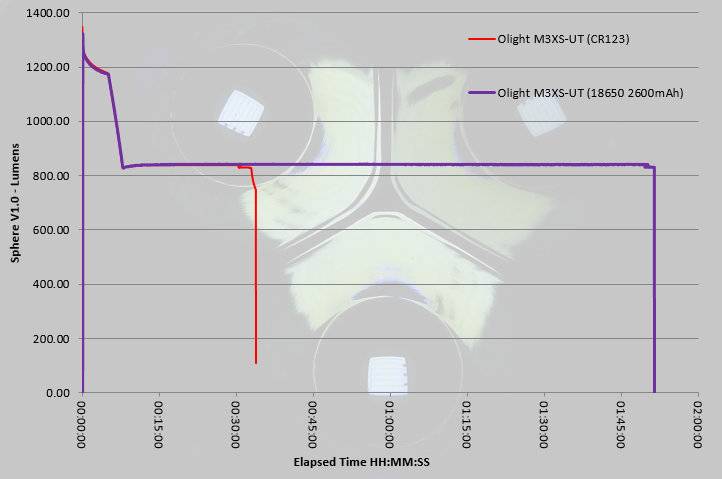
After 8 minutes on High (using either CR123 or 18650) the output makes a controlled reduction to 832lm which is then maintained as a regulated output for as long as the cells can manage.

Running on 2×18650 you have a huge difference in total runtime with the CR123s running into the ANSI cutoff at 35 minutes from turn on, but the 2×18650 (and only 2600mAh cells) gives you up to 1h51m at which point the protection cuts in and the output goes off.

The regulation used in the M3XS-UT means that you get little or no warning of the output cutting out. On 18650 the protection activates, and with CR123 the output plummets once the cells are depleted.

Troubleshooting

This section is included to mention any minor niggles I come across during testing, in case the information helps anyone else.

No issues were encountered during testing.

As per the description of this section, this information is provided in case anyone else finds a similar ‘issue’ that might be fixed in the same way.

The M3XS-UT Javelot in use

This light is an out-and-out throw monster. Unless the extra 3.5cm is a deal breaker, you will want to use the extension tube for the massive increase in run time and guilt-free rechargeable lumens.

At short ranges the M3XS-UT is too tight a beam for comfortable use. It is great for ceiling bounce, but not when directed towards whatever you are looking at. Of course if you are peering into a deep space, the tight beam works wonders, but for general use this extreme-thrower is not the right choice. What you want this light for is its throw and lightsaber like beam.

Due to the intensity of the beam, if you hold it too near to your line of vision the beam itself can obscure your view of what you are shining it at. It is best to hold the light away from your head to allow you to see further. This varies with atmospheric conditions being far more noticeable when the air is moisture laden.

Compared to the smaller M2X-UT (which has very impressive performance – see my review of the M2X-UT for more details), the M3XS-UT steps things up. At 182800 lux@1m the M2X-UT has a beam range of 855m, but with the M3SX-UT this is raised to 249000 lux@1m and a beam range of 998m. A significant jump in beam intensity from the same diameter reflector.

If you are using the momentary output to flash a signal, it is quite easy to activate strobe, and I’d much prefer there to be no strobe at all. In an extreme-range searchlight I see no point in strobe.

Much better is the partly hidden Moonlight mode. In practical terms, due to the highly focussed beam, Moonlight mode is not terribly useful. All you end up seeing is a small bright circle with very dim spill round it. Better than nothing, but this is not a close-range light even with moonlight mode. If only strobe were hidden in this way, then you could easily avoid it.

Handling with the extension fitted is really good. Though the grip ring is now further from the switch, it simply sits between your middle and ring finger, or ring finger and little finger, and gives you plenty of security. I particularly like the machined grip pattern on the battery tube. It is not as abrasive as knurling, but the knobbles give great hold without acting like sandpaper.

The lux figures speak for themselves, and yet the M3XS-UT is not overly large, so you get fantastic throw in a still relatively compact and easy to handle light.

It may not be an all-rounder, but that is not what this light is all about – give it some range and the M3XS-UT truly sings.

Review Summary

_______________________________________________ _______________________________________________
Things I like What doesn’t work so well for me
_______________________________________________ _______________________________________________
Super throw with 249000 lux @1m – 998m beam range Strobe too easily activated
1200lm output Not suited to short range use
Included extension tube allows for longer runtimes Regulated output results in shutdown with little warning
Holster accommodates extension tube
Bare XP-L HI LED used for highest lux
Relatively compact for its performance

Knife Review: Böker Plus Kwaiken Damascus/Damast (3.5″ blade – Odins Eye Damasteel)

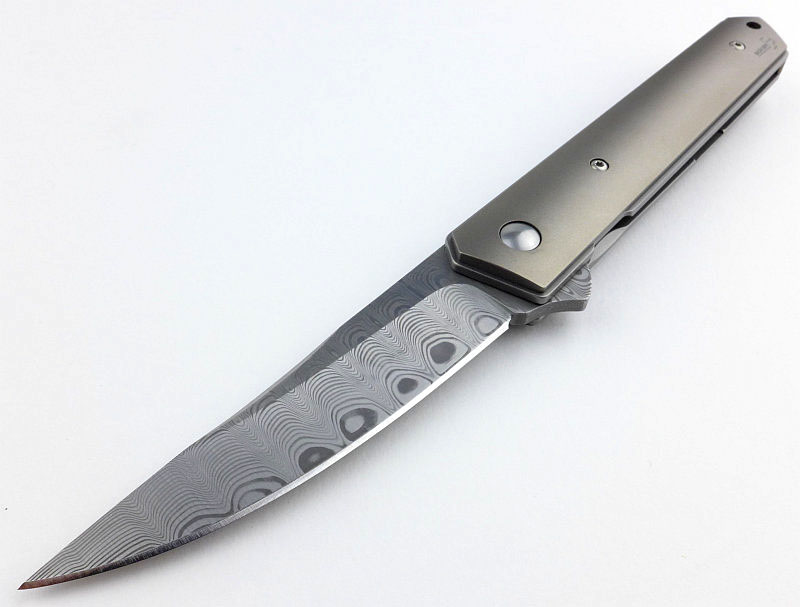
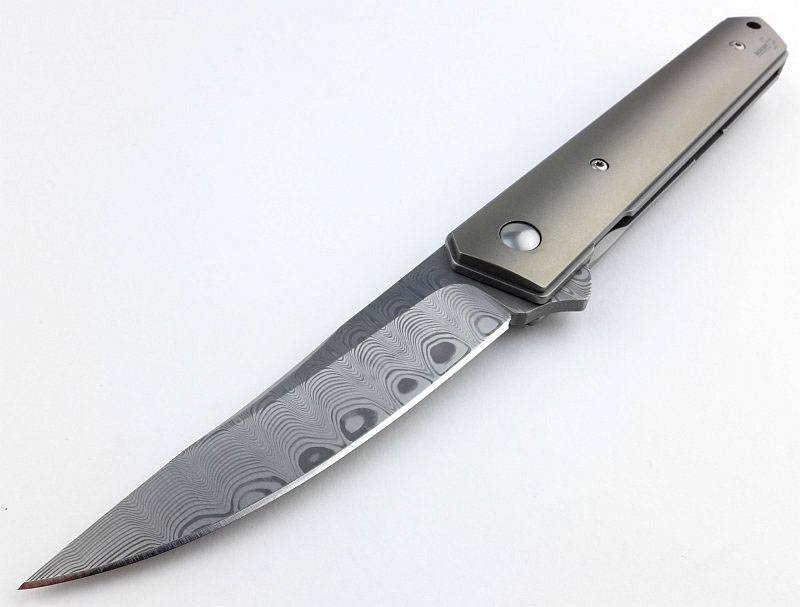
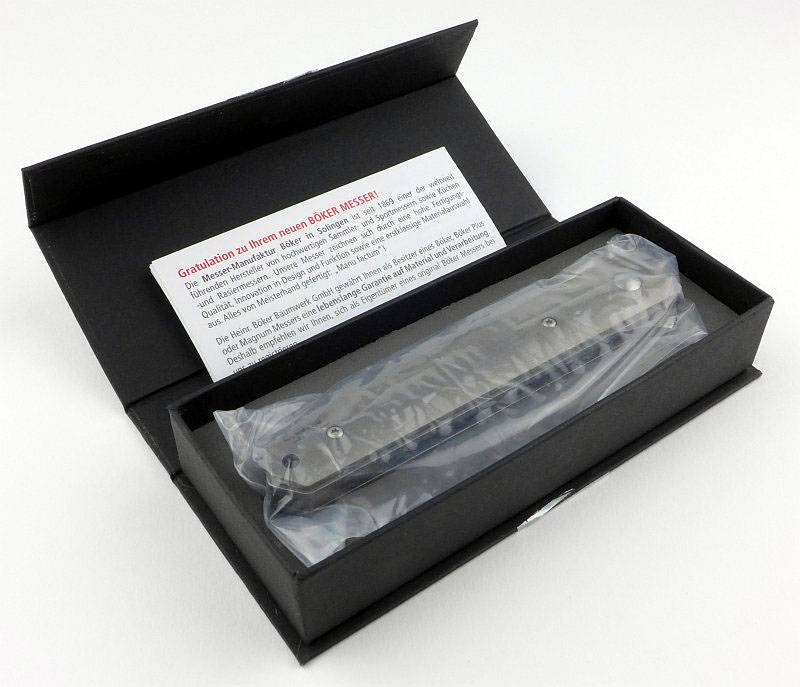
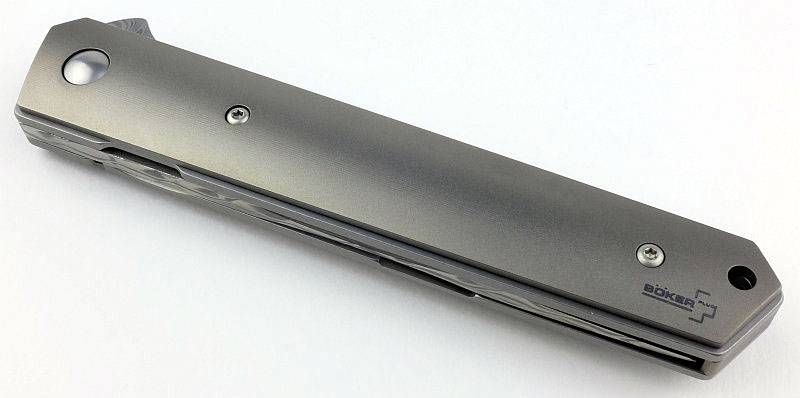
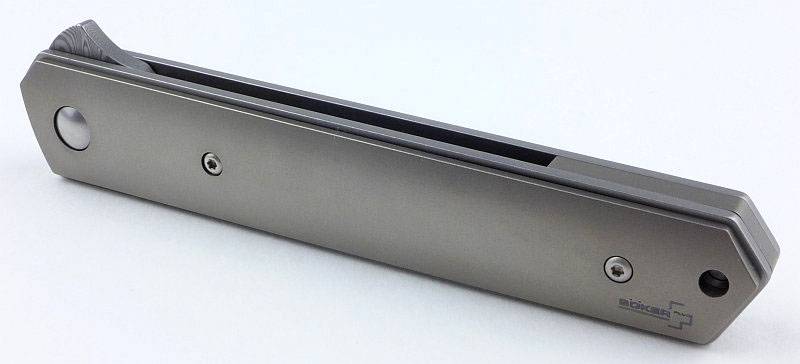
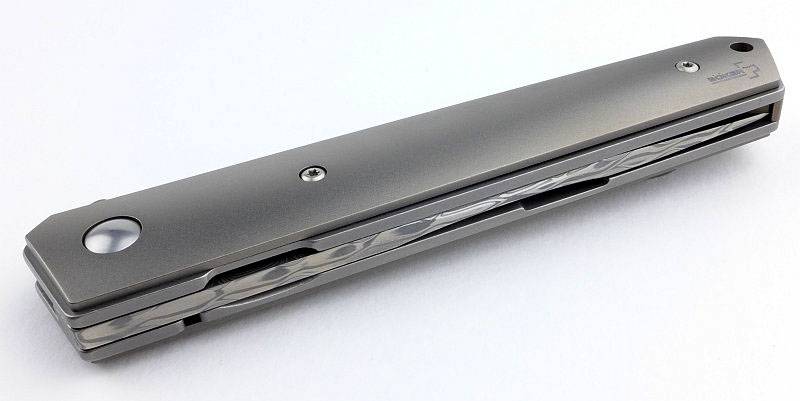
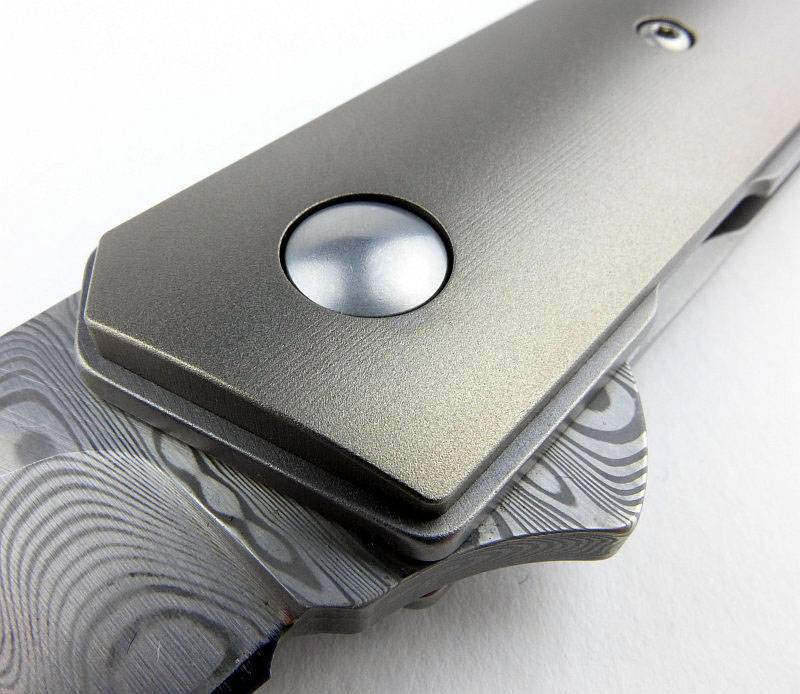
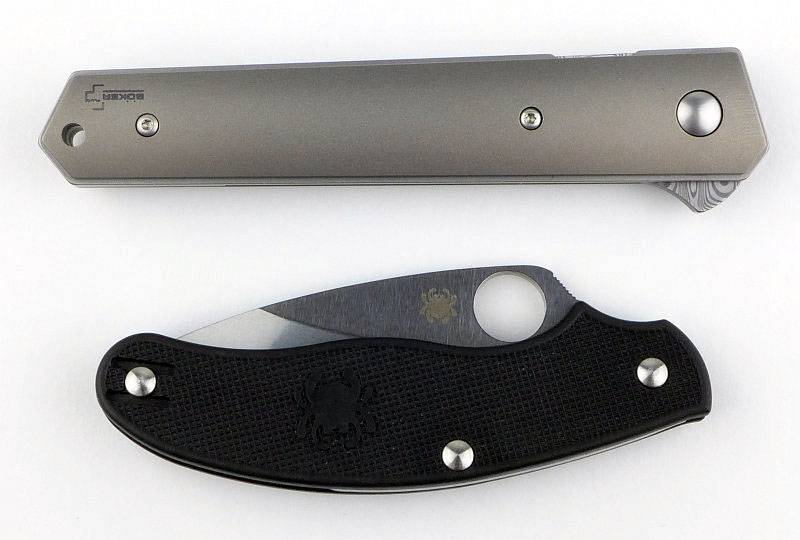
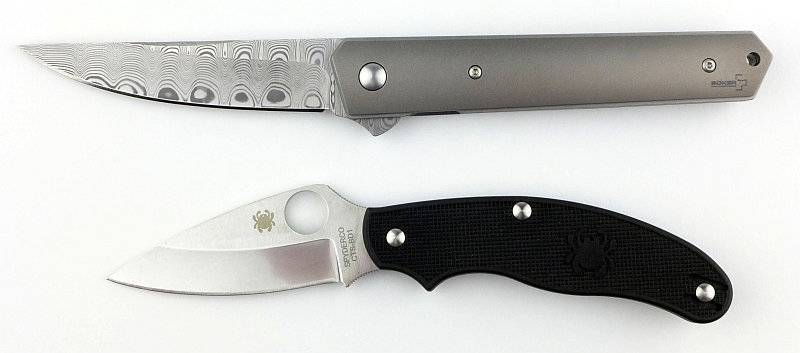
The Böker Plus Kwaiken Flipper is one of Böker Plus’s most popular knives, and is the result of a collaboration with renowned knife maker Lucas Burnley. The Kwaiken Flipper is available in many variations of blade and handle materials. This review is looking at the Damascus / Titanium version.

The Blade and Handle Geometry:

Most knives specifications have a basic description of the blade geometry, but in this section I will be taking a more detailed look at geometry and balance.

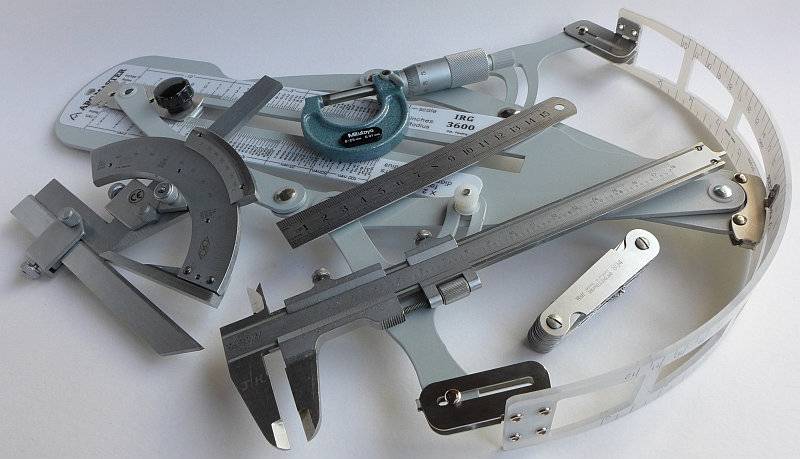
Using a set of gauges and precision measuring equipment including a Vernier protractor, callipers, fixed radius gauges and the unique Arc Master adjustable radius gauge (the one that looks like a crossbow).

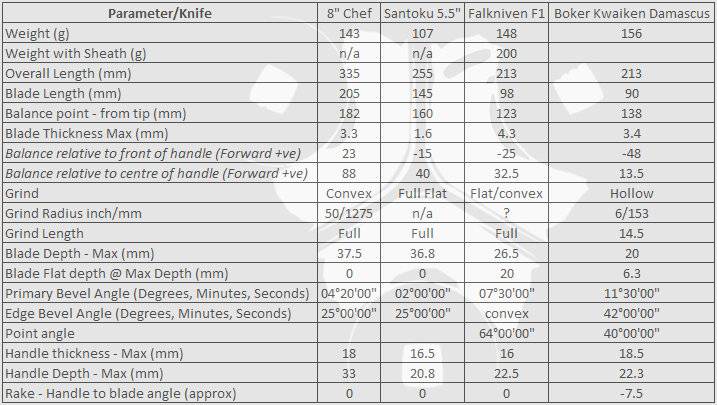
These measurements have been tabulated and are presented along with a few reference blades (8″ Chef’s Knife, 5.5″ Santoku and the popular Fallkniven F1).

Key aspects such as the primary bevel angle, grind type, blade depth, blade thickness, length, weight are detailed, along with balance information.

The ‘Balance relative to the front of the handle’ tells you if the knife will feel front heavy, or if the weight is in your hand (a positive value means the weight is forward of the front of the handle). The ‘Balance relative to the centre of the handle’ indicates how close to a ‘neutral balance’ the knife has in the hand.

In the case of full convex grinds the approximate centre of the grind is used for the primary bevel angle estimate.

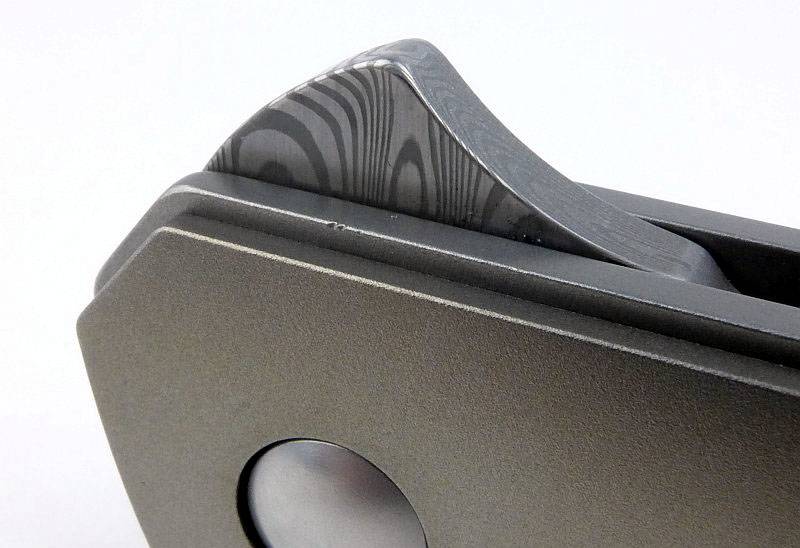
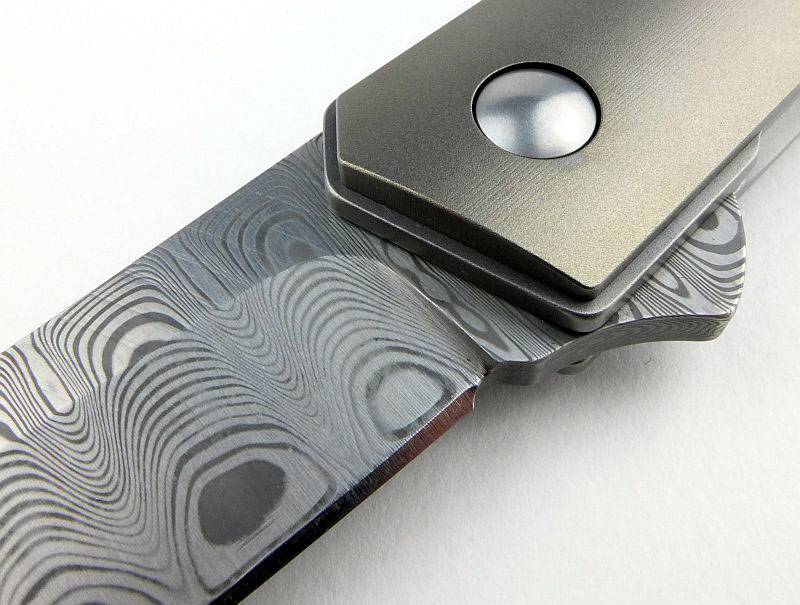
The blade is made from Odins Eye pattern DAMASTEEL martensitic stainless Damascus steel.

Explained by the Maker:

The reasons for certain design choices may not be clear when simply looking at an object, so this section is intended to give an insight into the thinking behind a design by speaking to the designer themselves.

Unfortunately I can’t always get time with the designer so will use this section to include relevant information about the knife and its designer.
This knife started as the distinctive Kwaiken fixed blade design created by Lucas Burnley from New Mexico. Lucas Burnley wanted to transfer the thin and narrow concept into a folding knife, without changing the proportions too much. Working with Böker, Lucas developed the Kwaiken folder in thumb stud and flipper varieties maintaining the unique character of the clean lines and sleek design

In keeping with the sleek design, the knife uses a hidden stop pin, IKBS ball bearing system and liner locking mechanism.

The Böker Plus Kwaiken flipper has been available in several other versions with a recent upgrade to VG-10, but this special edition is presented with the blade made from the Swedish powdered-metal Damascus steel (ie DAMASTEEL).
Before talking a little more about the exact steel used in this knife, here is a quick note about Damascus steel:

Damascus steel was considered the ultimate blade material in the Middle Ages, and is named after the Syrian city of Damascus, a once important commercial centre for knives and swords with blades made from this special composite steel.

Ignoring its decorative appeal, Damascus is a composite steel, (made of at least two steels with different properties). These steels are folded over each other again and again creating a layered structure which is clearly visible when etched. Combining the steels in this way allowed their respective strengths (edge holding and toughness) to overcome their weaknesses (easily blunting and brittleness) resulting in a far superior steel. The more layers in the final steel, the better they work together.

The properties of Damascus steel can now be recreated in a single modern steel so it is no longer necessary to use Damascus steel. Damascus steel is still highly desirable for its historical and decorative appearance.

DAMASTEEL is a Swedish brand of specialist manufacturer of stainless Damascus steel.

DAMASTEEL’s products are all made from a martensitic stainless Damascus steel which is a powder based steel with the two alloys RWL 34 and PMC 27. They are both variations of the martensitic stainless steel 420 type with a minimum of 13 percent chromium content.

For the Kwaiken flipper, Böker Plus have chosen the ‘Odins Eye’ pattern. When etched to bring out the detail of the layers, the RWL34 shows as Bright and the PMC27 as Dark.

A few more details:

The Kwaiken folder arrives in a sealed presentation box.

The box lid is held closed by a magnetic catch, and the knife is plastic wrapped and held in a foam liner.

The first full view of the super sleek Kwaiken flipper fresh out of the box.

A couple of hints of something special. First the flipper is clearly Damascus steel, and secondly, the folded knife is sitting upright with the blade opening downward – not something you can do with most folding knives. Oh and let’s not forget the Titanium scales.

Yes that definitely is Damascus.

Turning it over to look at the spine of the blade and you can see it sits flush with the liners giving a completely flat profile. The only part of the blade protruding from the handle is the flipper.

The small pocket clip is steel.

Looking down into the handles, there is still something we haven’t seen, a stop pin. This is because the Kwaiken folder uses a hidden stop pin which runs in a slot cut into the blade tang near the pivot, allowing it to be totally out of sight.

We can start to take in the details on the blade-side of the handle. The spine of the blade shows the Damascus pattern etched into it along with some sculpting. There is also the liner lock detail from its spring section to the lock release cut-out.

Moving closer there is just a small cut-out to give just enough access to the lock bar to release it, and the lock bar has a shallow bevel to ‘ease’ the corner of the lock bar where you press on it.

Two long scallops on the blade spine sit near the thinned liner which acts as the lock bar spring.

And the blade emerges…

…allowing us to take in the beauty of that Damascus blade. The etching of the blade brings out the layers, but you can see how the polished edge conceals those layers. (To those not familiar with Damascus steel, it is only the etching that shows the layers, otherwise it would look no different.)

This image has several details of note. The blade has a sharpening choil – this is a favourite feature of mine. The entire blade side is etched including the flipper (the effect this has will be discussed later). You can see some diagonal grinding line remnants on the blade flat as well as some machining lines running along the Titanium handle scales.

Looking very very closely at where the point sits when the knife is closed, you can see it is the tiniest bit off centre. However, for some reason this photo makes it look much worse than to the eye. You can also see a slight unevenness of the final edge bevel, but these are tiny details magnified significantly.

The Böker Plus logo is etched into the Titanium. It appears to be a laser etching but is not ‘cut’ into the surface, instead appearing mainly as a colour change. I can’t find the logo just by feeling for it.

Now to concentrate on the lock and its engagement. Here the full lock-bar is shown from where it bends inward at the thinned section of liner, to the lock surface.

The lock bar does not quite get to the centre of the blade.

A view from the other side.

Having operated the lock quite a few times a set of marks show on the blade’s lock surface giving a better indication of the contact point.

What it is like to use?

To try to describe what this knife is like to use, I need to go back to its ultra-sleek lines with a fully concealed folded blade.

Being so streamlined and being all metal, the Kwaiken feels relatively heavy, yet fine at the same time. In a similar way to the fusion of beneficial characteristics in the Damascus steel used for the blade, the Kwaiken flipper manages to give you the best of each of its characteristics with a reassuring weight and a handle that is slim, elegant and easy to hold.

Flippers vary enormously in the smoothness of their opening. Böker Plus’s Kwaiken flipper is known for is silky flip, but in this photo I’ve gone in very close to look at the etched blade and flipper surface. Though the blade itself runs on an IKBS ball bearing, the lock-bar sits against the side of the blade tang inside the handle.

The lock-bar has a blade retaining detent and once the blade starts to open, the ‘ball’ part of this detent sits against the side of the blade and rubs over the surface. Due to this, the opening of the blade has a slightly gritty feeling as the blade rotates round into the locked position.

Holding the lock bar away from the side of the blade removes this gritty feeling straight away, and the more I flip the knife open, the smoother it is becoming. It is an unfortunate consequence of the Damascus etching and that the entire blade surface is etched. If you go for this version you will forgive this because you wanted this steel.

To give an idea of scale, the Kwaiken flipper is being shown next to a UKPK FRN. Also notice again the fully enclosed blade unlike the UKPK.

And with the blades open. Compared to the UKPK with its contoured grip, finger choil and negative rake, the Kwaiken looks straight, stiff and not very ergonomic, but don’t be misled by this. Actually it sits very well in the hand, not for extended periods of heavy cutting, but for general EDC work it is fine.

For a narrow blade, the blade stock is quite thick and this does affect the ease with which you can make deep slicing cuts. As with any hollow ground blade, the first part of the cut is easy, but as the cut depth increases the blade starts to bind. Having said this I think the spine thickness suits the style and length of blade perfectly and I wouldn’t change it.

The point is great for piercing cuts, in fact with its slim blade the Kwaiken is excellent at deep piercing cuts

The Kwaiken flipper is an outstanding piece of design and I take my hat off to Lucas Burnley for creating a timeless masterpiece which, thanks to Böker Plus, is within reach of just about everyone.

Review Summary

The views expressed in this summary table are from the point of view of the reviewer’s personal use. I am not a member of the armed forces and cannot comment on its use beyond a cutting tool or field/hunting knife.

Something that might be a ‘pro’ for one user can be a ‘con’ for another, so the comments are categorised based on my requirements. You should consider all points and if they could be beneficial to you.

_______________________________________________ _______________________________________________
Things I like What doesn’t work so well for me
_______________________________________________ _______________________________________________
Sleek lines Slight roughness in the opening due to Damascus etch
Fully enclosed blade Relatively heavy
DAMASTEEL blade Small pocket clip
Easy flip
Ball-bearing pivot


If you enjoyed my reviews, please remember to ‘Like’ me on Facebook and follow me on Twitter to get all the latest updates and news. You can also find exclusive insights on Instagram and Pinterest