Knife Review: Buck Selkirk, Compadre Chopping Froe and Kinetic Fishing Spear

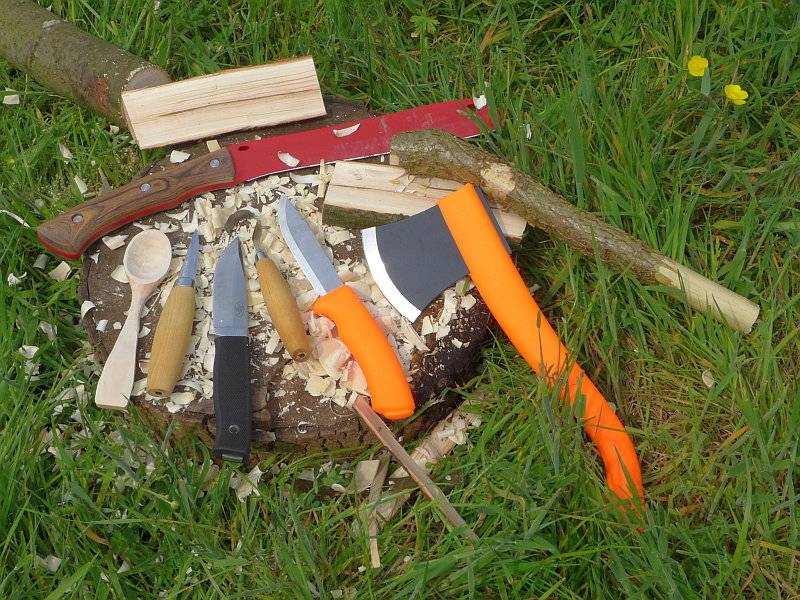
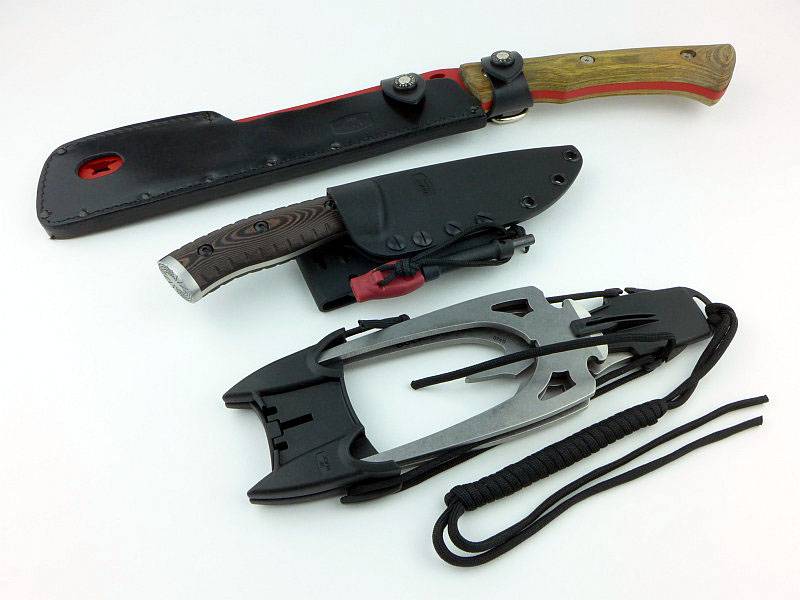
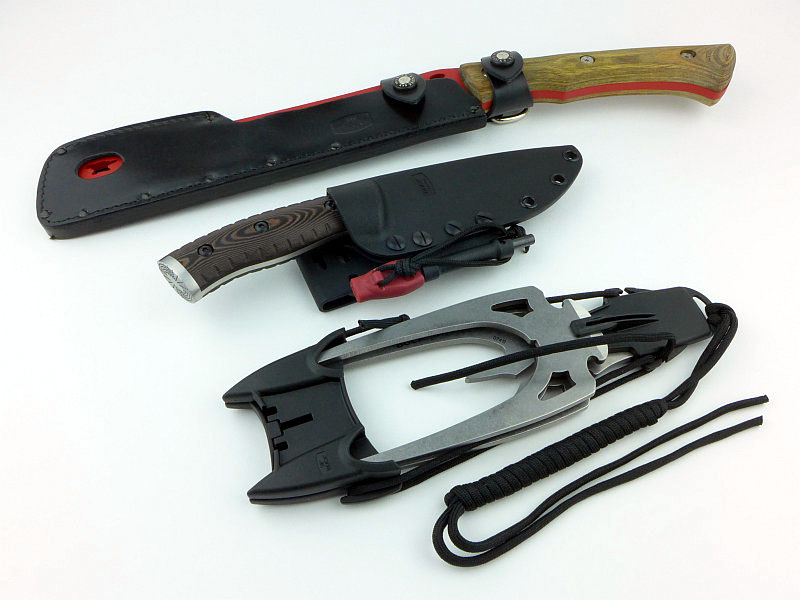
Buck’s Selkirk, Compadre Chopping Froe and Kinetic Fishing Spear were specifically chosen for this review to compliment each other for camp/survival tasks. Following a visit to Buck at IWA 2016 I’ve been able to give these a good workout to see how they fare.

 photo 0 07 trio P1030840.jpg

The Blade and Handle Geometry:

Most knife specifications have a basic description of the blade geometry, but in this section I will be taking a more detailed look at geometry and balance.
 photo 25 Selkirk grind P1180965.jpg

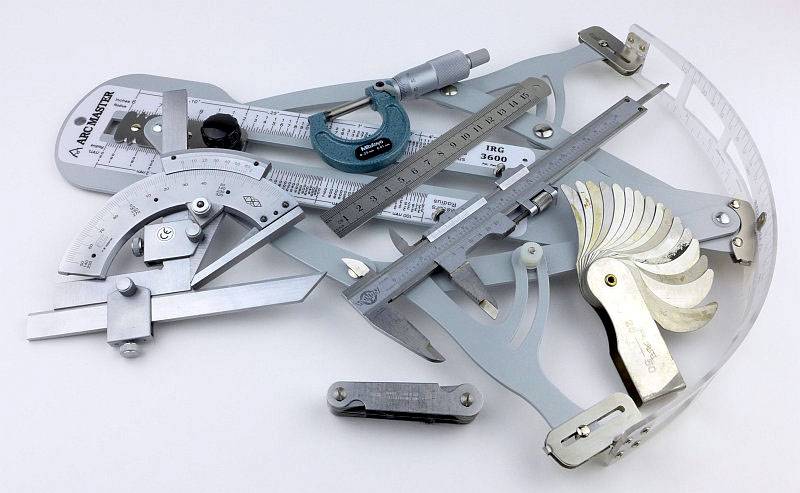
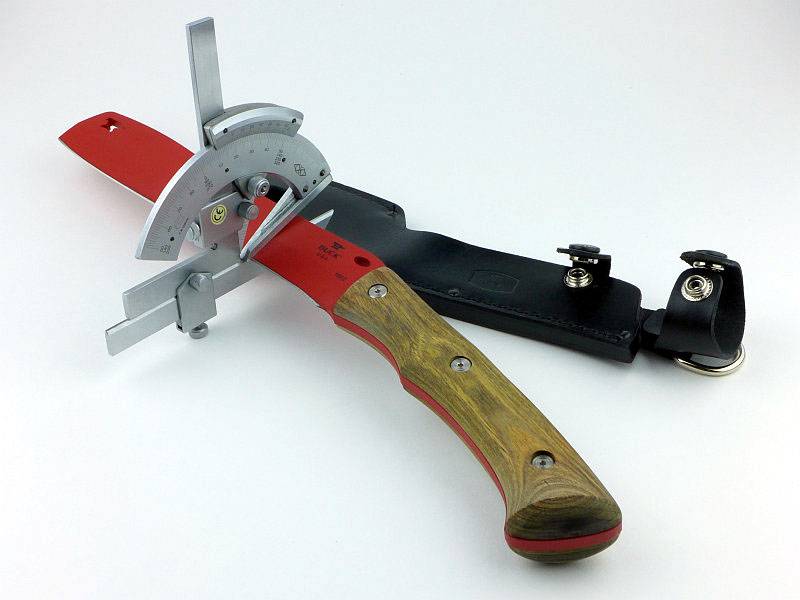
Using a set of gauges and precision measuring equipment including a Vernier protractor, callipers, fixed radius gauges and the unique Arc Master adjustable radius gauge (the one that looks like a crossbow).
 photo Knife measuring P1180483.jpg

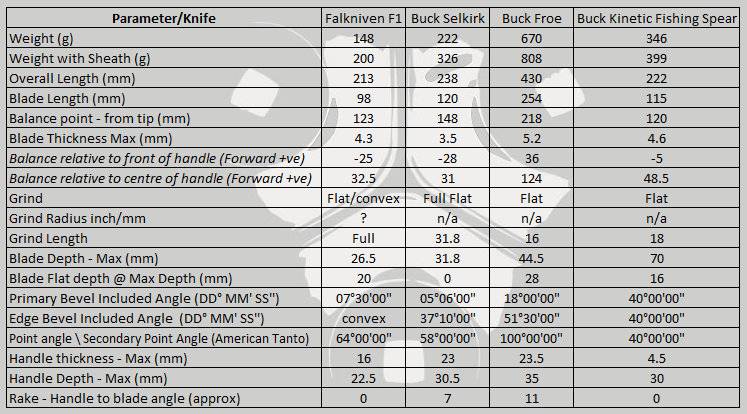
These measurements have been tabulated and are presented along with a few reference blades (8″ Chef’s Knife, 5.5″ Santoku and the popular Fällkniven F1).

Key aspects such as the primary bevel angle, grind type, blade depth, blade thickness, length, weight are detailed, along with balance information.
 photo 54 Froe grind angle P1180981.jpg

The ‘Balance relative to the front of the handle’ tells you if the knife will feel front heavy, or if the weight is in your hand (a positive value means the weight is forward of the front of the handle). The ‘Balance relative to the centre of the handle’ indicates how close to a ‘neutral balance’ the knife has in the hand.
 photo 24 Selkirk balance P1180963.jpg

In the case of full convex grinds the approximate centre of the grind is used for the primary bevel angle estimate.

 photo Buck Parameters.jpg

Explained by the Maker:

The reasons for certain design choices may not be clear when simply looking at an object, so this section is intended to give an insight into the thinking behind a design by speaking to the designer themselves.

Unfortunately I can’t always get time with the designer so will use this section to include relevant information about the knife and its designer.

The following comments are noted from a walk-through that Joseph Piedmont kindly gave at SHOT Show.

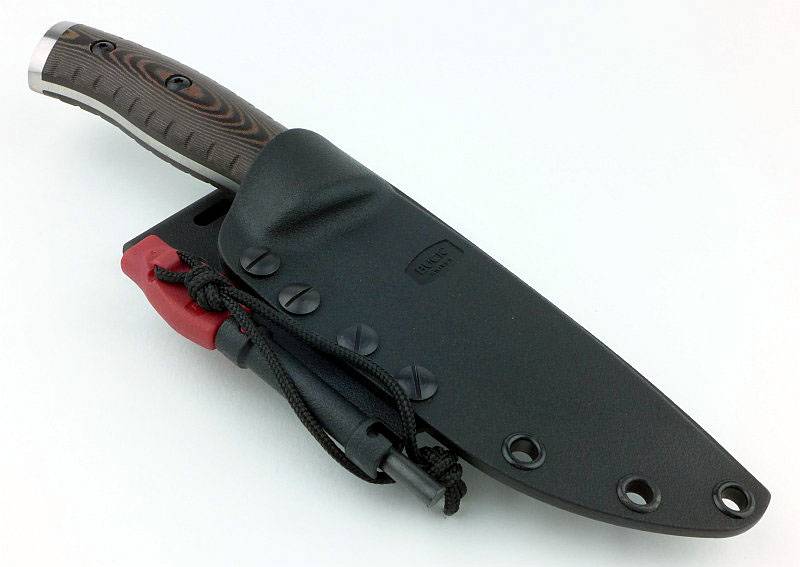
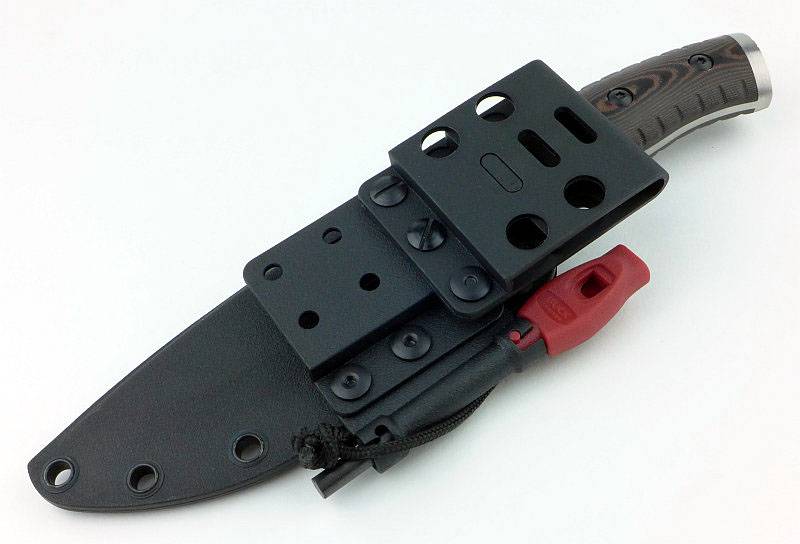
Model 863, the Selkirk is Buck’s new survival knife which includes a fire-rod with whistle for signaling. The sheath is moulded plastic and features multi-carry capability that can be reconfigured to allow for vertical or horizontal carry, and even upside-down as a neck knife.

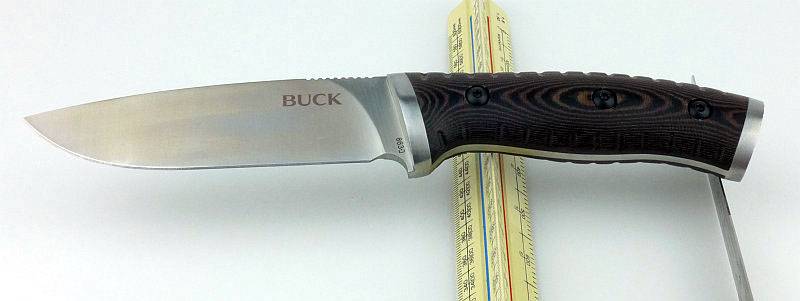
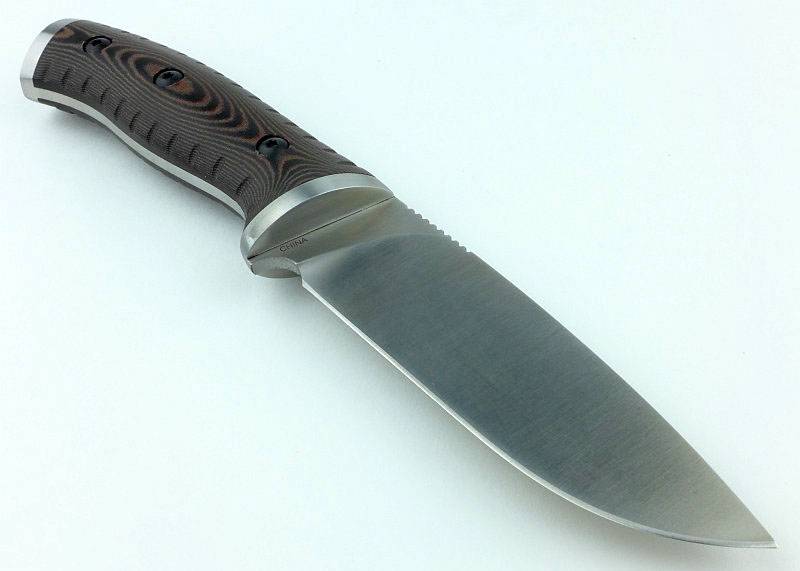
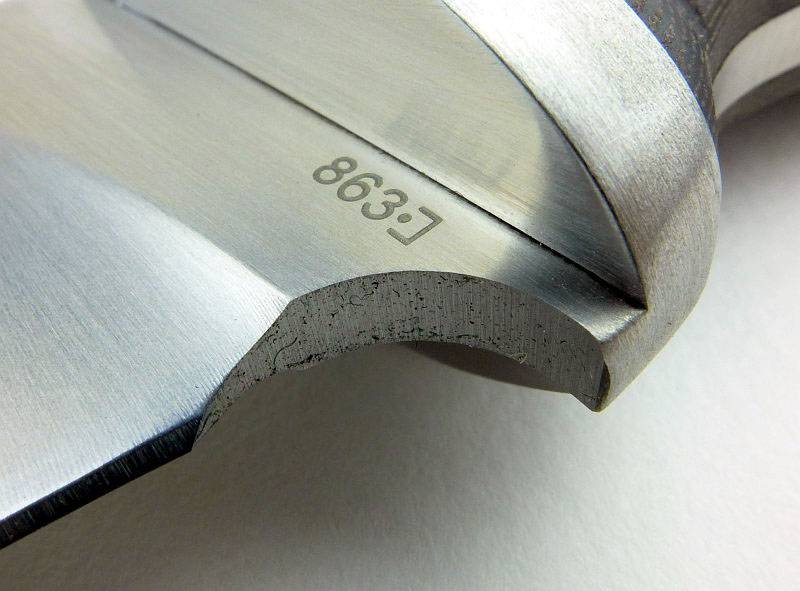
The knife itself is a flat-grind drop-point featuring a guard and a hammer pommel. The handle has custom micarta sides. The choil is left with its sharp ground edge to allow it to be used with the fire-starter and have a nice grip to get good sparks.

The Selkirk’s sheath has a nice crisp snap-in, really holding the knife, so you won’t have to worry about it falling out.

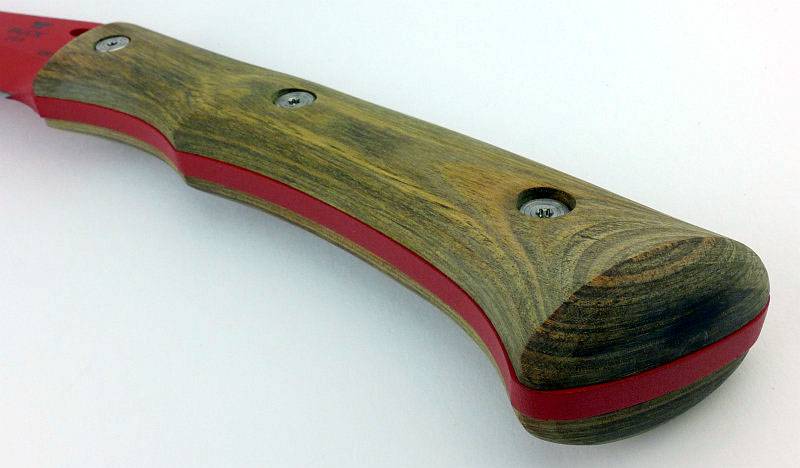
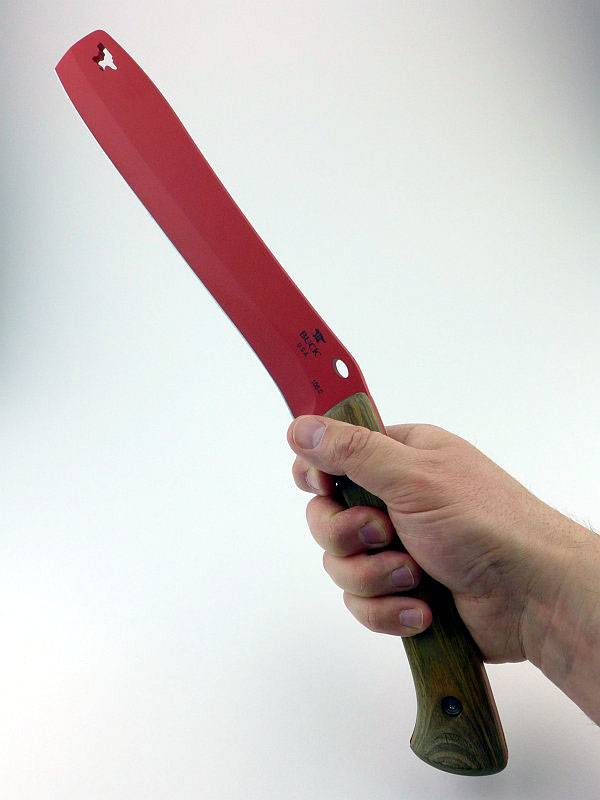
Chopping Froe model 108 is fitted with American walnut handles and a red powder coated 5160 blade. This is part of the camping and outdoor survival series. Red was chosen to tie in camping of yesteryear (where it was common to use red-headed hatchets), with the camping of today.

The knife was modelled from a Scandinavian tool with the same name used to chop kindling. Buck have modified it with the handle and putting a knife edge on it to make it more versatile. (Reader’s NOTE: a traditional froe has a dull edge, a handle at 90 degrees to the blade, and is use for controlling and advancing a split in a piece of wood)

The Buck froe has been given a very steep grind producing a wedge behind the knife edge. When splitting wood, the knife edge starts the cut, but the wedge takes over so the knife edge is not finishing the cut.

The black leather sheath protects the blade and the D-ring makes it really easy to connect it to your gear or hang it up.

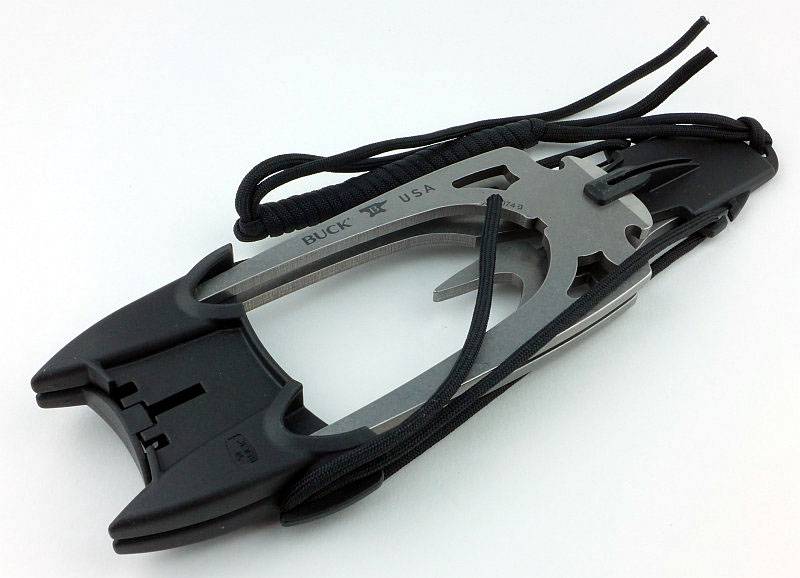
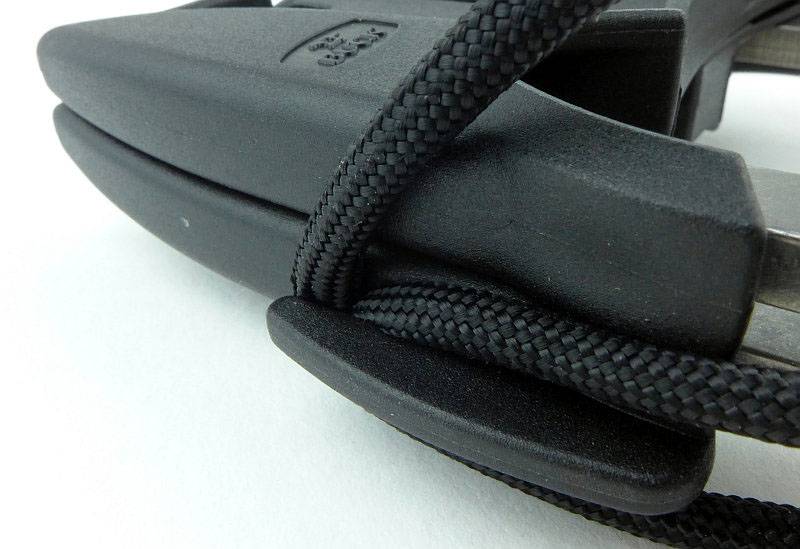
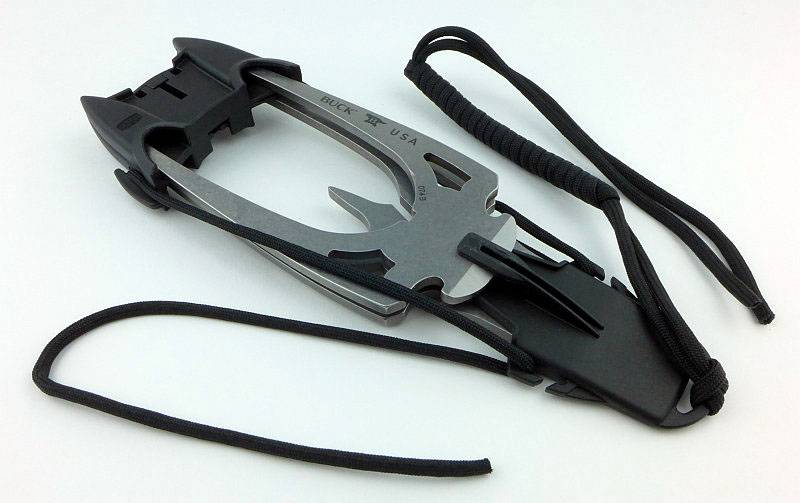
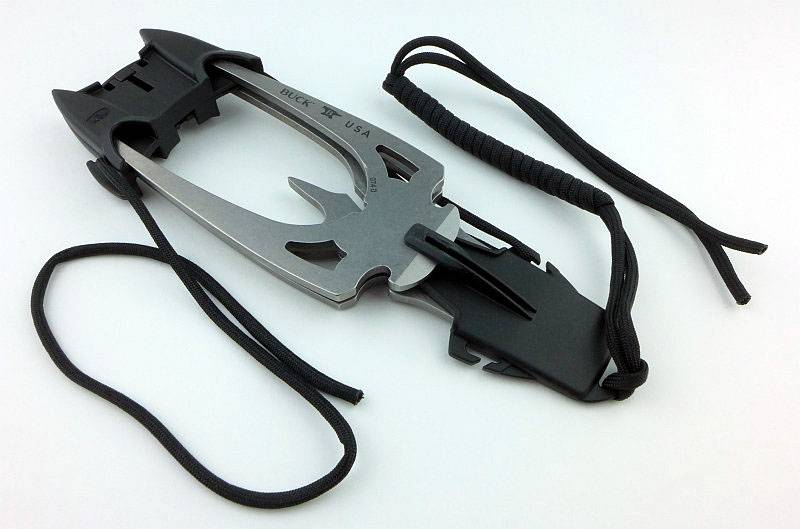
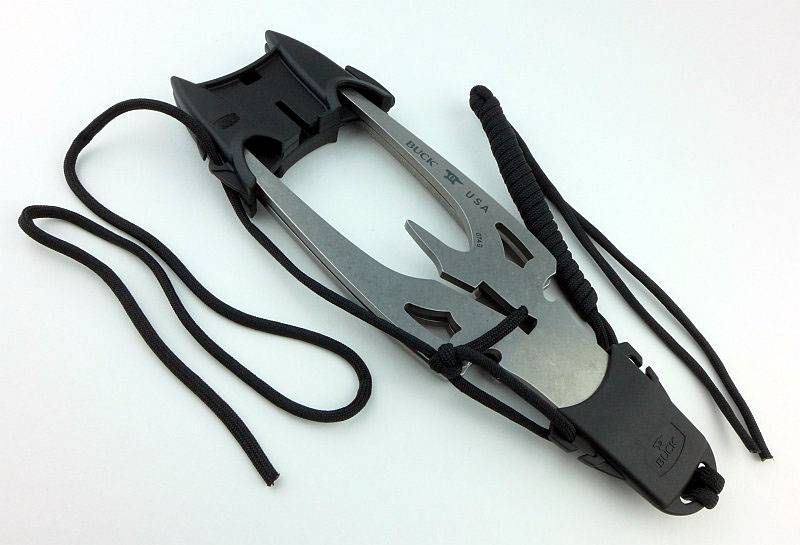
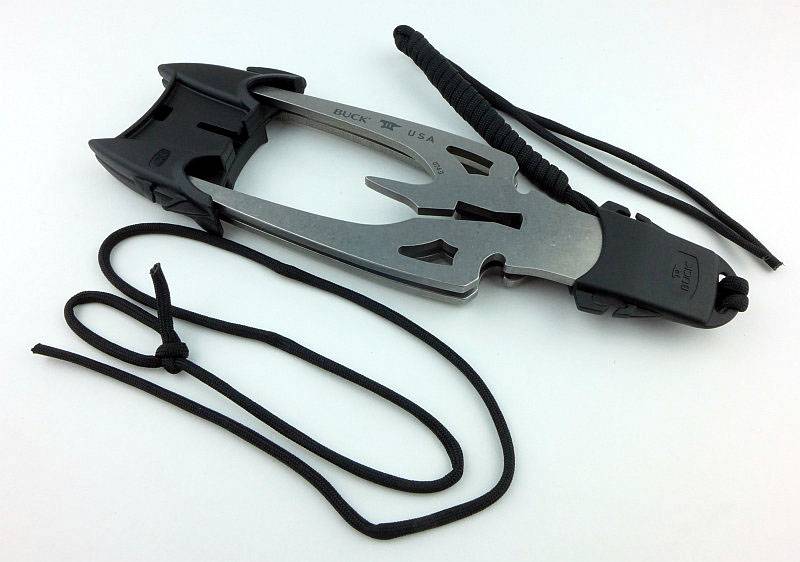
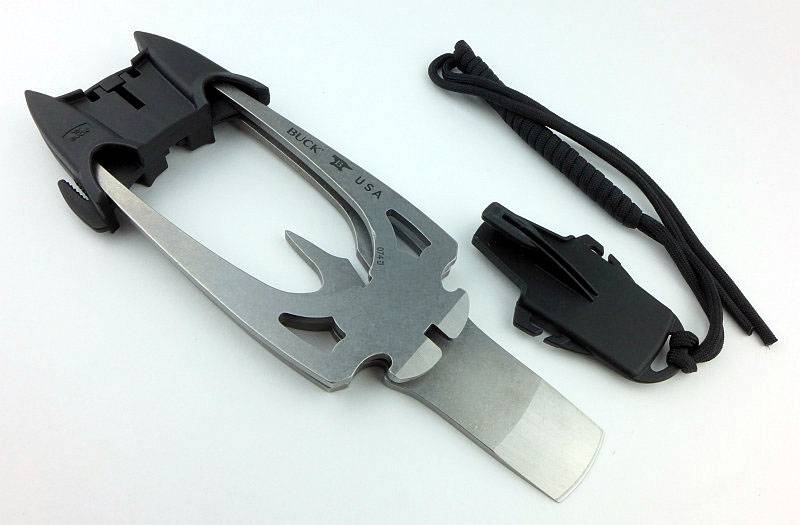
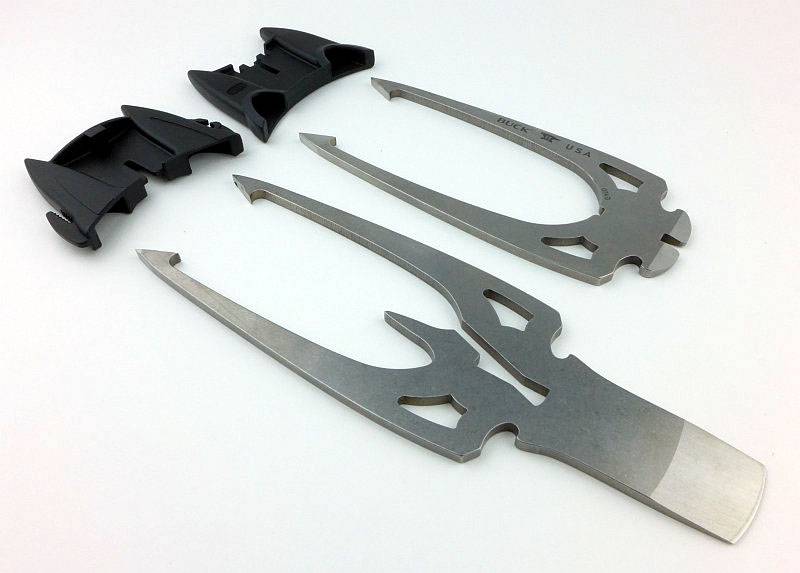
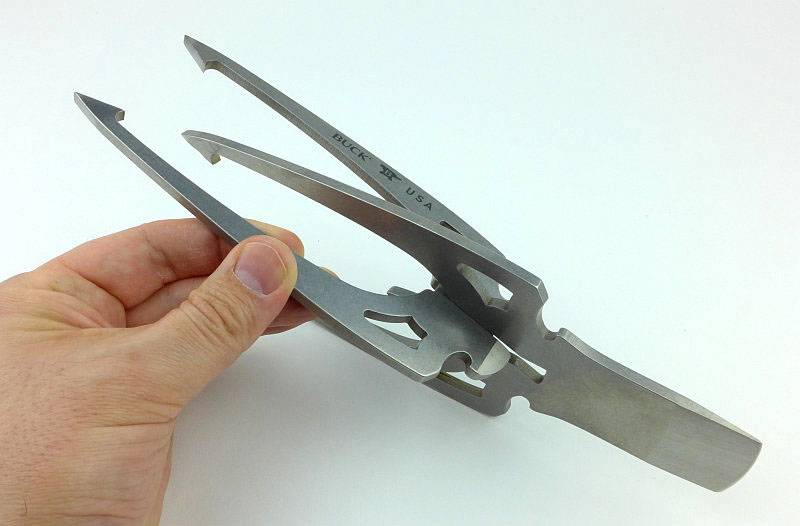
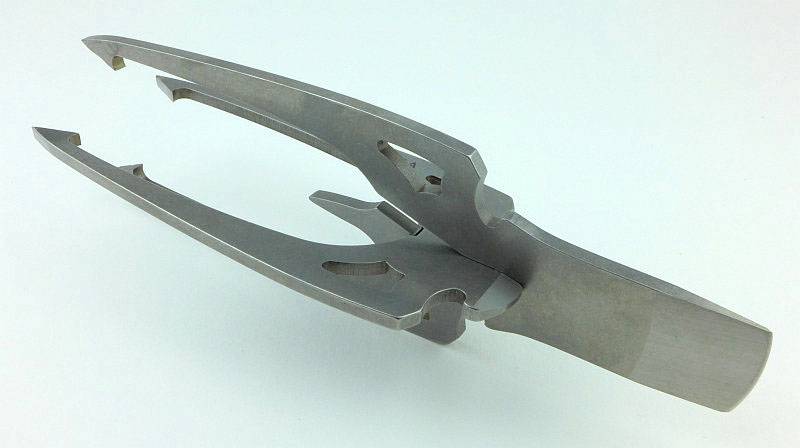
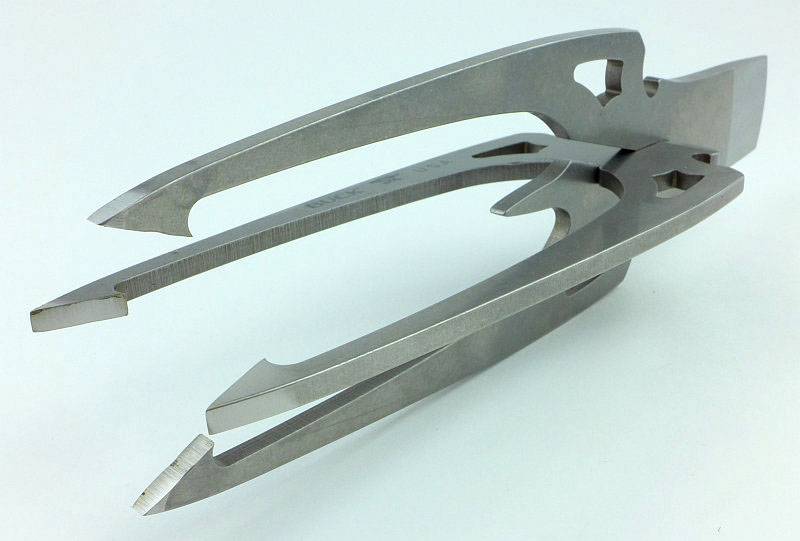
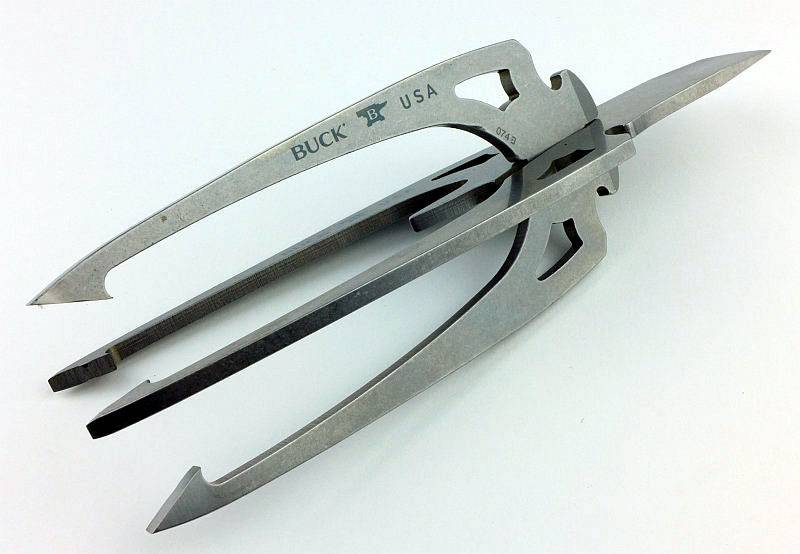
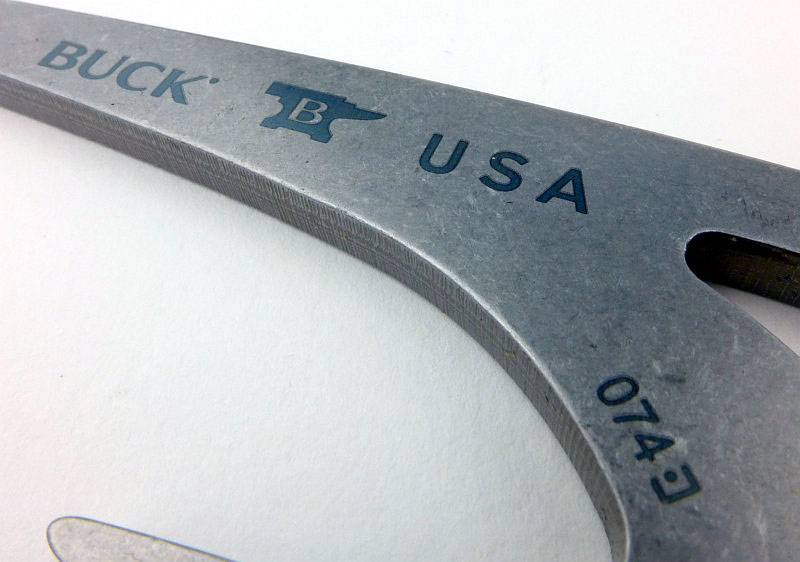
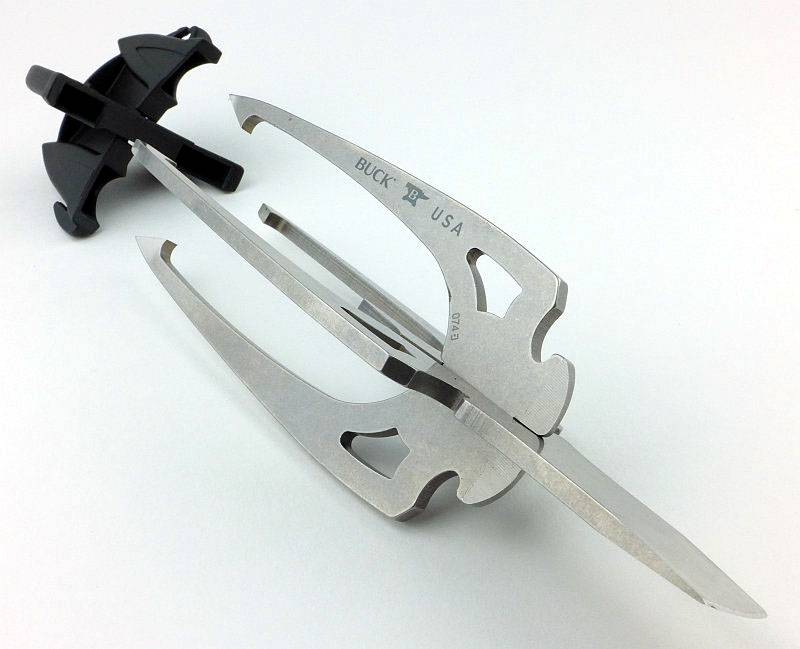
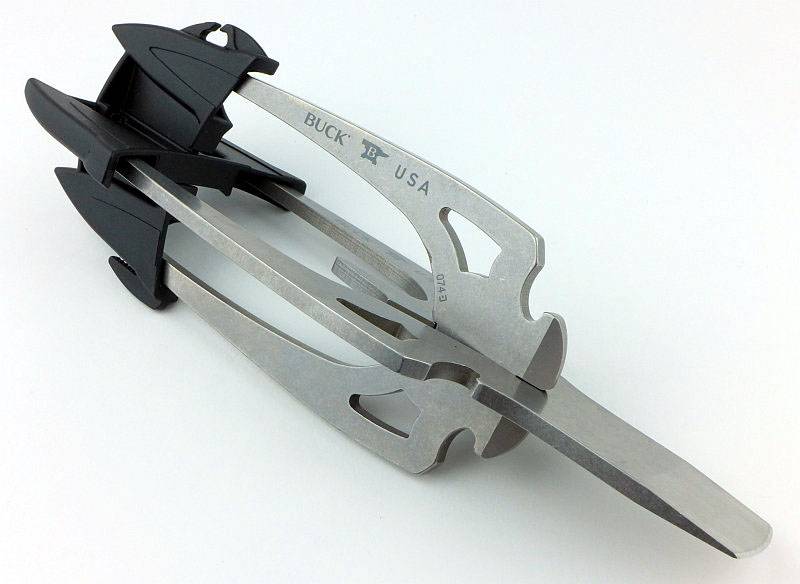
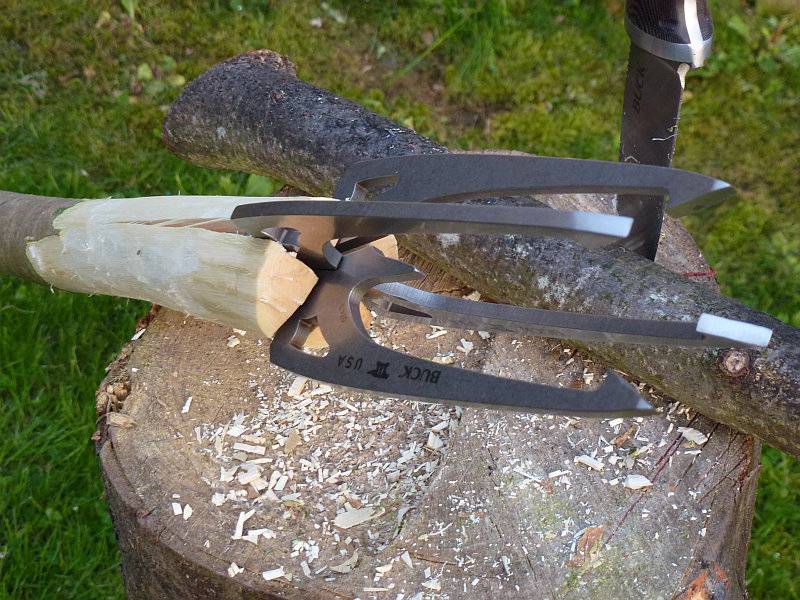
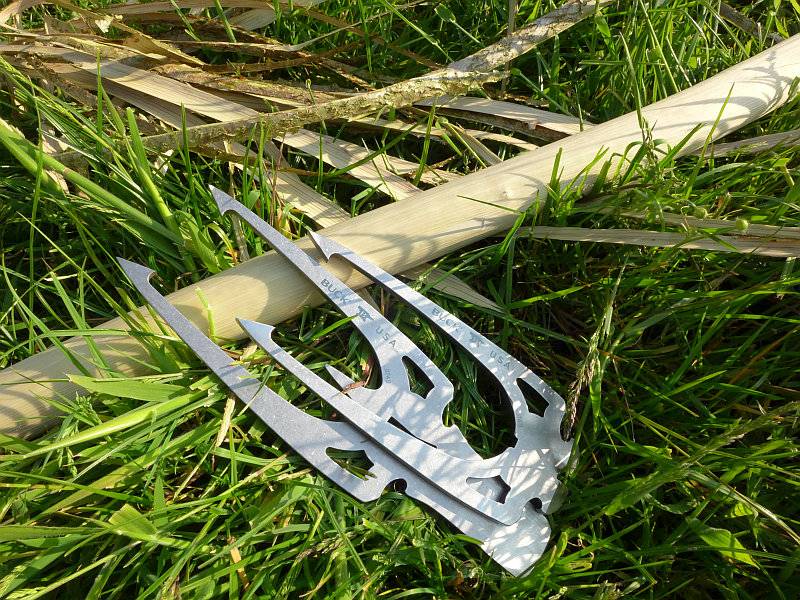
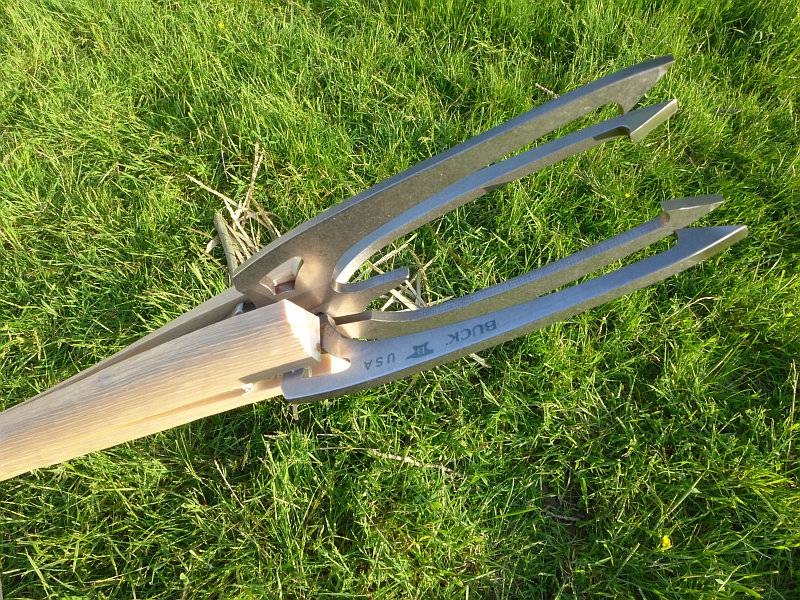
The Kinetic Fishing spear is one of three new spears. This range goes from the smallest, the Hunt Spear, to the Two Tined Gig spear, and finally the 074 Fishing Spear. The fishing spear is the most involved design with two interconnecting pieces. In its folded-flat state the spear is covered front and back by a plastic sheath tied together with paracord. The paracord is held in place with a moulded pinch-grip making it quick and easy to secure and release. The two parts of the spear lock together to form a four point spear. It has the same chisel on the back as the other two spears, and crucially needs to be driven deep enough into the stick to engage the secondary wedge. The beauty of this design is that the sheath parts go from the flat packed configuration into a cross shaped safety cover for the four points when it is mounted.

One trick to be aware of when mounting the spear heads is to wrap the paracord onto the stick before pounding the spear into the end of the stick. This really tightens up the paracord giving a very secure fit.

A few more details of the Selkirk Survival Knife:

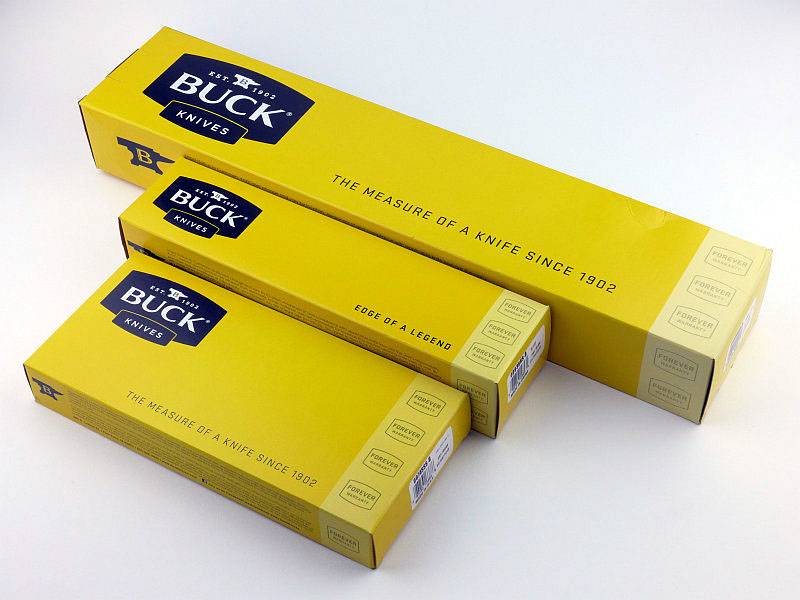
Before concentrating on the Selkirk, here are the boxes for all three together.
 photo 00 01 Buck Boxed P1180722.jpg

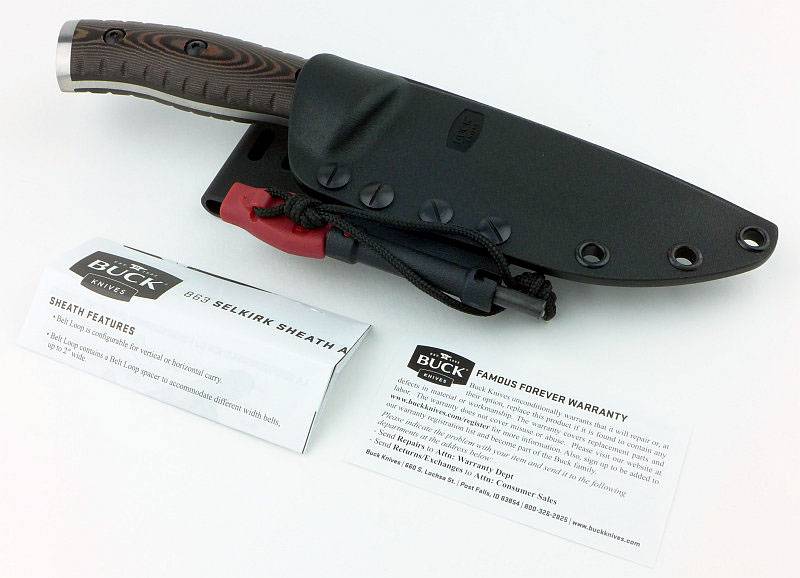
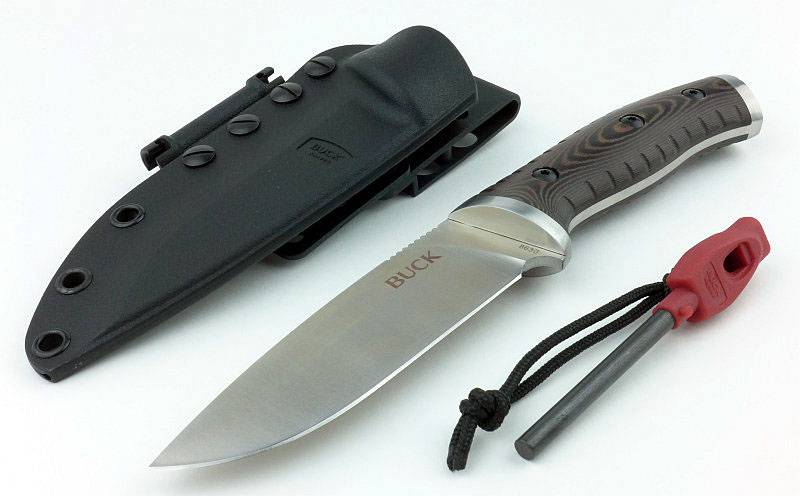
The Selkirk arrives in its sheath with ferrocerium rod and whistle, plus an instruction leaflet for the sheath mounting options and a warranty card.
 photo 01 Selkirk Contents P1180728.jpg

Though it looks like a Kydex type of sheath, it is a moulded plastic.
 photo 02 Selkirk Sheath front P1180731.jpg

On the back of the sheath, the belt loops can be removed and refitted in different positions.
 photo 03 Selkirk Sheath back P1180734.jpg

All the components lined up with the sheath, knife and ferrocerium rod/whistle.
 photo 04 Selkirk parts P1180740.jpg

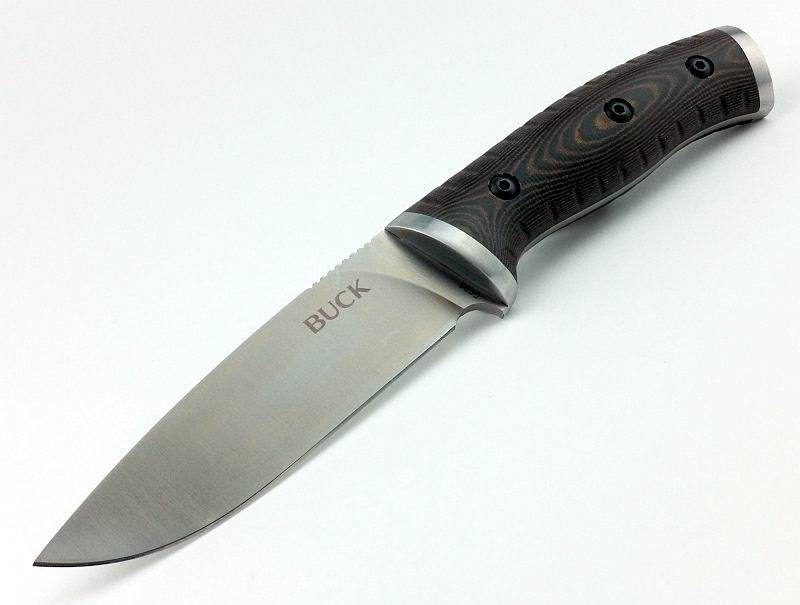
The Selkirk has a nice deep blade with full flat grind.
 photo 05 Selkirk angle P1180743.jpg

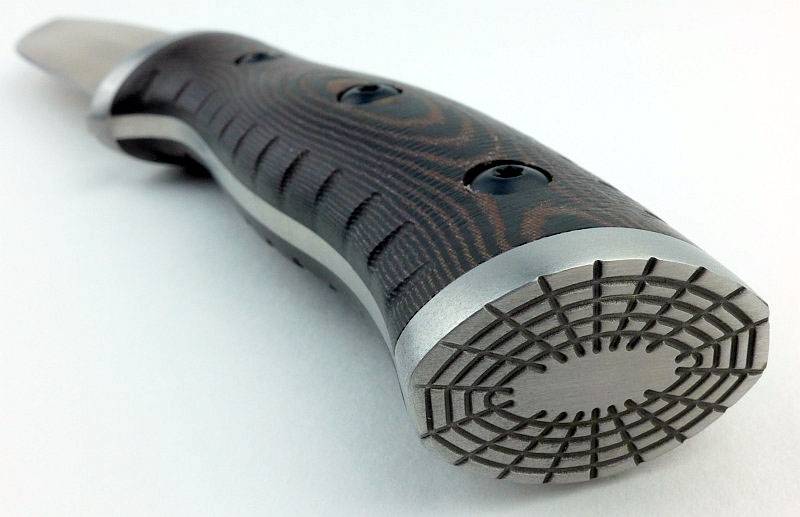
Buck say that the pommel (rear bolster) can be used as an improvised hammer.
 photo 06 Selkirk pommel P1180745.jpg

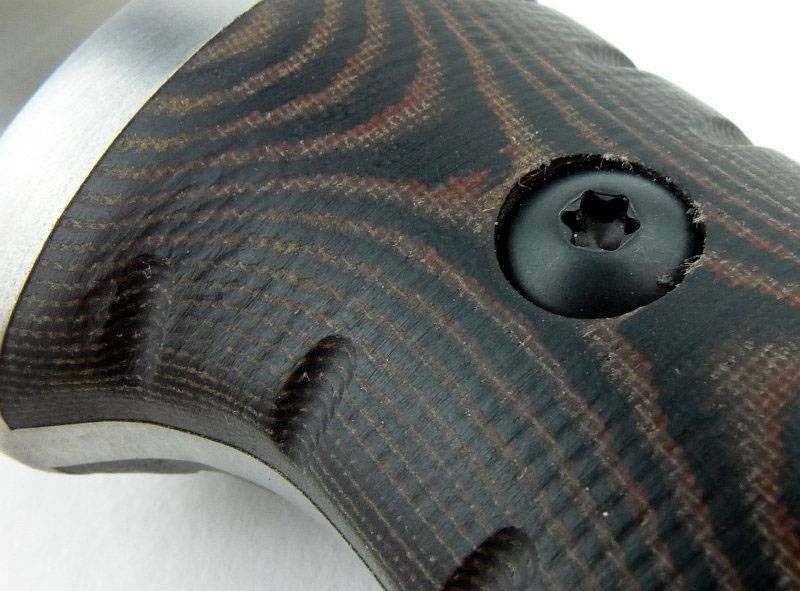
Looking close up at the handle micarta sides you can see the semi-smooth finish and additional grip grooves.
 photo 07 Selkirk grip detail P1180748.jpg

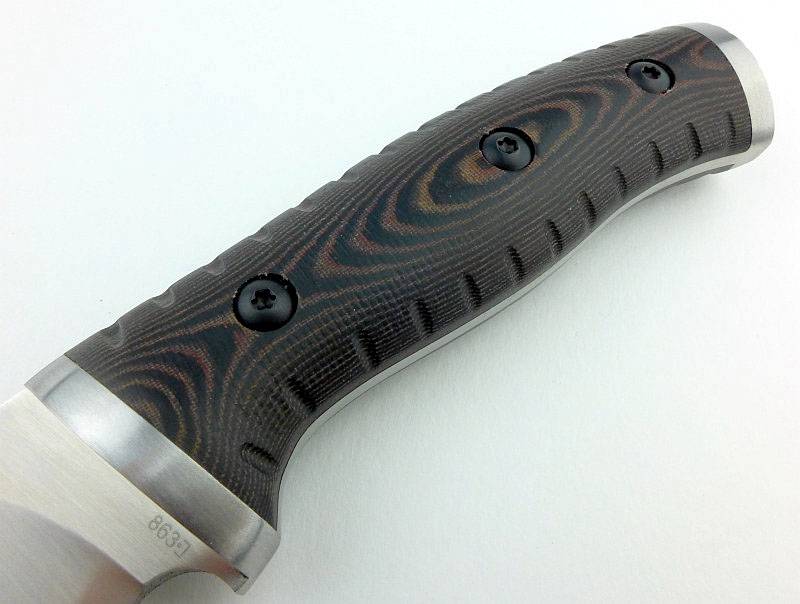
An overall view of the handle. The layers in the micarta act as contour lines showing the shaping.
 photo 08 Selkirk grip P1180749.jpg

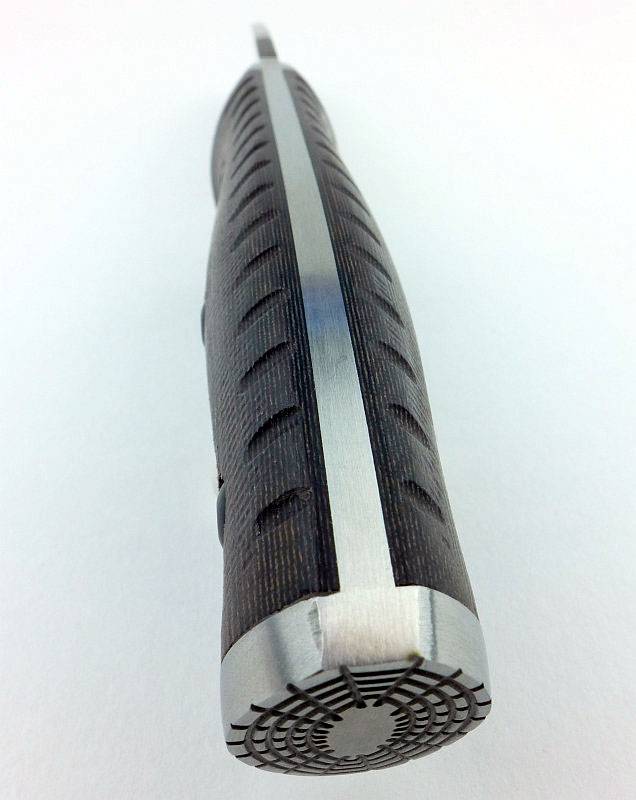
From a different angle you can see the palm swell and grip flaring.
 photo 20 Selkirk handle swells P1180787.jpg

A very close view of the choil and its sharp edges for striking the fire-rod.
 photo 09 Selkirk choil P1180752.jpg

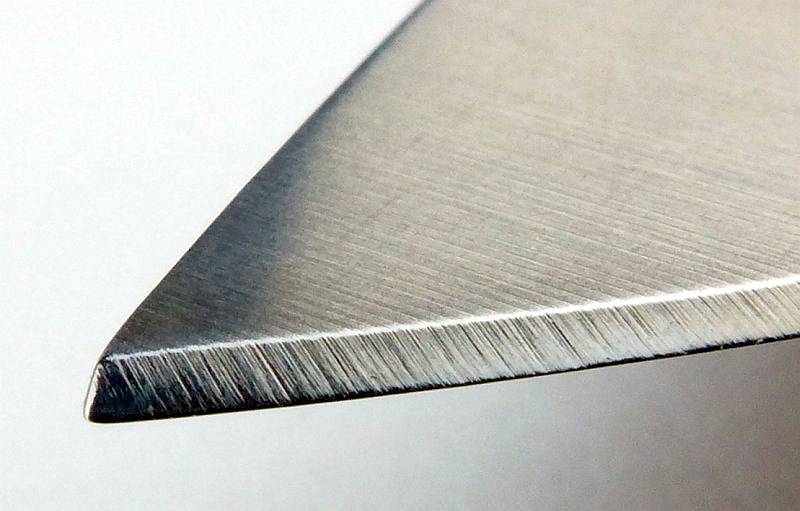
Going closer still for a look at the point and how the cutting edge has been formed from a coarse grit followed by a polishing process.
 photo 10 Selkirk point P1180756.jpg

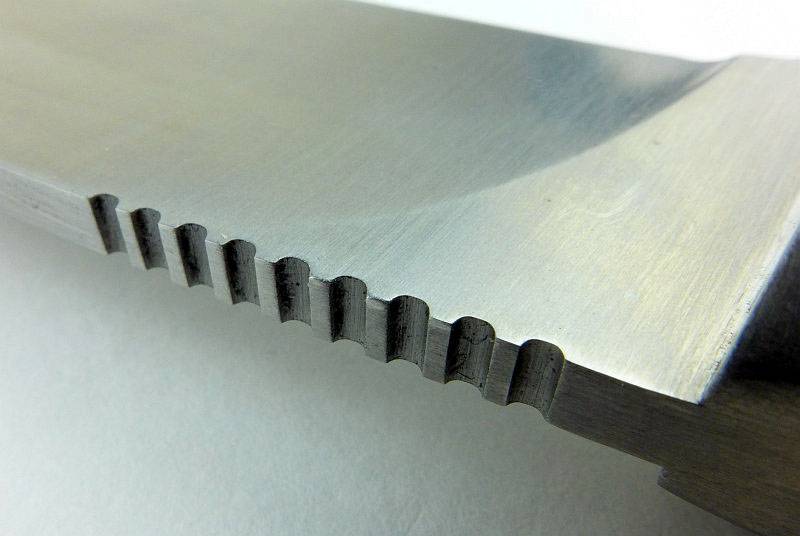
On the spine there is an area of jimping for the thumb to sit on. On this example this was well formed and not too sharp.
 photo 11 Selkirk jimping P1180758.jpg

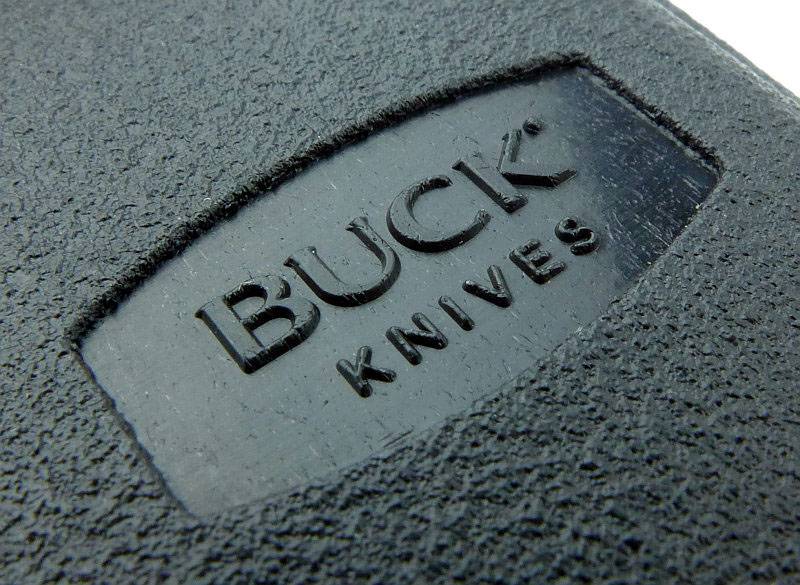
Keeping on the up-close theme, the moulded sheath has the Buck logo moulded into it.
 photo 13 Selkirk sheath brand P1180768.jpg

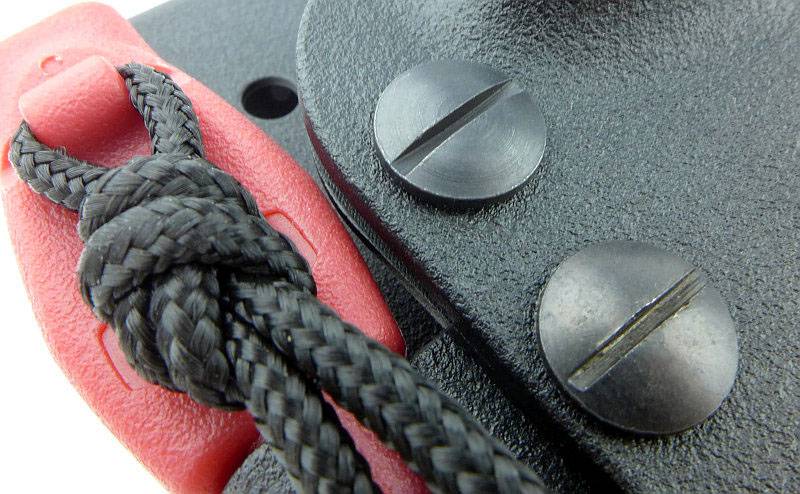
Next to the fire-rod holder are the sheath screws which adjust the retention tension of the sheath. You can change how much force is needed to remove and insert the knife by adjusting these screws.
 photo 14 Selkirk sheath screws P1180769.jpg

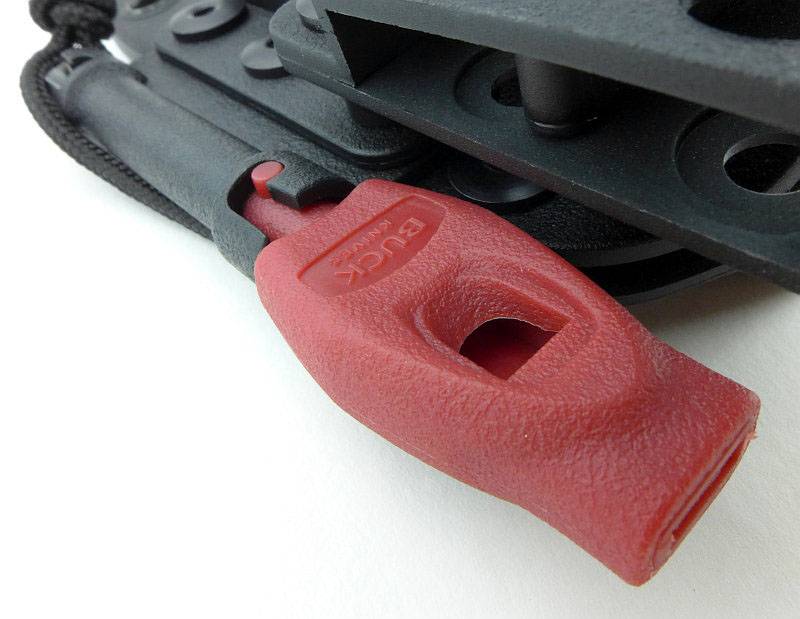
On the lower part of the whistle is a bayonet fitting to hold the fire-rod in place. There is also a cord which can be stretched over the end of the rod to further secure it.
 photo 15 Selkirk ferro rod whistle P1180770.jpg

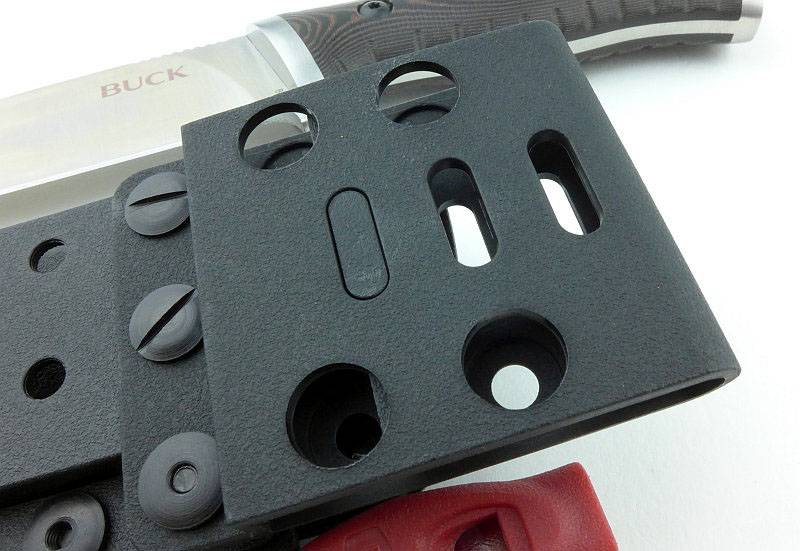
Inside the belt loop is a moveable adjuster block to cater for different width belts.
 photo 16 Selkirk belt loop adjuster P1180775.jpg

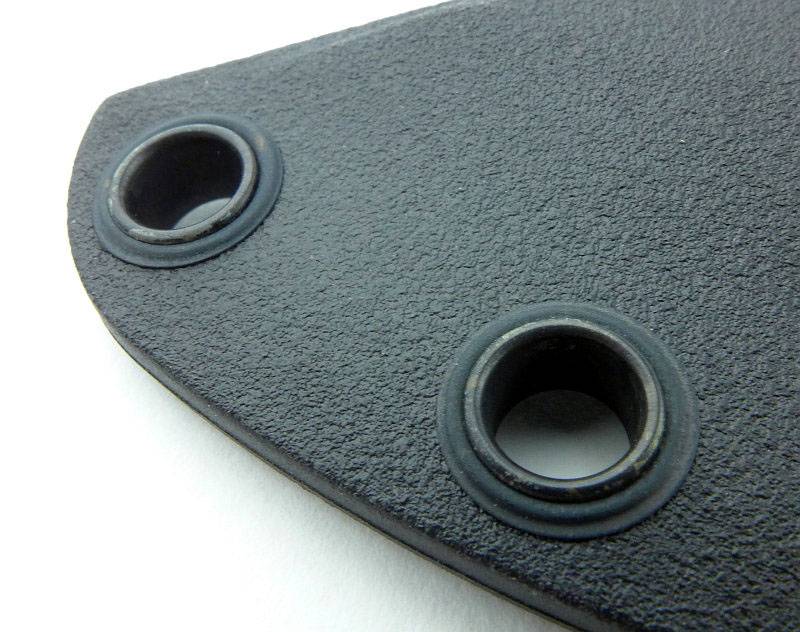
At the tip of the sheath there are metal rivets that provide tying points.
 photo 17 Selkirk sheath rivets P1180777.jpg

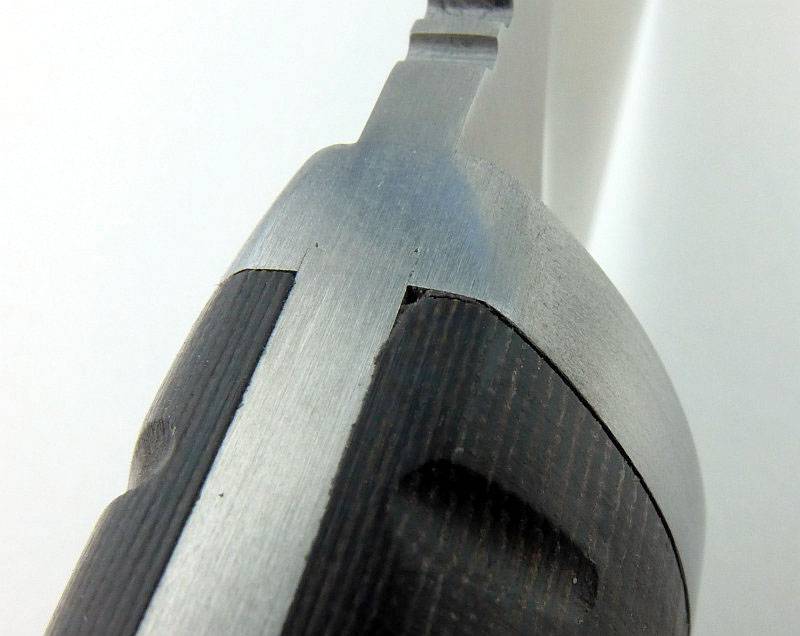
The overall impression of this knife is good, but its mass produced character is visible when you start looking and small details. Here the micarta handle is not a perfect fit.
 photo 18 Selkirk finish P1180782.jpg

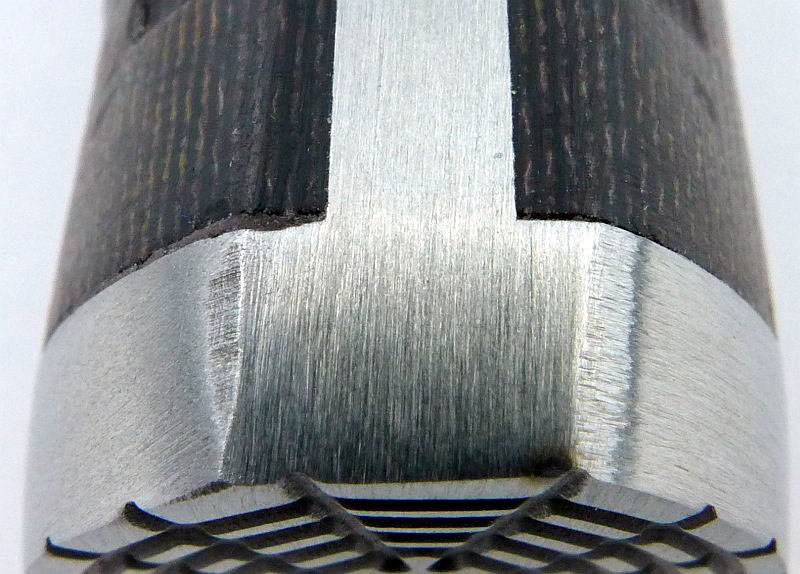
Still looking for flaws, this time at the pommel, the grinding is not that precise and filler appears to have been used between the micarta and steel pommel.
 photo 19 Selkirk finish P1180784.jpg

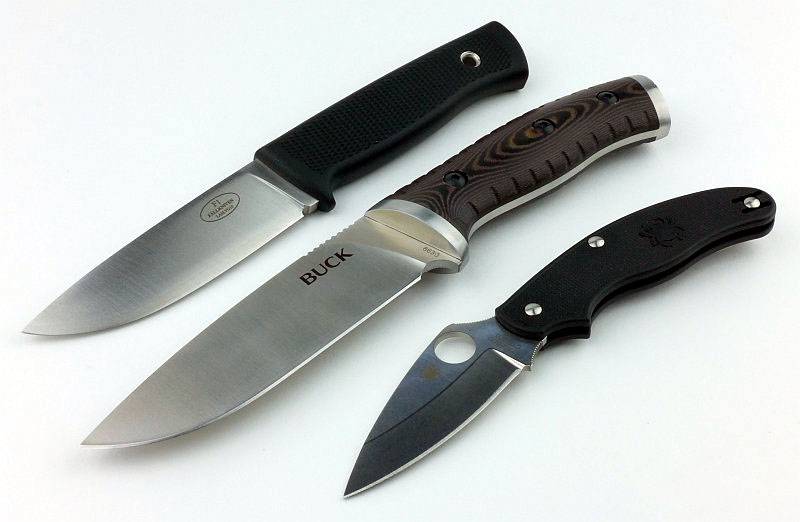
The Selkirk with a couple of other well known knives to provide the scale. (Fällkniven F1 and a Spyderco UK Pen Knife)
 photo 22 Selkirk size P1180797.jpg

One last look at this knife before moving onto the Froe.
 photo 21 Selkirk angle P1180792.jpg

A few more details of the Compadre Chopping Froe:

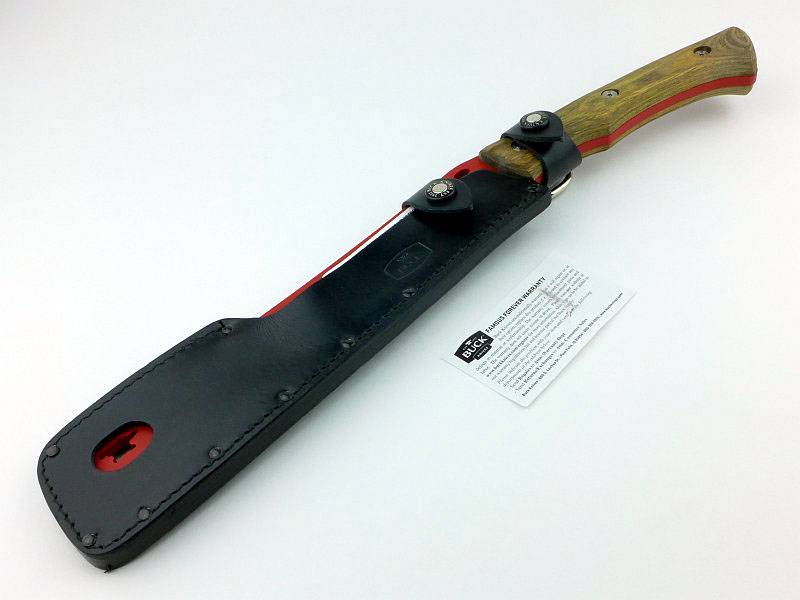
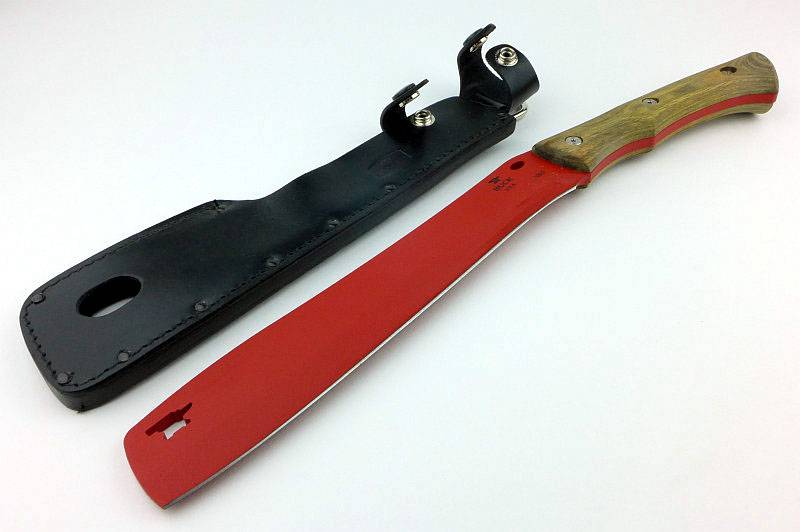
First impressions are really good thanks to the leather sheath the Froe arrives in. The only other item in the box is the warranty card.
 photo 30 Froe contents P1180804.jpg

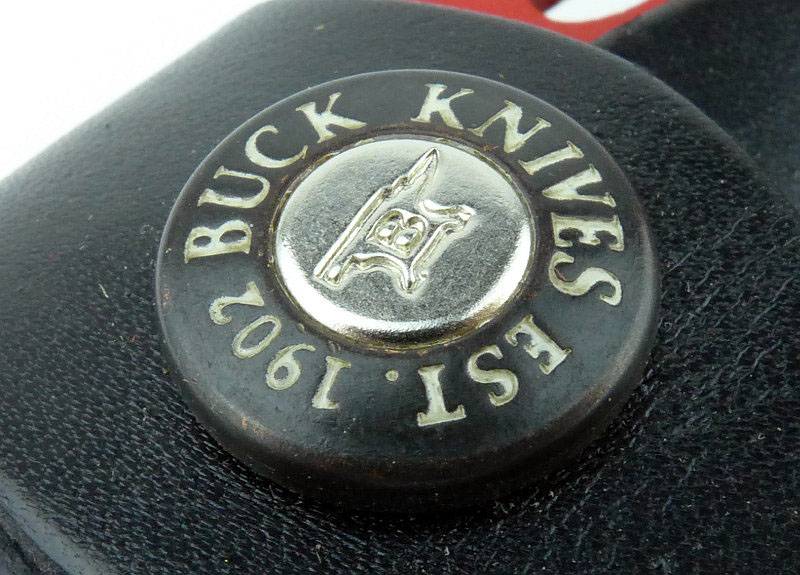
Immediately obvious are some nice touches like the retaining strap’s popper cover having Buck’s logo and name on it.
 photo 31 Froe popper P1180811.jpg

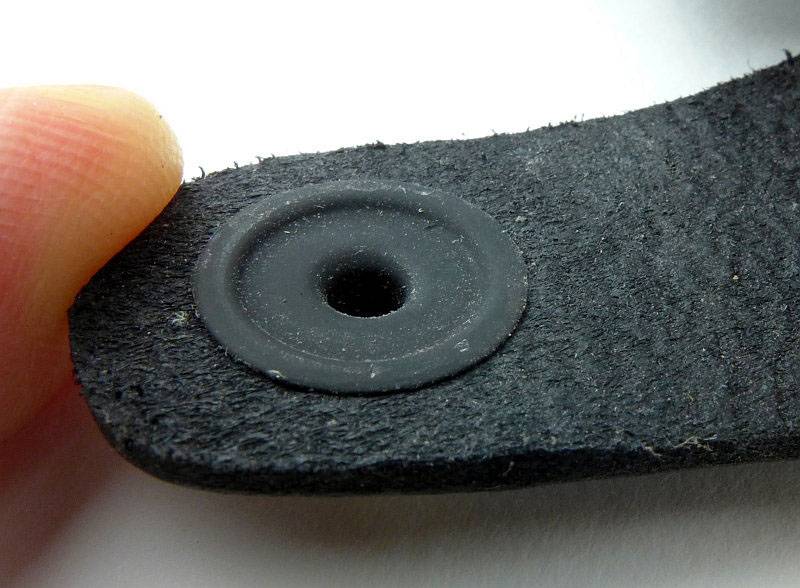
Also of note with the retaining strap is that the metal back of the popper that sits against the handle has been covered to prevent it marking the wooden handle.
 photo 51 Froe sheath popper back P1180883.jpg

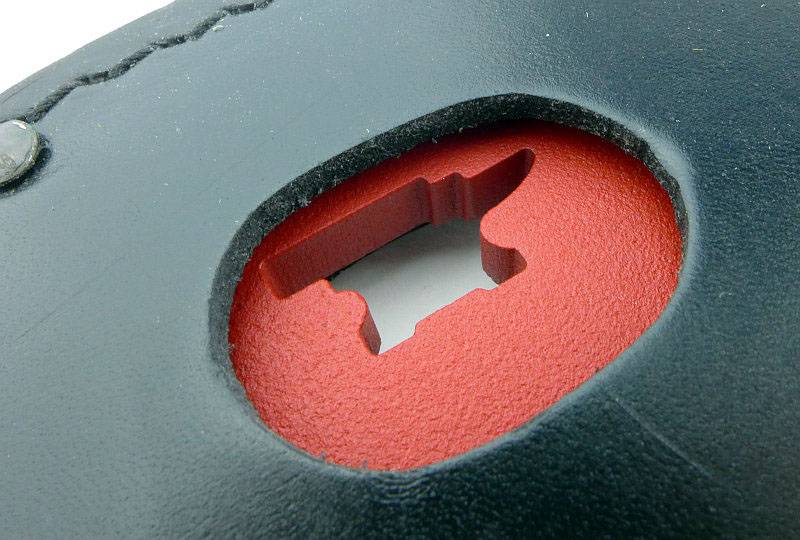
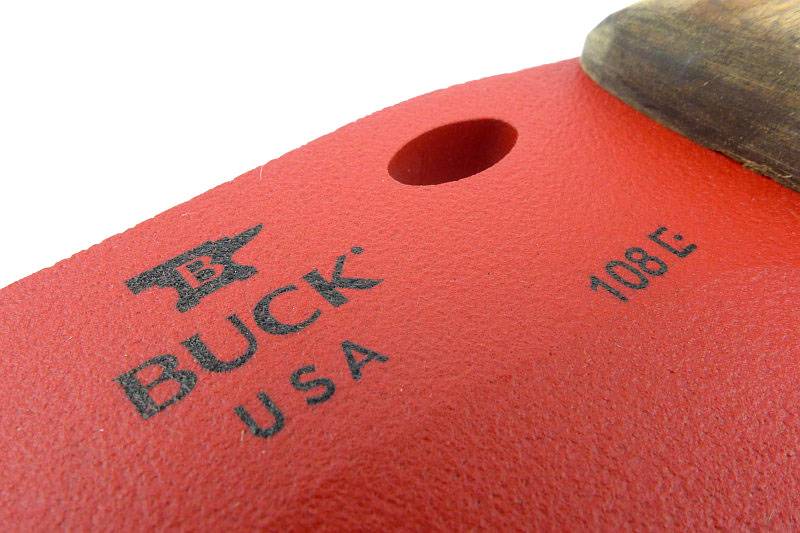
There is a cut-out in the sheath that shows the Buck anvil logo cut into the blade.
 photo 32 Froe sheath detail P1180813.jpg

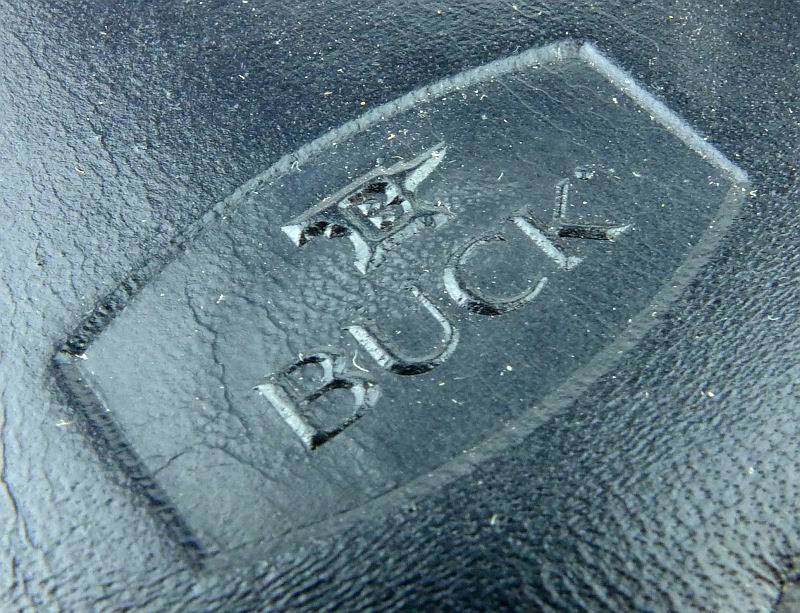
Pressed into the leather sheath is the Buck logo.
 photo 33 Froe sheath logo P1180815.jpg

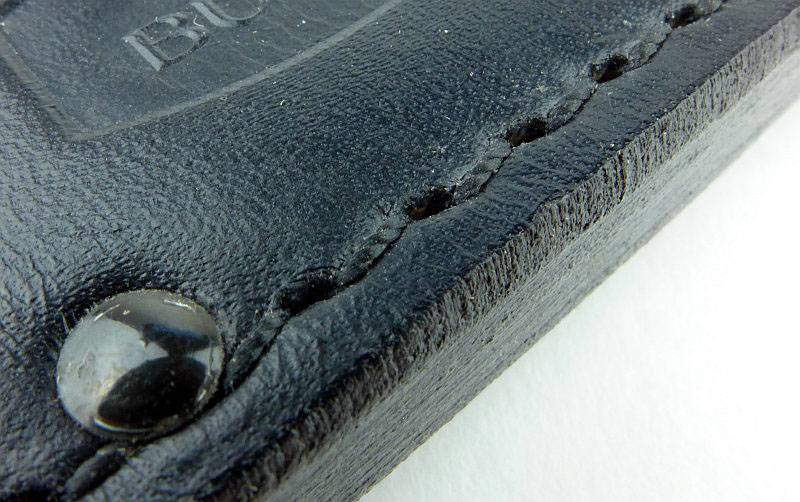
The sheath is well stitched and riveted for extra strength.
 photo 34 Froe sheath stitching P1180818.jpg

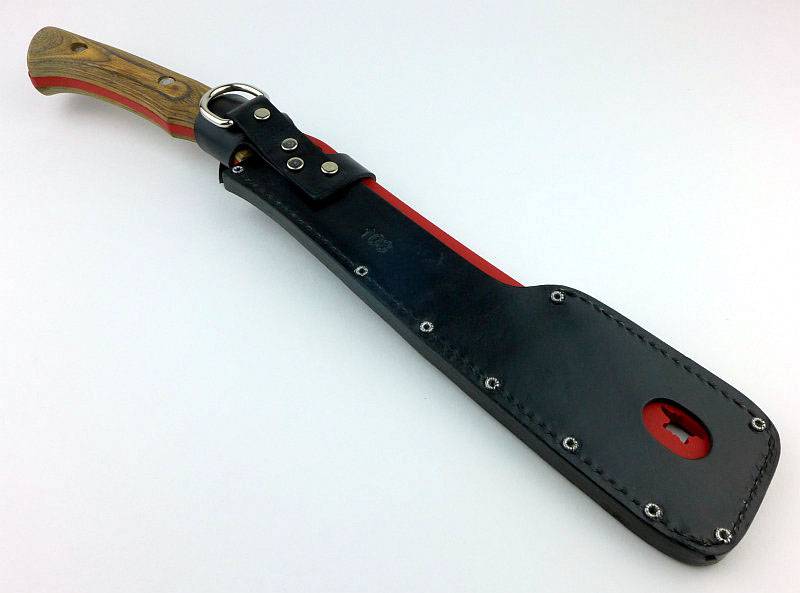
On the back of the sheath the rolled rivet heads are not as neat as on the front, but fit with the rivet colour used for the hanging loop.
 photo 35 Froe sheath reverse P1180820.jpg

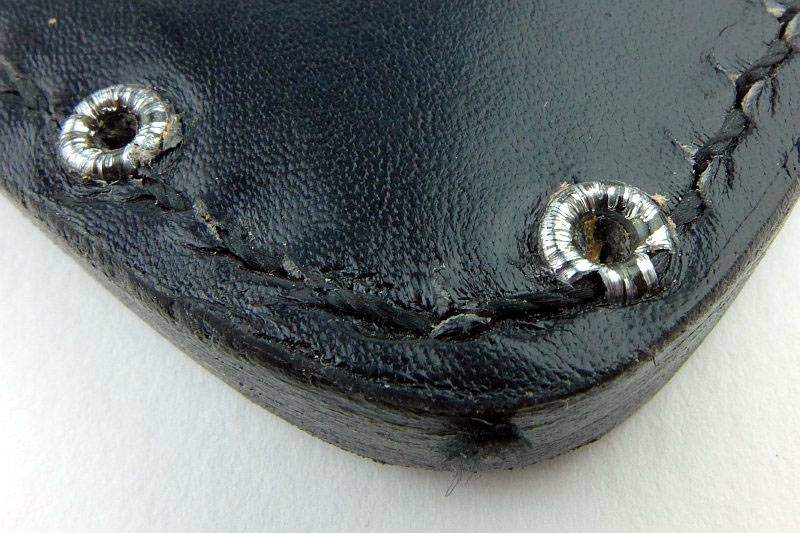
The rolled over heads of the rivets on the back of the sheath look like this.
 photo 36 Froe sheath rivet reverse P1180823.jpg

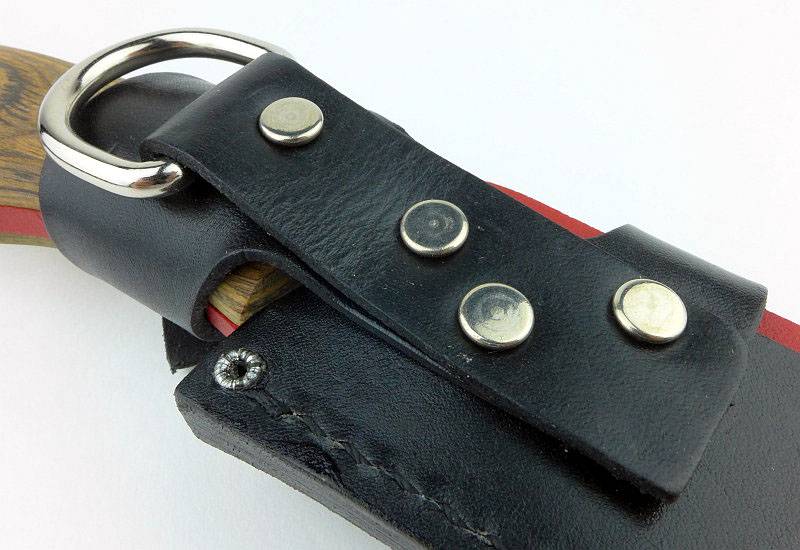
A nice heavy duty D-ring is used for the hanger.
 photo 37 Froe sheath hanger P1180826.jpg

Opening the two retaining straps allows the Froe to slide out.
 photo 38 Froe unsheathed P1180829.jpg

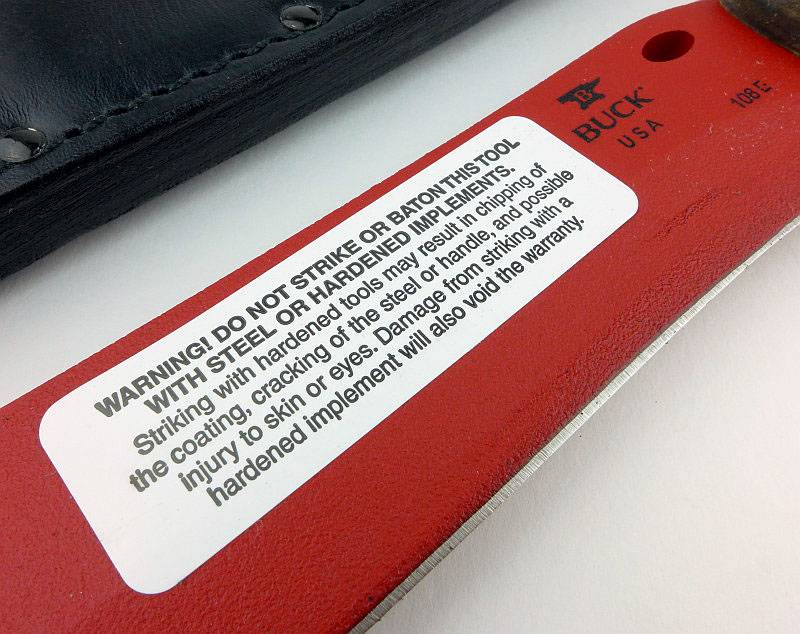
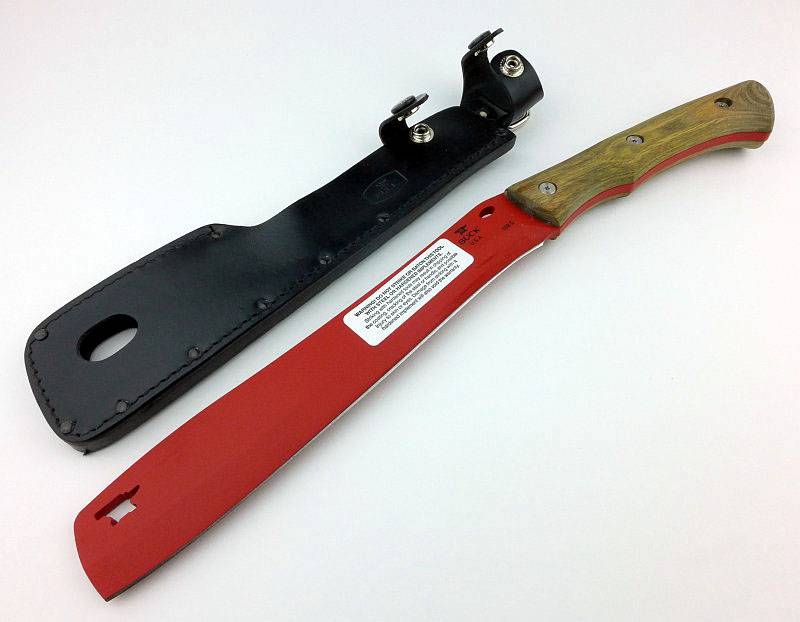
A very obvious label warning you not to strike the Froe’s blade with hardened tools is on the side of the blade. This is no different to traditional froes or any other blade you might baton with.
 photo 39 Froe warning P1180833.jpg

Whipping the label off gives you the full effect of the red powder coating.
 photo 40 Froe no label P1180835.jpg

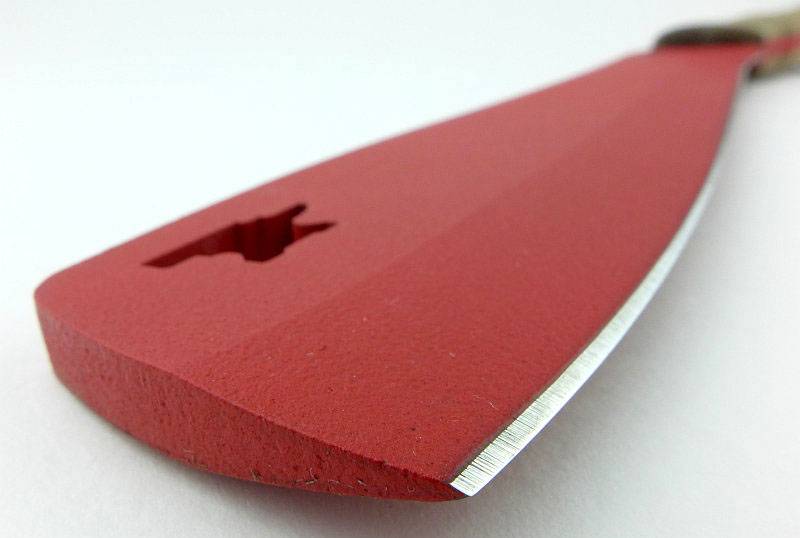
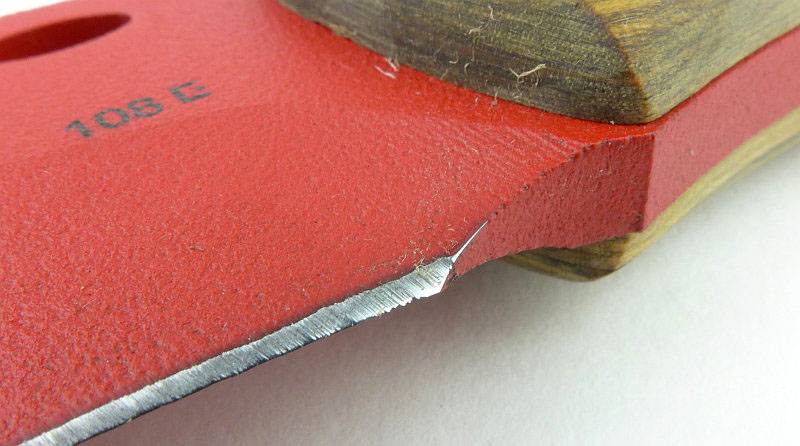
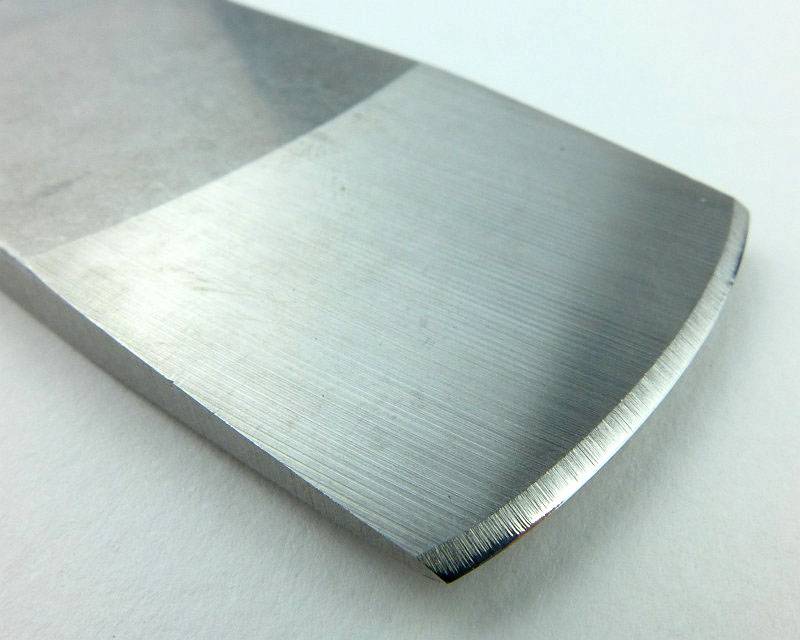
The ‘tip’ of the blade shows the splitting wedge design of the blade grind.
 photo 41 Froe point wedge P1180840.jpg

There is a subtle choil next to the handle.
 photo 42 Froe choil P1180844.jpg

At the top of the blade next to the handle there is a hole in the blade. Though this could be used as a wrist strap attachment point, I would advise you to be very careful if you want to do this as it can become more dangerous than the tool coming out of the hand.
 photo 43 Froe hole P1180846.jpg

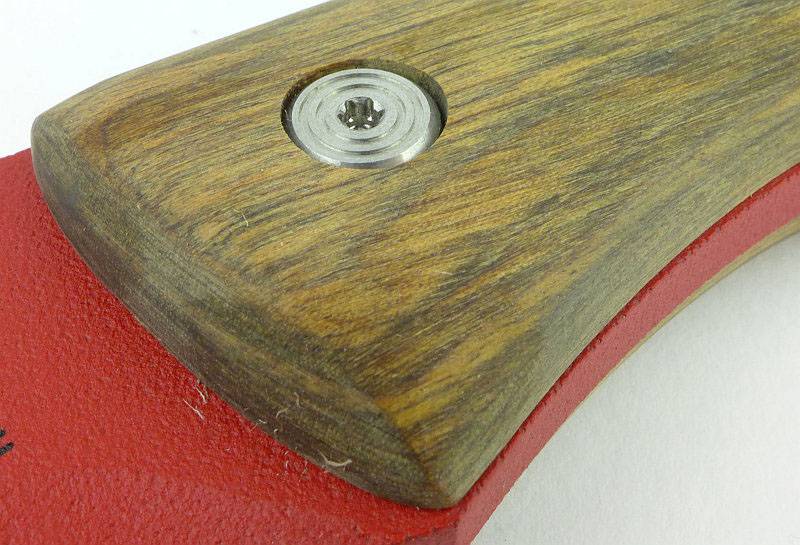
The American walnut handle slabs are held on with nice looking bolts.
 photo 44 Froe wooden handle P1180849.jpg

Blade stock used for the Froe is substantial.
 photo 45 Froe thick blade P1180853.jpg

Having a long handle, the Froe can be used with different grips.
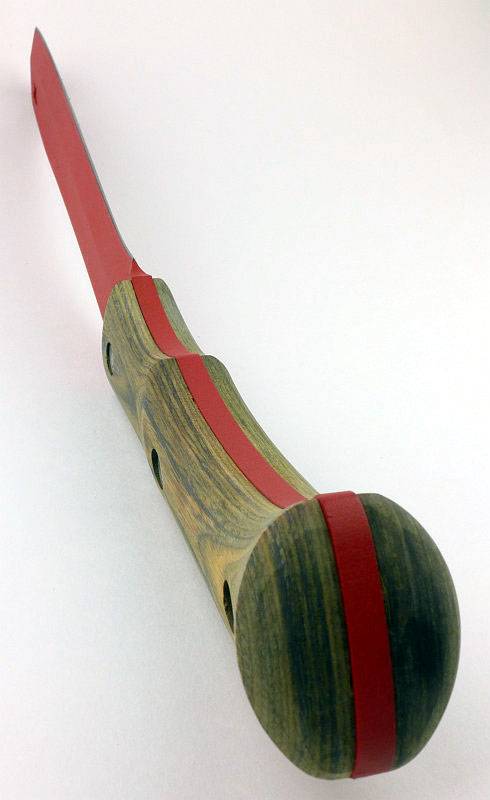
 photo 46 Froe handle P1180857.jpg

looking along the Froe to show more of the contours of this tool.
 photo 47 Froe contours P1180859.jpg

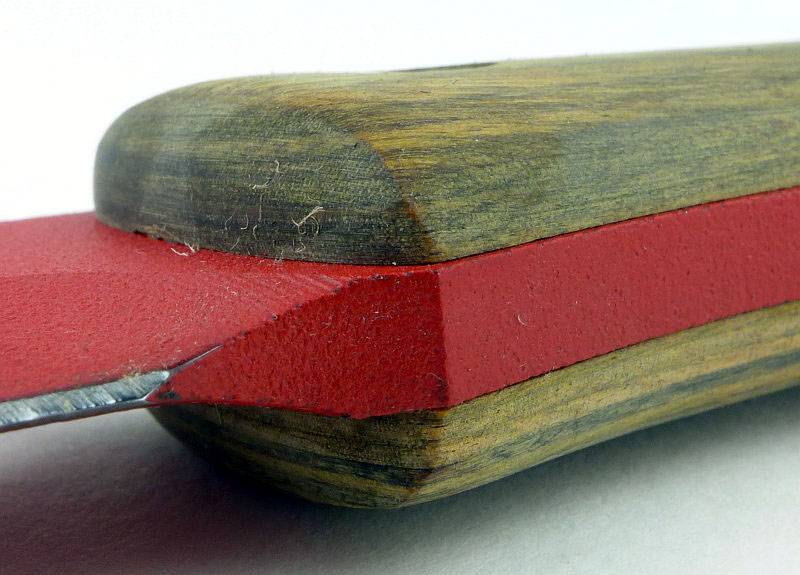
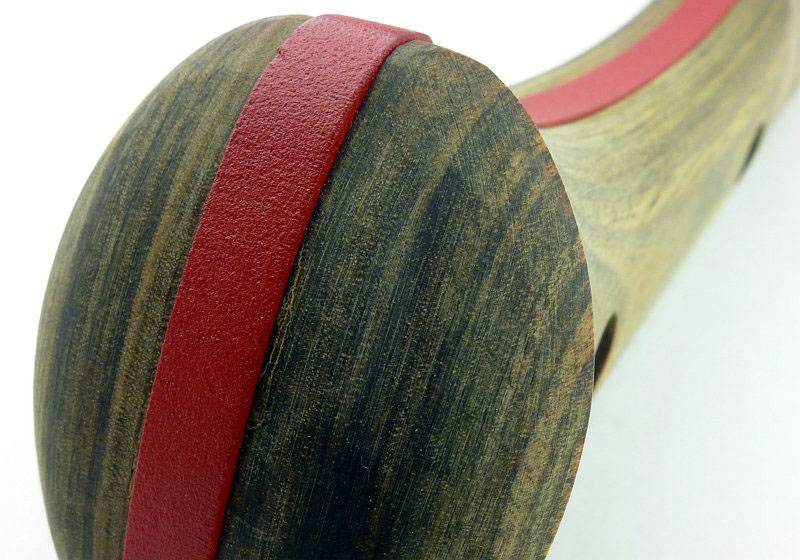
There is a nice swell at the pommel to prevent slipping, but no striking surface. If you hammer on, or with, this tool you risk damaging the handle. This view also shows the handle is made from plywood, not solid wood, as this will be more resilient and resistant to cracking.
 photo 48 Froe pommel P1180863.jpg

A few more details of the Kinetic Fishing Spear:

And now for something completely different, a fishing spear.

Folding flat, the Kinetic Fishing Spear is very neat in its folded state.
 photo 60 Kinetic contents P1180889.jpg

This package is held together by a paracord tie and a pinch-grip.
 photo 61 Kinetic tie point P1180896.jpg

Pulling the end of the cord out of the pinch-grip you can start to unwind it.
 photo 62 Kinetic opening P1180897.jpg

Releasing one side of the plastic cover.
 photo 63 Kinetic opening P1180900.jpg

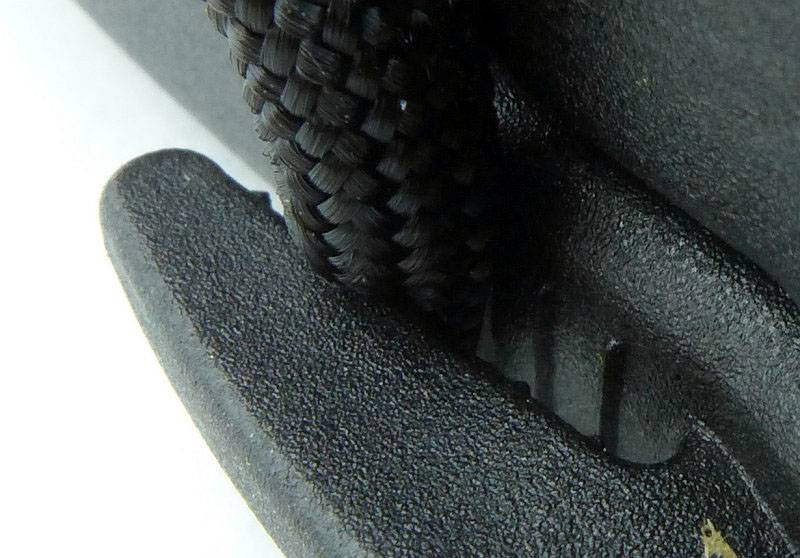
The pinch-grip has small teeth to hold onto the cord.
 photo 64 Kinetic tie teeth P1180903.jpg

The same piece of cord then releases the other side of the cover.
 photo 65 Kinetic opening P1180905.jpg

Fully unwound the cord comes completely off the cover.
 photo 66 Kinetic opening P1180908.jpg

Now you can slide off the lower cover.
 photo 67 Kinetic opening P1180911.jpg

And then the point covers, which also slide apart to give two separate pieces.
 photo 68 Kinetic opening P1180917.jpg

The shorter of the two parts of the spear head slides into a slot in the larger part.
 photo 69 Kinetic fitting together P1180918.jpg

This then rotates into place, and in this position cannot move backwards or forward.
 photo 70 Kinetic together P1180921.jpg

When assembled the spear suddenly looks very capable.
 photo 71 Kinetic together front P1180925.jpg

The smaller piece has the Buck logo on it.
 photo 72 Kinetic together angle P1180927.jpg

As does the larger piece.
 photo 77 Kinetic logo P1180946.jpg

A really cleaver feature is that the two pieces of the point guard slide together to form a cross shape.
 photo 73 Kinetic guard P1180935.jpg

This cross shaped guard can then cover the points of the assembled spear head.
 photo 74 Kinetic guard fitted P1180937.jpg

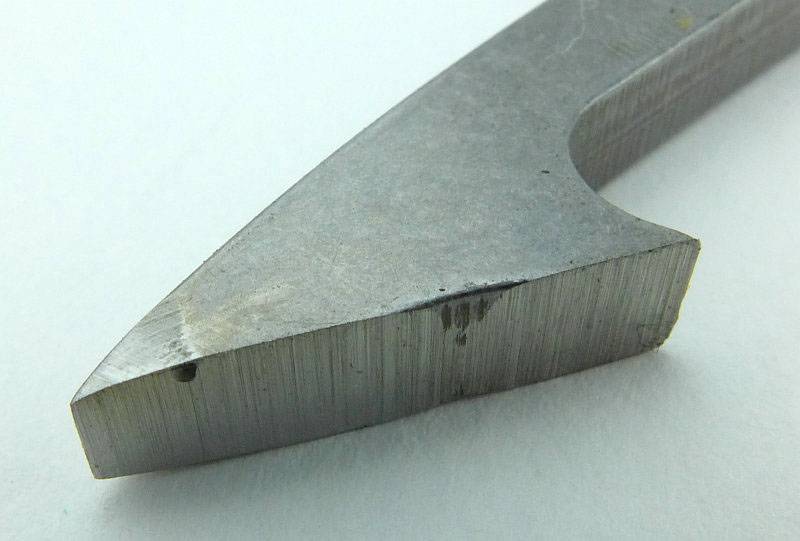
There is a barb on each of the four points.
 photo 75 Kinetic barb P1180939.jpg

A chisel point is provided on the tang of the larger piece of the spear that can both be used for some of the spear pole preparation, and to make it easier to drive into the end of the pole.
 photo 76 Kinetic axe P1180944.jpg

What are they like to use?

It is not that I expected anything to be bad about the Selkirk, but it has really surprised me just how good it has been for me to use. Not only that, but anyone I’ve handed it to has also been impressed with how good it feels in the hand.

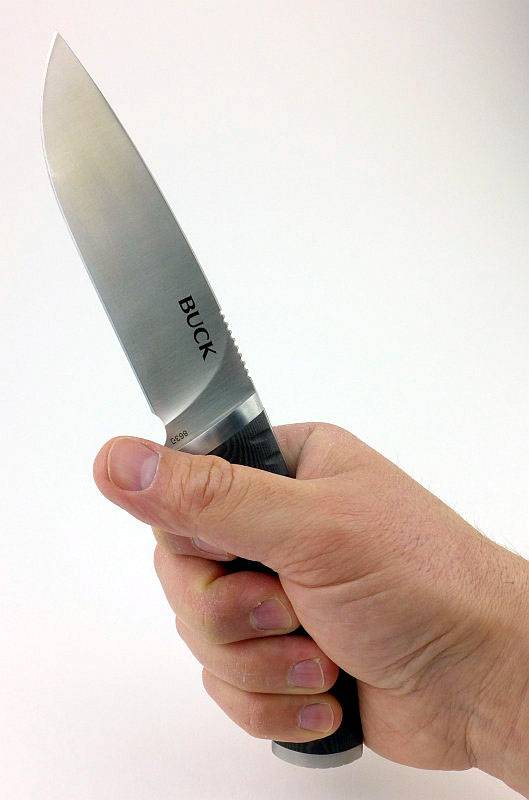
Remembering that I take an XL size glove, this is how the Selkirk looks in the hand.
 photo 12 Selkirk in hand P1180767.jpg

The shaping of the handle is excellent. The palm swell is just enough to sit very naturally, and the curve of the handle allows your hand to work with the Selkirk. Flaring at the front and back of the handle stops you hand moving, and even working hard with this knife on hot days with sweaty hands didn’t cause any issues.
Resting between cutting jobs, the Selkirk just seems to stay in place in a relaxed hand, and when working I was never aware of the handle, instead all my focus was allowed to fall onto the cutting task and directing the blade. I did not expect this level of comfort and control.

I’m going to look at more of the Selkirk in use later on, but switching now to the fire-lighting capability of the Selkirk, and how well it strikes sparks from the ferrocerium rod.

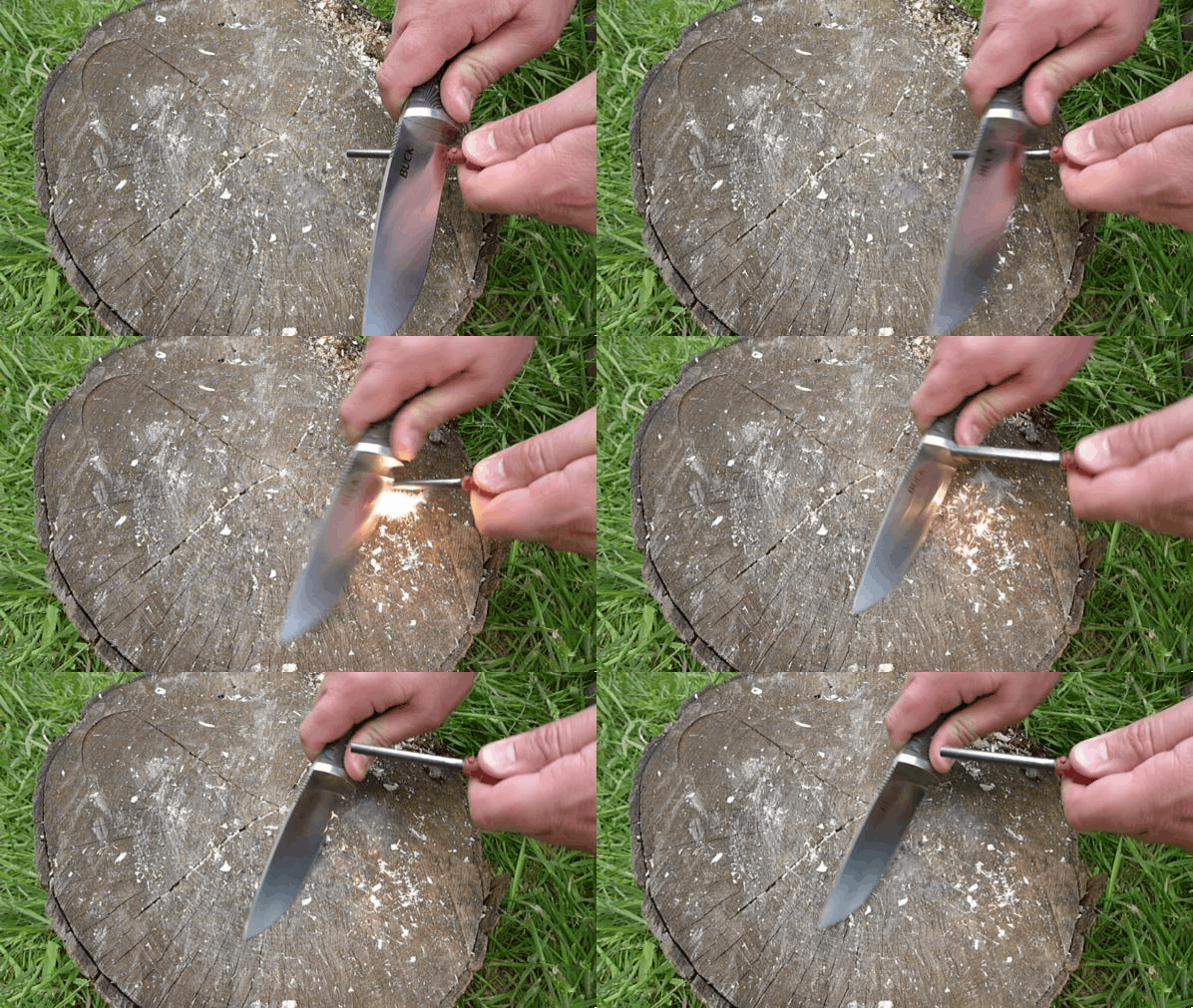
As the product description from Buck specifically says the choil has been left with a sharp corner to use for striking sparks, I’ll start with this. Once you get through the outer coating of the new rod, you then start to get proper sparks. Using the choil does work OK, but is not that good.
 photo Buck Selkirk Choil Ferro 600px 200ms.gif

Flip the blade round and use the spine instead and you are rewarded with a bigger shower of sparks. So the specific feature of using the choil to strike sparks is a little redundant. What you do have is a choice of more or less sparks. Striking fewer sparks with the choil will wear the fire-rod away less and may be all you need.
 photo Buck Selkirk Spine Ferro 600px 200ms.gif

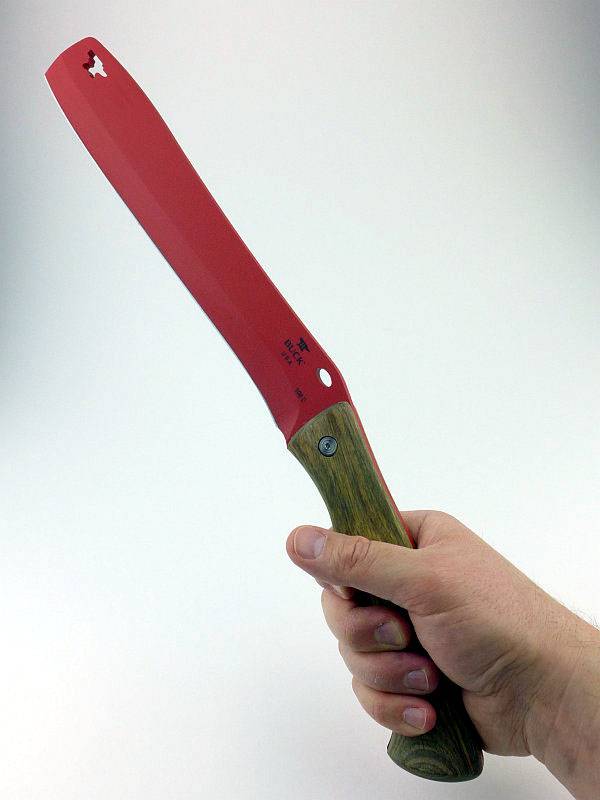
Scaling up in size we have the heavy Chopping Froe. Here the grip is closest to the pommel and gives the greatest striking advantage.
 photo 49 Froe in hand P1180872.jpg

For more control you can grip the Froe handle near the blade. This is good for finer chopping tasks, but the blade edge is not really sharp enough (due to the edge angle) for fine carving or slicing cuts.
 photo 50 Froe in hand P1180874.jpg

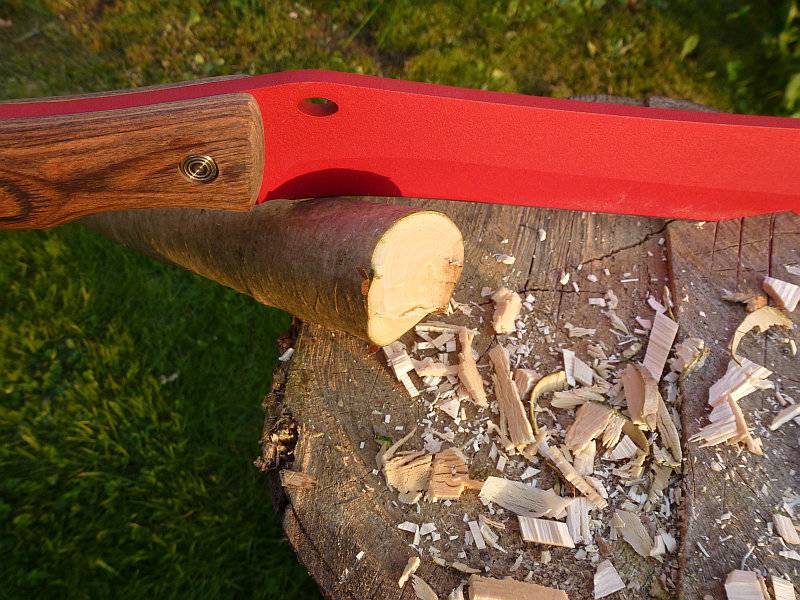
When I initially saw the rake of the Froe’s blade, I thought it would be awkward to use, and if working onto a chopping block, the angle does mean you can’t really strike down onto the block and have the edge strike squarely, you always end up cutting into the edge of the block.

Moving to free-cutting when you are chopping through branches or the trunks of smaller trees, then this rake actually ensure the edge strikes at a slight angle which does enhance the cutting power. The Froe is very efficient when used in this way.

The more I use the Buck Froe, the more I would compare it to a hatchet rather than a knife, but a hatchet with a very long edge and which does not need a precisely positioned strike to get a good result. The knife edge, despite being sharp enough, is not well suited to anything but chopping. The blade thickness and steep primary grind make it pretty hopeless for slicing cuts and the overall size/weight and rake make fine work difficult.

Finally a quick mention of the Kinetic Fishing Spear. Unfortunately I’ve not been able to spear any fish with it so far. Not due to always missing, but due to a lack of suitable fishing opportunities. Mounted it seems very capable and with an overall good balance, but unfortunately up to now that is as far as I can comment.

Mounting the Kinetic Fishing Spear

One small project that would cover all three of these Buck products is to make a shaft for the Kinetic fishing spear head. A quick visit to a local wooded site resulted in a pole for a first attempt.
 photo 0 01 Collecting staff P1030781.jpg

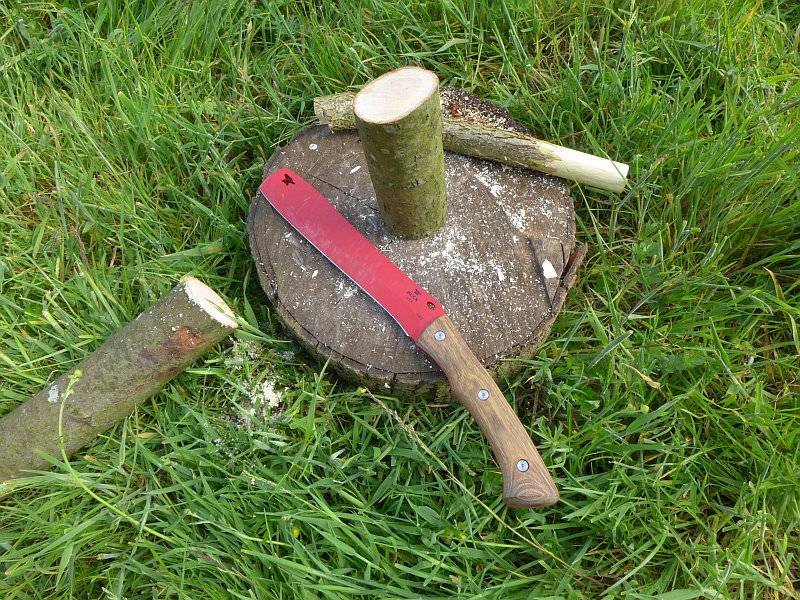
Working onto a cutting block I used the Froe to trim the pole to length and to prepare a baton for later. As you can see here the Froe has cut quite deeply into the edge of the cutting block.
 photo 0 02 trimming staff P1030809.jpg

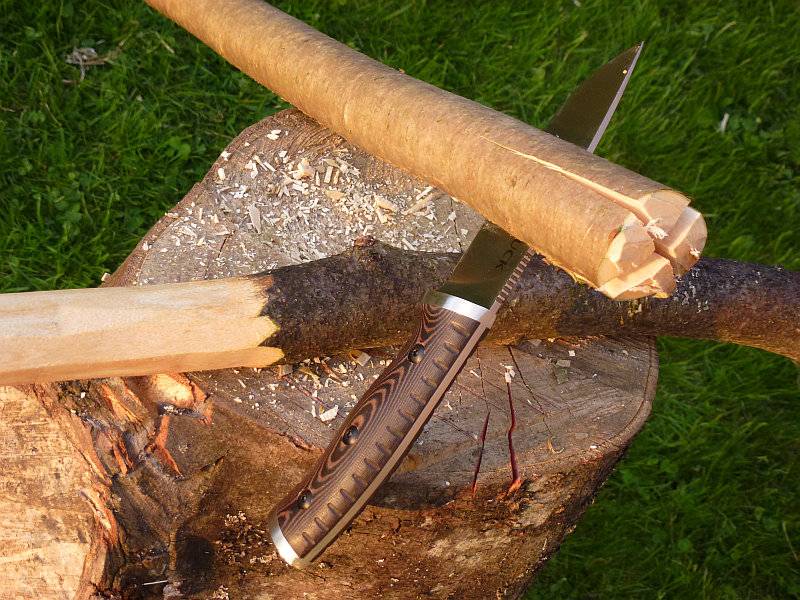
The spear head needs a cross shaped split to fit into. For finer control than the Froe would provide, instead I went for batoning the Selkirk to create the split.
 photo 0 03 splitting pole P1030821.jpg

A quick clean up of the end of the pole.
 photo 0 04 remove bark P1030824.jpg

And setting the Kinetic spear head into place.
 photo 0 05 insert spear P1030827.jpg

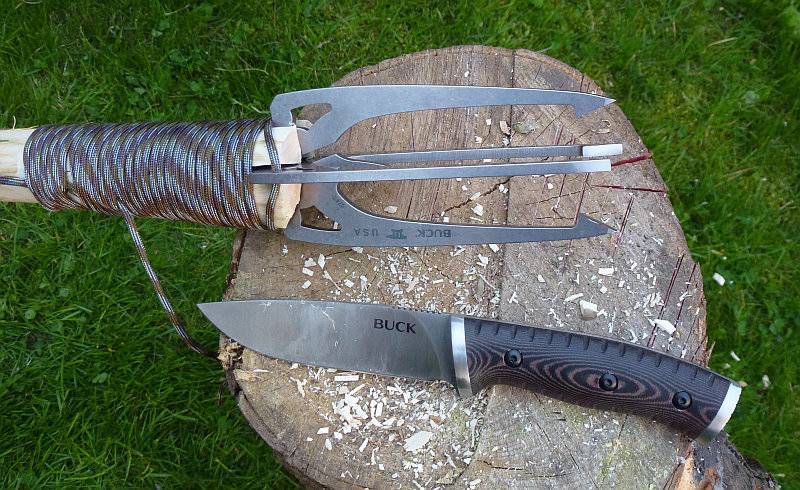
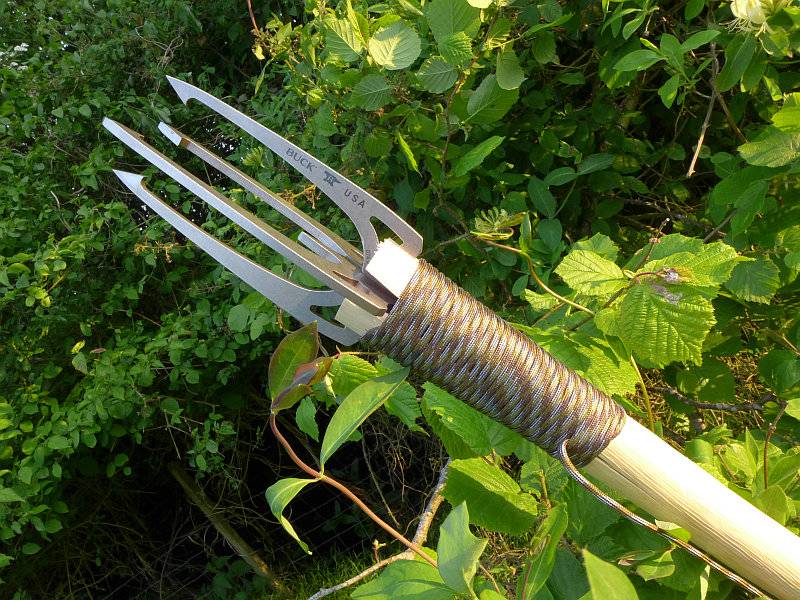
Then using a cord wrap to hold the spear head firmly. (keeping the cord in a single piece and using a whipping technique to secure the ends.
 photo 0 06 cord wrap P1030831.jpg

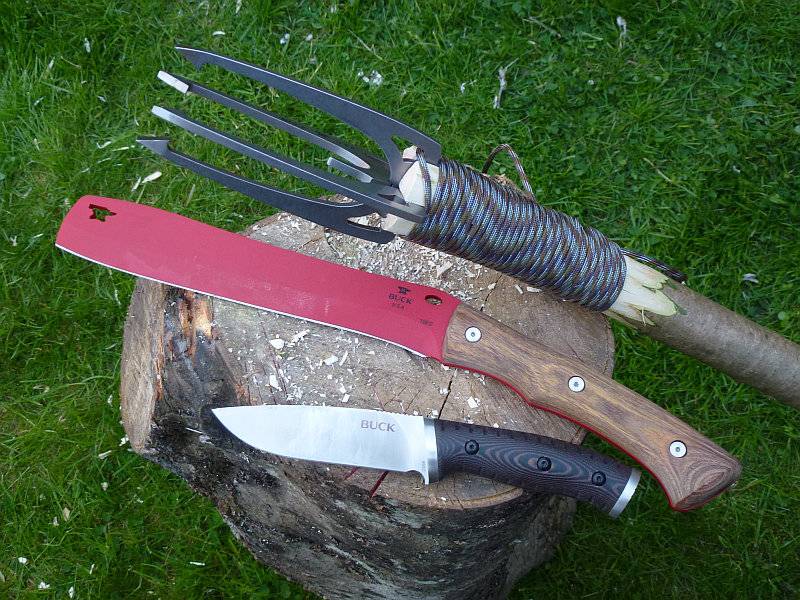
All ready to go, the fearsome Kinetic spear and the partnership of the Selkirk and Froe.
 photo 0 07 trio P1030840.jpg

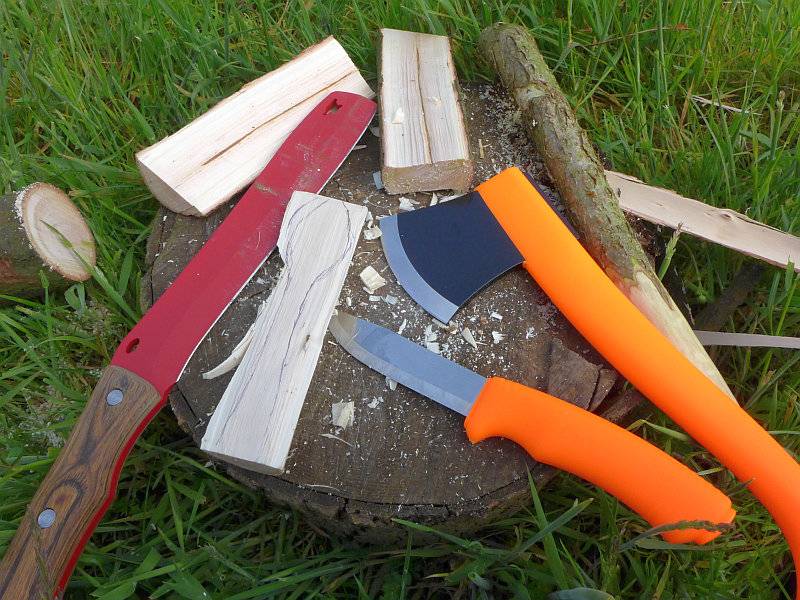
Onto another project, and in this instance I was making a wooden spoon. This requires some careful splitting of a small log, so again I whipped up a baton and used this for making the controlled split with the Froe.
 photo 01 spoon start P1190531.jpg

The splitting worked very well and the Froe also did a little rough shaping, before it became a little awkward to use due to the rake.
 photo 02 spoon split P1190535.jpg

Other tools were used, but it all started with the Froe.
 photo 03 spoon P1190550.jpg

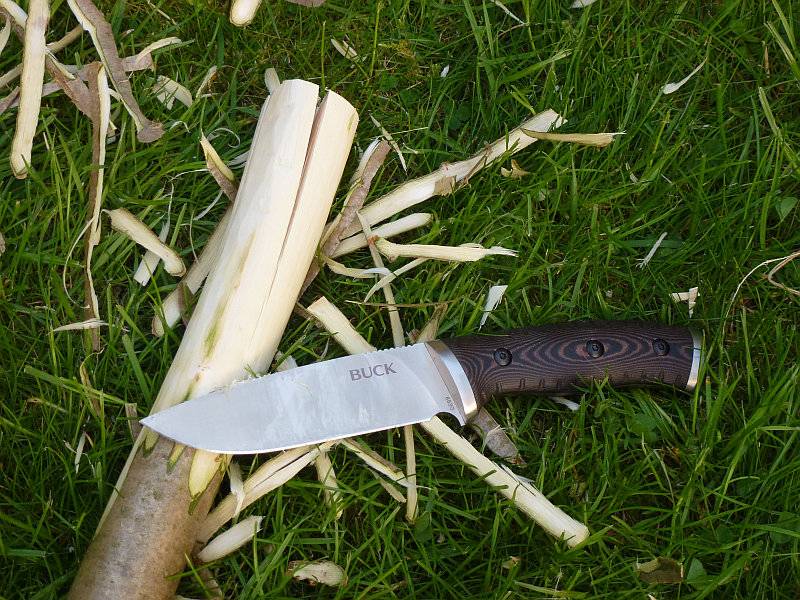
While things were going well I decided to have another go at the spear’s pole. I found a rather good piece of hazel, and this time cleaned off all the bark with the Selkirk.
 photo Fishing spear 01 start P1190494.jpg

The size of the pole was chosen to suit the tang of the spear head.
 photo Fishing spear 02 closer P1190495.jpg

Pre-split using the Selkirk, the Kinetic spear head was then tapped into place.
 photo Fishing spear 03 cross P1190501.jpg

Wrapped tightly with paracord to secure the head. As the wood dries further the cord needs to be re-wrapped to stay tight.
 photo Fishing spear 04 whipped P1190508.jpg

Ready to go, the only issue, no suitable fishing spots round here.
 photo Fishing spear 05 overall P1190506.jpg

Review Summary

The views expressed in this summary table are from the point of view of the reviewer’s personal use. I am not a member of the armed forces and cannot comment on its use beyond a cutting tool or field/hunting knife.

Something that might be a ‘pro’ for one user can be a ‘con’ for another, so the comments are categorised based on my requirements. You should consider all points and if they could be beneficial to you.

_______________________________________________ _______________________________________________
Things I like What doesn’t work so well for me
_______________________________________________ _______________________________________________
Selkirk – Excellent handling. Selkirk – Fit/Finish is not the best.
Selkirk – Versatile sheath. Selkirk – Ferrocerium rod retention may not be secure if not using the cord loop.
Selkirk – All rounder FFG blade.
Selkirk – Hammer pommel.
Selkirk – Ferrocerium rod with Whistle.
Froe – Effective heavy chopper. Froe – Relatively expensive.
Froe – Great for splitting even large logs. Froe – Poor performance for other cutting tasks.
Froe – Very sturdy leather sheath. Froe – Blade rake is awkward when cutting onto a block.
Froe – Long Handle allows different grips.
Kinetic – Strong construction. Kinetic – Requires mounting before it can be used.
Kinetic – Guard can be used folded or assembled. Kinetic – It is necessary to hammer on the prongs to mount it.
Kinetic – Cord is provided.

 photo 00 02 Buck UnBoxed P1180950.jpg


Discussing the Review:

Please feel free to add comments to the review, but the ideal place to freely discuss these reviews is on a forum. If you started reading the shorter forum version of the review, but followed the link this full exclusive review, please return to that forum to discuss the review there.
If you read the review entirely on Tactical Reviews, please consider one of the following to join in any discussion.

EdgeMatters – Sponsored Reviews (UK based Forum for Knife Makers and Collectors)

BladeForums – Knife Reviews (US based Forum for Knife Discussion)

CandlePowerForums – Knife Reviews Section (Largest and Friendliest Flashlight Community Forum)
Gear Review: Walkstool ‘Comfort 65’ Portable Stool with Telescopic Legs

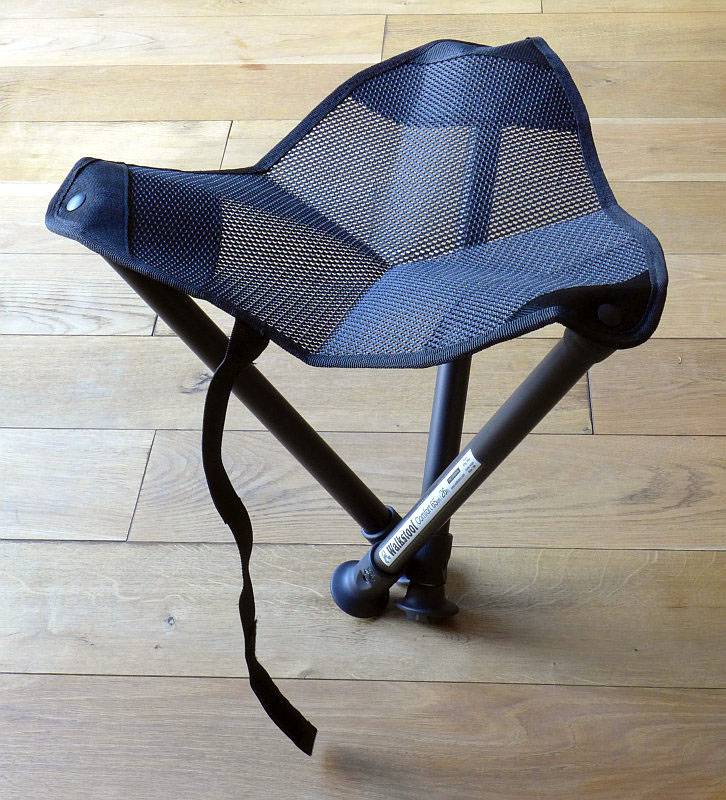
It was at IWA 2016 that I came across Walkstool on my way to another appointment. As soon as I saw their telescopic folding stools I felt they were worth further investigation, and after a demonstration by Pius Schmitt (who is featured in the Walkstool website videos) didn’t need any further persuasion; I knew this was something special.

 photo 13 walkstool featured P1190526.jpg

A little more background:

Background, but not about Walkstool, instead about me and portable seating. Maybe it is a sign of age, or maybe just being in favour of comfort, but I’ve used some form of portable seating whenever I could carry it on various trips and outings.

These have included shooting sticks, many different folding chairs and lots of different folding stools. In all cases, the only telescopic part of any design was on a few shooting sticks to give some degree of height adjustment but no real saving in carried size.

The compromises in size and weight have always resulted in anything comfortable being large and heavy and not very portable, and anything small and light being really quite uncomfortable and generally too short for comfort.

At IWA I was not looking for anything like Walkstool’s Comfort (65cm model on test here), but it simply stood out. As soon as I saw that there were several different sizes, that the legs were telescopic (making them nearly 50% smaller when folded, and giving you two sitting heights) and the strong comfortable seat, the Walkstool had me interested.

The Walkstool family with the two Basic models on the left (made in China) and the four Comfort models (made in Sweden).
 photo ws_family_screen.jpg

A few more details:

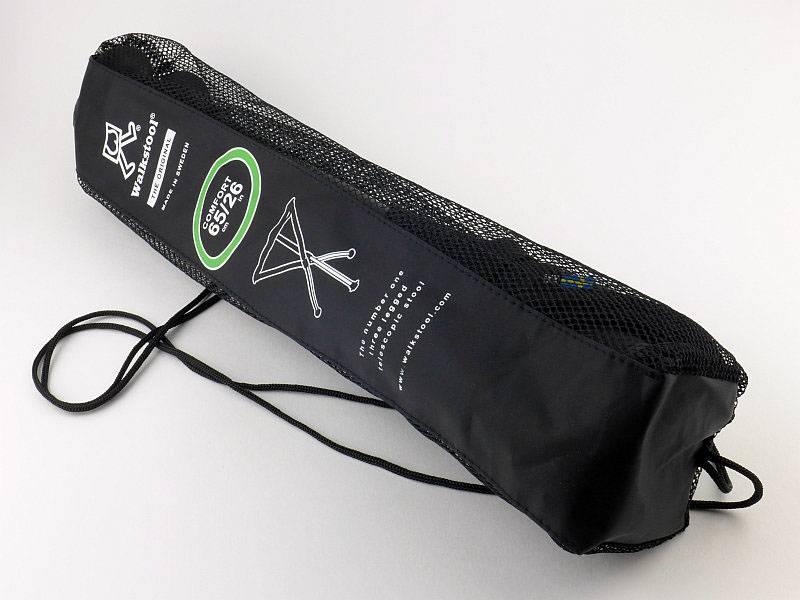
Each Walkstool comes in a carry bag that can be carried over your shoulder.
 photo 01 walkstool bag P1180579.jpg

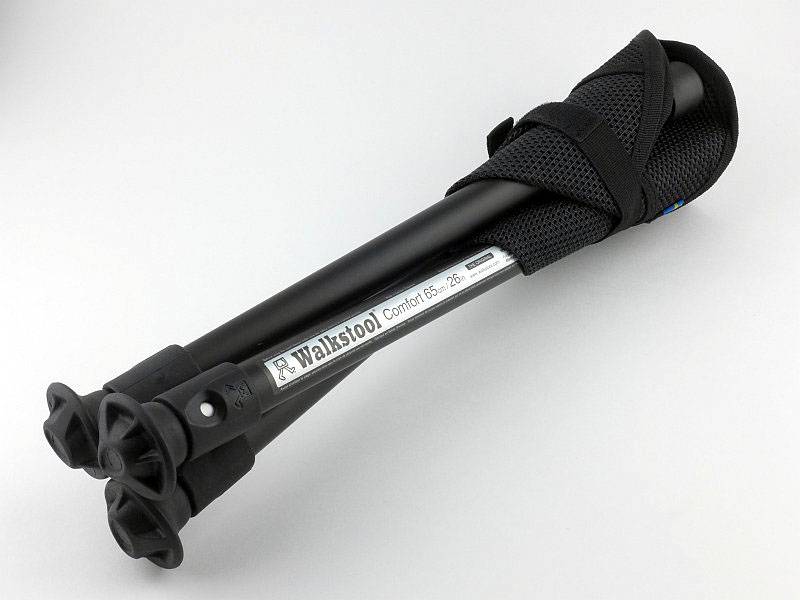
When folded it is an extremely neat package.
 photo 02 walkstool folded P1180580.jpg

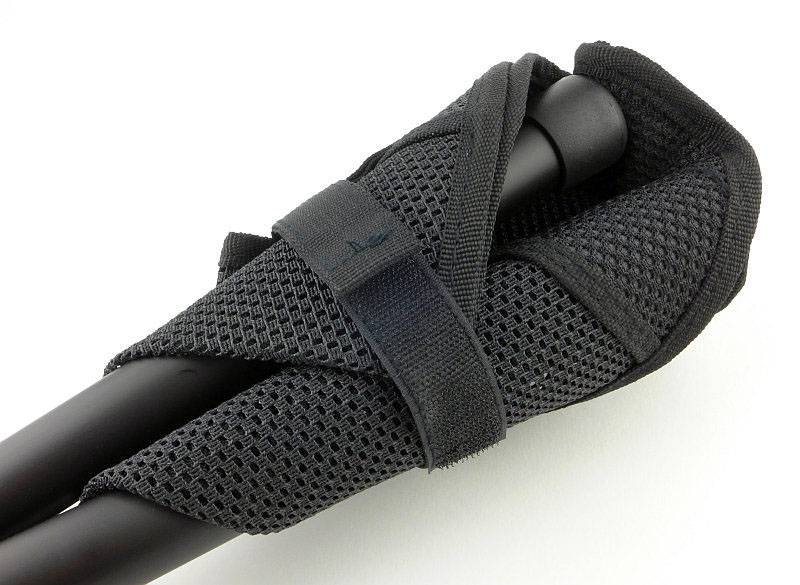
Wrapped round the seat is a strap with Velcro fastening to hold the stool tightly closed.
 photo 03 walkstool opening P1180584.jpg

Just tear back the free end of the strap to open.
 photo 04 walkstool opening P1180585.jpg

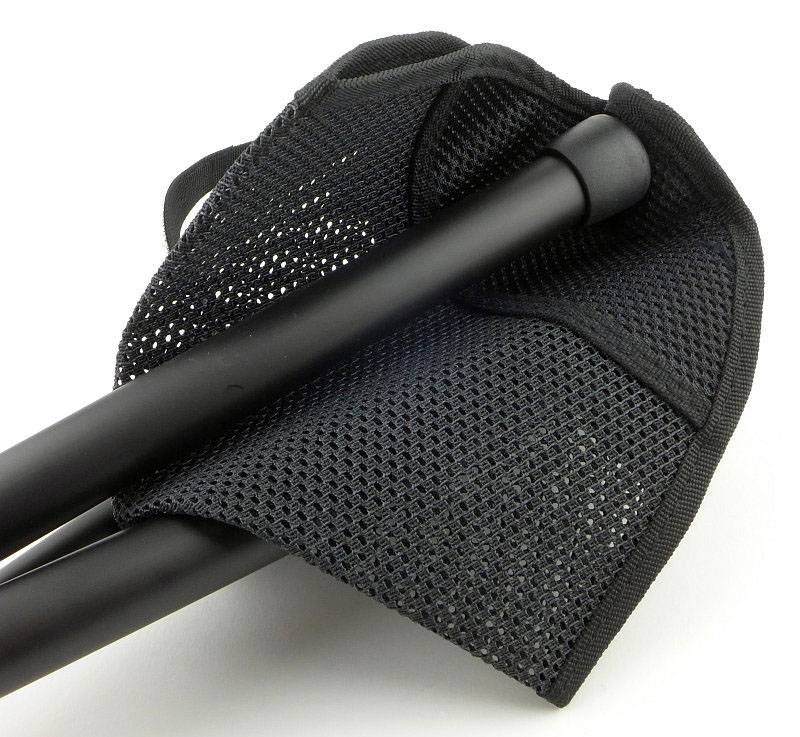
Once released the seat material starts to open up
 photo 05 walkstool opening P1180587.jpg

Strap released and ready to be opened.
 photo 06 walkstool opening P1180590.jpg

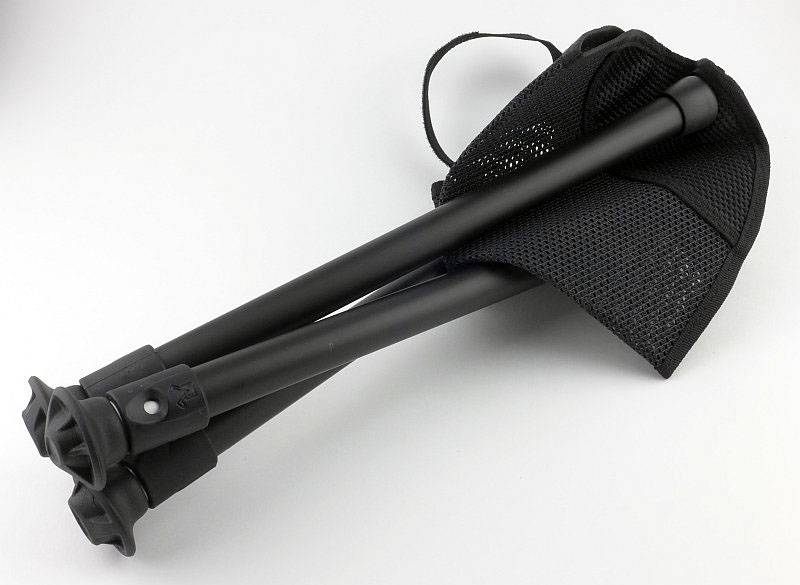
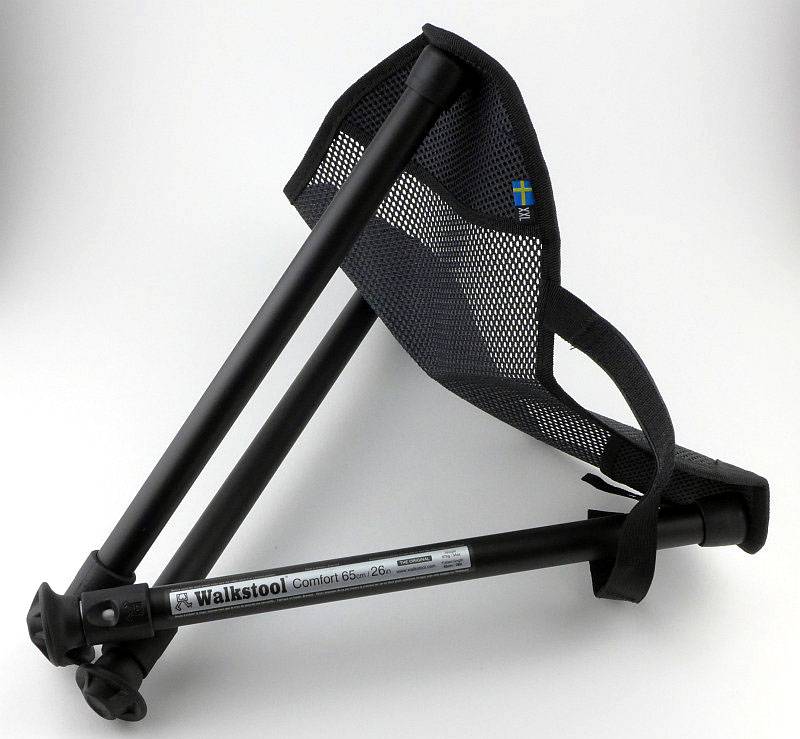
Opening out the seat, but not yet the legs. You can use the Walkstool in this configuration for a lower seating position, or to sit with a knee down to the ground.
 photo 07 walkstool half open P1180591.jpg

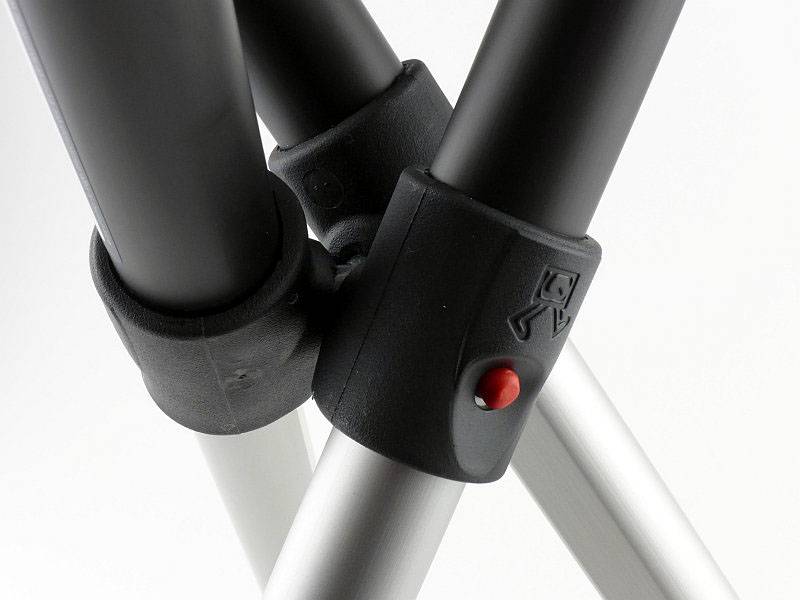
A special tri-bolt holds the legs together very strongly. Here you can see one of the leg release buttons (red) which is visible with the legs extended, and must be pressed in to allow the legs to retract. If you press the release button and pull the leg, you can remove it for cleaning.
 photo 08 walkstool detail leglocks P1180594.jpg

Ready to sit on the lower height.
 photo 10 walkstool half open P1180634.jpg

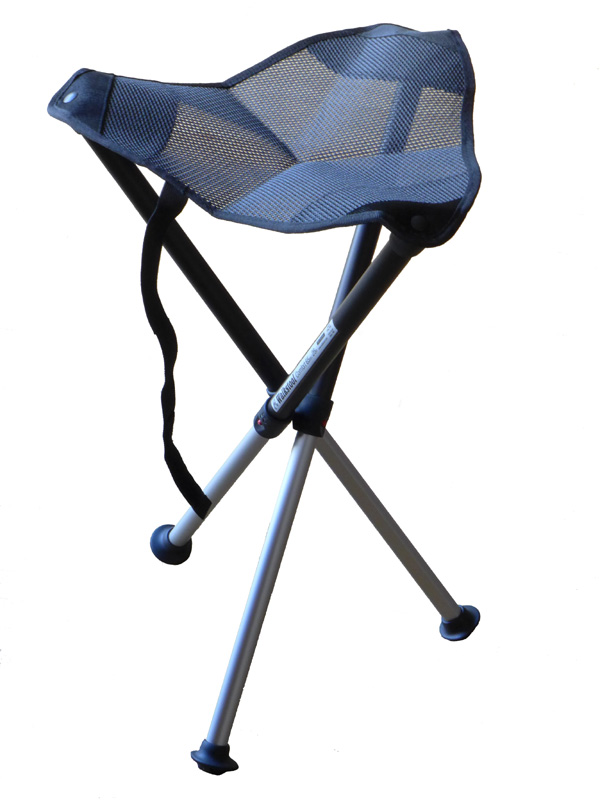
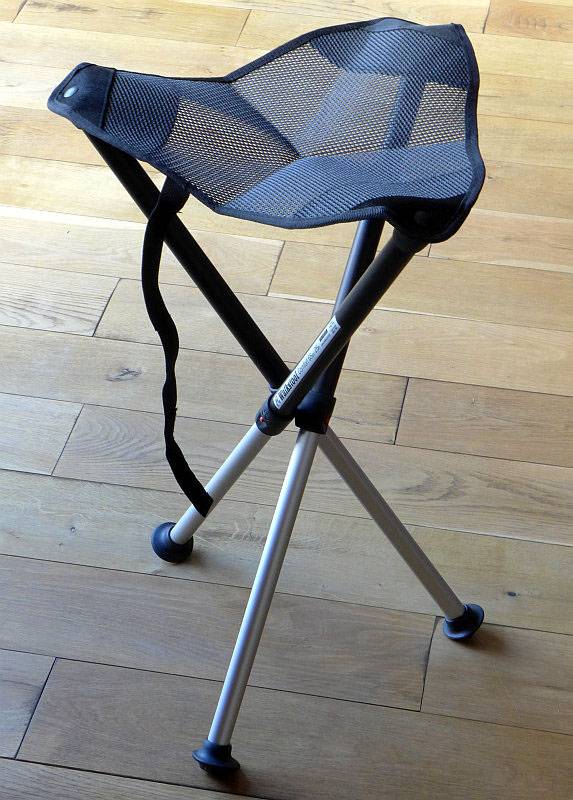
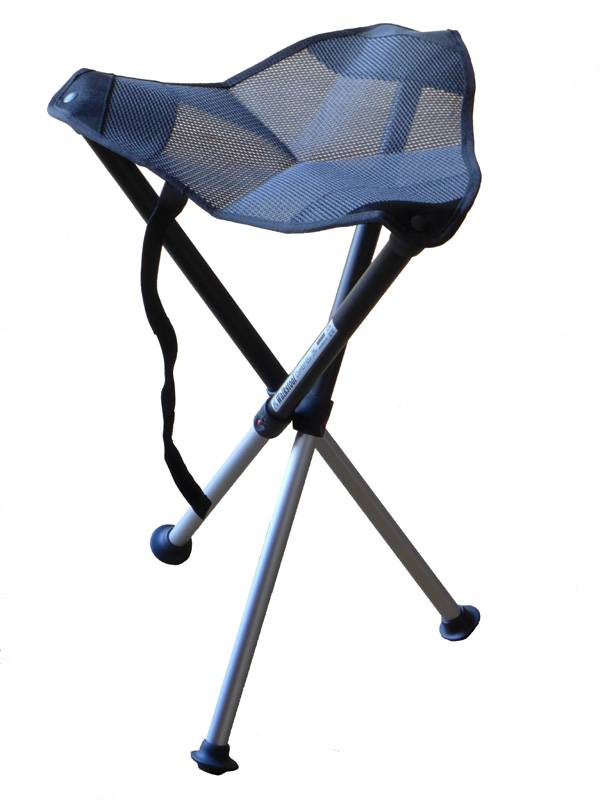
With legs extended you have a proper stool to sit on.
 photo 09 walkstool fully open P1180628.jpg

It is worth having a look at Walkstool’s video demonstration.

What it is like to use?

The first point to consider is that part of ‘using’ this stool is carrying it with you. It certainly is light enough to be an all day companion and you will want to take it with you rather than agonise over if it is worth the effort of carrying it.

I’ve carried it in three ways; firstly in the supplied bag, out of the bag and using the strap to secure it to my belt or a backpack, and finally actually fully inside a backpack.

Of these carry methods, my least favourite is using the carry bag. The strap is a string which has a tendency to want to slip off your shoulder. Not a design fault or problem, just a reason I would generally avoid this.

If I have a full size backpack I will simply pop the Walkstool inside the backpack, zip up and forget I have it with me until I want to use it. This is my preferred carry method.

Lastly the strap for folding up the Walkstool has intentionally been made longer than needed so that you can use this strap to attach it to something else. Walkstool show this being fixed to a belt, but I’ve also used it to attach the Walkstool to the outside of my backpack. Particularly useful if the backpack too small to fit the Walkstool fully inside. A minor annoyance on this subject though is that there is exposed ‘hook’ Velcro on the strap; this has a tendency to be very aggressive to other fabrics. I have used some Velcro ‘loop’ tape to cover this up, but it would be nice if this was included with the stool.

So many stools I’ve used in the past have been too short, and that makes you less stable and sitting on these becomes tiring. When looking at the Walkstool models I assumed I would find the tallest would suit me as I’m 6’2″ with relatively long legs. To my surprise, the Walkstool 75 (the largest) was too tall for me and it turns out the Comfort 65 was a much better match. If you can, try the different models, or at least consult the Walkstool size guide.

So you have it with you, and now it is time for a sit down. Extend the legs, open them out and sit in excellent comfort. I was doing a little whittling (with a Swedish knife, as it happens, the Fällkniven F1 Pro) and was perfectly comfortable and stable on the Walkstool.
 photo 13 walkstool featured P1190526.jpg

There are often instances where you want to be sitting lower, but not on the ground, perhaps if you are with a group of people not so well equipped who are sitting on the ground, or if you are working with several things and have them laid out on the ground.
Using the Walkstool with the legs retracted, you have this low height stool which can rock around the central point where the legs are connected, giving you mobility and the ability to turn.
 photo 12 walkstool sitting half open P1190529.jpg

Having this dual height is more useful than I thought it would be and is a unique feature made possible by the telescopic legs.

Quite simply I would not go back to anything else having used this folding stool, as nothing else I have ever seen provides so much comfort, quality and strength in such a small light package.

Review Summary

The views expressed in this summary table are from the point of view of the reviewer’s personal use. I am not a member of the armed forces and cannot comment on its use beyond a cutting tool or field/hunting knife.

Something that might be a ‘pro’ for one user can be a ‘con’ for another, so the comments are categorised based on my requirements. You should consider all points and if they could be beneficial to you.

_______________________________________________ _______________________________________________
Things I like What doesn’t work so well for me
_______________________________________________ _______________________________________________
Excellent comfort. More expensive than other folding stools.
Strong and stable. Exposed ‘hook’ Velcro tape.
Dual height. Potential for dirt to seize the telescopic legs (but legs are removable for cleaning).
Different sizes available.
Easy to carry.

See Walkstool’s Website for the sizing guide, Walkstools holding up a car and more. This review is included on the Walkstool Testimonial Page.


Discussing the Review:

Please feel free to add comments to the review, but the ideal place to freely discuss these reviews is on a forum. If you started reading the shorter forum version of the review, but followed the link this full exclusive review, please return to that forum to discuss the review there.
If you read the review entirely on Tactical Reviews, please consider one of the following to join in any discussion.

(You many need to use the forum’s ‘Search’ to find the review.)

EdgeMatters – Sponsored Reviews (UK based Forum for Knife Makers and Collectors)

CandlePowerForums (Largest and Friendliest Flashlight Community Forum)
Gear Review: ZTS MBT-1 Pulse Load Battery Tester

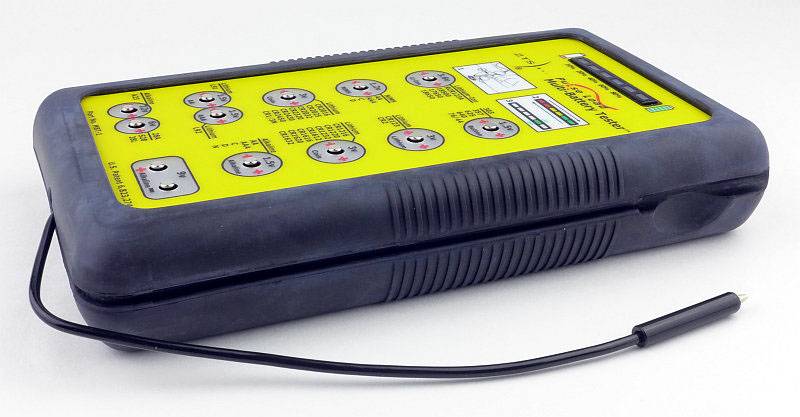
In the course of reviewing, I use rather a large number of primary and rechargeable cells. MyFenix generously sent Tactical Reviews a ZTS MBT-1 Pulse Load battery tester to help me keep track, and it has certainly proven its worth.

 photo 05 ZTS probe out P1150583.jpg

Taking a more detailed look:

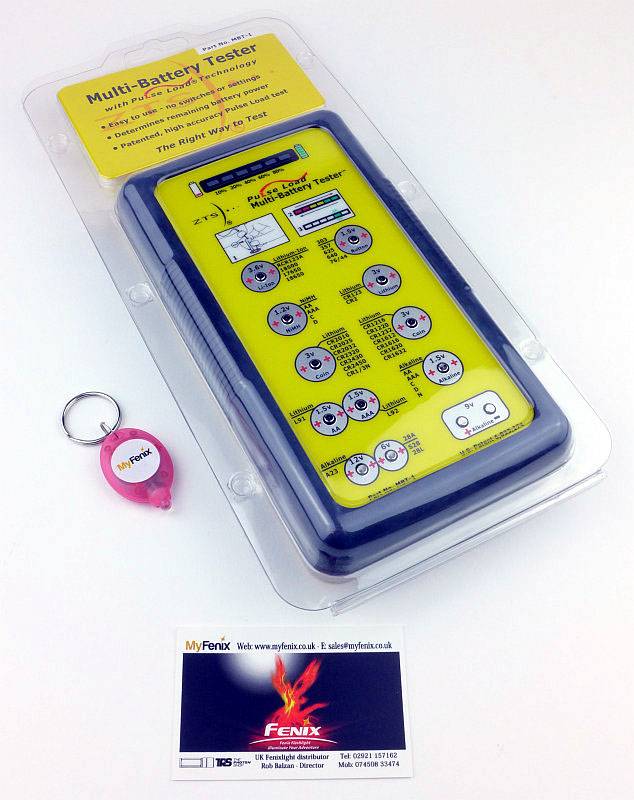
Unlike many blister packs, the MBT-1 has an easy to open blister pack as it is closed by moulded poppers. This means you can use to store the MBT-1 in if you want.
 photo 01 ZTS boxed P1150570.jpg

There are two information leaflets included with the MBT-1.
 photo 02 ZTS unboxed P1150577.jpg

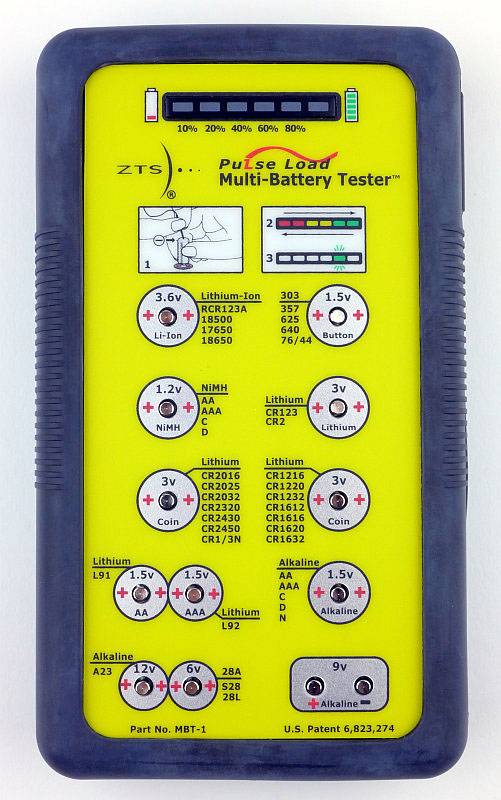
On the front panel are a set of contacts for the positive terminals of the various cells to be placed onto when testing them.
 photo 03 ZTS front P1150578.jpg

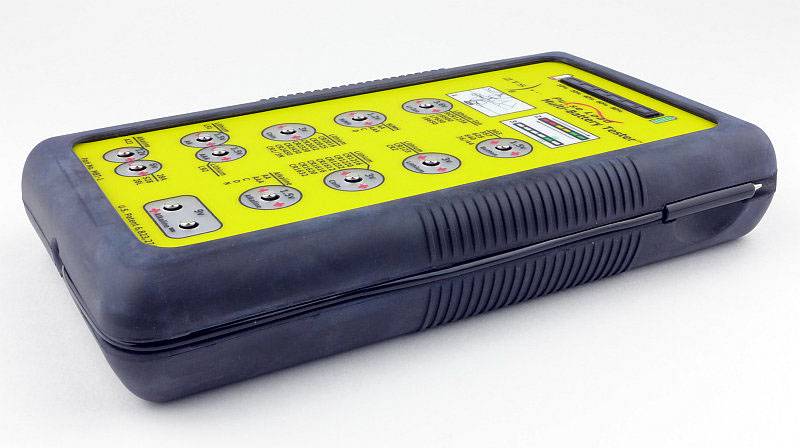
Tucked away neatly along the side is a test probe and its wire.
 photo 04 ZTS probe stowed P1150580.jpg

The probe pops out easily for use.
 photo 05 ZTS probe out P1150583.jpg

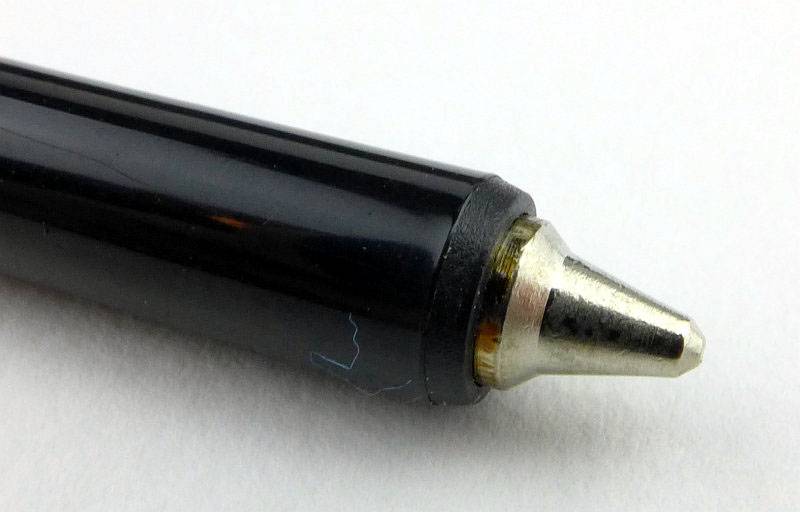
A closer look at the probe tip.
 photo 06 ZTS probe tip P1150587.jpg

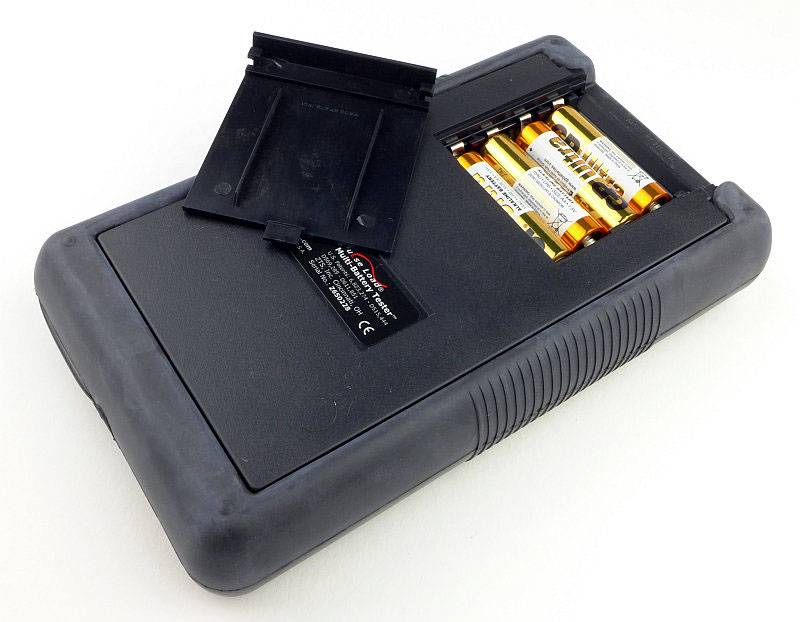
This battery tester, runs on 4xAA batteries fitted into a compartment on the back.
 photo 07 ZTS back cover off P1150592.jpg

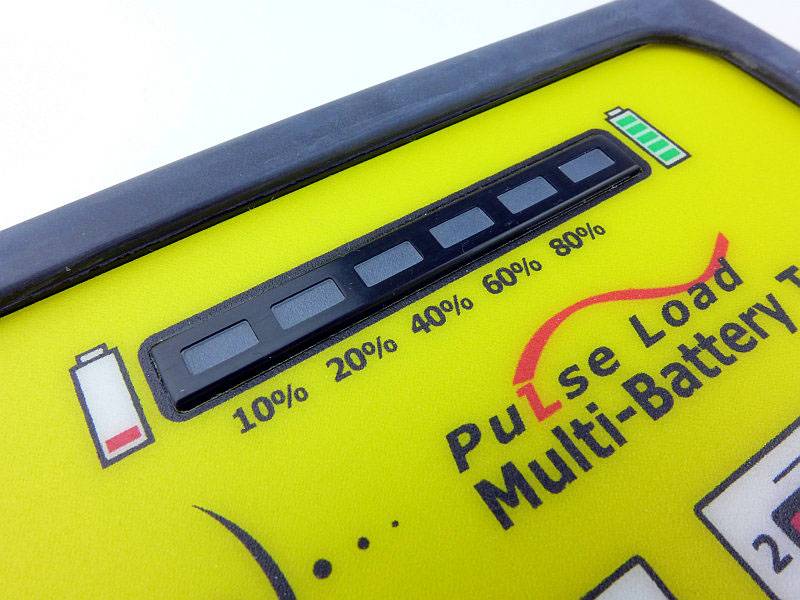
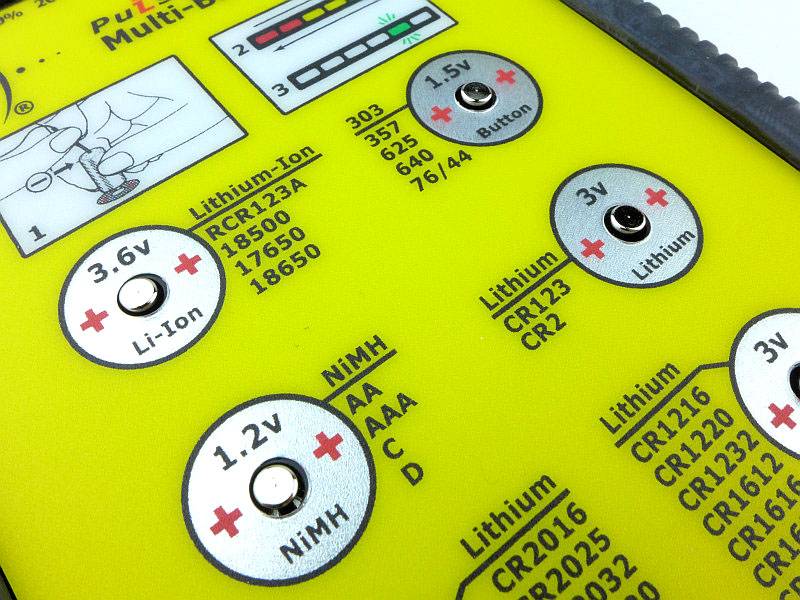
There is a simple display showing percentages from 10% to 100% capacity.
 photo 09 ZTS display P1150602.jpg

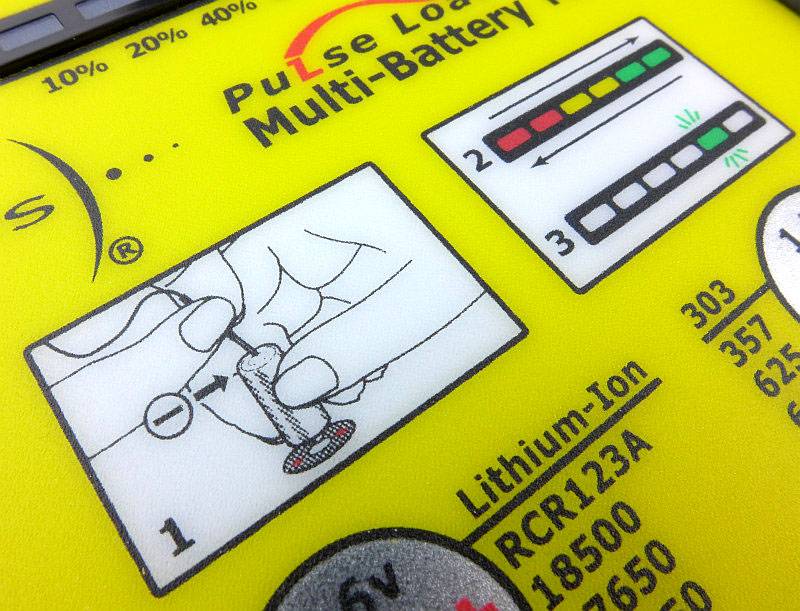
In case you misplace the instructions, there is a reminder on the front panel.
 photo 10 ZTS method P1150603.jpg

I’m not going to list all the exact cells as they are in the picture, but the tester works with Li-ion, various button cells, NiMh….
 photo 11 ZTS types P1150606.jpg

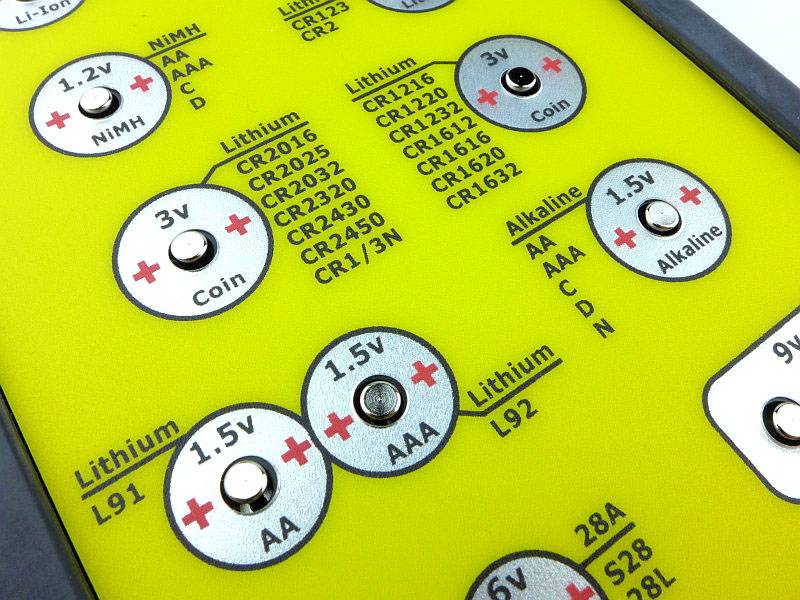
…loads more coin cells, Energizer L91 and L92, 1.5V Alkaline…
 photo 12 ZTS types P1150608.jpg

…12V and 6V Alkaline and 9V Alkaline.
 photo 13 ZTS types P1150609.jpg

Troubleshooting

This section is included to mention any minor niggles I come across during testing, in case the information helps anyone else.

No issues were encountered during testing.

As per the description of this section, this information is provided in case anyone else finds a similar ‘issue’ that might be fixed in the same way.

The MBT-1 in use

Even moderate battery users are going to appreciate the MBT-1. It is easy enough to lose track of which cells are which and then have to start again with new cells or recharging cells. Not so with the MBT-1 as it is so quick and easy to test a cell and find out its real condition. You can also check cells in remote controls, doorbells and other devices that would otherwise have no indication of the condition of the batteries.

Remember, this is not a voltage based tester, it is a pulse load tester. Cells can often recover their voltage when not loaded, so the reason this tester has so many test contact points for different cells, is because it is actually loading the cell to truly test how it responds when it will actually have to do some work (so needs to use the different responses at each contact point to work out the percentage).

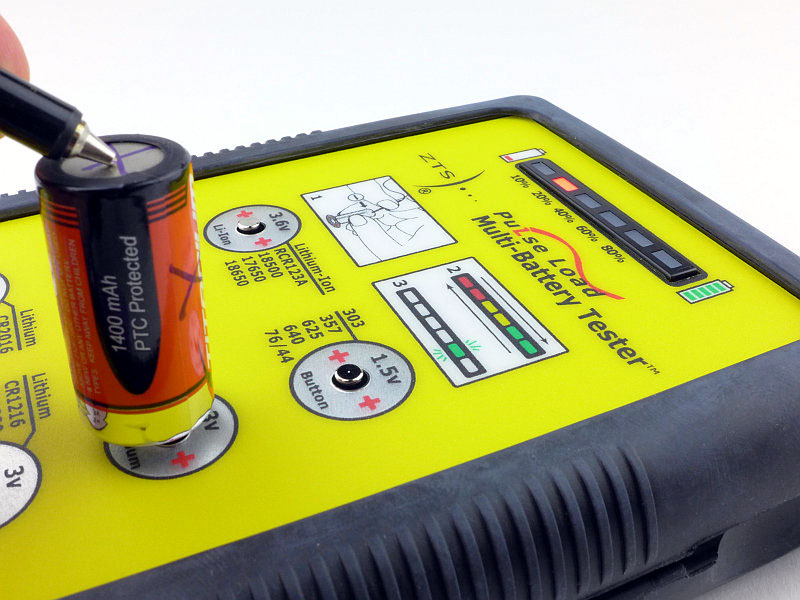
Notice in this photo I have marked an X on the cell with a sharpie to indicate it has been used for a runtime test. Normally I simply discard these cells as I’ve taken the test light down to the ANSI cut-off, but as you can see here the MBT-1 has revealed that this cell still has 20% capacity left. Perfectly fine to use for some low output backup lights and not yet ready for the recycle bin.

I’ve even found that it can be worth testing new cells as I’ve had some turn out not to be matched perfectly for use in multi-cell lights.

The testing methodology is that even during the first set of pulse loads the cell may have recovered and give a false reading, so the recommendation is to test each cell three times. That last reading is the most accurate.

No more guessing with straight voltage readings, simple quick and effective testing.

Review Summary

_______________________________________________ _______________________________________________
Things I like What doesn’t work so well for me
_______________________________________________ _______________________________________________
Pulse load testing (not simply voltage). Relatively expensive.
Huge range of cells can be tested. Relatively bulky.
Very simple to use.
Allows for cells to be matched and graded.
Minimises wastage.

A big thanks to MyFenix for supporting Tactical Reviews with this ZTS MBT-1 Battery Tester (MyFenix is the Official UK Fenix Distributor).

Sunglasses Review: Wiley X MEGA Test – Saber, Twisted and Knife

I first came across Wiley X due to the fact they manufacture 5.11 Tactical’s range of sunglasses. It is a real compliment that 5.11 chose Wiley X, and when you see more of what Wiley X make you will understand why they are a brand you can trust if you want protection as well as style.

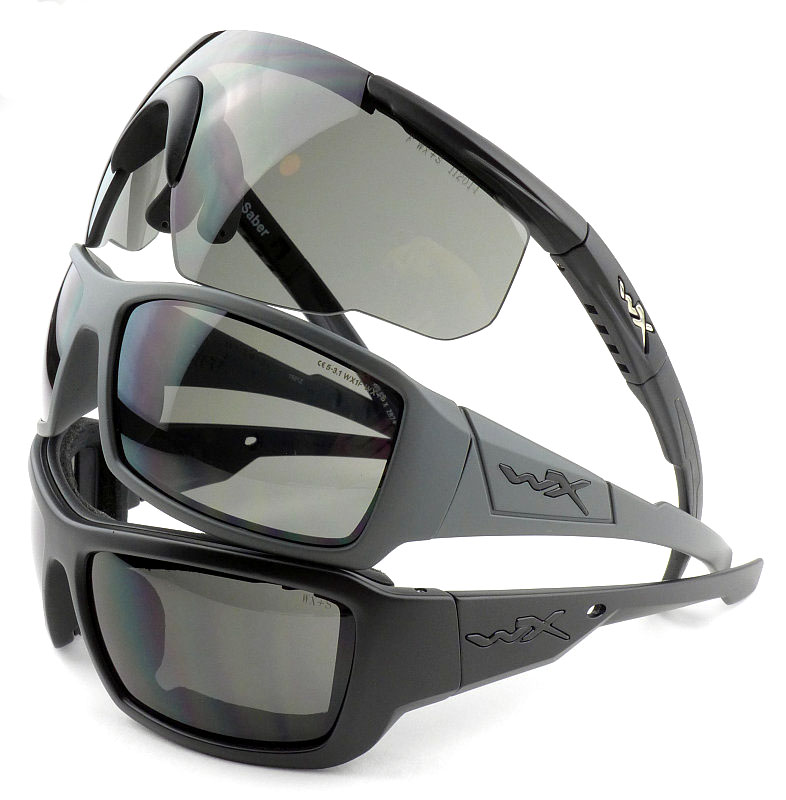
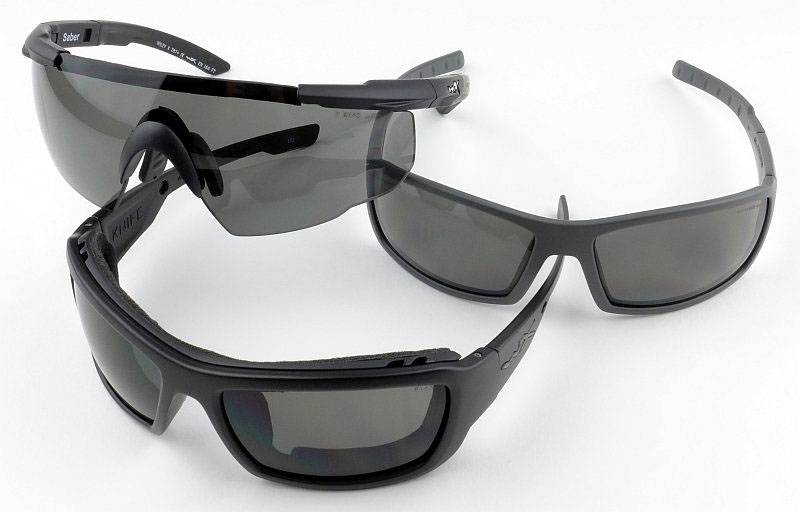
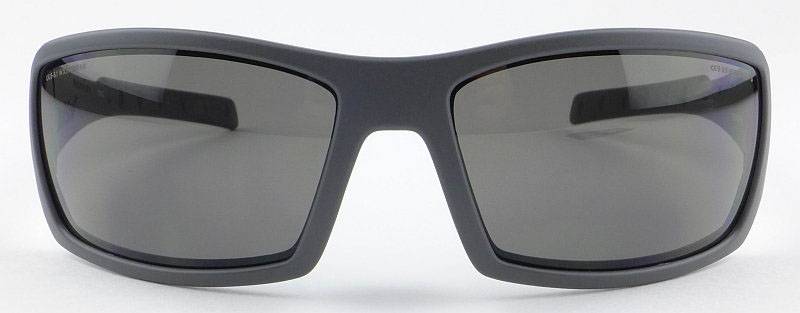
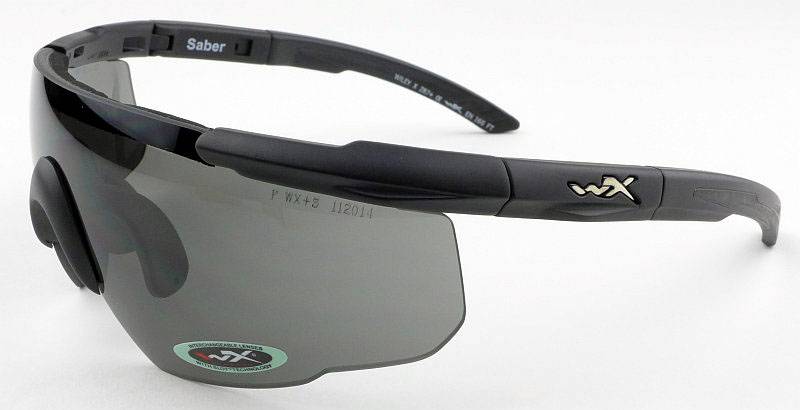
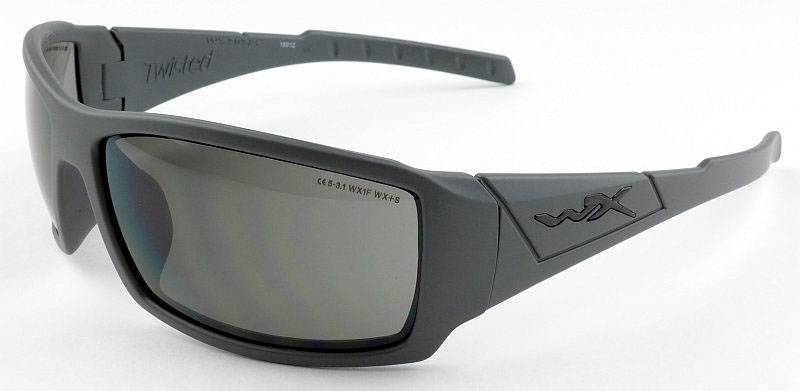
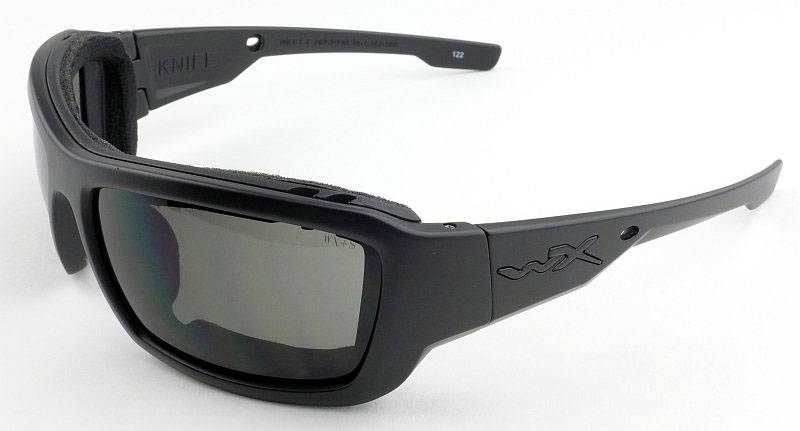
In this group review I’m looking at three very different pairs of glasses showing some of the key benefits Wiley X offer. On test we have the Sabre – wrap around ultra-protective shooting glasses, Twisted – the simplest glasses but in a special Stealth Grey frame, and Knife – using Wiley X’s Facial Cavity Seal making them as close fitting as goggles.
All three are in a non-polarized grey lens aimed at tactical use. For tactical use you want to avoid polarized lenses due to their tendency to cause issues with various device displays – it is just not worth the risk.
There is a lot to show as each of these models have features specific to Wiley X. Many of these features are repeated across the Wiley X range. The models in this MEGA review will help you understand what options you have.

Taking a more detailed look at the Saber:

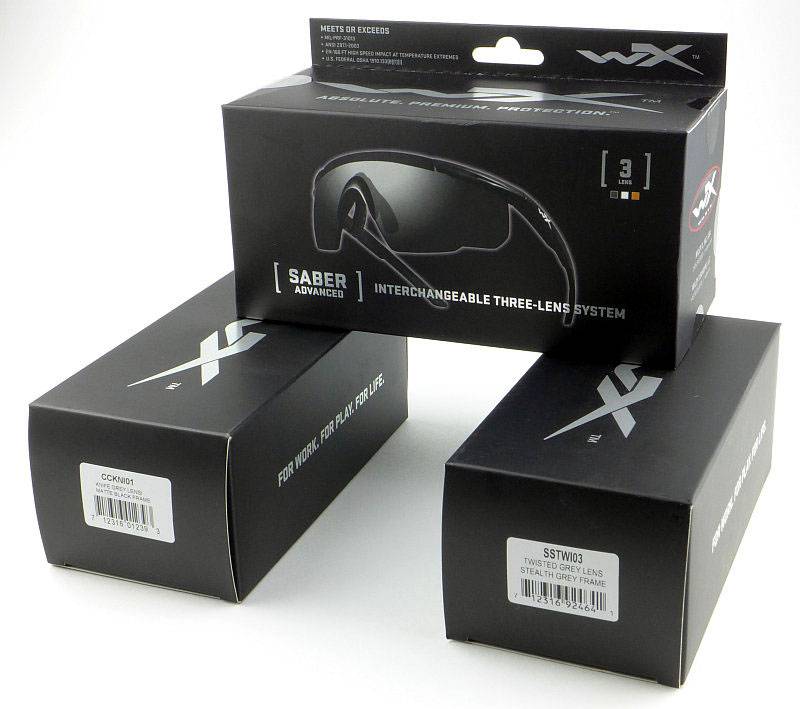
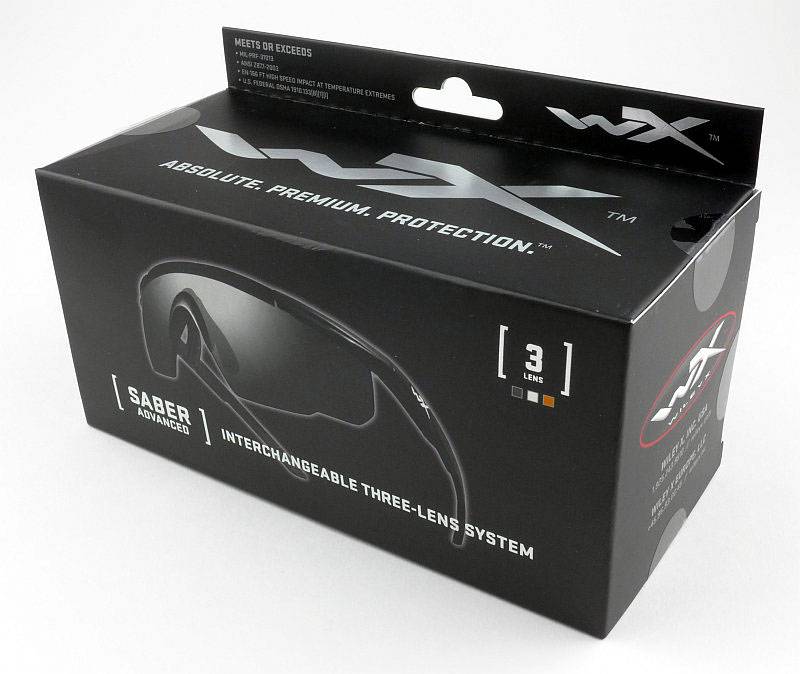
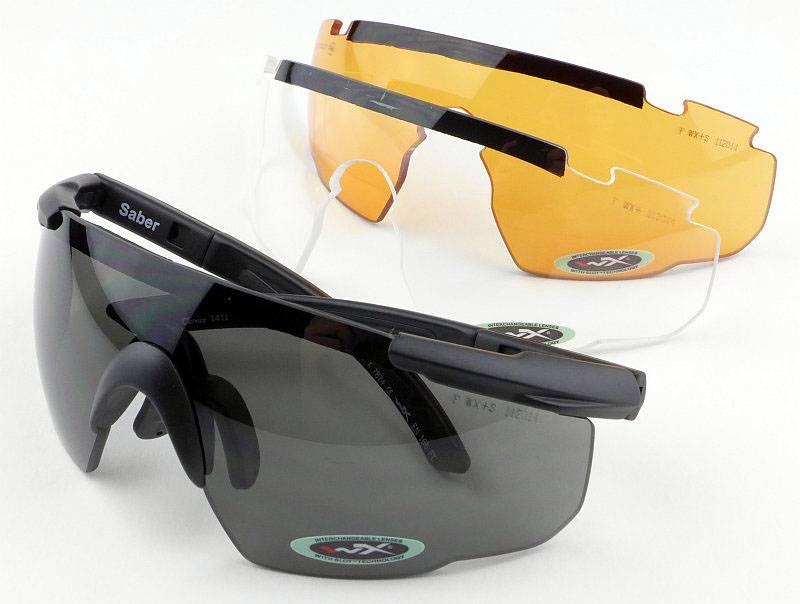
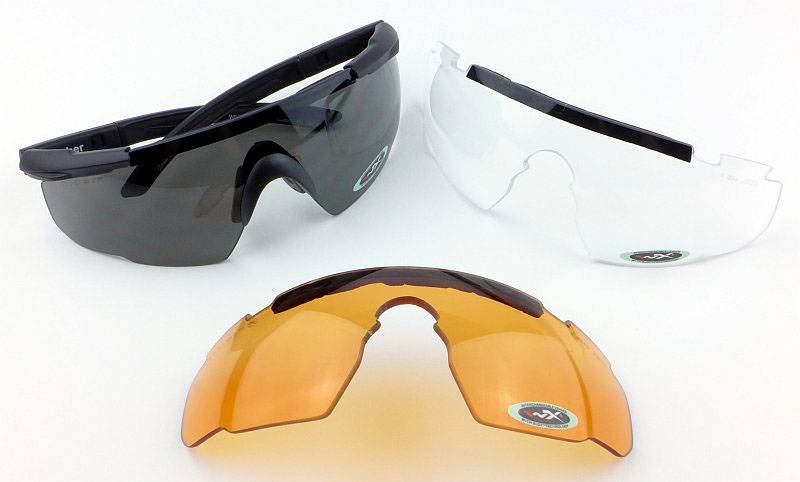
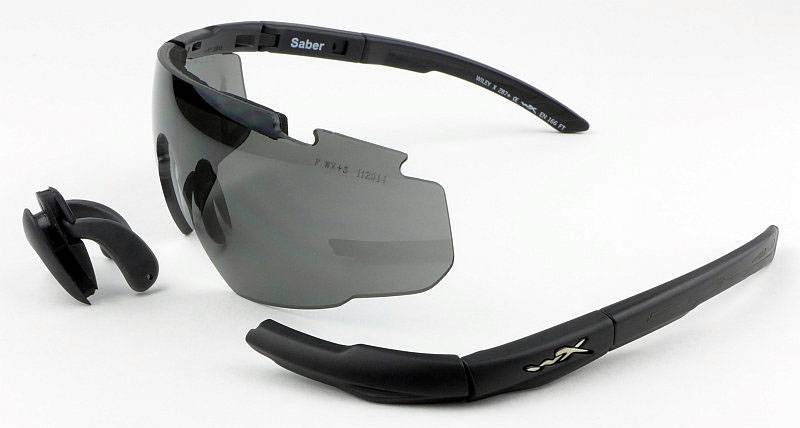
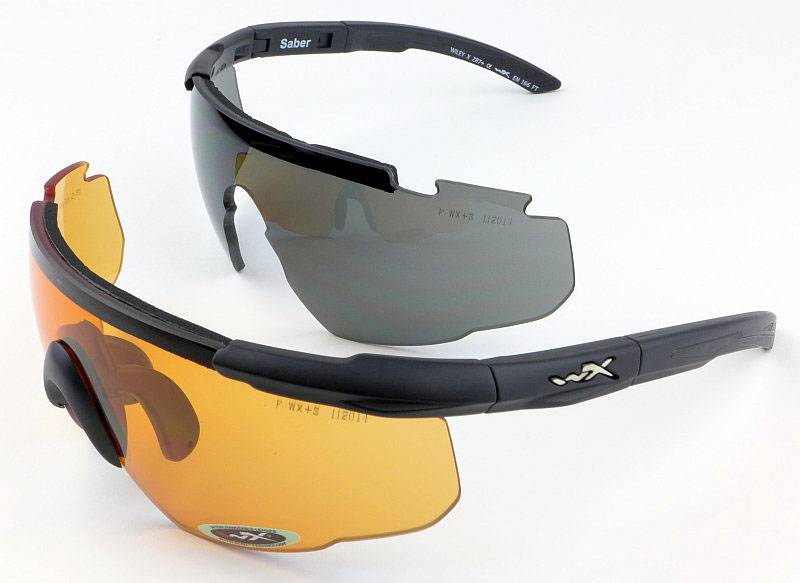
There are several options for the Saber, from individual lenses to a full set, and this is the full triple lens set.

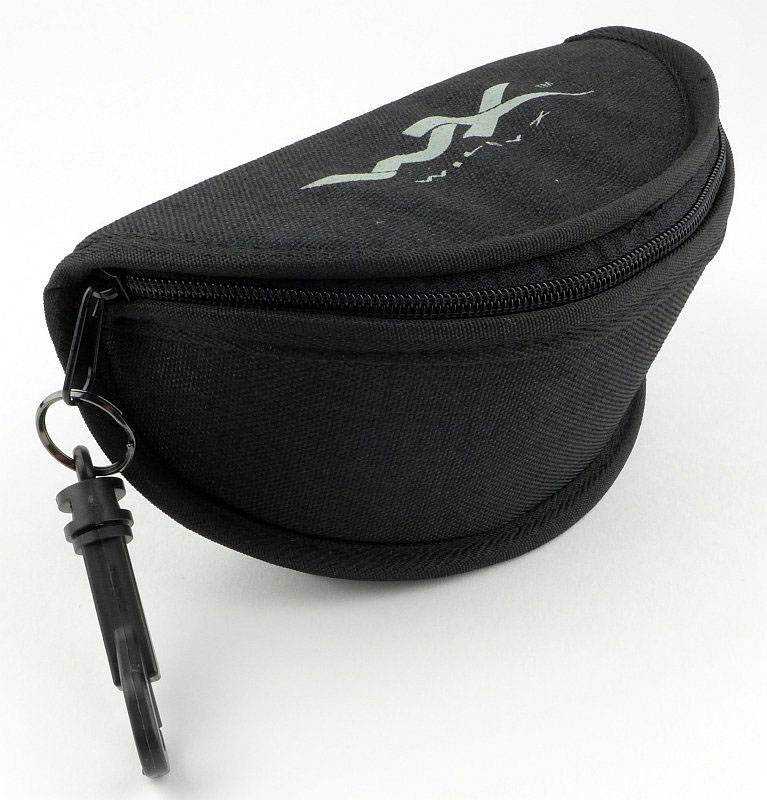
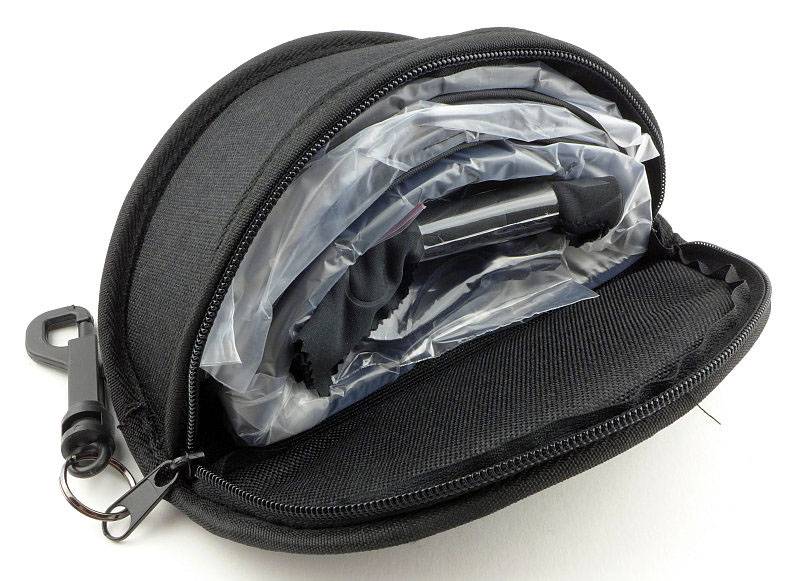
Everything is supplied in a Wiley X multi-lens case.

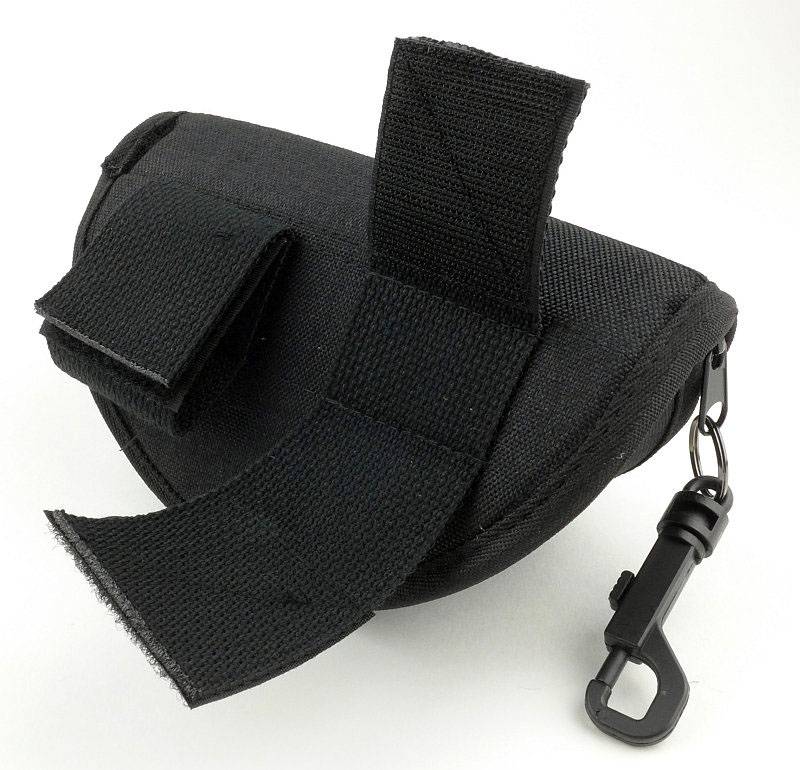
The case has two Velcro loops on the back for mounting to a belt/strap/etc.

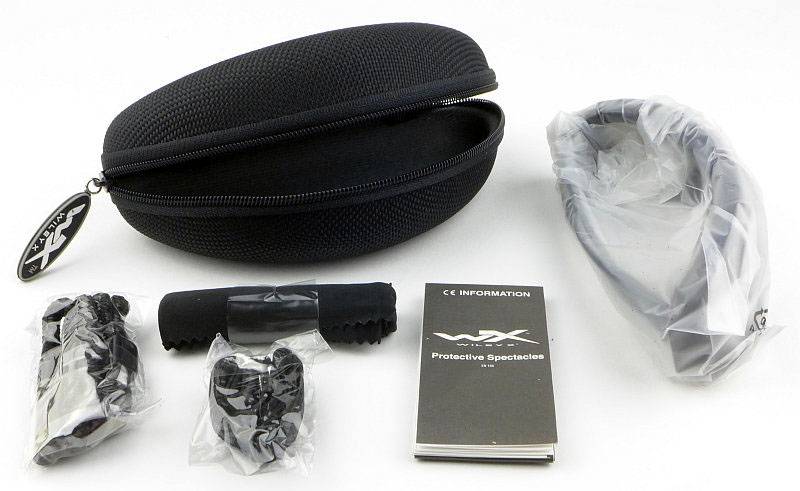
Each component arrives wrapped in a protective plastic bag so it is in perfect condition when you first unpack it. After that, well, it is up to you.

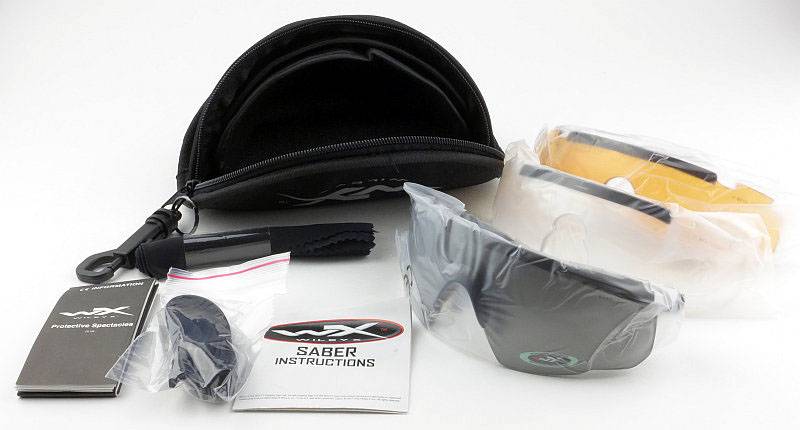
In the case is the Saber with grey lens, a clear lens, orange lens, strap, cleaning cloth and instructions.

The set of lenses fresh out of its wrapping.

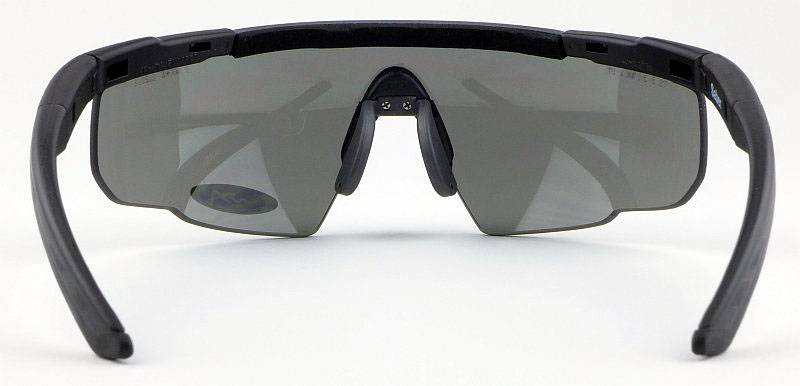
Each lens is a compound curve to fully wrap the eyes.

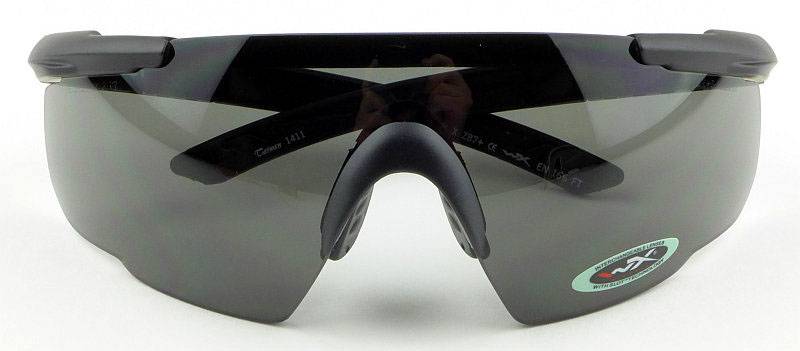
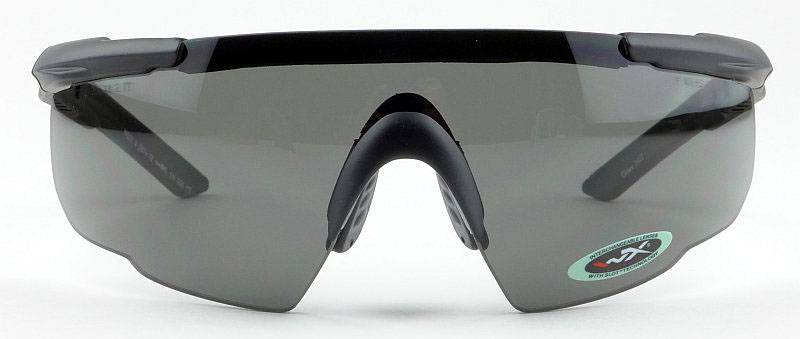
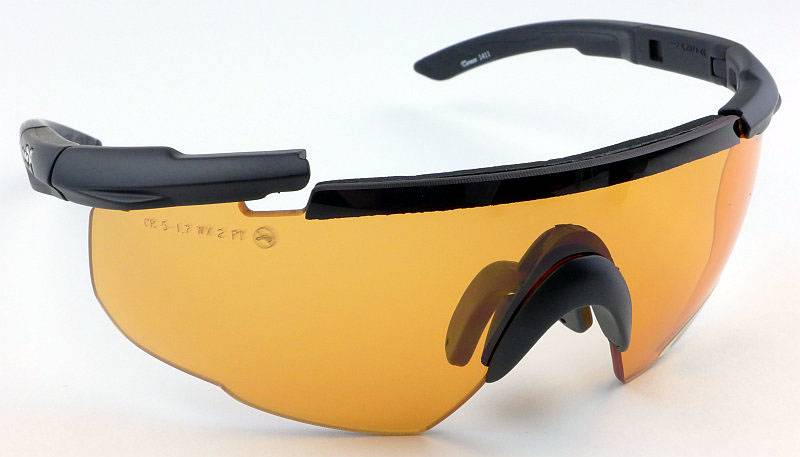
Taking a closer look round the Saber here it is from the front with arms folded.

And arms unfolded.

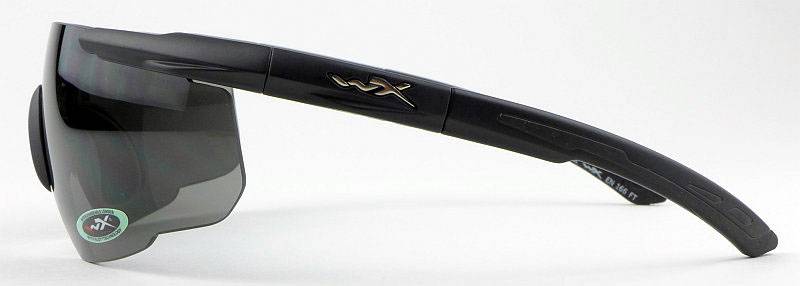
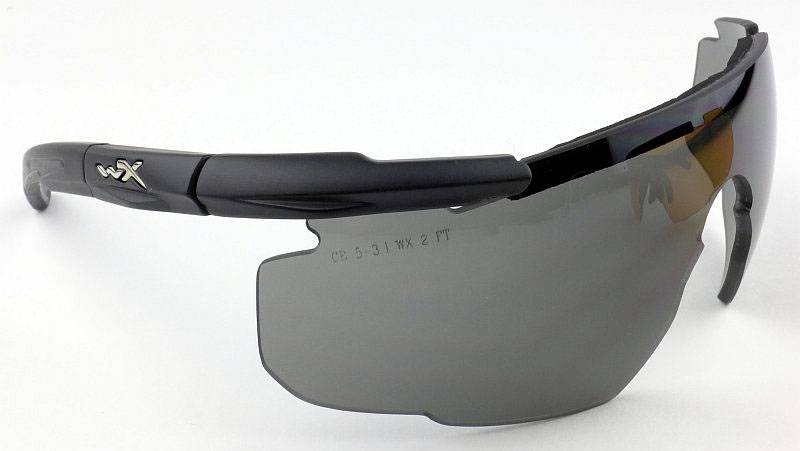
From the side.

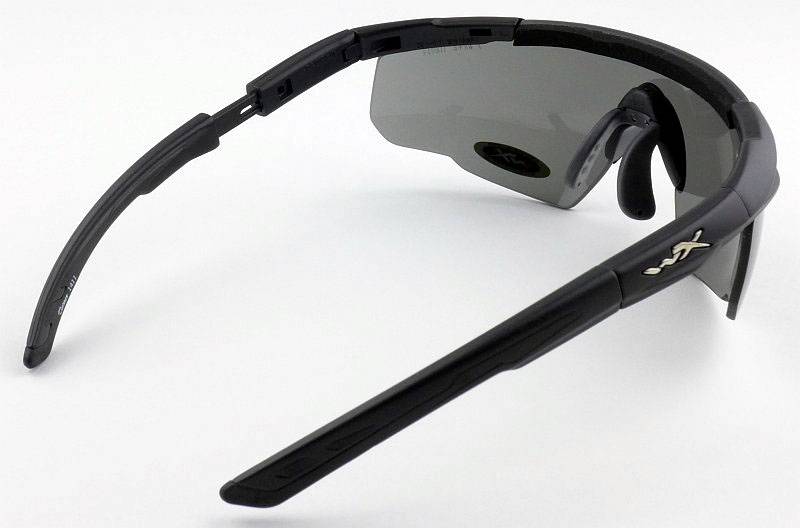
Then from the inside.

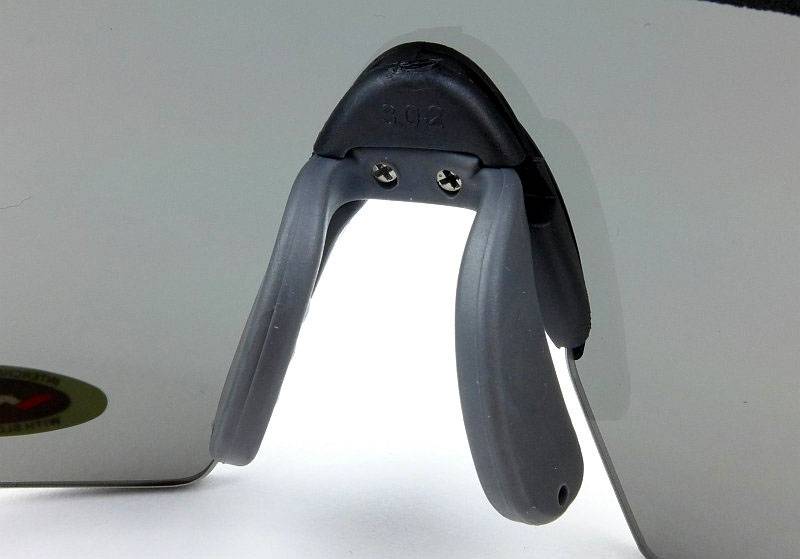
The nose piece has fully adjustable rubber covered pads. You simply bend them to fit.

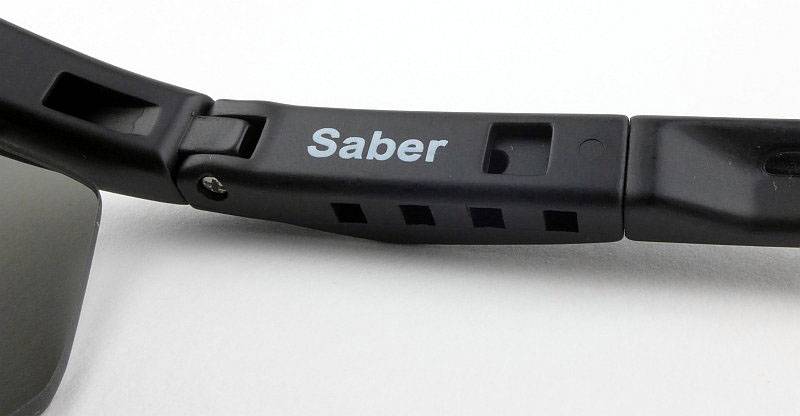
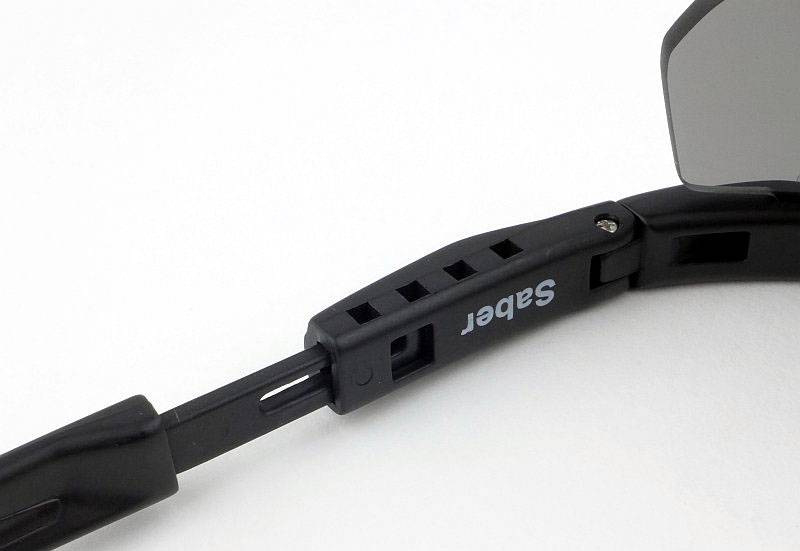
On the inside of the arm, the model name is printed on the ‘active’ section of the arm.

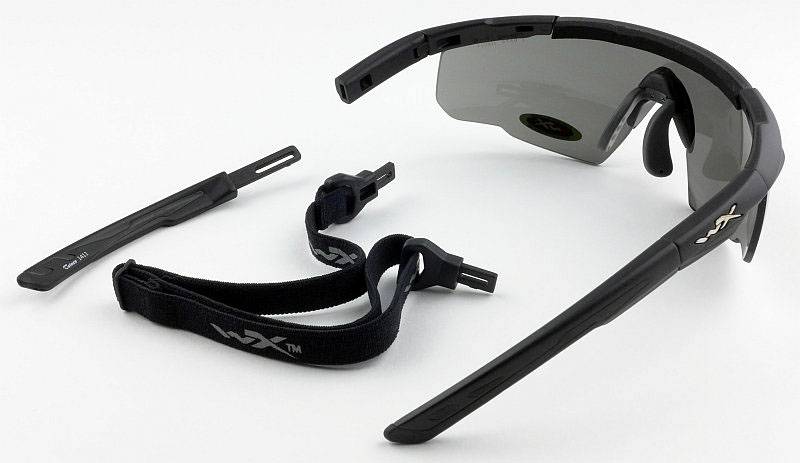
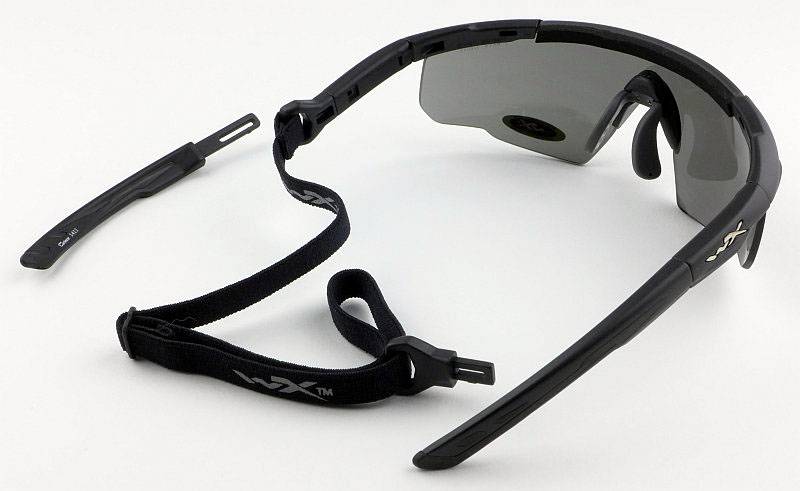
The first ‘active’ feature of the arm is that you can remove the rigid arm and replace it with a goggle style strap. First pull out the arm.

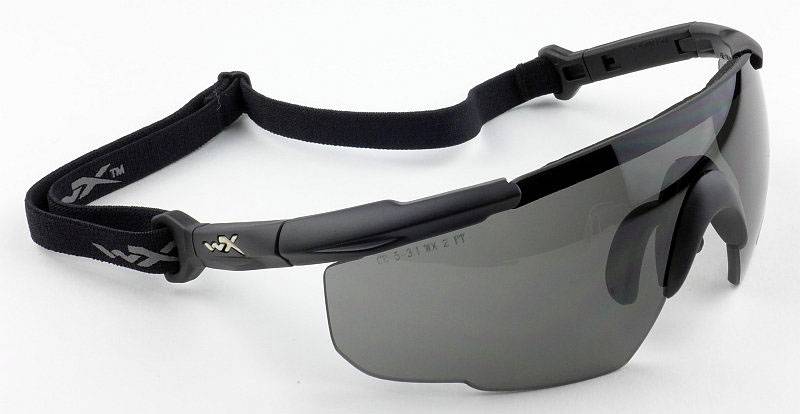
Plug in the first end of the strap.

Repeat with the other arm and strap end.

Instead of just pulling the arm out entirely, each arm has length adjustment to enable the best possible fit for each person.

The arm has four ‘stops’.

Being a frameless interchangeable lens system, you need to remove the arms and nose part and transfer these over to the lens you want to use. The fit of these parts is really quite firm.

Here we are 2/3 transferred over to the orange lens, just the second arm to move.

I found the easiest process was to pull the arm outward and then lift the hinge upward ensuring you don’t try to lever with the whole arm, instead applying pressure as close to the lens as possible. The arm then pops up.

Fitting the arm was easiest doing this the other way round, first seating the hinge side of the mount, pressing the arm inwards and then pushing down on the mount.

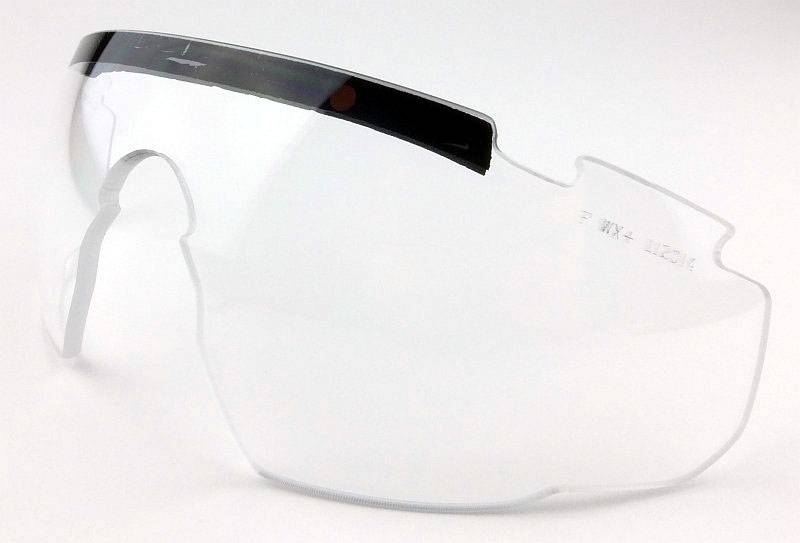
The clear lens almost disappears in the photo despite one of the Saber’s special features. The Sabre has the thickest lens, at 3mm thick, I’ve ever come across. This gives it probably the highest protection rating for any glasses of this type. With the bare lens you can see this thickness at the nose cut out.

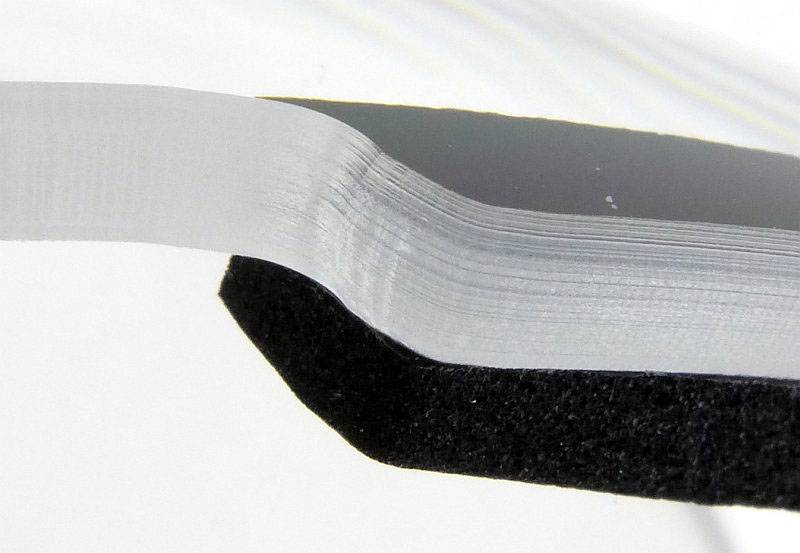
Looking closer to where the brow foam padding is attached you can see the machining marks in the lens edge.

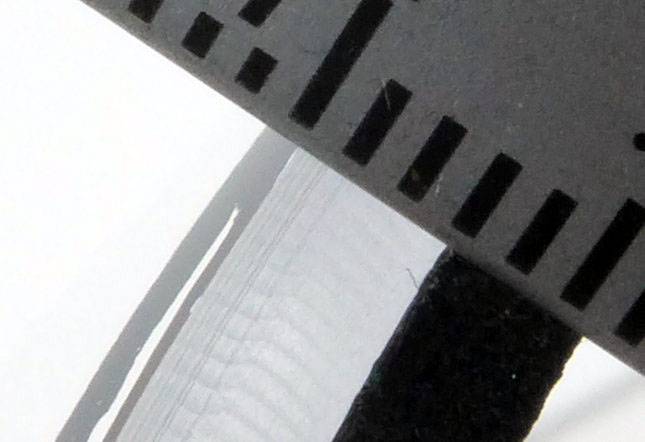
And next to a ruler with mm graduations.

Taking a more detailed look at the Twisted Stealth Grey:

The Twisted model originally came in a black frame, but with more demand for grey, Wiley X have released a special ‘Stealth Grey’ version.

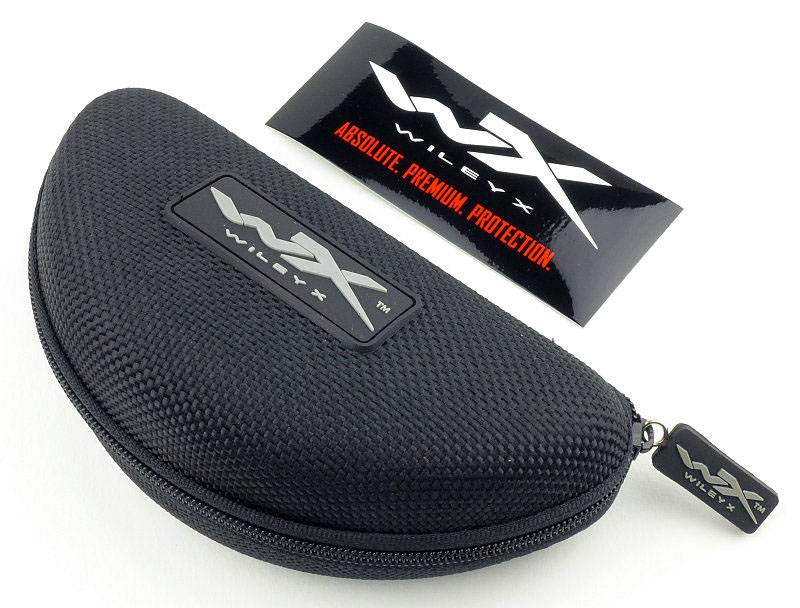
With no additional lenses to carry, the case for the Twisted is the Wiley X standard case. You also get a sticker in the box.

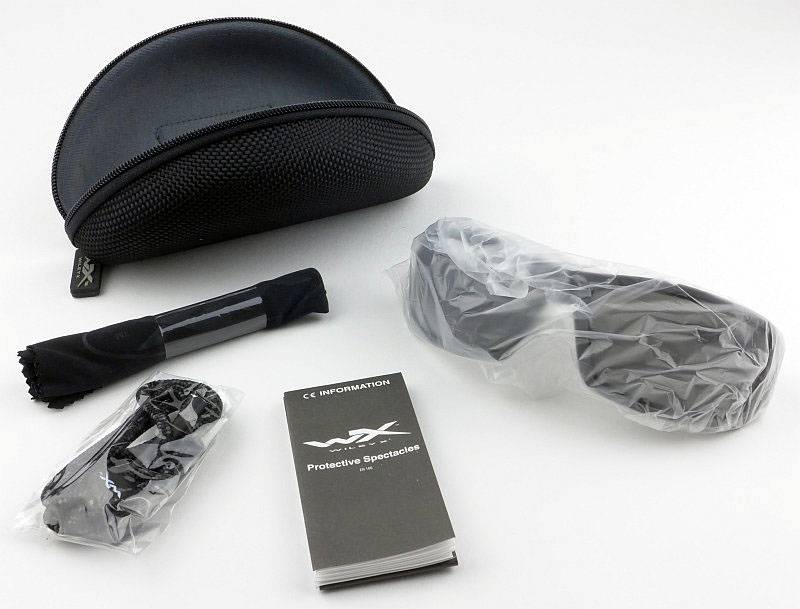
Inside the case are the plastic wrapped glasses, a cleaning cloth, information leaflet and a neck strap.

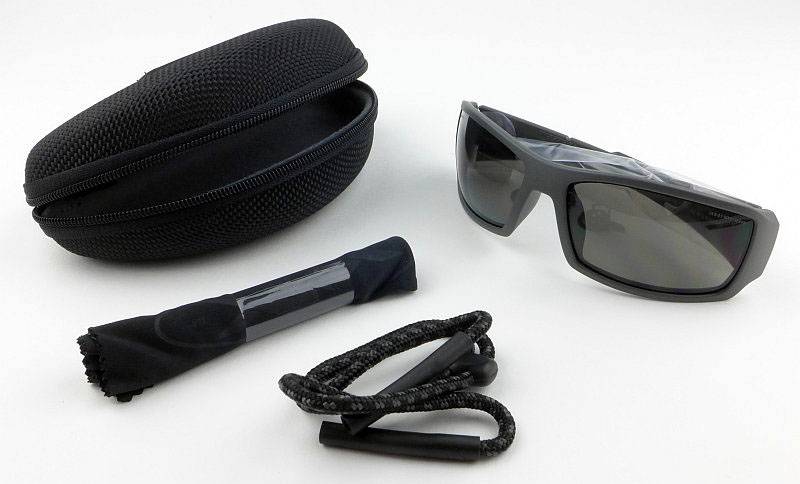
Getting rid of some of the plastic wrap for a better look.

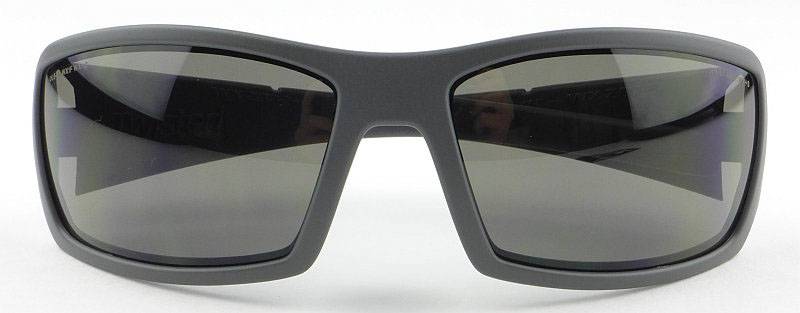
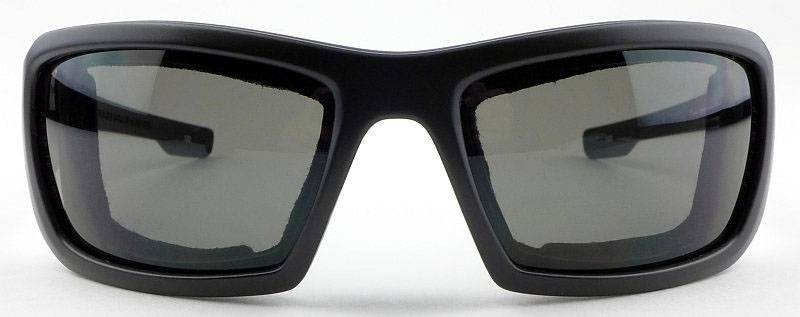
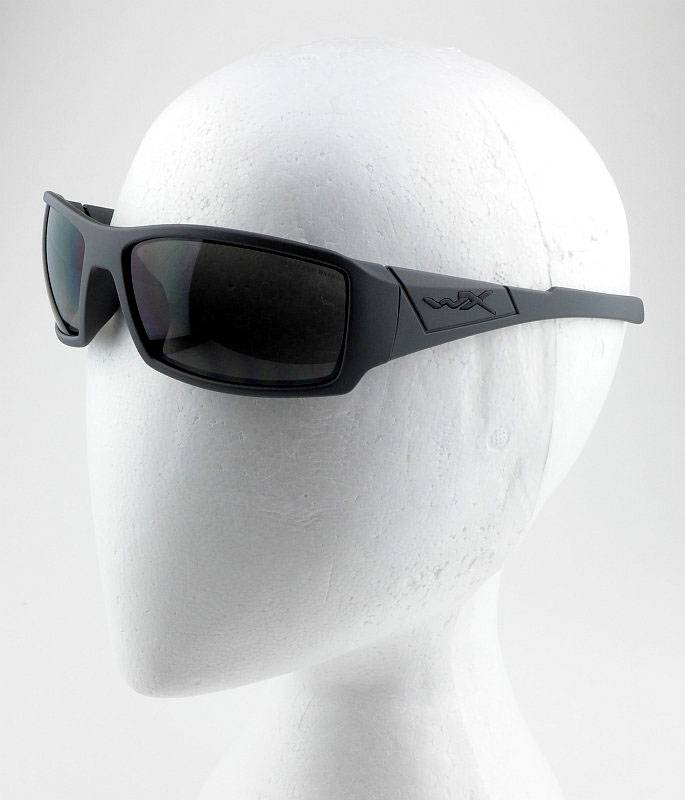
Taking a closer look round the Twisted here it is from the front with arms folded.

And arms unfolded.

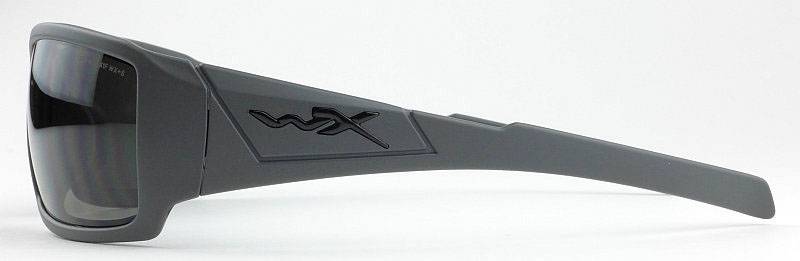
From the side.

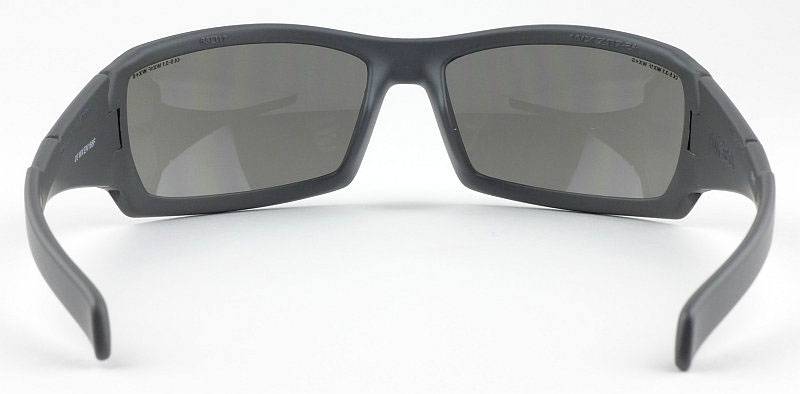
Then from the inside.

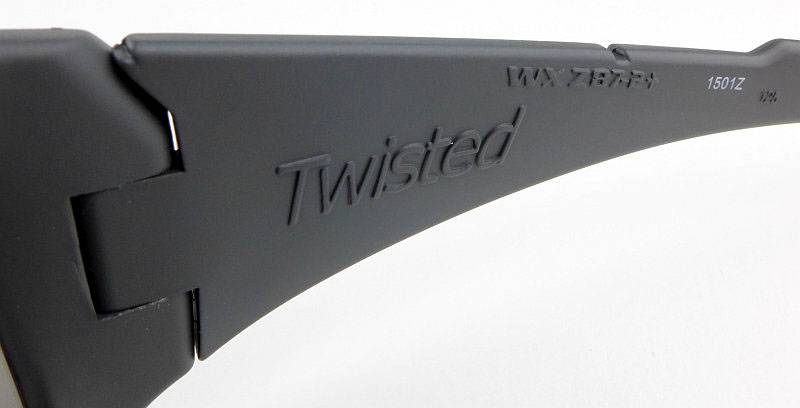
The arm is wide at the hinge which helps shade the wearer from light and debris coming from the side.

A detail of the hinge.

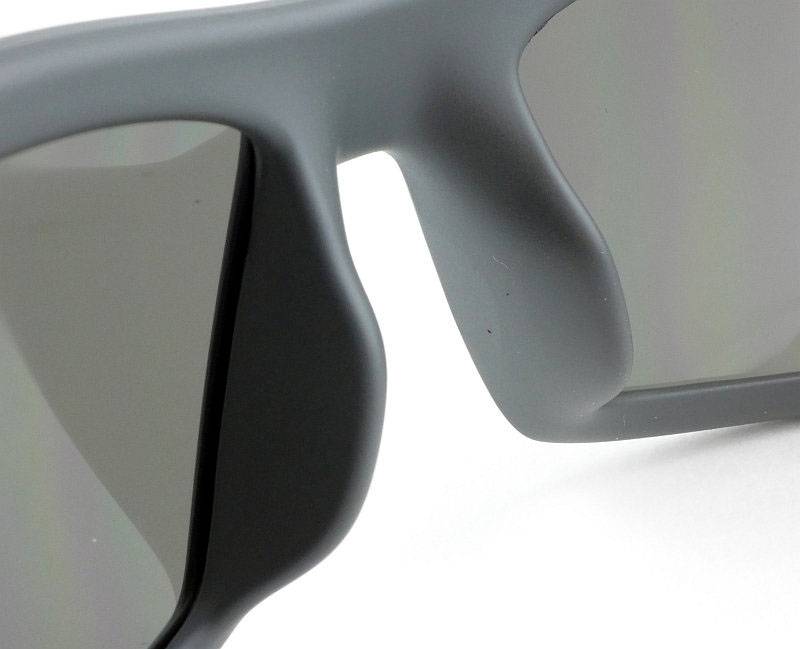
On the Twisted, the nose bridge is a fixed, moulded design. The surfaces are all rounded with no corners to dig in.

Taking a more detailed look at the Knife:

The last in this set is the Knife which features Wiley X’s facial cavity seal.

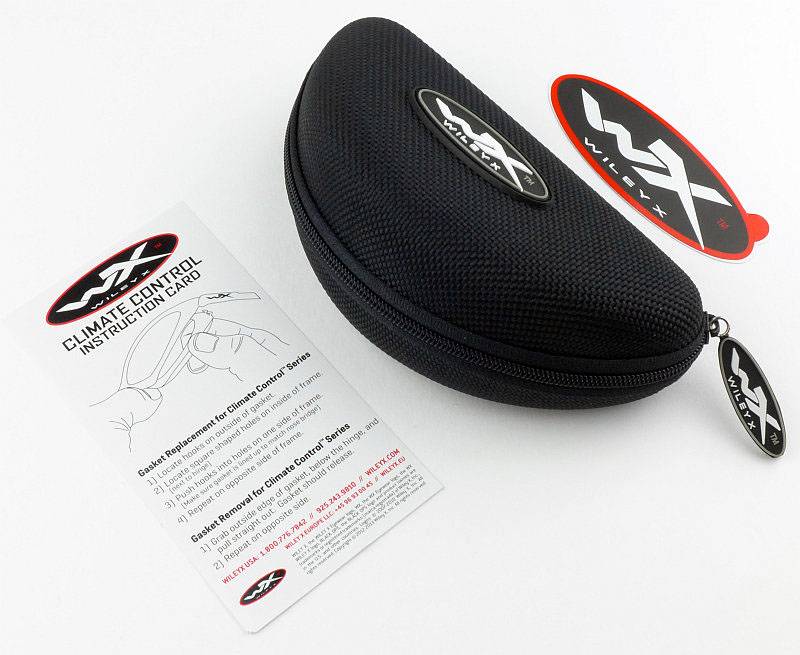
As well as the cased glasses and sticker, the Knife comes with an instruction leaflet for the facial cavity seal.

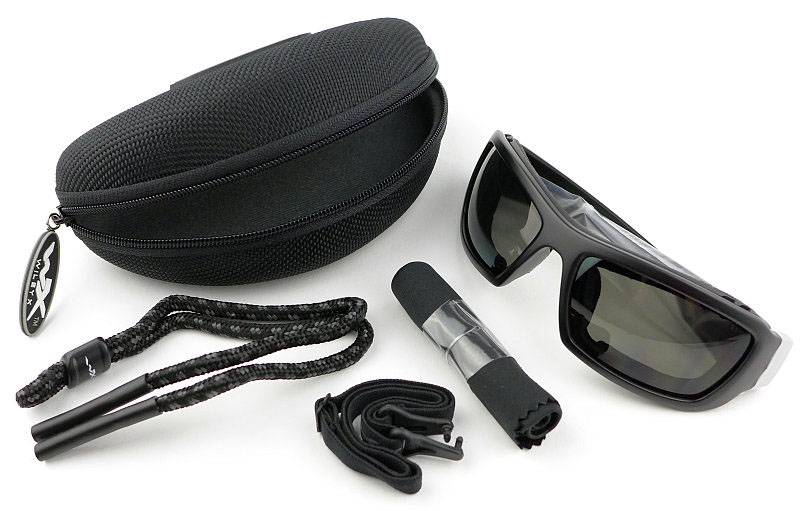
With the Knife you get a cleaning cloth, neck strap, and T-bar ‘goggle’ strap (more on that later).

Everything unwrapped.

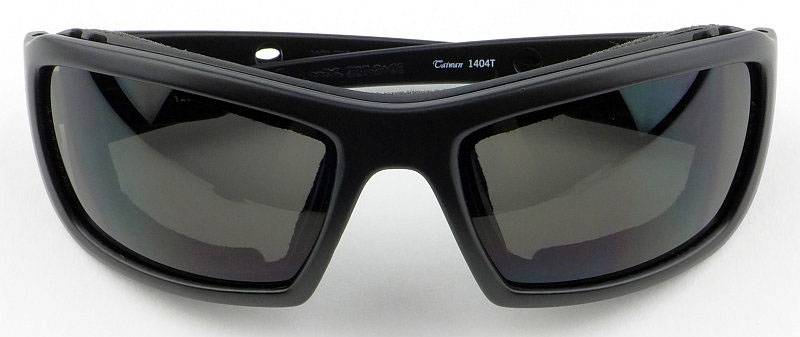
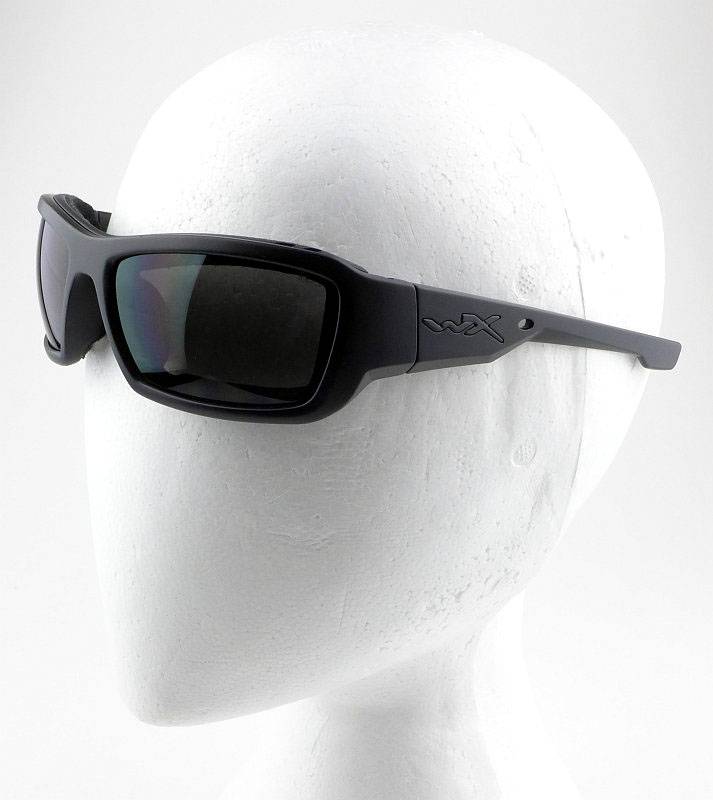
Taking a closer look round the Knife here it is from the front with arms folded.

And arms unfolded.

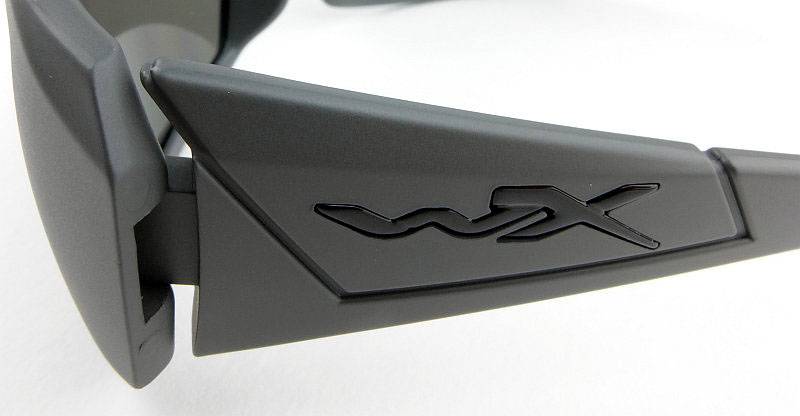
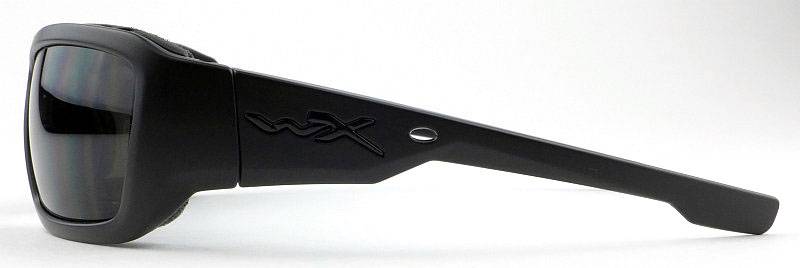
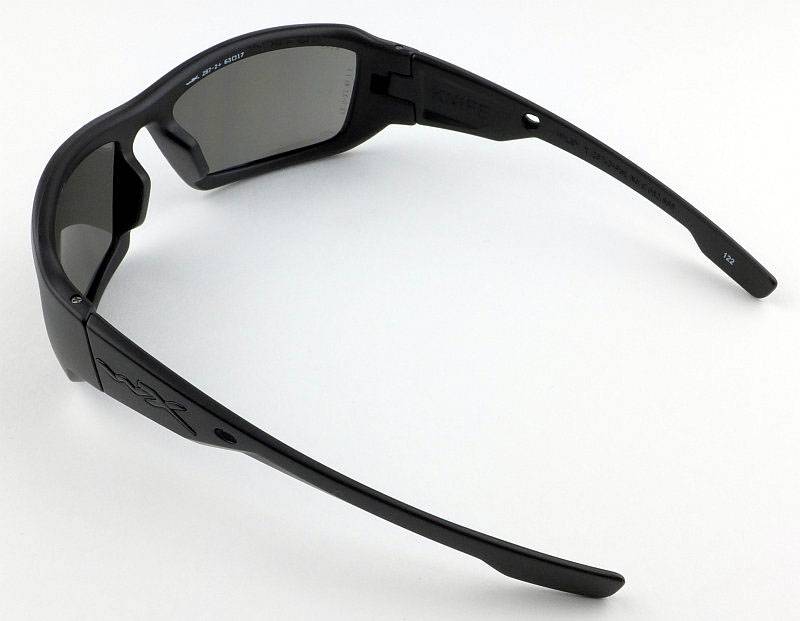
From the side.

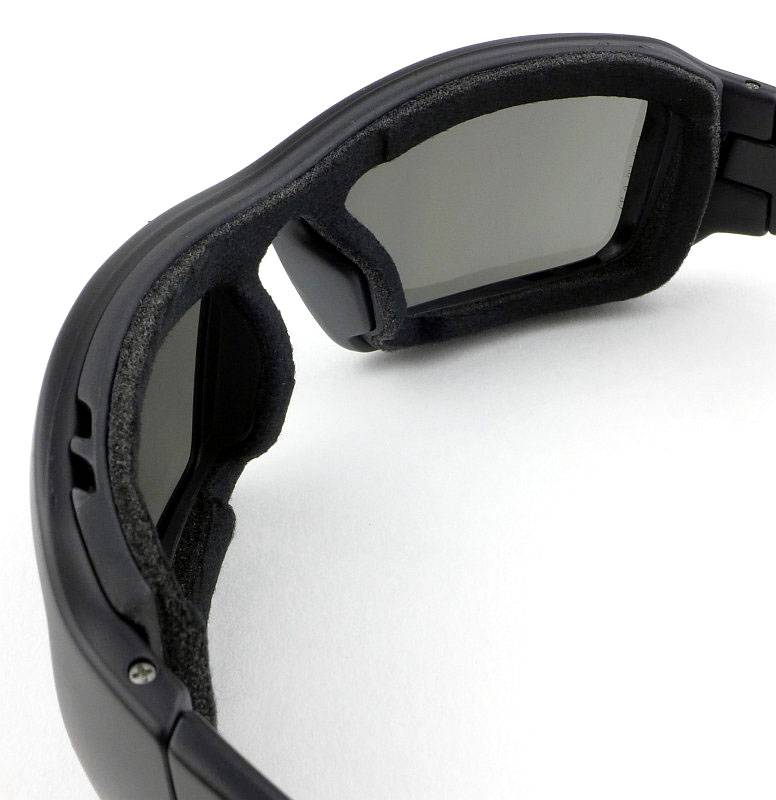
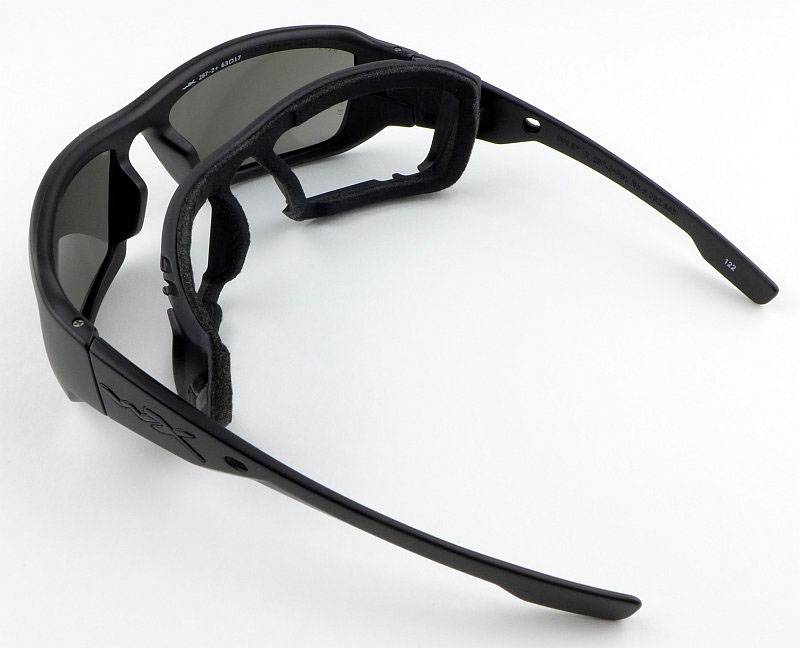
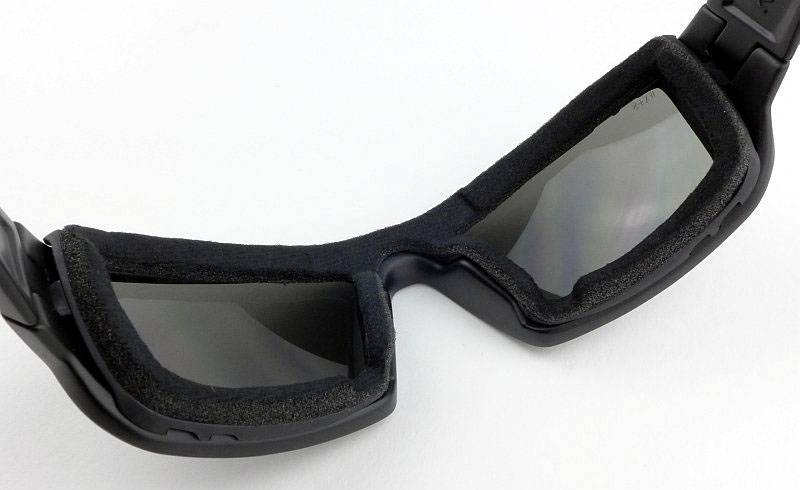
Then an inside view to show the facial cavity seal insert.

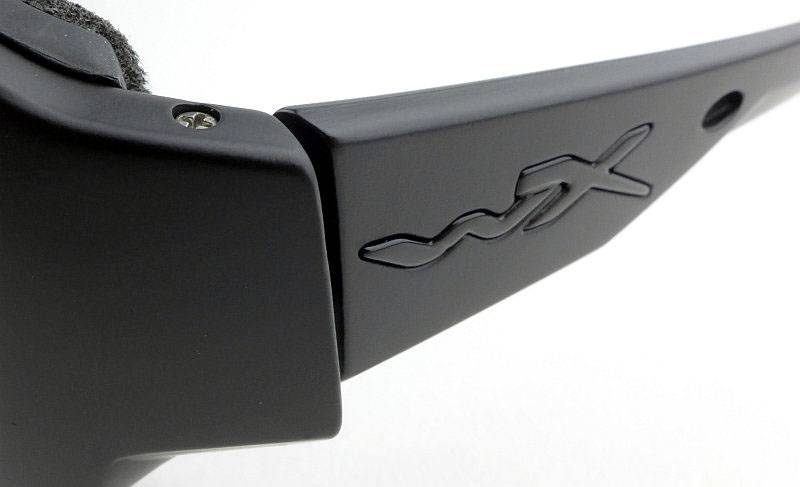
The Knife’s hinge.

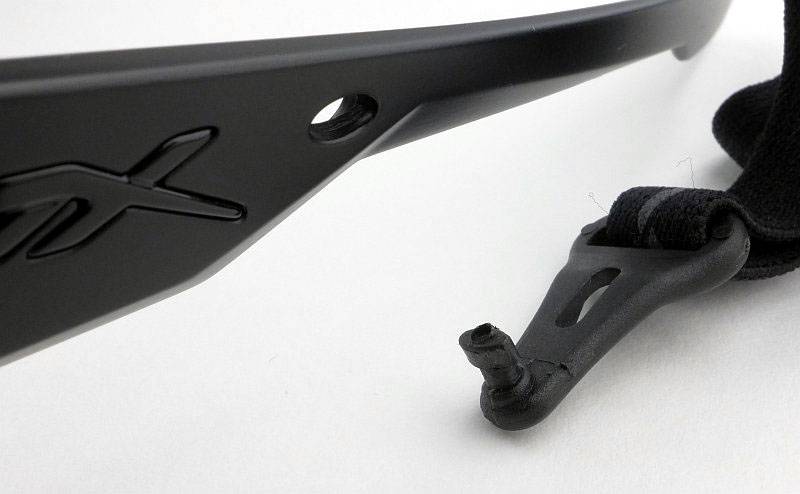
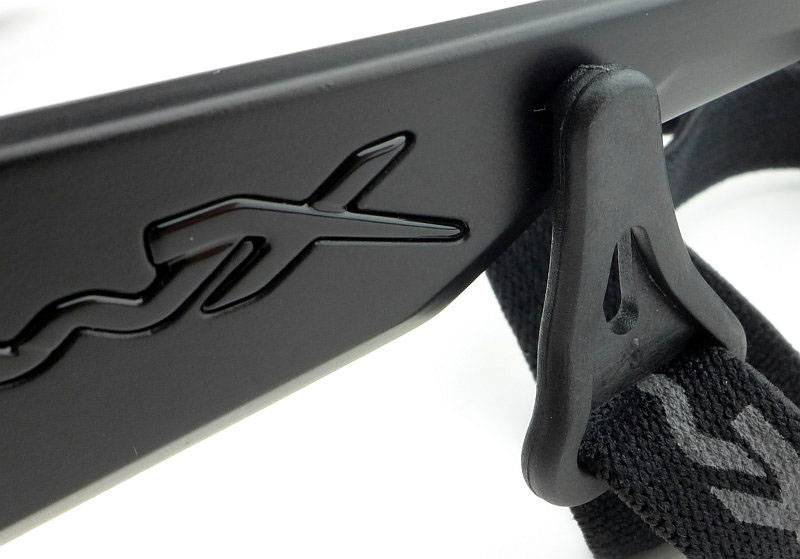
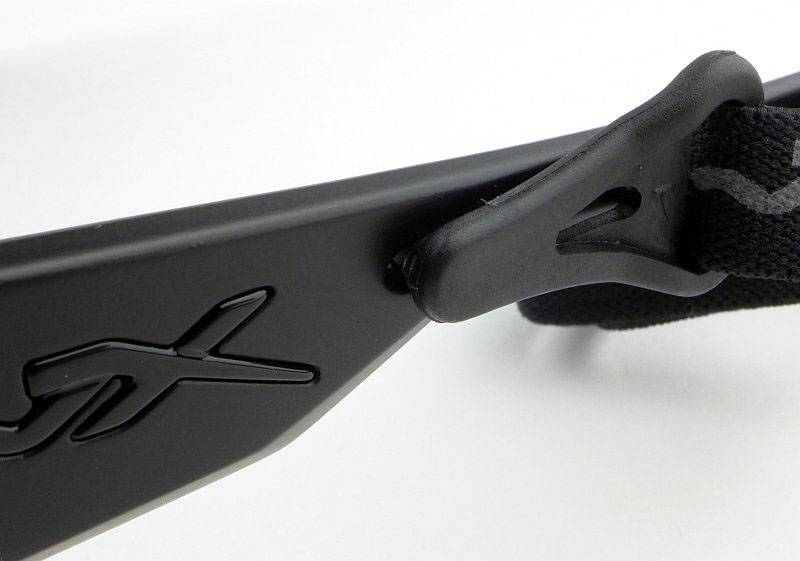
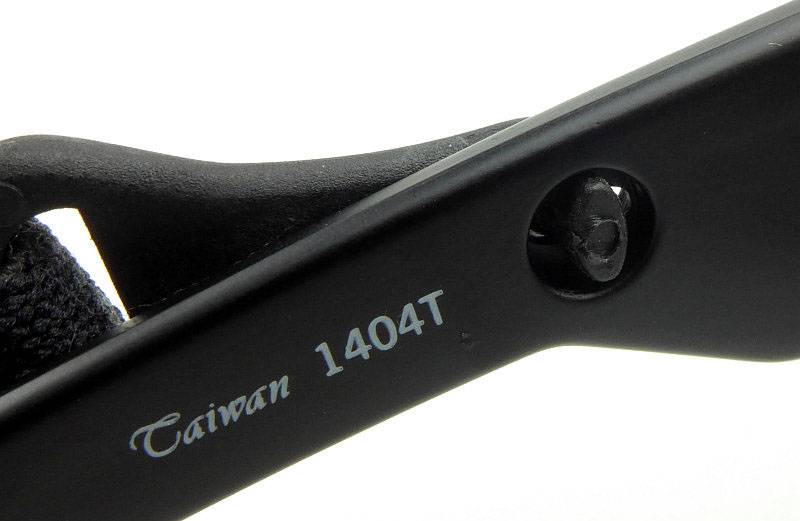
Each arm has a mounting hole for the T-bar strap system. This is a strap to hold the glasses firmly onto the face. With the facial cavity seal, these glasses become almost goggles, so this system makes perfect sense as it keeps the seal good.

The T-bar strap fits in pointing downwards.

Then rotates back to lock in place. You can only release the strap by rotating the mount back down to the previous position.

Inside the arm you can see the T-bar in the locked position.

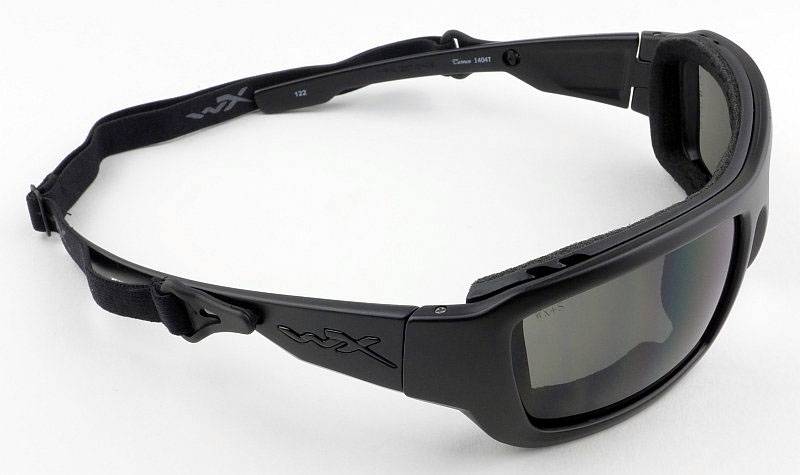
Here the knife has the goggle strap fully fitted.

It is possible to remove the facial cavity seal for cleaning or to use the glasses without the seal. There are times when the extra ventilation is needed.

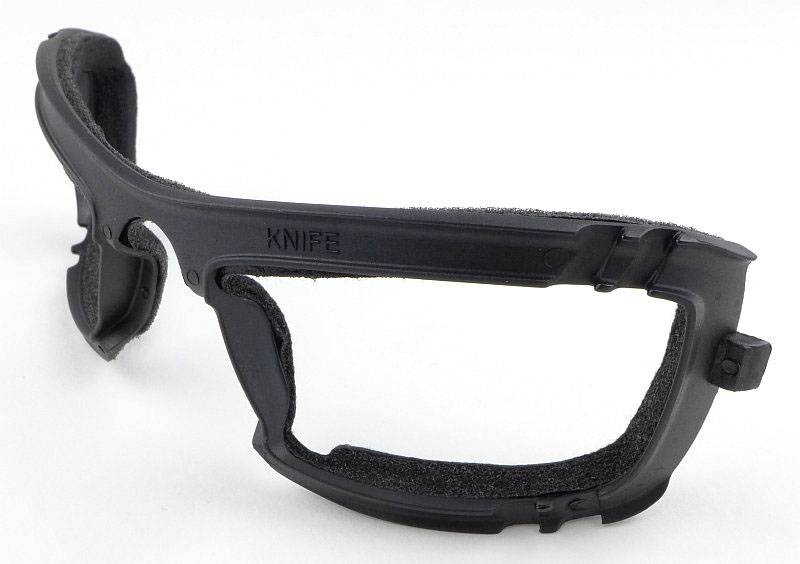
The seal is specific to the model and is labelled for the Knife.

Here is the Knife without the seal.

The facial cavity seal has a soft foam edge to fit closely to the face.

Comparing the three:

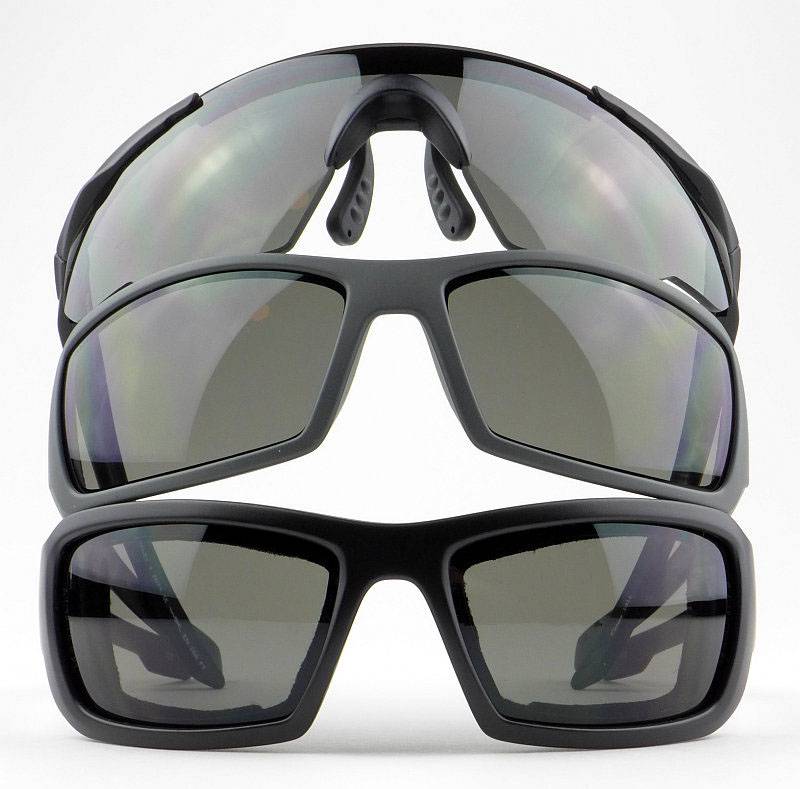
We’ve spent some time looking at each one in detail, now a first quick comparison series.

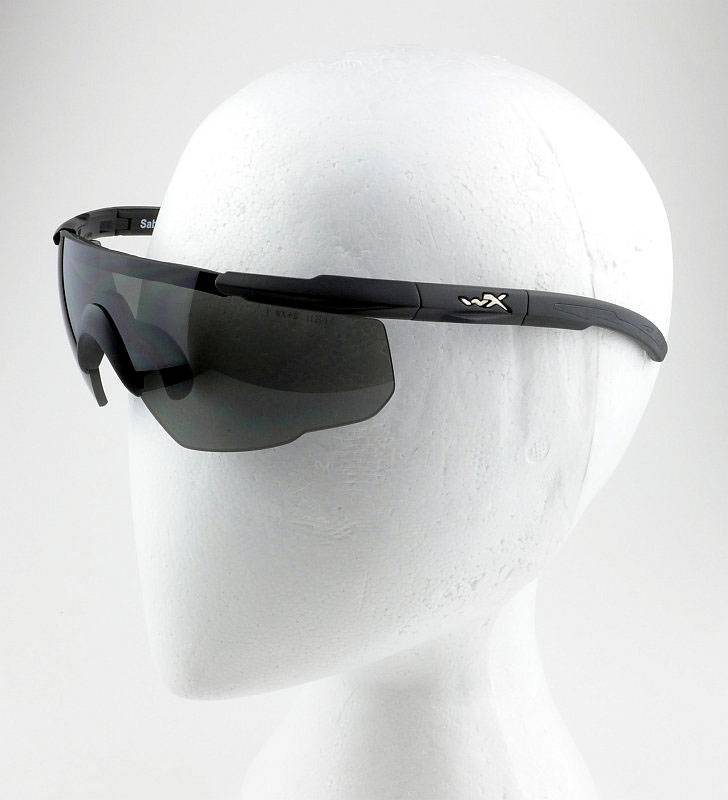
And now with each one on a display head:

Troubleshooting

This section is included to mention any minor niggles I come across during testing, in case the information helps anyone else.

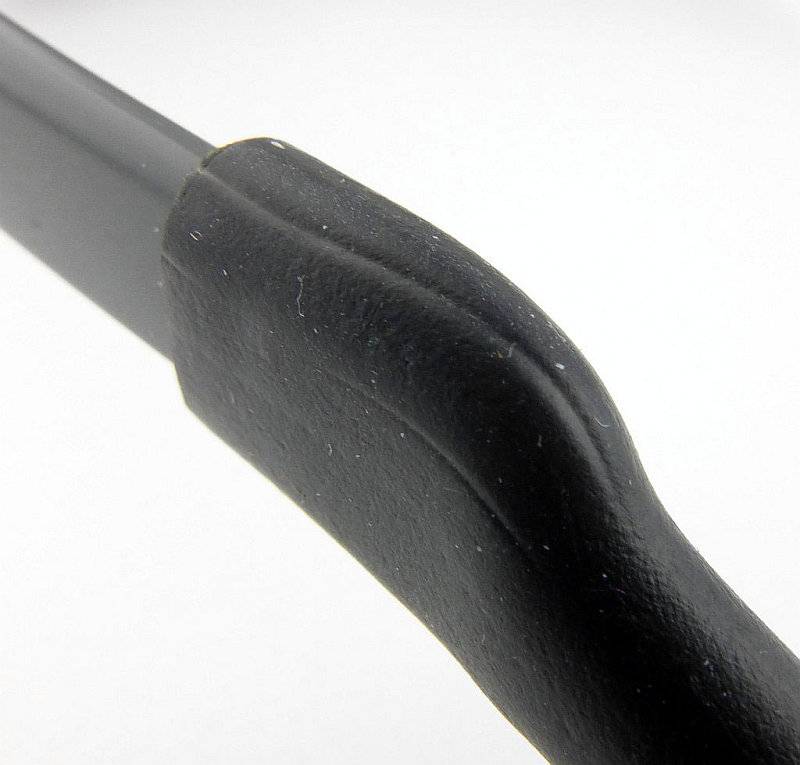
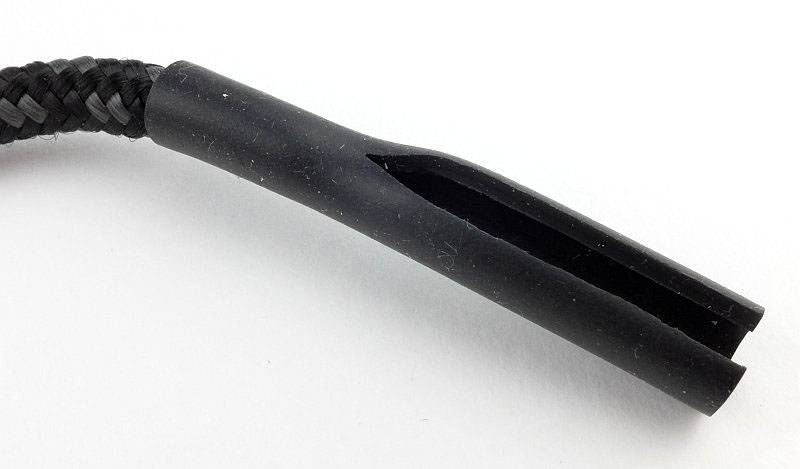
The standard neck straps that were supplied with the Twisted and Knife both failed with the rubber tubing splitting.
From the moment they were fitted there appeared to be stress lines in the rubber.

This line turned into a split.

Altogether I’ve had three of these straps, and all three have split.
As per the description of this section, this information is provided in case anyone else finds a similar ‘issue’ that might be fixed in the same way.

In use

Each of these Wiley X models was chosen to represent a different use or requirement, and provide an excellent representation of what Wiley X offer.
For the utmost in protection you need to choose a wrap-around lens as this does not reply on the frame, or how well individual lenses fit in the frame, for protection. You have a one-piece protector positioned over your eyes.
The Saber is exceptional in its lens thickness at 3mm and exceeds all the safety standards, military and civilian, for protective eyewear. It does this without any distortion to your vision. I am very sensitive to poor lens design and have used compound curvature lenses that distort the wearer’s view. The Saber has not caused any visual distortions or strange sensations at all.
The full wrap gives excellent all round vision well around your peripheral vision giving uninterrupted views, just like your uncovered eyes, but protected from bright conditions and flying objects. What this does mean is that you are not protected from glaring light such as low sun to your side which the arms of certain glasses would shade you from.
For use as shooting glasses or to guard against flying objects (not dust) the Saber will give you exceptional protection.
Adjustable arms allow the maximum comfort for most users. You also have a great deal of fit adjustment with the nose piece which can be bent to raise or lower the Saber and bring it closer or further from the face. Do not neglect this, you can get a fantastic fit and comfort by taking the time to adjust the nose piece, and don’t be afraid to experiment to find the optimum fit.

Of the three, the Twisted is the most conventional ‘fit’ with no actual adjustment. On this point, of course, unlike the Saber, the Twisted will not fit everyone, but Wiley X give you excellent size information for every model so you can look for those suitable for small, medium and large heads and also at the detailed specifications of lens width, arm length and bridge width to find your best fitting model.
The arms of the Twisted curve inwards to wrap around the head and provide a good level of grip to keep them in place. The entire frame flexes as you put them on, and acts like a spring to prevent sliding. Coupled with their light weight, this makes them some of the most securely fitting glasses I’ve used without creating hotspots and discomfort when wearing for extended periods.
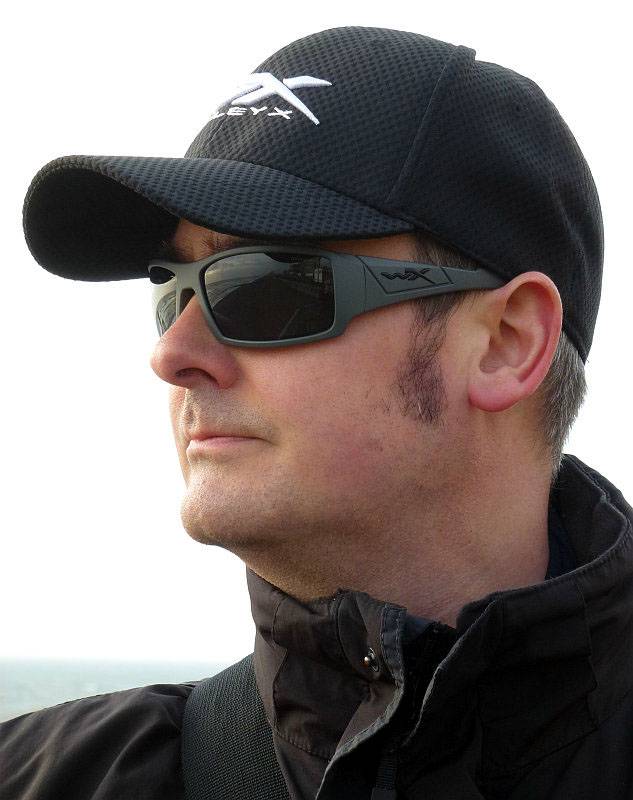
With the lenses curving round, there is minimal frame visible in my peripheral vision, yet the wide arms protect from low-angle light coming in from the side. An excellent compromise, and one reason the Twisted has become my most worn of the three and great for driving as well as outdoor activities.
The Stealth Grey frame is also a bit different and it is good to have a break from the normal black.

Last up in this group is the Knife. Its key feature to look at is the FACIAL CAVITY SEAL which also appears on several other models, but provides a very specific function.
When you first put on a model with the FACIAL CAVITY SEAL they feel more like goggles than glasses and it can take a little while to get used to. However as you get used to it, the feeling becomes more comforting and the benefits can be very obvious.
The FACIAL CAVITY SEAL is designed to protect you from wind, fine dust and pollen as well as blocking light that normally leaks in around the edges of sunglasses.
I’ve found that in situations where I would want to wear a peaked hat, the FACIAL CAVITY SEAL provides sufficient protection from the light that would normally leak in around the frame that I didn’t need the hat.
Where the FACIAL CAVITY SEAL really shines is in wind and dust protection. Though normal sunglasses provide a degree of protection from wind, once it is coming from the side this is far less effective. Add in dust and your normal sunglasses are not much use. The FACIAL CAVITY SEAL immediately shields you from this and stops the blinking and squinting. You could use actual goggles, but Wiley X’s FACIAL CAVITY SEAL gives you the protection of goggles in a pair of sunglasses.
You also have the option of removing the seal and using the sunglasses as normal sunglasses. This is crucial as they do also come with some of the issues of goggles.
Although the FACIAL CAVITY SEAL has some venting built in, yes, just like goggles you do get fogging. I found that this was particularly bad when driving (due to the lack of airflow), and other situations where I was hot and there was little or no airflow.
When it is windy, the small vents seem to cope with preventing fogging very well, but once conditions are calm, you are at the mercy of the temperature of the sunglasses and your immediate humidity (a nice way of describing the body’s output of moisture).
Knowing that when using the FACIAL CAVITY SEAL you can get fogging is just something you need to work with. When the situation demands the extra protection, the Knife delivers exactly that.
Remember though, that unlike goggles, you can remove the seal and they become normal sunglasses.
Due to hyper sensitivity to light, I wear sunglasses 100% of the time during daylight hours when I’m outside, so get a lot of wearing time. I would never consider having only one pair of sunglasses and have many different types and styles. Just as most people have many shoes and jackets to suit different situations, I consider sunglasses the same in that you benefit from a choice of different features. (I’m also a lens quality perfectionist)
The reason for explaining that is that now I’ve experienced it, Wiley X’s FACIAL CAVITY SEAL has become an essential part of my eyewear options.

Sunglasses are not just sunglasses and are not just eye protection. These three different models give three very different experiences and features while ensuring your eyes are protected to standards above and beyond most requirements

Review Summary

_______________________________________________ _______________________________________________
Things I like What doesn’t work so well for me
_______________________________________________ _______________________________________________
Saber – 3mm thick super tough wrap-around lens
Saber – interchangeable lenses
Saber – adjustable nose bridge and arms
Twisted – Lightweight, comfortable and secure Twisted – supplied neck strap failed
Twisted – Stealth Grey frame option
Knife – FACIAL CAVITY SEAL technology Knife – fogging in still conditions
Knife – T-bar retention system Knife – supplied neck strap failed